Ethereum validator exit queue drops to zero – Will it boost ETH’s Q3 recovery?

ambcryptoPublished on 2026-07-24Last updated on 2026-07-24

Abstract

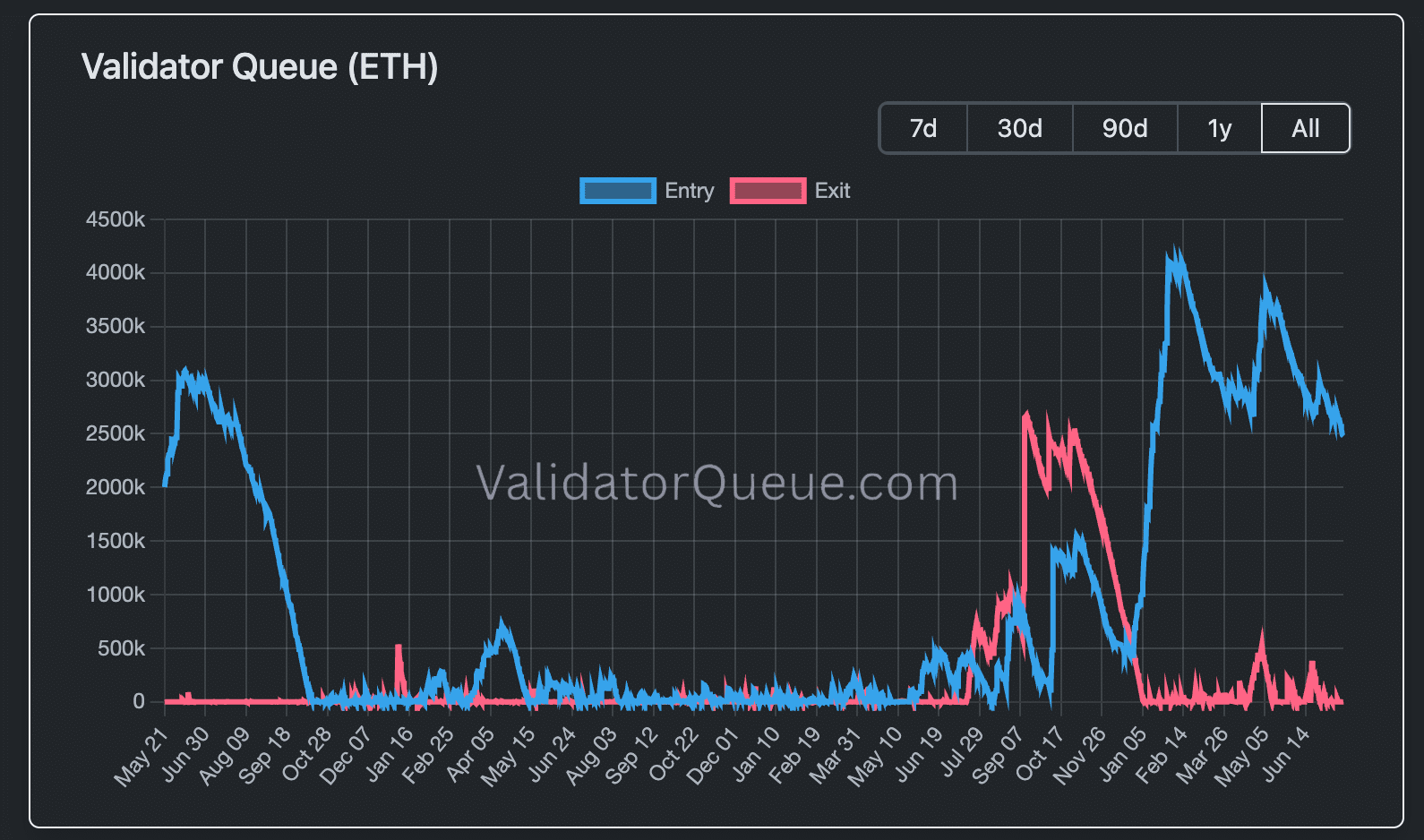
The Ethereum validator exit queue has fallen to zero, eliminating any waiting time for withdrawals. This contrasts sharply with late last year's market crash, which saw a peak of 2.6M ETH waiting to exit with a 44-day delay. Meanwhile, the entry queue for new stakers remains significant, with approximately 2.5M ETH waiting to enter and a 44-day processing time. This imbalance indicates strong, long-term staking demand and supports tighter ETH supply dynamics, with the staking ratio hitting a record 33.97% of total supply. Additional demand is driven by the U.S. spot ETH ETF inflows and institutional activity. Option market data shows dominant bullish bets targeting $2K and $2.4K price levels. While ETH's price has risen towards $2K, its near-term movement is tied to the potential passage of the CLARITY Act, with regulatory developments remaining a key catalyst for Q3.

Ethereum [ETH] is currently seeing strong staking demand compared to the market distress in Q4 2025.

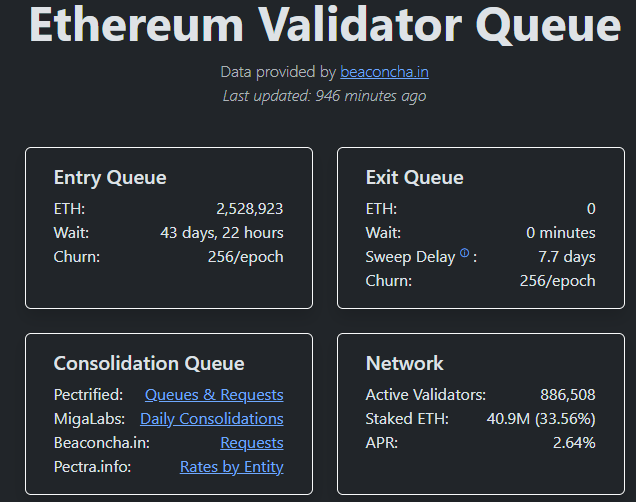
According to analytics platform Arkham, the Ethereum validator exit queue has dropped to zero with no waiting time, signaling that stakers have ‘long-term conviction.’

For comparison, during the market crash late last year, ETH queued for exit peaked at 2.6M ETH, and the waiting time was about 44 days. Now, it takes 0 minutes to withdraw staked ETH.
Source: Validator Queue

Will Ethereum staking demand boost ETH value?

In contrast, the entry queue is taking nearly 44 days to get into the staking ecosystem. About 2.5 million ETH is currently waiting to be staked, underscoring a massive divergence between demand and exit. For Arkham, this was a bullish signal.

This imbalance demonstrates robust demand to stake ETH. This development supports tighter ETH supply dynamics, as more capital flows into staking than leaves it.
Source: Validator Queue

Worth noting that staked ETH has surged to 40.9 million ETH, marking a 14% year-on-year (YoY) increase. This translates to a record high of 33.97% in the staking ratio relative to the overall ETH supply.

But staking is just one side of the demand line. In fact, part of the staking demand comes from the U.S. spot ETH ETF and treasury firms like Bitmine.

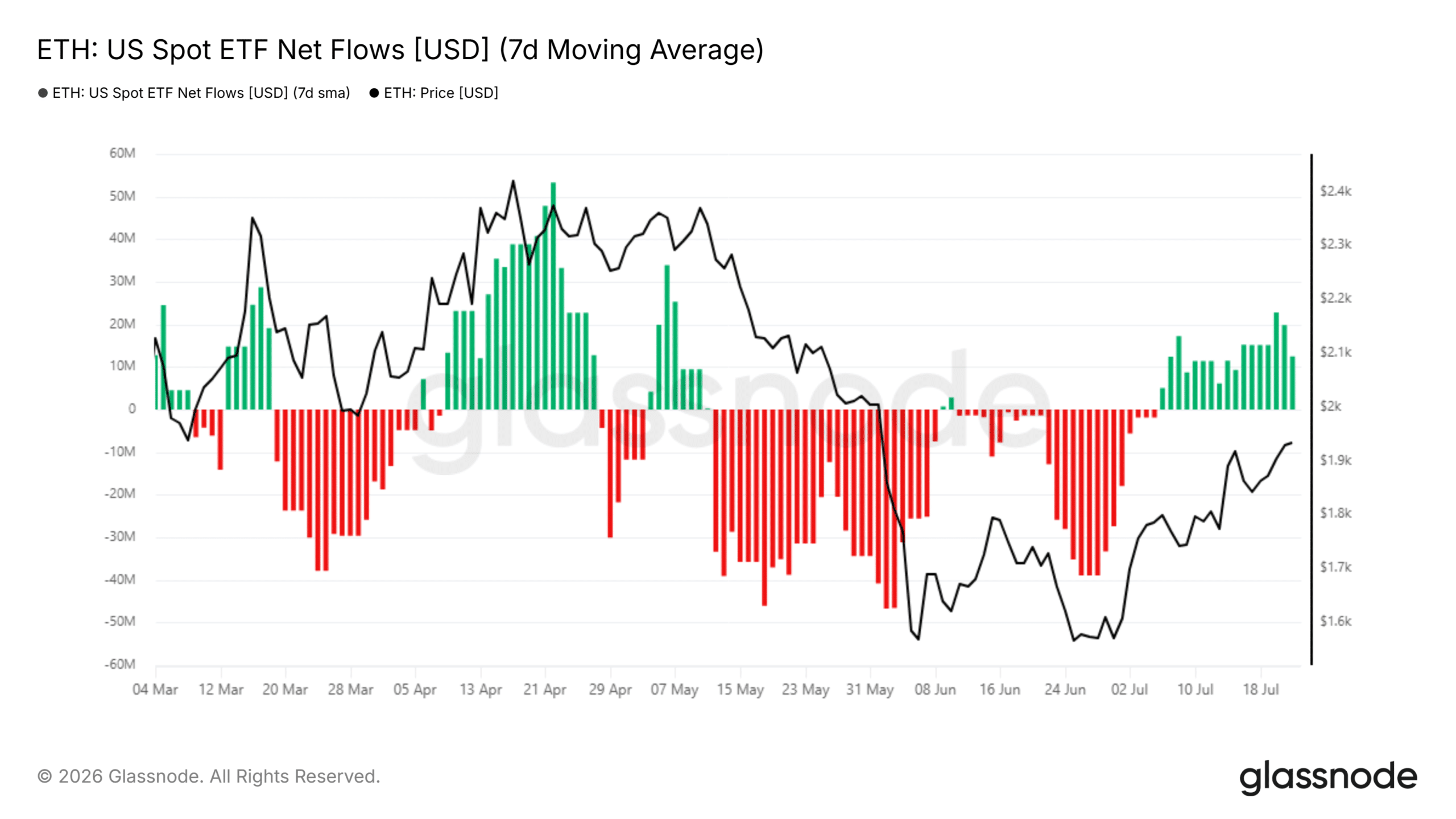
Speaking of the U.S. Spot ETH ETF, the products have been positive in the past two weeks, lifting the price from below $1.8K to nearly $2K.
Source: Glassnode

If the flows remain green, perhaps the $2K psychological level could be decisively reclaimed as support.

And institutional positioning in the Options market signaled a similar stance. In the past 24 hours, calls (bullish bets) were the most dominant trading volume for the September and early August option expiries, eyeing $2.4K and $2K targets, respectively.
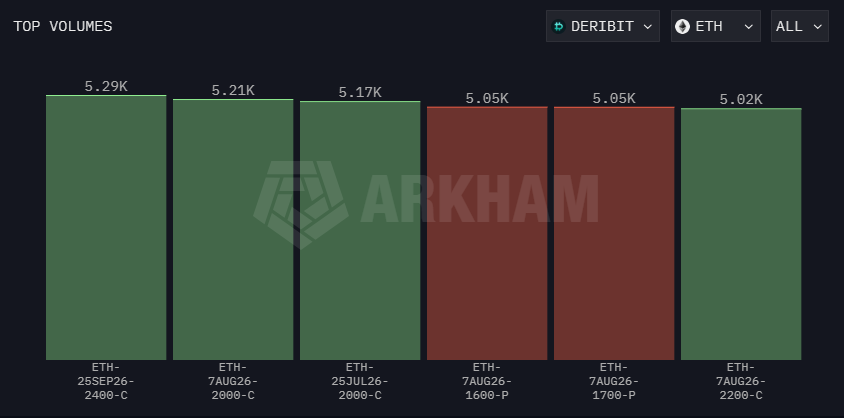
Source: Arkham

As of writing, the altcoin was valued at $1.926K as the market focused on the CLARITY Act passage ahead of Congress’ August recess. If the bill stalls, ETH price will likely slip lower.

However, any resolutions on key issues like ethics and subsequent passage of the bill would eventually lift the entire market. In other words, regulatory developments could remain a key catalyst in Q3.


Final Summary

  • ETH validator exit queue has dropped to zero while the entry line hit 2.5M ETH with a 44-day waiting period.
  • Option traders were betting on an ETH rally to $2K-$2.4K despite uncertainty on CLARITY Act passage.


Trending Cryptos

Related Questions

QWhat does the drop of the Ethereum validator exit queue to zero signify according to the article?

AAccording to the article, the drop of the Ethereum validator exit queue to zero, with no waiting time, signifies that stakers have 'long-term conviction' in the asset, reflecting strong staking demand and a lack of pressure to withdraw funds.

QHow does the current entry queue for Ethereum staking contrast with the exit queue?

AThe current entry queue for Ethereum staking shows about 2.5 million ETH waiting to be staked with a nearly 44-day waiting period. This massive divergence from the zero-queue, zero-wait-time exit queue underscores robust demand to stake ETH and supports tighter ETH supply dynamics.

QWhat other factors, besides staking demand, are mentioned as contributing to positive sentiment for Ethereum's price?

ABesides staking demand, the article mentions positive inflows from the U.S. spot ETH ETF and bullish institutional positioning in the Options market (with calls targeting $2K-$2.4K) as factors contributing to positive sentiment. Regulatory developments, specifically the CLARITY Act, are also cited as a key potential catalyst.

QWhat is the current staking ratio of ETH, and what does it represent?

AThe current staking ratio of ETH is a record high of 33.97%, which represents the proportion of the overall ETH supply that is staked. This is based on staked ETH reaching 40.9 million ETH, marking a 14% year-on-year increase.

QWhat are the two main potential price outcomes for ETH mentioned in the article, depending on the CLARITY Act?

AThe article states that if the CLARITY Act stalls, the ETH price will likely slip lower. Conversely, any resolutions on key issues and subsequent passage of the bill would eventually lift the entire market, potentially acting as a key catalyst in Q3.

Related Reads

Coldcard Hardware Wallet Hacked: 594 Bitcoin Withdrawn in 25 Minutes

The Coldcard hardware wallet has been compromised, with hackers stealing approximately 594.5 Bitcoin (~$40 million) from 500 addresses in just 25 minutes. The root cause was a critical software bug, undetected for five years, which disabled the device's secure chip for generating true random numbers. This led to the creation of private keys based on predictable data like the processor's serial number, drastically reducing cryptographic security. The attackers exploited this offline by brute-forcing possible seed phrases, finding active addresses on the public ledger, and signing transactions. Initially, Coinkite (Coldcard's maker) claimed only older models were at risk but later admitted all devices running the compromised firmware were vulnerable. CEO Rodolphe Novak (NVK) apologized but ruled out financial compensation for affected users. To secure funds, owners must urgently update their firmware to specific safe versions, generate a completely new seed phrase on the updated device, and transfer all assets to new addresses created with that new seed. While a BIP-39 passphrase can help, it does not replace this migration process. Other Coinkite products like TAPSIGNER were not affected. This incident underscores that even specialized hardware requires rigorous, independent code audits, especially for cryptographic functions. It parallels past failures, like a 2006 OpenSSL bug in Debian, and raises questions about whether automated code analysis can ever fully replace human scrutiny in critical security areas.

cryptonews.ru33m ago

Coldcard Hardware Wallet Hacked: 594 Bitcoin Withdrawn in 25 Minutes

cryptonews.ru33m ago

Trading

Spot

Hot Articles

Discussions

Welcome to the HTX Community. Here, you can stay informed about the latest platform developments and gain access to professional market insights. Users' opinions on the price of S (S) are presented below.

活动图片