Ethereum validator exit queue drops to zero – Will it boost ETH’s Q3 recovery?

ambcryptoPublished on 2026-07-24Last updated on 2026-07-24

Abstract

The Ethereum validator exit queue has fallen to zero, eliminating any waiting time for withdrawals. This contrasts sharply with late last year's market crash, which saw a peak of 2.6M ETH waiting to exit with a 44-day delay. Meanwhile, the entry queue for new stakers remains significant, with approximately 2.5M ETH waiting to enter and a 44-day processing time. This imbalance indicates strong, long-term staking demand and supports tighter ETH supply dynamics, with the staking ratio hitting a record 33.97% of total supply. Additional demand is driven by the U.S. spot ETH ETF inflows and institutional activity. Option market data shows dominant bullish bets targeting $2K and $2.4K price levels. While ETH's price has risen towards $2K, its near-term movement is tied to the potential passage of the CLARITY Act, with regulatory developments remaining a key catalyst for Q3.

Ethereum [ETH] is currently seeing strong staking demand compared to the market distress in Q4 2025.

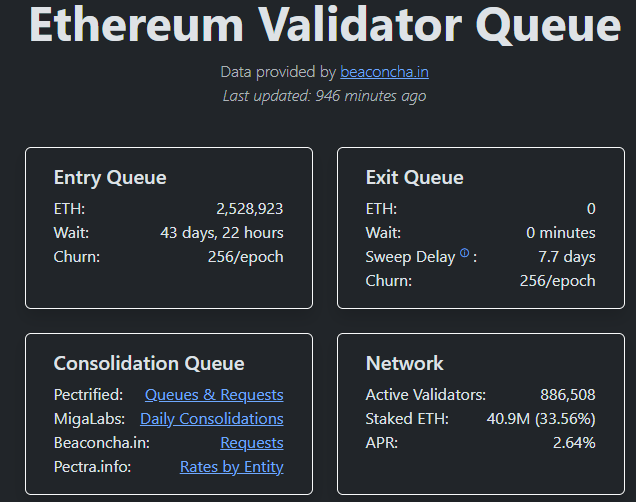
According to analytics platform Arkham, the Ethereum validator exit queue has dropped to zero with no waiting time, signaling that stakers have ‘long-term conviction.’

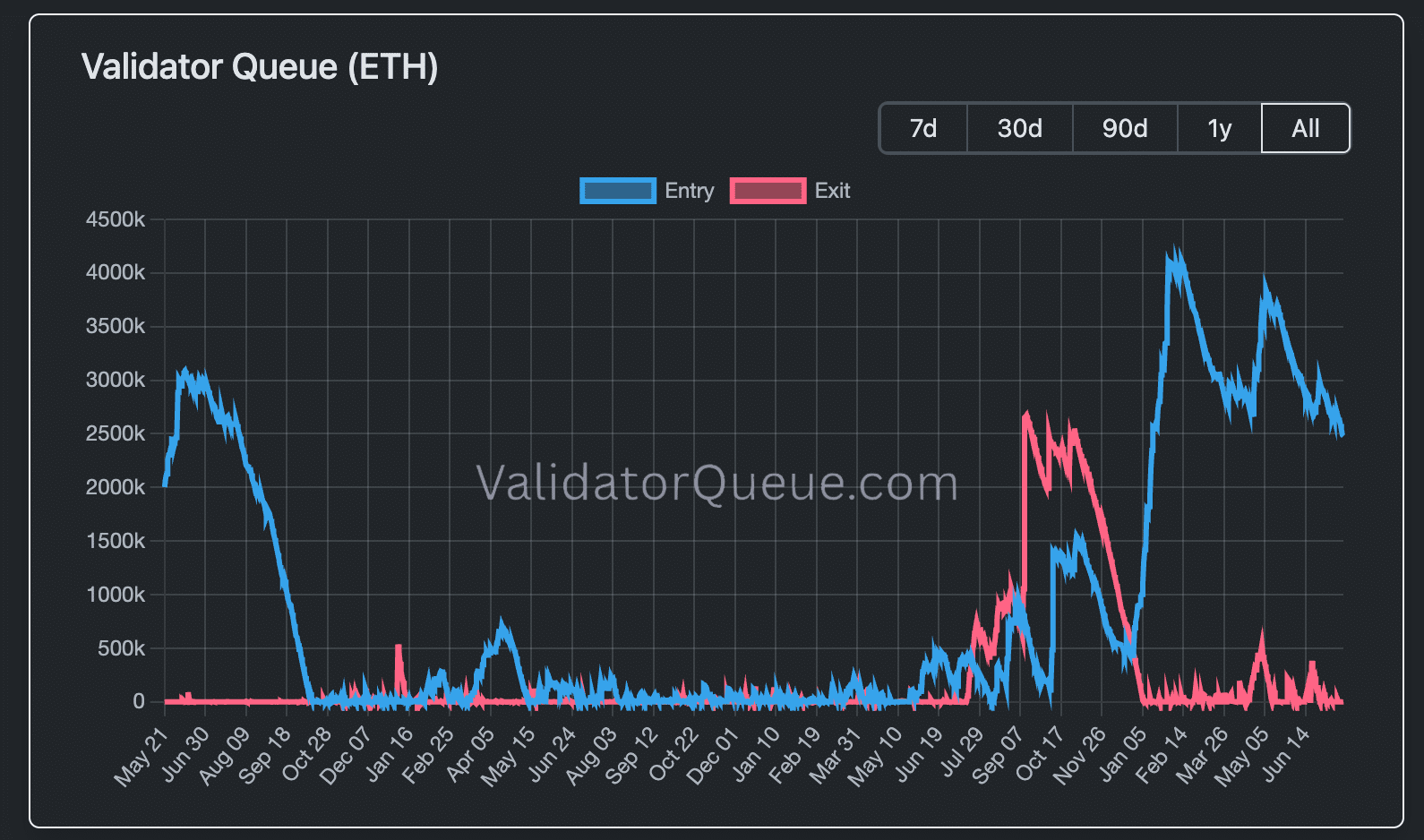
For comparison, during the market crash late last year, ETH queued for exit peaked at 2.6M ETH, and the waiting time was about 44 days. Now, it takes 0 minutes to withdraw staked ETH.
Source: Validator Queue

Will Ethereum staking demand boost ETH value?

In contrast, the entry queue is taking nearly 44 days to get into the staking ecosystem. About 2.5 million ETH is currently waiting to be staked, underscoring a massive divergence between demand and exit. For Arkham, this was a bullish signal.

This imbalance demonstrates robust demand to stake ETH. This development supports tighter ETH supply dynamics, as more capital flows into staking than leaves it.
Source: Validator Queue

Worth noting that staked ETH has surged to 40.9 million ETH, marking a 14% year-on-year (YoY) increase. This translates to a record high of 33.97% in the staking ratio relative to the overall ETH supply.

But staking is just one side of the demand line. In fact, part of the staking demand comes from the U.S. spot ETH ETF and treasury firms like Bitmine.

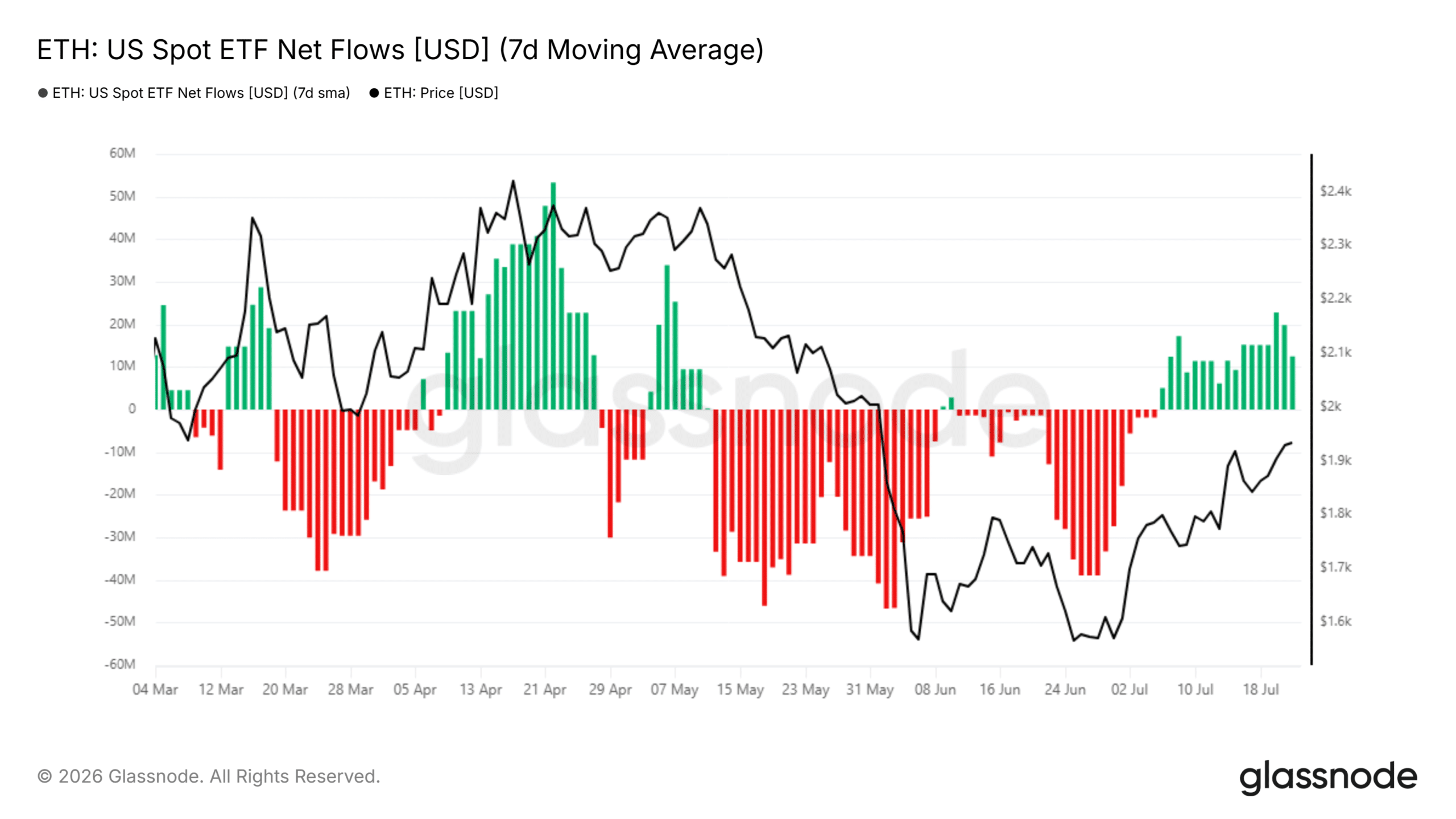
Speaking of the U.S. Spot ETH ETF, the products have been positive in the past two weeks, lifting the price from below $1.8K to nearly $2K.
Source: Glassnode

If the flows remain green, perhaps the $2K psychological level could be decisively reclaimed as support.

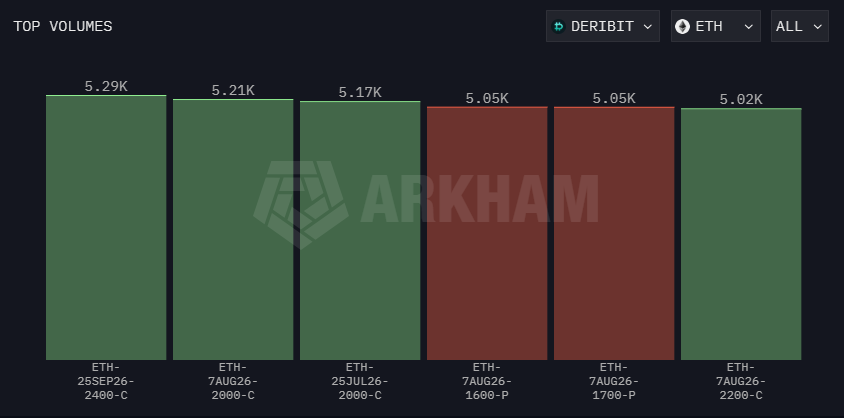
And institutional positioning in the Options market signaled a similar stance. In the past 24 hours, calls (bullish bets) were the most dominant trading volume for the September and early August option expiries, eyeing $2.4K and $2K targets, respectively.
Source: Arkham

As of writing, the altcoin was valued at $1.926K as the market focused on the CLARITY Act passage ahead of Congress’ August recess. If the bill stalls, ETH price will likely slip lower.

However, any resolutions on key issues like ethics and subsequent passage of the bill would eventually lift the entire market. In other words, regulatory developments could remain a key catalyst in Q3.


Final Summary

  • ETH validator exit queue has dropped to zero while the entry line hit 2.5M ETH with a 44-day waiting period.
  • Option traders were betting on an ETH rally to $2K-$2.4K despite uncertainty on CLARITY Act passage.


Trending Cryptos

Related Questions

QWhat does the drop of the Ethereum validator exit queue to zero signify according to the article?

AAccording to the article, the drop of the Ethereum validator exit queue to zero, with no waiting time, signifies that stakers have 'long-term conviction' in the asset, reflecting strong staking demand and a lack of pressure to withdraw funds.

QHow does the current entry queue for Ethereum staking contrast with the exit queue?

AThe current entry queue for Ethereum staking shows about 2.5 million ETH waiting to be staked with a nearly 44-day waiting period. This massive divergence from the zero-queue, zero-wait-time exit queue underscores robust demand to stake ETH and supports tighter ETH supply dynamics.

QWhat other factors, besides staking demand, are mentioned as contributing to positive sentiment for Ethereum's price?

ABesides staking demand, the article mentions positive inflows from the U.S. spot ETH ETF and bullish institutional positioning in the Options market (with calls targeting $2K-$2.4K) as factors contributing to positive sentiment. Regulatory developments, specifically the CLARITY Act, are also cited as a key potential catalyst.

QWhat is the current staking ratio of ETH, and what does it represent?

AThe current staking ratio of ETH is a record high of 33.97%, which represents the proportion of the overall ETH supply that is staked. This is based on staked ETH reaching 40.9 million ETH, marking a 14% year-on-year increase.

QWhat are the two main potential price outcomes for ETH mentioned in the article, depending on the CLARITY Act?

AThe article states that if the CLARITY Act stalls, the ETH price will likely slip lower. Conversely, any resolutions on key issues and subsequent passage of the bill would eventually lift the entire market, potentially acting as a key catalyst in Q3.

Related Reads

The Verdict in Choi Tae-won's Divorce Case: Revealing the Inheritance Undercurrent Behind SK Hynix's Trillion-Won Empire

SK Group Chairman Chey Tae-won's high-profile divorce case, involving a record 1.38 trillion won settlement, has drawn attention to the succession plans for Korea's second-largest conglomerate, especially its crown jewel, SK hynix. Unlike traditional chaebol scripts centered on the eldest son, Chey's three children from his marriage to former President Roh Tae-woo's daughter, Roh Soh-yeong, are carving distinct, non-traditional paths. Eldest daughter Chey Yun-jung (b. 1989) is seen as the most evident successor. With a scientific and consulting background, she holds executive roles at SK bioscience and SK Inc.'s growth support department, focusing on future strategy and biopharma. Her marriage is to an AI infrastructure entrepreneur, not a traditional business alliance. Second daughter Chey Min-jung (b. 1991) took a unique route, voluntarily serving as a South Korean naval officer, including an anti-piracy deployment. She later worked on policy and strategy for SK hynix in Washington D.C. before co-founding an AI-driven healthcare startup. She married a former U.S. Marine Corps officer, connecting her to U.S. defense and policy circles—networks crucial for a global semiconductor giant. The only son, Chey In-geun (b. 1995), who studied physics like his father, worked briefly at SK E&S before joining McKinsey. Despite fitting the traditional "heir" profile as the eldest son, he remains silent and holds no public position or shares in SK, suggesting the old succession playbook is obsolete. As SK hynix's valuation soars, becoming a geopolitical asset in the AI era, the heirs' legitimacy is no longer automatic. They must prove themselves in fields like AI biotech, global policy, and strategic consulting. Their marriages also reflect new elite networks in tech and defense, not old political alliances. Their inheritance is the complex challenge of navigating a globalized, tech-driven world, not just a corporate throne.

marsbitYesterday 09:06

The Verdict in Choi Tae-won's Divorce Case: Revealing the Inheritance Undercurrent Behind SK Hynix's Trillion-Won Empire

marsbitYesterday 09:06

From OpenSea to OpenRouter: Is Alex Atallah Repeating His 'Exit at the Peak' Playbook?

From OpenSea to OpenRouter: Is Alex Atallah Repeating His "Exit at the Peak" Playbook? According to the Wall Street Journal, payments giant Stripe is in talks to acquire the AI model aggregation platform OpenRouter in a potential deal valuing the company near $100 billion. This would mark founder Alex Atallah's second creation of a company reaching a $100 billion valuation, following his co-founding of NFT marketplace OpenSea. OpenRouter, founded just over three years ago, has grown rapidly by acting as a unified gateway for developers to access over 400 AI models. It currently has about 10 million users and processes over 200 trillion tokens monthly. While the platform's annualized revenue is around $50 million, its valuation has skyrocketed from $1.3 billion in March 2026. The potential acquisition by Stripe, a company OpenRouter's founder once likened it to, represents a major expansion into AI infrastructure for the payments leader. This move echoes Atallah's previous timing with OpenSea, where he departed before the NFT market's significant downturn. For OpenRouter, selling now may be strategic. Despite its scale, its business model—charging a 5-5.5% fee on AI inference calls—faces pressure from competition, open-source models, and potential price wars among model providers, limiting its profitability narrative for an IPO. A key asset for potential acquirers like Stripe is OpenRouter's vast repository of real-world AI usage data, which offers unique insights into model performance and developer preferences that are difficult to replicate. Whether this potential deal signifies a new valuation benchmark for AI infrastructure or another market peak signal remains to be seen.

链捕手Yesterday 08:42

From OpenSea to OpenRouter: Is Alex Atallah Repeating His 'Exit at the Peak' Playbook?

链捕手Yesterday 08:42

Trading

Spot

Hot Articles

Discussions

Welcome to the HTX Community. Here, you can stay informed about the latest platform developments and gain access to professional market insights. Users' opinions on the price of S (S) are presented below.

活动图片















