Chain Gaming Giant YGG Capitulates, Losing $15 Billion in Value Over 5 Years

Foresight NewsPublished on 2026-07-07Last updated on 2026-07-07

Abstract

The leading blockchain gaming guild Yield Guild Games (YGG) is shutting down its publishing arm, YGG Play, announced on July 6th by its official account and co-founder Gabby Dizon. The platform and its supported games will be phased out by July 31st. While YGG Play successfully validated a market for casual, crypto-native mobile games—generating over $9M in total revenue, including $876,000 in Q1 2026—Dizon stated the closure was a market-driven decision. He cited insufficient liquidity and declining user confidence in the macroeconomic environment, making the business commercially unsustainable. Founded in 2020, YGG rose to prominence during the Play-to-Earn (P2E) boom, particularly with Axie Infinity, organizing players and managing assets. Its token price soared above $10 during the 2021 bull market. However, the 2022 crypto downturn exposed the fragility of P2E economic models. YGG attempted to pivot in 2025 with the YGG Play publishing initiative, focusing on short-session casual games. The shutdown reflects broader struggles in the Web3 gaming sector. An April 2026 report highlighted a "structural mismatch" between speculative financial designs and genuine player entertainment needs, leading to an estimated $15 billion in destroyed capital. The report noted that 93% of roughly 3,200 tracked blockchain game projects are now "functionally dead," with token prices down an average of 95% from 2022 peaks. YGG itself is now pivoting its strategy entirely towards the AI Data...


By Ma He, Foresight News


On July 6th, both the official account of Yield Guild Games (YGG) and its co-founder Gabby Dizon simultaneously announced the decision to shut down its game publishing division, YGG Play. The team will gradually phase out the platform and certain games by July 31st according to plan, with 35 employees receiving an additional 8 weeks of salary compensation. Some games, like GIGACHADBAT, will be transferred to the developer Delabs for continued operation. Others, such as LOL Land and Waifu Sweeper, will be officially retired. Games published by YGG Play have generated cumulative revenue exceeding $9 million, with a single quarter in Q1 2026 contributing $876,000.
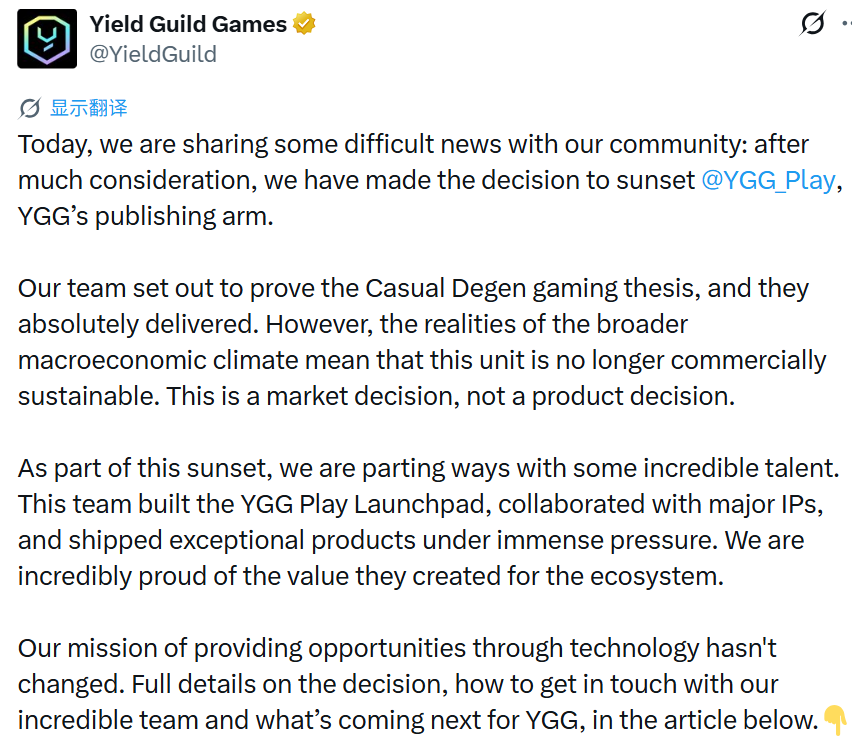


In the statement, Gabby Dizon stated: This is a market decision, not a product decision. Although the team successfully validated the casual gaming segment—short sessions, high engagement, and rapid feedback loops for crypto-native users—the lack of liquidity and declining user confidence in the macroeconomic environment have rendered this business commercially unsustainable.


Alongside shutting down YGG Play, YGG also announced a full pivot to the AI Data Economy, aiming to capture the multibillion-dollar market for AI training datasets, initially focusing on building B2B pipelines around gaming datasets.


The Chain Game Publishing Platform YGG Play


Launched by YGG in 2025, YGG Play was its Web3 game publishing arm, dedicated to serving the casual player community in the crypto space. It targeted short, quick, mobile-friendly games with a touch of social interaction and rewards, helping independent studios quickly go on-chain for distribution and acquire and operate users through YGG's community network. These games accumulated significant revenue during 2025-2026, proving that specific vertical segments could still generate genuine revenue even at the tail end of a bear market.


However, revenue peaked around October 2025. The large-scale liquidation event in October's crypto market further dampened the payment willingness and retention of target users. The closure of YGG Play marks a strategic contraction for YGG, moving away from the dual-engine drive of "guild operations + publishing."


To understand the weight of this closure, one must trace YGG's complete trajectory.


In 2020, veteran Philippine gaming industry figures Gabby Dizon, Beryl Li, and anonymous partner Owl of Moistness co-founded YGG. This was during the peak of the COVID-19 pandemic when many service industry workers in the Philippines were unemployed. Axie Infinity, the hottest Play-to-Earn (P2E) game at the time, was enabling players to borrow Axie NFTs for free to battle and share earnings through its "scholarship" model.


YGG seized this window, starting as a small guild, raising funds to purchase Axie assets, organizing and training players, and rapidly becoming one of the largest and most scalable guilds within the Axie ecosystem.
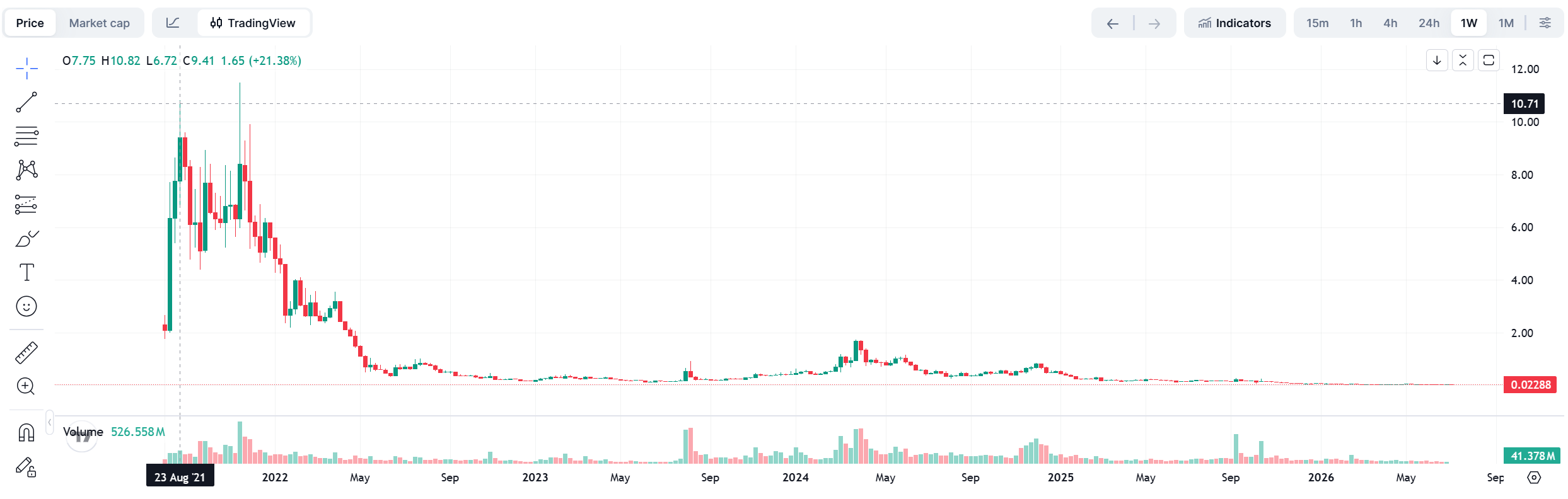


2021 was YGG's peak year. Driven by both the bull market and the P2E narrative, its token price soared, exceeding $10 at its highest. YGG expanded from a single Axie guild into a global network covering dozens of regional sub-guilds and partnered with over 80 blockchain games and infrastructure projects. It moved beyond mere asset lending, helping players maximize earnings through quests, events, and community operations. In places like the Philippines, the real economic phenomenon of "playing games as work" emerged, and YGG became a benchmark for the P2E model.


At its peak, YGG's model was widely replicated: guilds became crucial intermediaries connecting players, assets, and games, with DAO governance and token incentives allowing participants to share in growth benefits. YGG evolved from a simple "asset manager" into an investment, content, and community platform.


When the crypto bear market arrived in 2022, the fragility of Axie Infinity's economic model was laid bare—new user inflow slowed, token prices crashed, and player churn was severe. Many guilds and P2E projects vanished outright, and the entire industry entered a deep trough. YGG did not collapse but began a long adaptation. In 2025, YGG bet on a new direction: launching YGG Play and formally entering the game publishing arena, as heavy P2E was no longer viable, while crypto users naturally gravitated towards high-frequency, instant-feedback casual experiences.


This shutdown comes barely a year after that last pivot.


A Microcosm of the Chain Gaming Industry


The closure of YGG Play can be seen as a concentrated reflection of the chain gaming industry's development trajectory over the past five years.


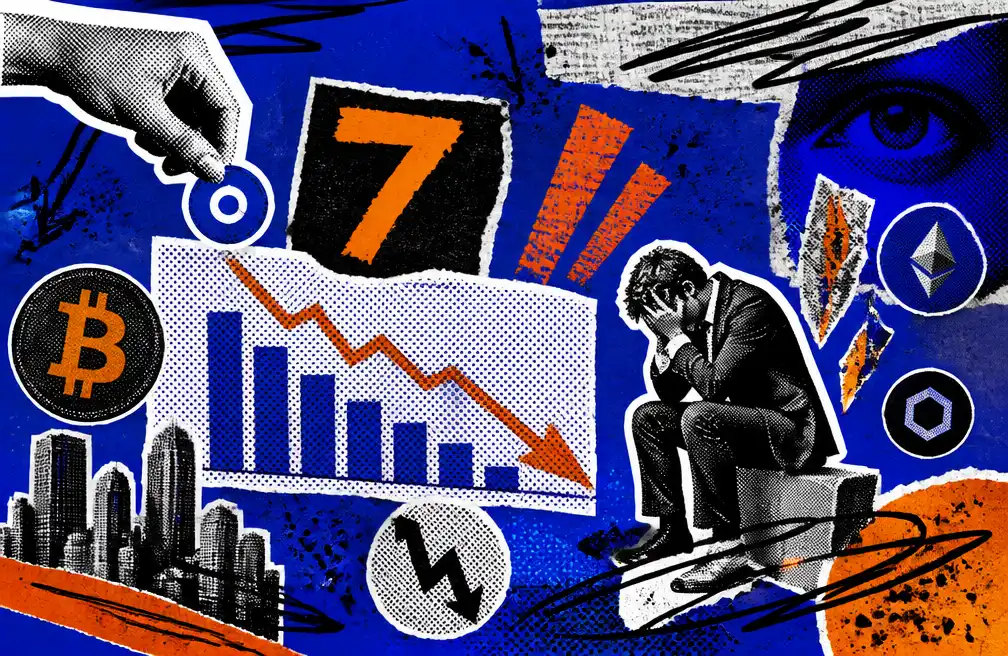
In April this year, the crypto quantitative trading and market-making firm Caladan reviewed the five-year journey of the Web3 gaming sector from frenzied explosion to comprehensive collapse. Its core conclusion was that the decline of Web3 games is not a normal cyclical downturn but stems from a fundamental "structural misalignment" between the underlying speculative financial design and the genuine entertainment needs of players, leading to a staggering $15 billion in capital being obliterated.


Examples abound: Pixelmon, which raised $70 million but failed to launch public beta in 4 years; Ember Sword, which burned through $18 million and was liquidated; and Hamster Kombat, which lost 96% of its users within 6 months.


As of April 2026, in the roughly 3,200 chain gaming projects tracked by the report, 93% have been categorized as "practically dead" or have completely lost activity. The average decline in the crypto token prices for the entire gaming sector compared to the 2022 all-time highs reached 95%.


The prosperity of chain gaming was entirely built upon the Ponzi-like dividend logic of "Play-to-Earn." This model is inherently an unsustainable speculative financial closed loop: the earnings of early players and token prices entirely depend on a constant influx of new players buying tokens or NFTs to sustain the system. Once new user growth slows and external capital inflow decreases, the token's severe inflation rapidly breaches economic equilibrium, triggering a "death spiral" of token crashes, shrinking earnings, and a mass exodus of users.


YGG Play was not a failure in terms of product delivery or revenue figures but was defeated by "market timing."


The story of chain gaming may be nearing its end.

Trending Cryptos

Related Questions

QWhy did YGG decide to shut down its YGG Play division?

AYGG decided to shut down its YGG Play division due to market conditions, specifically insufficient market liquidity and declining user confidence in the macroeconomic environment, which made the business commercially unsustainable, despite having validated the casual gaming niche.

QWhat was the original core business model of Yield Guild Games (YGG) at its peak?

AAt its peak during the 2021 bull market, YGG's core model was operating as a major guild within the Play-to-Earn (P2E) ecosystem, most notably for Axie Infinity. It provided asset lending (scholarships), player training, and community management to help players maximize earnings, evolving into a global network and a platform for investment, content, and community.

QWhat new strategic direction has YGG announced alongside the closure of YGG Play?

AAlongside the closure of YGG Play, YGG announced a full-scale pivot into the AI Data Economy, aiming to capture a share of the multi-billion dollar AI training dataset market, with an initial focus on building B2B pipelines around gaming datasets.

QAccording to the article, what is the fundamental structural flaw of most Web3/blockchain games as identified by Caladan's report?

AAccording to Caladan's report cited in the article, the fundamental structural flaw of most Web3 games is a 'structural misalignment' between their underlying speculative financial design and genuine player entertainment needs. Their models rely on an unsustainable Ponzi-like financial loop where early player returns depend on constant new user inflow to buy tokens/NFTs, leading to a 'death spiral' when growth slows.

QWhat statistics does the article provide to illustrate the scale of failure in the blockchain gaming sector over the past five years?

AThe article provides several statistics illustrating the sector's failure: a collective loss of $150 billion in capital, 93% of tracked projects (~3200) being 'effectively dead' or inactive by April 2026, and an average token price decline of 95% from the 2022 highs for the gaming sector. It also cites specific failed projects like Pixelmon and Ember Sword.

Related Reads

Saeed Al-Marri: How Tokenization Unlocks New Opportunities for Shipping Funds

Said Al-Marri: How Tokenization Opens New Opportunities for Shipping Funds For centuries, commercial shipping has been a capital-intensive asset class limited to institutional funds and shipping dynasties. Said bin Saleh Al-Marri, CEO of Ethra Invest and Ethra Ship, aims to break down these barriers by combining Real World Asset (RWA) tokenization with conservative private equity principles. This bridges decentralized finance (DeFi) with the physical realities of global trade. Tokenization allows fractional ownership of ships on a blockchain, giving smaller investors access to previously inaccessible markets. However, Al-Marri warns it is not a regulatory loophole or a cure for asset illiquidity. The core physical risks are isolated in Special Purpose Vehicles (SPVs) for qualified investors. While tokenization enhances transparency and ownership record-keeping, Al-Marri stresses that a liquid secondary market depends on transparent asset valuation and must not interfere with ship operations managed by professionals. Regarding legal enforcement, smart contracts cannot physically seize a ship. Legal recourse still relies on traditional maritime courts, ship mortgages, and flag state laws, with blockchain records needing to mirror legal ownership in the SPV perfectly. Beyond ownership, the industry faces administrative hurdles like paper-based bills of lading. Al-Marri argues the bottleneck is legal and operational standardization, not technology. He advocates for a hybrid model combining digital trade documents and programmable settlements with support from regulated financial institutions, rather than a full crypto replacement for tools like Letters of Credit. A major challenge is decarbonizing the global fleet by 2050. Transitioning to green fuels requires massive upfront investment. Al-Marri emphasizes a conservative, holistic approach to underwriting these projects, evaluating technology, fuel availability, safety, and resale value. Investments must be justified under conservative forecasts, not just optimistic ones. By combining pragmatic risk management with digital infrastructure, leaders like Al-Marri show that the evolution of maritime finance is about mobilizing capital to build a modernized and sustainable global fleet, not just putting ships on a blockchain.

cryptonews.ruJust now

Saeed Al-Marri: How Tokenization Unlocks New Opportunities for Shipping Funds

cryptonews.ruJust now

Six Years Later, UNI Finally Welcomes Its Own "Buyback Bull"

After years of debate, Uniswap's UNI token has finally entered a 'buyback bull' phase following the long-awaited activation of its fee-switch mechanism. The UNIfication proposal, executed in December 2025, redirected a portion of protocol fees from select pools and Unichain sequencer revenue into a treasury (TokenJar) dedicated to buying back and permanently burning UNI. Initial market reaction was muted due to modest early burn rates. A significant shift occurred in July 2026 with the launch of Robinhood Chain. Uniswap's immediate deployment there skyrocketed trading volume, making it a top fee-generator. Subsequently, governance votes extended the fee mechanism to v4 pools and Robinhood Chain, causing protocol revenue to nearly triple. Daily funds directed to UNI burns rose sharply, with Robinhood Chain contributing over half. This transitioned UNI's narrative from a governance token to a cash-flow asset backed by a perpetual automatic buyer. UNI's price, which had languished around $2.30 in early June, nearly doubled to approach $4.60 by late July. Analysts credit this to the tangible cash flow from fees rather than mere speculation. Unlike many newer projects where buybacks are offset by large investor unlocks, UNI's six-year history has resulted in a widely distributed and relatively clean supply, allowing the buyback pressure to effectively impact the secondary market. The key test will be whether trading activity, particularly on Robinhood Chain, sustains after its initial gas subsidies expire.

marsbit5m ago

Six Years Later, UNI Finally Welcomes Its Own "Buyback Bull"

marsbit5m ago

Only 153 Venture Capital Firms Invested in July: Is the Crypto VC Industry Experiencing a 'Mass Extinction'?

In July 2026, only 153 unique venture capital firms participated in disclosed crypto funding rounds, marking the lowest monthly count since November 2020. This figure represents an 87% decline from the peak of 1,177 firms in 2022. Overall, the first seven months of 2026 saw crypto projects raise approximately $11.78 billion across 481 rounds. This crypto VC contraction contrasts sharply with the broader venture capital landscape, where global VC investment reached a record $560.4 billion in H1 2026, heavily fueled by major AI company financings. This shift in capital allocation has drawn funds away from the crypto sector. Within crypto, funding is highly concentrated. Trading platforms, prediction markets, and payment sectors absorbed 53% of the total capital. While early-stage deals remain frequent, the largest sums flow to a few late-stage rounds and mergers & acquisitions, which surged to $7.23 billion in Q2 2026. The market is consolidating around top funds like a16z crypto and Dragonfly, which successfully raised new multi-billion dollar funds, while many smaller firms have retreated. Analysts describe this as a "great extinction" for crypto VCs, where capital is becoming more selective, favoring proven business models and assets over early-stage speculation. This raises the bar for project quality, funding efficiency, and viable exit paths.

marsbit26m ago

Only 153 Venture Capital Firms Invested in July: Is the Crypto VC Industry Experiencing a 'Mass Extinction'?

marsbit26m ago

Trading

Spot

Hot Articles

How to Buy YGG

Welcome to HTX.com! We've made purchasing Yield Guild Games (YGG) simple and convenient. Follow our step-by-step guide to embark on your crypto journey.Step 1: Create Your HTX AccountUse your email or phone number to sign up for a free account on HTX. Experience a hassle-free registration journey and unlock all features.Get My AccountStep 2: Go to Buy Crypto and Choose Your Payment MethodCredit/Debit Card: Use your Visa or Mastercard to buy Yield Guild Games (YGG) instantly.Balance: Use funds from your HTX account balance to trade seamlessly.Third Parties: We've added popular payment methods such as Google Pay and Apple Pay to enhance convenience.P2P: Trade directly with other users on HTX.Over-the-Counter (OTC): We offer tailor-made services and competitive exchange rates for traders.Step 3: Store Your Yield Guild Games (YGG)After purchasing your Yield Guild Games (YGG), store it in your HTX account. Alternatively, you can send it elsewhere via blockchain transfer or use it to trade other cryptocurrencies.Step 4: Trade Yield Guild Games (YGG)Easily trade Yield Guild Games (YGG) on HTX's spot market. Simply access your account, select your trading pair, execute your trades, and monitor in real-time. We offer a user-friendly experience for both beginners and seasoned traders.

3.3k Total ViewsPublished 2024.03.29Updated 2026.06.02

How to Buy YGG

Discussions

Welcome to the HTX Community. Here, you can stay informed about the latest platform developments and gain access to professional market insights. Users' opinions on the price of YGG (YGG) are presented below.

活动图片