Tron Founder Justin Sun Addresses Controversy After Bitcoin Removal From USDD’s Collateral

bitcoinistPublished on 2024-08-23Last updated on 2024-08-23

Abstract

Amid the memecoin frenzy on the Tron network, Justin Sun is facing backlash for the controversial removal of over $700...

Amid the memecoin frenzy on the Tron network, Justin Sun is facing backlash for the controversial removal of over $700 million in Bitcoin (BTC) as USDD’s collateral without the Tron DAO Reserve’s vote. Sun has now addressed the situation after the move raised concerns about the stablecoin’s decentralization.

12,000 Bitcoin Removed From USDD Collateral

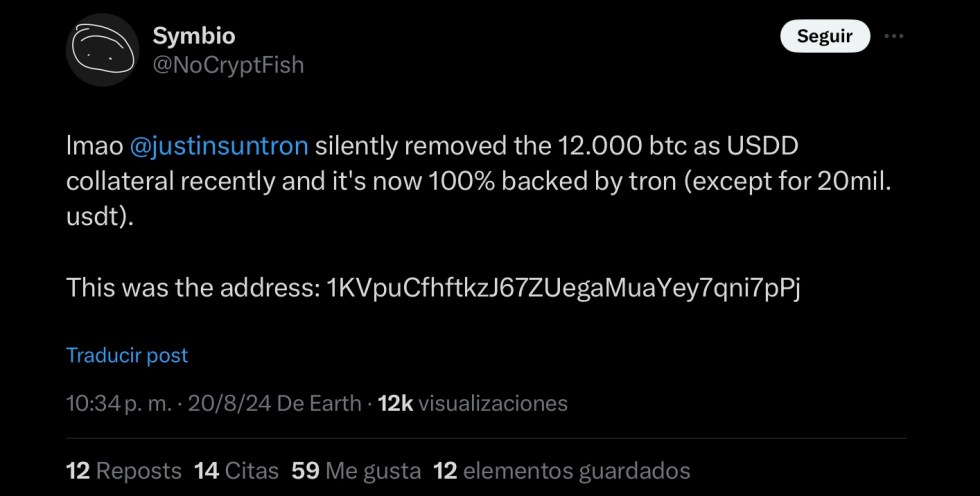
On Wednesday, online reports revealed that 12,000 Bitcoin, worth around $732 million, were removed from Tron’s Decentralized USD (USDD) stablecoin collateral reserves.

USDD is a decentralized over-collateralized stablecoin pegged to the US Dollar through TRX and governed by the Tron DAO Reserve. According to the report, the significant change means the stablecoin is now almost fully backed by TRX, except for 20 million USDT.
Tron

Online reports unveil BTC removal from USDD collateral. Source: Symbio on X

The modification was done “silently” without the DAO’s consultation or approval despite the continued emphasis on community governance. Reportedly, the USDD transparency page listed 12,000 Bitcoin under an address, which has now been removed.

The removal raised questions among investors who criticized the lack of transparency. Many X users questioned the “decentralized stablecoin” narrative claim by the Tron Foundation.

Other community members drew parallels between Sun’s “shady” actions and the behavior that led to the collapses of UST or FTX. Meanwhile, others noted that the news seemed like “100 red flags.”

Veritas Protocol alleged this is not the first issue with USDD’s collateral. Per the post, it “has also faced issues with its collateral, such as storing significant amounts of HTX without consulting the DAO.”

Justin Sun Addresses Concerns

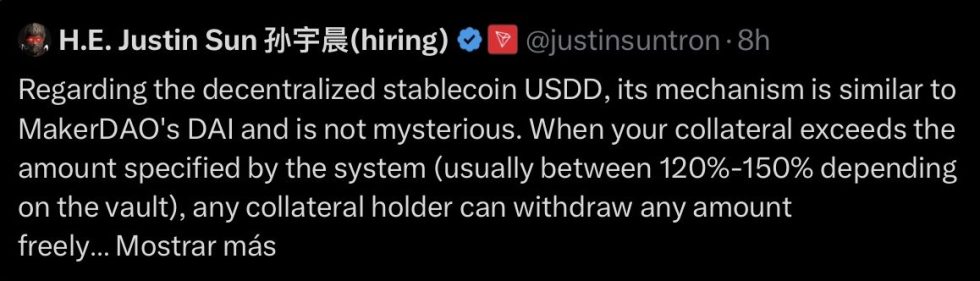
Following the criticism, Justin Sun addressed users’ concerns in an X post. Tron’s founder claimed that USDD’s mechanism is “not mysterious” since it works like MakerDAO’s DAI.

Sun explained that when the collateral exceeds the amount specified by the system, collateral holders can move the funds. Per the post, this amount is usually set between 125% and 150%, and if the collateral falls below a certain level, “it needs to be topped up; otherwise, the collateral may trigger liquidation.”
Tron

Tron's Founder addresses BTC removal without DAO's vote. Source: Justin Sun on X

Based on it, Sun alleges that “any collateral holder can withdraw any amount freely without anyone’s approval.” He also noted that USDD currently “has a long-term collateralization rate exceeding 300%,” which is inefficient for capital utilization and is planned to be upgraded.

Currently, USDD has a long-term collateralization rate exceeding 300%, which means that the capital utilization is not very efficient. The TRON DAO Reserve plans to spend time upgrading USDD in the future to make it a more competitive decentralized stablecoin in the market. Remember, Tron is also a kingdom of stablecoins.

USDD’s X account cited Sun’s response, echoing TRD’s plans to upgrade and enhance the stablecoin. Nonetheless, Bennet Tomlin, co-host of Crypto Critic Pod, questioned Tron founder’s statement. Tomlin claims Sun’s description does not match the issuance process described on USDD’s page.

Moreover, he stated that, according to the whitepaper, the removed Bitcoin is “explicitly supposed to be managed by the TRON DAO Reserve (…), not whatever collateral holders Sun is imagining. At the time of writing, Sun has not responded to the apparent discrepancies raised by Tomlin.
Tron, TRX, TRXUSDT

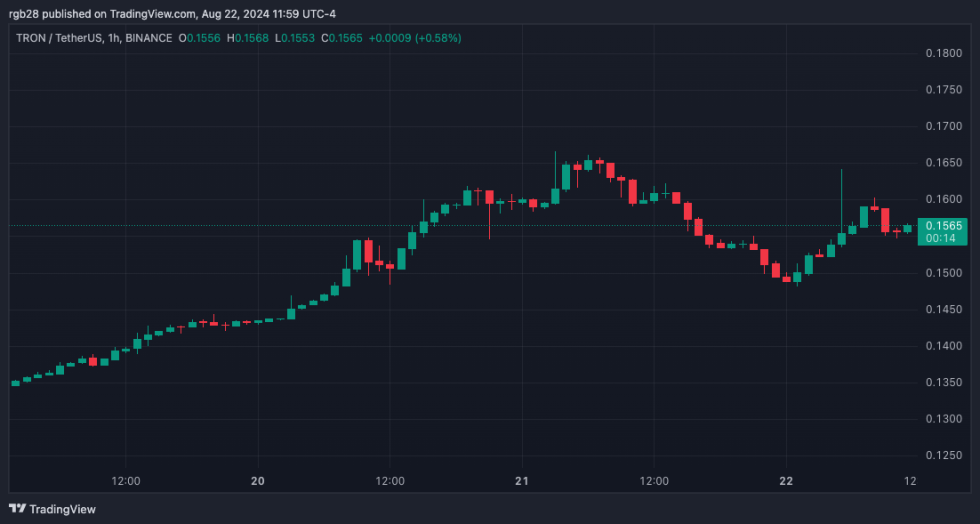
TRX is trading at $0.15 in the three-day chart. Source: TRXUSDT on TradingView
Featured Image from Unsplash.com, Chart from TradingView.com
Rubmar Garcia

Rubmar Garcia

Rubmar is a crypto enthusiast who likes learning and improving constantly. She enjoys reporting on the latest news and developments in the crypto industry. Rubmar also enjoys scrapbooking, crafting, simulation games, and watching football.

Trending Cryptos

Related Reads

Behind the 67,000 Semiconductor Talent Shortage: U.S. Industrial Policy Game and Implications for China

The U.S. push to reshore semiconductor manufacturing faces a core challenge: a significant talent shortage. While over $770 billion in investments are planned across 160 projects, a key hurdle is finding enough people to run the new fabs. According to industry projections, the U.S. could face a shortage of approximately 67,000 technicians, engineers, and computer scientists by 2030. This shortage is multi-faceted. It includes not only high-level chip design engineers requiring advanced degrees but also a substantial need for technicians to operate and maintain fab equipment. Technician roles, while often requiring less formal education, are hard to fill due to factors like shift work, factory locations, and local community infrastructure. Conversely, for high-end engineers, the issue is less about salary—which is already competitive—and more about intense competition for specialized skills from other tech sectors and the long lead time to develop such expertise. The geographic dispersion of new investments complicates recruitment, as fabs need large numbers of local, stable employees. In response, U.S. policy emphasizes building workforce development as critical infrastructure. Strategies include expanding community college programs for technician training, fostering industry-education partnerships, and pursuing immigration reforms for high-skilled talent, aiming to balance immediate needs with long-term domestic pipeline development. For China, the key takeaway is the need to integrate talent supply planning with factory construction from the outset. This involves requiring companies to submit workforce plans, strengthening vocational education aligned with industry needs, and building supportive local ecosystems to retain talent. Ultimately, a sustainable semiconductor industry depends not just on building fabs, but on cultivating a continuous, local talent pipeline capable of keeping them running and advancing.

marsbit46m ago

Behind the 67,000 Semiconductor Talent Shortage: U.S. Industrial Policy Game and Implications for China

marsbit46m ago

Trading

Spot

Hot Articles

How to Buy SUN

Welcome to HTX.com! We've made purchasing SUN (SUN) simple and convenient. Follow our step-by-step guide to embark on your crypto journey.Step 1: Create Your HTX AccountUse your email or phone number to sign up for a free account on HTX. Experience a hassle-free registration journey and unlock all features.Get My AccountStep 2: Go to Buy Crypto and Choose Your Payment MethodCredit/Debit Card: Use your Visa or Mastercard to buy SUN (SUN) instantly.Balance: Use funds from your HTX account balance to trade seamlessly.Third Parties: We've added popular payment methods such as Google Pay and Apple Pay to enhance convenience.P2P: Trade directly with other users on HTX.Over-the-Counter (OTC): We offer tailor-made services and competitive exchange rates for traders.Step 3: Store Your SUN (SUN)After purchasing your SUN (SUN), store it in your HTX account. Alternatively, you can send it elsewhere via blockchain transfer or use it to trade other cryptocurrencies.Step 4: Trade SUN (SUN)Easily trade SUN (SUN) on HTX's spot market. Simply access your account, select your trading pair, execute your trades, and monitor in real-time. We offer a user-friendly experience for both beginners and seasoned traders.

7.6k Total ViewsPublished 2024.03.29Updated 2026.06.02

How to Buy SUN

Discussions

Welcome to the HTX Community. Here, you can stay informed about the latest platform developments and gain access to professional market insights. Users' opinions on the price of SUN (SUN) are presented below.

活动图片