Original Author: Zhao Ying
Original Source: Wall Street News
The hottest question in the market recently is: Are global central banks selling gold? Has this 15-year-long official "gold hoarding wave" come to an end?
According to Wind Trading Desk, UBS strategist Joni Teves gave a clear judgment in the latest precious metals research report released on April 2: The possibility of a structural shift and large-scale selling by central banks is extremely low. Official institutions will maintain a net buying stance, but the pace of purchases will slow moderately—it is estimated that gold purchases in 2026 will be about 800 to 850 tons, slightly lower than the approximately 860 tons in 2025.
The report targeted the most glaring recent example—the news that Turkey "sold about 50 tons of gold in a few weeks." Teves believes: Turkey's official gold data includes commercial bank positions, swaps, and other operations. Relying solely on headlines to infer that "central banks are starting to sell" is highly risky, and it is better to wait for more detailed breakdown data before making a judgment.
In terms of price, UBS defines the short term as "full of noise": news cycles about geopolitical situations will keep gold prices fluctuating and consolidating; but the medium-term logic still points to new highs. The bank lowered its 2026 average gold price forecast to $5,000 (previously $5,200, mainly an adjustment for the first quarter) and maintained its year-end target price of $5,600 (set at the end of January).
Evidence That "Central Bank Gold Selling" Is the Main Cause of This Pullback Is Not Solid; 800-850 Tons Is More Like "Slowing Down"
The market's concern is specific: If the Middle East conflict prolongs, oil prices push up inflation, growth weakens, and local currencies depreciate, some central banks may be forced to sell gold to cope with the pressure. The report does not deny that "individual central banks may sell," but it emphasizes that this does not equate to a trend reversal in the official sector.
A key reminder from the report is: During the past 15 years of continuous gold accumulation by the official sector, "selling" in a single month is not uncommon. The reasons can be practical—central banks that bought cheaply earlier may take some profit tactically outside their core positions; sharp gold price increases trigger rebalancing; "natural inflows" from gold-producing countries turn into external shipments at certain points. In other words, selling can be an action, not necessarily a stance.
The baseline judgment is that net buying continues, but at a slower pace. The detail here lies in the trading habits of the official sector: They are more like "physical buyers," often providing support during pullbacks, helping the market stabilize more quickly at higher levels; conversely, the official sector typically does not chase rallies, preferring to intervene when prices are more suitable and volatility is lower.
This also explains why, when volatility increases, the market suddenly feels that "central banks have disappeared." The observation mentioned in the research is: Recently, the official sector and other long-term holders have tended to wait and see rather than immediately replenish positions in every decline.
The Narrative of Turkey Selling "50 Tons" Is Overstated; Short-Term Gold Prices Are More Influenced by the Dollar and Real Interest Rates
The case of Turkey is sensitive because it seems to fit the narrative of "central banks starting to sell gold." But Turkey has certain particularities: Some changes may be due to swaps rather than direct selling; more importantly, the Turkish Central Bank has long used gold as a policy tool to support liquidity management in the domestic banking system.
Part of the total gold disclosed by the Turkish Central Bank corresponds to commercial bank positions. Combined with policies since 2017 that allow banks and other entities to use gold within the financial system, "changes in total data" do not equal "central bank selling in the market." The report's advice is clear: Wait for more detailed data that can break down the口径 before discussing trends.
The trading environment in March had "dual uncertainty": On one hand, gold prices were seeking a new stable range after sharp rises and falls in January-February when Iran-related news fermented; on the other hand, the impact of the Middle East conflict on macro and asset pricing is nonlinear, and long-term funds are reluctant to bet easily.
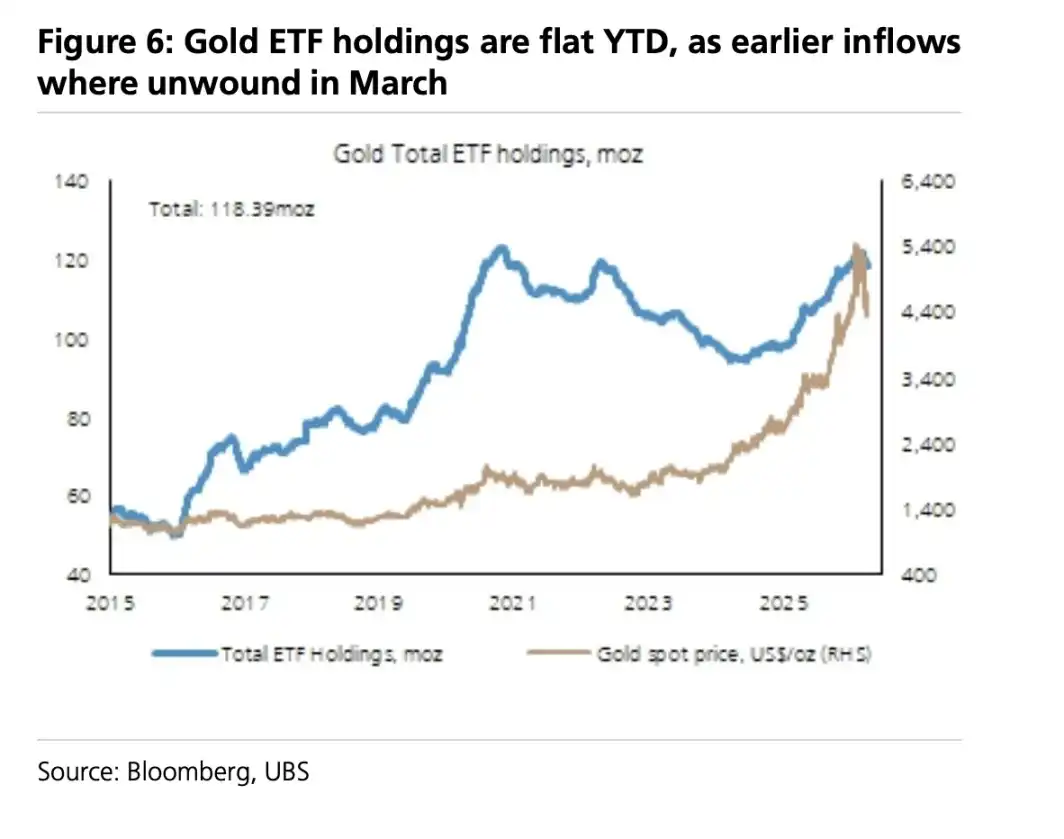
When strategic funds that "buy on dips" are absent, gold prices in the short term are more likely to return to the traditional framework: A stronger U.S. dollar and rising U.S. real interest rates suppress gold prices; long positions are further squeezed out, and even some short-selling forces emerge. In addition, Chinese demand supported the decline during this phase, with gold prices stabilizing near $4,500 before fluctuating around the $4,700 level.
The Underlying Logic of Central Bank Gold Holdings: Buy and Hold
The World Bank's "Fifth Biennial Reserve Management Survey Report (2025)" explains a more fundamental question: How do central banks really think about gold? The survey covers holdings as of December 2024, with 136 institutions participating—the highest ever—and for the first time includes a separate chapter on gold.
Several numbers can clarify the behavioral boundaries of central banks: About 47% of central banks determine gold holdings based on "historical legacy," about 26% based on qualitative judgment; only about a quarter incorporate gold into a formal strategic asset allocation framework.
More critically, only about 4.5% make short-term tactical adjustments to gold reserves, while the investment style for gold is mainly buy-and-hold (about 62%). This profile means: Even if the buying pace slows, the official sector is not like a group of traders driven by news to frequently trade positions.
In terms of reasons for increasing holdings, more than half cited "diversification" as the primary reason; local gold purchase plans accounted for about 35%, geopolitical risks about 32%; only about 6% cited "liquidity needs" as a reason. The official sector's rationale for gold has not been invalidated by recent volatility.
Short-Term Volatility Is Inevitable, but "New Highs Not Finished" Remains the Main Theme
Returning to the trading level, gold's rise is not a straight line: It may continue to consolidate and experience bumpy movements in the coming weeks as the market repeatedly reassesses geopolitical risks. But it believes that the two long-term drivers pushing funds to allocate to gold—the combination of growth and inflation risks, and the persistence of geopolitical tensions—are making "diversification into gold" a more common portfolio action.
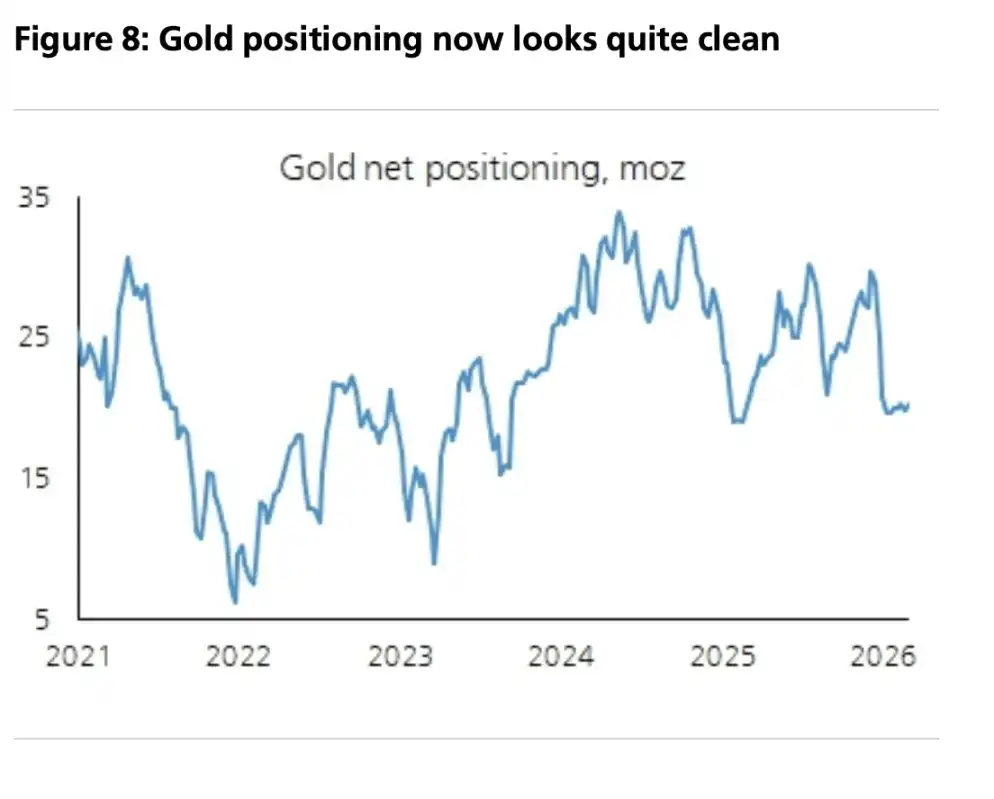
Under this framework, the report's pricing anchor is: An average gold price of $5,000 in 2026, with a year-end target of $5,600. It also mentions that speculative positions are already "cleaner," and long-term participants are still underweight; if another pullback occurs, it is closer to a "strategic window for building positions" rather than a signal of the end of the trend.