Ethereum Spot ETFs Stack In Silence – Here’s How Much Have Been Accumulated So Far

bitcoinistPublished on 2025-12-11Last updated on 2025-12-11

Abstract

Ethereum Spot ETFs are demonstrating strong and steady accumulation despite recent price fluctuations, with on-chain holdings reaching a record 10.48 million ETH. This quiet but consistent institutional buildup suggests smart money is positioning for long-term gains ahead of potential retail attention. While ETH's derivatives market shows cooling funding rates, this indicates an uncrowded leverage environment that could support a sustained upward move. Major firms like Bitmine continue acquiring ETH at scale, with one report noting over 138,000 ETH purchased in a week. The data points to growing institutional demand and a bullish outlook for Ethereum's price trajectory.

Despite recent fluctuations in the price of Ethereum, accumulation seems to be holding strong, which is observed in the Spot Ethereum Exchange-Traded Funds (ETFs). With more ETH leaving exchanges and ETFs stacking ETH, the leading altcoin could be poised for a crucial shift in market dynamics, which may be good for its price trajectory.

Smart Money Moves Quietly Via Ethereum Spot ETFs

The broader cryptocurrency market is shifting towards a bullish state once again, and the Ethereum institutional story is subtly transitioning into a new chapter. While price action remains relatively subdued, on-chain and fund flow data show a strong undercurrent as Spot Ethereum ETFs are steadily stacking.

According to Everstake.eth, the head of the Ethereum segment at Everstake, the ETH spot ETFs have been quietly increasing, reaching unprecedented levels. This silent accumulation raises the possibility that major companies are positioning themselves well ahead of the competition, creating long-term exposure while retail attention is still dispersed.

Data shared by the expert reveals that spot Ethereum ETF on-chain holdings have now reached approximately 10.48 million ETH. Everstake added that this is one of the strongest, most consistent accumulation trends ever recorded since the launch of the funds about a year ago.
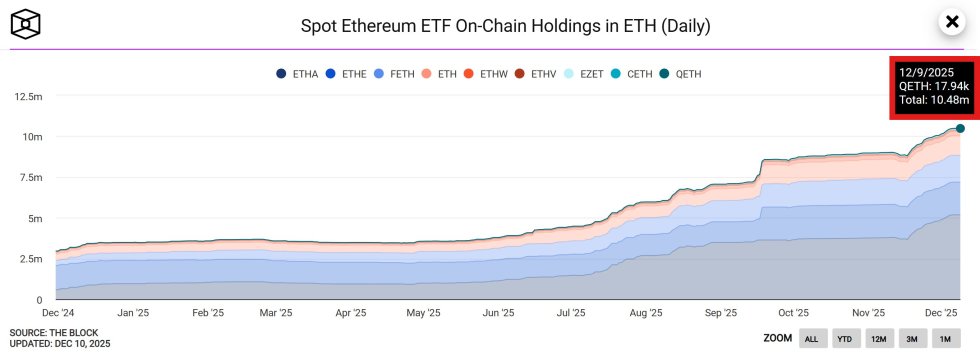
ETH spot ETFs at a historical level | Source: Chart from Everstake.eth on X

Given the substantial growth of the funds, the expert has declared that “the future is bullish, and the future is Ethereum.” As ETF holdings rise to previously unheard-of levels, the question now is not whether smart money is going in, but rather what they anticipate.

The steady growth is not observed among other metrics, like the Funding Rates. Currently, the derivatives market for ETH is starting to cool, and funding rates are clearly reflecting this change. However, this is not entirely a bad thing for the altcoin and its price trajectory.

As reported by Sina Estavi, the Chief Executive Officer (CEO) of Bridge Capital, a declining ETH funding rate is not merely a sign of a cool market. Rather, it is the structure that typically appears on the chart prior to a sustained move.

When funding resets in the absence of aggressive shorting, it usually implies that leverage is not overcrowded, the rally is not overheated, and spot-driven demand can carry the price further. Should ETH register even a modest growth in demand, the market may have room to extend this bullish leg.

Institutional Demand For ETH Is Returning

Ethereum’s recent sideways price movements do not seem to have swayed institutions from acquiring the altcoin. Big firms such as Bitmine Immersion, a leading treasury company run by industry leader Tom Lee, are still scooping up ETH at a substantial rate and scale.

The report from Arkham shows that as of Tuesday, Bitmine has purchased over 138,452 ETH valued at approximately $431.97 million since last week. Following the purchase, the company’s crypto holdings now boost about $12.05 billion in ETH. Despite this massive holding of ETH, the firm still has $1 billion left to accumulate more of the altcoin.

ETH trading at $3,186 on the 1D chart | Source: ETHUSDT on Tradingview.com

Related Reads

Who Will Define the Rules of the AI Era? Anthropic Discusses the 2028 US-China AI Landscape

This article, based on Anthropic's analysis, outlines the intensifying systemic competition between the U.S./allies and China for AI leadership by 2028. It argues that access to advanced computing power ("compute") is the critical bottleneck, where the U.S. currently holds a significant advantage through chip export controls and allied innovation. However, China's AI labs remain competitive by exploiting policy loopholes—via chip smuggling, overseas data center access, and "model distillation" attacks to copy U.S. model capabilities—keeping them close to the frontier. The piece presents two contrasting scenarios for 2028. In the first, decisive U.S. action to tighten compute controls and curb distillation locks in a 12-24 month AI capability lead, cementing democratic influence over global AI norms, security, and economic infrastructure. In the second, policy inaction allows China to achieve near-parity through continued access to U.S. technology, enabling Beijing to promote its AI stack globally and integrate advanced AI into its military and governance systems, altering the strategic balance. Anthropic contends that maintaining a decisive U.S. lead is essential for shaping safe AI development and governance. The core recommendation is for U.S. policymakers to urgently close compute and model access loopholes while promoting global adoption of the U.S. AI technology stack to secure a lasting strategic advantage.

marsbit1h ago

Who Will Define the Rules of the AI Era? Anthropic Discusses the 2028 US-China AI Landscape

marsbit1h ago

“Why Didn’t You Buy 2x Long SK Hynix?”

The article discusses the immense popularity of the "2x Long SK Hynix ETF" (07709.HK) in Hong Kong, which became the world's largest single-stock leveraged ETF by May 2026. Launched in October 2025, the ETF's net value soared over 1000% in seven months, significantly outperforming the 324% gain of SK Hynix's underlying stock, driven by the AI boom and a critical shift in industry demand from computing power to memory. It highlights the mechanics and risks of daily-rebalanced leveraged ETFs. In a smooth bullish market, they generate amplified returns, but during volatile periods—exemplified by market swings during geopolitical tensions in the Strait of Hormuz in March-April 2026—they suffer severe "volatility decay," where choppy price action can cause losses far exceeding twice the drop of the underlying asset. The piece frames SK Hynix, as NVIDIA's primary HBM supplier, within the classic cycle of the memory chip industry—a commoditized sector prone to boom-and-bust cycles of shortage, price hikes, overcapacity, and crashes. While current AI-driven demand and high margins (Q1 2026毛利率~79%) create a "super cycle," the article questions its sustainability. It warns that extreme profits will inevitably tempt competitors like Samsung and Micron to ramp up HBM production, potentially eroding scarcity. Furthermore, the entire narrative remains tethered to the massive AI capital expenditure of tech giants. In conclusion, the ETF's trajectory symbolizes the accelerated, all-in nature of the current AI revolution, where timeframes are compressed and market moves are extreme. However, it also underscores that while industry trends define ultimate returns, macro-geopolitical risks dictate the volatile and uncertain path to get there.

marsbit1h ago

“Why Didn’t You Buy 2x Long SK Hynix?”

marsbit1h ago

a16z Crypto: A Guide to the CLARITY Act for Crypto Entrepreneurs

The CLARITY Act, a bipartisan crypto market structure bill, has advanced through the Senate Banking Committee, marking a potential historic shift in U.S. digital asset regulation. For years, a lack of clear rules has stifled innovation, pushed development overseas, and exposed consumers to risk. This bill aims to establish a comprehensive framework, providing long-needed regulatory clarity for blockchain networks and digital assets. It builds upon previous legislative efforts like FIT21 and the House version of CLARITY, which gained strong bipartisan support. CLARITY is crucial because it recognizes that blockchain networks are fundamentally different from traditional companies. Networks operate through decentralized, shared rules rather than centralized control. Applying corporate legal frameworks to networks forces them into a centralized model, concentrating power and value. In contrast, decentralized blockchain networks can function as user-owned public infrastructure, distributing value more equitably among participants. The bill seeks to enable the safe launch of networks in the U.S., clarify regulatory jurisdiction between the SEC and CFTC, oversee crypto exchanges, and enhance consumer protections. Its passage would align U.S. law with the nature of decentralized technology, allowing builders to operate transparently and fund projects domestically without structural compromises due to regulatory uncertainty. Similar to the positive impact seen after the stablecoin-focused GENIUS Act, CLARITY could unlock a new wave of innovation, helping the U.S. reclaim leadership in the crypto space while combating fraud and abuse.

链捕手2h ago

a16z Crypto: A Guide to the CLARITY Act for Crypto Entrepreneurs

链捕手2h ago

Trading

Spot
Futures

Hot Articles

Discussions

Welcome to the HTX Community. Here, you can stay informed about the latest platform developments and gain access to professional market insights. Users' opinions on the price of S (S) are presented below.

活动图片