Bitmine Secures 60,976 Ethereum In Volatile Condition, But Here’s How They Are Making Money

bitcoinistPublished on 2026-03-10Last updated on 2026-03-10

Abstract

Despite ongoing market volatility, Bitmine Immersion Technologies has significantly increased its Ethereum holdings, purchasing an additional 60,976 ETH valued at over $122 million. The company now holds over 4.53 million ETH, representing 3.76% of the total supply. While paper losses exist due to ETH's price decline, Bitmine generates approximately $174 million annually from staking rewards alone, regardless of market conditions. This staking yield model distinguishes Ethereum from Bitcoin's treasury strategy, which relies solely on price appreciation. Meanwhile, market analysts observe that Ethereum's price chart mirrors Netflix's historical pattern before a major surge, suggesting a potential significant upward move for ETH in the future.

Ethereum may be back above the pivotal $2,000 price level, but the broader cryptocurrency landscape is still struggling to regain a bullish trajectory. Even with the market struggling with persistent volatility, Ethereum buying activity on the institutional level does not seem to be slowing down yet.

Another Major Ethereum Buy From Bitmine

When it seems like sentiment is cooled down, Bitmine Immersion Technologies has doubled down on Ethereum, the second-largest cryptocurrency asset, again. In the highly volatile sector, the company continues to expand its digital asset holdings, with strategic ETH purchases.

The report from Milk Road, a market expert and investor, Bitmine has secured an additional 60,976 units of Ethereum valued at over $122 million despite ongoing turbulent market conditions. This strategic move during the period of uncertainty underscores the company’s long-term confidence in the network and its prospects.

During this period, Milk Road highlighted that people tend to see Bitimine’s $10 billion in paper losses and neglect what lies beneath the surface. The $10 billion in paper losses are the result of ETH’s 62% drop from its prior highs on average, and the position is strongly underwater at current prices. However, the business continues to purchase ETH and make actual money from the stack.

Bitmine currently holds over 4.53 million ETH, representing 3.76% of ETH’s entire supply in circulation. It is worth noting that over 3 million of its ETH holdings are locked away in staking contracts, and they don’t just sit idle.

With this massive staked ETH, the company currently earns approximately $174 million per year from the stack. Furthermore, this notable value is being generated and added to the company’s balance sheet annually, regardless of ETH’s price.

This is a key feature that sets the Ethereum treasury model apart in the crypto sector, even compared with the Bitcoin treasury model. Milk Road made reference to Michael Saylor’s Strategy, stating that their BTC treasury generates yield only when the price appreciates. Meanwhile, with ETH, yields can be generated from different areas such as price appreciation and staking, as evidenced by the 174 million per year from Bitmine’s staking, irrespective of market conditions.

ETH Is Mirroring A Key Chart Pattern

While Ethereum’s price struggles, a market expert known as Crypto Tice has outlined a compelling, bold trend on ETH’s chart when compared to Netflix. After comparing the movement of both charts, the expert has predicted a massive upswing for ETH, similar to Netflix’s notable surge in 2009.

For years, Netflix was trapped in a range, and after multiple tests of support and rejection from resistance, the asset exploded hundreds of percent higher. Currently, ETH is exhibiting the exact same trend, with related compression, frustration, and capitulation from the crowd.
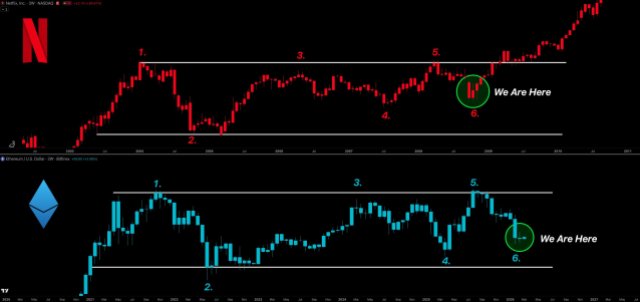
Source: Chart from Crypto Tice on X

With Ethereum mirroring this trend, the expert believes that history is about to repeat itself and ETH could see a violent upward move. “The assets that make people the most uncomfortable at the bottom are the ones that make people the most regretful at the top,” Crypto Tice added.

ETH trading at $2,055 on the 1D chart | Source: ETHUSDT on Tradingview.com

Related Questions

QHow much Ethereum did Bitmine recently purchase and what is its approximate value?

ABitmine recently purchased an additional 60,976 Ethereum, valued at over $122 million.

QDespite paper losses, how is Bitmine generating revenue from its Ethereum holdings?

ABitmine is generating approximately $174 million per year from staking its massive Ethereum holdings, regardless of the market price of ETH.

QWhat key difference does the article highlight between the Ethereum and Bitcoin treasury models?

AThe key difference is that the Ethereum treasury model can generate yield from both price appreciation and staking, while the Bitcoin treasury model (like Michael Saylor's) only generates yield when the price appreciates.

QWhat chart pattern is Ethereum mirroring according to analyst Crypto Tice, and what does it predict?

AEthereum is mirroring a chart pattern similar to Netflix's in 2009, which is characterized by a long period of compression and frustration before a massive upswing. This leads to the prediction of a violent upward move for ETH.

QWhat percentage of Ethereum's total circulating supply does Bitmine currently hold?

ABitmine currently holds over 4.53 million ETH, which represents 3.76% of Ethereum's entire circulating supply.

Related Reads

You Bet on the News, the Pros Read the Rules: The True Cognitive Gap in Losing Money on Polymarket

The article explains that the key to profiting on Polymarket, a prediction market platform, lies not just predicting real-world events correctly, but in meticulously understanding the specific rules that govern how each market will be resolved. It illustrates this with examples, such as a market on Venezuela's 2026 leader, where the official rules defining "officially holds" the office overruled the intuitive answer of who was in practical control. Other examples include debates over the definition of a "token" or what constitutes an "agreement." The core argument is that a "reality vs. rules" gap creates pricing discrepancies that savvy traders ("车头" or "whales") exploit. The platform has a formal dispute resolution process managed by UMA token holders to settle ambiguous outcomes. This process involves proposal submission, a challenge window, a discussion period, and a final vote. However, the article highlights a critical flaw in this system compared to a traditional court: the lack of separation between the arbiters (UMA voters) and the interested parties (traders with financial stakes in the outcome). This conflict of interest undermines the discussion phase, leads to herd mentality, and results in opaque final decisions without explanatory rulings. Consequently, the system lacks a body of precedent, making it difficult for users to learn from past disputes. The ultimate takeaway is that success on Polymarket requires a lawyer-like scrutiny of the rules to identify and capitalize on the cognitive gap between how events appear and how they are contractually defined for settlement.

marsbit4m ago

You Bet on the News, the Pros Read the Rules: The True Cognitive Gap in Losing Money on Polymarket

marsbit4m ago

Will the Fed Still Cut Interest Rates? Tonight's Data Is Crucial

The core debate surrounding the Federal Reserve's potential interest rate cuts is intensifying amid geopolitical conflict and rebounding inflation. The key question is whether high energy prices will cause persistent inflation or weaken consumer demand enough to force the Fed to cut rates. Citigroup presents a bullish case for cuts, arguing that oil supply disruptions from the Strait of Hormuz are temporary and will not lead to lasting inflationary pressure. They point to receding bond yields and oil prices as evidence the market is pricing in a short-lived shock. Citi's data also shows tightening financial conditions, a stabilizing labor market, and healthy tax returns, supporting their view that the path to lower rates remains open. Conversely, Deutsche Bank offers a starkly contrasting, more hawkish outlook. They argue the Fed's current policy is already neutral and expect rates to remain unchanged indefinitely. Their view is based on stalled disinflation progress and a shift toward more hawkish rhetoric from key Fed officials like Waller, who cited risks from prolonged Middle East conflict and tariffs. Other officials, including Williams and Hammack, signaled rates would likely stay on hold for a "considerable time." The market pricing has shifted dramatically, now forecasting zero cuts in 2026. The imminent release of the March retail sales "control group" data is highlighted as a critical test. This metric, which excludes gas station sales, will reveal if high gasoline prices are eroding consumer spending in other areas. A weak reading could support the case for imminent rate cuts, while a strong one would bolster the argument for the Fed to hold steady. This data is pivotal for determining the near-term policy path.

marsbit24m ago

Will the Fed Still Cut Interest Rates? Tonight's Data Is Crucial

marsbit24m ago

The Second Half of Macro Influencer Fu Peng's Career

Fu Peng, a prominent Chinese macroeconomist and former chief economist of Northeast Securities, has joined Hong Kong-based digital asset management firm Bitfire Group (formerly New Huo Group) as its chief economist. This move, announced in April 2026, triggered an 11% surge in Bitfire's stock price. Fu, known for his accessible macroeconomic commentary and large social media following, will focus on integrating digital assets into global asset allocation frameworks, particularly combining FICC (fixed income, currencies, and commodities) with cryptocurrencies for institutional clients. His career includes roles at Lehman Brothers and Solomon International, with significant influence gained through public communication. However, in late 2024, Fu faced temporary social media bans after a controversial private speech at HSBC on China's economic challenges, though he denied regulatory sanctions. He later left Northeast Securities citing health reasons. Bitfire, a licensed virtual asset manager serving high-net-worth clients, seeks to build trust and attract traditional capital through Fu’s expertise and credibility. The partnership represents a strategic shift for both: Fu enters the crypto sector after a traditional finance peak, while Bitfire aims to leverage his macro framework for institutional adoption. Outcomes remain uncertain regarding capital inflows and compatibility within corporate structure.

marsbit1h ago

The Second Half of Macro Influencer Fu Peng's Career

marsbit1h ago

Trading

Spot
Futures

Hot Articles

Discussions

Welcome to the HTX Community. Here, you can stay informed about the latest platform developments and gain access to professional market insights. Users' opinions on the price of ETH (ETH) are presented below.

活动图片