# Robotics Articoli collegati

Il Centro Notizie HTX fornisce gli articoli più recenti e le analisi più approfondite su "Robotics", coprendo tendenze di mercato, aggiornamenti sui progetti, sviluppi tecnologici e politiche normative nel settore crypto.

Meeting at the Pinnacle of Generalist: 30 Billion in 30 Days, What Did Qianxun AI Do Right?

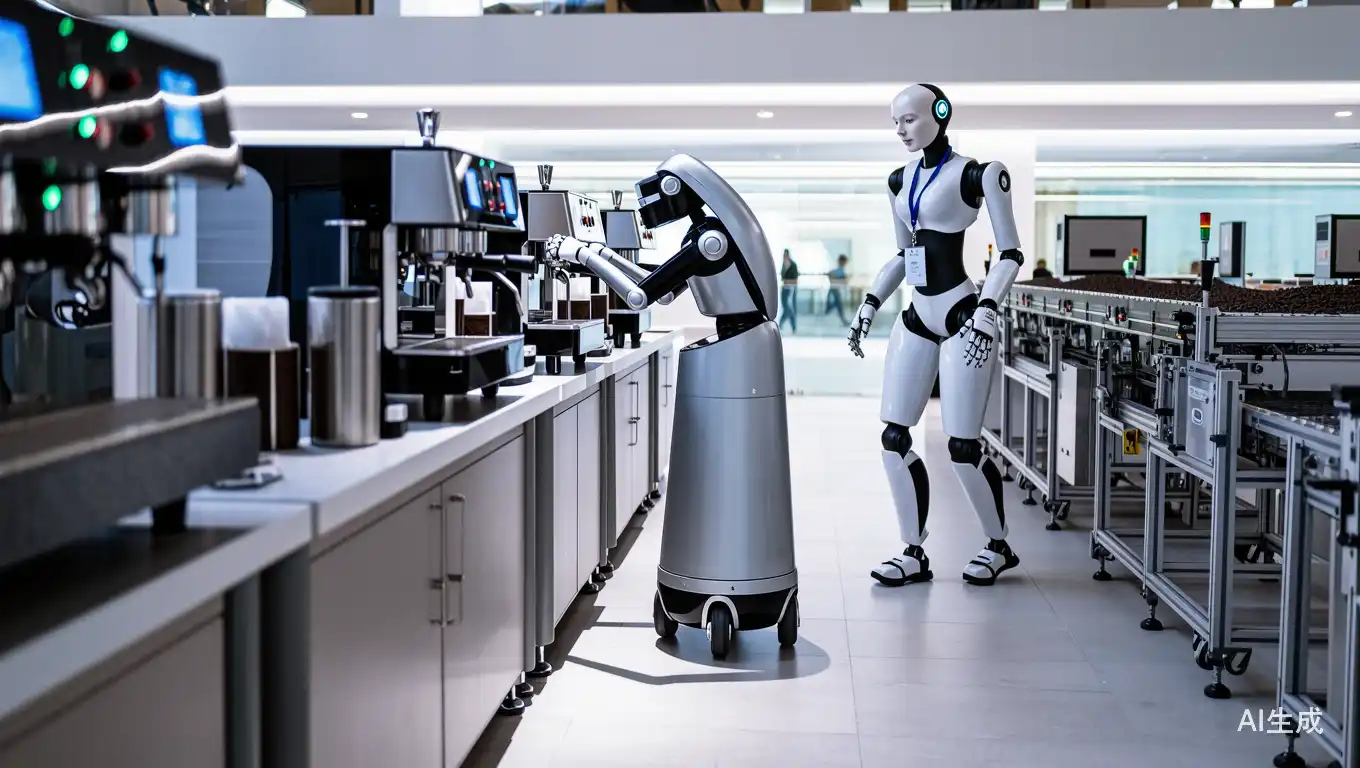
Qianxun Intelligence, a Chinese embodied AI and robotics startup, completed two major funding rounds totaling 3 billion RMB within 30 days in early 2026, backed by prominent investors including Shunwei Capital (Lei Jun) and Yunfeng Capital (Jack Ma). Founded in January 2024 by a team with expertise in robotics, AI, and commercialization, the company focuses on developing general-purpose embodied AI models. Its open-source model, Spirit v1.5, surpassed competitors in performance benchmarks, demonstrating strong zero-shot generalization capabilities for complex tasks. The company follows a scaling law approach similar to large language models (LLMs), leveraging massive diverse datasets—including internet videos, wearable device data, and teleoperation data—to train its Vision-Language-Action (VLA) model. Qianxun employs a multi-source data engine, collecting over 200,000 hours of real-world interaction data, with plans to reach 1 million hours by 2026. It uses low-cost wearable devices for efficient data acquisition and emphasizes real-world deployment for continuous data feedback. The company has deployed robots like "Xiao Mo" in industrial settings (e.g., battery production lines for CATL) and commercial scenarios (e.g., as baristas in JD.com malls), using operational data to refine its models. This "commercialize while iterating" strategy supports both revenue generation and model improvement, positioning Qianxun to compete globally in embodied AI.

marsbit04/07 04:05

Meeting at the Pinnacle of Generalist: 30 Billion in 30 Days, What Did Qianxun AI Do Right?

marsbit04/07 04:05

The Year of Physical AI: A Trillion-Dollar Gamble on 'How the World Works'

The year 2026 is being positioned as the dawn of the "Physical AI" era, marked by major funding rounds and technological breakthroughs. This shift signifies AI's evolution from understanding the digital world to perceiving and acting within the physical world. Key events include Yann LeCun's AMI Labs raising $1.03 billion to develop "world models," Fei-Fei Li's World Labs securing funding, and companies like Tesla deploying humanoid robots (Optimus) in factories. This transition expands the AI model competition into a broader infrastructure battle encompassing hardware, data, simulation, and real-world integration. The core debate is between two AI paths: the established LLM (Large Language Model) approach focused on text prediction and the emerging "world model" approach, which aims to understand physical states for action-oriented tasks. Hardware, particularly dexterous robotic hands, is a critical and expensive challenge. Companies are racing to build capable robotic bodies, with Tesla, Boston Dynamics, and Figure AI making significant progress. NVIDIA is positioning itself as the essential infrastructure provider for this new era, offering a full suite of development tools and platforms. A major bottleneck is the scarcity of high-quality physical world interaction data, with companies exploring solutions through real-world data collection, synthetic data generation, and human teleoperation. Substantial investments in Q1 2026, exceeding $6.4 billion, signal strong belief in Physical AI's potential, moving beyond concept validation into infrastructure building. While challenges like the sim-to-real gap, unproven business models, and safety regulations remain, the tangible engineering progress suggests this is a genuine technological inflection point, not merely a bubble. For the global Chinese community, this shift represents a significant structural opportunity to leverage their strengths in technology, engineering, hardware manufacturing, and cross-border collaboration to become key players in building the foundational layers of the Physical AI ecosystem.

marsbit04/03 09:39

The Year of Physical AI: A Trillion-Dollar Gamble on 'How the World Works'

marsbit04/03 09:39

Delphi Labs Founder: Two Weeks Deep in China's AI, Shenzhen Hardware Shocks Me, Software Valuations Scare Me

Delphi Labs co-founder José Maria Macedo spent two weeks in China meeting AI founders, VCs, and public company CEOs. His key takeaways: - **Hardware ecosystem in Shenzhen is impressive**, with systematic reverse-engineering of Western products and rapid iteration cycles. Companies like Bambu Lab are highly profitable and scaling fast. - **Software ecosystem is weaker than expected**. Chinese open-source models are strong, but closed-source models lag behind Western counterparts. GPU access remains constrained, and revenue gaps are significant (e.g., Anthropic’s $6B ARR vs. Chinese model companies at tens of millions). - **Founder profiles are highly accomplished** (top universities, Big Tech experience) but often lack rebellious, original vision. The education and VC systems favor execution over true innovation. - **Valuation bubbles exist** at both early and late stages. Some private AI companies are valued at 400x ARR, far exceeding Western multiples. Humanoid robotics is also overheating, with many pre-revenue companies targeting high-valuation IPOs. - **Information asymmetry favors Chinese founders**, who are highly informed about Western markets and tech trends. Many are building globally first, combining Chinese engineering with Western go-to-market strategies. Macedo believes the real alpha lies in finding non-traditional founders who break the "resume template" optimized by local VCs.

marsbit03/26 03:16

Delphi Labs Founder: Two Weeks Deep in China's AI, Shenzhen Hardware Shocks Me, Software Valuations Scare Me

marsbit03/26 03:16

The Investment Circle's Shared Answer: Unitree

English Summary: "Unitree, a leading Chinese humanoid robotics company, has officially filed for a科创板 (STAR Board) IPO, marking a potential 'A-share humanoid robotics first stock.' The company, founded by Wang Xingxing, has demonstrated remarkable commercial success, reporting 2025 revenue of approximately RMB 1.708 billion (a 335% year-on-year increase) and a net profit exceeding RMB 600 million, with gross margins nearing 60%. A key to its growth has been the strategic shift from quadruped robots to humanoids. Its humanoid robot sales surged from just 5 units in 2023 to 5,500 in 2025, with the average selling price dropping significantly to RMB 167,600 while maintaining high profitability. The company boasts a star-studded investor lineup, including Meituan, Sequoia China, Matrix Partners, Tencent, Alibaba, BYD, and Geely, reflecting strong industry and capital consensus on the robotics sector. Its IPO is seen as a major milestone, setting a valuation benchmark for the entire industry and opening a crucial exit channel for investors. The broader humanoid robotics market in China is experiencing a financing boom, with over 133 funding rounds in 2026 alone for 115 companies. However, Unitree acknowledges that a key technological challenge remains: the development of a mature 'brain' (embodied AI) for true autonomous decision-making, not just advanced 'cerebellum' movement control. Despite this, its successful commercialization and path to IPO have made it a standout, with early backers like Lei Jun's Shunwei Capital poised for significant returns."

比推03/23 08:19

The Investment Circle's Shared Answer: Unitree

比推03/23 08:19

NVIDIA Starts Installing Chips on Roads | Rewire Evening News Update

NVIDIA CEO Jensen Huang announced at GTC that the company's data center orders for Blackwell and Vera Rubin platforms are projected to exceed $1 trillion by 2027, doubling last year's estimates. He emphasized that computing demand will far surpass this figure. Beyond data centers, NVIDIA is expanding its autonomous driving ecosystem, adding BYD, Geely, Nissan, and Isuzu to its Drive Hyperion platform. A partnership with Uber aims to deploy robotaxis in Los Angeles and San Francisco by early 2027, expanding to 28 markets by 2028—a moment Huang calls "the ChatGPT moment for autonomous driving." In related news, Uber co-founder Travis Kalanick revealed his stealth robotics startup, Atoms, after eight years of operation. The company focuses on automating physical infrastructure, mining, and robotic platforms. Kalanick is reportedly acquiring autonomous driving firm Pronto, with Uber's support, signaling a strategic re-entry into automation. Meanwhile, Murata Manufacturing, the world's largest MLCC supplier with over 40% market share, raised prices for AI server and automotive-grade components by 15-35%, effective April 1. This marks its first major price hike in three years and highlights hidden cost pressures in AI infrastructure supply chains. The SEC is also considering allowing public companies to switch from quarterly to semi-annual financial reporting, reducing compliance costs and potentially benefiting tech firms making long-term AI investments. Additional updates include Alibaba providing employees with free AI tool tokens, FDIC moving to exclude stablecoins from deposit insurance, deepfake misinformation spreading during the Israel-Hamas war, and Picsart launching an AI Agent marketplace for creators.

marsbit03/17 19:08

NVIDIA Starts Installing Chips on Roads | Rewire Evening News Update

marsbit03/17 19:08

活动图片