What's New in Jensen Huang's 'Agent Factory'?

marsbitPubblicato 2026-06-01Pubblicato ultima volta 2026-06-01

Introduzione

In a keynote at COMPUTEX 2026, NVIDIA CEO Jensen Huang shifted the company's focus from hardware "full-stack" solutions to the era of AI Agents. The centerpiece is the Vera Rubin platform, now in production, which is designed specifically for Agent workloads and offers 10x the efficiency of its predecessor. The platform features the new Vera CPU, built for AI, and incorporates Spectrum-X Ethernet Photonics with CPO technology for improved networking and energy efficiency. NVIDIA introduced DSX, an integrated toolkit for designing, simulating, and operating AI data centers, aiming to streamline "AI factory" deployment and management. For end-user deployment, the company unveiled DGX Station for Windows, a desktop AI supercomputer for running Agents locally, and the RTX Spark SoC for AI PCs. On the software front, NVIDIA launched the 550B-parameter Nemotron 3 Ultra model for enterprise Agents and the Cosmos 3 foundation model for physical AI, unifying visual reasoning and action prediction. In robotics, a partnership with Unitree yielded the H2 Plus, a reference humanoid robot built on the Isaac GR00T platform to lower development barriers. Security was emphasized with enhanced confidential computing for Vera Rubin and new data path security features for the BlueField-4 STX storage platform. The presentation highlighted a strategic pivot: NVIDIA is reorganizing its entire technology stack—from chips and data centers to models, software, and robots—around the emerging ecosyst...

Original Author: Li Hailun, Su Yang

Original Editor: Xu Qingyang

Original Source: Tencent Technology

June 1, 2026 - NVIDIA Founder and CEO Jensen Huang delivered a keynote speech at the NVIDIA GTC Taipei conference held during COMPUTEX 2026.

It had only been three months since the last GTC.

At that time, NVIDIA announced the "chip family bundle" of Vera Rubin, including: the Vera CPU, Rubin GPU, Groq 3 LPU, ConnectX-9, BlueField-4 DPU, and Spectrum-6 switch. These six chips form a rack-scale AI supercomputer, announcing that the number of GPUs required to train large MoE models was reduced to one-quarter, inference throughput per watt improved 10x, and single token cost dropped to one-tenth.

Different from previous emphasis on system-level solutions like the "chip family bundle" or "computing power family bundle," three months later at COMPUTEX, Jensen Huang turned his focus to the target these infrastructures will serve—Agents.

In his speech, Jensen Huang revealed: Vera Rubin has officially entered mass production, Vera CPUs have begun shipping globally, DGX Station for the first time comes to enterprise desktops in a Windows form factor, Cosmos 3 redefines the perceptual framework for physical AI, and DSX becomes the operating system for AI factories. NVIDIA also partnered with Unitree to launch the H2 Plus—the first humanoid robot reference design based on Isaac GR00T, extending Agent boundaries from the digital world to physical form.

NVIDIA is reorganizing its complete technical system around the Agent ecosystem, from chips and data centers to models, software, and robotics platforms.

Jensen Huang said: "The era of Agent AI and practical artificial intelligence has arrived. Now tokens are the unit of profit, AI is the 'generator' of GDP, and the number of software engineers is increasing. People talk about AI reducing jobs; that's complete nonsense. In fact, more software engineers are being hired."
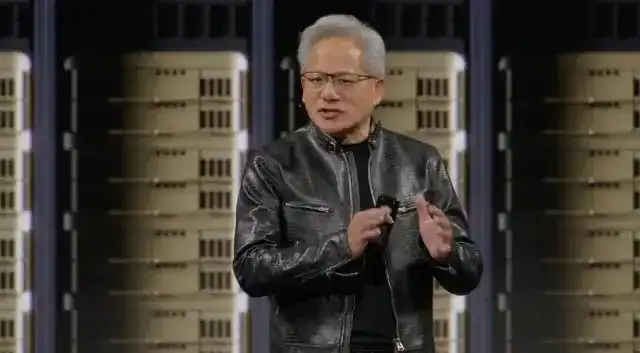
The Same AI Factory, Runs 10x More Agent Tasks

The Vera Rubin platform is now in full production.

Unlike the past, which mainly focused on large model training and inference, Vera Rubin was designed from the start with Agent as a key workload.

In his speech, Jensen Huang stated that an Agent task is often not just a single model inference, but includes multiple steps such as inference, search, tool calls, code execution, and result validation, potentially involving thousands of steps behind the scenes. In the future, data centers will need to handle not just individual model requests but more of these continuous, collaborative Agent tasks.

The platform is defined as a massive, unified compute-unit-level AI supercomputer built specifically for handling Agent workloads from inference, retrieval to tool usage. In a same-scale hyperscale data center, using the new Vera Rubin platform to run autonomous AI Agent tasks achieves a processing efficiency 10 times that of the previous generation Grace Blackwell platform.

Beyond the compute platform itself, networking has also become a focus of the Vera Rubin upgrade.

In the past, data transmission between GPUs in data centers relied primarily on traditional optical modules and switch architectures. However, as cluster sizes continue to expand, power consumption, cooling, and deployment complexity rapidly increase. To address this, NVIDIA introduced the Spectrum-X Ethernet Photonics networking system into the Vera Rubin platform.

This marks NVIDIA's first large-scale introduction of Co-Packaged Optics (CPO) technology into AI data center networks.

Simply put, traditional solutions require plugging optical modules externally into switches, while CPO directly integrates optical devices into the switch internal, thereby reducing energy consumption and signal loss.

Additionally, security is a core capability heavily emphasized in this Vera Rubin platform.

To this end, NVIDIA extended Confidential Computing capabilities across the entire Vera Rubin platform. Through trusted execution environments, hardware-level verification, and end-to-end encryption mechanisms, enterprises can achieve higher levels of security assurance when handling private data, industry-sensitive information, and critical models.

Jensen Huang revealed that Vera Rubin has entered mass production. As a third-generation MGX rack-level system, it involves over 150 partners, more than 350 factories, and a supply chain covering over 30 countries and regions. According to NVIDIA's announced plan, Vera Rubin will begin official shipments this fall.
The "Born-for-Agent" Processor

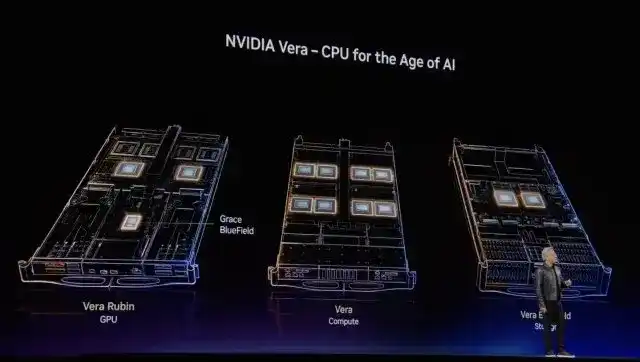
NVIDIA launched a new type of processor, Vera, designed specifically for the Agent era and has entered full production.

Jensen Huang pointed out that advancements in memory systems will drive innovation and modernization in storage systems. All CPUs to date have been built for humans, but Vera is a CPU designed for the AI era, built for Agents.

As the successor to Grace, Vera adopts NVIDIA's self-designed "Olympus" CPU core architecture, increasing core count from 72 to 88 cores and significantly improving memory and data processing capabilities. According to NVIDIA, in testing with Agent-related workloads, Vera achieved task execution speeds 1.8 times faster than contemporary x86 server CPUs.

More important than pure performance gains is the change in the relationship between Vera and the Rubin GPU: Vera connects to the Rubin GPU via second-generation NVLink-C2C, with an interconnect bandwidth reaching 1.8TB/s, further reducing the overhead of data transfer between CPU and GPU during Agent operation.

Jensen Huang stated that Vera Rubin uses HBM (High-Bandwidth Memory) from Micron, SK Hynix, and Samsung, and the supply chain scale is "twice" that of the previous generation Blackwell. However, deploying a large Blackwell rack took two hours, while the time for Vera Rubin has been compressed to the 5-minute level.
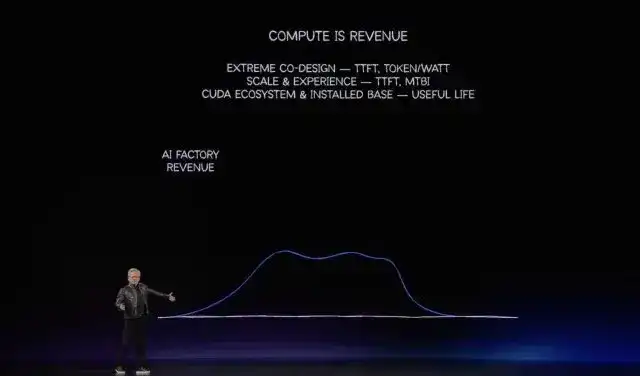
Moving AI Factories from "Construction" to "Operation"

The DSX launched by NVIDIA this time can be understood as an "AI Factory Construction and Operation Toolkit."

In the past, building an AI data center required clients to separately consider servers, networking, power, cooling, facility design, and operational systems, with many steps relying on coordination among different suppliers. DSX aims to integrate these previously fragmented steps into a single framework, providing clients with a standardized, verifiable reference plan from design, simulation, construction, to operation.

Jensen Huang stated at the launch event: "NVIDIA isn't just selling chips; we're providing infrastructure builders with a complete AI factory blueprint."

The most important new capabilities in DSX this time are two-fold.

The first is DSX MaxLPS. It addresses the most practical problem for AI factories: given a fixed power budget, how to place more GPUs and run more Tokens.

According to NVIDIA, MaxLPS, combined with liquid cooling and intra-rack power optimization, allows operators to run up to 40% more GPUs without significantly impacting performance.

The second is DSX OS. It acts as the operational software for the AI factory, responsible for lifecycle management, intelligent scheduling, health monitoring, failure recovery, multi-tenancy management, and more. Simply put, if an AI factory is a complex facility, DSX OS ensures its continuous, stable operation.

Within the DSX product matrix, Reference Design provides AI factory reference designs, telling clients how to build facilities, racks, networking, power, and cooling systems; DSX Sim handles simulation, allowing clients to verify designs before construction; DSX Flex connects the AI factory to the power grid, enabling data centers to adjust tasks based on electricity prices, loads, and demand response signals; DSX Exchange is responsible for data interfaces between IT systems, operational systems, energy, and cooling systems.

In terms of the ecosystem, cloud partners like CoreWeave, Crusoe, and Lambda are deploying DSX Sim, MaxLPS, and DSX OS to reduce risks and improve GPU utilization. Manufacturers like Dell, HPE, Lenovo, Supermicro, and ASUS, Foxconn, GIGABYTE, Wistron are building DSX-compatible systems.

Teaming Up with Windows and ARM

In his live speech, Jensen Huang officially announced the unveiling of the "DGX Station for Windows" workstation, defined by NVIDIA as a desktop-level AI supercomputer for the Windows ecosystem.

Hardware-wise, it features the GB300 Grace Blackwell Ultra Desktop Superchip, connecting the Blackwell Ultra GPU and 72-core Grace CPU via NVLink-C2C, offering up to 748GB unified memory and 20 PFLOPS FP4 performance, and equipped with up to 800Gb/s networking capability.

The key point of this product lies in the change in Agent deployment methods.

NVIDIA hopes enterprises can run multiple Agents locally, securely, and manageably within a Windows environment and integrate them into workflows like design, engineering, data science, inference, and Physical AI. Simultaneously launched, OpenShell handles Agent runtime security through isolated sandboxes and system-level policy control, limiting Agents from unauthorized operations or leaking credentials and private data.

Besides products for enterprise desktops, Jensen Huang also announced a system-level SoC—the RTX Spark SoC—integrating the N1X CPU and Blackwell GPU into a single chip with unified memory architecture, specifically for thin-and-light laptops and small form-factor desktops.

Among these, N1X is NVIDIA's first PC processor co-developed with Microsoft, based on Arm architecture, custom-designed by MediaTek, and manufactured using TSMC's 3nm process. It will debut this fall on laptops from Microsoft, Dell, HP, ASUS, Lenovo, and MSI, with over 30 models initially, targeting high-end thin-and-light notebooks.

This is NVIDIA's "super chip" prepared for the AI PC era, which Jensen Huang sees as a significant redefinition of the PC form factor.
The Agent's "Two Brains"

At this launch event, NVIDIA announced the latest progress on two core model product lines, corresponding to two scenarios for Agents: one running within enterprise systems and one running in the physical world.

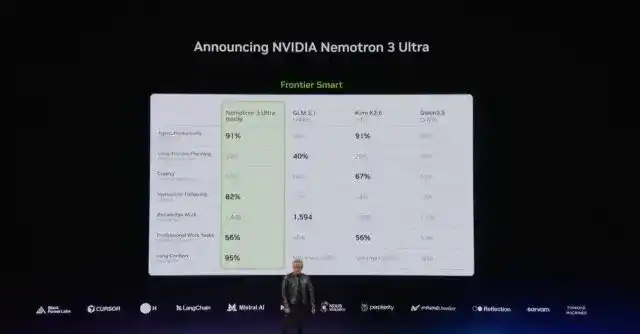
NVIDIA released Nemotron 3 Ultra, a 550-billion-parameter Mixture-of-Experts (MoE) model, providing top-tier intelligence for long-running agents in code development, scientific research, and enterprise business processes. Compared to mainstream open-source frontier models of similar scale, this model offers up to 5x faster inference speed and up to 30% lower usage cost, helping agents complete tasks more efficiently and affordably.

Surrounding the Nemotron open model, NVIDIA released a series of software, open-source models, and partnership progress, aiming to enable enterprises to build "digital colleagues" that assist employees in scenarios like engineering design, healthcare, software development, and business operations.

In this combination, Nemotron provides foundational model capabilities, NemoClaw organizes models into Agents, OpenShell handles runtime security, and Agent Toolkit transforms NVIDIA software libraries like CUDA-X into tools directly callable by Agents. Agents can use tools, call data, execute tasks, and integrate into existing enterprise systems within a controlled environment.

Jensen Huang stated that global software companies are bringing AI Agents into real work systems, enabling them to help employees complete complex tasks faster. NemoClaw provides open components needed to build long-running Agents, including orchestration, context, memory, tool calling, and security control capabilities.

In the past, enterprise discussions on AI focused more on what models could answer; now, NVIDIA aims to solve how Agents can securely integrate tools, data, and business processes and operate continuously in real work.

There's also Cosmos 3, officially launched as the third generation of the Cosmos series, representing an architectural-level redesign.

Cosmos 3 is a world foundation model for physical AI, providing the underlying ability to "understand the physical world, predict what will happen, and decide what to do."

Compared to previous Cosmos versions, earlier editions primarily targeted robotics and autonomous driving developers, focusing on video generation and physical world simulation, essentially being a relatively single-modal generation framework. Cosmos 3 adopts a new architecture—a hybrid Transformer—for the first time unifying three aspects: visual reasoning, world generation, and action prediction into a single system.

It can natively understand and generate text, images, videos, ambient sounds, and actions, achieving leading levels of physical accuracy, and is the world's first fully open, all-capable model. NVIDIA claims it has the potential to compress physical AI training and evaluation cycles from months in the past to days.

Jensen Huang predicted that due to breakthroughs in multimodal reasoning for language, vision, and world models, the big bang of physical AI is imminent.

The Cosmos 3 series of open frontier all-capable models provides developers with generational leap capabilities for building robots, autonomous vehicles, and visual AI that can perceive, reason, plan, and act in the physical world.

Lowering the Barrier to Physical AI

NVIDIA and Unitree jointly launched the H2 Plus—a sample humanoid robot for research and developers.

"Sample" means: Unitree is responsible for the robot body, NVIDIA is responsible for the software and computing platform, with both sides pre-integrating hardware and software. Development teams can start skill development immediately upon receiving it, without spending time solving underlying integration issues. It is also the world's first open humanoid robot built on the NVIDIA Isaac GR00T development platform.

This sample model targets a long-standing pain point in humanoid robot development: hardware integration, data collection, simulation, training, evaluation, deployment—each step operates in silos, making the entire process highly fragmented.

NVIDIA stated that research teams receiving a robot body often spend significant time on underlying integration, delaying actual skill development. What H2 Plus attempts to do is streamline this path, allowing research teams to skip underlying integration and directly enter skill development and real-world scenario validation.

In Jensen Huang's view, humanoid robots will bring physical AI to the world's largest industries, unlocking multi-trillion-dollar economic opportunities, and H2 Plus is the starting point for pushing frontier research into real scenarios like factories, warehouses, and logistics systems.

Additionally, NVIDIA announced the official open-sourcing of a set of Physical AI Skills toolkits, covering core scenarios like robotics, autonomous driving, visual AI, and industrial digital twins.

These "Skills" can be understood as standardized usage methods of NVIDIA's platforms like Cosmos, Omniverse, Isaac, Metropolis, written into operational instructions that Agents can directly read and execute. Open-sourcing these packaged instructions forms the toolkit released this time.

When an Agent receives a task, for example, generating a batch of training data for defect detection, it knows which model to call, what format to output, and how to validate results, automatically running the entire process without human step-by-step operation of each stage.

Upgrading AI Storage: From "Fast Running" to "Managed Control"

At the March GTC in San Jose, NVIDIA launched the Vera BlueField-4 STX. At that time, Jensen Huang focused on "AI-native storage architecture," with the core selling point being high-performance KV Cache storage support for Agents' long-context reasoning.

Now, NVIDIA announced the addition of a new set of security capabilities to STX, shifting the focus from "storage performance" to "storage security."

The core logic here stems from the changing context of enterprise AI usage. Now, many enterprises are actively deploying Agents. When Agents access enterprise systems, continuously reading and writing, sharing information across systems without direct human supervision—questions like who is accessing what data, whether there's unauthorized access, or data leakage become major headaches for enterprises.

NVIDIA's solution is to add a layer of security on top of accelerated storage—through a unified NVIDIA DOCA security software and hardware-enforced policies directly in the BlueField-4 chip, platforms based on STX can inspect and control interactions between agents, data, and contextual memory in real-time, helping enterprises achieve continuous policy enforcement across the AI data path.

Jensen Huang explained: "Agents have turned enterprise data into a real-time, living system, and this system must be protected wherever data moves, wherever context is stored, wherever Agents act. What Vera BlueField-4 STX aims to do is use inherently secure design to enforce trust at chip-level, at AI speeds."

Being "Mutual Suppliers" with TSMC

A particularly interesting point in this conference was the collaboration between NVIDIA and TSMC—Currently, TSMC is utilizing NVIDIA technology to improve cycle time, energy efficiency, yield, and operational productivity in advanced wafer fabs.

For the past thirty years, the relationship between TSMC and NVIDIA had only one form: TSMC manufacturing chips for NVIDIA. But now, roles have subtly changed; NVIDIA has begun helping TSMC "manage factories."

Jensen Huang stated: "NVIDIA and TSMC have collaborated for nearly thirty years, continuously pushing the limits of computing. TSMC is bringing NVIDIA's AI and accelerated computing inside the wafer fab, using simulation, optimization, and AI to tackle the world's most complex design and manufacturing challenges, improving speed, efficiency, and yield for next-generation chips."

Their relationship has evolved from a one-way client-vendor dynamic to one of mutual interdependence.

Conclusion

Looking back at this launch event, NVIDIA is piecing together a new blueprint around "Agents."

Vera CPU schedules tasks for Agents, Vera Rubin provides compute power for Agents, BlueField-4 STX secures data for Agents, Cosmos 3 enables Agents to understand the physical world, Nemotron+NemoClaw+OpenShell enables Agents to be organized, invoked, and constrained, DGX Station for Windows brings Agents to enterprise employee desktops, H2 Plus gives Agents a physical body, and DSX and Skills enable all this to be mass-produced and deployed.

From this perspective, Jensen Huang is attempting to depict a new computing era. This echoes his opening statement: "The era of Agent AI and practical artificial intelligence has arrived."

Ultimately, what Jensen Huang wanted to convey this time is one thing: when Agents become AI infrastructure, every layer can have NVIDIA.


Domande pertinenti

QAccording to the article, what is the main focus of NVIDIA's new strategy at COMPUTEX 2026, as outlined by Jensen Huang?

AAccording to Jensen Huang's keynote at COMPUTEX 2026, NVIDIA's main strategic focus has shifted from emphasizing 'system-level solutions' like chip or computing power 'family buckets' to the infrastructure's ultimate target: the Agent. NVIDIA is reorganizing its entire technology stack—from chips and data centers to models, software, and robotics platforms—around the Agent ecosystem.

QWhat key performance claim does NVIDIA make for the new Vera Rubin AI platform compared to its predecessor?

ANVIDIA claims that the new Vera Rubin platform can handle autonomous AI agent tasks with 10 times the processing efficiency of the previous-generation Grace Blackwell platform, within similarly sized mega-data centers.

QWhat is the significance of NVIDIA's collaboration with Unitree on the H2 Plus robot?

AThe collaboration with Unitree resulted in the H2 Plus, which is described as the first open humanoid robot reference design built on the NVIDIA Isaac GR00T platform. It serves as a 'template' or 'sample machine' that integrates hardware (by Unitree) and software/platform (by NVIDIA), allowing research teams to skip complex low-level integration and focus directly on skill development and real-world validation. Its goal is to lower the barrier to entry for Physical AI development.

QWhat are the two core model product lines NVIDIA announced for Agents, and what are their respective purposes?

ANVIDIA announced updates to two core model product lines for Agents: 1) The Nemotron series, exemplified by the Nemotron 3 Ultra model, is designed for 'digital colleagues' running within enterprise systems to assist with tasks like code development and business processes. 2) The Cosmos 3 series is a foundational world model for Physical AI, providing the underlying ability to understand the physical world, predict outcomes, and decide on actions for robots, autonomous vehicles, and visual AI.

QHow has the relationship between NVIDIA and TSMC evolved, as mentioned in the article?

AThe relationship between NVIDIA and TSMC has evolved from a traditional, one-way supplier-client dynamic (where TSMC manufactures chips for NVIDIA) into a more bidirectional, interdependent partnership. TSMC is now implementing NVIDIA's AI and accelerated computing technology within its own advanced wafer fabs to improve turnaround time, energy efficiency, yield, and operational productivity for next-generation chip manufacturing.

Letture associate

The Midlife Crisis of Crypto GPs: No PMF, No Next Check from LPs

The article "The Midlife Crisis of Crypto GPs: No PMF, No Next LP Check" analyzes the shifting crypto fundraising landscape. It argues the era of selling grand visions to LPs is over; GPs must now offer products with clear Product-Market Fit (PMF). The author categorizes crypto fundraising products into three types: Primary (VC funds), Liquid (trading strategies), and CeFi/DeFi Native Yield. This summary focuses on the Primary market. Key points include: * **Market Shift:** LPs are impatient, demand immediate returns, and are skeptical of future promises. The "easy money" narrative has faded. * **GP Value Erosion:** LP learning curves have shortened (aided by AI), reducing the value of a GP's basic "crypto knowledge." Superior judgment is now rare. * **Weakened LP Motivations:** Traditional reasons for LPs to invest in crypto VC funds (capturing industry beta, gaining access, leveraging GP judgment) have weakened due to new products like ETFs and increased LP sophistication. * **Surviving in Primary:** The primary market will likely persist for: 1) large funds in endowment mandates treating it as a lottery ticket, 2) family offices/HNWIs using proprietary capital, 3) a few funds with proven recent outperformance, and 4) funds with strong ecosystem "deal-making" capabilities. * **Conclusion:** For most GPs, rebuilding trust requires starting over in a niche, demonstrating alpha-generating ability, or providing concrete value/services to LPs.

marsbit1 h fa

The Midlife Crisis of Crypto GPs: No PMF, No Next Check from LPs

marsbit1 h fa

Crypto GPs' Midlife Crisis: No PMF, No LP's Next Check

The article "The Midlife Crisis of Crypto GPs: No PMF, No LP's Next Check" analyzes the shifting crypto fundraising landscape. It argues that the era of LPs funding vague "vision" is over; GPs must now offer products with clear Product-Market Fit (PMF) to secure capital. The market has matured. LPs, disillusioned by the last cycle's failures and wary of long lock-up periods, now demand tangible, near-term returns rather than speculative narratives. The proliferation of accessible crypto ETFs and other liquid products has reduced the need for VC blind pools as an entry point. The author categorizes crypto fundraising products into three types: Primary (VC funds, with blind pools or clear pipelines), Liquid (alpha/beta, directional/market-neutral strategies), and CeFi/DeFi Native Yield (crypto-specific mechanisms like staking, farming). Focusing on the Primary market, the piece details why traditional LP rationales for investing in crypto VCs have weakened: easier beta access via ETFs, diminished "access" and "judgement" premiums as LPs build internal teams, and a widespread lack of proven superior returns from GPs. Ultimately, only specific players are likely to remain at the primary VC table: large funds with access to patient endowment capital, family offices/HNWIs investing proprietary capital, the few funds with demonstrable excess returns from the last cycle, and those with clear "deal-making" or ecosystem resource advantages. For others, the path forward is to rebuild trust by proving alpha-generation capability in a niche or providing concrete, valuable services.

链捕手1 h fa

Crypto GPs' Midlife Crisis: No PMF, No LP's Next Check

链捕手1 h fa

The Age of Decoupling Has Arrived: Bitcoin is No Longer the Sole Compass of Crypto

The era of the cryptocurrency market moving in lockstep with Bitcoin is ending, as the industry splits into two distinct asset categories: endogenous and exogenous. Endogenous assets, like Bitcoin, derive value purely from the crypto market's cycles. Their narratives swing between being "interstellar money" in bull markets and "digital collectibles" in bear markets. Exogenous assets, however, are nominally crypto but operate with independent value drivers. Examples include: * **Venice:** An AI inference service using tokens for payments; its consumer-AI business model is decoupled from crypto price swings. * **Figure:** A fintech lender using blockchain to speed up loan approvals; its core value is in credit, not crypto. * **Stablecoin firms like BVNK:** Acquired by traditional finance giants (Mastercard, Stripe), their growth is tied to payment infrastructure, not market cycles. Hybrid projects like **Hyperliquid** (a decentralized exchange) show a shift, with a growing share of non-crypto trading (e.g., prediction markets). This divergence is fundamental. Endogenous assets remain highly correlated to Bitcoin, similar to gold miners to gold. Exogenous assets are evolving to have their own fundamentals, like the weak correlation between gold and the S&P 500. This changes investment analysis. Evaluating exogenous assets requires traditional fundamental research—assessing user bases, unit economics, and moats—more akin to fintech investing than charting Bitcoin. Promising exogenous sectors include: on-chain exchanges/brokers, AI-crypto fusion, privacy-focused digital banks, lending (institutional/private credit), stablecoins/real-world asset tokenization, payment rails, and non-financial crypto-consumer products. Currently, investing via equity is often safer than via tokens, as token value accrual mechanisms need further regulatory and industry development (e.g., the CLARITY Act). Nonetheless, the core trend is clear: crypto market drivers are diversifying from a single factor (Bitcoin) to multiple fundamentals, ending the era of uniform market moves.

marsbit2 h fa

The Age of Decoupling Has Arrived: Bitcoin is No Longer the Sole Compass of Crypto

marsbit2 h fa

Trading

Spot
Futures

Articoli Popolari

Cosa è $S$

Comprendere SPERO: Una Panoramica Completa Introduzione a SPERO Mentre il panorama dell'innovazione continua a evolversi, l'emergere delle tecnologie web3 e dei progetti di criptovaluta gioca un ruolo fondamentale nel plasmare il futuro digitale. Un progetto che ha attirato l'attenzione in questo campo dinamico è SPERO, denotato come SPERO,$$s$. Questo articolo mira a raccogliere e presentare informazioni dettagliate su SPERO, per aiutare gli appassionati e gli investitori a comprendere le sue basi, obiettivi e innovazioni nei domini web3 e crypto. Che cos'è SPERO,$$s$? SPERO,$$s$ è un progetto unico all'interno dello spazio crypto che cerca di sfruttare i principi della decentralizzazione e della tecnologia blockchain per creare un ecosistema che promuove l'impegno, l'utilità e l'inclusione finanziaria. Il progetto è progettato per facilitare interazioni peer-to-peer in modi nuovi, fornendo agli utenti soluzioni e servizi finanziari innovativi. Al suo interno, SPERO,$$s$ mira a responsabilizzare gli individui fornendo strumenti e piattaforme che migliorano l'esperienza dell'utente nello spazio delle criptovalute. Questo include la possibilità di metodi di transazione più flessibili, la promozione di iniziative guidate dalla comunità e la creazione di percorsi per opportunità finanziarie attraverso applicazioni decentralizzate (dApps). La visione sottostante di SPERO,$$s$ ruota attorno all'inclusività, cercando di colmare le lacune all'interno della finanza tradizionale mentre sfrutta i vantaggi della tecnologia blockchain. Chi è il Creatore di SPERO,$$s$? L'identità del creatore di SPERO,$$s$ rimane piuttosto oscura, poiché ci sono risorse pubblicamente disponibili limitate che forniscono informazioni dettagliate sul suo fondatore o fondatori. Questa mancanza di trasparenza può derivare dall'impegno del progetto per la decentralizzazione—un ethos che molti progetti web3 condividono, dando priorità ai contributi collettivi rispetto al riconoscimento individuale. Centrando le discussioni attorno alla comunità e ai suoi obiettivi collettivi, SPERO,$$s$ incarna l'essenza dell'empowerment senza mettere in evidenza individui specifici. Pertanto, comprendere l'etica e la missione di SPERO rimane più importante che identificare un creatore singolo. Chi sono gli Investitori di SPERO,$$s$? SPERO,$$s$ è supportato da una varietà di investitori che vanno dai capitalisti di rischio agli investitori angelici dedicati a promuovere l'innovazione nel settore crypto. Il focus di questi investitori generalmente si allinea con la missione di SPERO—dando priorità a progetti che promettono avanzamenti tecnologici sociali, inclusività finanziaria e governance decentralizzata. Queste fondazioni di investitori sono tipicamente interessate a progetti che non solo offrono prodotti innovativi, ma contribuiscono anche positivamente alla comunità blockchain e ai suoi ecosistemi. Il supporto di questi investitori rafforza SPERO,$$s$ come un concorrente degno di nota nel dominio in rapida evoluzione dei progetti crypto. Come Funziona SPERO,$$s$? SPERO,$$s$ impiega un framework multifunzionale che lo distingue dai progetti di criptovaluta convenzionali. Ecco alcune delle caratteristiche chiave che sottolineano la sua unicità e innovazione: Governance Decentralizzata: SPERO,$$s$ integra modelli di governance decentralizzati, responsabilizzando gli utenti a partecipare attivamente ai processi decisionali riguardanti il futuro del progetto. Questo approccio favorisce un senso di proprietà e responsabilità tra i membri della comunità. Utilità del Token: SPERO,$$s$ utilizza il proprio token di criptovaluta, progettato per servire varie funzioni all'interno dell'ecosistema. Questi token abilitano transazioni, premi e la facilitazione dei servizi offerti sulla piattaforma, migliorando l'impegno e l'utilità complessivi. Architettura Stratificata: L'architettura tecnica di SPERO,$$s$ supporta la modularità e la scalabilità, consentendo un'integrazione fluida di funzionalità e applicazioni aggiuntive man mano che il progetto evolve. Questa adattabilità è fondamentale per mantenere la rilevanza nel panorama crypto in continua evoluzione. Coinvolgimento della Comunità: Il progetto enfatizza iniziative guidate dalla comunità, impiegando meccanismi che incentivano la collaborazione e il feedback. Nutrendo una comunità forte, SPERO,$$s$ può affrontare meglio le esigenze degli utenti e adattarsi alle tendenze di mercato. Focus sull'Inclusione: Offrendo basse commissioni di transazione e interfacce user-friendly, SPERO,$$s$ mira ad attrarre una base utenti diversificata, inclusi individui che potrebbero non aver precedentemente interagito nello spazio crypto. Questo impegno per l'inclusione si allinea con la sua missione generale di empowerment attraverso l'accessibilità. Cronologia di SPERO,$$s$ Comprendere la storia di un progetto fornisce preziose intuizioni sulla sua traiettoria di sviluppo e sui traguardi. Di seguito è riportata una cronologia suggerita che mappa eventi significativi nell'evoluzione di SPERO,$$s$: Fase di Concettualizzazione e Ideazione: Le idee iniziali che formano la base di SPERO,$$s$ sono state concepite, allineandosi strettamente con i principi di decentralizzazione e focus sulla comunità all'interno dell'industria blockchain. Lancio del Whitepaper del Progetto: Dopo la fase concettuale, è stato rilasciato un whitepaper completo che dettaglia la visione, gli obiettivi e l'infrastruttura tecnologica di SPERO,$$s$ per suscitare interesse e feedback dalla comunità. Costruzione della Comunità e Prime Interazioni: Sono stati effettuati sforzi attivi di outreach per costruire una comunità di early adopters e potenziali investitori, facilitando discussioni attorno agli obiettivi del progetto e ottenendo supporto. Evento di Generazione del Token: SPERO,$$s$ ha condotto un evento di generazione del token (TGE) per distribuire i propri token nativi ai primi sostenitori e stabilire una liquidità iniziale all'interno dell'ecosistema. Lancio della Prima dApp: La prima applicazione decentralizzata (dApp) associata a SPERO,$$s$ è stata attivata, consentendo agli utenti di interagire con le funzionalità principali della piattaforma. Sviluppo Continuo e Partnership: Aggiornamenti e miglioramenti continui alle offerte del progetto, inclusi partnership strategiche con altri attori nello spazio blockchain, hanno plasmato SPERO,$$s$ in un concorrente competitivo e in evoluzione nel mercato crypto. Conclusione SPERO,$$s$ rappresenta una testimonianza del potenziale del web3 e delle criptovalute di rivoluzionare i sistemi finanziari e responsabilizzare gli individui. Con un impegno per la governance decentralizzata, il coinvolgimento della comunità e funzionalità progettate in modo innovativo, apre la strada verso un panorama finanziario più inclusivo. Come per qualsiasi investimento nello spazio crypto in rapida evoluzione, si incoraggiano potenziali investitori e utenti a ricercare approfonditamente e a impegnarsi in modo riflessivo con gli sviluppi in corso all'interno di SPERO,$$s$. Il progetto mostra lo spirito innovativo dell'industria crypto, invitando a ulteriori esplorazioni delle sue innumerevoli possibilità. Mentre il percorso di SPERO,$$s$ è ancora in fase di sviluppo, i suoi principi fondamentali potrebbero effettivamente influenzare il futuro di come interagiamo con la tecnologia, la finanza e tra di noi in ecosistemi digitali interconnessi.

75 Totale visualizzazioniPubblicato il 2024.12.17Aggiornato il 2024.12.17

Cosa è $S$

Cosa è AGENT S

Agent S: Il Futuro dell'Interazione Autonoma in Web3 Introduzione Nel panorama in continua evoluzione di Web3 e criptovalute, le innovazioni stanno costantemente ridefinendo il modo in cui gli individui interagiscono con le piattaforme digitali. Uno di questi progetti pionieristici, Agent S, promette di rivoluzionare l'interazione uomo-computer attraverso il suo framework agentico aperto. Aprendo la strada a interazioni autonome, Agent S mira a semplificare compiti complessi, offrendo applicazioni trasformative nell'intelligenza artificiale (AI). Questa esplorazione dettagliata approfondirà le complessità del progetto, le sue caratteristiche uniche e le implicazioni per il dominio delle criptovalute. Cos'è Agent S? Agent S si presenta come un innovativo framework agentico aperto, progettato specificamente per affrontare tre sfide fondamentali nell'automazione dei compiti informatici: Acquisizione di Conoscenze Specifiche del Dominio: Il framework apprende in modo intelligente da varie fonti di conoscenza esterne ed esperienze interne. Questo approccio duale gli consente di costruire un ricco repository di conoscenze specifiche del dominio, migliorando le sue prestazioni nell'esecuzione dei compiti. Pianificazione su Lungo Orizzonte di Compiti: Agent S impiega una pianificazione gerarchica potenziata dall'esperienza, un approccio strategico che facilita la suddivisione e l'esecuzione efficiente di compiti complessi. Questa caratteristica migliora significativamente la sua capacità di gestire più sottocompiti in modo efficiente ed efficace. Gestione di Interfacce Dinamiche e Non Uniformi: Il progetto introduce l'Interfaccia Agente-Computer (ACI), una soluzione innovativa che migliora l'interazione tra agenti e utenti. Utilizzando Modelli Linguistici Multimodali di Grandi Dimensioni (MLLM), Agent S può navigare e manipolare senza sforzo diverse interfacce grafiche utente. Attraverso queste caratteristiche pionieristiche, Agent S fornisce un framework robusto che affronta le complessità coinvolte nell'automazione dell'interazione umana con le macchine, preparando il terreno per innumerevoli applicazioni nell'AI e oltre. Chi è il Creatore di Agent S? Sebbene il concetto di Agent S sia fondamentalmente innovativo, informazioni specifiche sul suo creatore rimangono elusive. Il creatore è attualmente sconosciuto, il che evidenzia sia la fase embrionale del progetto sia la scelta strategica di mantenere i membri fondatori sotto anonimato. Indipendentemente dall'anonimato, l'attenzione rimane sulle capacità e sul potenziale del framework. Chi sono gli Investitori di Agent S? Poiché Agent S è relativamente nuovo nell'ecosistema crittografico, informazioni dettagliate riguardanti i suoi investitori e sostenitori finanziari non sono documentate esplicitamente. La mancanza di approfondimenti pubblicamente disponibili sulle fondazioni di investimento o sulle organizzazioni che supportano il progetto solleva interrogativi sulla sua struttura di finanziamento e sulla roadmap di sviluppo. Comprendere il supporto è cruciale per valutare la sostenibilità del progetto e il suo potenziale impatto sul mercato. Come Funziona Agent S? Al centro di Agent S si trova una tecnologia all'avanguardia che gli consente di funzionare efficacemente in contesti diversi. Il suo modello operativo è costruito attorno a diverse caratteristiche chiave: Interazione Uomo-Computer Simile a Quella Umana: Il framework offre una pianificazione AI avanzata, cercando di rendere le interazioni con i computer più intuitive. Mimando il comportamento umano nell'esecuzione dei compiti, promette di elevare le esperienze degli utenti. Memoria Narrativa: Utilizzata per sfruttare esperienze di alto livello, Agent S utilizza la memoria narrativa per tenere traccia delle storie dei compiti, migliorando così i suoi processi decisionali. Memoria Episodica: Questa caratteristica fornisce agli utenti una guida passo-passo, consentendo al framework di offrire supporto contestuale mentre i compiti si sviluppano. Supporto per OpenACI: Con la capacità di funzionare localmente, Agent S consente agli utenti di mantenere il controllo sulle proprie interazioni e flussi di lavoro, allineandosi con l'etica decentralizzata di Web3. Facile Integrazione con API Esterne: La sua versatilità e compatibilità con varie piattaforme AI garantiscono che Agent S possa adattarsi senza problemi agli ecosistemi tecnologici esistenti, rendendolo una scelta attraente per sviluppatori e organizzazioni. Queste funzionalità contribuiscono collettivamente alla posizione unica di Agent S all'interno dello spazio crittografico, poiché automatizza compiti complessi e multi-fase con un intervento umano minimo. Man mano che il progetto evolve, le sue potenziali applicazioni in Web3 potrebbero ridefinire il modo in cui si svolgono le interazioni digitali. Cronologia di Agent S Lo sviluppo e le tappe di Agent S possono essere riassunti in una cronologia che evidenzia i suoi eventi significativi: 27 Settembre 2024: Il concetto di Agent S è stato lanciato in un documento di ricerca completo intitolato “Un Framework Agentico Aperto che Usa i Computer Come un Umano”, mostrando le basi per il progetto. 10 Ottobre 2024: Il documento di ricerca è stato reso pubblicamente disponibile su arXiv, offrendo un'esplorazione approfondita del framework e della sua valutazione delle prestazioni basata sul benchmark OSWorld. 12 Ottobre 2024: È stata rilasciata una presentazione video, fornendo un'idea visiva delle capacità e delle caratteristiche di Agent S, coinvolgendo ulteriormente potenziali utenti e investitori. Questi indicatori nella cronologia non solo illustrano i progressi di Agent S, ma indicano anche il suo impegno per la trasparenza e il coinvolgimento della comunità. Punti Chiave su Agent S Man mano che il framework Agent S continua a evolversi, diversi attributi chiave si distinguono, sottolineando la sua natura innovativa e il potenziale: Framework Innovativo: Progettato per fornire un uso intuitivo dei computer simile all'interazione umana, Agent S porta un approccio nuovo all'automazione dei compiti. Interazione Autonoma: La capacità di interagire autonomamente con i computer attraverso GUI segna un passo avanti verso soluzioni informatiche più intelligenti ed efficienti. Automazione di Compiti Complessi: Con la sua metodologia robusta, può automatizzare compiti complessi e multi-fase, rendendo i processi più veloci e meno soggetti a errori. Miglioramento Continuo: I meccanismi di apprendimento consentono ad Agent S di migliorare dalle esperienze passate, migliorando continuamente le sue prestazioni e la sua efficacia. Versatilità: La sua adattabilità attraverso diversi ambienti operativi come OSWorld e WindowsAgentArena garantisce che possa servire un'ampia gamma di applicazioni. Man mano che Agent S si posiziona nel panorama di Web3 e delle criptovalute, il suo potenziale per migliorare le capacità di interazione e automatizzare i processi segna un significativo avanzamento nelle tecnologie AI. Attraverso il suo framework innovativo, Agent S esemplifica il futuro delle interazioni digitali, promettendo un'esperienza più fluida ed efficiente per gli utenti in vari settori. Conclusione Agent S rappresenta un audace passo avanti nell'unione tra AI e Web3, con la capacità di ridefinire il modo in cui interagiamo con la tecnologia. Sebbene sia ancora nelle sue fasi iniziali, le possibilità per la sua applicazione sono vaste e coinvolgenti. Attraverso il suo framework completo che affronta sfide critiche, Agent S mira a portare le interazioni autonome al centro dell'esperienza digitale. Man mano che ci addentriamo nei regni delle criptovalute e della decentralizzazione, progetti come Agent S giocheranno senza dubbio un ruolo cruciale nel plasmare il futuro della tecnologia e della collaborazione uomo-computer.

529 Totale visualizzazioniPubblicato il 2025.01.14Aggiornato il 2025.01.14

Cosa è AGENT S

Come comprare S

Benvenuto in HTX.com! Abbiamo reso l'acquisto di Sonic (S) semplice e conveniente. Segui la nostra guida passo passo per intraprendere il tuo viaggio nel mondo delle criptovalute.Step 1: Crea il tuo Account HTXUsa la tua email o numero di telefono per registrarti il tuo account gratuito su HTX. Vivi un'esperienza facile e sblocca tutte le funzionalità,Crea il mio accountStep 2: Vai in Acquista crypto e seleziona il tuo metodo di pagamentoCarta di credito/debito: utilizza la tua Visa o Mastercard per acquistare immediatamente SonicS.Bilancio: Usa i fondi dal bilancio del tuo account HTX per fare trading senza problemi.Terze parti: abbiamo aggiunto metodi di pagamento molto utilizzati come Google Pay e Apple Pay per maggiore comodità.P2P: Fai trading direttamente con altri utenti HTX.Over-the-Counter (OTC): Offriamo servizi su misura e tassi di cambio competitivi per i trader.Step 3: Conserva Sonic (S)Dopo aver acquistato Sonic (S), conserva nel tuo account HTX. In alternativa, puoi inviare tramite trasferimento blockchain o scambiare per altre criptovalute.Step 4: Scambia Sonic (S)Scambia facilmente Sonic (S) nel mercato spot di HTX. Accedi al tuo account, seleziona la tua coppia di trading, esegui le tue operazioni e monitora in tempo reale. Offriamo un'esperienza user-friendly sia per chi ha appena iniziato che per i trader più esperti.

943 Totale visualizzazioniPubblicato il 2025.01.15Aggiornato il 2026.06.01

Come comprare S

Discussioni

Benvenuto nella Community HTX. Qui puoi rimanere informato sugli ultimi sviluppi della piattaforma e accedere ad approfondimenti esperti sul mercato. Le opinioni degli utenti sul prezzo di S S sono presentate come di seguito.

活动图片













