Why Did Market Sentiment Collapse Completely in 2025? Deciphering Messari's 100,000-Word Annual Report

marsbitDipublikasikan tanggal 2025-12-23Terakhir diperbarui pada 2025-12-23

Abstrak

The 2025 crypto market experienced a historic collapse in sentiment, with the Crypto Fear & Greed Index hitting extreme fear levels of 10, despite the absence of systemic failures like exchange collapses or major bankruptcies. Messari's analysis attributes this not to industry failure, but to a deep structural shift: the market is transitioning from a speculative alpha-seeking environment to one dominated by institutional, long-term asset allocators. The core issue is a misalignment of participant identity. While institutions benefited from clear regulations, ETFs, and corporate treasury adoption (DATs), retail traders and active participants suffered from significantly reduced alpha, ineffective narrative cycles, and chronic underperformance of most assets against Bitcoin. The root cause of the emotional breakdown is identified as a crisis in the traditional global monetary system. With government debt consistently outpacing GDP growth worldwide, savers are systematically penalized through inflation, low real interest rates, and financial repression. Crypto, particularly Bitcoin, is not merely a tool for higher returns but offers a predictable, rules-based, and self-custodial monetary alternative. Bitcoin has decisively won the "monetary" competition. Its 429% price appreciation from 2022-2025 and dominant market share (57.3% of total crypto market cap) reflect its role as a non-sovereign store of value. Its "boring" reliability—lacking narratives or promises—is its great...

This article is based on the annual report "The Crypto Theses 2026" released by Messari in December 2025. The full report exceeds 100,000 words, with an official estimated reading time of 401 minutes. The information herein is for reference only and does not constitute any investment advice or offer. We are not responsible for the accuracy of the content, nor do we assume any consequences arising therefrom.

Introduction | The Worst Year for Sentiment, But Not the Most Fragile Year for the System

If we look only at sentiment indicators, the crypto market in 2025 could almost be pronounced "dead."
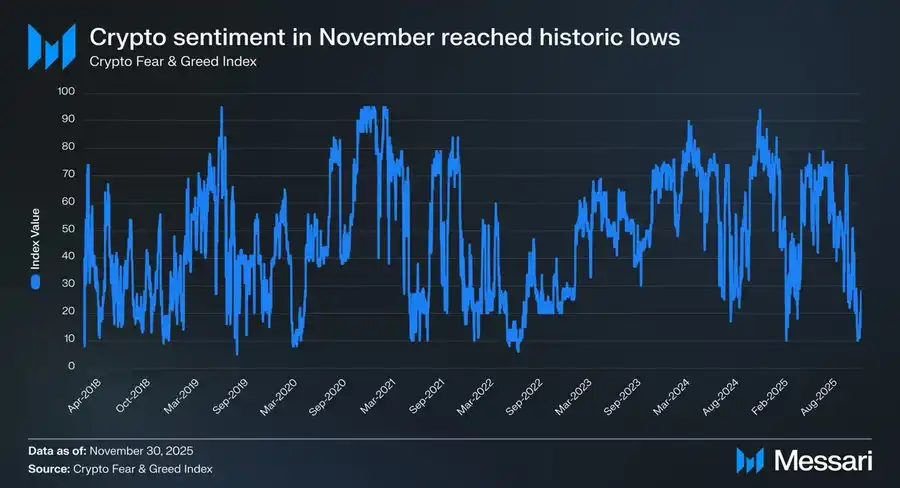
In November 2025, the Crypto Fear & Greed Index fell to 10, entering the "Extreme Fear" zone.

Historically, there have been very few moments when sentiment has fallen to this level:

· March 2020: Liquidity stampede triggered by the global pandemic

· May 2021: Chain reaction of leveraged liquidations

· May–June 2022: Systemic collapse of Luna and 3AC

· 2018–2019: Industry-wide bear market

These periods all share a commonality: the industry itself was failing, and the future was highly uncertain.

But 2025 does not fit this description. No major exchanges misappropriated user assets, no Ponzi projects with market caps of tens of billions of dollars dominated the narrative, the total market capitalization did not fall below the previous cycle's high, stablecoin scale instead hit a new all-time high, and regulatory and institutionalization processes continued to advance.

At the "fact level," this is not a year of industry collapse. However, at the "feeling level," it might be the most painful year for many practitioners, investors, and long-time users.

Why Did Sentiment Collapse?

Messari presents a highly impactful contrast at the beginning of the report:

If you were participating in crypto asset allocation from a Wall Street office building, 2025 might have been the best year since you entered the industry. But if you were staying up late watching charts and searching for Alpha in Telegram and Discord, this is probably the year you missed the "old days" the most.

The same market, two almost diametrically opposed experiences. This is not an accidental mood swing, nor a simple bull-bear switch, but a deeper structural misalignment: the market is changing participants, but most people are still participating in the new system with their old identities.

This Is Not a Market Recap

This article does not intend to discuss short-term price movements, nor does it attempt to answer "will it go up next?".

It is more like a structural explanation:

· Why, while institutions, capital, and infrastructure are continuously strengthening,

· did market sentiment slide to a historic low?

· Why do many people feel "they chose the wrong track," but the system itself has not failed?

In this 100,000-word report, Messari chooses to start from an extremely primitive question: If crypto assets are ultimately a form of "money," then who deserves to be treated as money?

Understanding this is a prerequisite for understanding the complete collapse of market sentiment in 2025.

Chapter 1 | Why Was Sentiment Abnormally Low?

If we look only at the outcome, the sentiment collapse of 2025 is almost "incomprehensible."

In the absence of exchange blow-ups, systemic credit collapses, or core narrative failures, the market nonetheless gave feedback接近 (close to) historical lows in sentiment.

Messari's judgment is very direct: This is an extreme case of "severe decoupling between sentiment and reality."

1. Sentiment Indicators Have Entered a "Historical Anomaly Zone"

The Crypto Fear & Greed Index falling to 10 is not an ordinary correction signal.

In the past decade, this value has only appeared at very few moments, and each time it appeared, it was accompanied by real and profound industry-level crises:

· Breakdown of the funding system

· Collapse of credit chains

· Market doubt about "whether the future exists"

But these problems did not appear in 2025.

No core infrastructure failed, no mainstream assets were liquidated to zero, and no systemic events occurred that could shake the industry's legitimacy. From a statistical perspective, this sentiment reading does not match any known historical template.

2. The Market Did Not Fail; "Personal Experience" Did

The collapse of sentiment did not come from the market itself, but from the subjective experience of the participants. Messari repeatedly emphasizes an overlooked fact in the report: 2025 was a year where the institutional experience was far better than the retail experience.

For institutions, this was an extremely clear, even comfortable environment:

· ETFs provided low-friction, low-risk allocation channels

· DATs (Digital Asset Treasuries) became stable, predictable long-term buyers

· Regulatory frameworks began to clarify, and compliance boundaries gradually became visible

But for a large number of participants under the old structure, this year was exceptionally brutal:

· Alpha significantly decreased

· Narrative rotation failed

· Most assets underperformed BTC for a long time

· The relationship between "degree of effort" and "results" was completely broken

The market did not reject people; it just changed the reward mechanism.

3. "Not Making Money" Was Misinterpreted as "The Industry Is Failing"

The real trigger for sentiment was not price decline, but cognitive dissonance. In past cycles, the implicit assumption of Crypto was: as long as you are diligent enough, early enough, and aggressive enough, you can obtain超额回报 (excess returns).

But 2025 was the first time this assumption was systematically broken.

· Most assets no longer gained premiums for "storytelling"

· L1 ecosystem growth no longer automatically translated into token returns

· High volatility no longer meant high returns

The result was that many participants began to have an illusion: If I didn't make money, then the entire industry must have a problem. Messari's conclusion is恰恰相反 (precisely the opposite): The industry is becoming more like a mature financial system, not a machine that continuously produces speculative红利 (dividends).

4. The Essence of the Sentiment Collapse Is Identity Misalignment

Synthesizing all phenomena, the implicit answer given by Messari is only one: The sentiment collapse of 2025 is essentially an identity misalignment.

· The market is tilting towards "asset allocators," "long-term holders," and "institutional participants"

· But a large number of participants still exist with the identity of "short-term Alpha seekers"

When the system's reward logic changes, and the participation method does not adjust同步 (synchronously), sentiment is必然 (bound to) collapse first. This is not a personal capability issue, but the friction cost of an era角色切换 (role shift).

Summary | Sentiment Did Not Tell You the Truth

The market sentiment of 2025 truly reflected the pain of the participants, but did not accurately reflect the state of the system.

· Sentiment collapse ≠ Industry failure

· Increased pain ≠ Value disappearance

It only提示 (indicated) one thing: the old way of participation is quickly becoming obsolete. Understanding this is a prerequisite for entering the next chapter.

Chapter 2 | The True Root of the Sentiment Collapse: The Monetary System Is Failing

If we stay only at the market structure level, the sentiment collapse of 2025 is still not fully explained. The real problem is not:

· Alpha decreased

· BTC is too strong

· Institutions entered

These are only superficial phenomena. The deeper judgment given by Messari in the report is: The collapse of market sentiment essentially stems from a long-ignored fact—the monetary system we are in is continuously putting pressure on savers.

A Chart That Must Be Faced: Global Government Debt Is Out of Control
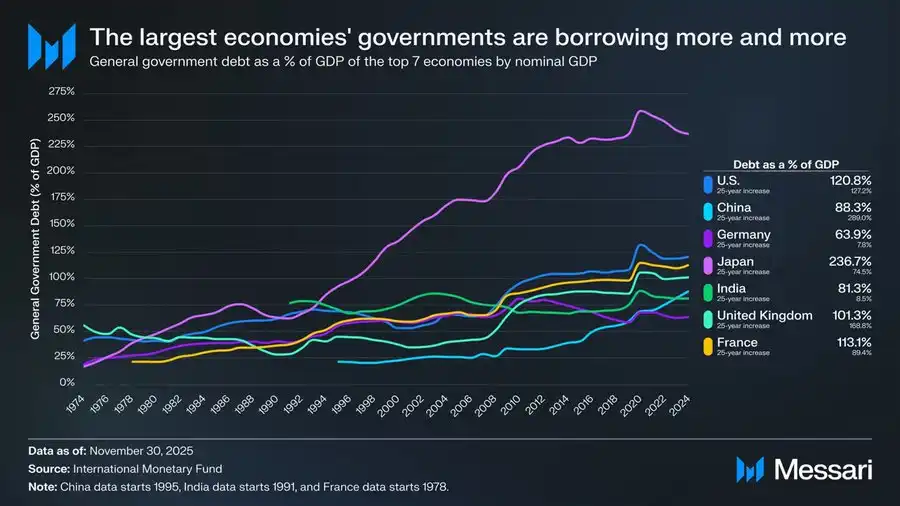
This chart is not a macro background decoration, but the logical starting point of the entire Cryptomoney argument.

Over the past 50 years, the ratio of government debt to GDP in major global economies has shown a highly consistent, almost irreversible upward trend:

· United States: 120.8%

· Japan: 236.7%

· France: 113.1%

· United Kingdom: 101.3%

· China: 88.3%

· India: 81.3%

· Germany: 63.9%

This is not the result of governance failure in a particular country, but a common outcome spanning systems, political structures, and development stages. Whether democratic countries, authoritarian states, developed economies, or emerging markets, government debt has long outpaced economic growth.

What This Chart Really Shows Is Not "High Debt," but "Savings Are Being Systematically Sacrificed"

When government debt growth长期 (long-term) outpaces economic output, the system can only maintain stability in three ways:

1. Inflation

2. Long-term low real interest rates

3. Financial repression (capital controls, withdrawal restrictions, regulatory intervention)

Regardless of which path is adopted, the ultimate cost will be borne by the same group: savers. Messari uses an extremely restrained but heavily weighted sentence in the report: When debt grows faster than economic output, the costs fall most heavily on savers. Translated: When debt outpaces growth, savings are注定 (destined) to be the sacrificed party.

Why Did Sentiment Collapse集中 (concentratedly) in 2025?

Because 2025 is the year when more and more participants clearly realized this for the first time.

Before this:

· "Inflation is only temporary"

· "Cash is always safe"

· "Fiat currency is stable in the long run"

And reality is constantly否定 (negating) these assumptions.

When people发现 (discover):

· Hard work ≠ Wealth preservation

· The act of saving itself is continuously shrinking

· The difficulty of asset allocation has significantly increased

The collapse of sentiment does not come from Crypto, but from a shaken confidence in the entire financial system. Crypto is just where this impact is felt first.

The Significance of Cryptomoney Is Not "Higher Returns"

This is also a point that Messari repeatedly emphasizes but is极易 (very easily) misinterpreted. Cryptomoney does not exist to promise higher returns.

Its core value lies in:

· Predictable rules

· Monetary policy not arbitrarily changed by a single institution

· Assets can be self-custodied

· Value can be transferred cross-border without permission

In other words, what it provides is not a "money-making tool," but: In a world of high debt and low certainty, it重新给予 (re-grants) individuals the right to choose their money.

The Sentiment Collapse Is Actually a Form of "Sobering Up"

When you place this debt chart alongside the 2025 market sentiment, you find a counterintuitive conclusion: The extreme pessimism of sentiment does not mean industry failure, but means more and more people are beginning to realize that the problems of the old system are real.

The problem with Crypto has never been "useless." The real problem is: It no longer produces easy excess returns for everyone.

Summary | From Sentiment, to Structure, to Money Itself

This chapter addresses a fundamental question: Why did market sentiment fall to a historic low in the absence of a systemic crash? The answer is not in the K-line charts, but in the monetary structure.

· Sentiment collapse is the表象 (surface phenomenon)

· Paradigm shift is the过程 (process)

· Monetary system imbalance is the根因 (root cause)

And this is precisely why Messari chose to start the entire report with "money" rather than "applications."

Chapter 3 | Why Only BTC Is Treated as "Real Money"

If you have read this far, you can easily have a question: If the problem lies in the monetary system, then why is the answer BTC, and not something else?

Messari's judgment in the report is exceptionally clear: BTC is no longer on the same competitive dimension as other Crypto assets.

1. Money Is Not a Technical Problem, but a Consensus Problem

This is the first key to understanding BTC. Messari repeatedly emphasizes a fact容易被工程师忽略 (easily overlooked by engineers) in the original text: Money is a social consensus, not a technical optimization problem. In other words:

· Money is not about "who is faster"

· Not "who is cheaper"

· Nor "who has more functions"

But rather who is长期稳定地 (long-term and stably) treated as a store of value. From this perspective, Bitcoin's victory is not mysterious.

2. Three Years of Data Have Written the Answer on Its Face
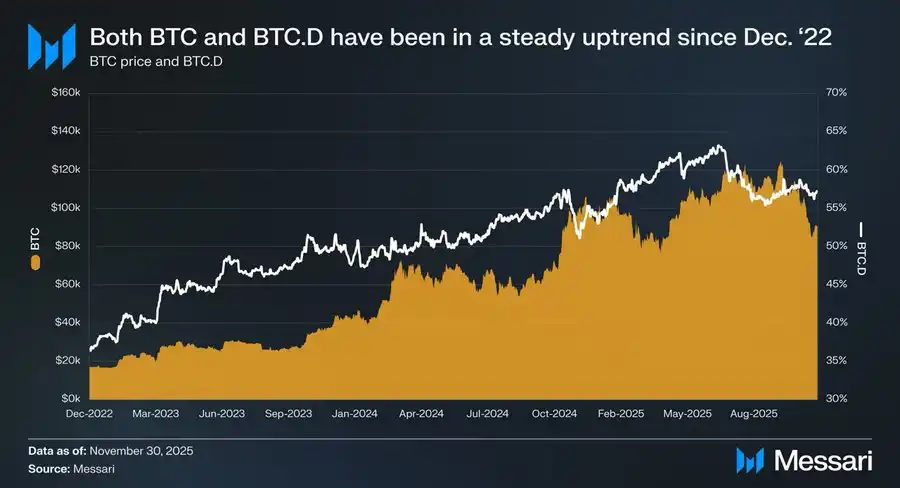
From December 1, 2022, to November 2025:

· BTC rose 429%

· Market cap from $318 billion → $1.81 trillion

· Global asset ranking entered the top ten

And more importantly, the relative performance: BTC.D (Bitcoin Dominance) from 36.6% → 57.3%. In a cycle where "theoretically, altcoins should soar," funds instead持续回流 (continuously flowed back) to BTC. This is not the偶然结果 (accidental result) of a market cycle; this is the market重新做资产分类 (re-categorizing assets).

3. ETFs and DATs Are Essentially "Institutionalizing Consensus"

Messari's evaluation of ETFs is very restrained, but the conclusion is extremely weighty. Bitcoin ETFs are not simply "new buying pressure"; what they truly change is: who is buying + why they are buying + how long they can hold

· ETFs turned BTC into a compliant asset

· DATs made BTC part of corporate balance sheets

· National reserves elevated BTC to the "strategic asset" level

When BTC is held by these actors, it is no longer: "a high-volatility risk asset that can be abandoned at any time" but rather: a monetary asset that must be held long-term and cannot afford to make mistakes. Money, once treated this way,很难再退回去 (is difficult to go back).

4. Why BTC, the More "Boring" It Is, the More It Resembles Money

This might be the most counterintuitive point of 2025:

· BTC has no applications

· No narrative rotation

· No ecosystem stories

· Not even "new things"

But precisely because of this, it meets all the characteristics of "money":

· Does not rely on future promises

· Does not need growth narratives

· Does not require teams to持续交付 (continuously deliver)

It only needs to not fail.

And in a world of high debt and low certainty, "not failing" is itself a scarce asset.

5. BTC's Strength Is Not a Market Failure

Many people's pain comes from an illusion: "BTC's strength means the market is not right." Messari's judgment is恰好相反 (precisely the opposite): BTC's strength is the market becoming more rational.

When the system begins to reward:

· Stability

· Predictability

· Long-term credibility

Then all strategies relying on "high volatility for high returns" will appear increasingly painful. This is not BTC's problem; this is a participation method problem.

Summary | BTC Didn't Win; It Was Chosen

BTC did not "defeat" other assets. It was just repeatedly verified by the market in an era of continuous monetary system failure as:

· The asset that needs the least explanation

· The asset that relies the least on trust

· The asset that needs the fewest promises about the future

This is not the result of a market cycle, but a kind of role confirmation.

Chapter 4 | When the Market Only Needs One Kind of "Money," the L1 Story Begins to Fail

After confirming that BTC has been selected by the market as the "primary Cryptomoney," one question cannot be avoided: If the answer for money already exists, then what is left for Layer 1? Messari does not directly give a conclusion, but after reading this section, a trend is very clear: L1 valuations are being forced to move from "future narratives" back to "real-world constraints."

1. A Harsh but True Fact: 81% of the Market Cap Is in the "Money" Narrative
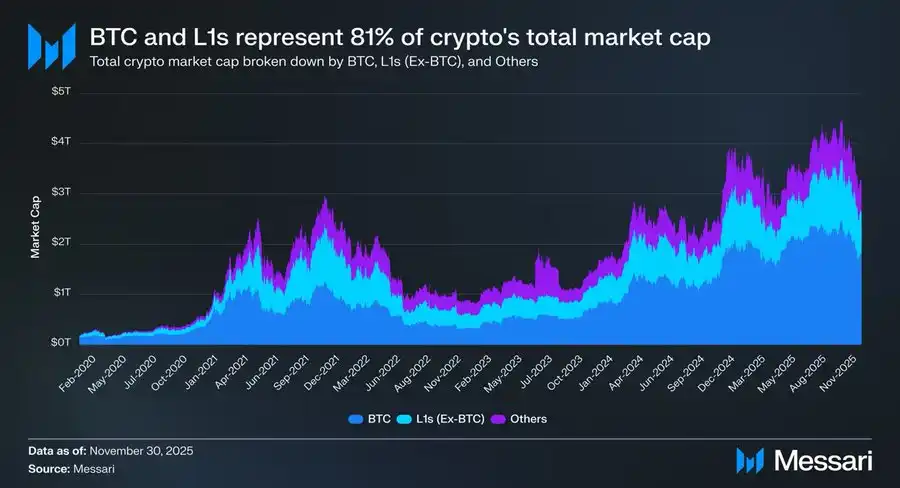
As of the end of 2025, the entire crypto market cap is approximately $3.26T:

· BTC: $1.80T

· Other L1s: approx. $0.83T

· Remaining assets: less than $0.63T

Combined: approximately 81% of the crypto asset market cap is being priced by the market as "money" or "potential money." What does this mean? It means that L1 valuations are早已不是 (long since not) priced on the logic of "application platforms," but on the logic of "does it qualify to be money?"

2. The Problem Is: Most L1s Do Not Qualify

The data provided by Messari is very direct and very冷酷 (cold).
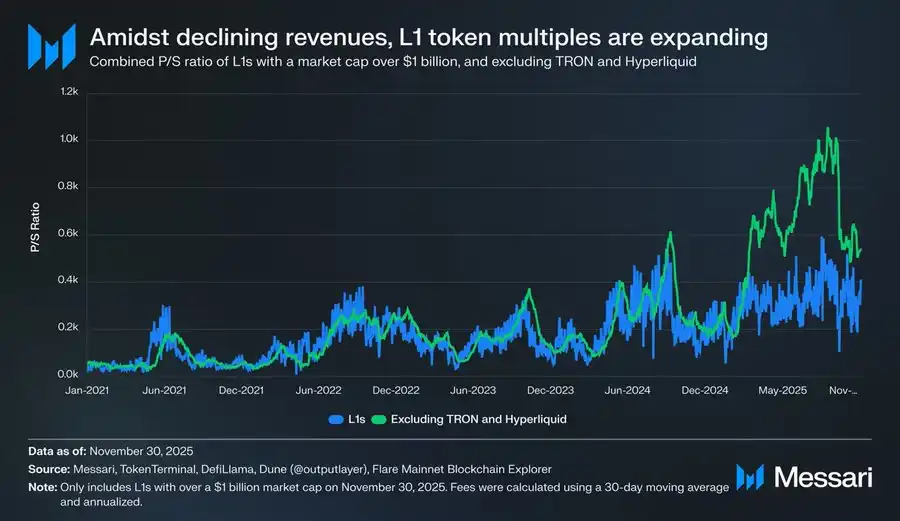
After剔除 (excluding) outliers with abnormally high revenue like TRON and Hyperliquid:

· The overall revenue of L1s continues to decline

· But valuation multiples are却在 (instead) continually rising

The adjusted P/S ratios are as follows:

· 2021: 40x

· 2022: 212x

· 2023: 137x

· 2024: 205x

· 2025: 536x

Meanwhile, total L1 revenue:

· 2021: $12.3B

· 2022: $4.9B

· 2023: $2.7B

· 2024: $3.6B

· 2025 (annualized): $1.7B

This is a剪刀差 (scissors gap) that cannot be reasonably explained by "future growth."

3. L1s Are Not "Undervalued"; They Are "Reclassified"

Many people's pain stems from a misunderstanding: "Are L1s being错杀 (wrongfully killed) by the market?". Messari's judgment is恰恰相反 (precisely the opposite): The market is not wrongfully killing L1s; it is reducing their "monetary imagination space."

If an asset:

· Cannot store value stably

· Cannot be held long-term

· And cannot provide certain cash flow

Then it ultimately only has one pricing method left: high beta risk asset.

4. The Example of Solana Actually Explains Everything

SOL was one of the few L1s that outperformed BTC in 2025. But Messari points out a highly damaging fact:

· SOL ecosystem data grew by 20–30 times

· The price only outperformed BTC by an additional 87%

In other words: to obtain "significant excess returns" relative to BTC, an L1 needs an生态爆发 (ecosystem explosion) of orders of magnitude. This is not "not trying hard enough," but the回报函数 (return function) has been rewritten.

5. When BTC Becomes "Money," the Burden on L1s Actually Becomes Heavier

This is a structural change that many people have not realized. Before BTC's monetary status was clear:

· L1s could tell the story of "becoming money in the future"

· The market was willing to pay提前付费 (prepay) for this possibility

Now:

· BTC has solidified its position

· The market is no longer willing to pay the same premium for a "second money"

Thus, L1s face a more difficult question: If not money, then what exactly are you?

Summary | The Problem of L1s Is Not Competition, but Positioning

L1s did not "lose to BTC." What they lost is:

· In the dimension of money

· The market no longer needs more answers

And once they lose the shelter of the "monetary narrative," all valuations must重新接受现实约束 (re-accept real-world constraints).

This is the direct source of the sentiment collapse for a large number of participants in 2025.

Pertanyaan Terkait

QWhy did market sentiment in the crypto space collapse in 2025, according to the Messari report?

AThe collapse in market sentiment was not due to a systemic failure of the industry, but rather a structural shift where the market began rewarding stability, predictability, and long-term credibility (like BTC) over high-risk, high-reward strategies. This caused a severe cognitive and identity mismatch for participants still using old, speculative methods.

QWhat fundamental issue does the Messari report identify as the root cause of the 2025 sentiment crash?

AThe root cause is the ongoing failure of the global traditional monetary system, where government debt growth has consistently outpaced economic output for decades. This systemically sacrifices savers through inflation, low real interest rates, and financial repression, eroding confidence in traditional finance.

QHow does the report explain Bitcoin's (BTC) dominant performance and its role in the 2025 market?

ABTC is no longer competing on the same plane as other crypto assets. It has been selected by the market as 'money' due to its predictable rules, immutable monetary policy, self-custody, and permissionless value transfer. Its 'boring' and reliable nature makes it a scarce asset in a high-debt, low-certainty world, and it is now treated as a long-term hold by institutions, corporations (DATs), and even national reserves.

QWhat does the data show about the valuation of Layer 1 (L1) blockchains compared to their fundamentals in 2025?

AThe data shows a severe and growing disconnect. The aggregate Price-to-Sales (P/S) ratio for L1s skyrocketed to 536x in 2025, while their total annualized revenue plummeted to $1.7B. This indicates that their valuations were not based on current fundamentals or cash flow but on a narrative that has now been reclassified by the market.

QWhy did the strong performance of Bitcoin (BTC) cause pain for many investors and participants in 2025?

AThe pain was caused by a paradigm shift in the market's reward mechanism. Participants who were accustomed to earning alpha through aggressive speculation, narrative trading, and investing in altcoins found that these strategies failed. The market began systematically rewarding long-term holders and institutional asset allocators instead, making the 'old way' of participating ineffective and emotionally painful.

Bacaan Terkait

Anda Bertaruh pada Berita, Para Pemain Pro Membaca Aturan: Perbedaan Kognitif Sebenarnya di Balik Kerugian di Polymarket

Artikel ini membahas bagaimana para trader berpengalaman ("车头") di Polymarket sering kali unggul karena mereka memahami aturan pasar prediksi secara mendetail, layaknya pengacara yang menganalisis kontrak. Menggunakan contoh pasar tentang "Siapa pemimpin Venezuela pada akhir 2026", artikel menunjukkan bahwa meskipun intuisi mungkin menunjuk pada pemimpin de facto, aturan pasar yang ketat tentang siapa yang "secara resmi memegang" jabatanlah yang menentukan hasilnya. Kasus serupa melibatkan definisi "token" Polymarket dan interpretasi "persetujuan" dalam perjanjian nuklir Iran. Polymarket memiliki mekanisme penyelesaian sengketa berlapis yang dijalankan oleh pemegang token UMA. Prosesnya melibatkan pengajuan proposal, periode sanggahan, diskusi, dan voting. Namun, sistem ini memiliki kelemahan krusial: tidak ada pemisahan antara pihak yang memiliki kepentingan finansial (trader) dan pihak yang menjadi penentu keputusan (voter). Hal ini dapat menyebabkan konflik kepentingan, membuat diskusi tidak efektif karena pengaruh kelompok dan perubahan posisi, serta menghasilkan keputusan yang tidak transparan tanpa penjelasan hukum yang dapat dijadikan preseden. Kesimpulannya, kunci sukses di Polymarket bukan hanya memprediksi peristiwa dengan benar, tetapi juga memahami celah antara "realitas" dan "aturan" tertulis untuk memanfaatkan kesalahan harga yang timbul dari misinterpretasi.

marsbit42m yang lalu

Anda Bertaruh pada Berita, Para Pemain Pro Membaca Aturan: Perbedaan Kognitif Sebenarnya di Balik Kerugian di Polymarket

marsbit42m yang lalu

Akankah The Fed (Bank Sentral AS) Masih Memotong Suku Bunga? Data Malam Ini Sangat Krusial

Ringkasan: Pasar sedang bergejolak mempertanyakan apakah Federal Reserve (The Fed) akan memangkas suku bunga, terjepit antara konflik geopolitik dan inflasi yang bangkit kembali. Inti perdebatan adalah apakah harga energi tinggi akan memicu inflasi berkepanjangan atau justru mengurangi permintaan konsumen sehingga memaksa The Fed untuk turunkan suku bunga. Dua pandangan bank investasi terkemuka saling bertolak belakang: * **Citi** optimis: yakin The Fed tetap akan memangkas suku bunga. Mereka berargumen bahwa gangguan pasokan minyak dari konflik di Selat Hormuz bersifat sementara dan tidak akan menyebabkan inflasi yang berlarut. Data ekonomi dasar seperti likuiditas dan pasar tenaga kerja juga mendukung pandangan ini. * **Deutsche Bank (DB)** pesimis: memperingatkan bahwa kebijakan The Fed sudah berada di posisi netral dan kemungkinan akan mempertahankan suku bunga saat ini untuk waktu yang tidak terbatas. Mereka menunjukkan bahwa proses penurunan inflasi mandek, pejabat The Fed bersikap lebih hawkish, dan pasar telah meniadakan ekspektasi penurunan suku bunga untuk tahun 2024, dengan perkiraan satu kali pemotongan baru pada pertengahan 2025. Data penjualan ritel Maret, khususnya "grup kontrol" yang mengesampingkan penjualan bensin, menjadi batu ujian kunci. Data ini akan mengungkap apakah harga minyak yang tinggi benar-benar melemahkan belanja konsumen di sektor lain, yang dapat mendukung argumen untuk penurunan suku bunga.

marsbit1j yang lalu

Akankah The Fed (Bank Sentral AS) Masih Memotong Suku Bunga? Data Malam Ini Sangat Krusial

marsbit1j yang lalu

Trading

Spot
Futures

Artikel Populer

Apa Itu $S$

Memahami SPERO: Tinjauan Komprehensif Pengenalan SPERO Seiring dengan perkembangan lanskap inovasi, munculnya teknologi web3 dan proyek cryptocurrency memainkan peran penting dalam membentuk masa depan digital. Salah satu proyek yang telah menarik perhatian di bidang dinamis ini adalah SPERO, yang dilambangkan sebagai SPERO,$$s$. Artikel ini bertujuan untuk mengumpulkan dan menyajikan informasi terperinci tentang SPERO, untuk membantu para penggemar dan investor memahami dasar-dasar, tujuan, dan inovasi dalam domain web3 dan crypto. Apa itu SPERO,$$s$? SPERO,$$s$ adalah proyek unik dalam ruang crypto yang berusaha memanfaatkan prinsip desentralisasi dan teknologi blockchain untuk menciptakan ekosistem yang mendorong keterlibatan, utilitas, dan inklusi finansial. Proyek ini dirancang untuk memfasilitasi interaksi peer-to-peer dengan cara baru, memberikan pengguna solusi dan layanan keuangan yang inovatif. Pada intinya, SPERO,$$s$ bertujuan untuk memberdayakan individu dengan menyediakan alat dan platform yang meningkatkan pengalaman pengguna dalam ruang cryptocurrency. Ini termasuk memungkinkan metode transaksi yang lebih fleksibel, mendorong inisiatif yang dipimpin komunitas, dan menciptakan jalur untuk peluang finansial melalui aplikasi terdesentralisasi (dApps). Visi mendasar dari SPERO,$$s$ berputar di sekitar inklusivitas, bertujuan untuk menjembatani kesenjangan dalam keuangan tradisional sambil memanfaatkan manfaat teknologi blockchain. Siapa Pencipta SPERO,$$s$? Identitas pencipta SPERO,$$s$ tetap agak samar, karena ada sumber daya publik yang terbatas yang memberikan informasi latar belakang terperinci tentang pendiriannya. Kurangnya transparansi ini dapat berasal dari komitmen proyek terhadap desentralisasi—sebuah etos yang banyak proyek web3 bagi, memprioritaskan kontribusi kolektif di atas pengakuan individu. Dengan memusatkan diskusi di sekitar komunitas dan tujuan kolektifnya, SPERO,$$s$ mewujudkan esensi pemberdayaan tanpa menonjolkan individu tertentu. Dengan demikian, memahami etos dan misi SPERO tetap lebih penting daripada mengidentifikasi pencipta tunggal. Siapa Investor SPERO,$$s$? SPERO,$$s$ didukung oleh beragam investor mulai dari modal ventura hingga investor malaikat yang berdedikasi untuk mendorong inovasi di sektor crypto. Fokus investor ini umumnya sejalan dengan misi SPERO—memprioritaskan proyek yang menjanjikan kemajuan teknologi sosial, inklusivitas finansial, dan tata kelola terdesentralisasi. Fondasi investor ini biasanya tertarik pada proyek yang tidak hanya menawarkan produk inovatif tetapi juga memberikan kontribusi positif kepada komunitas blockchain dan ekosistemnya. Dukungan dari investor ini memperkuat SPERO,$$s$ sebagai pesaing yang patut diperhitungkan di domain proyek crypto yang berkembang pesat. Bagaimana SPERO,$$s$ Bekerja? SPERO,$$s$ menerapkan kerangka kerja multi-faceted yang membedakannya dari proyek cryptocurrency konvensional. Berikut adalah beberapa fitur kunci yang menekankan keunikan dan inovasinya: Tata Kelola Terdesentralisasi: SPERO,$$s$ mengintegrasikan model tata kelola terdesentralisasi, memberdayakan pengguna untuk berpartisipasi aktif dalam proses pengambilan keputusan mengenai masa depan proyek. Pendekatan ini mendorong rasa kepemilikan dan akuntabilitas di antara anggota komunitas. Utilitas Token: SPERO,$$s$ memanfaatkan token cryptocurrency-nya sendiri, yang dirancang untuk melayani berbagai fungsi dalam ekosistem. Token ini memungkinkan transaksi, hadiah, dan fasilitasi layanan yang ditawarkan di platform, meningkatkan keterlibatan dan utilitas secara keseluruhan. Arsitektur Berlapis: Arsitektur teknis SPERO,$$s$ mendukung modularitas dan skalabilitas, memungkinkan integrasi fitur dan aplikasi tambahan secara mulus seiring dengan perkembangan proyek. Kemampuan beradaptasi ini sangat penting untuk mempertahankan relevansi di lanskap crypto yang selalu berubah. Keterlibatan Komunitas: Proyek ini menekankan inisiatif yang dipimpin komunitas, menggunakan mekanisme yang memberikan insentif untuk kolaborasi dan umpan balik. Dengan memelihara komunitas yang kuat, SPERO,$$s$ dapat lebih baik memenuhi kebutuhan pengguna dan beradaptasi dengan tren pasar. Fokus pada Inklusi: Dengan menawarkan biaya transaksi yang rendah dan antarmuka yang ramah pengguna, SPERO,$$s$ bertujuan untuk menarik basis pengguna yang beragam, termasuk individu yang mungkin sebelumnya tidak terlibat dalam ruang crypto. Komitmen ini terhadap inklusi sejalan dengan misi utamanya untuk memberdayakan melalui aksesibilitas. Garis Waktu SPERO,$$s$ Memahami sejarah proyek memberikan wawasan penting tentang trajektori dan tonggak perkembangannya. Berikut adalah garis waktu yang disarankan yang memetakan peristiwa signifikan dalam evolusi SPERO,$$s$: Fase Konseptualisasi dan Ideasi: Ide awal yang membentuk dasar SPERO,$$s$ dikembangkan, sangat selaras dengan prinsip desentralisasi dan fokus komunitas dalam industri blockchain. Peluncuran Whitepaper Proyek: Setelah fase konseptual, whitepaper komprehensif yang merinci visi, tujuan, dan infrastruktur teknologi SPERO,$$s$ dirilis untuk menarik minat dan umpan balik komunitas. Pembangunan Komunitas dan Keterlibatan Awal: Upaya jangkauan aktif dilakukan untuk membangun komunitas pengguna awal dan investor potensial, memfasilitasi diskusi seputar tujuan proyek dan mendapatkan dukungan. Acara Generasi Token: SPERO,$$s$ melakukan acara generasi token (TGE) untuk mendistribusikan token asli kepada pendukung awal dan membangun likuiditas awal dalam ekosistem. Peluncuran dApp Awal: Aplikasi terdesentralisasi (dApp) pertama yang terkait dengan SPERO,$$s$ diluncurkan, memungkinkan pengguna untuk terlibat dengan fungsionalitas inti platform. Pengembangan Berkelanjutan dan Kemitraan: Pembaruan dan peningkatan berkelanjutan terhadap penawaran proyek, termasuk kemitraan strategis dengan pemain lain di ruang blockchain, telah membentuk SPERO,$$s$ menjadi pemain yang kompetitif dan berkembang di pasar crypto. Kesimpulan SPERO,$$s$ berdiri sebagai bukti potensi web3 dan cryptocurrency untuk merevolusi sistem keuangan dan memberdayakan individu. Dengan komitmen terhadap tata kelola terdesentralisasi, keterlibatan komunitas, dan fungsionalitas yang dirancang secara inovatif, ia membuka jalan menuju lanskap keuangan yang lebih inklusif. Seperti halnya investasi di ruang crypto yang berkembang pesat, calon investor dan pengguna dianjurkan untuk melakukan riset secara menyeluruh dan terlibat dengan perkembangan yang sedang berlangsung dalam SPERO,$$s$. Proyek ini menunjukkan semangat inovatif industri crypto, mengundang eksplorasi lebih lanjut ke dalam berbagai kemungkinan yang ada. Meskipun perjalanan SPERO,$$s$ masih berlangsung, prinsip-prinsip dasarnya mungkin benar-benar mempengaruhi masa depan cara kita berinteraksi dengan teknologi, keuangan, dan satu sama lain dalam ekosistem digital yang saling terhubung.

75 Total TayanganDipublikasikan pada 2024.12.17Diperbarui pada 2024.12.17

Apa Itu $S$

Apa Itu AGENT S

Agent S: Masa Depan Interaksi Otonom di Web3 Pendahuluan Dalam lanskap Web3 dan cryptocurrency yang terus berkembang, inovasi secara konstan mendefinisikan ulang cara individu berinteraksi dengan platform digital. Salah satu proyek perintis, Agent S, menjanjikan untuk merevolusi interaksi manusia-komputer melalui kerangka agen terbuka. Dengan membuka jalan untuk interaksi otonom, Agent S bertujuan untuk menyederhanakan tugas-tugas kompleks, menawarkan aplikasi transformasional dalam kecerdasan buatan (AI). Eksplorasi mendetail ini akan menyelami seluk-beluk proyek, fitur uniknya, dan implikasinya untuk domain cryptocurrency. Apa itu Agent S? Agent S berdiri sebagai kerangka agen terbuka yang inovatif, dirancang khusus untuk mengatasi tiga tantangan mendasar dalam otomatisasi tugas komputer: Memperoleh Pengetahuan Spesifik Domain: Kerangka ini secara cerdas belajar dari berbagai sumber pengetahuan eksternal dan pengalaman internal. Pendekatan ganda ini memberdayakannya untuk membangun repositori pengetahuan spesifik domain yang kaya, meningkatkan kinerjanya dalam pelaksanaan tugas. Perencanaan Selama Rentang Tugas yang Panjang: Agent S menggunakan perencanaan hierarkis yang ditingkatkan pengalaman, pendekatan strategis yang memfasilitasi pemecahan dan pelaksanaan tugas-tugas rumit dengan efisien. Fitur ini secara signifikan meningkatkan kemampuannya untuk mengelola beberapa subtugas dengan efisien dan efektif. Menangani Antarmuka Dinamis dan Tidak Seragam: Proyek ini memperkenalkan Antarmuka Agen-Komputer (ACI), solusi inovatif yang meningkatkan interaksi antara agen dan pengguna. Dengan memanfaatkan Model Bahasa Besar Multimodal (MLLM), Agent S dapat menavigasi dan memanipulasi berbagai antarmuka pengguna grafis dengan mulus. Melalui fitur-fitur perintis ini, Agent S menyediakan kerangka kerja yang kuat yang mengatasi kompleksitas yang terlibat dalam mengotomatisasi interaksi manusia dengan mesin, membuka jalan untuk berbagai aplikasi dalam AI dan seterusnya. Siapa Pencipta Agent S? Meskipun konsep Agent S secara fundamental inovatif, informasi spesifik tentang penciptanya tetap samar. Pencipta saat ini tidak diketahui, yang menyoroti baik tahap awal proyek atau pilihan strategis untuk menjaga anggota pendiri tetap tersembunyi. Terlepas dari anonimitas, fokus tetap pada kemampuan dan potensi kerangka kerja. Siapa Investor Agent S? Karena Agent S relatif baru dalam ekosistem kriptografi, informasi terperinci mengenai investor dan pendukung keuangannya tidak secara eksplisit didokumentasikan. Kurangnya wawasan yang tersedia untuk umum mengenai fondasi investasi atau organisasi yang mendukung proyek ini menimbulkan pertanyaan tentang struktur pendanaannya dan peta jalan pengembangannya. Memahami dukungan sangat penting untuk mengukur keberlanjutan proyek dan potensi dampak pasar. Bagaimana Cara Kerja Agent S? Di inti Agent S terletak teknologi mutakhir yang memungkinkannya berfungsi secara efektif dalam berbagai pengaturan. Model operasionalnya dibangun di sekitar beberapa fitur kunci: Interaksi Komputer yang Mirip Manusia: Kerangka ini menawarkan perencanaan AI yang canggih, berusaha untuk membuat interaksi dengan komputer lebih intuitif. Dengan meniru perilaku manusia dalam pelaksanaan tugas, ia menjanjikan untuk meningkatkan pengalaman pengguna. Memori Naratif: Digunakan untuk memanfaatkan pengalaman tingkat tinggi, Agent S memanfaatkan memori naratif untuk melacak sejarah tugas, sehingga meningkatkan proses pengambilan keputusannya. Memori Episodik: Fitur ini memberikan panduan langkah demi langkah kepada pengguna, memungkinkan kerangka untuk menawarkan dukungan kontekstual saat tugas berlangsung. Dukungan untuk OpenACI: Dengan kemampuan untuk berjalan secara lokal, Agent S memungkinkan pengguna untuk mempertahankan kontrol atas interaksi dan alur kerja mereka, sejalan dengan etos terdesentralisasi Web3. Integrasi Mudah dengan API Eksternal: Versatilitas dan kompatibilitasnya dengan berbagai platform AI memastikan bahwa Agent S dapat dengan mulus masuk ke dalam ekosistem teknologi yang ada, menjadikannya pilihan menarik bagi pengembang dan organisasi. Fungsionalitas ini secara kolektif berkontribusi pada posisi unik Agent S dalam ruang kripto, saat ia mengotomatisasi tugas-tugas kompleks yang melibatkan banyak langkah dengan intervensi manusia yang minimal. Seiring proyek ini berkembang, aplikasi potensialnya di Web3 dapat mendefinisikan ulang bagaimana interaksi digital berlangsung. Garis Waktu Agent S Pengembangan dan tonggak Agent S dapat dirangkum dalam garis waktu yang menyoroti peristiwa pentingnya: 27 September 2024: Konsep Agent S diluncurkan dalam sebuah makalah penelitian komprehensif berjudul “Sebuah Kerangka Agen Terbuka yang Menggunakan Komputer Seperti Manusia,” yang menunjukkan dasar untuk proyek ini. 10 Oktober 2024: Makalah penelitian tersebut dipublikasikan secara terbuka di arXiv, menawarkan eksplorasi mendalam tentang kerangka kerja dan evaluasi kinerjanya berdasarkan tolok ukur OSWorld. 12 Oktober 2024: Sebuah presentasi video dirilis, memberikan wawasan visual tentang kemampuan dan fitur Agent S, lebih lanjut melibatkan pengguna dan investor potensial. Tanda-tanda dalam garis waktu ini tidak hanya menggambarkan kemajuan Agent S tetapi juga menunjukkan komitmennya terhadap transparansi dan keterlibatan komunitas. Poin Kunci Tentang Agent S Seiring kerangka Agent S terus berkembang, beberapa atribut kunci menonjol, menekankan sifat inovatif dan potensinya: Kerangka Inovatif: Dirancang untuk memberikan penggunaan komputer yang intuitif seperti interaksi manusia, Agent S membawa pendekatan baru untuk otomatisasi tugas. Interaksi Otonom: Kemampuan untuk berinteraksi secara otonom dengan komputer melalui GUI menandakan lompatan menuju solusi komputasi yang lebih cerdas dan efisien. Otomatisasi Tugas Kompleks: Dengan metodologinya yang kuat, ia dapat mengotomatisasi tugas-tugas kompleks yang melibatkan banyak langkah, membuat proses lebih cepat dan kurang rentan terhadap kesalahan. Perbaikan Berkelanjutan: Mekanisme pembelajaran memungkinkan Agent S untuk belajar dari pengalaman masa lalu, terus meningkatkan kinerja dan efektivitasnya. Versatilitas: Adaptabilitasnya di berbagai lingkungan operasi seperti OSWorld dan WindowsAgentArena memastikan bahwa ia dapat melayani berbagai aplikasi. Saat Agent S memposisikan dirinya di lanskap Web3 dan kripto, potensinya untuk meningkatkan kemampuan interaksi dan mengotomatisasi proses menandakan kemajuan signifikan dalam teknologi AI. Melalui kerangka inovatifnya, Agent S mencerminkan masa depan interaksi digital, menjanjikan pengalaman yang lebih mulus dan efisien bagi pengguna di berbagai industri. Kesimpulan Agent S mewakili lompatan berani ke depan dalam pernikahan AI dan Web3, dengan kapasitas untuk mendefinisikan ulang cara kita berinteraksi dengan teknologi. Meskipun masih dalam tahap awal, kemungkinan aplikasinya sangat luas dan menarik. Melalui kerangka komprehensifnya yang mengatasi tantangan kritis, Agent S bertujuan untuk membawa interaksi otonom ke garis depan pengalaman digital. Saat kita melangkah lebih dalam ke dalam ranah cryptocurrency dan desentralisasi, proyek-proyek seperti Agent S pasti akan memainkan peran penting dalam membentuk masa depan teknologi dan kolaborasi manusia-komputer.

737 Total TayanganDipublikasikan pada 2025.01.14Diperbarui pada 2025.01.14

Apa Itu AGENT S

Cara Membeli S

Selamat datang di HTX.com! Kami telah membuat pembelian Sonic (S) menjadi mudah dan nyaman. Ikuti panduan langkah demi langkah kami untuk memulai perjalanan kripto Anda.Langkah 1: Buat Akun HTX AndaGunakan alamat email atau nomor ponsel Anda untuk mendaftar akun gratis di HTX. Rasakan perjalanan pendaftaran yang mudah dan buka semua fitur.Dapatkan Akun SayaLangkah 2: Buka Beli Kripto, lalu Pilih Metode Pembayaran AndaKartu Kredit/Debit: Gunakan Visa atau Mastercard Anda untuk membeli Sonic (S) secara instan.Saldo: Gunakan dana dari saldo akun HTX Anda untuk melakukan trading dengan lancar.Pihak Ketiga: Kami telah menambahkan metode pembayaran populer seperti Google Pay dan Apple Pay untuk meningkatkan kenyamanan.P2P: Lakukan trading langsung dengan pengguna lain di HTX.Over-the-Counter (OTC): Kami menawarkan layanan yang dibuat khusus dan kurs yang kompetitif bagi para trader.Langkah 3: Simpan Sonic (S) AndaSetelah melakukan pembelian, simpan Sonic (S) di akun HTX Anda. Selain itu, Anda dapat mengirimkannya ke tempat lain melalui transfer blockchain atau menggunakannya untuk memperdagangkan mata uang kripto lainnya.Langkah 4: Lakukan trading Sonic (S)Lakukan trading Sonic (S) dengan mudah di pasar spot HTX. Cukup akses akun Anda, pilih pasangan perdagangan, jalankan trading, lalu pantau secara real-time. Kami menawarkan pengalaman yang ramah pengguna baik untuk pemula maupun trader berpengalaman.

1.1k Total TayanganDipublikasikan pada 2025.01.15Diperbarui pada 2025.03.21

Cara Membeli S

Diskusi

Selamat datang di Komunitas HTX. Di sini, Anda bisa terus mendapatkan informasi terbaru tentang perkembangan platform terkini dan mendapatkan akses ke wawasan pasar profesional. Pendapat pengguna mengenai harga S (S) disajikan di bawah ini.

活动图片