When On-Chain Lending Systems Converge

marsbitDipublikasikan tanggal 2026-02-10Terakhir diperbarui pada 2026-02-10

Abstrak

Credit is the time machine of the economy, enabling businesses to bring future cash flows into today's decisions. The global credit gap for SMEs in emerging markets is estimated at $5.7 trillion. Recent developments in on-chain lending, such as Kraken's DeFi Earn and Bitwise's vault strategies on Morpho, signal a maturation beyond the speculative cycles of 2022. The ecosystem now integrates vaults for self-custody and transparency, automated risk management by firms like Chaos Labs, and AI-driven optimization engines. Total value locked in lending protocols has grown 150% in two years, with active loans exceeding $40 billion—double the 2022 peak. This evolution reduces operational inefficiencies, lowers credit costs via stablecoins and smart contracts, and enhances accessibility, potentially helping bridge the global credit gap. However, risks like liquidity constraints and curator discretion remain.

Author: Prathik Desai

Compiled by: Block unicorn

Credit is the time machine of the economy. It allows businesses to bring future cash flows into today's decision-making.

I believe this is one of the most underrated aspects of the financial world.

People rarely notice credit at work, but it manifests in how businesses operate. An effective credit system enables businesses to restock shelves before they are empty, allows factories to upgrade equipment before it becomes obsolete, and lets founders to hire new employees before a human resource redundancy crisis erupts.

The gap between a good idea and its execution often stems from limited access to credit. And banks promise to bridge this gap.

Banks accept deposits from customers through bank accounts and provide credit to those who need loans. They pay a lower interest rate to depositors and charge a higher interest rate to borrowers, with the difference being their profit. However, bank credit also faces many challenges. The mismatch between credit supply and demand is one of the most significant among them.

Private credit fills the areas that bank credit cannot cover, but the gap remains. This gap reflects investors' current unwillingness to lend in the credit market.

In March 2025, a joint report by the International Finance Corporation and the World Bank, "Financing the Micro, Small, and Medium Enterprise (MSME) Gap," estimated the financing gap in 119 emerging markets and developing economies (EMDEs) to be approximately $5.7 trillion, accounting for about 19% of their combined GDP.

In this context, I find last week's developments in the on-chain credit space exciting. On-chain lending is not new. We experienced a crazy cycle in 2022, and people are still discussing it for various reasons today. But the current cycle feels different.

In this article, I will delve into all the changes happening in the on-chain credit market and explain why I believe it could revolutionize the credit industry.

Let's begin.

Money markets have existed on Ethereum for years. Over-collateralized lending, liquidation bots, interest rate curves, and occasional cascading liquidations are not new. Therefore, what truly caught my attention with last week's credit-related announcements was not the money markets themselves, but the players involved and how they are repackaging credit.

What excites me is that these sporadic partnership announcements collectively signal a broader trend of convergence. The fragmented DeFi landscape of summer 2022 is converging into a powerful force. Features like vault infrastructure, non-custodial wrapping, professional risk management, and automated yield optimization are being integrated and promoted.

Kraken launched DeFi Earn, a platform for retail users that can channel lenders' deposits into vaults (in this case, Veda). The vaults would then direct the funds to lending protocols like Aave. Chaos Labs would act as the risk manager, monitoring the entire engine. Kraken promises lenders an annual percentage yield (APY) of up to 8%.

What do vaults change? They offer lenders self-custody and fund visibility. Unlike traditional credit markets where you hand over funds to a fund manager and wait for monthly disclosures, vaults integrate smart contracts that mint claims on the funds and show the fund deployment in real-time on the blockchain.

Around the same time, Bitwise, the world's largest crypto fund manager, launched a non-custodial vault strategy on the on-chain lending platform Morpho.

This is not the first time on-chain lending has received institutional endorsement. In 2025, Coinbase launched its USDC lending service, enabling smart contract wallets to connect and route deposits via on-chain vaults to the Morpho platform. Steakhouse Financial used the platform for cross-market fund allocation to optimize yields.

This coincides with the on-chain lending market being on the verge of explosive growth, and the data confirms this.
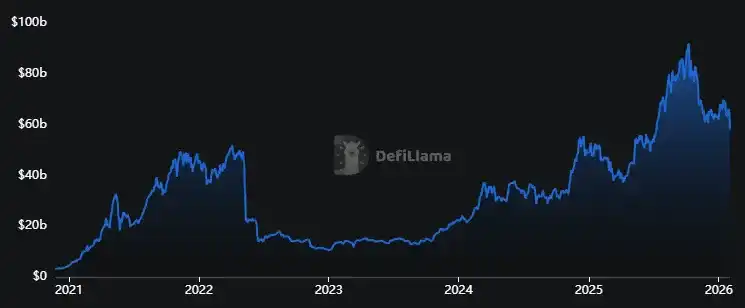
The total value locked (TVL) in lending protocols reached $58 billion, a 150% increase in two years. However, this figure is only 10% higher than the peak in 2022.

Here, the outstanding loan balance dashboard provides a more accurate picture of the actual situation.
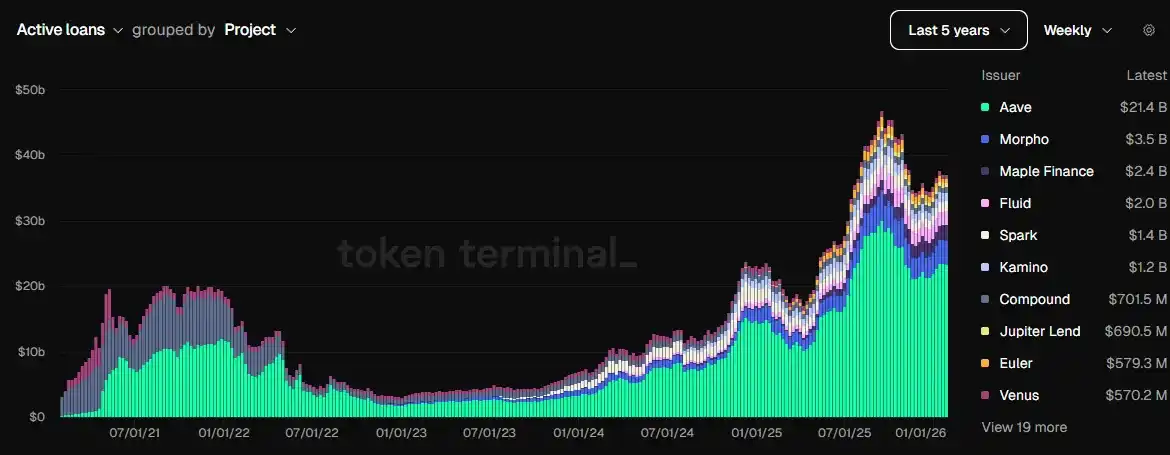
This dashboard shows that the foundation laid by leading protocols like Aave and Morpho is very solid, with active loans exceeding $40 billion in recent months, more than double the peak in 2022.

The dashboard shows that existing institutions, including Aave and Morpho, have laid a solid foundation, with active loans exceeding $40 billion in the past few months, more than double the peak level in 2022.

Today, both Aave and Morpho's revenues are six times what they were two years ago.

While these charts show investor confidence in lending protocols, I find the growth of vault deposits over time even more convincing.

In October 2025, total vault deposits surpassed the $6 billion mark for the first time. Today, deposits stand at $5.7 billion, more than double the amount from the same period last year ($2.34 billion).
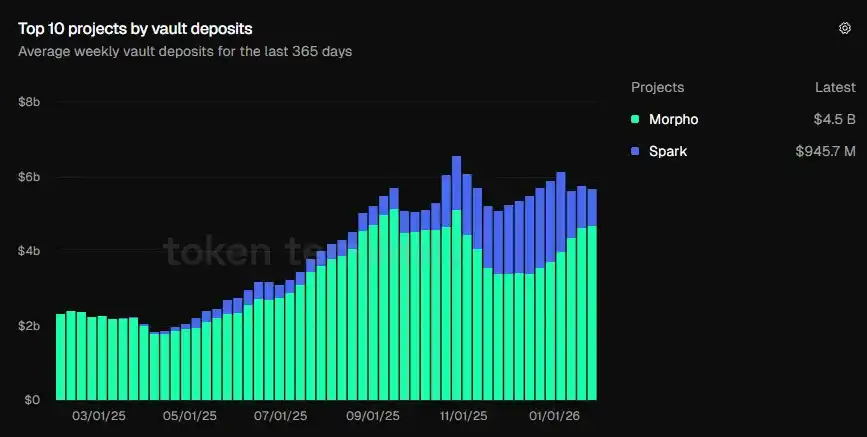
These charts indicate that users are opting for products that offer a comprehensive ecosystem, including vaults, yield optimization strategies, risk configuration, and professional management.

This is the evolution I am optimistic about, completely different from what we observed during the DeFi summer.

Back then, the lending market seemed like a closed loop. Users leveraged this loop by depositing collateral, borrowing funds, using the proceeds to buy more collateral, and depositing again to earn higher yields. Even if collateral prices fell, these users could at least earn rewards from the platform for using its lending protocol. But when those rewards themselves disappeared, the loop broke.

Even the current cycle is built on the same basic elements—over-collateralized lending—but on a fundamentally different and much more solid foundation. Today's vaults have evolved into wrappers that turn protocols into automated asset management tools. Risk managers play a central role, setting up safety measures.

This shift changes the appeal of on-chain lending for both investors and lenders.

During the DeFi summer, lending protocols were just another way to make quick money. This model worked until the incentives failed. Users registered Aave accounts, deposited funds, borrowed against collateral, and so on, until the incentives ran out. We saw this with Aave's Avalanche deployment: incentives attracted deposits and kept the cycle running initially. But when the subsidies waned, the cycle collapsed. As a result, Avalanche's outstanding debt decreased by 73% quarter-on-quarter in Q3 2022.

Today, the lending business has evolved into a mature ecosystem with specialized players responsible for risk management, yield optimization, and liquidity management.

Here's how I assemble the entire stack.

The bottom layer is settlement funds, existing in the form of stablecoins. They can be transferred instantly, stored anywhere, deployed at any time, and crucially, are easy to account for.

On top of this are the familiar money markets, such as Aave, where lending and borrowing are enforced by software code and collateral.

Next is the world of wrappers and routers that aggregate funds and route them from lenders to borrowers. Vaults act as wrappers, packaging the entire lending product in a way that is easy for retail investors to understand. For example, it can be presented as "Deposit $X to earn up to Y% yield," as Veda wallet does on Kraken's Earn platform.

Custodians sit above these protocols, deciding which collateral to allow, liquidation thresholds, exposure concentration, and when to close positions if collateral value declines. Think of how Steakhouse Financial operates on the Morpho platform, or how asset managers like Bitwise embed their judgment directly into the vault rules.

In the background, AI systems run 24/7, managing on-chain credit risk and acting as the nervous system of the lending ecosystem when humans are not around. Manual risk management is difficult to scale. Limited risk management increases credit risk during market volatility. The best outcome is substandard returns, the worst is liquidation.

AI optimization engines track borrowing demand, oracle deviations, and liquidity depth to trigger timely withdrawals. It alerts when vault exposure exceeds preset thresholds. Furthermore, it advises on risk mitigation measures and assists risk teams in decision-making.

It is this round-the-clock optimization, de-risking, audited vaults, carefully curated strategies, institutional backing, and professional risk management that make the current market feel safer and less risky.

But none of these measures can completely eliminate risk. Among them, liquidity risk is one of the most easily overlooked.

Although vaults offer better liquidity than isolated protocols, they still operate within the same markets as these protocols. In markets with thin trading volume, vaults increase the cost of closing positions, making it difficult to exit funds.

Furthermore, there is the risk of curator discretion.

When users deposit funds into a vault, they are essentially trusting certain institutions to make investment decisions based on market conditions, choose suitable collateral, and set corresponding redemption thresholds. Credit works in myriad ways, but lenders should understand that non-custodial does not necessarily mean zero risk.

Despite these challenges, on-chain lending is also changing the cryptocurrency landscape and, consequently, the economic landscape.

The cost of running a credit market depends on time and operational costs.

Heavy investment in verification, monitoring, reporting, settlement, and execution of transactions makes traditional credit expensive. A significant portion of the interest they charge borrowers is avoidable and not necessarily related to the "time value of money."

On-chain credit saves both time and operational costs.

Stablecoins minimize settlement time, smart contracts reduce execution time, transparent ledgers reduce audit and reporting time, and vaults simplify complexity for users. These cost savings will be even more significant when addressing the SME credit gap.

On-chain credit will not fill the credit gap overnight, but lower credit costs will make verification more convenient and credit access more inclusive. And this could reshape the economic landscape.


Kripto yang Sedang Tren

Pertanyaan Terkait

QWhat is the estimated financing gap for micro, small, and medium enterprises (MSMEs) in emerging markets and developing economies (EMDEs) according to the IFC and World Bank report from March 2025?

AThe estimated financing gap for MSMEs in 119 emerging markets and developing economies is approximately $5.7 trillion, which is about 19% of their combined GDP.

QHow does the current cycle of on-chain lending differ from the DeFi summer of 2022?

AThe current cycle is built on a more robust foundation with vaults acting as wrappers that turn protocols into automated asset management tools, professional risk managers setting safeguards, and AI systems managing credit risk. Unlike the 2022 cycle, which relied heavily on incentives that eventually failed, the current ecosystem includes dedicated players for risk management, yield optimization, and liquidity management.

QWhat role do vaults play in the on-chain lending ecosystem?

AVaults provide self-custody and transparency for lenders by integrating smart contracts that mint claims on funds and show real-time deployment on the blockchain. They package lending products in a user-friendly way for retail investors, such as offering fixed yield rates, and route funds to lending protocols like Aave.

QWhat are some risks associated with on-chain lending, even with the improvements in the current cycle?

ARisks include liquidity risk, where exiting positions can be costly in low-volume markets, and curator discretion risk, where users trust institutions to make investment decisions, choose collateral, and set redemption thresholds. Non-custodial vaults do not mean zero risk.

QHow does on-chain credit potentially lower the cost of credit and benefit the economy?

AOn-chain credit reduces time and operational costs by using stablecoins for faster settlement, smart contracts for execution, transparent ledgers for auditing, and vaults to simplify user complexity. Lower credit costs can make verification easier and credit access more inclusive, helping to bridge the financing gap for SMEs and reshape the economy.

Bacaan Terkait

Kirim Pesan Bisa Transfer Koin? Telegram Akan 'Suntik' Dompet Kripto untuk 1 Miliar Pengguna Musim Panas Ini

Pendiri Telegram, Pavel Durov, mengumumkan bahwa musim panas ini dompet kripto non-penampung (non-custodial) asli, "Gram wallet", akan dibangun ke dalam semua aplikasi Telegram. Langkah ini menargetkan lebih dari 1 miliar pengguna bulanan, menawarkan transfer aset kripto instan dan tanpa biaya. Dompet baru ini berbeda dari bot @wallet pihak ketiga yang sudah ada, karena dikembangkan langsung oleh Telegram dan pengguna mengontrol kunci pribadi mereka sendiri. Pengumuman tersebut mendorong harga GRAM (sebelumnya Toncoin) naik sekitar 8%. Namun, harga saat ini masih jauh dari titik tertinggi sebelumnya. Keputusan Durov ini adalah bagian dari roadmap "Make TON Great Again" (MTONGA), menandai kembalinya Telegram ke proyek blockchain TON setelah sebelumnya berkonflik dengan SEC pada 2018-2020. Langkah Telegram terjadi di tengah persaingan ketat fitur pembayaran di aplikasi super. X Money pimpinan Elon Musk fokus pada rute fiat yang sesuai regulasi, sementara Meta mengeksplorasi pembayaran stablecoin. Telegram memilih jalur asli kripto dengan dompet non-penampung, memanfaatkan basis pengguna besar dan kedekatan alami dengan komunitas kripto. Namun, janji "tanpa biaya" dan detail teknis lainnya, seperti dukungan aset selain GRAM serta strategi edukasi pengguna baru, masih belum diungkap. Jadwal peluncuran yang tepat juga hanya disebut "musim panas ini".

marsbit43m yang lalu

Kirim Pesan Bisa Transfer Koin? Telegram Akan 'Suntik' Dompet Kripto untuk 1 Miliar Pengguna Musim Panas Ini

marsbit43m yang lalu

7 Bulan Setelah Runtuhnya Huiwang, Lanskap Platform Jaminan Asia Tenggara Menghadapi Reshuffle Besar

Setelah platform garansi terkenal Asia Tenggara, "Huiwang Pay", runtuh pada Desember tahun lalu, pasar menyaksikan perubahan besar dan kemunculan platform-platform baru yang mengisi kekosongan. Platform-platform seperti XinBi, JinBei/JinBo, DaLi/TianCheng, Fulilai, dan LingHang kini beroperasi di wilayah gelap, terutama melayani industri abu-abu dan ilegal. Data dari Bitrace menunjukkan bahwa pendapatan platform XinBi telah melebihi 1,6 miliar USDT. Sementara itu, platform LingHang secara terbuka menyediakan layanan garansi untuk transaksi yang terkait dengan perdagangan manusia. JinBei, yang terkait erat dengan bisnis kasino, telah berganti nama menjadi JinBo. DaLi mewarisi banyak bisnis dari platform "Tudou" yang sebelumnya terkait dengan Huiwang. Adapun Fulilai terkait dengan kelompok kriminal keluarga Liu di Myanmar Utara. Meskipun platform-platform ini sering dijuluki "Alipay Asia Tenggara", fungsi sebenarnya jauh dari itu. Seperti yang ditunjukkan dalam laporan Elliptic, pasar garansi Huiwang telah menangani lebih dari 310 miliar dolar AS, menjadikannya pasar ilegal online terbesar yang pernah ada, yang terutama melayani pencucian uang, penipuan, perjudian, dan perdagangan manusia. Kebangkitan platform-platform baru ini mencerminkan ekosistem keuangan bawah tanah yang terus beradaptasi dan berkembang di Asia Tenggara, menunggu tindakan penegakan hukum lebih lanjut.

Odaily星球日报55m yang lalu

7 Bulan Setelah Runtuhnya Huiwang, Lanskap Platform Jaminan Asia Tenggara Menghadapi Reshuffle Besar

Odaily星球日报55m yang lalu

Cahaya Tak Semenarik Dulu: Apa yang Sedang Dialami oleh VC Kripto?

Krisis Dana Ventura Kripto Khusus: Pergeseran Menuju Infrastruktur dan Masa Depan yang Terpolarisasi Dana ventura khusus kripto, seperti Paradigm yang baru saja mengalihkan fokus ke AI dan robotika, sedang menghadapi tantangan eksistensial. Artikel ini membahas apakah dana semacam ini sedang menuju kepunahan, dengan menarik paralel dari siklus hidup dana khusus sebelumnya di sektor energi bersih dan SPAC. Inti masalahnya adalah runtuhnya *information advantage* (keunggulan informasi) yang dulunya dimiliki dana khusus. Saat teknologi kripto matang dan diadopsi raksasa tradisional seperti Stripe dan BlackRock, pengetahuan mendalam tentang MEV atau ekonomi validator tidak lagi menjadi penghalang masuk. Dana generalis besar (seperti a16z, Sequoia) kini dapat menilai proyek kripto dengan logika yang sama seperti fintech biasa. Industri ventura mengalami polarisasi "barbell": di satu ujung, platform besar multifokus; di ujung lain, dana kecil niche yang bisa bertahan dengan satu "home run". Dana khusus kripto ukuran menengah terjepit di "zona kematian", karena ukurannya terlalu besar untuk bergantung pada investasi seed kecil, namun terlalu kecil untuk bersaing di putaran growth. Ini memaksa banyak dana, seperti Framework Ventures, untuk melebarkan mandat investasi. Bahkan dana yang tetap berlabel "kripto" seperti Dragonfly dan a16z kini mendefinisikan ulang fokus mereka terutama pada infrastruktur keuangan berbasis blockchain (stablecoin, pasar prediksi), yang juga diminati dana generalis. Perubahan ini didorong oleh tekanan dari Limited Partner (LP) yang haus akan hasil di tengah kinerja buruk portofolio kripto mereka, dan teralihkan oleh daya tarik AI yang menyedot 70% modal ventura. Implikasi bagi startup kripto adalah tantangan baru: bersaing dengan proyek AI untuk mendapatkan perhatian di dana generalis, dan kehilangan sponsor jangka panjang untuk riset infrastruktur dasar yang kurang komersial (seperti yang pernah didanai Paradigm). Kesimpulannya, "dana ventura kripto" sebagai kategori mandiri mungkin akan usang, mirip dengan "dana internet". Kripto berevolusi menjadi infrastruktur dasar. Masa depan akan mengikuti pola barbell: dana besar multifokus mendanai pertumbuhan, sementara dana kecil khusus akan muncul untuk niche eksperimental baru (seperti tokenisasi). Dana ukuran menengah yang hanya fokus pada kripto akan menghadapi kesulitan bertahan.

Foresight News1j yang lalu

Cahaya Tak Semenarik Dulu: Apa yang Sedang Dialami oleh VC Kripto?

Foresight News1j yang lalu

Ketika Konsensus Semakin Cepat, Apa yang Ditaruhkan oleh Investor Muda?

Dengan kemajuan teknologi yang semakin cepat, terutama di bidang AI, robotika, dirgantara, dan komputasi kuantum, para investor muda berhadapan dengan perubahan logika investasi. Mereka tidak lagi cukup mengandalkan model keuangan dan pengalaman industri lama, tetapi juga harus memahami bahasa teknologi, menerima rute yang belum konvergen, dan membuat keputusan sebelum konsensus terbentuk. WAIC merilis daftar "Alpha Youth Investment Leaders," yang mencerminkan beberapa tren utama dalam investasi teknologi saat ini. Tren pertama adalah pergeseran AI dari layar ke dunia fisik. Perhatian kini beralih ke perangkat ujung, robot, mobil, sistem industri, dan infrastruktur luar angkasa. Meskipun robot humanoid dan kecerdasan emboddied menarik perhatian, fokus utama adalah kemampuan pengiriman dan ROI yang nyata, bukan hanya demonstrasi yang mengesankan. Kecerdasan ujung menjadi kunci, dengan perangkat keras AI yang membangun hubungan data dan layanan berkelanjutan dengan pengguna. Tren kedua adalah beralihnya fokus kompetisi dari model dasar ke "roda terbang cerdas." Manfaat model besar belum sepenuhnya terealisasi dalam merekonstruksi produktivitas. Nilai jangka panjang terletak pada perusahaan yang dapat mengintegrasikan kemampuan model ke dalam alur kerja nyata, membentuk siklus tertutup data, pelatihan, dan umpan balik pengguna yang saling memperkuat (roda terbang cerdas). Ini menciptakan nilai yang bertahan melampaui sekadar pembaruan model. Tren ketiga adalah munculnya teknologi dasar baru untuk mengatasi hambatan data. Ketika data manusia yang berkualitas tinggi menjadi langka, pembelajaran penguatan, permainan mandiri, dan model dasar ilmiah menjadi arah yang diperhatikan. Model-model ini bertujuan untuk membangun kemampuan yang lebih mendasar dan universal dalam bidang seperti ilmu kehidupan dan material, menggunakan data dan umpan balik eksperimen khusus untuk mendorong pertumbuhan kemampuan AI selanjutnya. Tren keempat adalah perlunya modal yang sabar untuk teknologi keras. Di bidang seperti dirgantara komersial, komputasi kuantum, dan energi canggih, siklus validasi lebih panjang dan penuh ketidakpastian teknis. Investasi di bidang ini memerlukan pemahaman awal tentang kemampuan teknik dan ketahanan tim, dengan harapan pengembalian dalam skala waktu yang lebih panjang, sambil mendorong perkembangan industri dan akumulasi kemampuan dasar. Peran investor muda adalah memahami teknologi lebih awal, masuk lebih dalam ke industri, dan membuat pilihan jangka panjang di tengah ketidakpastian.

marsbit1j yang lalu

Ketika Konsensus Semakin Cepat, Apa yang Ditaruhkan oleh Investor Muda?

marsbit1j yang lalu

Trading

Spot

Artikel Populer

Cara Membeli T

Selamat datang di HTX.com! Kami telah membuat pembelian Threshold Network Token (T) menjadi mudah dan nyaman. Ikuti panduan langkah demi langkah kami untuk memulai perjalanan kripto Anda.Langkah 1: Buat Akun HTX AndaGunakan alamat email atau nomor ponsel Anda untuk mendaftar akun gratis di HTX. Rasakan perjalanan pendaftaran yang mudah dan buka semua fitur.Dapatkan Akun SayaLangkah 2: Buka Beli Kripto, lalu Pilih Metode Pembayaran AndaKartu Kredit/Debit: Gunakan Visa atau Mastercard Anda untuk membeli Threshold Network Token (T) secara instan.Saldo: Gunakan dana dari saldo akun HTX Anda untuk melakukan trading dengan lancar.Pihak Ketiga: Kami telah menambahkan metode pembayaran populer seperti Google Pay dan Apple Pay untuk meningkatkan kenyamanan.P2P: Lakukan trading langsung dengan pengguna lain di HTX.Over-the-Counter (OTC): Kami menawarkan layanan yang dibuat khusus dan kurs yang kompetitif bagi para trader.Langkah 3: Simpan Threshold Network Token (T) AndaSetelah melakukan pembelian, simpan Threshold Network Token (T) di akun HTX Anda. Selain itu, Anda dapat mengirimkannya ke tempat lain melalui transfer blockchain atau menggunakannya untuk memperdagangkan mata uang kripto lainnya.Langkah 4: Lakukan trading Threshold Network Token (T)Lakukan trading Threshold Network Token (T) dengan mudah di pasar spot HTX. Cukup akses akun Anda, pilih pasangan perdagangan, jalankan trading, lalu pantau secara real-time. Kami menawarkan pengalaman yang ramah pengguna baik untuk pemula maupun trader berpengalaman.

928 Total TayanganDipublikasikan pada 2024.12.10Diperbarui pada 2026.06.02

Cara Membeli T

Diskusi

Selamat datang di Komunitas HTX. Di sini, Anda bisa terus mendapatkan informasi terbaru tentang perkembangan platform terkini dan mendapatkan akses ke wawasan pasar profesional. Pendapat pengguna mengenai harga T (T) disajikan di bawah ini.

活动图片












