Visa Effect

marsbitDipublikasikan tanggal 2026-01-15Terakhir diperbarui pada 2026-01-15

Abstrak

Visa Effect: A Blueprint for Stablecoin Network Growth The article draws parallels between the fragmented early days of the credit card industry and the current state of stablecoins. In the 1960s, numerous banks operated isolated payment networks, creating settlement chaos. Visa succeeded not just through technology, but by creating a cooperative, independent structure that aligned incentives. It acted as a neutral third party, allowing member banks to share profits proportionally, have governance rights, and initially adhere to exclusivity clauses. This fostered powerful network effects. Today, stablecoins face similar fragmentation, with over 300 stablecoins listed on Defillama. Services that enable protocols to issue their own branded stablecoins (e.g., Ethena, Anchorage Digital) are compared to the failed BankAmericard model, which only fractures liquidity and prevents any single stablecoin from achieving mainstream network effects. The proposed solution is a Visa-like model for stablecoins: an independent, third-party cooperative. Issuers and applications supporting a specific asset class would join, share in reserve yields, and have governance rights over the stablecoin's development. This structure would consolidate liquidity, create internal compounding network effects, and drive widespread adoption.

Author: Nishil Jain

Compiled by: Block unicorn

Preface

In the 1960s, the credit card industry was in chaos. Banks across the United States were trying to establish their own payment networks, but each network operated independently. If you held a Bank of America credit card, you could only use it at merchants that had a cooperation agreement with Bank of America. When banks tried to expand their business to other banks, all credit card payments encountered the problem of interbank settlement.

If a merchant accepted a card issued by another bank, the transaction had to be settled through its original check settlement system. The more banks that joined, the more settlement problems arose.

Then Visa emerged. Although the technology it introduced undoubtedly played a huge role in the credit card payment revolution, the more important success lay in its global universality and its success in getting global banks to join its network. Today, almost every bank in the world has become a member of the Visa network.

While this seems very normal today, imagine trying to convince the first thousand banks, both inside and outside the United States, that joining a cooperation agreement instead of building their own network was a wise move. Then you begin to realize the scale of this endeavor.

By 1980, Visa had become the dominant payment network, processing about 60% of credit card transactions in the United States. Currently, Visa operates in over 200 countries.

The key was not more advanced technology or more funding, but the structure: a model that could coordinate incentives, decentralize ownership, and create compound network effects.

Today, stablecoins face the same fragmentation problem. And the solution may be the same as what Visa did fifty years ago.

Experiments Before Visa

Other companies that appeared before Visa failed to develop.

American Express (AMEX) tried to expand its credit card business as an independent bank, but its scale expansion was limited to continuously adding new merchants to its banking network. On the other hand, BankAmericard was different; Bank of America owned its credit card network, and other banks only utilized its network effects and brand value.

American Express had to approach each merchant and user individually to open their bank accounts, while Visa achieved scale by accepting banks itself. Each bank that joined the Visa cooperative network automatically gained thousands of new customers and hundreds of new merchants.

On the other hand, BankAmericard had infrastructure issues. They did not know how to efficiently settle credit card transactions from one consumer bank account to another merchant bank account. There was no efficient settlement system between them.

The more banks that joined, the worse this problem became. Thus, Visa was born.

The Four Pillars of Visa's Network Effects

From the story of Visa, we learn about 2-3 important factors that led to the accumulation of its network effects:

Visa benefited from its status as an independent third party. To ensure that no bank felt threatened by competition, Visa was designed as a cooperative independent organization. Visa did not participate in competing for the distribution pie; the banks competed for it.

This incentivized participating banks to compete for a larger share of the profits. Each bank was entitled to a portion of the total profits, proportional to the total transaction volume it processed.

Banks had a say in the network's functions. Visa's rules and changes had to be voted on by all relevant banks and required 80% approval to pass.

Visa had exclusivity clauses with each bank (at least initially); anyone joining the cooperative could only use Visa cards and the network and could not join other networks—thus, to interact with Visa banks, you also needed to be part of its network.

When Visa's founder, Dee Hock, traveled across the United States to persuade banks to join the Visa network, he had to explain to each bank that joining the Visa network was more beneficial than building their own credit card network.
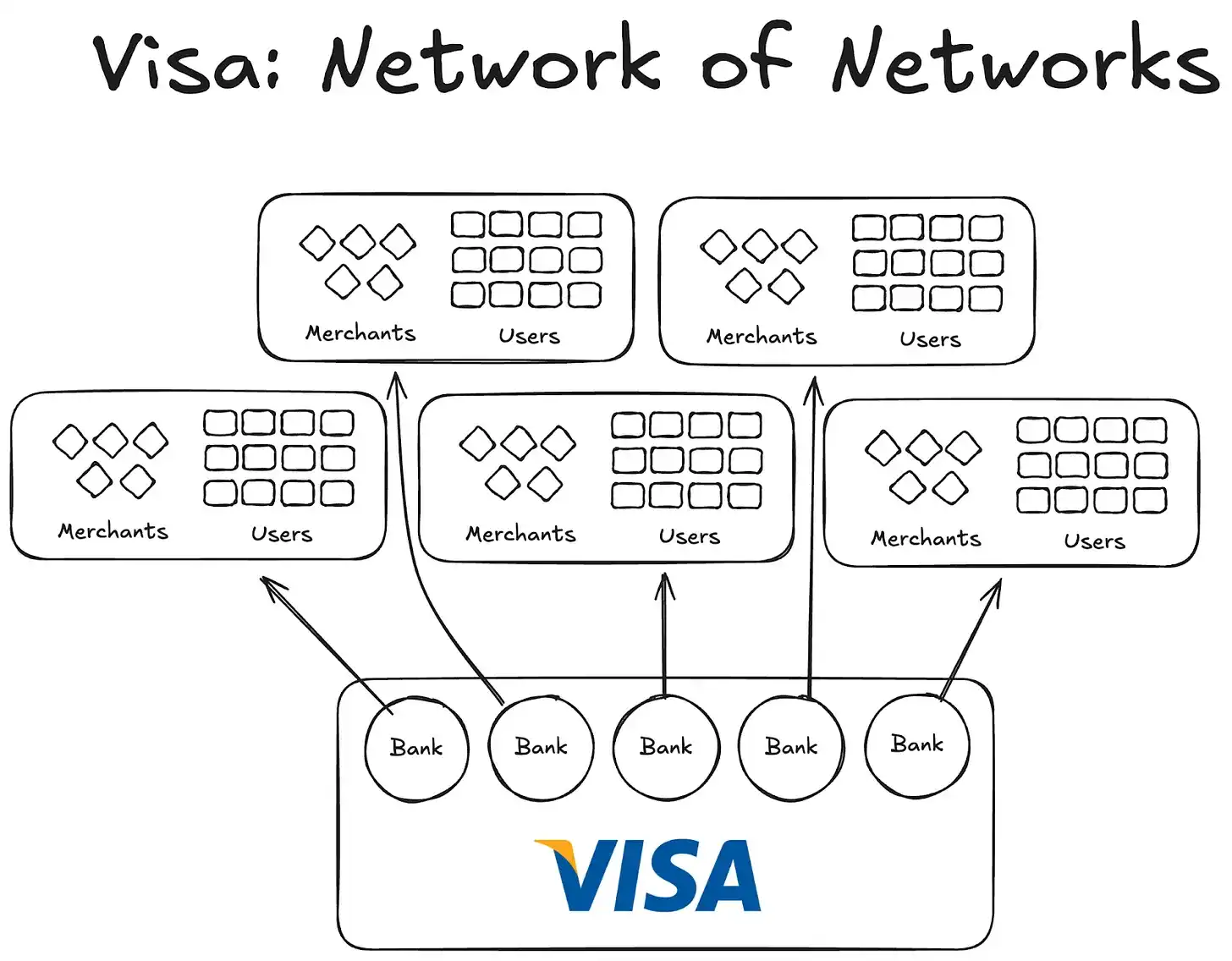
He had to explain that joining Visa meant more users and more merchants would be connected to the same network, which would promote more digital transactions globally and bring more benefits to all participants. He also had to explain that if they built their own credit card network, their user base would be very limited.

Implications for Stablecoins

In a sense, Anchorage Digital and other companies now offering stablecoin-as-a-service are replaying the BankAmericard story in the stablecoin space. They provide the underlying infrastructure for new issuers to build stablecoins, but liquidity continues to fragment into new tokens.

Currently, over 300 stablecoins are listed on Defillama. Moreover, each newly created stablecoin is limited to its own ecosystem. As a result, no single stablecoin can generate the network effects needed to go mainstream.

Since the same underlying assets support these new coins, why do we need more coins with new code?

In our Visa story, these are like BankAmericards. Ethena, Anchorage Digital, M0, or Bridge—each allows a protocol to issue its own stablecoin, but this only exacerbates industry fragmentation.

Ethena is another similar protocol that allows yield transmission and white-label customization of its stablecoin. Just like MegaETH issuing USDm—they issued USDm through tools that support USDtb.

However, this model failed. It only fragments the ecosystem.

In the credit card case, the brand differences between banks did not matter because it did not create any friction in user-to-merchant payments. The underlying issuance and payment layer was always Visa.

However, for stablecoins, this is not the case. Different token codes mean an infinite number of liquidity pools.

Merchants (or in this case, applications or protocols) will not add all stablecoins issued by M0 or Bridge to their list of accepted stablecoins. They will decide based on the liquidity of these stablecoins in the open market; the coins with the most holders and the highest liquidity should be accepted, while the rest will not.

The Way Forward: The Visa Model for Stablecoins
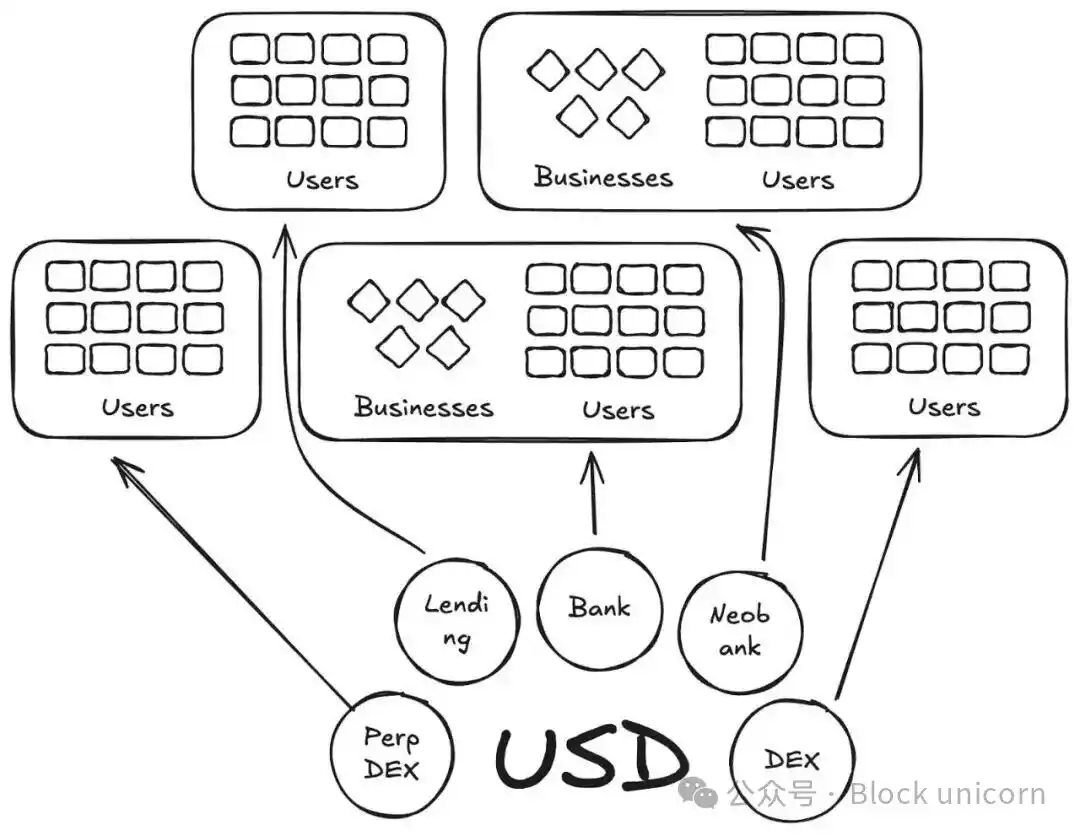
We need independent third-party institutions to manage stablecoins of different asset classes. Issuers and applications supporting these assets should be able to join cooperatives and access reserve earnings. At the same time, they should also have governance rights and be able to vote on the direction of their chosen stablecoin.

From a network effects perspective, this would be a superior model. As more issuers and protocols join the same token, it will facilitate the widespread adoption of a token that retains earnings internally rather than flowing into others' pockets.


Pertanyaan Terkait

QWhat was the main challenge faced by the credit card industry in the 1960s, and how did Visa address it?

AThe main challenge was fragmentation, with each bank operating its own isolated payment network. Visa addressed this by creating a cooperative network that allowed banks to join and share infrastructure, enabling universal acceptance and efficient interbank settlement.

QHow did Visa's structure differ from competitors like American Express and BankAmericard, and why was it more successful?

AVisa operated as an independent, cooperative organization where banks shared ownership and governance, avoiding competition among members. In contrast, American Express acted as a single bank expanding alone, and BankAmericard had infrastructure issues with interbank settlement. Visa's model incentivized participation and scaled network effects more effectively.

QWhat are the key pillars of Visa's network effects as described in the article?

AThe key pillars are: 1) Visa's independent third-party status to avoid competition among banks, 2) Profit sharing proportional to transaction volume, 3) Governance through voting by member banks requiring 80% approval, and 4) Initial exclusivity clauses preventing members from joining other networks.

QHow does the current stablecoin landscape resemble the pre-Visa credit card era, and what problem does this create?

AThe stablecoin landscape is fragmented, with over 300 stablecoins on Defillama, each limited to its own ecosystem. This prevents network effects, causes liquidity fragmentation, and hinders mainstream adoption, similar to how isolated bank networks struggled before Visa.

QWhat solution does the article propose for stablecoins, inspired by Visa's model?

AThe article proposes an independent third-party cooperative for stablecoins, where issuers and applications join to share reserve yields and governance rights. This would unify liquidity, enhance network effects, and keep benefits within the ecosystem rather than fragmenting them.

Bacaan Terkait

Dan Koe: Kebenaran Kontra-Intuitif, Anda Tidak Perlu Mengingat Semua yang Pernah Dibaca

Penulis Dan Koe berargumen bahwa kita tidak perlu mengingat semua yang kita baca. Masalah sebenarnya bukan pada ingatan, tetapi pada kesalahpahaman tentang pembelajaran. Belajar bukanlah tentang menghafal informasi, melainkan sistem umpan balik di sekitar **tujuan yang jelas**. Kunci sistem ini adalah **memulai dari keluaran (output)**, bukan masukan (input). Alih-alih mempelajari semuanya terlebih dahulu, mulailah dengan proyek nyata dan pelajari hanya apa yang diperlukan untuk mencapainya. Pengetahuan yang berguna diperoleh melalui tindakan, bukan hanya dengan mengumpulkan informasi. Konsep "otak kedua" (second brain) sering menjadi kuburan digital karena orang terjebak dalam koleksi dan organisasi berlebihan, tanpa pernah menggunakan catatan mereka. Solusinya adalah membangun **"alam bawah sadar kedua" (second subconscious)** — sistem yang secara aktif menghubungkan ide-ide dan mengingatkannya pada kita saat dibutuhkan untuk menciptakan karya. Alat seperti Obsidian+Claude atau Eden (dengan pencarian semantik) dapat membantu, tetapi fokusnya harus pada **penyaringan ketat**. Hanya simpan ide yang benar-benar membentuk pandangan dunia Anda dan dapat digunakan dalam proyek Anda. AI berperan sebagai asisten untuk mengurangi gesekan dalam penelitian dan penyusunan, tetapi **nilai, penilaian, dan suara Anda harus tetap berasal dari diri sendiri**. Pembelajaran mendalam dan worldview yang unik adalah hal yang tak tergantikan. Pada akhirnya, mengingat adalah produk sampingan. Yang penting adalah memiliki tujuan, bertindak berdasarkan tujuan itu, dan membiarkan pengetahuan yang relevan meresap melalui penggunaan dan refleksi. Hal-hal yang penting akan tertanam dengan sendirinya.

marsbit44m yang lalu

Dan Koe: Kebenaran Kontra-Intuitif, Anda Tidak Perlu Mengingat Semua yang Pernah Dibaca

marsbit44m yang lalu

Generasi Pengusaha Tiongkok Ini Telah Berubah Secara Total

Generasi Baru Pengusaha China: Dari Ekspansi Pasar ke Inovasi Teknologi Mendalam Pada 2026, peta kekayaan China mengalami pergeseran signifikan. Kelahiran perusahaan teknologi seperti Longxin Tech, Cambricon, dan DeepSeek—yang fokus pada AI, chip, dan robotika—menandai transisi dari era internet ke era kecerdasan buatan. Pendiri mereka, seperti Zhu Yiming (Longxin Tech) dan Chen Tianshi (Cambricon), seringkali memulai karir di laboratorium, menghabiskan bertahun-tahun untuk riset mendalam sebelum mencapai terobosan komersial. Ciri khas mereka adalah fokus pada teknologi inti, bukan sekadar model bisnis. Zhu Yiming, contohnya, tidak mengambil gaji selama tujuh tahun hingga perusahaannya untung. Perjalanan ini mencerminkan perubahan mendasar: titik awal kewirausahaan bergeser dari "berbisnis" menjadi "membuat teknologi." Pergeseran ini sejalan dengan transformasi ekonomi China menuju "produktivitas baru." Jika generasi sebelumnya membangun fondasi melalui manufaktur dan digitalisasi, generasi baru ini membangun menara di atasnya—mendorong inovasi orisinal dan bersaing di panggung global di bidang-bidang seperti chip dan model AI dasar. Nama-nama seperti Zhang Yiming (ByteDance), Liang Wenfeng (DeepSeek), dan Wang Xingxing (Unitree Robotics) mewakili kemampuan baru China: tidak lagi hanya mengejar, tetapi berinovasi, menembus, dan mengindustrialisasi teknologi di garis depan persaingan dunia. Transisi generasi ini adalah pergantian kemampuan suatu bangsa dalam bersaing secara global.

marsbit44m yang lalu

Generasi Pengusaha Tiongkok Ini Telah Berubah Secara Total

marsbit44m yang lalu

Web3 yang Dulu Begitu Populer, Kini Masuki Gelombang PHK

Web3 yang pernah panas memasuki gelombang PHK besar-besaran. Di tengah klaim bahwa AI adalah alasan utama pengurangan tenaga kerja, banyak perusahaan sebenarnya menghadapi tekanan finansial. Industri Web3, sebagai persimpangan teknologi dan keuangan, terkena dampak parah. PHK terjadi dengan cepat dan tanpa peringatan. Banyak karyawan menerima notifikasi tiba-tiba, akses sistem langsung diputus, dan komunikasi terputus. Kompensasi sering kali tidak memadai, dengan perusahaan menggunakan alasan seperti "kinerja buruk" atau mengarahkan karyawan untuk memilih "mengundurkan diri secara sukarela" guna menghindari pembayaran kompensasi. Tempat kerja menjadi sangat beracun. Budaya "rapat berdiri" yang ekstrem, jam kerja yang panjang tanpa batas, pengawasan ketat, dan tekanan konstan merusak moral. Perebutan kekuasaan di antara manajemen menciptakan ketidakstabilan, di mana karyawan menjadi korban. Mereka yang bukan bagian dari "kelompok dalam" sering dikucilkan atau dialihkan ke posisi pinggiran sebelum akhirnya dipecat. Model bisnis inti Web3 — biaya perdagangan dan pencatatan koin — sedang runtuh. Biaya pencatatan yang tinggi membunuh inovasi, kualitas proyek menurun, dan investor ritel menjauh. Peristiwa likuidasi besar-besaran pada Oktober lalu semakin menguras kepercayaan. Peningkatan platform derivatif on-chain juga memberikan tekanan pada pertukaran terpusat. Banyak pekerja yang di-PHK beralih ke industri AI, yang dilihat lebih cerah. Namun, mereka yang tetap di Web3 menghadapi diskriminasi dari industri tradisional, yang memandang rendah latar belakang kripto. Sementara itu, di dalam industri, persaingan tidak sehat seperti saling merebut karyawan dan perang gosip terus berlanjut, menguras energi dalam pasar yang menyusut. Musim dingin ini berbeda. Bukan hanya siklus biasa, tetapi akibat dari model bisnis yang tidak berkelanjutan, praktik buruk, dan hilangnya kepercayaan. Pertanyaannya tetap: kemunduran industri Web3 ini adalah kesalahan siapa?

marsbit1j yang lalu

Web3 yang Dulu Begitu Populer, Kini Masuki Gelombang PHK

marsbit1j yang lalu

Trading

Spot
活动图片