Trade.xyz is growing larger, is HYPE the ultimate winner?

marsbitDipublikasikan tanggal 2026-08-06Terakhir diperbarui pada 2026-08-06

Abstrak

The article analyzes Hyperliquid's token HYPE, which has faced bearish pressure due to team token unlocks, institutional selling, and excessive reliance on a single deployment partner, trade.xyz. Data shows HIP-3, Hyperliquid's open perpetuals platform, now drives over 60% of total volume, with trade.xyz capturing nearly 100% of HIP-3 activity. This extreme concentration stems from the mechanism's high staking barrier (500k HYPE), auction-based market creation favoring early movers, and poor economics for other deployers. The pattern is repeating in the newly launched HIP-4 prediction markets. While trade.xyz's growth provides real value—funding protocol fees and buybacks—it creates a dependency. The key risk is whether value accrues to the HYPE token long-term, especially as trade.xyz seeks independent funding at a ~$1.5B valuation. Analysts note both parties are deeply integrated, making a split unlikely, and HYPE's valuation based on cash flow appears relatively cheap versus traditional fintech. The core challenge for Hyperliquid is ensuring protocol-layer value capture amidst this centralized growth.

Recently, bearish sentiment towards HYPE has clearly intensified in the market. The focus of debate mainly falls on three things: the supply expectations from the continuous unlocking of team tokens, the direct selling pressure from institutional unstaking and ETF outflows, and the platform's excessive reliance on a single deployer.

These three concerns appear independent but actually point to the same root cause.

The team is unlocking, requiring the Assistance Fund to continue buying back to support the price; the money for buybacks comes from protocol fees; a significant portion of the fees comes from the trading activity of HIP-3; and the activity of HIP-3 is currently almost entirely concentrated on trade.xyz alone.

In other words, a significant portion of HYPE's value support rests on the continued operation of this single deployer.

More notably, the market has recently begun to spread news that trade.xyz is seeking financing at a valuation of approximately $15 billion. Although not officially confirmed, this signal has already led many to re-examine HYPE's medium- to long-term valuation logic.

This article aims to answer: Has HIP-3 reached a deadlock? What does this highly concentrated landscape mean for the subsequent development of HIP-4 and for the medium- to long-term value of HYPE?

1. What's Happening to HYPE?

First, let's look at the token price. HYPE peaked around mid-June, approaching $77, then fluctuated downward, currently retreating to about $56, a drop of approximately 25%.
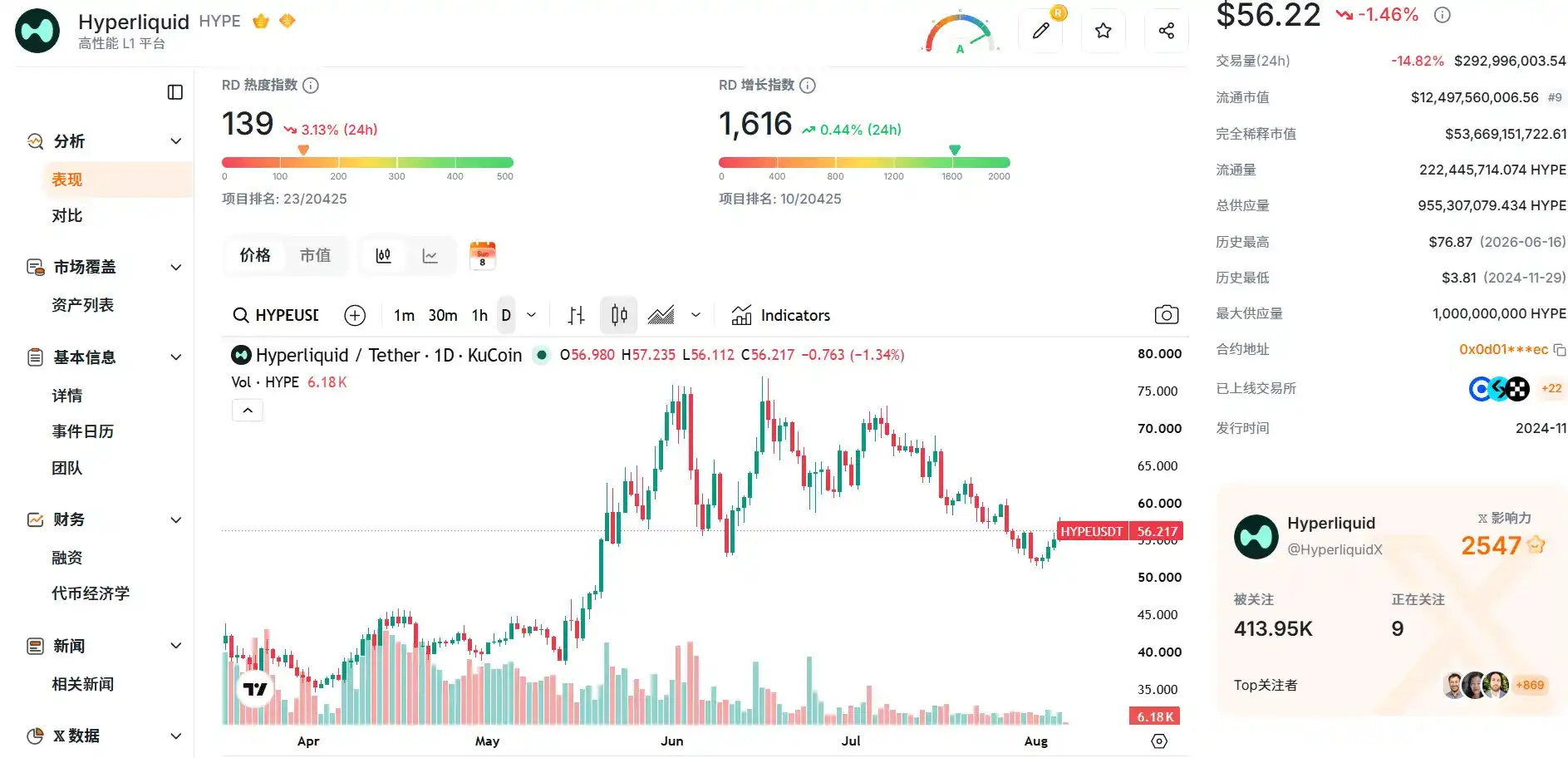
Signs of selling pressure actually emerged early in June. On June 4th, on-chain monitoring showed Arthur Hayes sold about 247,000 HYPE, cashing out approximately $18.02 million, almost clearing his holdings. Just days before, he had publicly stated he was betting HYPE would outperform the top ten crypto assets by market cap by year-end.

After entering July, institutional-level actions increased.Multicoin Capital unstaked about 1.97 million HYPE in late July, worth about $108 million, and also transferred tokens to multiple exchanges during the same period. Selini, Bitwise, and other institutions were also monitored transferring tokens to exchanges.

However, Selini founder Jordi Alexander responded that the transfers were not sales, as various business segments within their ecosystem require HYPE, including transaction fee staking, wallets, market making and arbitrage on HyperEVM, HYPE auctions, etc. Additionally, he does not believe Paradigm and Multicoin's positions are being sold.

But the direction of funds is indeed changing. According to SoSoValue, the HYPE spot ETF has shifted from continuous net inflows since its launch to three consecutive weeks of net outflow in July, becoming the only crypto ETF product with net outflows in July.
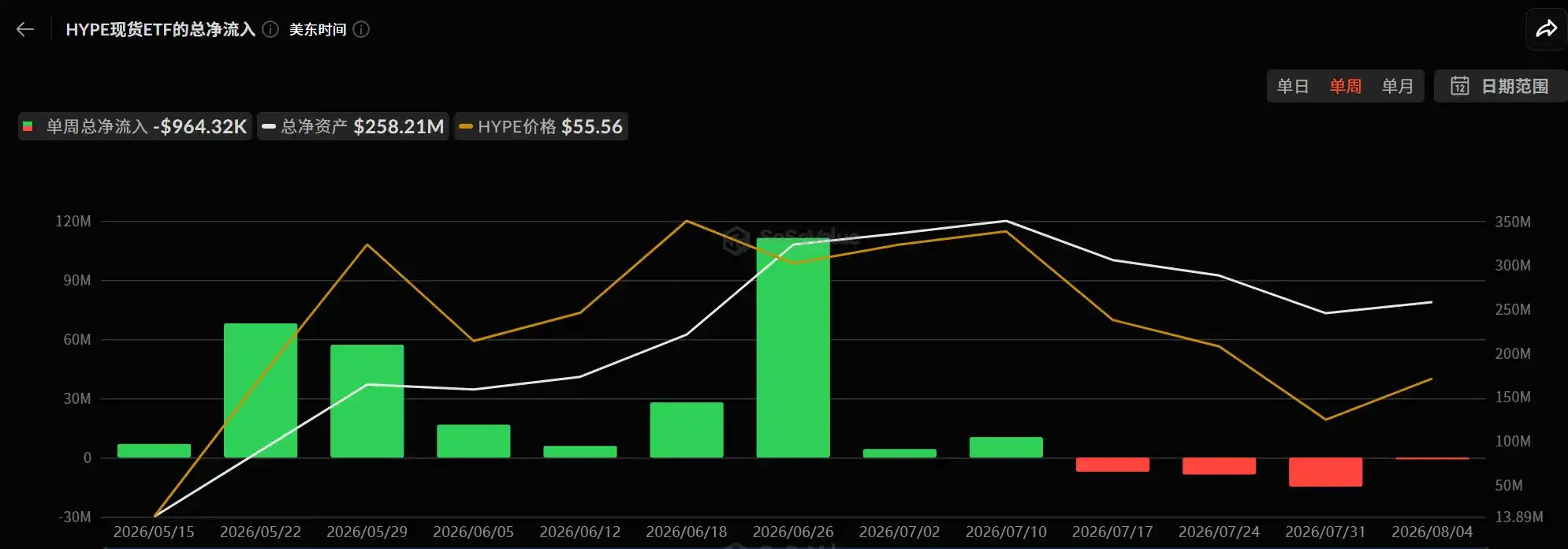
Simultaneously, short selling in the secondary market intensified. By early August, well-known trader Loracle had increased short positions on HYPE and ETH to over $46 million, with the HYPE short entry price around $52.7.

In this round of adjustment, HYPE's sentiment has significantly diverged from the overall market trend. Is this an ordinary cyclical pullback, or is there a structural issue with HYPE itself?

2. High Concentration is Already an Established Fact

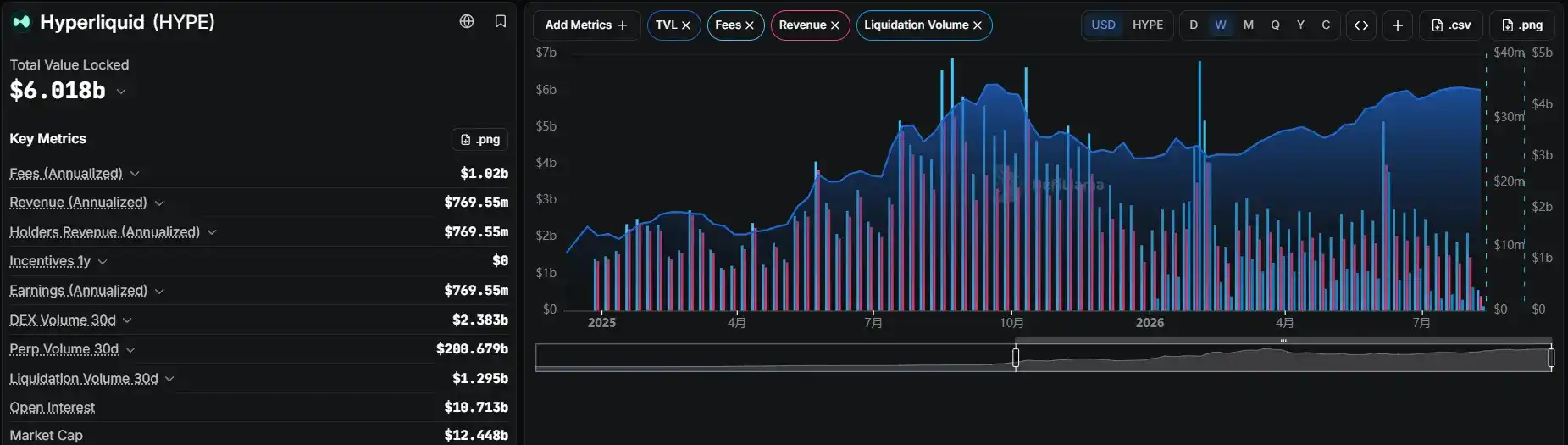
DefiLlama data shows Hyperliquid's perpetual trading volume in the last 30 days is about $200.7 billion, with open interest about $10.7 billion, and annualized protocol fees about $1.82 billion. This makes it one of the largest platforms by volume in the on-chain perpetuals sector.
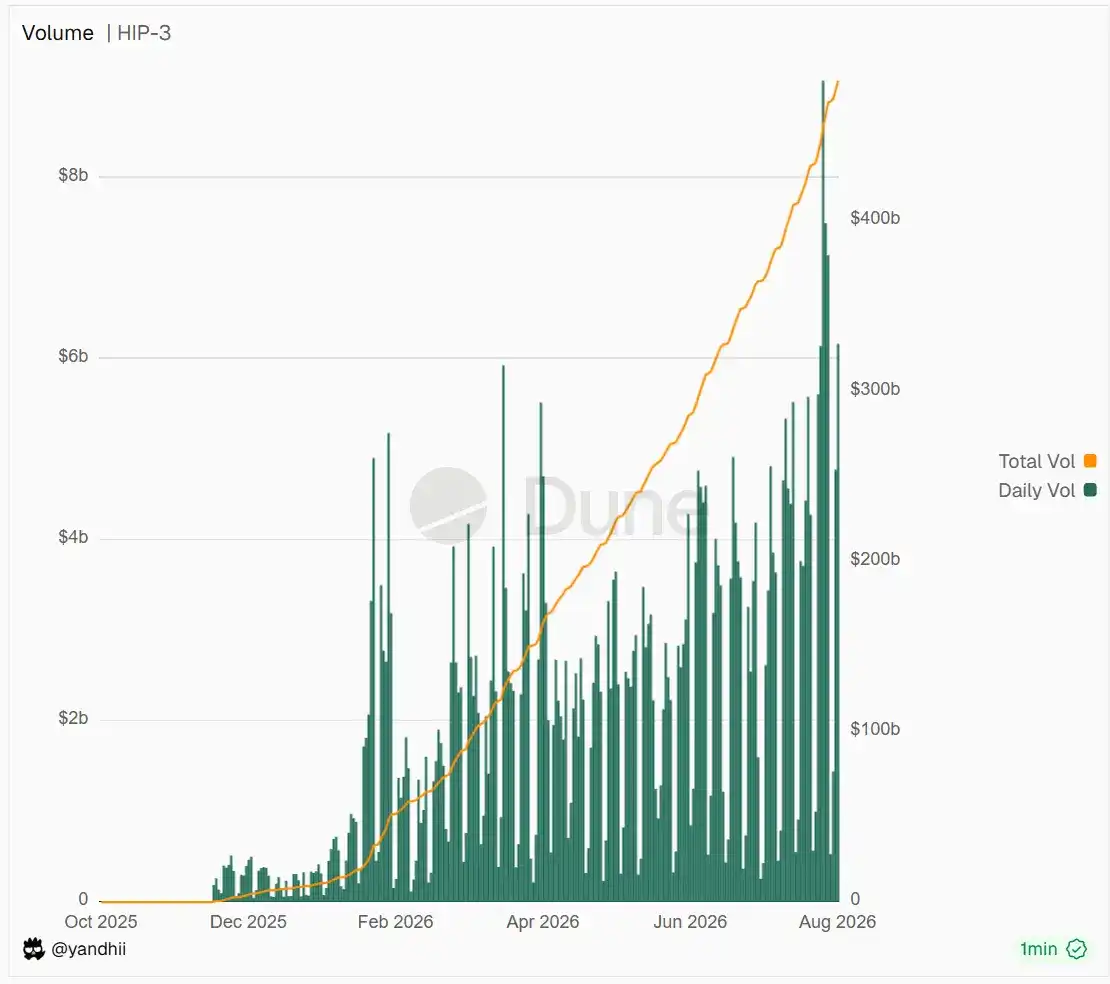
A significant portion of this comes from HIP-3. Dune data dashboard shows HIP-3 cumulative trading volume has exceeded $480 billion since its launch in October 2025.
According to the Hyperliquid Research Collective (HRC) Q2 report, HIP-3's share of platform trading volume rose from 1.8% last year to 20.7% in Q1 this year, and 32.2% in Q2.

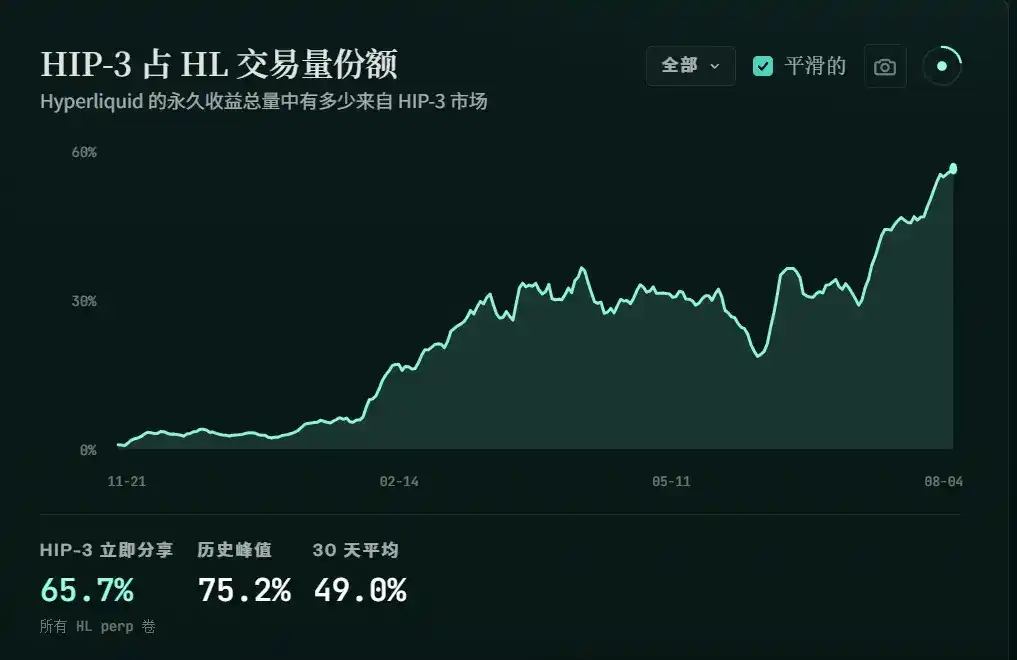
hl.eco data shows this ratio has recently increased further to about 64.6% on a 7-day smoothed basis. That means nearly half or more of Hyperliquid's trading activity is no longer from the official native markets, but from this open deployment mechanism.
Looking deeper inside HIP-3, the concentration is even more extreme. As of August 2026, TradeXYZ has deployed 103 markets, with 88 actively traded, covering commodities, forex, US and Asian stocks and indices, and pre-IPO products, including Cerebras (CBRS) and SpaceX (SPCX), as well as ChangXin Storage (CXMT).
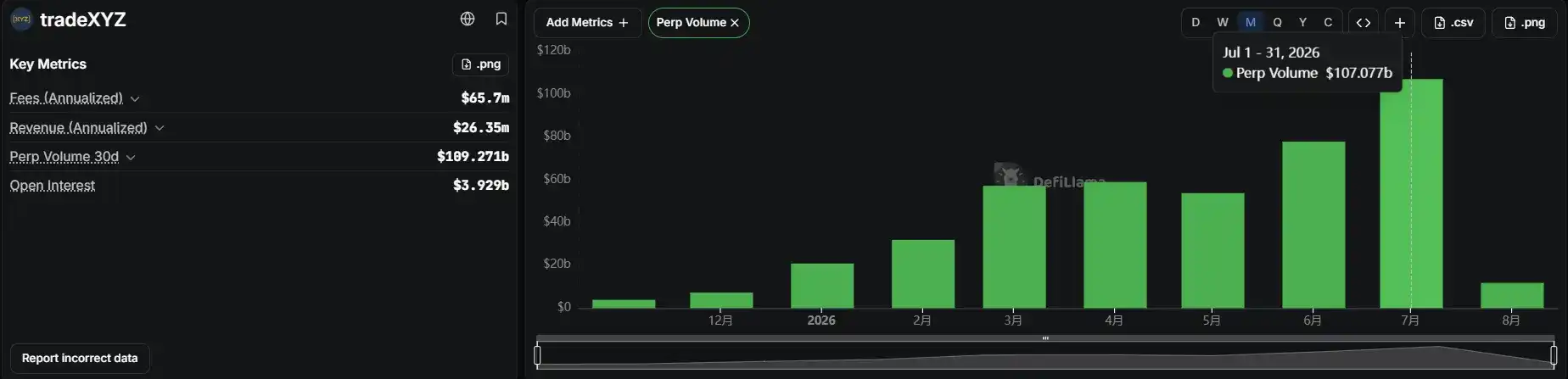
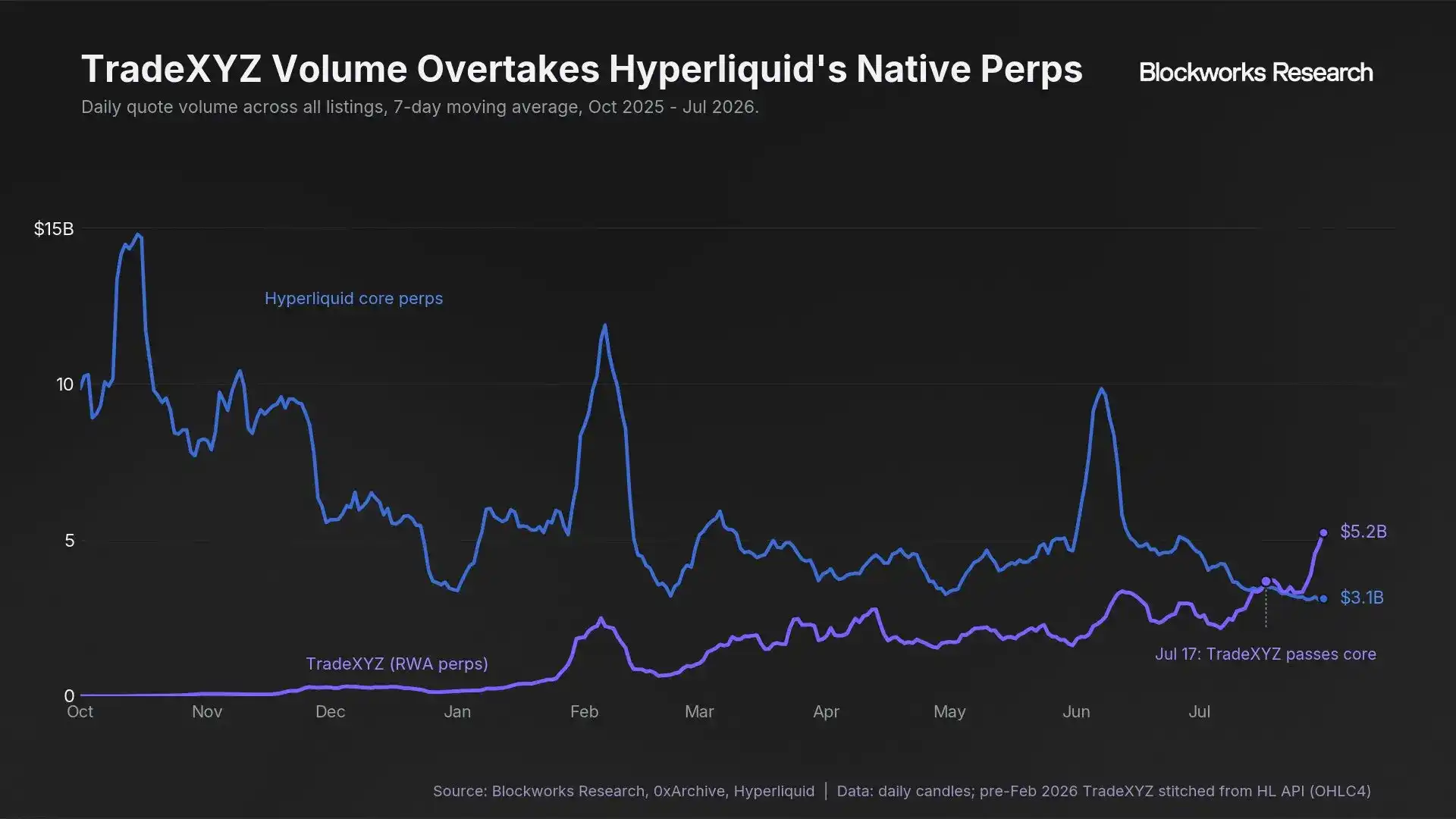
TradeXYZ's 30-day average daily trading volume is $3.7 billion, cumulative volume exceeds $440 billion, with open interest of $3.5 billion; since July 17, TradeXYZ's seven-day trading volume has exceeded Hyperliquid's native crypto perpetual contracts.
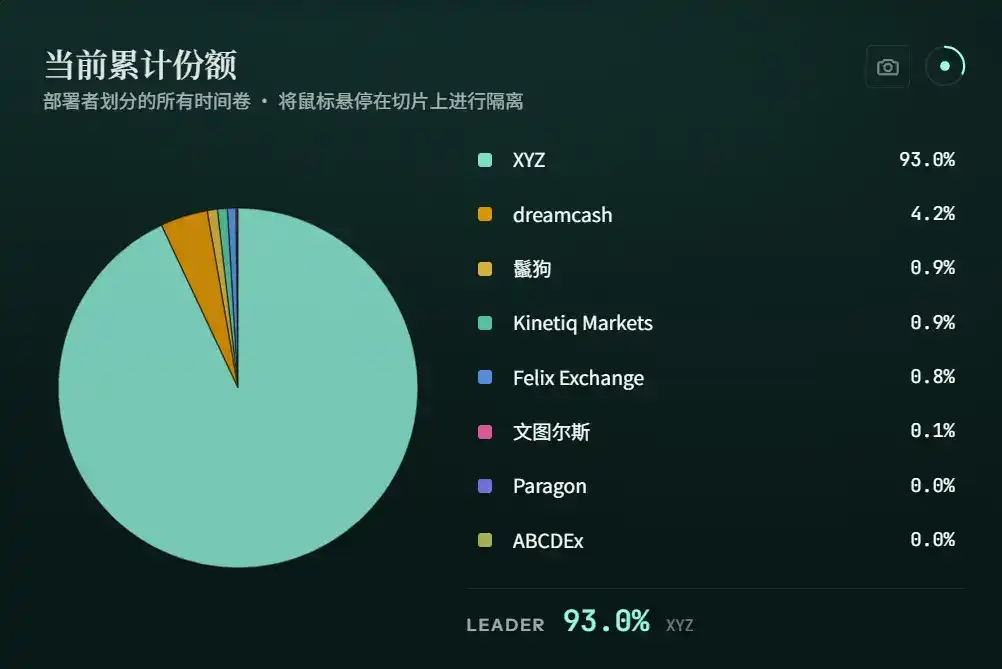
The Q2 report shows that trade.xyz's share of HIP-3 volume rose from 85% in March to 97% in June, and was close to 100% in July. On a cumulative historical basis, trade.xyz has also captured about 93% of HIP-3 volume, with second-place dreamcash at only 4.2%. All other deployers, including Kinetiq, Felix, Paragon, account for less than 3% combined.
It's worth noting that according to an Arrakis on-chain study from Q1, about 63% of trade.xyz's trading volume comes from approximately 360 market maker wallets, including professional market makers like Jump Crypto, Selini Capital, Wintermute. In terms of wallet count, about 43% of addresses come from a single Sybil farm built by a Polymarket operator, contributing less than 1% of real trading volume.

This landscape formed against a backdrop of others exiting and newcomers struggling to enter.

In June this year, early deployer Felix officially shut down its HIP-3 perpetual markets. Co-founder Charlie admitted in a review that even though they initially achieved about $3 billion in volume with pioneer products like crude oil, gold, and silver, they were eventually overtaken when trade.xyz launched identical markets denominated in USDC, forcing them to exit.

The report shows that among the same batch of deployers, Ventuals and Felix exited together during the USDH settlement in mid-June, Dreamcash halted operations in early July, while Kinetiq chose to migrate, launching its first batch of USDC pairs on July 1st.

Recently, new entrants are trying to grab share. Reportedly, Paragon has been consecutively auctioning multiple Tickers since mid-July, spending about 6,328 HYPE, focusing on AI industry chain, humanoid robots, Reddit, and other strong narrative assets, deliberately avoiding trade.xyz's mainstream large-cap stocks. Its weekly trading volume increased more than tenfold in a short period, but its cumulative share remains negligible.

3. The Mechanism's Default Outcome, HIP-4 is No Exception

HIP-3 was originally designed as a permissionless, open mechanism. Anyone staking enough HYPE could deploy their own perpetual markets. But in practice, it has become a winner-takes-all scenario.

The root of all this lies in the mechanism itself.

First, the barrier to entry: deploying a HIP-3 market requires staking 500,000 HYPE first, worth about $20-30 million at recent prices. This immediately blocks the vast majority of teams, leaving only a few well-capitalized players.

Second, the combination of auctions and first-mover advantage. Each deployer only gets their first three markets for free. Beyond that, they must bid in a shared Dutch auction, starting at 500 HYPE (which are directly burned). Latecomers not only face higher listing costs but also confront established liquidity attraction. Once a pioneer builds depth and user mindshare, newcomers have almost no cold-start space.

Finally, the economics of recouping costs. According to calculations by Blockworks Research analyst Shaunda Devens, excluding trade.xyz, the annualized return on staked HYPE for most HIP-3 deployers is close to or even below 1%. Among 136 paid listing markets she studied, only 44 recouped auction costs, with a median payback period of 4 years for non-trade.xyz markets.
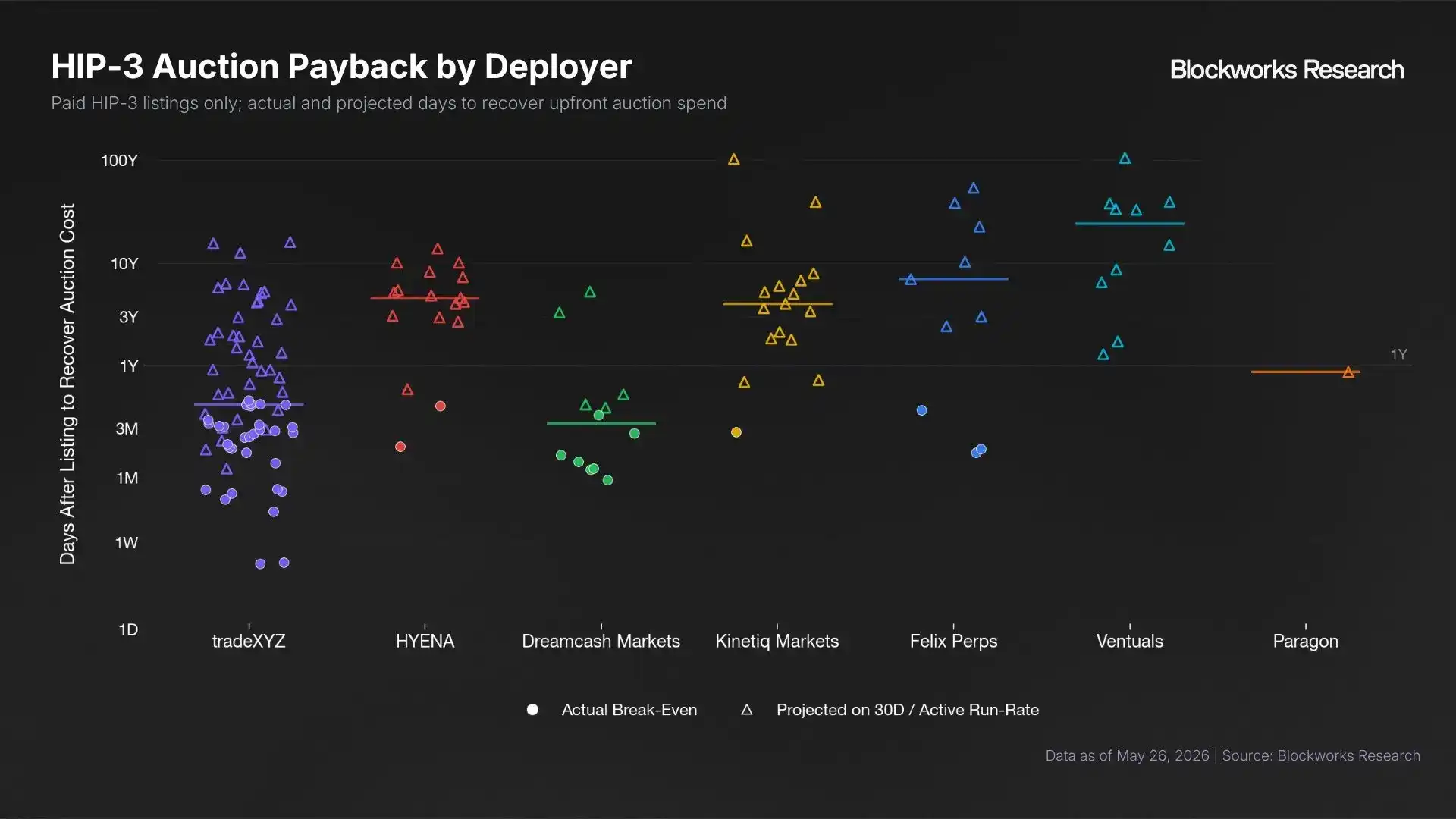
The same logic is now playing out on HIP-4.

On July 20th, Hyperliquid announced HIP-4 will open for permissionless deployment. HIP-4 is its attempt in the prediction market (binary outcome market) direction, with a more restrained path: it follows validator-voted-approved templates and limits direct validator deployments to under 10 markets per year. But the high staking barrier hasn't changed, still 500,000 HYPE.

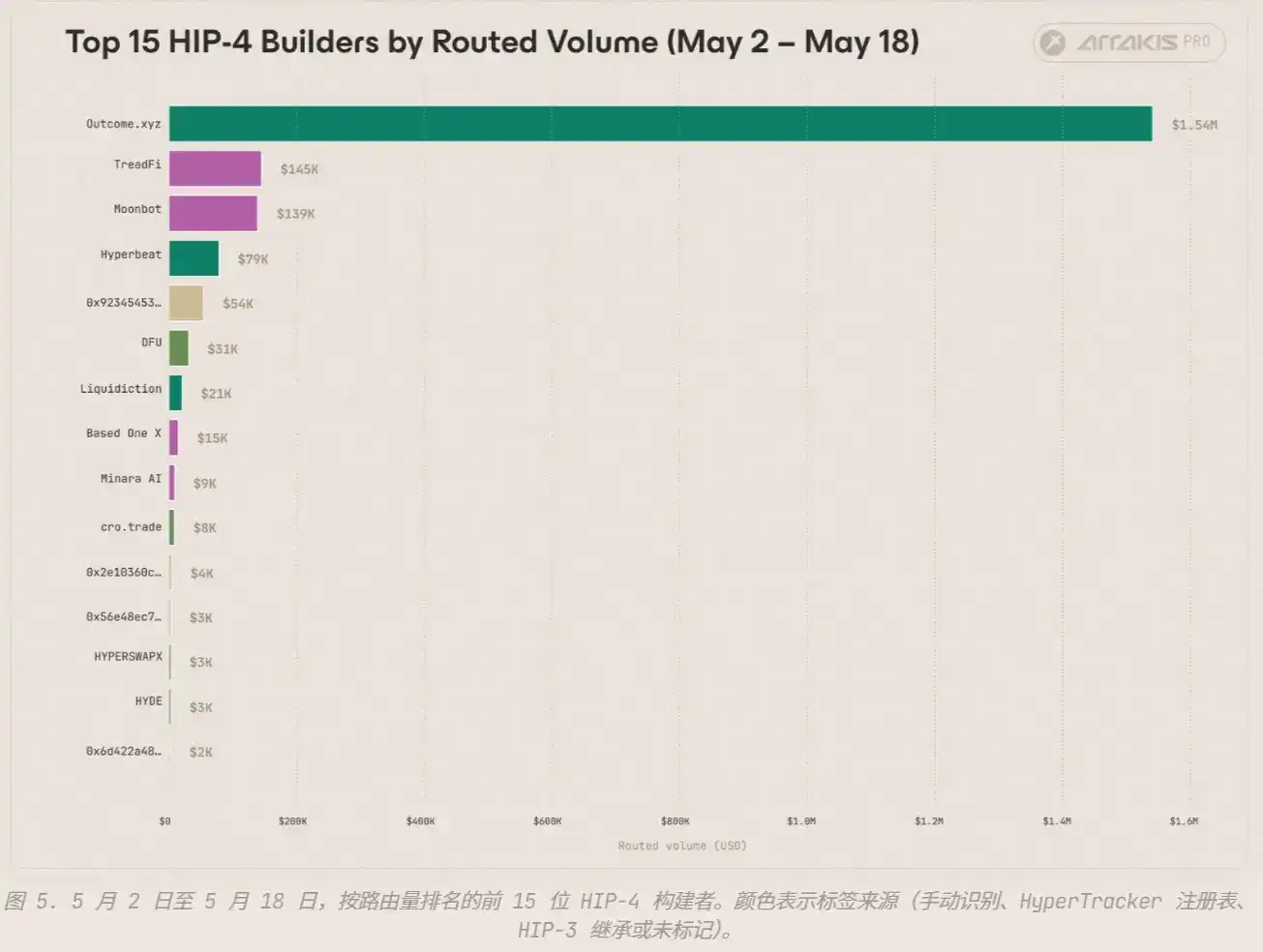
According to Arrakis' tracking of its first two weeks, one frontend Outcome.xyz's routed volume was over 10 times that of the second place.
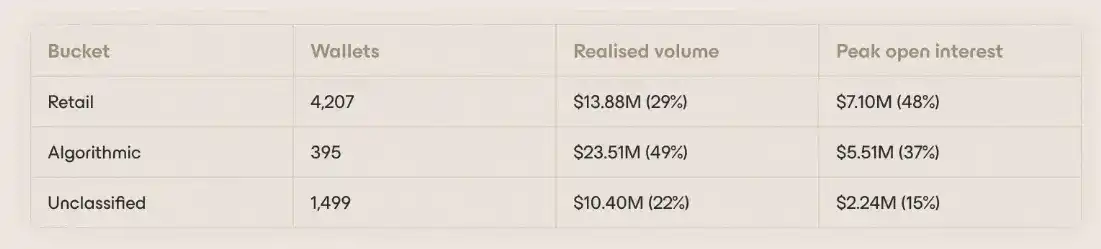
Algorithmic wallets constitute only 6% of total wallets, but they contribute nearly half of HIP-4's trading volume; while retail wallets constitute the majority of wallet count and had the highest peak open interest, their trading volume is less than one-third of HIP-4's.
During the same period, HIP-4's BTC binary option trading volume is already on par with Polymarket, but its pricing deviates from Deribit's implied probability by 4-5 times more than Polymarket or Kalshi.

The thin liquidity is also reflected in execution. Arrakis measured the maximum trade size markets could withstand at ±2% slippage, finding that after initial market hype brought high liquidity on launch day, subsequent execution experience worsened due to insufficient capital depth most of the time. In the worst case, a $1000 trade would cause the trader to bear 2% slippage.

Arrakis notes this is both a bottleneck for users and an opportunity for market makers. In such a low-volume market, the first market maker willing to deploy significant capital faces almost no competition and can profit from the market inefficiencies caused by the current order book's inefficiency.

Thus, HIP-4 also shows early signs of thin liquidity and high concentration. This is the mechanism's default outcome: a natural commercial bias towards a few players with capital, resources, and first-mover advantage.

4. Where is HYPE Headed?

The mechanism issue is an established fact. So, under this landscape, how long can HYPE's value support last?

In the short term, HYPE's price floor is mainly supported by trade.xyz. HIP-3 contributes a significant proportion of the platform's trading activity. The portion of fees belonging to the protocol enters the Assistance Fund for buybacks.

According to on-chain analyst MLM's data, since team token unlocking began in December 2025, about 4.93 million HYPE entered team wallets, with about 4.33 million sold or transferred OTC, cashing out about $165 million. During the same period, the Assistance Fund bought back about 9.8 million HYPE, investing about $364 million, at a rate over twice the team's selling.

Therefore, the unlocking itself hasn't created real selling pressure yet; the main pressure on price currently comes from changes in demand. Latest data shows that Hyperliquid has historically burned 47.53 million HYPE, worth about $2.68 billion, accounting for 4.75% of the 1 billion maximum supply.

In the medium term, variables are becoming more complex.

Recent market rumors suggest trade.xyz is seeking financing at a valuation of about $15 billion. While not officially confirmed, the signal itself is worth noting: the interest alignment between the protocol and the deployer may become less tight. Once an independent valuation is established, its bargaining power with the protocol will only increase, potentially renegotiating splits, terms, and continuation.

However, this may not lead to a split. Blockworks analysts point out that trade.xyz leaving due to a high fee split is the weakest among several concerns. Both sides are highly bound in reputation, economics, and architecture; neither has reason to leave the other.

If trade.xyz left, it would have to rebuild the entire exchange layer itself—the hardest part of the tech stack—and abandon almost its entire trader base. For Hyperliquid, bringing RWA in-house would signal to all future deployers that if you become big enough, you'll be replaced—also reputational suicide.

Analysts also remind that the 50% split is far from Hyperliquid's only monetization path. It also profits from write priority fees and read fees paid by market makers; a larger piece comes from second-order effects—traders bringing USDC to long RWA drives on-chain balance growth, from which Hyperliquid retains 90%, estimated at about $30 million per month, already exceeding the entire HIP-3 perpetual fee pool it shares equally with trade.xyz.

Another variable is HIP-4. The outcome market continues the high staking barrier, likely leading again to dominance by a few players. The open narrative will be further diluted, and HYPE's long-term premium as a platform token will be discounted.

Overall, the growth brought by trade.xyz is real. For Hyperliquid, the real test is whether it can continue to have value accrue at the protocol layer. As long as trade.xyz's growth can still translate into value capture for HYPE, concentration may not necessarily be a bad thing.

On valuation, Grayscale recent report notes that currently HYPE appears cheaper than traditional fintech companies based on cash flow valuation. The report, assuming protocol revenue of about $1 billion in 2027 (~20% growth from 2025), estimates corresponding earnings per share of about $3.25 to $3.75, resulting in a forward P/E ratio of only 15 to 18 times at the current price.


Kripto yang Sedang Tren

Pertanyaan Terkait

QWhat are the main concerns causing the bearish sentiment around HYPE according to the article?

AThe article identifies three primary concerns: 1) Continued supply pressure from ongoing team token unlocks, 2) Direct selling pressure from institutional un-staking and ETF fund outflows, and 3) The platform's excessive reliance on a single deployer, trade.xyz, for its HIP-3 trading activity and thus its fee revenue.

QWhy is the high concentration of trading volume on trade.xyz considered a structural issue for HYPE?

AThe high concentration creates a significant dependency risk. A large portion of HYPE's value support comes from protocol fees used for the Aid Fund buyback. A substantial share of these fees is generated by HIP-3 trading volume, which is almost entirely dominated by trade.xyz (approaching 100%). This means HYPE's price stability is heavily reliant on the continued operation and success of this single, independent entity.

QWhat are the key mechanisms within HIP-3 that have led to the 'winner-takes-all' outcome favoring trade.xyz?

AThe mechanism design naturally favors large, early players: 1) High entry barrier: Deploying a market requires staking 500,000 HYPE (~$25-30M). 2) Auction system and first-mover advantage: After the first three free markets, new markets are acquired via a shared Dutch auction, increasing costs for latecomers. Early deployers build liquidity and user habits that are hard to compete against. 3) Poor economics for others: For most non-trade.xyz deployers, the annualized return on staked HYPE is very low, with a median payback period of 4 years, making the business unsustainable.

QBased on the analysis in the article, is a split between Hyperliquid and trade.xyz likely? Why or why not?

ANo, a full split is considered unlikely by analysts cited in the article. Both parties are heavily interdependent. trade.xyz would have to rebuild the entire exchange layer and lose its entire trader base. Hyperliquid taking RWA markets in-house would be reputational suicide, signaling to all future deployers they could be replaced if successful. Their economic, reputational, and architectural ties are too deep for either to leave easily.

QWhat is Grayscale's perspective on HYPE's current valuation, and what key metric do they use?

AGrayscale's report suggests that HYPE appears relatively cheap compared to traditional fintech companies when valued on a cash flow basis. Assuming ~$1 billion in protocol revenue for 2027, they estimate earnings per share of $3.25 to $3.75. At the current price, this implies a forward Price-to-Earnings (P/E) ratio of only 15 to 18 times.

Bacaan Terkait

Arthur Hayes Mengintensifkan Pembelian Altcoin Ini, Menginvestasikan 2 Juta Dolar dalam Lima Hari Terakhir!

Arthur Hayes, pendiri BitMEX dan tokoh yang banyak diikuti di pasar kripto, terus meningkatkan pembelian token $ENA, aset native ekosistem Ethereum. Menurut data dari platform analisis blockchain Lookonchain, dalam transaksi terbarunya, Hayes membeli 10,9 juta $ENA lagi senilai sekitar $985.000. Total pembeliannya dalam lima hari terakhir mencapai 22,64 juta token, dengan nilai diperkirakan sekitar $2 juta. Aksi beli besar-besaran ini kembali menyoroti proyek Ethena dan menarik perhatian terhadap peningkatan kepemilikan altcoin tertentu oleh tokoh-tokoh pasar terkemuka. Hayes dikenal dengan analisis makroekonominya yang sering kali menjadi sorotan. Evaluasi positifnya terhadap ekosistem Ethereum dan proyek DeFi, serta peningkatan investasi ke $ENA, memicu interpretasi baru mengenai pandangan jangka panjangnya. Ethena adalah salah satu proyek yang mengembangkan produk keuangan berbasis blockchain, terkenal dengan solusi dolar sintetisnya. Token $ENA digunakan dalam tata kelola platform dan berbagai fungsi di ekosistemnya. Kebangkitan minat sektor DeFi baru-baru ini mendorong investor untuk memantau proyek seperti Ethena lebih cermat. Namun, para ahli mengingatkan bahwa pembelian oleh investor besar saja tidak cukup untuk mendorong kenaikan harga. Meski aktivitas "paus" seperti Hayes merupakan indikator pasar penting, pergerakan harga tetap dipengaruhi banyak faktor seperti kondisi pasar, likuiditas, permintaan investor, dan peristiwa makroekonomi. Analis menekankan bahwa keputusan investasi seharusnya tidak hanya mengandalkan aktivitas investor besar, tetapi juga mempertimbangkan fundamental proyek, utilitas, dan dinamika pasar secara keseluruhan.

cryptonews.ru16m yang lalu

Arthur Hayes Mengintensifkan Pembelian Altcoin Ini, Menginvestasikan 2 Juta Dolar dalam Lima Hari Terakhir!

cryptonews.ru16m yang lalu

Bisakah AI Mengambil Alih Laboratorium? Studi Terbaru USTC Memberikan Uji Tekanan di Dunia Fisik Nyata

Bagaimana menilai apakah kecerdasan buatan (AI) sudah cukup cerdas untuk melakukan penelitian ilmiah dan mencapai penemuan ilmiah otonom secara end-to-end? Penelitian terbaru dari University of Science and Technology of China (USTC) menguji pertanyaan ini di dunia fisik nyata dengan membuat "otak" AI mengoperasikan laboratorium ilmuwan mesin. Tim peneliti membangun laboratorium katalisis mesin dengan 45 stasiun kerja otomatis modular yang mencakup sintesis, karakterisasi, dan pengujian kinerja katalitik. Kemampuan laboratorium ini dibungkus sebagai "keterampilan" yang dapat dibaca mesin, memungkinkan agen AI memanggil peralatan eksperimen dengan batasan nyata seperti kemampuan perangkat, protokol operasi, dan kondisi eksperimen. Penelitian ini melakukan "uji tekanan" sistematis terhadap 48 konfigurasi yang terdiri dari 6 kerangka kerja agen dan 9 model bahasa besar (LLM), mencakup 4.608 percobaan evaluasi untuk 32 tugas penelitian yang ditentukan pakar. Hasilnya mengungkap kesenjangan signifikan antara rencana yang dihasilkan AI dan eksekusi fisik: hanya 151 alur kerja (3,3%) yang dapat dieksekusi tanpa perbaikan manual. Kombinasi terbaik, Claude Code dengan Claude Opus 4.7, mencapai tingkat eksekusi 28,1%. Uji lebih lanjut dalam loop tertutup lima putaran menunjukkan bahwa meskipun agen AI (menggunakan Codex/GPT 5.5) dapat menyesuaikan parameter berdasarkan hasil eksperimen, penyesuaian itu hanya pada tingkat optimasi lokal. Agen gagal melakukan perencanaan ulang strategis tingkat ilmiah, seperti mendesain ulang metode analisis atau memperbaiki kelalaian kritis yang persisten. Studi ini membedakan tiga kemampuan yang sering tercampur dalam diskusi "AI ilmuwan": 1) Merencanakan eksperimen secara lancar, 2) Menghasilkan alur kerja yang benar-benar dapat dieksekusi di lab fisik, dan 3) Menyesuaikan strategi penelitian secara keseluruhan berdasarkan bukti. Hasil menunjukkan kemampuan perencanaan tingkat bahasa tidak secara otomatis diterjemahkan menjadi kemampuan eksekusi yang andal, dan penyesuaian parameter lokal tidak sama dengan perencanaan ulang ilmiah. Laboratorium ilmuwan mesin berfungsi sebagai infrastruktur cerdas untuk "AI for Science", yang dapat menjadi "tempat uji" dan "tempat pelatihan" untuk AI. Lingkaran tertutup "perencanaan-eksekusi-umpan balik-perencanaan ulang" ini dapat mengekspos kekurangan AI dan menyediakan data untuk pelatihan model dan penyelarasan agen yang berkelanjutan. Pendekatan ini memberikan bukti dunia fisik yang dapat diukur, dapat direplikasi, dan dapat divalidasi untuk menilai kecerdasan ilmiah AI, mendorongnya menuju penemuan ilmiah otonom end-to-end.

marsbit20m yang lalu

Bisakah AI Mengambil Alih Laboratorium? Studi Terbaru USTC Memberikan Uji Tekanan di Dunia Fisik Nyata

marsbit20m yang lalu

Token Anjlok 99% dan Pendiri Ditahan: Startup NFT Few and Far Rugikan Investor $10 Juta

Pendiri startup NFT Few and Far, Taj Tarsha (34 tahun), telah ditangkap dan didakwa dengan penipuan sekuritas dan penipuan kawat oleh Kantor Kejaksaan AS untuk Distrik Selatan New York. Tarsha dituduh telah mengumpulkan lebih dari $10 juta dari sedikitnya 67 investor melalui perjanjian Simple Agreement for Future Tokens (SAFT) untuk pengembangan token FAR dan pasar NFT di blockchain NEAR Protocol, dimulai Februari 2022. Alih-alih mengembangkan proyek, Tarsha diduga menggunakan dana investor untuk tujuan pribadi seperti perjudian online, spekulasi mata uang kripto, kredit apartemen di Miami, layanan desain interior, dan hobinya sebagai DJ. Dia juga dituduh menarik sekitar $1 juta sebagai bonus dan gaji yang tidak wajar, serta memberhentikan hampir semua staf sambil membuat ilusi bahwa pengembangan terus berjalan. Token FAR akhirnya diluncurkan pada Mei 2024 dengan harga sekitar $0,13 tetapi segera anjlok lebih dari 99% dan berhenti diperdagangkan. Tarsha, yang ditangkap pada 6 Juni 2026, menghadapi hukuman maksimum 20 tahun penjara untuk setiap dakwaan. Kasus ini mengingatkan pada pola penipuan serupa di industri NFT pada periode 2022-2024, seperti kasus Frosties, namun dengan kerugian yang jauh lebih besar. Mekanisme SAFT, yang dimaksudkan untuk menunda penjualan token hingga produk selesai, justru membuat pengawasan penggunaan dana investor menjadi sangat sulit.

cryptonews.ru26m yang lalu

Token Anjlok 99% dan Pendiri Ditahan: Startup NFT Few and Far Rugikan Investor $10 Juta

cryptonews.ru26m yang lalu

Wawancara Terbaru Fei-Fei Li: Manusia Juga Tidak Belajar Sepenuhnya dari Data Dunia Nyata

Dalam wawancara terbaru dengan a16z, Li Fei-Fei membahas visi World Labs untuk menjadikan "kecerdasan spasial" sebagai frontier AI berikutnya. Ia menekankan bahwa robotika adalah batu uji pertama untuk penerapan kecerdasan spasial, di mana kemampuan bertindak di ruang fisik tetap menjadi salah satu yang paling menarik dan berdampak luas. World Labs baru-baru ini mengakuisisi SceniX, sebuah perusahaan yang berfokus mengatasi masalah utama dalam robotika: kelangkaan data pelatihan dan evaluasi. Bersama-sama, mereka bertujuan membangun "lapangan pelatihan digital" yang dapat diskalakan untuk robot, menggunakan pendekatan "real-to-sim-to-real". Intinya, mereka membuat replika digital dunia nyata yang selaras, sehingga proses pelatihan dan evaluasi yang lambat, berbahaya, dan mahal di dunia fisik dapat sebagian digantikan dengan simulasi yang lebih cepat, aman, dan terkendali. Li Fei-Fei dan Li Yunzhu (pendiri SceniX) menjelaskan bahwa simulasi memungkinkan "penalaran kontrafaktual" dan cakupan yang sistematis terhadap variasi lingkungan, yang penting untuk membangun keandalan (robustness). Infrastruktur yang mereka bangun bersifat netral terhadap bentuk robot atau model AI tertentu, berfokus pada penciptaan dunia digital di mana berbagai robot dapat berlatih dan dievaluasi. Mereka mengakui bahwa jalan menuju robot serba guna di lingkungan tidak terstruktur (seperti rumah) masih panjang. Pendekatan yang lebih realistis dan langsung berdampak adalah menyasar lingkungan semi-terstruktur terlebih dahulu, seperti gudang atau restoran. Dalam dua tahun ke depan, kesuksesan akan diukur dengan adopsi dan validasi oleh beberapa pelanggan utama di vertikal tertentu, membuktikan bahwa platform mereka secara signifikan mempercepat pengembangan dan penyebaran sistem robotika yang andal.

marsbit29m yang lalu

Wawancara Terbaru Fei-Fei Li: Manusia Juga Tidak Belajar Sepenuhnya dari Data Dunia Nyata

marsbit29m yang lalu

Trading

Spot

Artikel Populer

Cara Membeli HYPE

Selamat datang di HTX.com! Kami telah membuat pembelian Hyperliquid (HYPE) menjadi mudah dan nyaman. Ikuti panduan langkah demi langkah kami untuk memulai perjalanan kripto Anda.Langkah 1: Buat Akun HTX AndaGunakan alamat email atau nomor ponsel Anda untuk mendaftar akun gratis di HTX. Rasakan perjalanan pendaftaran yang mudah dan buka semua fitur.Dapatkan Akun SayaLangkah 2: Buka Beli Kripto, lalu Pilih Metode Pembayaran AndaKartu Kredit/Debit: Gunakan Visa atau Mastercard Anda untuk membeli Hyperliquid (HYPE) secara instan.Saldo: Gunakan dana dari saldo akun HTX Anda untuk melakukan trading dengan lancar.Pihak Ketiga: Kami telah menambahkan metode pembayaran populer seperti Google Pay dan Apple Pay untuk meningkatkan kenyamanan.P2P: Lakukan trading langsung dengan pengguna lain di HTX.Over-the-Counter (OTC): Kami menawarkan layanan yang dibuat khusus dan kurs yang kompetitif bagi para trader.Langkah 3: Simpan Hyperliquid (HYPE) AndaSetelah melakukan pembelian, simpan Hyperliquid (HYPE) di akun HTX Anda. Selain itu, Anda dapat mengirimkannya ke tempat lain melalui transfer blockchain atau menggunakannya untuk memperdagangkan mata uang kripto lainnya.Langkah 4: Lakukan trading Hyperliquid (HYPE)Lakukan trading Hyperliquid (HYPE) dengan mudah di pasar spot HTX. Cukup akses akun Anda, pilih pasangan perdagangan, jalankan trading, lalu pantau secara real-time. Kami menawarkan pengalaman yang ramah pengguna baik untuk pemula maupun trader berpengalaman.

503 Total TayanganDipublikasikan pada 2024.12.11Diperbarui pada 2026.06.02

Cara Membeli HYPE

Diskusi

Selamat datang di Komunitas HTX. Di sini, Anda bisa terus mendapatkan informasi terbaru tentang perkembangan platform terkini dan mendapatkan akses ke wawasan pasar profesional. Pendapat pengguna mengenai harga HYPE (HYPE) disajikan di bawah ini.

活动图片