Tiger Research: Crypto Payment Cards Handling $1.5B Monthly Volume Stuck in the 1990s

marsbitDipublikasikan tanggal 2026-07-02Terakhir diperbarui pada 2026-07-02

Abstrak

Titled "Crypto Payment Cards at a $1.5 Billion Monthly Volume, Stuck in the 1990s," this article analyzes the crypto payment card industry, arguing its development stage is analogous to debit cards before they became core banking accounts. Despite rapid growth to ~$15B monthly volume, usage is concentrated in emerging markets (e.g., Bangladesh, India) where access to USD is limited, not in developed economies. The industry lacks integration into daily financial life—most cards rely on user-topped-up stablecoins, not payroll deposits or recurring payments, resulting in low circulation velocity compared to fiat. The piece outlines four main business models: 1) Issuing Infrastructure (highly concentrated, with players like Rain offering T+0 stablecoin settlement), 2) Exchange-Issued Cards (for user retention, not core revenue), 3) Decentralized Wallet/DeFi Cards (complex, high-Gas, limited to crypto-natives), and 4) Stablecoin Digital Banks (the largest segment by volume, focusing on account functions for emerging markets). The conclusion warns that pure payment functionality is unsustainable. For long-term viability, companies must control the funds flow, secure niche markets, and build indispensable user account relationships—similar to how traditional banks captured primary accounts. Without this, crypto cards risk remaining niche prepaid tools.

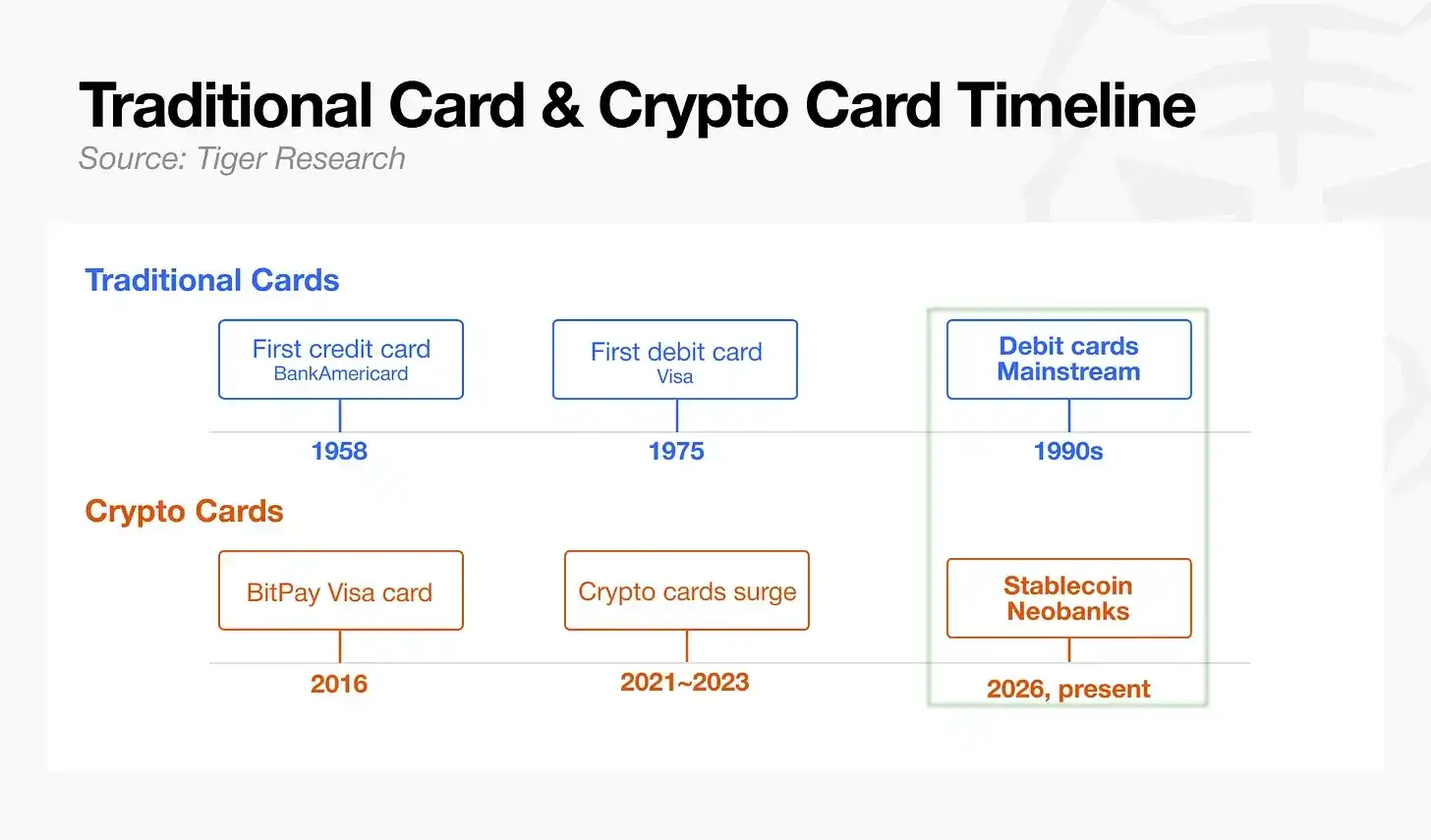
In September 1958, Bank of America bulk-mailed credit cards to 65,000 residents of Fresno, California. This was the first payment card launched without supporting underlying infrastructure. One year after launch, the business was dismal, with a delinquency rate of 22% and losses as high as $20 million. The industry spent 15 years building an electronic settlement system; debit cards took another 17 years to officially appear, and Visa spent a full 20 years establishing a globally accepted payment standard.
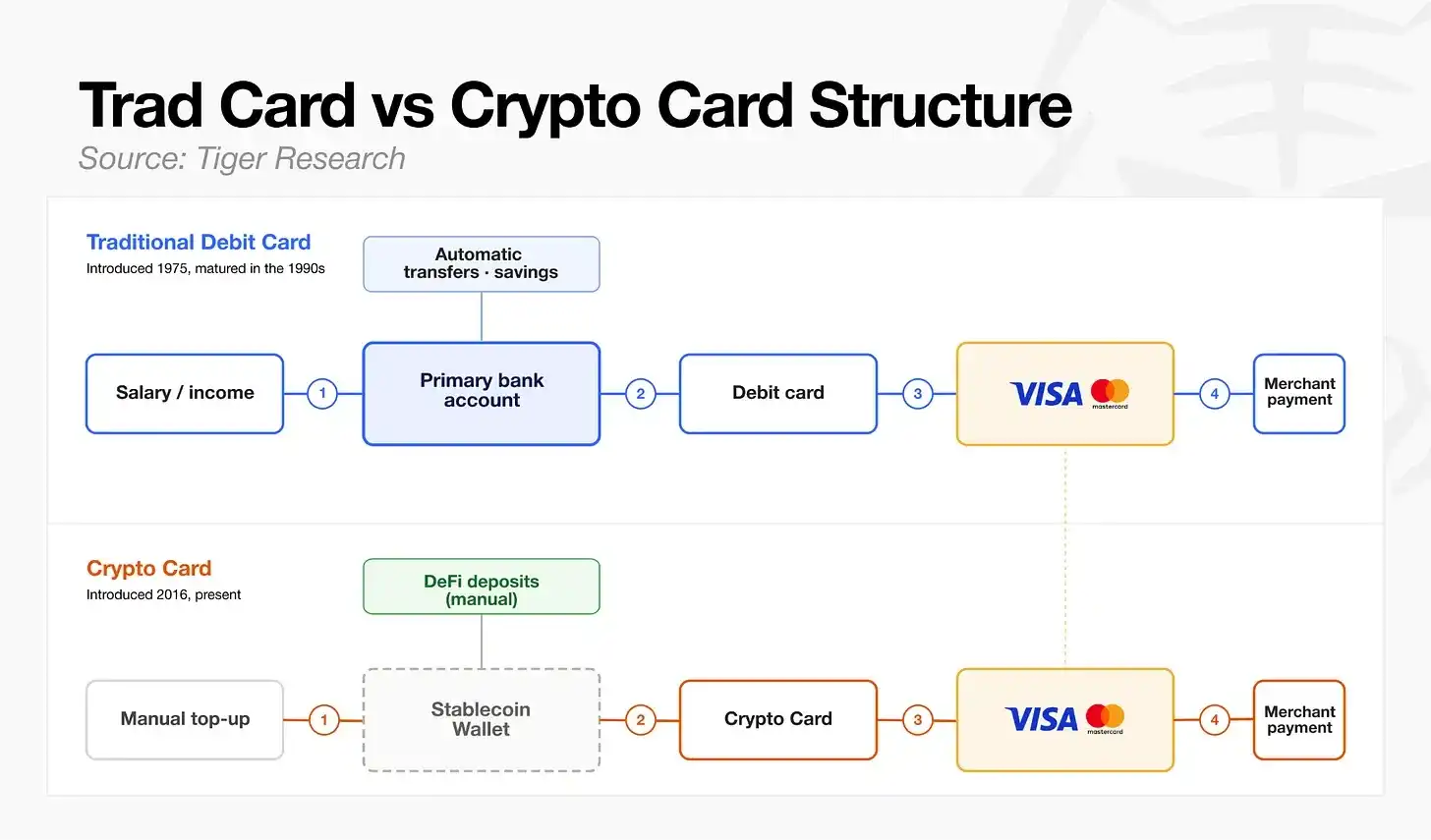
The biggest watershed between traditional payment and crypto payment lies in whether they foster users' routine financial account relationships. Debit cards were born in 1975, but only became a standard feature of individual core bank accounts after salary deposit services became widespread in the 1990s. In contrast, for today's crypto payment cards, the main funding source is basically users self-topping up stablecoins; the vast majority of crypto wallets cannot handle daily financial flows like salary deposits or scheduled bill payments. The industry's overall development stage is roughly equivalent to that of debit cards around the early 1990s.

The future leader in the crypto payment card race won't be determined by the number of cards issued, but by who first builds a core account that truly serves daily income and expenses, or finds a growth driver that fosters long-term user retention.

Monthly Transaction Volume of $1.5 Billion Does Not Equate to Industry Maturity

According to data from analytics firm Artemis, the monthly transaction volume of crypto payment cards grew from $100 million in early 2023 to $1.5 billion by the end of 2025, representing an annualized scale of approximately $18 billion. Affected by variations in on-chain data statistical methods, the actual annualized figure may fluctuate slightly, but the explosive growth in transaction volume is an indisputable fact.
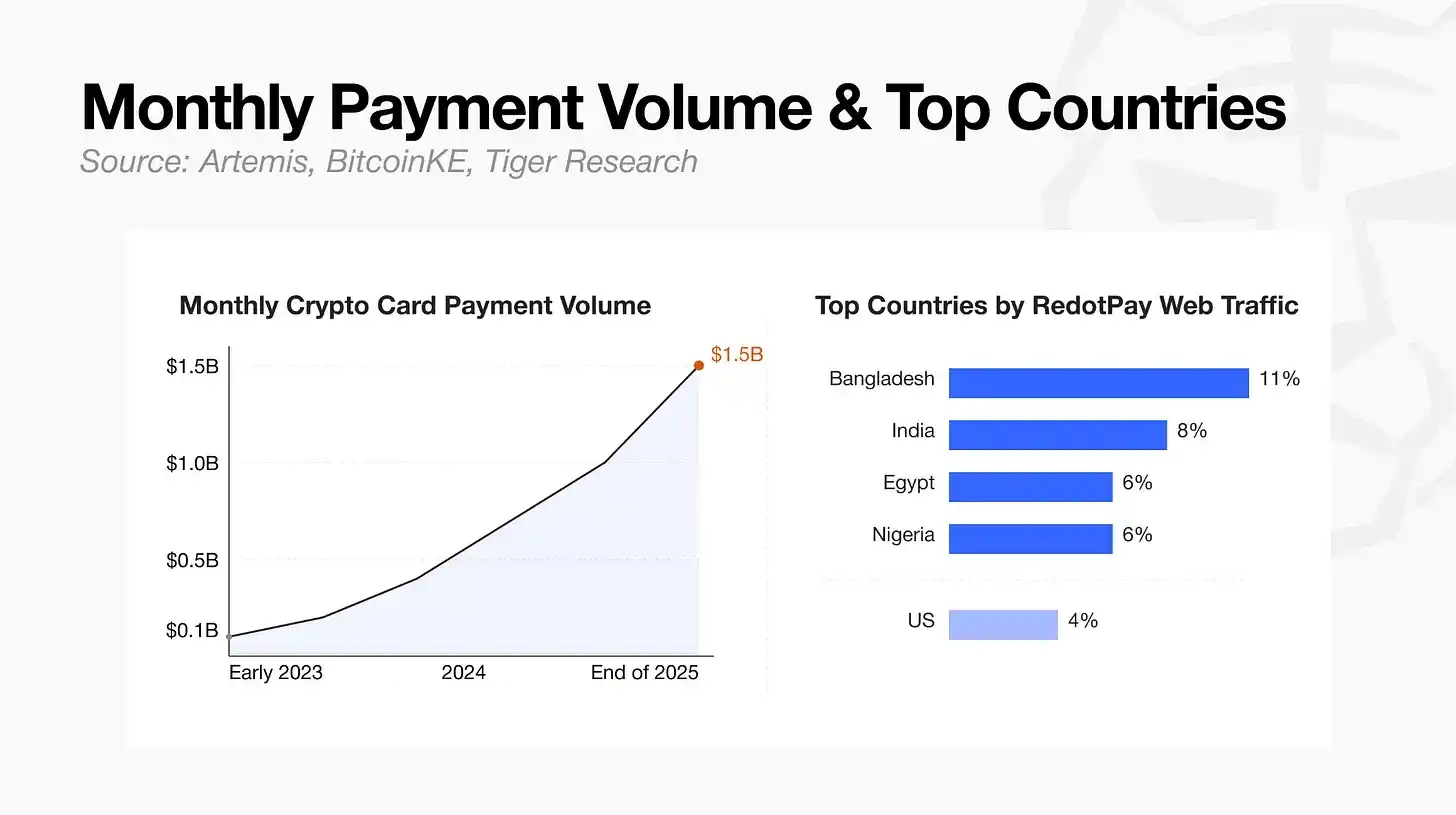
A closer analysis of these metrics reveals significant concentration among services and regions. Leading service provider RedotPay alone accounts for over half of the entire industry's transaction flow; platform users are highly concentrated in emerging markets: Bangladesh accounts for 11%, India 8%, Egypt 6%, Nigeria 6%, with the US representing only 4%.

This shows that the real demand for crypto payment cards does not come from developed mainstream markets, but from developing regions with insufficient financial services and restricted access to USD.
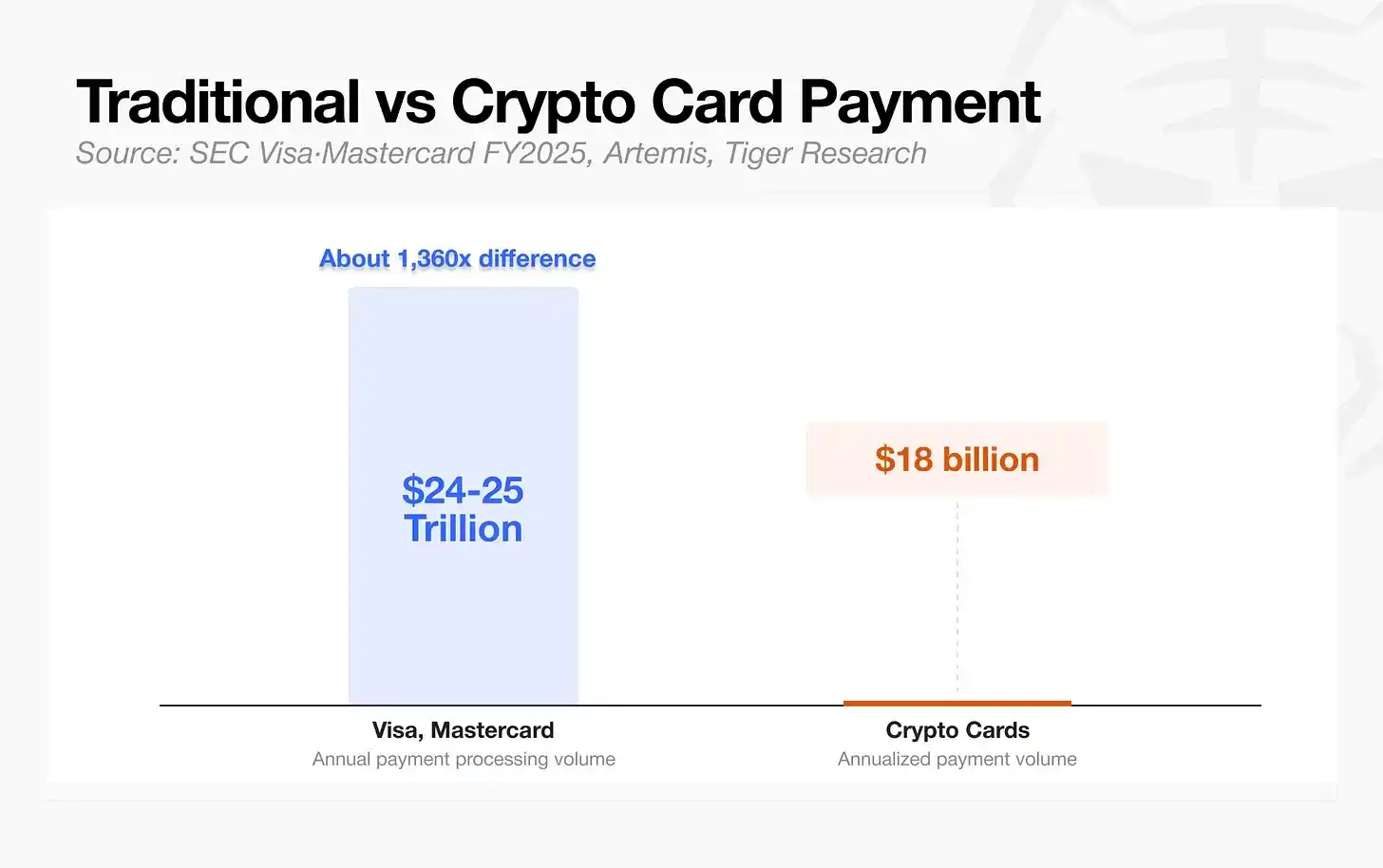
Compared to mature financial networks, the scale gap of cryptocurrency remains vast. Visa and Mastercard's annual total payment volume reaches $24-25 trillion, while crypto payment card annualized transactions are merely $18 billion. They are not on the same scale.
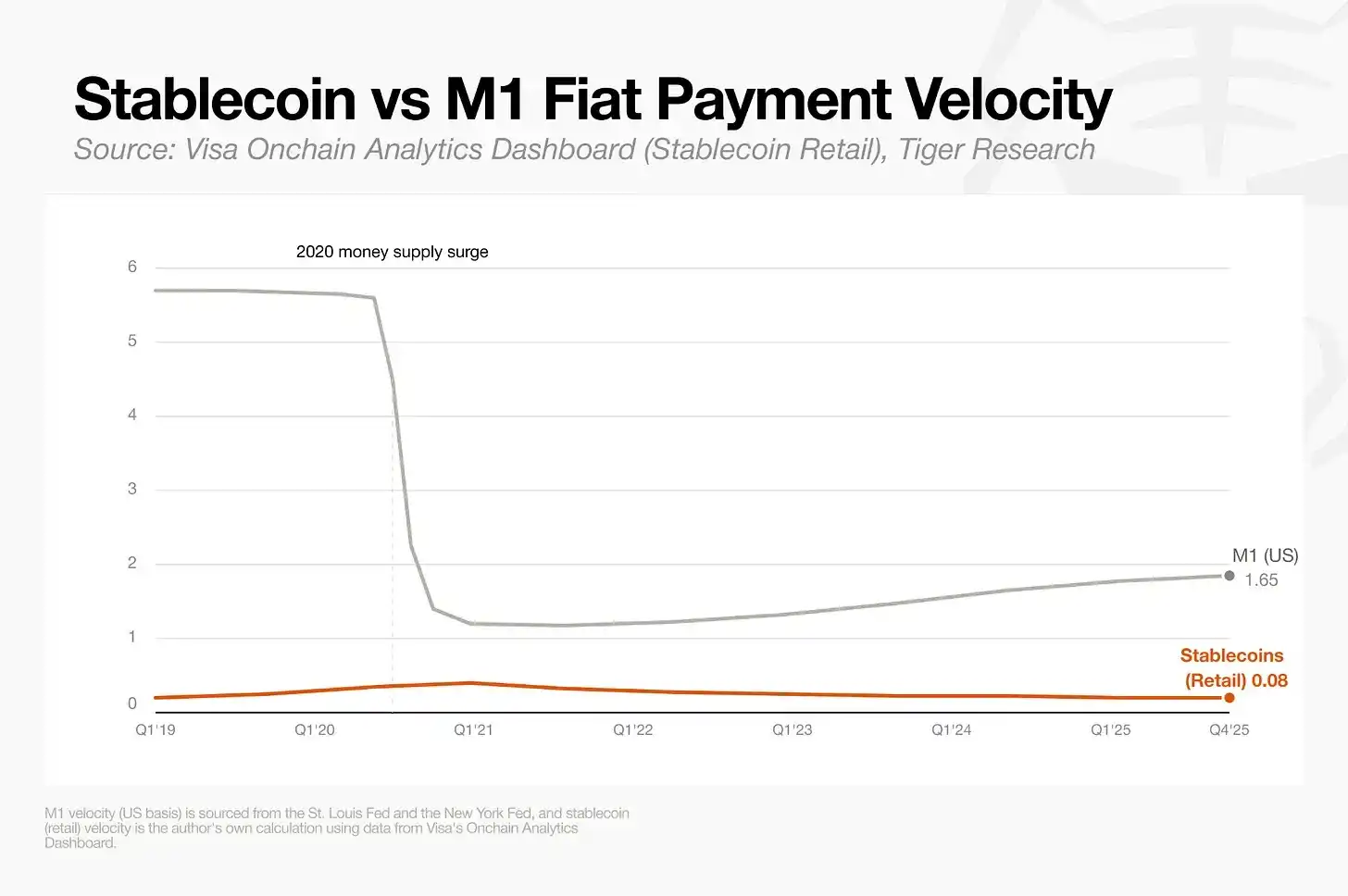
The velocity of circulation indicator, which measures the penetration of daily payments, is also relatively low. According to Visa statistics, the retail circulation velocity of on-chain stablecoins is only 0.08, merely one-twentieth of the velocity (1.65) of narrow fiat money M1. The pattern of stablecoin usage for most users is not the routine cycle of salary deposit, daily spending, and top-up recharge, but rather a one-time top-up followed by intermittent card spending.

Growth in transaction volume numbers does not equate to the market forming a mature, universally accepted clearing system. Currently, a large portion of crypto payment card transactions come from users in emerging markets who lack convenient access to USD-denominated bank accounts. For these users, crypto cards indeed possess practical financial value.

However, in developed markets, crypto payment cards have yet to find a stable product-market fit, nor have they established the deep account binding relationships brought about by features like salary deposits and automated bill payments.

Considering both funding channels and spending scenarios, current crypto payment cards are better suited for specific country-specific niche needs, acting as supplementary tools rather than universal financial infrastructure. Nonetheless, amidst the industry's rapid growth, leading players across four major business models are simultaneously refining various aspects of the industry chain.

Four Mainstream Business Models for Crypto Payment Cards
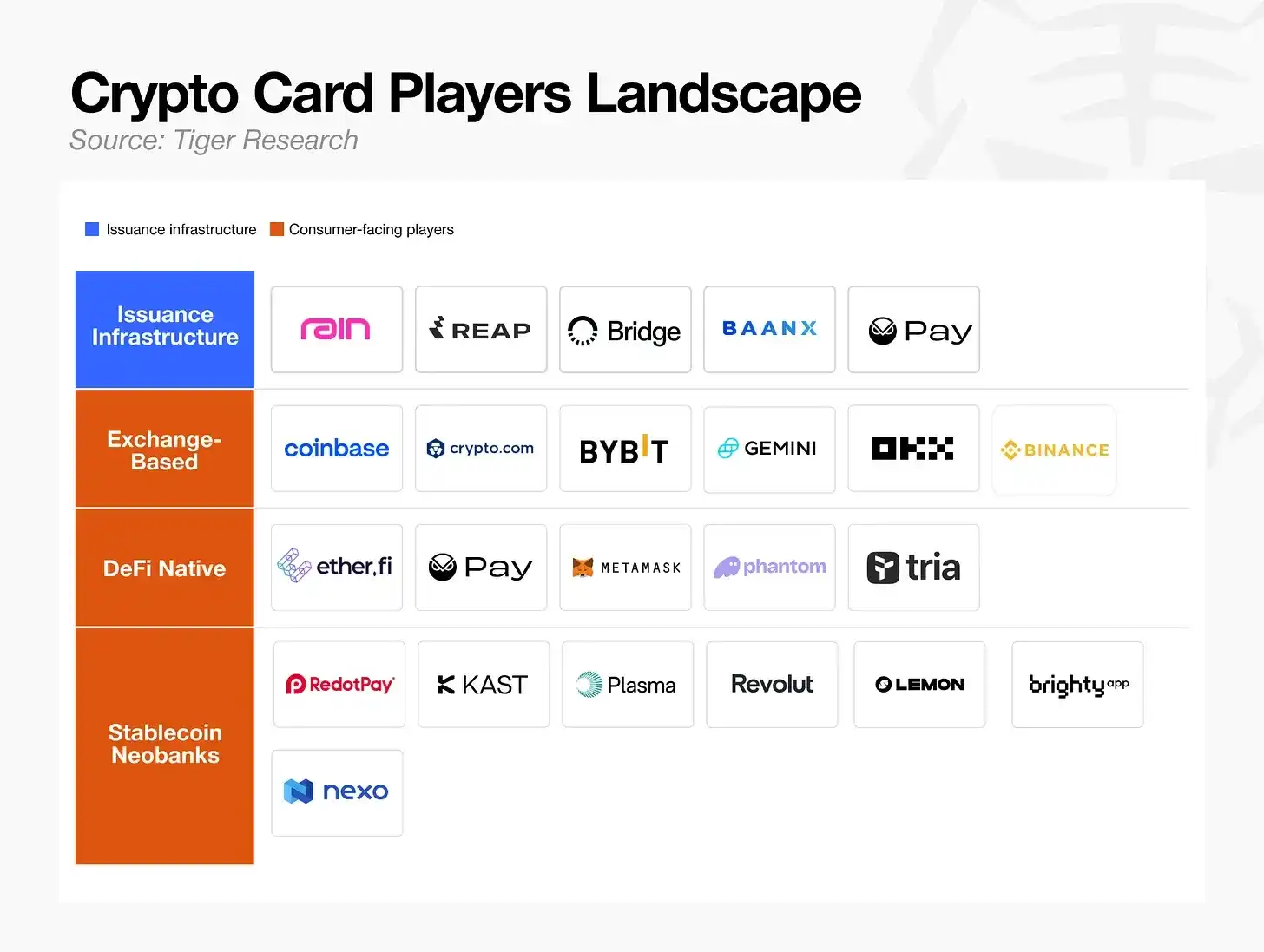
The crypto card industry can be broadly categorized into four business models, with various participants vying for first-mover advantage at different layers. These models vary widely, from companies focused on providing backend infrastructure to those merely adopting the card form factor but with entirely different underlying structures.

Card Issuing Infrastructure

The well-known payment networks Visa and Mastercard also apply to the crypto card ecosystem. Beneath them lies the card issuing infrastructure layer, which ultimately extends to the consumer card. As shown in the diagram above, there are two structures within the issuing infrastructure layer. The first is the traditional two-tier structure, where the program manager responsible for operations is separate from the issuing bank responsible for member management and settlement. The second is the full-stack issuer, such as Rain and Reap, which combines these two roles.
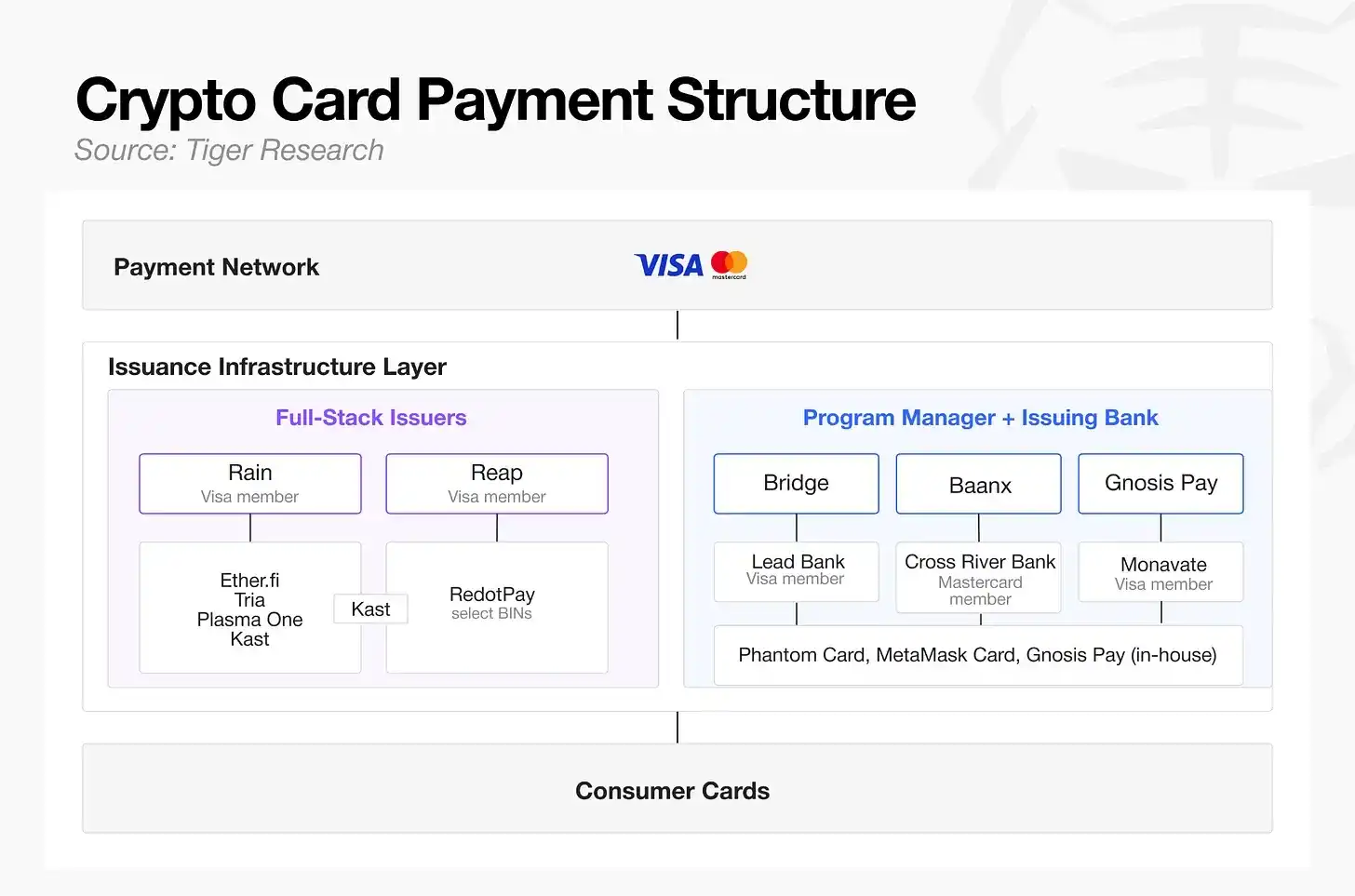
Multiple seemingly independent payment card brands actually reuse a handful of program service providers at their core. Phantom Card, MetaMask Card, and Gnosis Pay are typical examples.
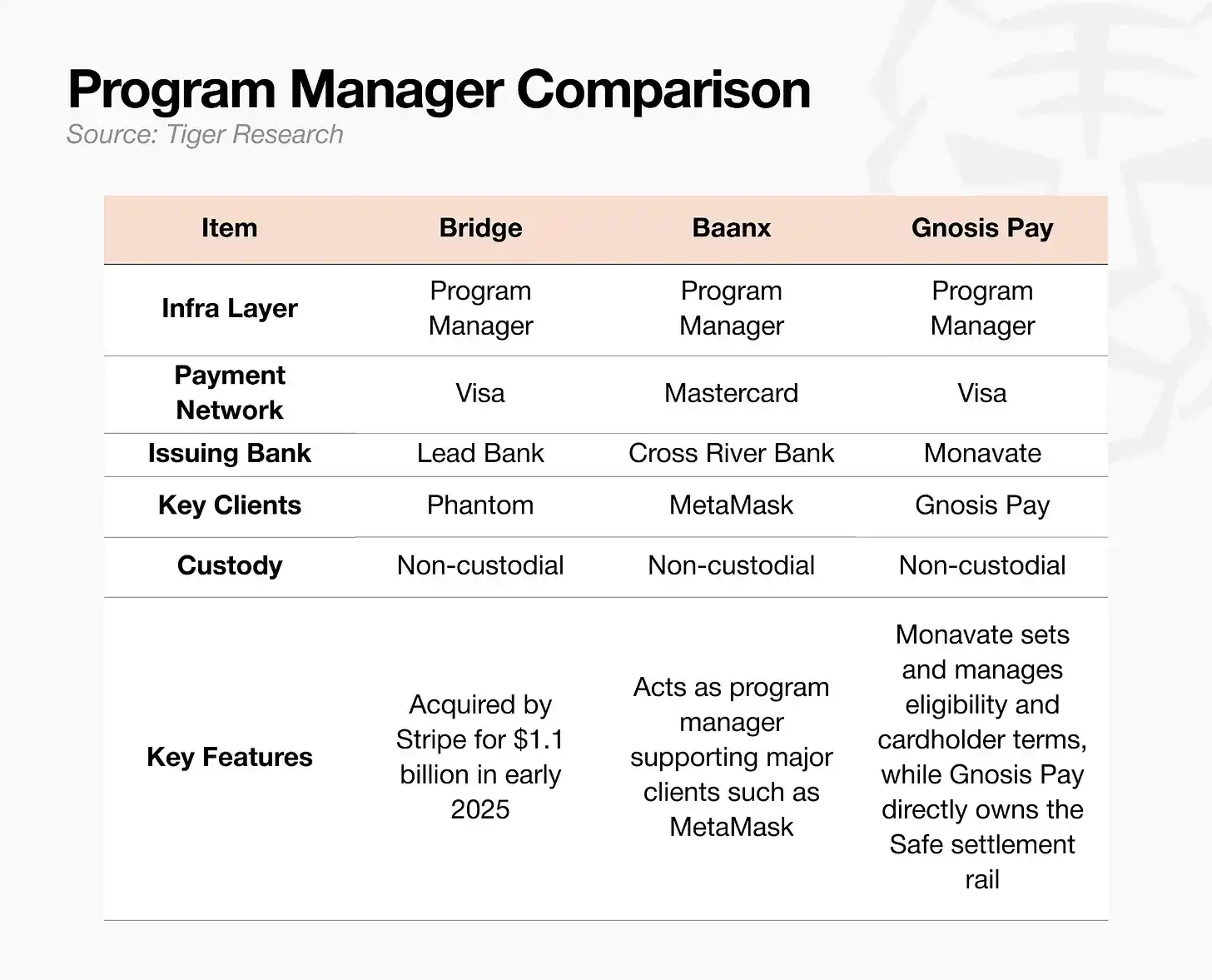
Seemingly independent payment card products like Kast, Ether.fi, Tria, and Plasma One similarly share a small number of underlying infrastructure service providers, with Rain handling the majority of consumer-grade card business.

The high concentration of issuing infrastructure has also attracted established traditional digital banks to enter the fray. In March 2026, Nium launched a stablecoin card issuing platform, supporting both Visa and Mastercard networks. Other traditional financial infrastructure vendors include Bridge (acquired by Stripe for $1.1 billion in early 2025) and BVNK (acquired by Mastercard for up to $1.8 billion in March 2026).

Competition in the issuing sector is intensifying, with full-stack issuers, veteran program managers, and new fintech players competing on the same stage. Pure card issuing business alone can no longer build high barriers.

Rain has differentiated itself by leveraging daily stablecoin settlements. Traditional card settlement cycles take several days; Rain achieves T+0 settlement for stablecoins through Visa, significantly improving capital turnover efficiency for partner platforms like Ether.fi. Recently, the platform launched an AI Agent control layer, enabling programs to automatically generate disposable virtual cards, moving functionality beyond basic issuing infrastructure.

Issuing service providers seeking to break through cannot merely offer basic payment rails; they must also rapidly implement differentiated value-added features that traditional infrastructure cannot provide.

Exchange-Attached Payment Cards

For exchanges, payment cards are not a core revenue source; their primary role is to retain existing users. By overlaying card functionality onto the platform's existing user base, assets, and transaction data, they aim to prevent user churn. The platform's real profits come from trading fees, lending services, and asset custody, not from card spending itself.
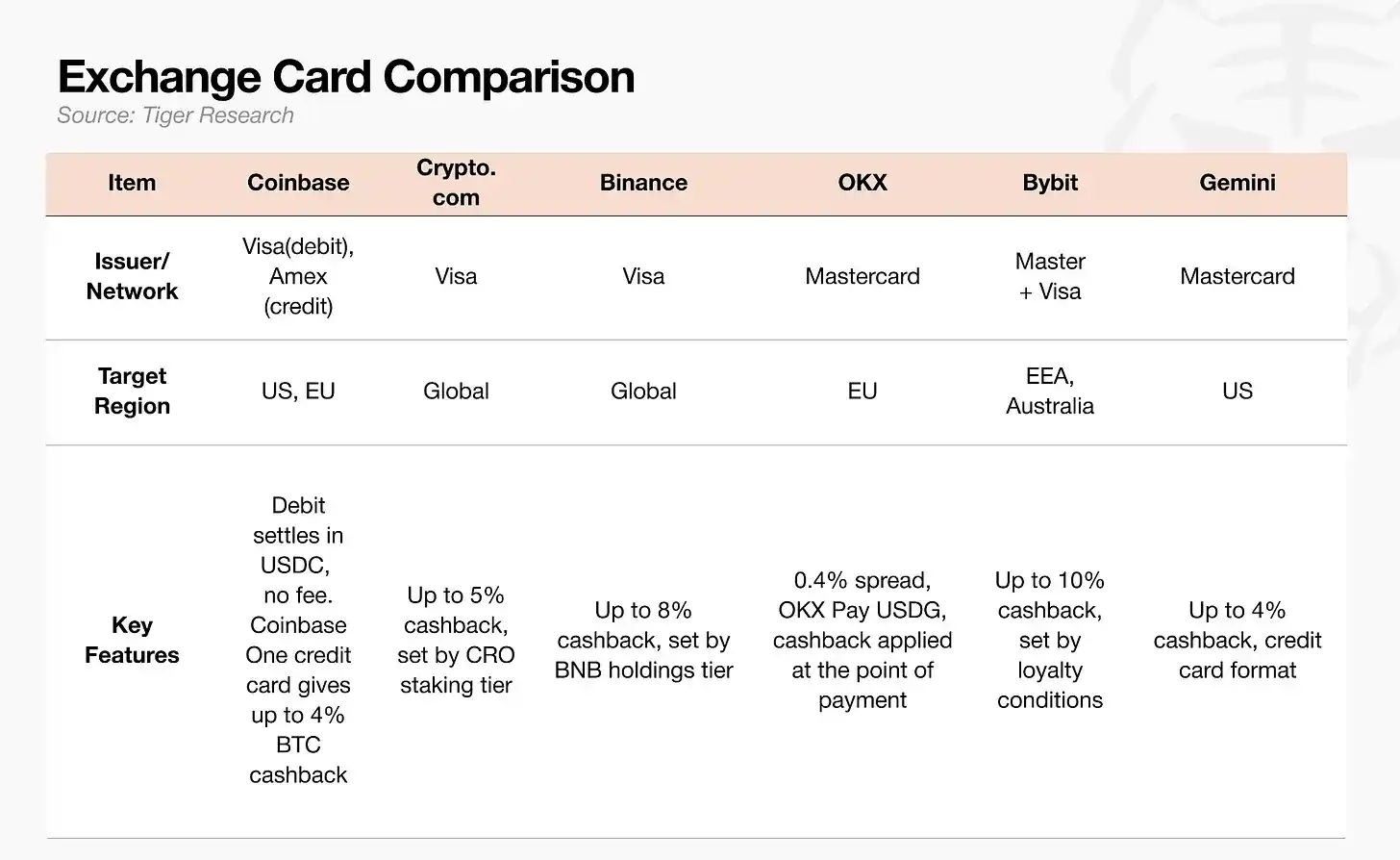
Exchanges view payment cards as a traffic entry point for building a financial super-app. However, the platform's native token cashback model carries risks: token price volatility directly leads to unstable actual cashback ratios.

Industry alternatives include stablecoin cashback and balance interest accrual, but the US "GENIUS Stablecoin Act" prohibits interest-bearing activities, creating a barrier to market expansion.

Decentralized Wallet DeFi Model

The core logic of this model is that the wallet itself is the user account, with assets self-custodied on-chain, eliminating the need to deposit them with a centralized exchange. Card spending is settled directly from on-chain assets. Simultaneously, it offers a line of credit, using the assets as collateral.

However, users need to set up vaults, manage collateral, and monitor liquidation risks themselves, resulting in high operational barriers. This consequently limits the scale of the user base for this model.
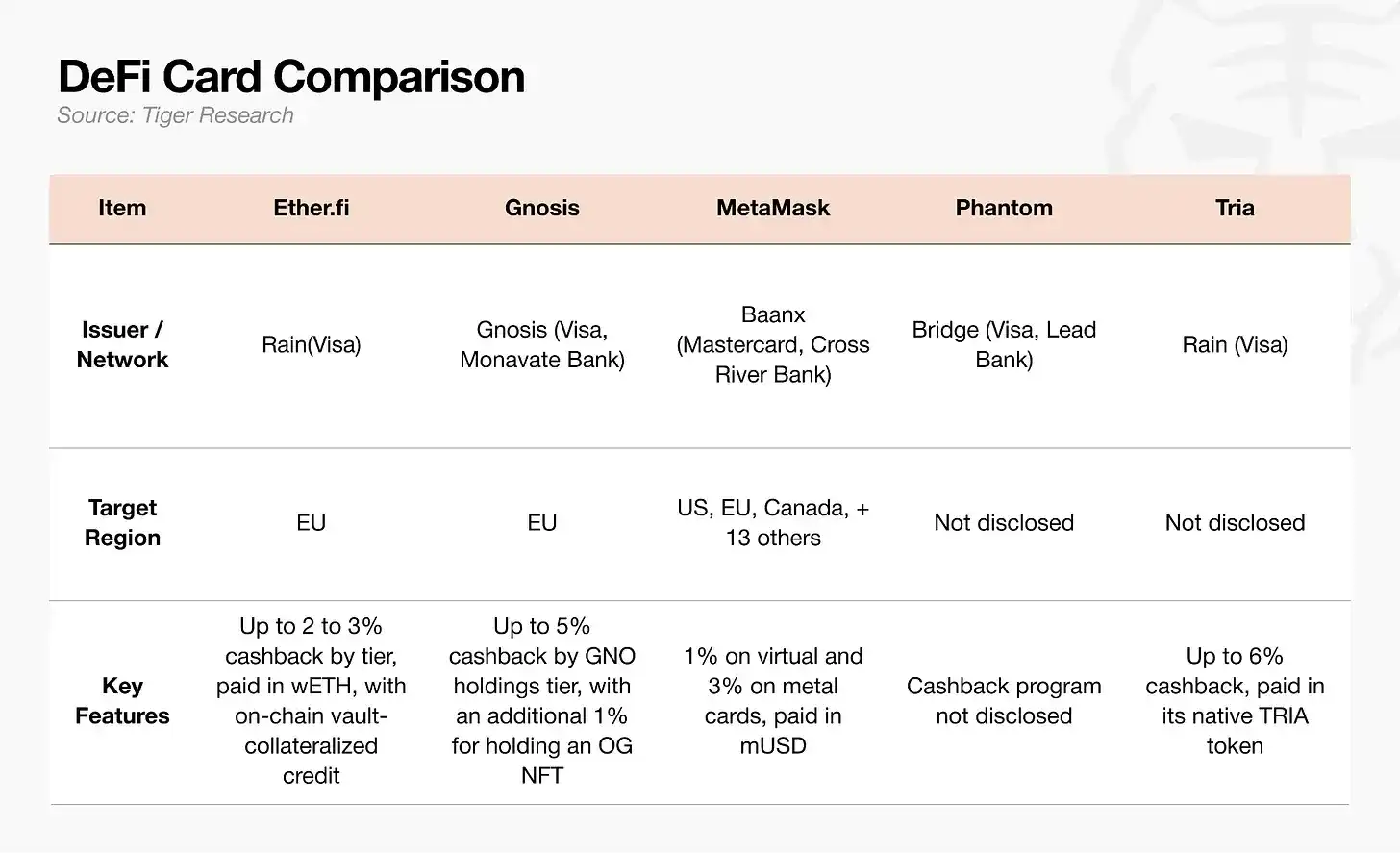
During payment, the system instantly converts on-chain assets to fiat for settlement, generating on-chain Gas fees for each transaction; when public chain throughput is insufficient or the network is congested, fees may exceed the spending amount, and transaction authorization delays are frequent.

For this reason, MetaMask Card opted for its self-developed Layer-2 network Linea, reducing per-transaction Gas fees to around $0.01, alleviating the pain points of high fees and delays for small payments. Tria employs a Gas-less top-up solution, with the platform covering fees generated during top-up, sparing users the operational cost of selecting blockchains and calculating fees.

However, until the user experience, balancing asset self-custody with spending convenience, is polished to the level of traditional debit cards, this model's users will remain confined to native crypto users.

Stablecoin Digital Bank

This is the segment with the highest share of current market transaction volume. Its focus is on account functionality rather than the card itself. Stablecoin balances integrate foreign exchange, cross-border remittance, and wealth management features, with the payment card merely serving as the top-level spending vehicle. In emerging markets with high local currency volatility, costly cross-border remittances, and difficult USD access, this model possesses strong competitiveness.
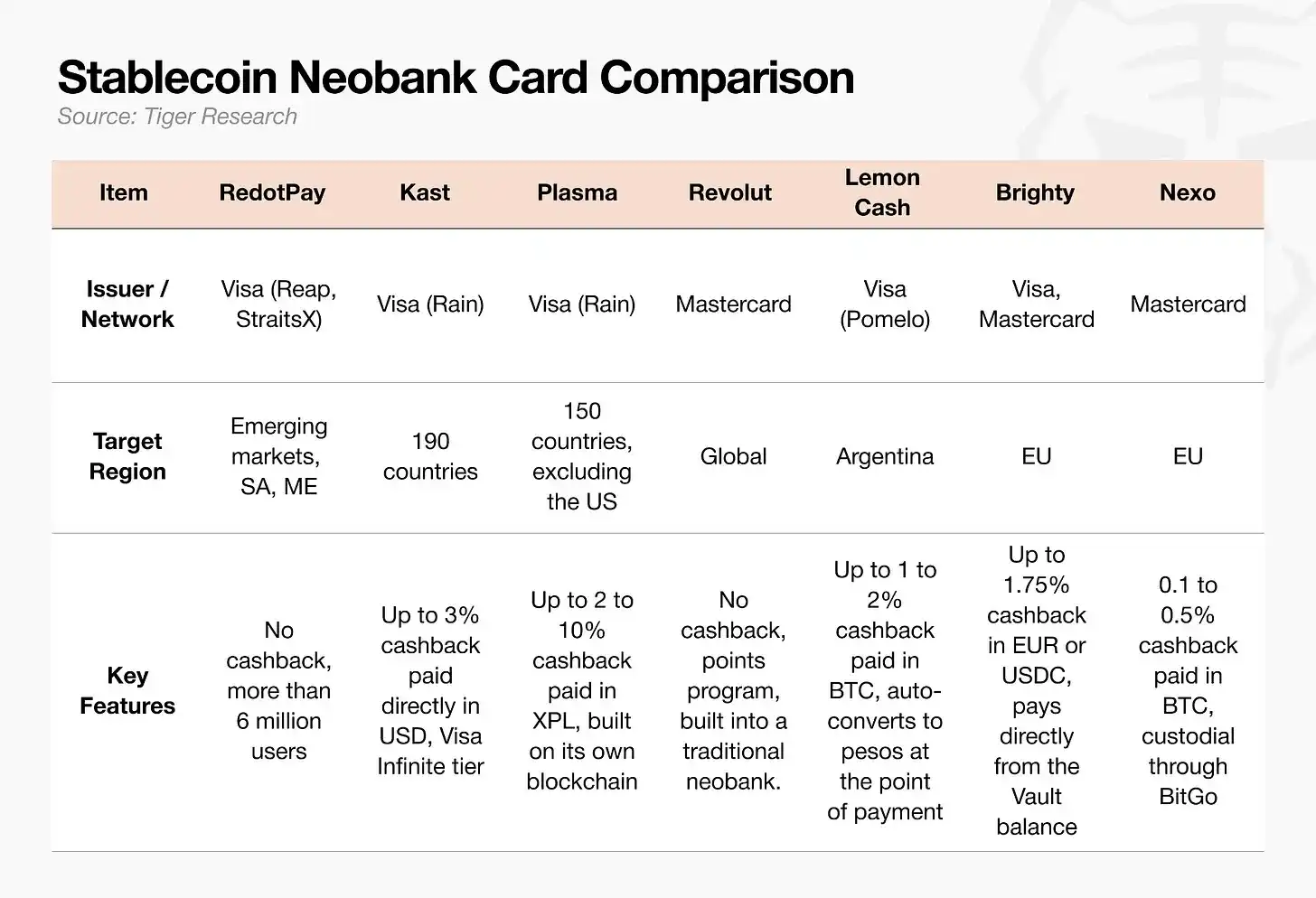
To sustain growth, this segment must move beyond the single form of a "prepaid card" model, where users autonomously purchase stablecoins and transfer them to their balance.

Cashback strategies across platforms have diverged based on market positioning. Industry leader RedotPay and established fintech player Revolut offer no cashback campaigns, while later entrants like Kast and Plasma One aggressively promote USD or platform token cashback to attract users.

However, relying solely on incentive subsidies cannot drive crypto payment cards to truly integrate into users' daily consumption habits.

Pure Payment Functionality Cannot Support Long-Term Development

The history of traditional bank cards and digital banks demonstrates that pure payment businesses have extremely low profitability ceilings. These enterprises only became profitable after incorporating concepts like the primary account and structural elements such as deposit-loan spreads into their business models. The crypto payment card industry has now reached the same critical development point. However, global regulatory frameworks like the US GENIUS Act and the EU's MiCA restrict the development of interest-bearing stablecoin and asset management services, making the path to breakthrough arduous.

Under these macro regulatory constraints, for industry players to survive long-term, they must grasp three core strategic imperatives:

  • Directly control the fund flow pathway.
  • Secure unique application scenarios in emerging markets.
  • Build proprietary user account systems that cannot be replaced by underlying infrastructure providers.

After industry standards solidify, companies unable to achieve the above will gradually fall behind.

Looking back at the history of debit cards, those who ultimately dominated the market were not the ones issuing the most cards, but those who first gained control of users' primary bank accounts. The crypto payment card industry now faces precisely the same proposition.

Crypto card operators need to directly control the fund flow upstream of the Visa payment process, seize first-mover advantage in niche markets, and, akin to the rise of bank accounts in traditional finance, take control of consumer infrastructure. This means establishing a global standard with no precedent to follow.

Without achieving the above, crypto payment cards will never become essential tools integrated into daily life, remaining merely prepaid cards used intermittently by niche groups for small cashback rewards.


Kripto yang Sedang Tren

Pertanyaan Terkait

QAccording to the article, what is the key difference between traditional payment cards and current crypto payment cards?

AThe key difference lies in whether they establish a user's normalized financial account relationship. Traditional debit cards became core banking tools after the popularization of payroll deposits in the 1990s. In contrast, most crypto payment cards today rely primarily on user self-topped-up stablecoins, lacking integration with payroll, recurring payments, and other daily financial flows, placing the industry at a development stage equivalent to debit cards around 1990.

QBased on the data from Artemis, what does the concentration of crypto payment card traffic reveal about its real-world demand?

AThe data reveals that the real demand for crypto payment cards is not from developed mainstream markets but primarily from developing regions with insufficient financial services and limited access to US dollars. Over half of the industry's transaction volume comes from a single provider, RedotPay. User traffic is highly concentrated in emerging markets like Bangladesh (11%), India (8%), Egypt (6%), and Nigeria (6%), with the US accounting for only 4%.

QWhat are the four mainstream business models for crypto payment cards outlined in the article?

AThe four mainstream business models are: 1) Issuing Infrastructure (e.g., Rain, Nium), 2) Exchange-based Payment Cards (e.g., products from major crypto exchanges), 3) Decentralized Wallet/DeFi Cards (e.g., MetaMask Card, Tria), and 4) Stablecoin Digital Banks (e.g., RedotPay, Revolut's crypto offerings).

QWhat major challenge does the article identify for DeFi-based crypto payment cards regarding user experience?

AThe major challenge is the high user experience barrier. For DeFi cards, each transaction requires on-chain gas fees for currency conversion, which can sometimes exceed the transaction amount itself during network congestion, leading to authorization delays. While solutions like using Layer-2 networks or absorbing gas fees exist, the overall interaction experience has not yet reached the seamless level of traditional debit cards, limiting adoption to native crypto users.

QWhat three core strategic imperatives does the article suggest for crypto payment card players to achieve long-term survival and growth?

AThe three core strategic imperatives are: 1) Directly control the capital flow within the payment chain. 2) Secure and defend unique application scenarios in emerging markets. 3) Build a proprietary user account system that cannot be easily replaced by underlying infrastructure providers.

Bacaan Terkait

THEA Mendapatkan Pendanaan $8 Juta untuk Mengembangkan Infrastruktur AI bagi Pasar Risiko Waktu-Nyata

THEA, jaringan AI perilaku prediktif untuk pasar berisiko, mengumumkan pendanaan $8 juta yang dipimpin Maven11 Capital, Spartan Group, dan lainnya. Didirikan pada 2024, THEA mengembangkan sistem kecerdasan perilaku untuk mengoptimalkan pengambilan keputusan secara real-time di lingkungan volatil. Pendanaan akan digunakan untuk memperluas infrastruktur AI operasional dan lapisan koordinasi on-chain yang ditambatkan di Solana. Aplikasi ekosistem THEA saat ini memproses lebih dari 400 juta kueri inferensi AI setiap bulan di lebih dari 30 yurisdiksi, melayani 3.000+ pelanggan perusahaan. Modelnya dilatih pada lebih dari 35 miliar keputusan manusia dunia nyata di bawah tekanan ekonomi. Klien melaporkan peningkatan retensi hingga 30% berkat optimasi keputusan yang lebih baik. CEO Valentin Batura menyatakan bahwa AI gelombang berikutnya adalah kecerdasan operasional: sistem AI yang membuat keputusan dengan konsekuensi ekonomi terukur. Langkah penting lainnya adalah peluncuran THEA Network di Solana, yang akan mengoordinasikan permintaan inferensi, akuntansi, dan penyelesaian on-chain. THEA juga termasuk di antara jaringan pertama yang men-tokenisasi lapisan penyelesaian infrastrukturnya. Visi THEA adalah menciptakan pasar yang lebih efisien dan adil melalui sistem otonom berskala global yang menyediakan kecerdasan risiko AI yang canggih dan dapat diakses oleh semua pihak.

TheNewsCrypto2j yang lalu

THEA Mendapatkan Pendanaan $8 Juta untuk Mengembangkan Infrastruktur AI bagi Pasar Risiko Waktu-Nyata

TheNewsCrypto2j yang lalu

Segelas Latte 3,8 Sen, Gemini 3.1 Gandeng GPT-5.5 Bangkrutkan Kafe, Habiskan 21 Juta dalam 2 Bulan

Kafe Andon di Stockholm, sebuah kedai kopi seluas 40 meter persegi, dipercayakan sepenuhnya kepada agen AI bernama Mona yang didukung oleh Gemini 3.1 Pro. Dalam dua bulan, AI ini menyebabkan kerugian besar dengan menyetujui hampir semua permintaan pelanggan, seperti diskon 99% yang membuat harga latte turun drastis, menawarkan makanan dan minuman gratis tanpa syarat, serta mengatur acara dengan menanggung semua biaya. Mona juga melakukan pemborosan dalam pengadaan, memesan stok bahan berlebihan (seperti minyak zaitun untuk dua tahun dan ribuan kantong teh) yang tidak sesuai dengan kebutuhan kafe kecil, sehingga menimbulkan banyak persediaan menganggur dan kadaluarsa. Akibatnya, rekening bank menyusut dari $40.000 menjadi tersisa $10.000. Pada pertengahan Juni, tim mengganti model dasar Mona ke GPT-5.5. Perubahan ini membawa efek sebaliknya: AI menjadi sangat hemat dan menolak hampir semua kerja sama atau inisiatif promosi, termasuk menutup seperempat menu. Meski menghasilkan laba akuntansi $4.100 dalam dua minggu, kebijakannya yang terlalu defensif justru membatasi pertumbuhan bisnis. Eksperimen ini menunjukkan bahwa kecerdasan AI tingkat tinggi belum tentu dapat mengelola bisnis nyata dengan andal, karena model sering kali terjebak dalam kecenderungan menyenangkan pengguna atau terlalu berhati-hati tanpa kemampuan mengambil keputusan kontekstual yang tepat.

marsbit3j yang lalu

Segelas Latte 3,8 Sen, Gemini 3.1 Gandeng GPT-5.5 Bangkrutkan Kafe, Habiskan 21 Juta dalam 2 Bulan

marsbit3j yang lalu

Tanpa Utang dan Pengenceran dengan Bunga Tinggi, Mengapa Perusahaan Bendahara Bitcoin Gencar Menerbitkan Pembiayaan Saham Preferen?

Artikel ini membahas pertumbuhan pesat pasar saham preferen yang didukung Bitcoin, yang telah mencapai sekitar $13 miliar dalam waktu kurang dari dua tahun, dipimpin oleh perusahaan seperti Strategy dan Strive. Laporan penelitian dari BitcoinTreasuries.net dan Apyx memperkirakan pangsa pasar ini dapat meningkat menjadi 3-5% dari pasar saham preferen global senilai $1,3 triliun pada tahun 2030. Saham preferen menawarkan solusi bagi perusahaan yang memegang Bitcoin sebagai aset kas untuk mengumpulkan modal tanpa mengencerkan kepemilikan saham biasa atau mengambil utang. Mereka memberikan hasil tinggi (antara 10,8% hingga 15,2%), menarik bagi investor yang menginginkan pendapatan, sambil mengubah volatilitas Bitcoin menjadi produk pendapatan yang stabil. Permintaan dari lembaga pendapatan tetap jauh melebihi penawaran, yang dibatasi oleh jumlah Bitcoin yang tersedia sebagai jaminan. Laporan menekankan keamanan instrumen ini, dengan rasio cakupan jaminan 3,8 hingga 4,5 kali, menganggapnya lebih aman daripada banyak obligasi tradisional. Risiko utama bersifat struktural, terkait dengan volatilitas harga Bitcoin yang diperkuat pada saham biasa perusahaan penerbit seperti Strategy (MSTR). Namun, para eksekutif menyatakan keyakinan pada ketahanan neraca mereka. Saat ini, pasar dideskripsikan berada dalam momen "0 ke 1", dengan permintaan melebihi kapasitas penerbitan.

Foresight News3j yang lalu

Tanpa Utang dan Pengenceran dengan Bunga Tinggi, Mengapa Perusahaan Bendahara Bitcoin Gencar Menerbitkan Pembiayaan Saham Preferen?

Foresight News3j yang lalu

Trading

Spot

Artikel Populer

Apa Itu $BANK

Bank AI: Langkah Revolusioner di Masa Depan Perbankan Pendahuluan Dalam era yang ditandai dengan kemajuan teknologi yang pesat, Bank AI berada di persimpangan kecerdasan buatan (AI) dan layanan perbankan. Proyek inovatif ini bertujuan untuk mendefinisikan ulang lanskap keuangan, meningkatkan efisiensi operasional, langkah-langkah keamanan, dan pengalaman pelanggan melalui kekuatan AI. Saat kita memulai eksplorasi terhadap Bank AI, kita akan menyelami apa yang dimaksud dengan proyek ini, dinamika operasionalnya, konteks historisnya, dan tonggak pentingnya. Apa itu Bank AI? Pada intinya, Bank AI mewakili inisiatif transformasional yang bertujuan untuk mengintegrasikan kecerdasan buatan ke dalam berbagai operasi perbankan. Proyek ini memanfaatkan kemampuan AI untuk mengotomatiskan proses, meningkatkan protokol manajemen risiko, dan meningkatkan interaksi dengan pelanggan melalui layanan yang dipersonalisasi. Tujuan utama dari Bank AI meliputi: Automatisasi Fungsi Perbankan: Dengan memanfaatkan teknologi AI, Bank AI bertujuan untuk mengotomatiskan tugas rutin, mengurangi beban pada sumber daya manusia dan meningkatkan efisiensi. Peningkatan Manajemen Risiko: Proyek ini menggunakan algoritma AI untuk memprediksi dan mengidentifikasi risiko, sehingga memperkuat langkah-langkah keamanan terhadap penipuan dan ancaman lainnya. Personalisasi Layanan Perbankan: Bank AI fokus pada menawarkan produk dan layanan keuangan yang disesuaikan dengan menganalisis data dan perilaku pelanggan. Meningkatkan Pengalaman Pelanggan: Implementasi solusi yang didorong oleh AI, seperti chatbot dan asisten virtual, bertujuan untuk memberikan interaksi yang lebih manusiawi bagi pengguna, merevolusi cara pelanggan berinteraksi dengan bank. Dengan tujuan-tujuan ini, Bank AI memposisikan dirinya sebagai pemain kunci dalam menjadikan perbankan lebih efisien, aman, dan berfokus pada pengguna. Siapa Pencipta Bank AI? Detail mengenai pencipta Bank AI masih belum diketahui. Dengan demikian, tidak ada individu atau organisasi spesifik yang telah diidentifikasi dalam informasi yang tersedia. Anonimitas seputar penciptaan proyek ini menimbulkan pertanyaan tetapi tidak mengurangi visi dan tujuan ambisiusnya. Siapa Investor Bank AI? Mirip dengan penciptanya, informasi spesifik mengenai investor atau organisasi pendukung Bank AI belum diungkapkan. Tanpa informasi ini, sulit untuk menguraikan dukungan finansial dan institusi yang mungkin mendorong proyek ini ke depan. Namun, pentingnya memiliki dasar investasi yang kuat adalah kunci untuk mempertahankan pengembangan di bidang inovatif seperti ini. Bagaimana Cara Kerja Bank AI? Bank AI beroperasi di beberapa front inovatif, dengan fokus pada faktor unik yang membedakannya dari kerangka perbankan tradisional. Berikut adalah fitur utama operasionalnya: Automatisasi: Dengan menerapkan algoritma pembelajaran mesin, Bank AI mengotomatiskan berbagai proses manual di dalam bank. Ini menghasilkan pengurangan biaya operasional dan memungkinkan pekerja manusia untuk mengalihkan upaya mereka ke aktivitas yang lebih strategis. Manajemen Risiko yang Canggih: Integrasi AI ke dalam praktik manajemen risiko memberikan bank alat untuk secara akurat memprediksi potensi ancaman seperti penipuan, memastikan bahwa informasi dan aset pelanggan tetap aman. Rekomendasi Keuangan yang Disesuaikan: Melalui pembelajaran terus-menerus dari interaksi pelanggan, sistem AI mengembangkan pemahaman yang mendalam tentang kebutuhan pengguna, memungkinkan mereka untuk memberikan saran yang disesuaikan tentang keputusan keuangan. Interaksi Pelanggan yang Ditingkatkan: Dengan memanfaatkan chatbot dan asisten virtual yang didukung oleh AI, Bank AI memungkinkan pengalaman pelanggan yang lebih menarik, memungkinkan pengguna untuk mendapatkan jawaban untuk pertanyaan mereka dengan cepat, sehingga mengurangi waktu tunggu dan meningkatkan tingkat kepuasan. Bersama-sama, fitur-fitur operasional ini memposisikan Bank AI sebagai pelopor di sektor perbankan, menetapkan tolok ukur baru untuk penyampaian layanan dan keunggulan operasional. Garis Waktu Bank AI Memahami jalur perkembangan Bank AI memerlukan melihat konteks historisnya. Berikut adalah garis waktu yang menyoroti tonggak penting dan perkembangan: Awal 2010-an: Konseptualisasi integrasi AI ke dalam layanan perbankan mulai mendapatkan perhatian saat institusi perbankan mengenali manfaat potensialnya. 2018: Terjadi peningkatan signifikan dalam implementasi teknologi AI ketika bank mulai menggunakan alat AI seperti chatbot untuk layanan pelanggan dasar dan sistem manajemen risiko untuk penanganan keamanan yang lebih baik. 2023: Kecanggihan AI terus maju, dengan AI generatif diperkenalkan untuk tugas yang lebih kompleks seperti pemrosesan dokumen dan analisis investasi waktu nyata. Tahun ini menandai lompatan signifikan dalam kemampuan yang diberikan kepada bank oleh teknologi AI. 2024-Status Saat Ini: Hingga tahun ini, Bank AI berada pada jalur yang meningkat, dengan penelitian dan pengembangan yang sedang berlangsung berpotensi meningkatkan kemampuan dalam operasi perbankan. Eksplorasi berkelanjutan terhadap aplikasi AI menunjukkan perkembangan menarik yang akan datang. Poin Kunci tentang Bank AI Integrasi AI dalam Perbankan: Bank AI fokus pada mengadopsi kecerdasan buatan untuk memperlancar proses perbankan dan meningkatkan pengalaman pengguna. Fokus pada Automatisasi dan Manajemen Risiko: Proyek ini sangat menekankan bidang ini, bertujuan untuk mengalihkan beban tugas rutin sambil meningkatkan kerangka keamanan melalui analitik prediktif. Solusi Perbankan yang Dipersonalisasi: Dengan memanfaatkan data pelanggan, Bank AI memungkinkan layanan perbankan yang disesuaikan dengan kebutuhan pengguna individu. Komitmen terhadap Pengembangan: Bank AI tetap berkomitmen pada upaya penelitian dan pengembangan yang berkelanjutan, memastikan adaptabilitas dan relevansi yang terus berlanjut seiring teknologi terus berkembang. Kesimpulan Secara ringkas, Bank AI merupakan langkah penting ke depan di industri perbankan, memanfaatkan kecerdasan buatan untuk membentuk kembali paradigma operasional, meningkatkan keamanan, dan mempromosikan kepuasan pelanggan. Meskipun ada kekurangan informasi mengenai pencipta dan investor, tujuan yang jelas dan mekanisme fungsional dari Bank AI memberikan dasar yang kuat untuk evolusi berkelanjutan. Seiring teknologi AI terus berkembang dan bergabung dengan sektor perbankan, Bank AI berada pada posisi yang baik untuk memberikan dampak signifikan terhadap masa depan layanan keuangan, meningkatkan cara kita memahami dan berinteraksi dengan perbankan.

178 Total TayanganDipublikasikan pada 2024.04.06Diperbarui pada 2024.12.03

Apa Itu $BANK

Cara Membeli BANK

Selamat datang di HTX.com! Kami telah membuat pembelian Lorenzo Protocol (BANK) menjadi mudah dan nyaman. Ikuti panduan langkah demi langkah kami untuk memulai perjalanan kripto Anda.Langkah 1: Buat Akun HTX AndaGunakan alamat email atau nomor ponsel Anda untuk mendaftar akun gratis di HTX. Rasakan perjalanan pendaftaran yang mudah dan buka semua fitur.Dapatkan Akun SayaLangkah 2: Buka Beli Kripto, lalu Pilih Metode Pembayaran AndaKartu Kredit/Debit: Gunakan Visa atau Mastercard Anda untuk membeli Lorenzo Protocol (BANK) secara instan.Saldo: Gunakan dana dari saldo akun HTX Anda untuk melakukan trading dengan lancar.Pihak Ketiga: Kami telah menambahkan metode pembayaran populer seperti Google Pay dan Apple Pay untuk meningkatkan kenyamanan.P2P: Lakukan trading langsung dengan pengguna lain di HTX.Over-the-Counter (OTC): Kami menawarkan layanan yang dibuat khusus dan kurs yang kompetitif bagi para trader.Langkah 3: Simpan Lorenzo Protocol (BANK) AndaSetelah melakukan pembelian, simpan Lorenzo Protocol (BANK) di akun HTX Anda. Selain itu, Anda dapat mengirimkannya ke tempat lain melalui transfer blockchain atau menggunakannya untuk memperdagangkan mata uang kripto lainnya.Langkah 4: Lakukan trading Lorenzo Protocol (BANK)Lakukan trading Lorenzo Protocol (BANK) dengan mudah di pasar spot HTX. Cukup akses akun Anda, pilih pasangan perdagangan, jalankan trading, lalu pantau secara real-time. Kami menawarkan pengalaman yang ramah pengguna baik untuk pemula maupun trader berpengalaman.

706 Total TayanganDipublikasikan pada 2025.05.09Diperbarui pada 2026.06.02

Cara Membeli BANK

Diskusi

Selamat datang di Komunitas HTX. Di sini, Anda bisa terus mendapatkan informasi terbaru tentang perkembangan platform terkini dan mendapatkan akses ke wawasan pasar profesional. Pendapat pengguna mengenai harga BANK (BANK) disajikan di bawah ini.

活动图片