Tech stocks suffered their biggest drop in months, with Bitcoin falling below the $60,000 mark, all just as Elon Musk's SpaceX is preparing for what could be the largest IPO in history.
On June 5, according to Wall Street News, the May non-farm payrolls data significantly exceeded expectations, dashing market hopes for Federal Reserve rate cuts and bringing rate hike expectations to the forefront.
High-valuation sectors in US stocks were severely hit, with AI and semiconductors leading the declines. The S&P 500 fell 2.6%, the Nasdaq plunged over 4%, and the semiconductor index plummeted 10% in a single day, erasing over a trillion dollars in market value.
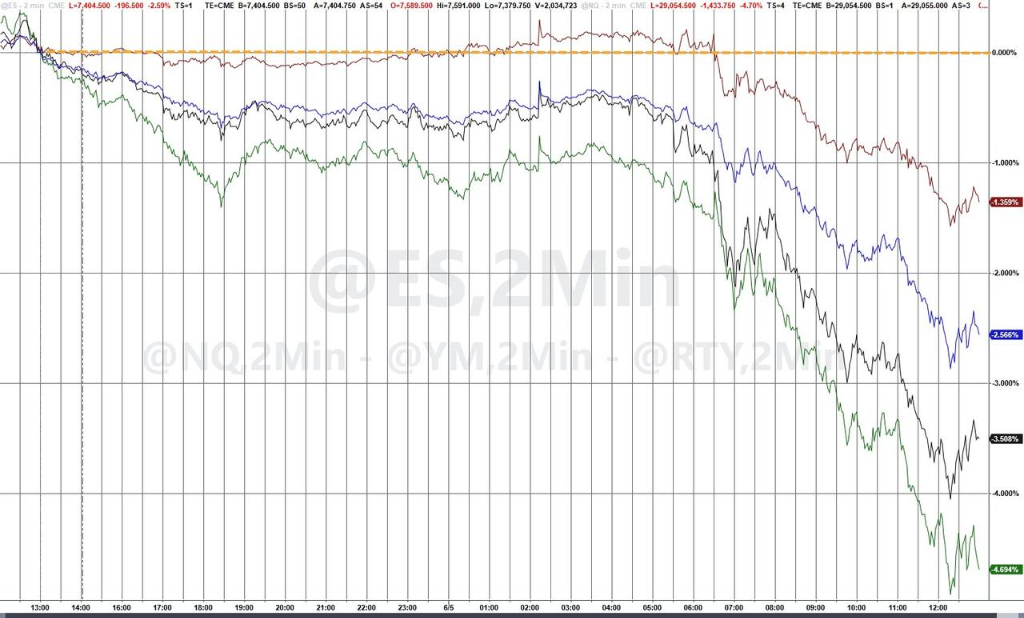
Cryptocurrencies plunged sharply due to high interest rates and a strong dollar. Bitcoin plummeted up to 7%, briefly falling below $60,000 for the first time since October 2024, wiping out all gains made since Trump's election. Ethereum tumbled 11% in a day, down over 20% for the week.
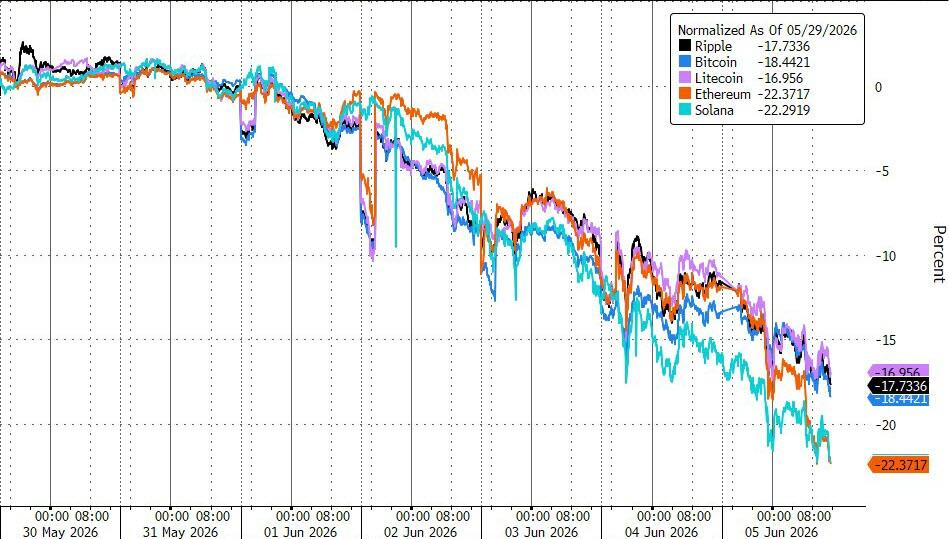
Multiple speculative trades favored by retail investors came under simultaneous pressure, leading to renewed scrutiny of the limits of retail capital and where this money might ultimately flow.
SpaceX's listing plan becomes even more uncertain against this backdrop. The demand for this rocket, satellite, and artificial intelligence company appears unstoppable, but the market's violent swings have planted doubts in investors' minds.
Friday's market plunge represents a concentrated stress test of the current market structure.
The simultaneous decline in the artificial intelligence sector, cryptocurrencies, and high-risk tech stocks made the day particularly unusual. Alex Morris of F/m Investments stated:
This feels like a severe shakeout in the tech sector, and it's another reminder that speculative assets like Bitcoin and SpaceX can sometimes quickly unwind their premiums and bleed out fast. No matter how real, how breathtaking SpaceX's rockets and satellite internet business are, they're not immune to this.
Steve Sosnick, Chief Strategist at Interactive Brokers, characterized this decline as a deeper structural warning:
It's a reminder that parabolic rises are inherently unstable and often end in surprising ways, especially when masses of investors equate risk with reward rather than viewing it as a variable to be balanced.
Mina Krishnan, a multi-asset portfolio manager at Schroders, pointed out that market fragility had already been building:
After nine consecutive weeks of gains and with positioning stretched to the limit, the kindling for a sell-off was already in place, waiting for a match. Today, it finally found one.
SpaceX plans to allocate up to 30% of its offering to retail investors, a proportion far exceeding the usual industry norm of around 5%.
Musk is clearly targeting his fanbase, a group that has flooded into the stock market in the era of zero commissions and become a formidable market force.
However, the timing for a retail allocation potentially as large as $22.5 billion may be less than ideal.
According to Bloomberg, at major retail broker Charles Schwab, client cash as a percentage of assets has fallen to its lowest level since at least 2019.
Bloomberg Intelligence data shows retail accounts now account for one-fifth of total trading volume, double the level 15 years ago; while data cited by Jefferies from Bloomberg indicates the combined market share of long-only and hedge funds has shrunk from 23% in 2010 to 15%.
This means that for retail investors to buy SpaceX, they will likely need to sell existing holdings to free up capital. Tesla, Musk's other public company, is seen as the most vulnerable candidate for such selling.
Meir Statman, a finance professor at Santa Clara University, was blunt:
Musk is trying to make SpaceX stock a meme stock, and he may well succeed. But I keep telling my students: a good company's stock is not necessarily a good investment. Valuation is always key.
SpaceX is entering a market ecosystem where speculative options have never been more concentrated.
From cryptocurrencies to meme stocks, zero-day options, leveraged ETFs, AI concept stocks, and prediction markets—each wave of narrative is backed by increasingly sophisticated trading infrastructure, all vying for the same pool of retail attention and capital.
According to Bloomberg Intelligence, over 600 US ETFs have been launched in the past six months alone, accounting for more than one-tenth of the roughly 5,200 products in the entire industry.
More than 20 ETFs linked to SpaceX have filed for registration this year, spanning various forms including leveraged, inverse, and options strategies.
Anthropic and OpenAI are not yet public, but ETFs tracking them are already queuing up for preparation. David Kass, a finance professor at the University of Maryland's business school, warned:
IPOs for Anthropic and OpenAI are likely coming later this year, and investors will then shift capital from one name to another. It's extremely rare to have several massive IPOs in such a short timeframe, and they're all competing for the same fixed pool of capital.
Dan Suzuki, Global Investment Strategist at iCapital, highlighted another possibility:
This creates a tricky setup for the upcoming SpaceX IPO, and there are genuine concerns about the market's capacity to digest supply. But the surprise might just be that this IPO could instead inject fresh excitement, offering retail investors a new story beyond the AI infrastructure theme, and thus provide market support.
Even if SpaceX successfully attracts a massive retail subscription, retaining those investors may be an even greater challenge.
According to JPMorgan's analysis of recent IPOs, retail investors chase first-day momentum about 86% of the time, and if the stock continues to rise, buying activity often increases further in the following weeks.
But retail holding periods themselves are inherently short. Kass stated:
A significant number of retail investors operate on a very short time horizon. They're more inclined to ask 'how much can I make this week or this month' rather than hold and wait like a value investor.
Kass emphasized that the spread of zero-commission trading combined with a constant barrage of information "only accelerates the flow of money between different narratives."
As regulators approve new rules, active margin traders are no longer bound by the long-standing requirement to maintain "at least $25,000 in account equity," further lowering the barrier to high-frequency trading.
Prediction markets, perpetual contracts, and the rise of brokerage platforms have collectively created a market environment where capital can switch between narratives faster than ever before.
This means that even if SpaceX sets a historic IPO record, it is unlikely to stand alone in the current market landscape.
It is merely the latest, and so far the most expensive, chip in this endless battle for attention.




















