Original|Odaily Planet Daily(@OdailyChina)
Author|Wenser(@wenser 2010)
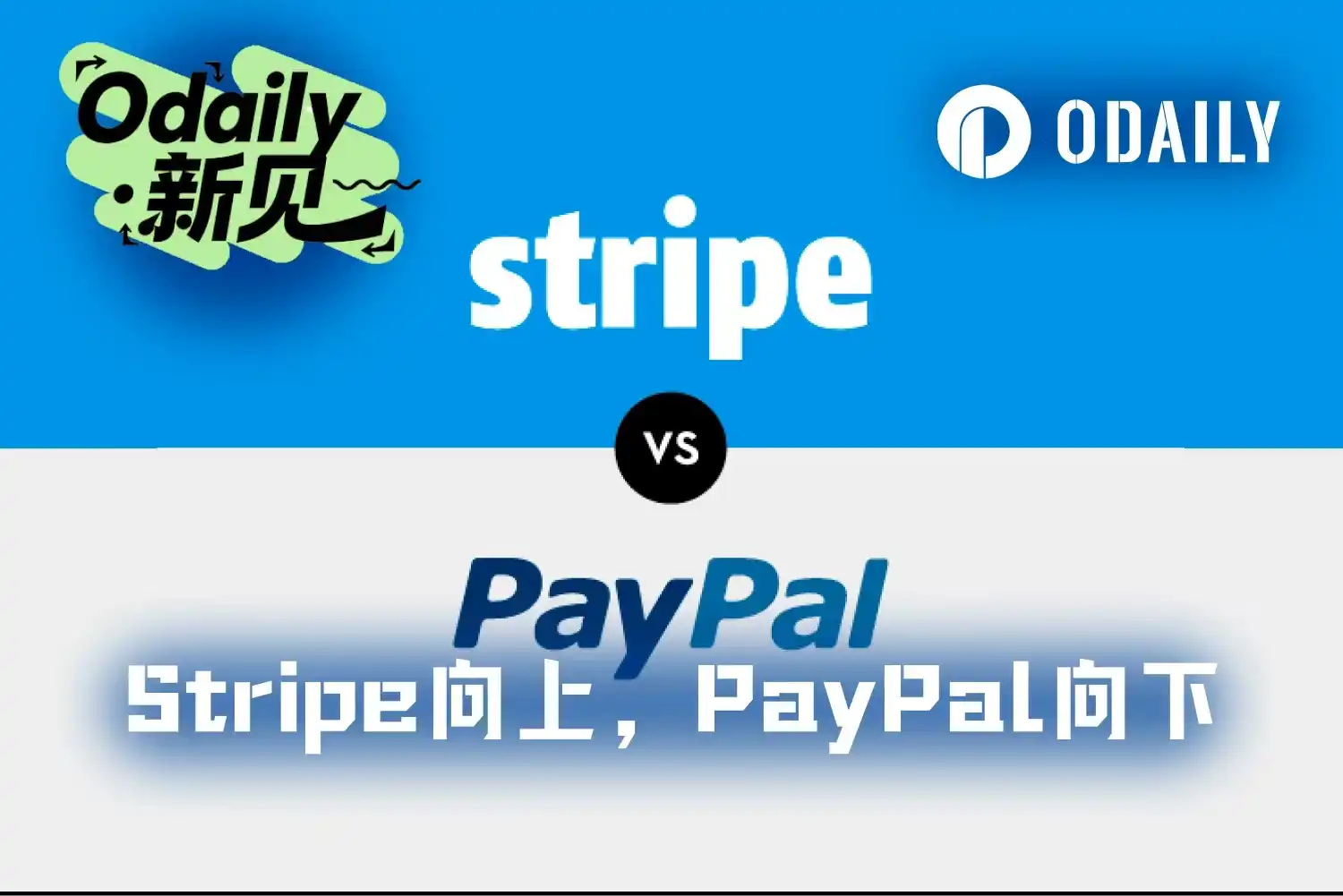
On February 24, 2026, the global payments industry witnessed two landmark "turning point events":
First, Stripe announced a new tender offer round completed at a valuation of $159 billion, with Thrive Capital, Coatue, a16z, and other institutions jointly providing the funds. This represents a staggering 74% surge from its $91.5 billion valuation a year ago. On the same day, Stripe's co-founders Patrick and John Collison released their 2025 public letter, reviewing $1.9 trillion in annual transaction volume on the Stripe platform—a 34% year-over-year increase, accounting for approximately 1.6% of global GDP.
Second, was the latest news from the "former payments霸主 (overlord)" PayPal: According to Bloomberg, PayPal is engaging with potential acquirers, with at least one major competitor evaluating a potential acquisition. The news sent PayPal's stock soaring intraday by 9.7%, closing up about 5.76%, making it the biggest gainer in the S&P 500 that day (Odaily Planet Daily Note: even as the three major indices fell across the board).
Worth pondering is the subsequent Bloomberg report that Stripe is considering acquiring all or part of PayPal's business. Interesting, right? The former's positive news is its soaring valuation; the latter's positive news is that "finally, a big buyer is willing to take me."
This is not merely an episode in the story of two payment giants, but more like a dividing line about "who saw the next era."
Stripe's Infinite Game: The Operating System for the "Financial Internet"
If your understanding of Stripe is still stuck at "a company that makes payment APIs," you are at least three years behind.
Looking back at Stripe's 2025 business revenue, its achievements are evident: 90% of companies in the Dow Jones index and 80% of companies in the Nasdaq 100 use Stripe; almost all top AI companies—OpenAI (ChatGPT), Anthropic (Claude), Cursor, Midjourney—use Stripe for their payment infrastructure; In Delaware, known as the "heartland of American innovation," 25% of newly registered companies are created through Stripe Atlas (Odaily Planet Daily Note: a B2B company registration service platform). In 2025, 20% of Atlas startups completed their first charge within 30 days of incorporation, a figure that was only 8% five years ago.
An important driver behind these achievements is undoubtedly Stripe's deep strategic layout in the business line of crypto payments and on-chain finance.
The Collison brothers wrote a line in their public letter that forces deep thought across the entire payments industry and even the crypto market: "It might be crypto winter now, but it's definitely stablecoin summer." Data confirms this judgment—In 2025, Bitcoin's price fell about 50% from its peak, but stablecoin trading volume reached an unprecedented $34 trillion; Payment volume doubled, reaching approximately $400 billion, with about 60% coming from B2B payment scenarios.
The reality is that in 2025, the growth data for stablecoin adoption officially decoupled from the price volatility of crypto assets.
Stripe placed a heavy bet before this inflection point arrived:
In October 2024, it acquired stablecoin infrastructure company Bridge for approximately $1.1 billion, its largest single acquisition ever. Post-acquisition, Bridge's transaction volume grew by over 4 times; In July 2025, it acquired crypto wallet infrastructure company Privy, which supports over 110 million programmable wallets;
In September 2025, it co-incubated Tempo, a Layer 1 blockchain designed for payments, with Paradigm. The mainnet officially launched in March 2026, supporting over 100,000 TPS and sub-second settlement. Visa, Shopify, Mastercard, Anthropic, OpenAI, Revolut, and others have already integrated.
Thus, Stripe built its own stablecoin ecosystem—stablecoin backend infrastructure Bridge, wallet frontend application Privy, and underlying settlement system Tempo—intertwining vertically and horizontally, spanning the closed-loop ecosystem of stablecoin issuance, custody, and settlement.
Looking further ahead: Stripe also co-developed the Agent Commerce Protocol (ACP) with OpenAI, launching Machine Payments—allowing developers to charge AI Agents directly for API calls, settled via stablecoin micro-payments. This is a payment scenario that did not exist. Stripe's judgment is direct: When AI Agents start making purchasing decisions for humans, whoever controls the payment channel抢先 (seizes the initiative) masters the core lifeline of the AI economy.
Stripe's Foresight: Letting the Entire Payments Industry Copy Its Homework
How far ahead Stripe's布局 (layout) is can be seen by the actions of its peers.
In March 2026, Mastercard announced the acquisition of stablecoin infrastructure company BVNK for up to $1.8 billion, Mastercard's largest acquisition ever in the digital asset space. Mastercard's Chief Product Officer Jorn Lambert was frank: "We expect that, over time, most financial institutions and fintech companies will offer digital currency services."
Note the phrase—"will offer." Stripe is already offering them, and has been for a full year and a half. The timeline for this battle over stablecoin infrastructure is laid out here:
October 2024: Stripe acquires Bridge;
May 2025: Visa makes a strategic investment in BVNK;
2025: Coinbase negotiates to acquire BVNK for ~$2 billion, but talks ultimately collapse;
March 2026: Mastercard acquires BVNK for $1.8 billion. The entire traditional payments industry is only scrambling to buy this ticket in 2026, which Stripe had already purchased in 2024.
Additionally, another industry anecdote: Airwallex founder Jack Zhang previously revealed that as early as 2018, Stripe made a $1.2 billion offer to acquire Airwallex—at a time when Airwallex's annual revenue was only about $2 million, corresponding to a valuation of approximately 600 times revenue. This means that in cross-border payments, Stripe saw something others hadn't as early as 2018.
Foresight is never one correct judgment, but a sustained ability to perceive trends.
PayPal's Past Dilemma: When the Former Overlord Gets Lost in the New Age of Navigation
Now, look at PayPal.
To summarize the history of this former giant in one sentence: In 1998, PayPal was born in the golden age before the dot-com bubble burst, quickly becoming the default payment method for eBay e-commerce and an early foundational player in internet finance. But the more glorious the history, the more starkly it highlights the harsh present reality: PayPal is losing momentum across the board, and precisely in the areas where it was once most proud.
For the full year 2025, PayPal's net revenue was $33.2 billion, with growth of only 4.3%, lower than 2024's 6.8%, and continuing to decline. Core unbranded checkout business grew only 4% for the year, dropping to 1% in Q4, a cliff-like fall from 7% a year ago—behind this number is the comprehensive erosion of PayPal's core territory by Apple Pay, Google Pay, Stripe, and Adyen. Transactions per active account fell 5% year-over-year in Q4, and the total number of active accounts stagnated around 439 million.
In February 2026, after the Q4 earnings release, the stock price plummeted over 20% in a single day. CEO Alex Chriss subsequently stepped down, and new CEO Enrique Lores took over on March 1st. Management's statement on the earnings call was: "Our execution has not been at the level it should be."
The PYUSD card was once PayPal's biggest bet to enter the on-chain world, but reality dealt it a harsh slap: Launched in August 2023, its current market capitalization is still less than $4 billion, with a market share of less than 0.5%, almost negligible compared to USDT and USDC, and even surpassed by the later entrant USD1's market cap.
Only recently, after nearly 3 years, has PayPal expanded PYUSD to approximately 70 markets globally—this move itself isn't wrong, but on a track where competitors have been racing ahead for nearly two years, the advantage of an early start has become meaningless.
More fatally, the "early bird catches the worm, but PayPal ended up late" situation reflected a fundamental矛盾 (contradiction) hidden beneath its surface business: PayPal's business model relies on "revenue from funds flow fees," while the stablecoin business model relies on "earning interest on Treasury bills from settled assets." There is a natural conflict between these two logics—every time PayPal promotes a PYUSD stablecoin payment, it is, to some extent, cannibalizing its own traditional fee revenue.
This is a problem that is difficult to solve within PayPal's existing business framework.
The Battle of the New and Old "Kings of Payment": Who is Building New Infrastructure, Who is Repairing Old Pipelines?
Looking at the two companies together, the node of their diverging fates lies not in a single product decision, but in the截然不同 (starkly different) answers they gave to the question "what is the next step for payments?"
PayPal's answer was to make existing payment services better. Venmo monetization, BNPL business, PYUSD expansion—these actions themselves are not problematic, but they are repairs within the existing framework, not bets on the next paradigm.
When stablecoins appeared, PayPal's reaction was "let's issue a stablecoin too"; and when the AI wave arrived, PayPal's reaction was "add a more convenient and quick function button on the checkout page."
Unable to see the forest for the trees. PayPal's disappointment was perhaps destined when management and the entire company chose to defend their turf rather than pursue disruptive innovation.
In contrast, Stripe has never been confined to existing standard answers, instead constantly seeking better solutions.
Faced with the proposition of "the future state of payments," Stripe's answer is to redefine payment itself: starting from seven lines of code for收款 (payment acceptance), it built all the way to stablecoin orchestration (Bridge), crypto wallets (Privy), a payment-specific blockchain (Tempo), and an AI Agent Commerce Protocol (ACP)—each step is not about grabbing market share in the existing payments market, but about building the foundation for the next era of finance and payments.
The Collison brothers wrote in their 2025 annual summary public letter: "Our best guess is that the acceleration in 2025 is the beginning of a larger inflection point in entrepreneurship and creativity driven by large language models."
Behind this sentence lies a clear judgment—they are operating not just a payment company, but laying the financial foundation for the next internet era.
In their view, the entire industry will eventually move towards on-chain payments, stablecoin settlement, and the AI Agent economy; there is little dispute about this anymore. The difference lies only in: who is building this road, and who is waiting for the road to be built before getting on it.
Stripe chose the former, and did so nearly two years ahead of its peers. PayPal's current situation is that of a company with massive scale, healthy cash flow, but half a step behind on时代趋势 (era trends)—it does not lack the cards for a comeback, but the time window left for it is narrowing.
Of course, we must affirm that PayPal is not a "bad company." It boasts 439 million active accounts, Venmo's social payment基因 (genes), nearly $2 trillion in annual transaction volume, and a business model that still generates real cash flow. But in the new payments era, these assets resemble a底牌 (trump card) that needs to be reactivated, rather than an impregnable moat.
Every technological paradigm shift in history has swept a large number of "taken-for-granted giants" into the dustbin of history. PayPal now faces precisely such a question it must answer: Do you want to continue being a seemingly better, yet实际上 (actually) complacent PayPal, or do you want to forge ahead锐意进取 (with determination), striving to become the payment infrastructure for the next era?
The answer determines fate.
Recommended Reading:
Stripe 2025 Annual Public Letter (Official Original)
Stripe Official Press Release: Tender Offer and Annual Update
Stripe is Building the Tempo Blockchain
Stripe Considers Acquiring PayPal
Mastercard Acquires BVNK for Up to $1.8 Billion
PayPal Q4 2025 Earnings, CEO Departure
In-Depth Analysis of PayPal's 2025 Performance
Airwallex Founder Discloses Rejecting $1.2 Billion Stripe Acquisition
Mastercard Plans to Acquire BVNK for Up to $1.8 Billion