Pricing Mechanism Failure: Bitcoin Lost in Conflicting Narratives

marsbitDipublikasikan tanggal 2026-02-05Terakhir diperbarui pada 2026-02-05

Abstrak

Bitcoin's identity crisis is causing its pricing mechanism to fail, as it simultaneously tries to function as four conflicting assets: an inflation hedge, a tech stock, digital gold, and an institutional reserve asset. This confusion was starkly exposed on January 29, 2026, when Bitcoin crashed 15% amid contradictory market events—falling both when it should have risen (as a safe haven during a stock market crash) and when it should have fallen (as a risk asset on hawkish signals). The article argues that Bitcoin's price is no longer driven by fundamentals like adoption or scarcity, but by institutional algorithmic trading and correlation assumptions with equities. Its volatility now moves in lockstep with stock market volatility (correlation of 0.88 with VIX), amplifying portfolio losses instead of providing diversification. Four potential resolution paths are outlined: Bitcoin could solidify as a strategic reserve asset (pushing price to $150K), normalize as a risk asset ($80K-$110K), become a true inflation hedge ($110K-$140K), or fail as a diversifier ($40K-$60K). The market's direction will be determined by key indicators like correlation shifts, government adoption announcements, on-chain activity, and volatility decoupling from stocks. Until Bitcoin’s identity is clearly defined, it will remain prone to reflexive price swings disconnected from utility.

Original Author: Luis Flavio Nunes

Original Compilation: Deep Tide TechFlow

Guide: On January 29, 2026, Bitcoin plummeted 15% in a single day, falling from $96,000 to $80,000. The strangeness lies in this: when the stock market crashed, it should have risen as a safe-haven asset, but it fell; when the Fed sent hawkish signals, it should have fallen as a risk asset, but it also fell. Bitcoin collapsed in both opposing events.

This article points out that Bitcoin is simultaneously playing four conflicting identities: inflation hedge, tech stock, digital gold, and institutional reserve asset. When these four identities vie for control, the result is chaos.

The author proposes four possible resolution paths and analyzes which path would push Bitcoin to $150,000.

Full Text Below:

On January 29, 2026, Bitcoin plummeted 15% in a single day, falling from $96,000 to $80,000. What is striking is not the crash itself, but that Bitcoin fell during the simultaneous occurrence of two opposing events.

The stock market crashed. This should have helped Bitcoin as a safe-haven asset.

The Fed signaled a tightening policy. This should have hit Bitcoin as a risk asset.

Bitcoin collapsed in both events. It moved with stocks when it should have moved opposite to them. It fell on hawkish news when digital gold should have risen. The fundamental logic of the market's understanding of what Bitcoin actually is was broken.

Four Incompatible Identities

Bitcoin is simultaneously trading as four different assets. Each identity demands different price behavior. When all four identities vie for control, the result is chaos.

Identity One: Inflation Hedge

Bitcoin has a fixed supply of 21 million coins. When governments print money and devalue currency, Bitcoin should rise. This was the original promise. Digital scarcity triumphs over government printing presses.

The data tells a different story. In 2025, when inflation panic dominated the markets, gold rose 64%. Bitcoin fell 26%. When the Consumer Price Index (CPI) showed unexpected increases, Bitcoin sometimes rose. When Core Personal Consumption Expenditures (Core PCE) showed inflation, Bitcoin sometimes fell. The reaction was random, not consistent.

If Bitcoin were truly an inflation hedge, it should react the same way to all inflation signals. Instead, it reacts to some signals and ignores others. This suggests Bitcoin is reacting to something else, perhaps energy prices that affect mining costs and consumer inflation.

Identity Two: Tech Stock

Bitcoin moves in sync with the Nasdaq. The 30-day correlation reached 0.68. When tech stocks fall due to growth concerns, Bitcoin falls. When the Fed hints at tightening and tech stocks sell off, Bitcoin sells off harder.

If Bitcoin were a tech stock, investors might as well buy the Nasdaq index directly. Tech stocks don't pay dividends, but they generate revenue and profits. Bitcoin generates neither. A pure tech bet through actual tech stocks makes more sense.

The problem goes deeper. Bitcoin was supposed to be uncorrelated with traditional markets. That was the whole value proposition. If Bitcoin is just a leveraged Nasdaq bet, then it has no place in a portfolio already holding stocks.

Identity Three: Digital Gold

In late January, when investors fled risk, gold soared to $5,500. Bitcoin crashed to $80,000. At the exact moment digital gold should have proven its value, the two assets moved in opposite directions.

Bitcoin's correlation with gold turned negative in 2026. Precisely negative 0.27. When gold rose 3.5% on hawkish Fed news, Bitcoin fell 15%. The Bitcoin-to-gold ratio hit a record low of 16.68x.

If Bitcoin is digital gold, it failed the most basic test. Gold works as a crisis hedge because it moves away from risk assets when panic rises. Bitcoin moves with risk assets, proving it is not gold in any meaningful sense.

Identity Four: Institutional Reserve Asset

Some companies and governments hold Bitcoin as a strategic reserve. Japan's Metaplanet holds 35,100 Bitcoins. The U.S. government integrates seized Bitcoin into its strategic reserves. This narrative suggests Bitcoin will become a core holding for pension funds and central banks.

The behavior doesn't match the story. Institutional investors are not holding through volatility. They are running basis trades, selling volatility, and treating Bitcoin as a trading tool. ETF flows mainly show arbitrage activity, not long-term conviction buying.

If institutions truly saw Bitcoin as a reserve asset like gold, they would accumulate during crashes and never sell. Instead, they sell during crashes and buy during rallies. This is trader behavior, not reserve manager behavior.

Valuation Paradox

Each identity implies a different fair value for Bitcoin.

If Bitcoin is an inflation hedge, based on gold's performance under similar monetary conditions, the price should be $120,000 to $150,000.

If Bitcoin is a tech stock, based on correlation with the Nasdaq and lack of cash flow, the price should be $50,000 to $70,000.

If Bitcoin is digital gold, based on gold's 65-year value trajectory applied to digital scarcity, the price should exceed $150,000.

If Bitcoin is an institutional reserve asset, the price should track government and corporate adoption rates, suggesting $100,000 to $120,000 by year-end.

The current price of $80,000 satisfies none of these frameworks. It is in the middle, pleasing no model and validating no thesis. This isn't the market finding equilibrium. This is a market that cannot agree on what it is pricing.

When Wall Street Can't Define What It Owns

Robbie Mitchnick manages digital asset strategy at BlackRock, the world's largest asset manager. In March 2025, he said something remarkable:

"Bitcoin fundamentally looks like digital gold. But some days it doesn't trade like it. Tariffs were announced, and it fell like a stock, which confused me because I don't understand why tariffs would affect Bitcoin. The answer is they don't."

Even Bitcoin's primary institutional advocates admit confusion. If BlackRock doesn't understand what Bitcoin is, how can retail investors be expected to know?

This confusion creates a mechanical problem. When institutions cannot classify an asset, they default to correlation-based risk models. These models assume historical correlations persist. When correlations shift suddenly, as in January, institutions must rebalance their portfolios. Rebalancing during a crash means forced selling. Forced selling creates a cascading effect.

Think of it like a ship's autopilot. The autopilot steers based on past wind patterns. When the wind suddenly changes direction, the autopilot overcorrects, causing violent swings. Human judgment could smooth the course, but the autopilot only knows historical patterns. Bitcoin's identity crisis is the changing wind, and institutional algorithms are the autopilot overcorrecting in the storm.
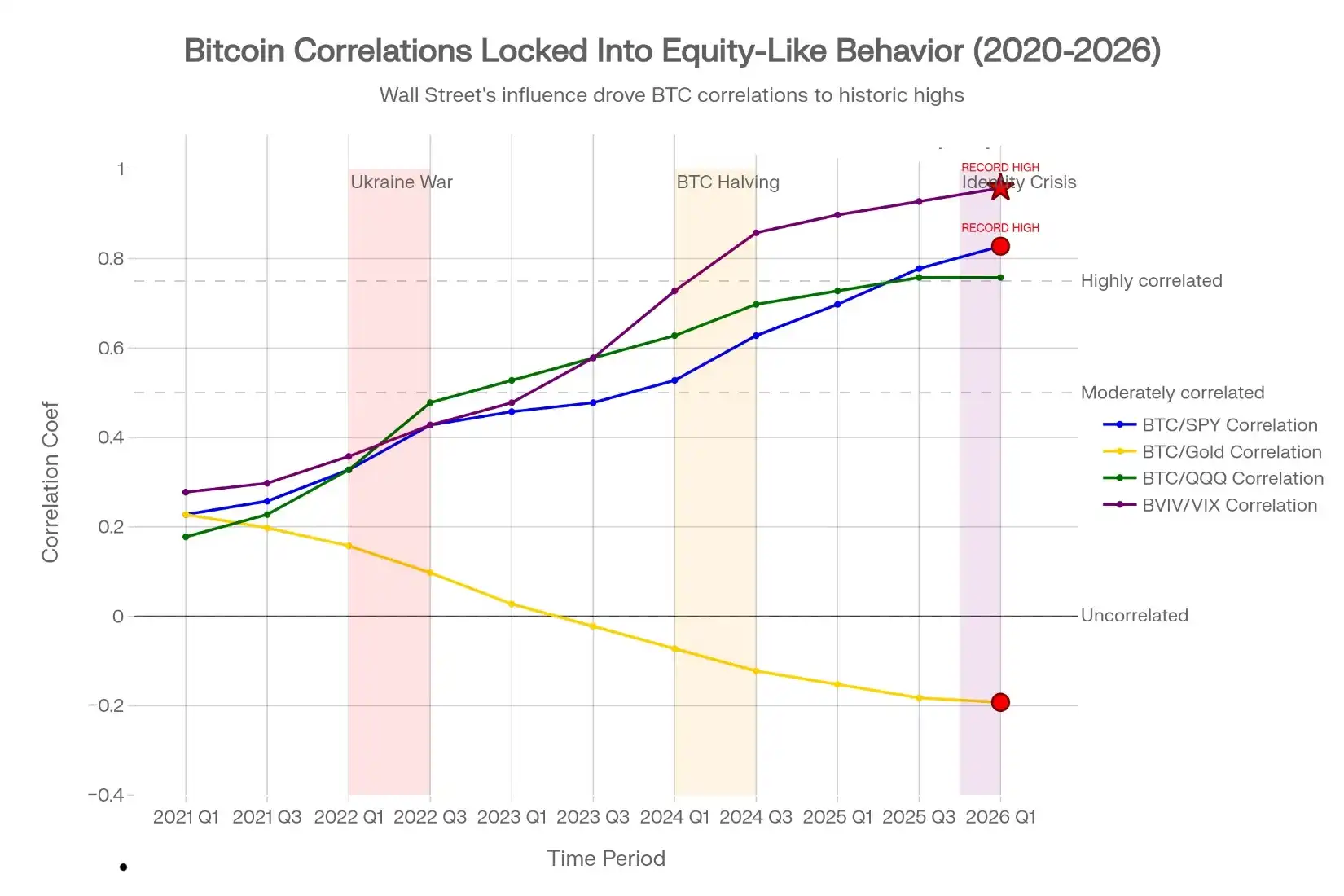
The Death of Diversification: Bitcoin's correlation with stocks surged from 0.15 (2021) to 0.75 (January 2026), a five-year shift driven entirely by institutional risk management, not Bitcoin adoption or fundamentals. A more destructive metric: Bitcoin volatility now correlates with stock volatility at 0.88 (purple line), the highest level ever recorded. This proves Bitcoin is traded mechanically based on stocks, not its own utility. Investors buying Bitcoin as a hedge are actually buying a leveraged, volatile stock bet that amplifies losses during crashes rather than offsetting them.

Volatility Homogenization

Bitcoin's volatility now moves in sync with stock market volatility. The correlation between Bitcoin volatility and the VIX stock volatility index reached 0.88 in January 2026. This is the highest reading ever recorded.

In 2020, this correlation was 0.2. Bitcoin volatility was independent. By 2026, it had become identical to stock volatility.

This is because institutional traders sell volatility across all asset classes simultaneously. When the VIX rises above certain levels, algorithms automatically sell Bitcoin, stocks, and commodities to reduce portfolio volatility. This mechanical selling has nothing to do with Bitcoin fundamentals. It is pure risk management, applied equally across all assets.

The result is that Bitcoin has lost independent price discovery. Its price is no longer driven by adoption, usage, or scarcity. It is driven by correlation assumptions and volatility control algorithms.

The data proves this. In January 2026, even as the price rebounded to $96,000, Bitcoin's daily active addresses were declining. Trading volume was falling even as institutional adoption was supposedly accelerating. The Lightning Network, which processes actual Bitcoin payments, grew 266% year-over-year. Yet the price fell.

Usage is up. Price is down. This proves that what drives the price is positioning and correlation, not fundamentals.

Reflexivity Trap

George Soros described reflexivity as a feedback loop where price movements themselves drive further movements, independent of fundamentals.

Bitcoin is caught in reflexivity.

Institutions assume a 0.75 correlation between Bitcoin and stocks. Option traders build hedges based on this assumption. When stocks move 2%, algorithms trigger a 2% move in Bitcoin. This creates a self-fulfilling prophecy. Bitcoin moves with stocks, so traders think it's a stock. Retail investors adopt this view and trade accordingly. Actual Bitcoin fundamentals become irrelevant. The price is completely detached from utility.

This is not temporary confusion. It is structural. Until institutions agree on what Bitcoin is, the reflexivity loop will persist. Every rally will contain the seeds of the next crash because the market cannot agree on why the rally is happening.

What Retail Investors Actually Own

Most retail investors think they own diversification when they buy Bitcoin. They believe Bitcoin protects against inflation and reduces stock exposure. The math proves otherwise.

Take a simple example. An investor holds $100,000 in stocks and allocates $5,000 to Bitcoin, expecting diversification.

When stocks fall 10%, the portfolio loses $9,000. But Bitcoin, with a 0.75 correlation, falls 15%. The Bitcoin position loses $750. Total loss: $9,750.

Without Bitcoin, the loss would have been $9,000. Bitcoin made the portfolio worse, not better. This correlation means Bitcoin amplifies stock losses rather than offsetting them.

True diversification requires negative correlation. Bonds are negatively correlated with stocks during risk-off periods. Gold is negatively correlated during crises. Bitcoin is positively correlated, making it useless as a hedge.

The Inevitable Resolution

Bitcoin cannot sustain four conflicting identities. The market will force a resolution in 2026 through one of four paths.

Path One: Strategic Reserve

Governments and corporations treat Bitcoin like gold reserves. They buy and never sell. Price volatility becomes irrelevant because holders measure success in decades, not quarters. Institutions stop trading Bitcoin and start hoarding it. Price finds equilibrium based on slow, steady accumulation. This path leads to $120,000 to $150,000 by year-end.

Path Two: Risk Asset Normalization

Institutions formally classify Bitcoin as a commodity derivative or stock analogue. They build risk models that account for extreme volatility. They accept that Bitcoin is not a hedge but a leveraged bet on monetary expansion. Position sizing adjusts accordingly. Correlations become predictable because everyone agrees on what Bitcoin is. Price trades in an $80,000 to $110,000 range with lower volatility.

Path Three: Inflation Hedge Acceptance

After resolving which inflation metric matters, the market agrees Bitcoin reacts to monetary debasement, not consumer price changes. Correlation with stocks falls to 0.3 or 0.4. Bitcoin becomes a true alternative to gold. This path leads to $110,000 to $140,000 as portfolio managers allocate for inflation protection.

Path Four: Diversification Failure

Institutions realize Bitcoin cannot diversify a stock portfolio. A 0.75 correlation is too high to justify an allocation. Capital flows reverse as portfolio managers exit. Retail investors understand Bitcoin is not a hedge. Price falls to $40,000 to $60,000 as the strategic allocation story collapses.

The most likely outcome is a slow resolution in 2026. Bitcoin will gradually shift from a risk asset to a reserve asset, with periodic corrections as institutions recalibrate. Price will consolidate between $80,000 and $110,000 until one path dominates.

What to Watch

Four indicators will show which path Bitcoin takes.

  • Correlation Inflection: If Bitcoin stops moving with stocks and correlation drops below 0.5, it becomes a hedge again. This favors Path Three.
  • Government Announcements: If a major government formally allocates Bitcoin to reserves, Path One accelerates. Watch for announcements from the U.S., E.U., or Japan.
  • On-Chain Metrics: If daily active addresses and transaction volume reverse upward while price is flat or falling, fundamentals are improving even as speculation decreases. This indicates long-term strength.
  • Volatility Normalization: If the correlation between Bitcoin volatility and stock volatility drops below 0.60, institutional volatility selling is easing. This allows true price discovery to return.

These indicators don't require capital to track. They provide better insight than price charts.

Conclusion

Bitcoin's fall to $80,000 was no accident. It was Bitcoin confronting a question it has avoided since institutional money arrived: What am I?

Until there is a clear answer to this question, every rally will contain the seeds of the next crash. Bitcoin will move with stocks when it should diverge. It will fall on news that should help it. It will rise on developments that shouldn't matter.

This is not temporary confusion. It is a structural identity crisis that defines the entire 2026 narrative.

Investors buying Bitcoin as an inflation hedge will be disappointed during inflation panics. Investors buying it for diversification will be disappointed when it amplifies stock losses. Investors buying it as digital gold will be disappointed when it trades like a tech stock.

The only investors who will succeed are those who understand Bitcoin is currently none of these things. It is a positioning-driven, correlation-dependent, volatility-controlled instrument that has temporarily lost its connection to its fundamental purpose.

The crash exposed this truth. The recovery will depend on Bitcoin's ability to answer what it is before institutions decide the answer for it.


Pertanyaan Terkait

QWhat are the four conflicting identities that Bitcoin is simultaneously trying to embody according to the article?

AThe four conflicting identities are: 1) Inflation hedge, 2) Tech stock, 3) Digital gold, and 4) Institutional reserve asset.

QWhy did the author describe Bitcoin's price drop on January 29, 2026, as particularly significant?

AIt was significant because Bitcoin crashed in response to two opposing events simultaneously: a stock market crash (where it should have risen as a safe-haven asset) and a hawkish signal from the Fed (where it should have fallen as a risk asset). This broke the fundamental logic of how the market understood Bitcoin.

QWhat is the article's main argument for why Bitcoin's price action has become chaotic and disconnected from its fundamentals?

AThe main argument is that institutional algorithms and risk models, which trade Bitcoin based on its high correlation to stocks and volatility control mechanisms, have taken over price discovery. This creates a reflexive loop where price movements are driven by positioning and correlation assumptions rather than adoption, utility, or scarcity.

QWhat does the 'volatility homogenization' phenomenon refer to in the context of Bitcoin's trading behavior?

AVolatility homogenization refers to the phenomenon where Bitcoin's volatility has become highly correlated (0.88) with stock market volatility (VIX). This means algorithms automatically sell Bitcoin along with stocks when volatility spikes to manage portfolio risk, making its price movements mechanical and detached from its own fundamentals.

QAccording to the author, what are the four possible paths for a resolution to Bitcoin's identity crisis, and which one would push its price toward $150,000?

AThe four paths are: 1) Strategic Reserve (price target $120K-$150K), 2) Risk Asset Normalization ($80K-$110K), 3) Inflation Hedge Acceptance ($110K-$140K), and 4) Diversification Failure ($40K-$60K). The path that would push the price toward $150,000 is Path One, the Strategic Reserve path, where governments and corporations treat it like gold and accumulate it long-term without selling.

Bacaan Terkait

RUU Kejelasan Mencapai Titik Kritis, Persimpangan Jalan Regulasi Kripto AS

Titik Kritis untuk RUU CLARITY: Amerika di Persimpangan Regulasi Kripto Pada musim semi 2026, regulasi aset kripto AS berada di titik balik sejarah. RUU *CLARITY Act* menghadapi tenggat kritis: jika tidak disetujui Komite Perbankan Senat sebelum akhir April, peluang penerapannya pada 2026 akan turun drastis dan mungkin tertunda hingga 4 tahun. RUU ini, bersama *GENIUS Act* yang mengatur stableket, akan membentuk masa depan industri. *GENIUS Act* telah menetapkan kerangka ketat untuk stableket, menuntut kepatuhan AML/CFT, cadangan 100%, dan pengawasan federal. Ini akan memicu konsolidasi pasar, menguntungkan penerbit besar dan patuh seperti USDC dan USAT (varian Tether yang patuh), sementara mempersulit pemain kecil. Inti perdebatan adalah soal imbal hasil (*yield*) stableket. Bankir tradisional memperingatkan risiko aliran dana besar-besaran, tetapi laporan penasihat ekonomi Gedung Putih menyatakan dampaknya pada pinjaman bank minimal, justru melindungi kepentingan konsumen. Kompromi politik yang dipelopori Senator Tillis dan Alsobrooks berusaha menemukan jalan tengah, dengan membedakan imbal hasil berbasis aktivitas dan pasif. Namun, isu seperti wewenang Federal Reserve, kepatuhan AML untuk DeFi, dan konflik kepentingan pejabat pemerintah masih menjadi hambatan. Jika *CLARITY Act* lolos, AS akan bersaing dengan kerangka regulasi Eropa (MiCA) dan menarik aliran modal institusional besar. Jika gagal, kepemimpinan regulasi global akan dipegang Eropa dan pusat kripto lain seperti Hong Kong dan Singapura. Kepatuhan (*compliance*) akan menjadi kompetensi inti dalam era baru aset kripto yang semakin terlembaga.

marsbit8j yang lalu

RUU Kejelasan Mencapai Titik Kritis, Persimpangan Jalan Regulasi Kripto AS

marsbit8j yang lalu

Trading

Spot
Futures

Artikel Populer

Apa Itu BITCOIN

Memahami HarryPotterObamaSonic10Inu (ERC-20) dan Posisinya dalam Ruang Crypto Dalam beberapa tahun terakhir, pasar cryptocurrency telah menyaksikan peningkatan popularitas koin meme, menarik minat tidak hanya dari para pedagang, tetapi juga mereka yang mencari keterlibatan komunitas dan nilai hiburan. Di antara token unik ini adalah HarryPotterObamaSonic10Inu (ERC-20), sebuah proyek menarik yang memadukan referensi budaya ke dalam dunia cryptocurrency. Artikel ini membahas aspek-aspek kunci dari HarryPotterObamaSonic10Inu, menjelajahi mekanismenya, etos yang digerakkan oleh komunitas, dan keterlibatannya dengan lanskap crypto yang lebih luas. Apa itu HarryPotterObamaSonic10Inu (ERC-20)? Seperti namanya, HarryPotterObamaSonic10Inu adalah koin meme yang dibangun di atas blockchain Ethereum, diklasifikasikan di bawah standar ERC-20. Berbeda dengan cryptocurrency tradisional yang mungkin menekankan utilitas praktis atau potensi investasi, token ini berkembang berdasarkan nilai hiburan dan kekuatan komunitasnya. Proyek ini bertujuan untuk menciptakan lingkungan di mana pengguna yang terlibat dapat berkumpul, berbagi ide, dan berpartisipasi dalam aktivitas yang terinspirasi oleh berbagai fenomena budaya. Salah satu fitur mencolok dari HarryPotterObamaSonic10Inu adalah nol pajak pada transaksi. Elemen menarik ini bertujuan untuk mendorong perdagangan dan keterlibatan komunitas, tanpa biaya tambahan yang dapat menghalangi pedagang berskala kecil. Total pasokan koin ditetapkan pada satu miliar token, sebuah angka yang menandakan niatnya untuk menjaga sirkulasi yang substansial di dalam komunitas. Pencipta HarryPotterObamaSonic10Inu (ERC-20) Asal usul HarryPotterObamaSonic10Inu agak diselimuti misteri; rincian tentang penciptanya tetap tidak diketahui. Pengembangan token ini tidak memiliki tim yang teridentifikasi atau cetak biru yang jelas, yang bukan hal yang aneh dalam sektor koin meme. Sebaliknya, proyek ini muncul secara organik, dengan kemajuannya sangat bergantung pada antusiasme dan partisipasi komunitasnya. Investor HarryPotterObamaSonic10Inu (ERC-20) Terkait investasi eksternal dan dukungan, HarryPotterObamaSonic10Inu juga tetap ambigu. Token ini tidak mencantumkan yayasan investasi atau dukungan organisasi yang signifikan. Sebaliknya, denyut nadi proyek ini adalah komunitas akar rumputnya, yang menginformasikan pertumbuhannya dan keberlanjutan melalui aksi kolektif dan keterlibatan di ruang crypto. Bagaimana HarryPotterObamaSonic10Inu (ERC-20) Bekerja? Sebagai koin meme, HarryPotterObamaSonic10Inu beroperasi terutama di luar kerangka tradisional yang sering mengatur nilai aset. Ada beberapa aspek khas yang mendefinisikan cara kerja proyek ini: Transaksi Tanpa Pajak: Dengan tidak ada biaya pajak pada transaksi, pengguna dapat membeli dan menjual token tanpa khawatir akan biaya tersembunyi. Keterlibatan Komunitas: Proyek ini berkembang melalui interaksi komunitas, memanfaatkan platform media sosial untuk menciptakan buzz dan memfasilitasi keterlibatan. Diskusi, berbagi konten, dan keterlibatan adalah elemen penting yang membantu memperluas jangkauannya dan membangun loyalitas di antara para pendukung. Tidak Ada Utilitas Praktis: Perlu dicatat bahwa HarryPotterObamaSonic10Inu tidak menawarkan utilitas konkret dalam ekosistem finansial. Sebaliknya, ia diklasifikasikan sebagai token yang terutama untuk hiburan dan aktivitas komunitas. Referensi Budaya: Token ini dengan cerdik menggabungkan elemen dari budaya populer untuk menarik minat, terhubung dengan penggemar meme dan pengikut crypto. HarryPotterObamaSonic10Inu menunjukkan bagaimana koin meme beroperasi berbeda dari proyek cryptocurrency yang lebih tradisional, memasuki pasar sebagai konstruksi sosial yang inovatif daripada aset utilitarian. Garis Waktu HarryPotterObamaSonic10Inu (ERC-20) Sejarah HarryPotterObamaSonic10Inu ditandai oleh beberapa tonggak yang patut dicatat: Penciptaan: Token ini muncul dari meme viral, menangkap imajinasi banyak penggemar crypto. Tanggal penciptaan spesifik tidak tersedia, menekankan kebangkitannya yang organik. Pendaftaran di Bursa: HarryPotterObamaSonic10Inu telah muncul di berbagai bursa, memungkinkan akses dan perdagangan yang lebih mudah oleh komunitas. Inisiatif Keterlibatan Komunitas: Kegiatan yang sedang berlangsung bertujuan untuk meningkatkan interaksi komunitas, termasuk kontes, kampanye media sosial, dan generasi konten dari penggemar dan pendukung. Rencana Ekspansi Masa Depan: Peta jalan proyek ini mencakup peluncuran koleksi NFT, merchandise, dan situs eCommerce yang terkait dengan tema budayanya, lebih lanjut melibatkan komunitas dan berusaha menambahkan lebih banyak dimensi ke ekosistemnya. Poin Kunci Tentang HarryPotterObamaSonic10Inu (ERC-20) Sifat yang Diggerakkan oleh Komunitas: Proyek ini memprioritaskan masukan dan kreativitas kolektif, memastikan bahwa keterlibatan pengguna berada di garis depan pengembangannya. Klasifikasi Koin Meme: Ini mewakili puncak cryptocurrency berbasis hiburan, terpisah dari kendaraan investasi tradisional. Tidak Ada Afiliasi Langsung dengan Bitcoin: Meskipun ada kesamaan dalam nama ticker, HarryPotterObamaSonic10Inu berbeda dan tidak memiliki hubungan dengan Bitcoin atau cryptocurrency lain yang mapan. Fokus pada Kolaborasi: HarryPotterObamaSonic10Inu dirancang untuk menciptakan ruang untuk kolaborasi dan berbagi cerita di antara para pemegangnya, memberikan saluran untuk kreativitas dan ikatan komunitas. Prospek Masa Depan: Ambisi untuk berkembang melampaui premis awalnya ke dalam NFT dan merchandise menggambarkan jalur bagi proyek ini untuk berpotensi memasuki lebih banyak saluran arus utama dalam budaya digital. Seiring dengan terus meningkatnya daya tarik koin meme di komunitas cryptocurrency, HarryPotterObamaSonic10Inu (ERC-20) menonjol karena keterikatan budayanya dan pendekatan yang berorientasi pada komunitas. Meskipun mungkin tidak sesuai dengan pola tipikal token berbasis utilitas, esensinya terletak pada kegembiraan dan persahabatan yang ditegakkan di antara para pendukungnya, menyoroti sifat cryptocurrency yang terus berkembang dalam era digital yang semakin meningkat. Saat proyek ini terus berkembang, akan penting untuk mengamati bagaimana dinamika komunitas mempengaruhi trajektori dalam lanskap teknologi blockchain yang selalu berubah.

1.4k Total TayanganDipublikasikan pada 2024.04.01Diperbarui pada 2024.12.03

Apa Itu BITCOIN

Cara Membeli BTC

Selamat datang di HTX.com! Kami telah membuat pembelian Bitcoin (BTC) menjadi mudah dan nyaman. Ikuti panduan langkah demi langkah kami untuk memulai perjalanan kripto Anda.Langkah 1: Buat Akun HTX AndaGunakan alamat email atau nomor ponsel Anda untuk mendaftar akun gratis di HTX. Rasakan perjalanan pendaftaran yang mudah dan buka semua fitur.Dapatkan Akun SayaLangkah 2: Buka Beli Kripto, lalu Pilih Metode Pembayaran AndaKartu Kredit/Debit: Gunakan Visa atau Mastercard Anda untuk membeli Bitcoin (BTC) secara instan.Saldo: Gunakan dana dari saldo akun HTX Anda untuk melakukan trading dengan lancar.Pihak Ketiga: Kami telah menambahkan metode pembayaran populer seperti Google Pay dan Apple Pay untuk meningkatkan kenyamanan.P2P: Lakukan trading langsung dengan pengguna lain di HTX.Over-the-Counter (OTC): Kami menawarkan layanan yang dibuat khusus dan kurs yang kompetitif bagi para trader.Langkah 3: Simpan Bitcoin (BTC) AndaSetelah melakukan pembelian, simpan Bitcoin (BTC) di akun HTX Anda. Selain itu, Anda dapat mengirimkannya ke tempat lain melalui transfer blockchain atau menggunakannya untuk memperdagangkan mata uang kripto lainnya.Langkah 4: Lakukan trading Bitcoin (BTC)Lakukan trading Bitcoin (BTC) dengan mudah di pasar spot HTX. Cukup akses akun Anda, pilih pasangan perdagangan, jalankan trading, lalu pantau secara real-time. Kami menawarkan pengalaman yang ramah pengguna baik untuk pemula maupun trader berpengalaman.

9.8k Total TayanganDipublikasikan pada 2024.12.12Diperbarui pada 2025.03.21

Cara Membeli BTC

Apa Itu $BITCOIN

EMAS DIGITAL ($BITCOIN): Analisis Komprehensif Pengenalan EMAS DIGITAL ($BITCOIN) EMAS DIGITAL ($BITCOIN) adalah proyek berbasis blockchain yang beroperasi di jaringan Solana, yang bertujuan untuk menggabungkan karakteristik logam mulia tradisional dengan inovasi teknologi terdesentralisasi. Meskipun berbagi nama dengan Bitcoin, yang sering disebut sebagai “emas digital” karena persepsinya sebagai penyimpan nilai, EMAS DIGITAL adalah token terpisah yang dirancang untuk menciptakan ekosistem unik dalam lanskap Web3. Tujuannya adalah untuk memposisikan diri sebagai aset digital alternatif yang layak, meskipun rincian mengenai aplikasi dan fungsionalitasnya masih dalam pengembangan. Apa itu EMAS DIGITAL ($BITCOIN)? EMAS DIGITAL ($BITCOIN) adalah token cryptocurrency yang dirancang secara eksplisit untuk digunakan di blockchain Solana. Berbeda dengan Bitcoin, yang menyediakan peran penyimpanan nilai yang diakui secara luas, token ini tampaknya lebih fokus pada aplikasi dan karakteristik yang lebih luas. Aspek-aspek penting meliputi: Infrastruktur Blockchain: Token ini dibangun di atas blockchain Solana, yang dikenal karena kemampuannya menangani transaksi berkecepatan tinggi dan biaya rendah. Dinamika Pasokan: EMAS DIGITAL memiliki pasokan maksimum yang dibatasi pada 100 kuadriliun token (100P $BITCOIN), meskipun rincian mengenai pasokan yang beredar saat ini belum diungkapkan. Utilitas: Meskipun fungsionalitas yang tepat tidak dijelaskan secara eksplisit, ada indikasi bahwa token ini dapat digunakan untuk berbagai aplikasi, yang mungkin melibatkan aplikasi terdesentralisasi (dApps) atau strategi tokenisasi aset. Siapa Pencipta EMAS DIGITAL ($BITCOIN)? Saat ini, identitas pencipta dan tim pengembang di balik EMAS DIGITAL ($BITCOIN) tetap tidak diketahui. Situasi ini umum terjadi di antara banyak proyek inovatif dalam ruang blockchain, terutama yang sejalan dengan keuangan terdesentralisasi dan fenomena koin meme. Meskipun anonimitas semacam ini dapat mendorong budaya yang dipimpin komunitas, hal ini juga meningkatkan kekhawatiran tentang tata kelola dan akuntabilitas. Siapa Investor EMAS DIGITAL ($BITCOIN)? Informasi yang tersedia menunjukkan bahwa EMAS DIGITAL ($BITCOIN) tidak memiliki pendukung institusional yang dikenal atau investasi modal ventura yang menonjol. Proyek ini tampaknya beroperasi dengan model peer-to-peer yang berfokus pada dukungan dan adopsi komunitas daripada jalur pendanaan tradisional. Aktivitas dan likuiditasnya terutama terletak di bursa terdesentralisasi (DEX), seperti PumpSwap, daripada platform perdagangan terpusat yang mapan, lebih menyoroti pendekatan akar rumputnya. Bagaimana EMAS DIGITAL ($BITCOIN) Bekerja Mekanisme operasional EMAS DIGITAL ($BITCOIN) dapat dijelaskan berdasarkan desain blockchain dan atribut jaringannya: Mekanisme Konsensus: Dengan memanfaatkan bukti sejarah (PoH) unik dari Solana yang dipadukan dengan model bukti kepemilikan (PoS), proyek ini memastikan validasi transaksi yang efisien yang berkontribusi pada kinerja tinggi jaringan. Tokenomik: Meskipun mekanisme deflasi tertentu belum dijelaskan secara mendetail, pasokan token maksimum yang besar menunjukkan bahwa ini mungkin ditujukan untuk mikrotransaksi atau kasus penggunaan niche yang masih perlu didefinisikan. Interoperabilitas: Ada potensi untuk integrasi dengan ekosistem lebih luas Solana, termasuk berbagai platform keuangan terdesentralisasi (DeFi). Namun, rincian mengenai integrasi spesifik tetap tidak ditentukan. Garis Waktu Peristiwa Kunci Berikut adalah garis waktu yang menyoroti tonggak penting terkait EMAS DIGITAL ($BITCOIN): 2023: Penempatan awal token terjadi di blockchain Solana, ditandai dengan alamat kontraknya. 2024: EMAS DIGITAL mendapatkan visibilitas saat tersedia untuk diperdagangkan di bursa terdesentralisasi seperti PumpSwap, memungkinkan pengguna untuk memperdagangkannya melawan SOL. 2025: Proyek ini menyaksikan aktivitas perdagangan sporadis dan potensi minat dalam keterlibatan yang dipimpin komunitas, meskipun belum ada kemitraan atau kemajuan teknis yang signifikan yang didokumentasikan hingga saat ini. Analisis Kritis Kekuatan Skalabilitas: Infrastruktur Solana yang mendasari mendukung volume transaksi yang tinggi, yang dapat meningkatkan utilitas $BITCOIN dalam berbagai skenario transaksi. Aksesibilitas: Potensi harga perdagangan yang rendah per token dapat menarik investor ritel, memfasilitasi partisipasi yang lebih luas karena peluang kepemilikan fraksional. Risiko Kurangnya Transparansi: Ketidakhadiran pendukung, pengembang, atau proses audit yang dikenal publik dapat menimbulkan skeptisisme mengenai keberlanjutan dan keandalan proyek. Volatilitas Pasar: Aktivitas perdagangan sangat bergantung pada perilaku spekulatif, yang dapat mengakibatkan volatilitas harga yang signifikan dan ketidakpastian bagi investor. Kesimpulan EMAS DIGITAL ($BITCOIN) muncul sebagai proyek yang menarik namun ambigu dalam ekosistem Solana yang berkembang pesat. Meskipun berusaha memanfaatkan narasi “emas digital”, perbedaannya dari peran Bitcoin yang sudah mapan sebagai penyimpan nilai menyoroti perlunya diferensiasi yang lebih jelas mengenai utilitas dan struktur tata kelolanya. Penerimaan dan adopsi di masa depan kemungkinan akan bergantung pada penanganan ketidakjelasan saat ini dan mendefinisikan strategi operasional dan ekonominya dengan lebih eksplisit. Catatan: Laporan ini mencakup informasi yang disintesis yang tersedia hingga Oktober 2023, dan perkembangan mungkin telah terjadi di luar periode penelitian.

93 Total TayanganDipublikasikan pada 2025.05.13Diperbarui pada 2025.05.13

Apa Itu $BITCOIN

Diskusi

Selamat datang di Komunitas HTX. Di sini, Anda bisa terus mendapatkan informasi terbaru tentang perkembangan platform terkini dan mendapatkan akses ke wawasan pasar profesional. Pendapat pengguna mengenai harga BTC (BTC) disajikan di bawah ini.

活动图片