Netting $2.4 Million: These 9 Insider Addresses Knew the US-Iran War Best

marsbitDipublikasikan tanggal 2026-05-25Terakhir diperbarui pada 2026-05-25

Abstrak

On May 18th, Bubblemaps investigators disclosed the discovery of nine highly correlated anonymous accounts on Polymarket that netted over $2.4 million from prediction markets tied to US military actions, with a 98% win rate. The accounts focused almost exclusively on the 2026 US-Iran conflict, placing bets with uncanny precision days before key events like the "Operation Epic Fury" strike on February 28th, which eliminated Iran's Supreme Leader. Bubblemaps' analysis linked four core accounts—each profiting around $400k—and five others through synchronized timing, transaction patterns, and fund flows. The money moved through shared wallet networks, suggesting professional obfuscation. This case is six times larger than the earlier prosecution of US Army Sergeant Gannon Van Dyke for insider trading on Polymarket. While platforms like Polymarket have established AI monitoring and explicit rules against trading on stolen or confidential information, the incident has spurred controversial "insider copy-trading" services that help users follow high-success accounts, raising new regulatory questions.

Written by: Mahe, Foresight News

On May 18, Nicolas Vaiman, founder of Bubblemaps, and lead investigator Deebs (a pseudonym used by a former U.S. military officer for safety reasons) disclosed to the public: they discovered nine highly correlated anonymous accounts on Polymarket that collectively netted over $2.4 million from prediction markets related to U.S. military actions, with a winning rate as high as 98%.
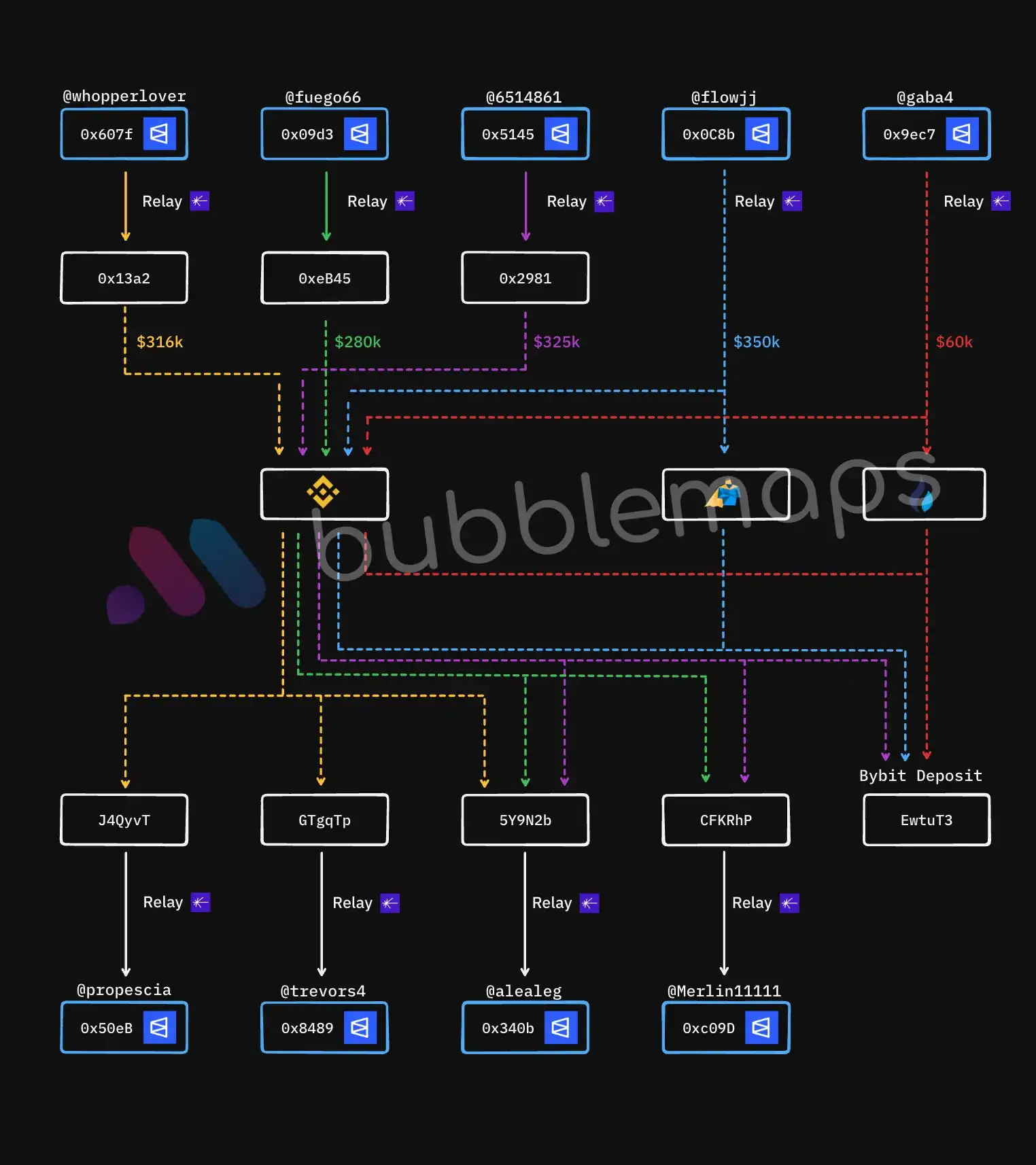
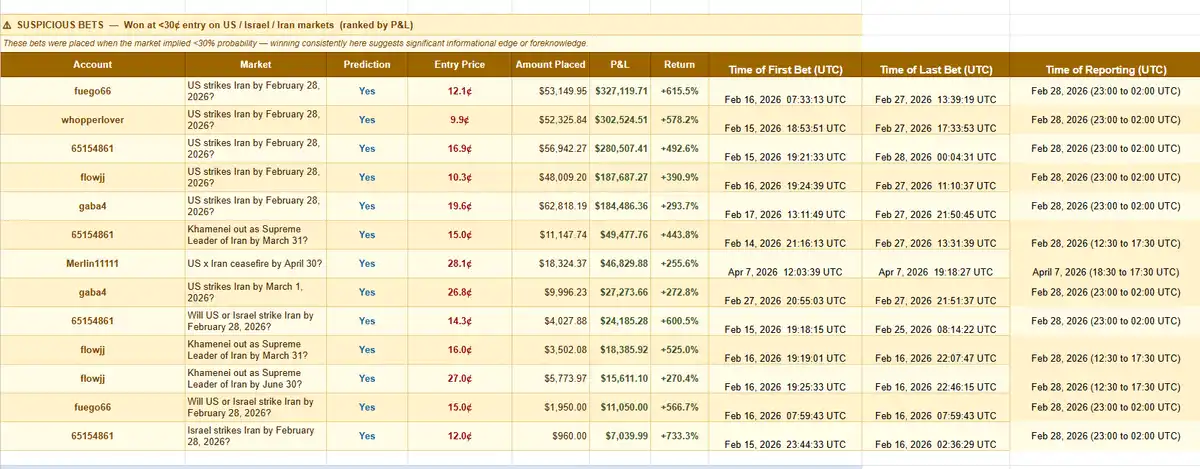
Bubblemaps provided a detailed analysis of these accounts on Twitter. They almost exclusively bet on military events related to the US-Iran conflict in 2026, with timing so precise it was chilling—often placing bets just days before key actions occurred, and favoring long-odds, low-probability options.

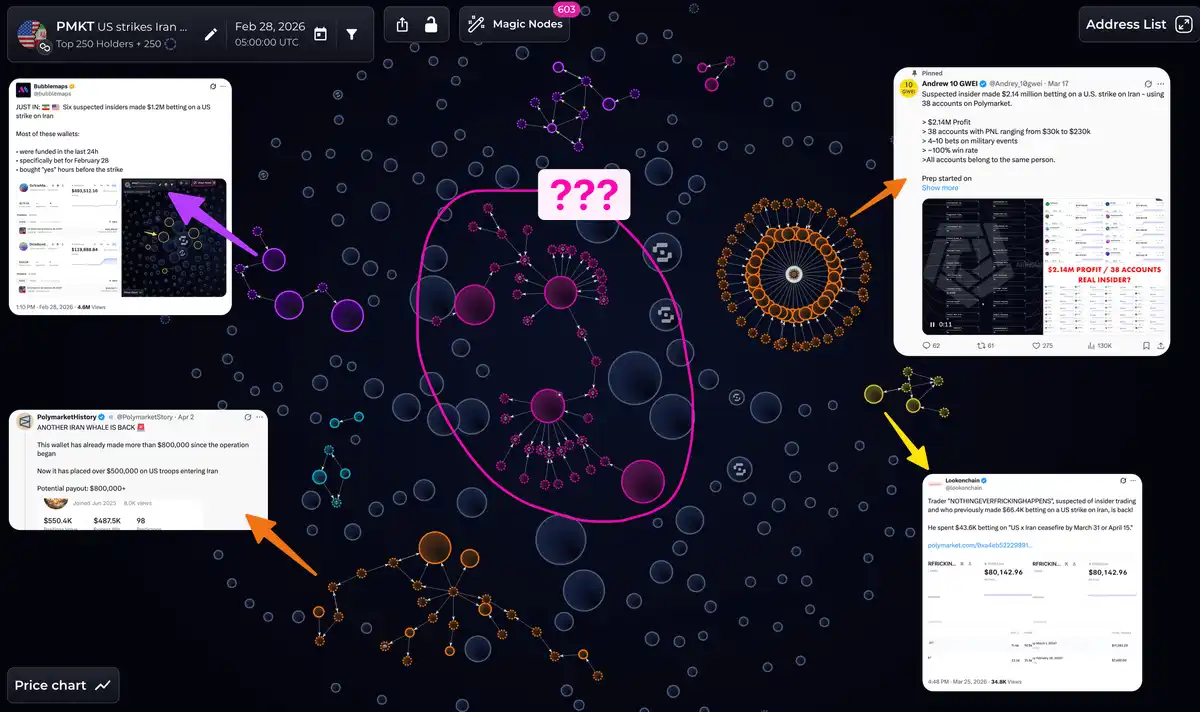
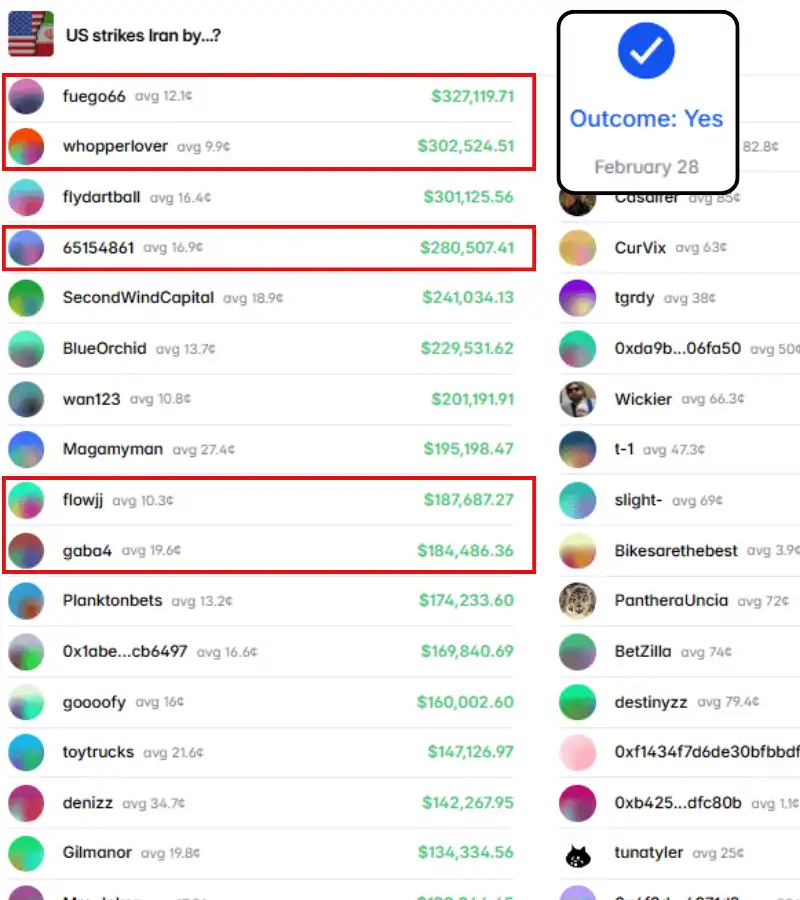
This wasn't simply "good luck." After visualizing the trades in the "Will the US strike Iran for the first time before February 28?" market on Polymarket, Bubblemaps discovered a massive pink cluster previously unmentioned on the X platform.
Further investigation linked the initial 4 accounts to another 5 through identical time windows, trade sizes, and fund flow paths. The nine accounts followed highly consistent funding paths: funds were transferred via centralized exchanges into a shared wallet network within an extremely short timeframe, with suspected use of professional services to hide traces.

4 Core Accounts Each Earned $400,000

In the early morning of February 28, 2026, the United States and Israel launched large-scale joint strikes codenamed "Operation Epic Fury" and "Lion's Roar." US-Israeli forces conducted nearly 900 strikes against Iran within 12 hours, targeting nuclear facilities, missile bases, military command centers, and hideouts of senior leaders. Iran's Supreme Leader Ali Khamenei and several of his family members, along with senior commanders of the Revolutionary Guard Corps, were killed in the initial strikes.

As early as the day of the February 28 strikes, Bubblemaps had publicly flagged six "fresh" accounts. Most of these accounts were created and funded within 24 hours before the strike, accurately betting on "the US will strike Iran before February 28," collectively netting about $1 million (some reports said $1.2 million). At the time, market odds were extremely low, yet these accounts heavily bet on them. Bubblemaps called it "suspected insider trading."

Five months later, the nine-account cluster they discovered was larger and had a higher win rate.
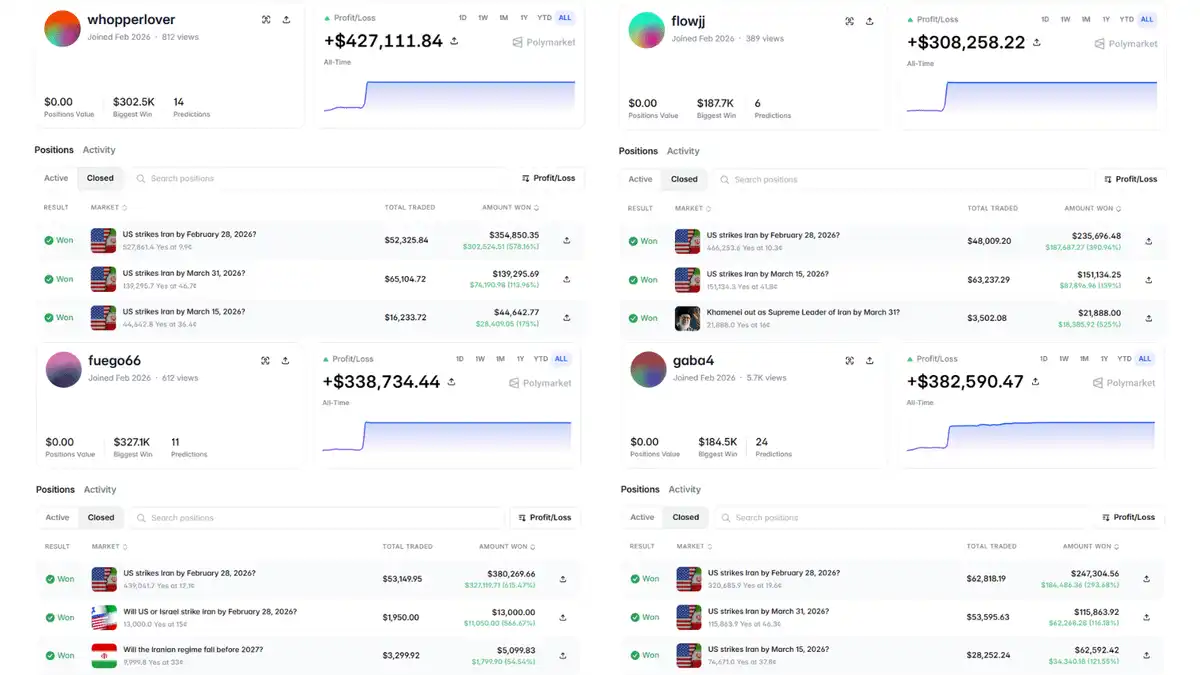
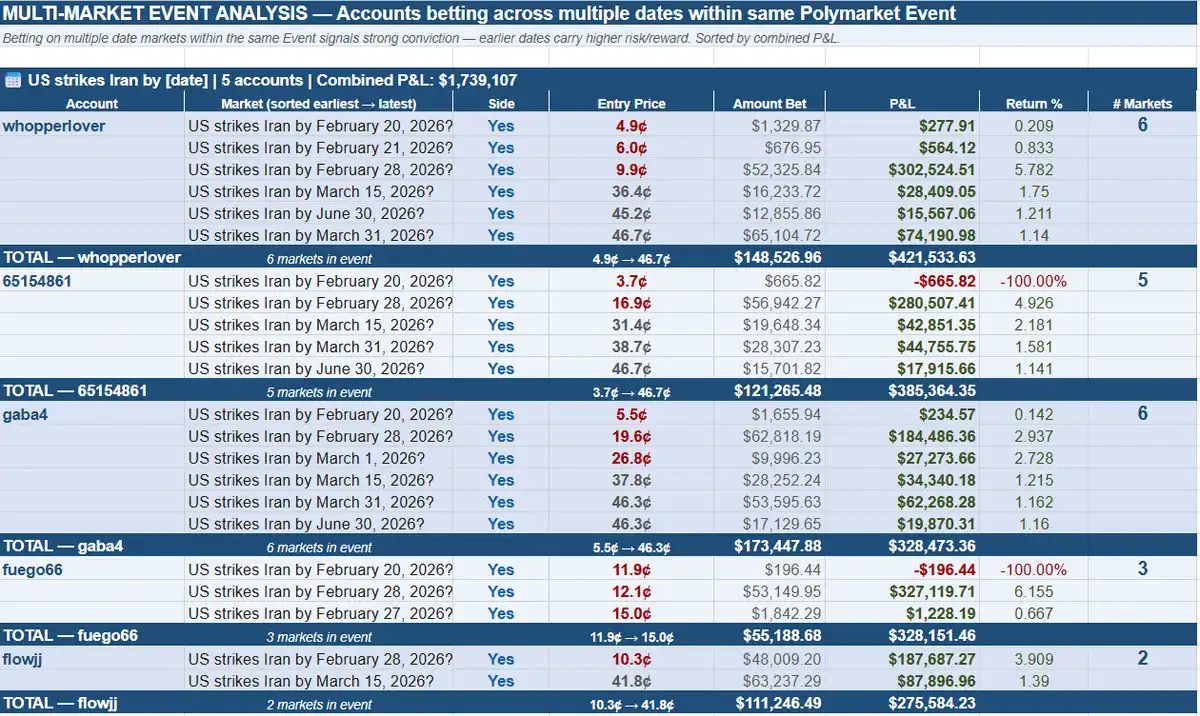
The four core accounts were created a few days before February 28, each earning about $400,000; the subsequent five accounts were linked through fund flows and trade overlaps. The nine accounts placed over 80 bets, almost all on US military actions: the first strike on February 28, the specific timing of Khamenei's elimination, the announcement of a ceasefire agreement, etc. They even placed bets spread across multiple dates to maximize gains, while occasionally placing one or two small losing bets (like on February 20), likely as cover.
Bubblemaps listed the nine Polymarket wallet addresses (including 0x09d3273fa76282ce09f4f35a87d6f087c05f4e84, etc.), emphasizing that these accounts have long dominated the profit/loss leaderboards. Funds ultimately flowed to a shared wallet network, showing signs of professionalized money laundering or service use.
Vaiman stated bluntly: "Luck cannot explain these numbers." Deebs added that potential insider sources are numerous—government officials, military planners, intelligence analysts, even family members of military personnel.
Earlier this year, US Army Staff Sergeant Gannon Ken Van Dyke was charged with using classified intelligence to bet on special operations in Venezuela on Polymarket, investing $34,000 to profit $400,000 before quickly withdrawing funds and attempting to delete the account. Polymarket cooperated closely with law enforcement, ultimately leading to the prosecution. The Van Dyke case is seen as a landmark case for insider trading in prediction markets.

This nine-account cluster's profit is six times that amount, with a higher win rate, and is entirely concentrated on US-Iran military events.
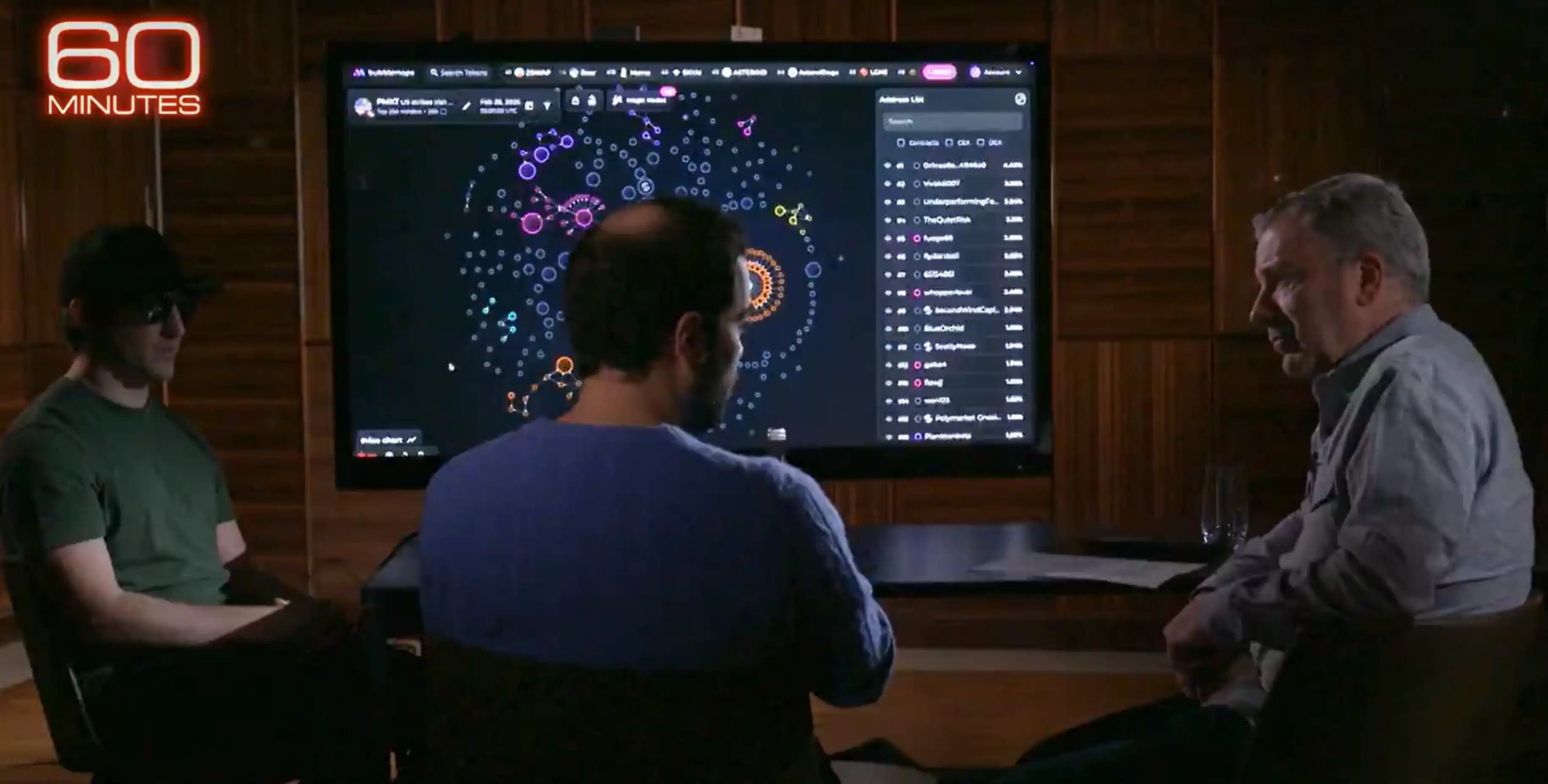
Bubblemaps exclusively shared the investigation with "60 Minutes." The segment aired on the evening of May 17, garnering significant attention. The CBS report noted that Polymarket has established AI monitoring and blockchain forensics systems, reporting suspicious activities to law enforcement authorities once detected, and emphasized that "insider trading is not welcome on the platform."

As of publication, Bubblemaps has not directly linked the nine accounts to any specific entity or government agency, stating only that "the correlation and near-perfect win rate raise serious suspicions."

Fighting Insider Trading vs. Copying Insider Trading

Insider trading makes many market participants feel the game is unfair. Prediction market platforms, including Kalshi and Polymarket, are taking more measures to combat it.

In late March this year, Polymarket updated its market integrity rules for its DeFi platform and its US exchange regulated by the U.S. Commodity Futures Trading Commission (CFTC). The updated rules clarify three core prohibited insider trading behaviors:

  • Trading using stolen confidential information—Participants may not trade any contracts if they possess confidential information about the outcome or likely outcome of an underlying event, and using that information would breach a pre-existing duty of trust or confidence owed to another person or entity.
  • Prohibition on trading using illegal insider tips—Participants may not trade using confidential information provided to them by another person, if the information was provided by someone who owed a pre-existing duty of trust or confidence to another, and the participant knows or has reason to know that the person providing the information themselves would be prohibited from trading on it.
  • Trading by those able to influence the outcome—Participants may not trade any contracts if they have authority or influence sufficient to affect the outcome of the underlying event.

However, rules always have loopholes. Since insider trading cannot be completely eradicated, some ill-intentioned so-called "insider copy-trading projects" have also sparked controversy. These applications compile trading accounts with abnormally high win rates for users, or flag suspiciously timed, abnormally sized trades, helping users copy these trades with one click.

Kreo's selling point is helping users "find insider traders before others." Polycool directly posts a "Polymarket Insider Trading Guide" on its website, stating "This isn't the stock market, betting with non-public information won't land you in jail, the rules for decentralized prediction markets are completely different."

A question then arises: does copying trades from insider trading addresses constitute a violation?

There has been no official response yet.

However, so-called "insider copy-trading platforms" like PolyGUN and Polycule have suffered hacker attacks this year, incurring losses ranging from tens of thousands to hundreds of thousands of dollars.


Pertanyaan Terkait

QWhat did Bubblemaps investigators discover about a group of anonymous accounts on Polymarket?

ABubblemaps investigators discovered nine highly correlated anonymous accounts that collectively netted over $2.4 million from prediction markets related to US military actions, with a win rate of 98%. They were primarily focused on US-Iran conflict events in 2026.

QAccording to the article, what characteristics made the trading activity of these nine accounts highly suspicious?

AThe accounts were highly suspicious because they placed bets almost exclusively on US-Iran military events, their timing was unnervingly precise (often days before key actions), they preferred low-odds, long-term options, and they used shared wallet networks and professional services to obscure fund flows.

QWhat is the name of the US soldier mentioned in the article who was charged for insider trading on Polymarket, and what was his profit?

AThe US soldier mentioned is US Army Staff Sergeant Gannon Ken Van Dyke. He was charged for using classified intelligence to bet on a Venezuelan special operations event on Polymarket, investing $34,000 and making a profit of $400,000.

QWhat are the three core types of prohibited insider trading behaviors outlined in Polymarket's updated market integrity rules?

AThe three core prohibited behaviors are: 1) Trading using stolen confidential information. 2) Trading using illegal insider information provided by someone who breached a duty of trust. 3) Trading by individuals who have the authority or influence to affect the outcome of the event.

QWhat controversial practice related to potential insider trading has emerged on prediction market platforms according to the article?

AThe controversial practice is the emergence of 'insider copy-trading' platforms or applications. These services identify accounts with suspiciously high win rates or anomalous trades, allowing users to copy their bets, essentially attempting to profit from potential insider information.

Bacaan Terkait

NodeStrategy: Proyek DAT Ordinals Pertama, Membawa Narasi Perbendaharaan Strategy ke NFT

**Ringkasan:** NodeStrategy, proyek token Rune di Bitcoin yang disebut-sebut sebagai DAT Ordinals pertama, berupaya meniru narasi "vault" seperti MicroStrategy pada NFT. Proyek ini menggunakan token NODESTRAT untuk membangun perbendaharaan aset berupa koleksi NFT NodeMonkes. Skemanya adalah siklus empat langkah: biaya transaksi 10% digunakan untuk membeli NFT, NFT dijual dengan target keuntungan, dan hasilnya dipakai untuk membeli kembali & menghancurkan NODESTRAT untuk mendorong harga. Namun, desainnya memiliki kelemahan mendasar. Karena Bitcoin L1 tidak memiliki kontrak pintar, biaya 10% itu hanya dapat diterapkan di satu platform perdagangan tertentu (radFi/Bound). Jika token diperdagangkan di tempat lain, siklus pendanaannya akan berhenti. Ini membatasi likuiditas secara ekstrem. Masalah lainnya adalah biaya 10% yang sama justru meredam permintaan. Pembeli dan penjual terkena biaya bolak-balik 20%, menghambat aktivitas perdagangan. Volume rendah berarti sedikit biaya yang masuk ke perbendaharaan, sehingga mekanisme pembelian kembali dan penghancuran token hampir tidak bekerja. Akibatnya, harga token stagnan dan terdiskonto besar (0.46x) dibandingkan nilai aset bersih (NAV) vault. NAV itu sendiri tidak dapat ditebus secara langsung, sehingga tidak mampu mendukung harga. Singkatnya, mesin yang dirancang untuk *number go up* ini justru mengunci dirinya sendiri: bahan bakarnya (biaya transaksi) membunuh permintaan, dan hanya bisa didapat dengan membatasi perdagangan pada satu platform, yang pada akhirnya mencekik likuiditas dan pertumbuhannya.

marsbit4m yang lalu

NodeStrategy: Proyek DAT Ordinals Pertama, Membawa Narasi Perbendaharaan Strategy ke NFT

marsbit4m yang lalu

Agentic Design Patterns: Buku yang Membuat Saya Memahami Kembali "Apa Itu Agent Sebenarnya"

Buku *Agentic Design Patterns* oleh Antonio Gulli (direktur teknik Google) menawarkan kerangka untuk memahami dan membangun AI Agent. Artikel ini menyoroti beberapa konsep kunci: **1. Level Agent (0-3):** Sebagian besar "AI" saat ini hanya Level 0 (LLM telanjang tanpa alat). Agent sejati dimulai dari Level 1 (pengguna alat yang memutuskan kapan dan bagaimana menggunakan alat), Level 2 (pemikir strategis dengan perencanaan dan *Context Engineering*), hingga Level 3 (kolaborasi multi-Agent seperti tim). **2. Context Engineering:** Lebih dari sekadar *prompt engineering*, ini adalah seni menyusun konteks yang tepat (termasuk *system prompt*, data eksternal, data implisit, dan umpan balik) untuk memberi Agent informasi yang terfokus dan relevan, meningkatkan akurasi. **3. Reflection (Produser-Kritikus):** Pola praktis di mana satu Agent (Produser) menghasilkan output, dan Agent lain (Kritikus) dengan peran/prompt berbeda meninjaunya. Mereka berinteraksi dalam loop hingga kualitas memadai. Pendekatan ini meningkatkan kualitas hasil untuk coding, penulisan, dll. **4. Kolaborasi Multi-Agent:** Tidak harus kompleks. Tiga topologi komunikasi umum: Agen Tunggal, Peer-to-Peer, dan Supervisor (agen pengatur yang mengoordinasikan pekerja). Pilihan tergantung pada kompleksitas tugas. **5. Memori Tiga Lapis:** *Session* (memori percakapan sementara), *State* (data sementara untuk satu tugas), dan *Memory* (penyimpanan jangka panjang untuk preferensi dan pembelajaran). Desain strategi penyimpanan dan pengambilan memori penting. **6. Tindakan Langsung:** Artikel menyarankan untuk segera: (a) menambahkan Agent Kritikus pada workflow yang ada, (b) menerapkan *Context Engineering*, dan (c) fokus menyempurnakan satu Agent hingga Level 2 sebelum beralih ke sistem multi-Agent yang kompleks. Buku ini memetakan pola-pola inti dalam pengembangan Agent, membantu developer menghindari "mengulangi penemuan roda" dan membangun sistem yang lebih robust.

链捕手47m yang lalu

Agentic Design Patterns: Buku yang Membuat Saya Memahami Kembali "Apa Itu Agent Sebenarnya"

链捕手47m yang lalu

Sebuah AI Membaca Prospektus SpaceX, dan Menghasilkan Memo Investasi Ini dalam 12 Menit

Sebuah agen AI secara mandiri menganalisis dokumen S-1 SpaceX (226 MB), membeli data pasar real-time menggunakan USDC di blockchain Base, dan menghasilkan memo investasi lengkap dalam 12 menit dengan biaya total $1,87. Memo ini menyimpulkan rekomendasi **"Tahan dan Awasi"** untuk IPO SpaceX. **Argumen Pro:** SpaceX mendominasi 80% massa yang mencapai orbit sejak 2023 dengan kesuksesan Falcon 99%. Starlink memiliki 10,3 juta pelanggan dengan EBITDA disesuaikan $7,2 miliar. Integrasi vertikal dari roket, satelit, spektrum, hingga kemampuan AI (via akuisisi xAI) merupakan aset generasi. **Argumen Kontra:** Divisi AI merugi besar ($6,4 miliar pada 2025) dengan pengeluaran modal tinggi. Utang bersih perusahaan diperkirakan sekitar $550 miliar jika memperhitungkan kewajiban tersembunyi seperti pinjaman jembatan $200 miliar untuk akuisisi xAI, komitmen spektrum EchoStar $19,6 miliar, dan kewajiban kontinjensi lainnya. Pertumbuhan pendapatan melambat, dan struktur kepemilikan saham akan memberi Elon Musk kendali mayoritas pasca-IPO. **Kesimpulan:** Meskipun bisnis Starlink dan peluncuran sangat kuat, risiko signifikan berasal dari divisi AI yang boros biaya, struktur utang yang kompleks, kewajiban kontinjensi besar, dan konflik kepentingan para penjamin emisi. Rekomendasi adalah untuk menunggu harga IPO yang menarik (di bawah ~$350 miliar valuasi implisit) dan memantau pencapaian tonggak kunci Starship serta pengendalian pembakaran uang di divisi AI sebelum mempertimbangkan investasi.

marsbit1j yang lalu

Sebuah AI Membaca Prospektus SpaceX, dan Menghasilkan Memo Investasi Ini dalam 12 Menit

marsbit1j yang lalu

Mengupas Prospektus IPO Unitree: Realitas Pasar Robotik

**Ringkasan IPO Unitree Robotics: Gambaran Nyata Pasar Robot Humanoid** Unitree Robotics, perusahaan robotika asal Tiongkok, telah mengajukan IPO di Bursa Saham Shanghai dengan target pendanaan US$6,2 miliar. Laporan penawaran saham perdananya mengungkapkan data keuangan perusahaan robot yang menguntungkan untuk pertama kalinya. **Inti dari IPO ini menunjukkan:** * **Kinerja Hardware yang Kuat:** Unitree unggul dalam produksi robot humanoid, mengirimkan 5.500 unit pada 2025 (terbanyak di dunia). Pendapatan melonjak 335% menjadi sekitar US$252 juta pada 2025, dengan margin kotor hampir 60% berkat strategi integrasi vertikal mereka yang memproduksi sebagian besar komponen kunci sendiri. * **Realitas Pasar Saat Ini:** Meski angka penjualan robot humanoid impresif, **74%** dijual ke institusi pendidikan/pendidikan untuk penelitian. Hanya **9%** yang digunakan dalam aplikasi industri produktif, sedangkan **17%** untuk penggunaan komersial/konsumen seperti pameran dan atraksi. Ini menunjukkan bahwa teknologi hardware telah matang, tetapi adopsi komersial skala luas masih menunggu kemajuan kecerdasan buatan (AI) dan model perangkat lunak. * **Ambisi Masa Depan di Lapisan Model (Software):** Separuh dari dana IPO (sekitar US$300 juta) akan dialokasikan untuk pengembangan model AI "embodied" selama tiga tahun ke depan. Unitree berfokus pada dua arsitektur: **VLA** (Vision-Language-Action) dan **WMA** (World Model + Action), yang terakhir dianggap lebih menjanjikan karena melibatkan simulasi internal sebelum robot bertindak. **Kesimpulan:** Unitree memiliki bisnis hardware yang menguntungkan dan kepemimpinan manufaktur, tetapi laporan IPO-nya dengan jujur mencerminkan bahwa cerita aplikasi robot humanoid di dunia nyata—di luar penelitian dan pameran—masih dalam tahap sangat awal. Perlombaan sebenarnya menuju utilitas yang meluas akan terjadi di lapisan perangkat lunak dan model AI.

marsbit1j yang lalu

Mengupas Prospektus IPO Unitree: Realitas Pasar Robotik

marsbit1j yang lalu

Trading

Spot
Futures

Artikel Populer

Cara Membeli WAR

Selamat datang di HTX.com! Kami telah membuat pembelian WAR (WAR) menjadi mudah dan nyaman. Ikuti panduan langkah demi langkah kami untuk memulai perjalanan kripto Anda.Langkah 1: Buat Akun HTX AndaGunakan alamat email atau nomor ponsel Anda untuk mendaftar akun gratis di HTX. Rasakan perjalanan pendaftaran yang mudah dan buka semua fitur.Dapatkan Akun SayaLangkah 2: Buka Beli Kripto, lalu Pilih Metode Pembayaran AndaKartu Kredit/Debit: Gunakan Visa atau Mastercard Anda untuk membeli WAR (WAR) secara instan.Saldo: Gunakan dana dari saldo akun HTX Anda untuk melakukan trading dengan lancar.Pihak Ketiga: Kami telah menambahkan metode pembayaran populer seperti Google Pay dan Apple Pay untuk meningkatkan kenyamanan.P2P: Lakukan trading langsung dengan pengguna lain di HTX.Over-the-Counter (OTC): Kami menawarkan layanan yang dibuat khusus dan kurs yang kompetitif bagi para trader.Langkah 3: Simpan WAR (WAR) AndaSetelah melakukan pembelian, simpan WAR (WAR) di akun HTX Anda. Selain itu, Anda dapat mengirimkannya ke tempat lain melalui transfer blockchain atau menggunakannya untuk memperdagangkan mata uang kripto lainnya.Langkah 4: Lakukan trading WAR (WAR)Lakukan trading WAR (WAR) dengan mudah di pasar spot HTX. Cukup akses akun Anda, pilih pasangan perdagangan, jalankan trading, lalu pantau secara real-time. Kami menawarkan pengalaman yang ramah pengguna baik untuk pemula maupun trader berpengalaman.

256 Total TayanganDipublikasikan pada 2024.12.11Diperbarui pada 2026.04.28

Cara Membeli WAR

Diskusi

Selamat datang di Komunitas HTX. Di sini, Anda bisa terus mendapatkan informasi terbaru tentang perkembangan platform terkini dan mendapatkan akses ke wawasan pasar profesional. Pendapat pengguna mengenai harga WAR (WAR) disajikan di bawah ini.

活动图片