Internet-Famous Institution Battles White-Haired Stock God: What Does the Report That Crashed CPO Stocks Actually Recommend?

marsbitDipublikasikan tanggal 2026-06-10Terakhir diperbarui pada 2026-06-10

Abstrak

The recent sell-off in optical stocks is not about CPO's validity but a reassessment of its *timeline*. A report by SemiAnalysis suggested NVIDIA's CPO mass production could be delayed to 2028-2029, challenging market expectations for rapid 2027-2028 volume ramp-up, causing corrections in stocks like AAOI and LITE. This sparked a debate. SemiAnalysis argues CPO's complexity and reliability challenges, particularly for large-scale data centers, could slow its adoption, benefiting intermediate solutions like NPO (near-packaged optics) and traditional pluggable modules. In response, analyst Serenity counters that NVIDIA's strong supply chain influence could accelerate the CPO adoption cycle. She cites signals like Lumentum's significant CPO orders for H1 2027 and NVIDIA's own announcements of CPO switches entering production. The core debate is the *slope* of CPO's rollout. The disagreement won't be settled by reports but by production data in 2026-2028—actual order volumes, yield rates, and field reliability will determine the timeline. While cautious on the near-term CPO ramp, SemiAnalysis highlights five alternative investment areas: Copper/AEC/ACC, Pluggable Optics/DSP, CPO Test Equipment, Power/UPS, and Board-level Power components. The market is now pricing not if CPO will happen, but how quickly.

TL;DR

The recent decline in optical stocks, ostensibly triggered by a cooling of the CPO narrative, is fundamentally the market repricing a more sensitive question: Is the 2027-2028 volume ramp a period of actual earnings realization, or is it still merely an introduction/validation phase?

CPO (co-packaged optics) itself is not being negated. The bandwidth, power consumption, and switching density pressures within AI data centers continue to increase, and the physical limitations of copper cables and traditional pluggable optical modules haven't disappeared. The issue is that the previous rally in related stocks had priced in an aggressive timeline: after Nvidia pushes CPO into its commercialization window, segments like optical engines, lasers, silicon photonics, and switch chips would rapidly ramp into volume shipments around 2027-2028.

The report from SemiAnalysis on June 9 precisely struck at this pricing assumption. According to public summaries, the report suggests that Nvidia's 800V DC with CPO large-scale production might be delayed until around 2028-2029, with 400V DC still on track to ramp in 2026, and some NPO (near-packaged optics) projects possibly accelerating. Following the market volatility sparked by the report, optical and related supply chain stocks like AAOI, LITE, COHR, GLW, and MRVL saw high single-digit to double-digit pullbacks. The market isn't trading on "whether the CPO direction is valid," but on "how quickly CPO can translate into orders."
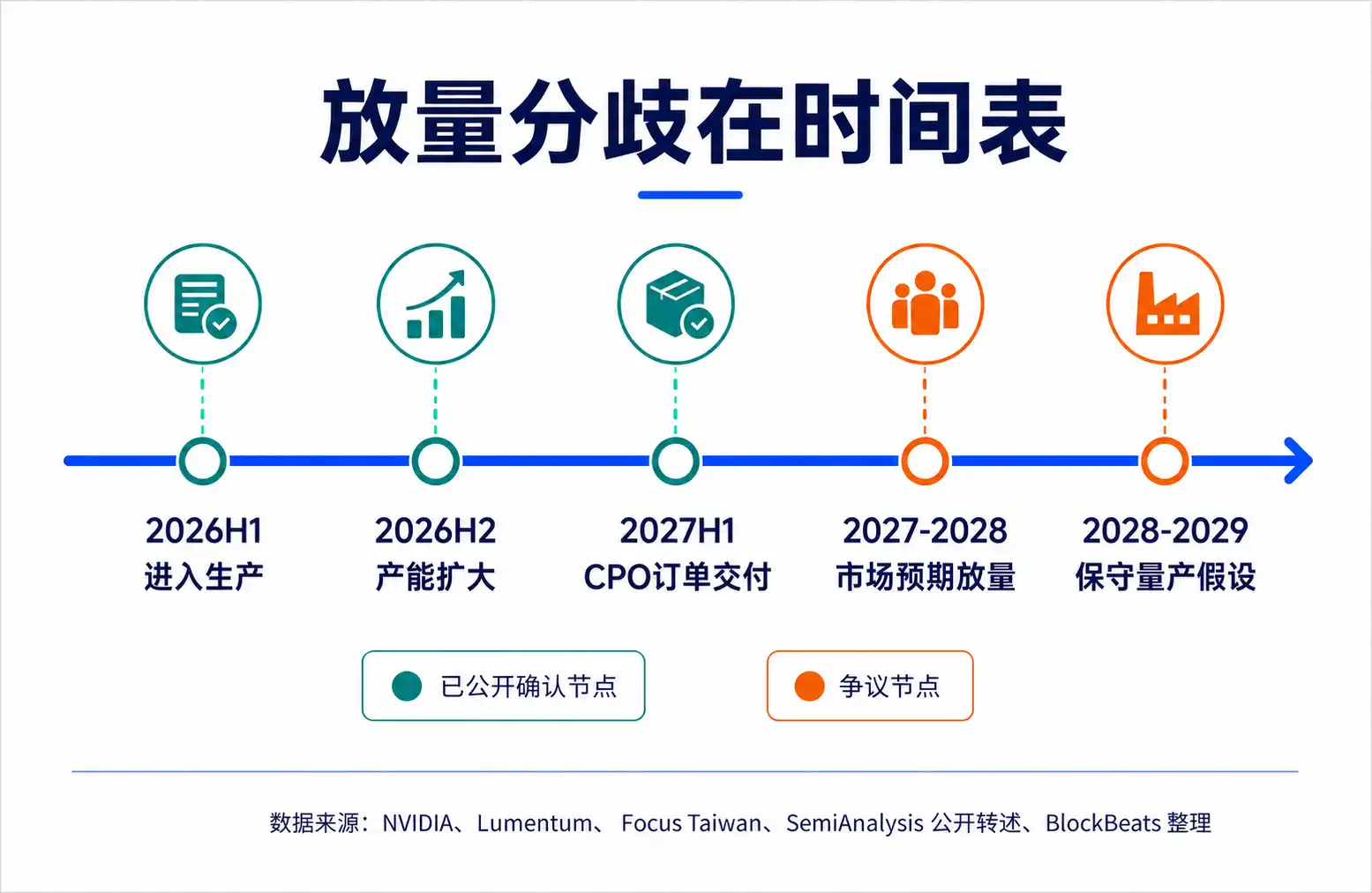
But this is not a one-sided bearish view. The "White-Haired Stock God" and AI supply chain analyst Serenity (@aleabitoreddit) subsequently rebutted SemiAnalysis, arguing that it overly relies on conservative engineering models and underestimates Nvidia's ability to compress hardware cycles. Based on her interpretation of signals from Nvidia, Lumentum, Foxconn, and others, she emphasized that CPO remains on track for ramps in the second half of 2026, the second half of 2027, and 2028.

The value of this debate is not in determining who "won," but in shifting the valuation anchor for the optical supply chain from an ultimate-narrative back to a timeline verification: CPO will come, but the slope at which it arrives determines the value distribution between NPO, pluggable modules, light sources, and switch chips.

The Timetable Reassessment Behind the Optical Stock Decline

Over the past few months, the market's buying of the optical chain was based not on current revenue, but on the anticipated capital expenditure migration towards the next-generation network architecture for AI data centers.

As model training and inference clusters expand, communication pressure between GPUs, between racks, and within data centers continues to rise. The network is no longer just a supporting system outside the servers but increasingly a bottleneck for the efficiency of the AI factory. Higher bandwidth density and lower power consumption mean higher expansion limits for a given compute cluster, which is why CPO has been brought to the forefront.

CPO's theoretical appeal is straightforward: placing the optical engine as close as possible to the ASIC (application-specific integrated circuit), shortening the high-speed electrical signal path, and reducing the power consumption, signal loss, and integrity pressures from serializer/deserializer circuits and copper traces. Compared to traditional pluggable modules, CPO offers superior power consumption and density potential in the high-bandwidth era.

The market's problem is its tendency to prematurely trade "the right direction" as "certain volume ramp." Nvidia's official press releases state that the Vera Rubin platform will introduce Spectrum-X Ethernet Photonics, and that CPO switches have entered production for AI factory scale-out and cross-cluster deployment. According to Taiwanese media reports on June 3, Nvidia networking executives indicated that Spectrum-X CPO switches have been shipped to some partners, with capacity expected to expand in the second half of 2026.

These signals are sufficient to prove CPO is advancing, but they cannot be directly equated with risk-free realization of production-scale, large-volume orders. For capital markets, there is a significant valuation difference between "entering production," "shipping to some partners," "customer evaluation," and "mass production." The pullback triggered by the SemiAnalysis report is essentially the market starting to re-differentiate these qualifiers.

The Conservative Model from SemiAnalysis: CPO's Challenge Lies in Systems Engineering

SemiAnalysis is not saying CPO has no future. Its core judgment is more like: CPO's theoretical advantages are clear, but scaling its deployment will be slower than the market imagines.

The reason isn't just one or two components not being ready; it's that CPO concentrates complexity that was originally distributed across modules, boards, and systems into a more deeply coupled system. Higher integration yields more impressive single-point performance, but it also amplifies pressures on manufacturing, testing, maintenance, and supply chain resilience simultaneously.

Traditional pluggable modules benefit from modularity. If a module fails, it can be replaced, and switching between suppliers is relatively easy. CPO is different. The optical engine is placed closer to the ASIC, even integrated into the same packaging system. The power and density benefits come from this close coupling, but the radius of repair also expands. If an optical component fails, it no longer just affects an easily replaceable module but may involve the higher-value switch chip and the entire system.

SemiAnalysis's previous CPO Book repeatedly emphasized serviceability, reliability, yield, and supply chain maturity. Especially in the hyperscale cloud provider scenario, performance is not the only metric. Large customers have high demands for reliability and operational manageability. If production environment failure rates, repair processes, and replacement costs are not under control, even the best power consumption model could see delayed adoption.

InP lasers are another point of contention. Laboratory-level port runtime data can prove technical feasibility but doesn't equate to covering long-term operation, mass manufacturing, field maintenance, and supply chain redundancy in large-scale data centers. For investors, this distinction is crucial: lab validation proves the direction, field reliability determines the volume ramp.

In SemiAnalysis's framework, NPO and pluggable modules are not outdated technologies but more practical intermediate layers before engineering risks are fully resolved. CPO is theoretically superior, but if its comprehensive adoption requires more time, the market must reprice these "less-than-ultimate but easier-to-manufacture-and-maintain" solutions.

Serenity's Rebuttal: Nvidia Could Compress Hardware Cycles

Serenity's rebuttal does not deny CPO's engineering difficulties but argues that SemiAnalysis underestimates Nvidia's organizational capabilities within the AI hardware cycle.

Her logic is clear: ordinary hardware adoption can indeed be delayed by yield, reliability, and customer validation, but Nvidia is no ordinary customer. It is both the definer of GPU cluster architectures and the core driver of networking, switching, system integration, and supply chain cadence. When the expansion of AI factories is constrained by network power and bandwidth limits, Nvidia has a strong enough economic incentive and industry chain leverage to compress traditional adoption cycles.

Serenity's cited evidence comes in two layers. The first is publicly cross-verifiable company statements, including Nvidia's official information about Spectrum-X Photonics entering production, and Lumentum's Q2 FY26 comments regarding CPO order and delivery schedules. Lumentum mentioned receiving incremental CPO orders worth hundreds of millions of dollars for delivery in the first half of 2027, and company materials also noted CPO-related business is expected to begin a broader ramp in the second half of 2026.

The second layer is her interpretation of supply chain signals, such as Foxconn shipping optical switches to Nvidia early. However, the specific scale of these signals and whether they represent test samples or production-level orders still require more public information for confirmation.

This is also the core of the divergence between Serenity and SemiAnalysis: SemiAnalysis believes systems engineering variables will naturally lengthen the cycle, while Serenity believes Nvidia's supply chain execution capabilities will steepen this curve.

These two judgments are not entirely contradictory. Nvidia could bring CPO into production and customer validation earlier, possibly driving adoption in some scale-out scenarios first, but this doesn't automatically mean all AI data center networks will rapidly switch to CPO by 2027. Scale-out, single-rack scaling, intra-rack, inter-rack scenarios, and different customers' reliability tolerances and cost models vary, potentially leading to layered adoption rhythms.

Serenity is rebutting the overly conservative conclusion that "CPO will be significantly delayed," not proving "CPO is already comprehensively risk-free." For the market, this is enough to support a bounce-back logic from an oversold position, but not enough to directly rewrite the aggressive 2027-2028 revenue curve back into certainty.

Why NPO Suddenly Became Important

NPO became important in this debate because it sits precisely between the logics of SemiAnalysis and Serenity.
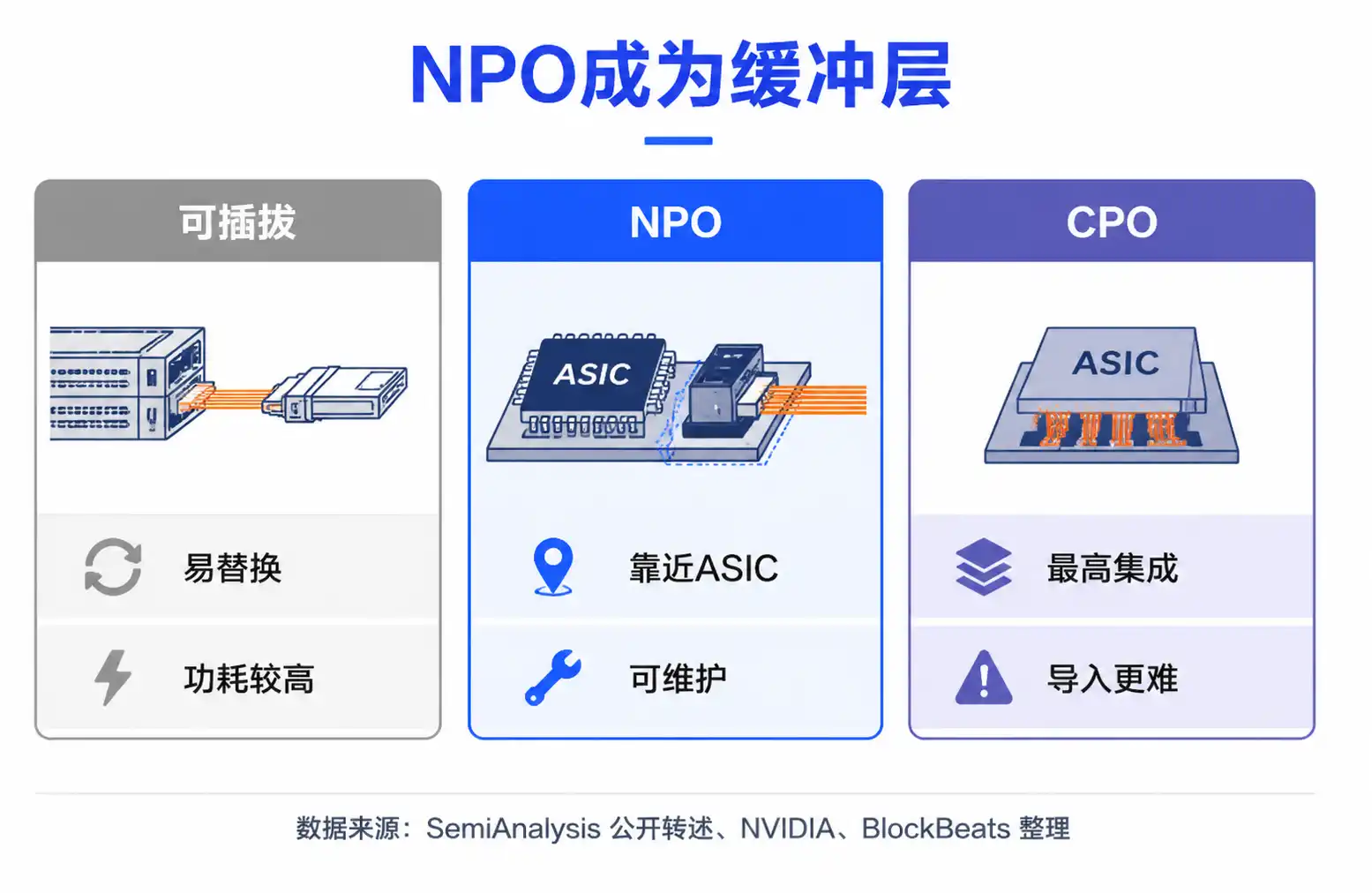
It is not the opposite of CPO, nor a simple continuation of traditional pluggable modules. The basic idea of NPO is to place the optical engine on a pluggable socket substrate near the ASIC, shortening the electrical path to gain some power and density benefits while retaining better testability, replaceability, and supply chain elasticity.

If SemiAnalysis's conservative model proves closer to reality, and CPO's deep packaging is slowed by yield, repair, and reliability issues, NPO would become the more realistic choice for a longer period. It allows hyperscalers to gradually accumulate optical interconnect operational experience without taking on the full CPO risk too soon, and also leaves a longer window for existing optical module and engine suppliers.

If Serenity's judgment about Nvidia's execution is more accurate, NPO may not disappear either. A more likely scenario is the parallel existence of NPO, CPO, pluggable modules, and copper interconnects across different network layers. Nvidia's own roadmap indicates that scale-out CPO can proceed first, while some single-rack scaling scenarios may still rely on copper or hybrid architectures into 2027-2028.

The implication for investors is that they cannot price the optical chain solely with a "CPO wins, everything else loses" mentality. Different technology paths benefit different segments: CPO favors highly integrated optical engines, laser light sources, silicon photonics, and the switch chip ecosystem. A prolonged window for NPO and pluggables could mean continued order and margin support for existing optical module makers, connectors, materials, and some light source suppliers.

The market's previous mistake was prematurely translating a technological endpoint into the earnings trajectory of a single path. What has now reopened is the valuation space for the intermediate paths.

Production-Level Data Is the Next Verification Point

This debate will not be resolved by one report or a series of posts in the short term. SemiAnalysis reminds the market that CPO's difficulty lies in systems engineering. Serenity reminds the market that Nvidia's supply chain organizational capabilities could alter traditional hardware adoption rhythms. The true divergence between the two will need to be verified by production-level data from the second half of 2026 through 2028.
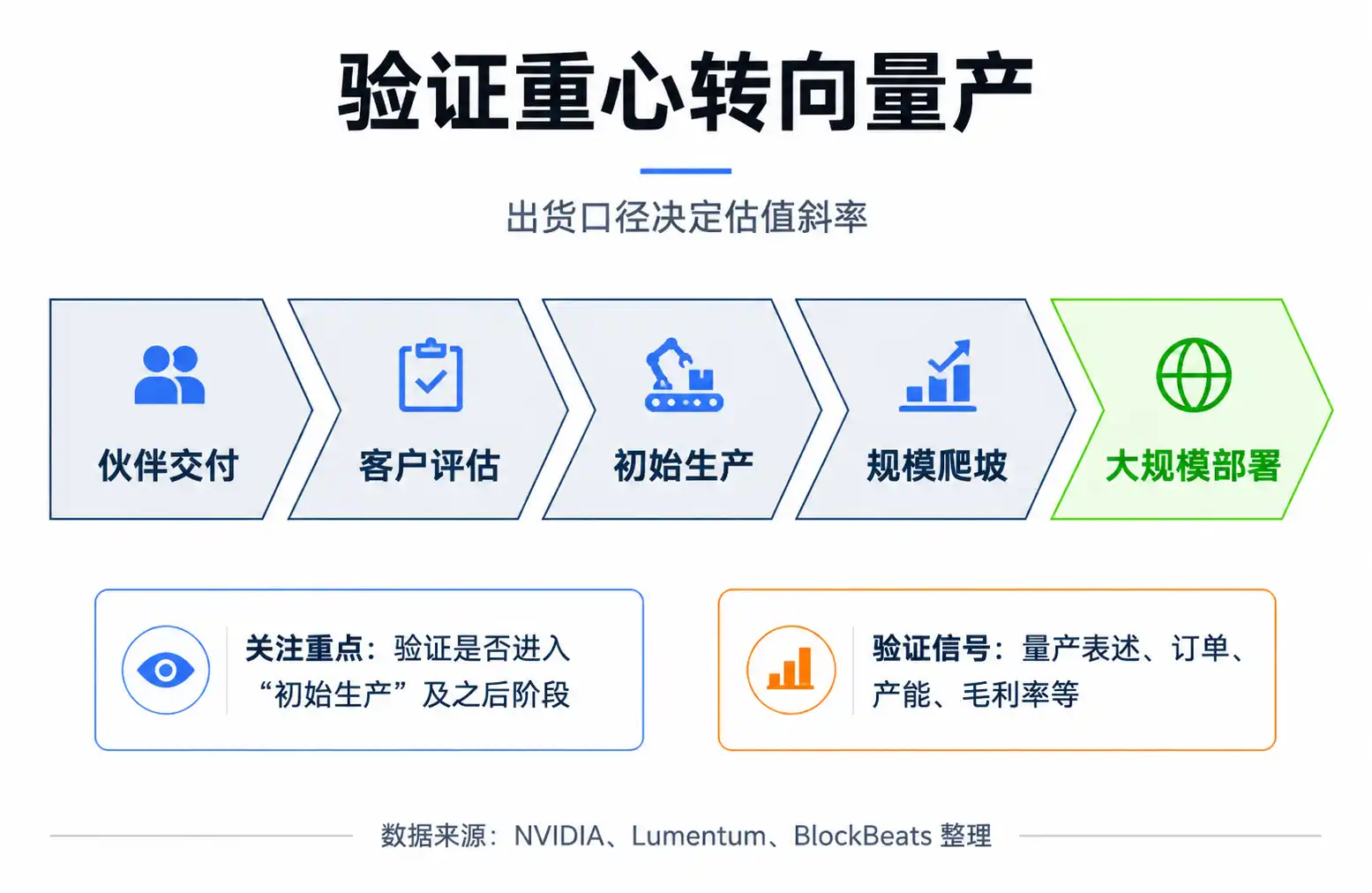
The most critical factor going forward is not "whether shipments are happening," but the qualification of those shipments. Delivery to some partners, customer evaluation, initial production, volume ramp, and large-scale deployment are completely different phases. Future statements from Nvidia regarding Spectrum-X / Quantum-X Photonics production scale, and comments from optical suppliers like Lumentum and Coherent on orders, capacity, and margins in their earnings reports will be more important than the wording of a single conference.

Equally important to watch will be field reliability and maintenance data. If CPO's failure rates, replacement procedures, yield curves, and total cost of ownership in production environments prove sufficiently stable, SemiAnalysis's conservative model will be adjusted. If this data remains confined to labs or small-batch validation, the window for NPO and pluggable modules will continue to be priced higher by the market.

The optical chain is now trading not on CPO's life or death, but on the slope of the timetable. The next verification point will lie in whether "entering production" translates into sustainable volume ramp, and the speed at which this ramp is ultimately reflected in orders, margins, and customer deployment qualifiers.

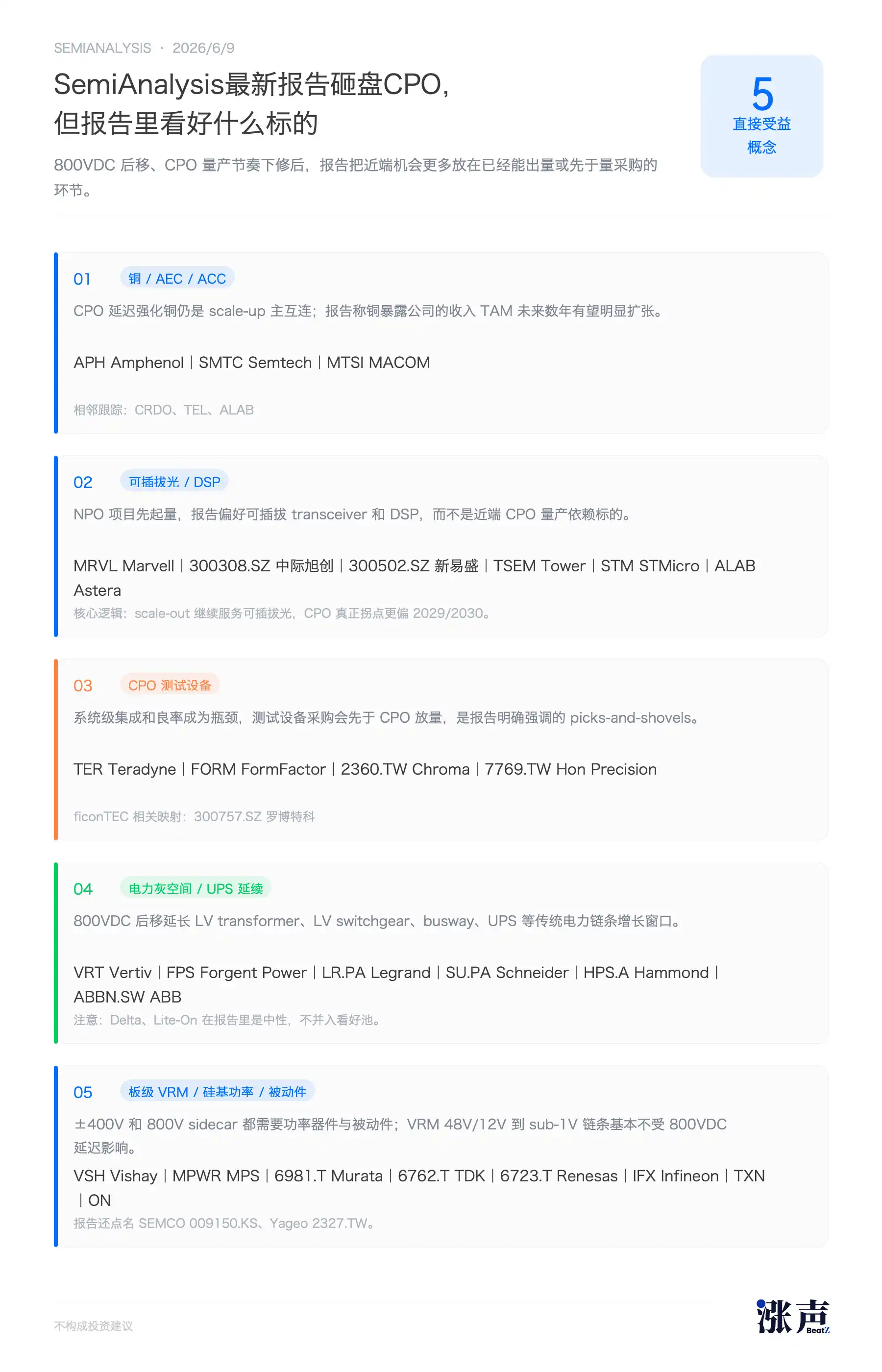
Although SemiAnalysis expressed concerns about the CPO technology over the next couple of years, they still identified five semiconductor sub-sectors they are optimistic about, namely:
Copper / AEC / ACC;
Pluggable Optics / DSP;
CPO Test Equipment;
Power Gray Space / UPS Continuation;
Board-Level VRM / Silicon-Based Power / Passive Components.

The specific related stock tickers are included in the image below for readers' reference.
Pertanyaan Terkait

QWhat is the core debate in the market regarding CPO adoption timelines?

AThe core debate is not about whether CPO technology is valid, but about its pace of commercialization. The market is reevaluating whether the 2027-2028 period will be a phase of mass production and revenue realization or remain an extended validation and initial ramp-up phase.

QWhat was the main argument of the SemiAnalysis report that triggered the sell-off in optical stocks?

AThe main argument of the SemiAnalysis report was that large-scale commercial production of CPO (specifically for NVIDIA's 800V DC) might be delayed until around 2028-2029. It focused on the engineering and supply chain complexities of CPO, such as manufacturing yield, field reliability, maintainability, and systemic risk, suggesting these factors would slow down widespread adoption compared to market expectations.

QWhat are the key points of Serenity's rebuttal to SemiAnalysis's conservative view?

ASerenity argued that SemiAnalysis underestimated NVIDIA's ability to compress the hardware adoption cycle due to its strong economic incentive and supply chain influence as the dominant AI ecosystem driver. She cited signals like NVIDIA's official statements on Spectrum-X production, Lumentum's multi-billion dollar CPO-related orders, and Foxconn's early delivery of optical switches as evidence that CPO is on track for ramps in 2026-2028.

QWhy has NPO (Near-Packaged Optics) become a more important topic in light of this debate?

ANPO has gained importance as a potential middle ground. It offers some of the power and density benefits of tighter optical integration (like CPO) while retaining better testability, serviceability, and supply chain flexibility (like traditional pluggables). If CPO adoption faces delays due to system-level challenges, NPO could serve as a more viable intermediate solution for a longer period, benefiting different parts of the supply chain.

QAccording to the article, what is the next critical data point for validating the CPO timeline?

AThe next critical validation points are production-level data, not just announcements of initial production or sampling. Key factors to watch are the scale and sustainability of order volumes, shipment figures (moving from initial production to mass deployment), field reliability metrics, maintenance procedures, and the reflection of this ramp in the gross margins and forward guidance of key suppliers like Lumentum and Coherent.

Bacaan Terkait

Setelah Tiga Kuartal Berturut-Turut Turun, Bisakah Pasar Kripto Menyambut Jendela Stabilitas di Kuartal Ketiga?

Pasar kripto mengalami kuartal terburuk sejak 2022, dengan kapitalisasi pasar turun 12.6% menjadi $2.1 triliun, didorong oleh keluarnya modal dan penurunan volume perdagangan. Bitcoin dan Ethereum masing-masing jatuh 14.2% dan 25.4% di kuartal kedua. Aliran keluar bersih dari ETF Bitcoin AS mencapai $4.67 miliar, menandakan tekanan jual yang berkelanjutan. Faktor utama meliputi terputusnya hubungan dengan saham AS, kebijakan moneter Federal Reserve yang ketat, dan pelepasan aset oleh perusahaan seperti Strategy. Proses legislasi UU CLARITY yang akan memberikan kejelasan regulasi terhambat, meningkatkan premi risiko di sektor ini. Namun, ada tanda-tanda potensi stabilisasi. Aliran keluar ETF yang besar secara historis sering terjadi di akhir fase penurunan, dan para pemegang Bitcoin jangka panjang mulai menambah kepemilikan lagi. Sementara sebagian besar sektor menyusut, pasar prediksi dan aset koleksi yang ditokenisasi mencatat pertumbuhan signifikan. Pandangan untuk kuartal ketiga sangat bergantung pada pertemuan Fed akhir Juli. Sinyal kebijakan yang lunak dapat mendukung pemulihan Bitcoin, sementara sikap yang hawkish dapat memicu konsolidasi lebih lanjut. Meskipun tantangan regulasi tetap ada, indikator teknis seperti harga Bitcoin yang mendekati rata-rata bergerak 200-mingguannya menunjukkan dasar jangka panjang belum rusak. Logika pasar telah bergeser dari mengandalkan narasi ke faktor fundamental seperti kebijakan dan ekspektasi suku bunga.

marsbit7j yang lalu

Setelah Tiga Kuartal Berturut-Turut Turun, Bisakah Pasar Kripto Menyambut Jendela Stabilitas di Kuartal Ketiga?

marsbit7j yang lalu

The SpaceX Trade, Terbuka: SPCXON Mulai Diperdagangkan di WEEX

SpaceX meluncurkan IPO terbesar dalam sejarah pada Juni 2026, namun akses bagi banyak pedagang terhambat oleh batasan regional dan prosedur broker. WEEX kini menghadirkan SPCXON/USDT di pasar spotnya, sebuah instrumen tokenisasi yang memungkinkan paparan terhadap pergerakan harga SpaceX melalui akun kripto yang diselesaikan dengan USDT, tanpa memerlukan broker AS atau pembiayaan bank. SPCXON adalah produk tokenisasi yang mencerminkan ekonomi kepemilikan SpaceX bagi pedagang yang memenuhi syarat di luar AS, dengan dividen diinvestasikan kembali. Aset ini diperdagangkan di WEEX sebagai pasangan spot dengan USDT, tersedia selama jam pasar, memberikan akses mudah bagi trader kripto. Kasus investasi untuk SpaceX didasarkan pada pertumbuhan pendapatan Starlink dan pencapaian Starship, meskipun valuasinya yang tinggi (sekitar 90-110 kali pendapatan) telah memperhitungkan eksekusi sempurna selama bertahun-tahun. Faktor seperti jumlah saham publik yang terbatas dan masa buka kunci (unlock) insider pertama menjadi pertimbangan penting. Penting untuk diingat bahwa SPCXON memberikan paparan, bukan kepemilikan langsung atas saham atau hak suara. Harganya dapat diperdagangkan pada premium atau diskon terhadap nilai aset bersih. WEEX menawarkan akses ke berbagai aset TradFi yang ditokenisasi seperti ini dalam satu akun terpadu, bersama dengan pasar futures dan kampanye perdagangan dengan pool hadiah.

TheNewsCrypto7j yang lalu

The SpaceX Trade, Terbuka: SPCXON Mulai Diperdagangkan di WEEX

TheNewsCrypto7j yang lalu

Momen Perdagangan BIT: BTC Masih Tertekan oleh EMA 200 Mingguan, Setelah Ditolak Mungkin Kembali Turun, Saham Penyimpanan dan Semikonduktor yang Melonjak Malam Kemudian Mulai Anjlok di Pasar Malam

**PASAR KRIPTO & SAHAM: BTC Hadapi Resistensi, Saham Semikonduktor Turun di Perdagangan Malam** Pasar kripto melanjutkan pemulihan, dengan harga Bitcoin bertahan di sekitar $66,000 setelah rebound lebih dari 15% dari titik terendah Juli. Namun, BTC menghadapi **tembok resistensi kuat di dekat $68,000**, yang bertepatan dengan biaya rata-rata investor selama lima bulan terakhir dan titik gagalnya rebound pertengahan Juni. Secara teknis, perhatian tertuju pada **200 EMA mingguan (~$68,328) sebagai level kunci**. Jika BTC ditolak di level ini, potensi penurunan menuju support $63,000 terbuka. Analis menyoroti volume rendah dan penurunan open interest futures di CME, menandakan rebound ini lebih dipicu likuiditas rendah musim panas daripada awal bull run penuh. Di pasar saham AS, **indeks futures utama turang** setelah sesi kemarin yang kuat. Sektor semikonduktor dan penyimpanan (storage), yang melonjak pada hari Selasa (contoh: Micron +12%), **mengalami koreksi di perdagangan malam (night trading)**. ETF semikonduktor turun 2,22% dan saham Micron turun 2,29%. Meski begitu, ada sorotan positif seperti **Super Micro Computer (SMCI)** yang naik lebih dari 15% setelah melaporkan pandangan pendapatan yang kuat dan pesanan baru yang sangat besar, mengonfirmasi permintaan server AI tetap solid. Kekhawatiran makro muncul dari **kenaikan harga minyak mentah (di atas $91)** akibat ketegangan geopolitik dan **lonjakan imbal hasil (yield) obligasi pemerintah AS**, dengan imbal hasil 10-tahun mencapai sekitar 4,64%. Faktor-faktor ini dapat menambah tekanan inflasi dan membatasi ruang gerak pasar saham. Saham terkait kripto seperti Coinbase dan Robinhood naik kuat didorong oleh perkembangan regulasi yang lebih jelas di AS. Di Asia, **Korea Selatan** dan **Jepang** menunjukkan kinerja beragam. Indeks KOSPI Korea naik didukung pemulihan saham semikonduktor, sementara pasar Jepang melemah dengan **Yen terus melemah ke level terendah sejak 1986**, meningkatkan kekhawatiran akan intervensi bank sentral. **Yang Perlu Diperhatikan Selanjutnya:** * **22 Juli:** Acara AI AMD, rilis laporan keuangan dari Google (Alphabet), Tesla, IBM. * **23 Juli:** Keputusan suku bunga Bank Sentral Eropa (ECB), data klaim pengangguran AS, laporan keuangan Intel. * Perkembangan lebih lanjut dari **harga minyak, imbal hasil obligasi, dan dinamika Yen Jepang** akan menjadi penentu sentimen pasar risiko secara keseluruhan.

marsbit7j yang lalu

Momen Perdagangan BIT: BTC Masih Tertekan oleh EMA 200 Mingguan, Setelah Ditolak Mungkin Kembali Turun, Saham Penyimpanan dan Semikonduktor yang Melonjak Malam Kemudian Mulai Anjlok di Pasar Malam

marsbit7j yang lalu

Mantan Ketua CFTC dan Presiden Circle, Tarbert: Satu Pihak Menasihati Anda untuk Berpikir Jangka Panjang, di Sisi Lain Menguangkan $30 Juta Sendiri

Penulis: Zen, PANews Heath Tarbert, mantan Ketua CFTC dan Presiden Circle, baru-baru ini menyerukan kepada investor untuk mengadopsi pandangan jangka panjang terhadap saham Circle, meskipun harganya telah turun 70% dari puncaknya. Namun, ia sendiri secara konsisten menjual saham CRCL sejak perusahaan go public, menguangkan sekitar $30 juta tanpa pernah membeli saham tambahan di pasar terbuka. Tarbert, yang bergabung dengan Circle pada Juli 2023 dan menjadi Presiden pada awal 2025, dikenal sebagai pendukung kuat narasi "jangka panjang" perusahaan. Namun, sehari sebelum IPO Circle, ia menetapkan rencana perdagangan 10b5-1 untuk menjual hingga 353.290 saham dalam setahun. Dalam 13 bulan setelah IPO, ia menjual lebih dari 360.000 saham, termasuk penjualan tunggal senilai $11,5 juta pada Maret 2026. Ia bahkan menetapkan rencana 10b5-1 kedua untuk menjual hingga 160.000 saham lagi pada akhir tahun 2026. Langkah Tarbert ini menuai kecaman karena dianggap tidak konsisten dengan pesan "jangka panjang" yang ia sampaikan kepada publik. Perjalanan kariernya sering dikaitkan dengan "revolving door" antara regulator dan dunia keuangan. Setelah mengundurkan diri sebagai Ketua CFTC pada Maret 2021, ia bergabung dengan Citadel Securities hanya 27 hari kemudian sebagai Kepala Penasihat Hukum, tepat saat perusahaan itu menghadapi pengawasan ketat terkait peristiwa GameStop. Di Citadel, ia juga mendukung undang-undang yang memperluas wewenang CFTC atas pasar crypto, sementara Citadel diketahui berencana berekspansi ke aset kripto. Tarbert kemudian pindah ke Circle pada 2023, membantu perusahaan mengatasi tantangan regulasi dan akhirnya go public melalui IPO langsung. Meskipun sangat berharga bagi perusahaan, tindakannya menjual saham dalam jumlah besar sambil mendorong investor untuk bertahan menimbulkan pertanyaan tentang komitmennya yang sebenarnya terhadap masa depan jangka panjang Circle.

marsbit7j yang lalu

Mantan Ketua CFTC dan Presiden Circle, Tarbert: Satu Pihak Menasihati Anda untuk Berpikir Jangka Panjang, di Sisi Lain Menguangkan $30 Juta Sendiri

marsbit7j yang lalu

Gate Research Institute: Produk Keuangan Kripto Menggulirkan Gelombang "Wall Street-ization", Kompetisi atau Integrasi?

**Ringkasan: Gelombang "Wall Street-ization" Produk Keuangan Kripto: Kompetisi atau Integrasi?** Artikel ini membahas fenomena konvergensi antara keuangan tradisional (TradFi) dan keuangan kripto (Crypto). Meskipun Bitcoin awalnya dirancang sebagai sistem peer-to-peer yang terdesentralisasi dan bebas dari perantara seperti bank, pasar kripto kini semakin diintegrasikan ke dalam infrastruktur keuangan tradisional. **Tren "Wall Street-ization":** Dimulai dengan disetujuinya ETF spot Bitcoin pada 2024, aset kripto kini dikemas menjadi produk seperti ETF (oleh BlackRock, Fidelity, dll.), futures, dan sekuritisasi aset riil (RWA) seperti obligasi pemerintah yang ditokenisasi. Ini memberikan akses yang mudah dan teregulasi bagi investor institusional, tetapi juga berarti kekuasaan atas penerbitan, penentuan harga, kustodian, dan distribusi aset kripto semakin bergeser ke lembaga keuangan besar. **Dua Jalur Konvergensi (1+1>2):** Artikel ini menyoroti dua arah integrasi: 1. **Dari CEX ke TradFi:** Dilambangkan oleh **Gate.io**, yang berkembang dari bursa kripto menjadi platform multi-aset. Gate kini menawarkan perdagangan saham nyata (AS, Hong Kong, Korea) menggunakan USDT, menyediakan akses tanpa batas waktu ke pasar tradisional. 2. **Dari TradFi ke Crypto:** Dilambangkan oleh **Robinhood**, platform broker tradisional yang memperluas layanannya ke aset kripto (termasuk melalui akuisisi Bitstamp) dan mengembangkan produk seperti token saham di blockchain. **Tujuan Bersama: Akun Keuangan "Super" Terpadu:** Kedua jalur ini bertujuan menciptakan **akun keuangan generasi berikutnya yang terpadu**. Pengguna di masa depan mungkin dapat memperdagangkan Bitcoin, saham Apple, ETF, emas, dan obligasi pemerintah yang ditokenisasi dalam satu antarmuka yang sama, menggunakan stablecoin sebagai lapisan dana. **RWA dan Obligasi Pemerintah di On-Chain sebagai Lapisan Tengah:** Tokenisasi aset dunia nyata, terutama obligasi pemerintah AS, menyediakan aset berpenghasilan rendah risiko di ekosistem on-chain. Pasar ini tumbuh pesat (naik 40% pada paruh pertama 2026) meskipun pasar kripto turun, menunjukkan permintaan nyata. **Kesimpulan:** "Wall Street-ization" bukanlah pengambilalihan sepihak, melainkan **transformasi timbal balik**. TradFi dan Crypto saling melengkapi: Crypto mendapatkan akses ke likuiditas, kepatuhan, dan jaringan distribusi yang luas, sementara TradFi mengadopsi efisiensi, kecepatan, dan pasar 24/7 dari Crypto. Hasil akhirnya adalah pembentukan **pasar modal terpadu yang lebih efisien dan global**, di mana batas antara aset tradisional dan kripto semakin kabur.

marsbit7j yang lalu

Gate Research Institute: Produk Keuangan Kripto Menggulirkan Gelombang "Wall Street-ization", Kompetisi atau Integrasi?

marsbit7j yang lalu

Trading

Spot
活动图片





