Illustrating Meta's Layoffs: Firing 700 Employees on the Same Day, Offering Executives a $9 Trillion Bet-Based Incentive

marsbitDipublikasikan tanggal 2026-03-26Terakhir diperbarui pada 2026-03-26

Abstrak

On March 25, Meta laid off approximately 700 employees across departments including Reality Labs, Facebook, recruiting, and sales. On the same day, the SEC disclosed an executive stock option plan for six top executives, tied to a $9 trillion market cap target—the first such grant since Meta’s 2012 IPO. This reflects Meta’s strategic shift: fewer but higher-value talent and massive AI investment. Since its 2022 peak of 86,482 employees, Meta has cut nearly 8,000 roles. Meanwhile, annual revenue grew 72% to $201 billion by Q4 2025, and revenue per employee surged 89% to $2.55 million. Meta’s 2026 capital expenditure is projected to reach $115–135 billion, part of a collective $650 billion AI infrastructure push by Amazon, Google, Microsoft, and Meta. This spending is prioritized over short-term cash flow, with free cash flow expected to drop nearly 90% in 2026. The executive options are structured with tiered targets: the highest requires Meta’s market cap to reach $9 trillion—six times its current $1.5 trillion—by 2031. If achieved, top executives could gain up to $2.7 billion each. The underlying formula is clear: reallocating resources from broad headcount to elite talent and AI infrastructure, with leadership incentives aligned to extreme growth.

On March 25, Meta notified approximately 700 employees to leave, affecting five departments including Reality Labs, Facebook social media, recruitment, and sales. On the same day, the SEC disclosed an executive stock option plan, where six core executives will receive stock options tied to a $9 trillion market cap. This is the first time Meta has issued options to executives since its IPO in 2012.

Laying off employees while rolling out the most aggressive executive incentive plan in Silicon Valley history. These two actions taken by Meta on the same day are not contradictory; they are two sides of the same strategy. The AI race doesn't need more people; it needs more expensive people and more machines.

Fewer People, Each More "Valuable"

2022 was Meta's peak year for employees, with 86,482 people company-wide. That year, Zuckerberg bet heavily on the metaverse, hiring frantically, only to see annual revenue drop from the previous year's $117.9 billion to $116.6 billion. Revenue per employee fell to a trough of $1.35 million.

What happened next is known to all. In November 2022, 11,000 people were laid off, followed by another 21,000 in 2023, cutting a quarter of the company's workforce. Zuckerberg named 2023 the "Year of Efficiency".

The results of efficiency are written in the numbers. According to Meta's Q4 2025 earnings report, by the end of 2025, the company had 78,865 employees, nearly 8,000 fewer than the peak. However, annual revenue grew from $116.6 billion to $201 billion during the same period, an increase of 72%. Revenue per employee soared from $1.35 million to $2.55 million, an 89% increase.
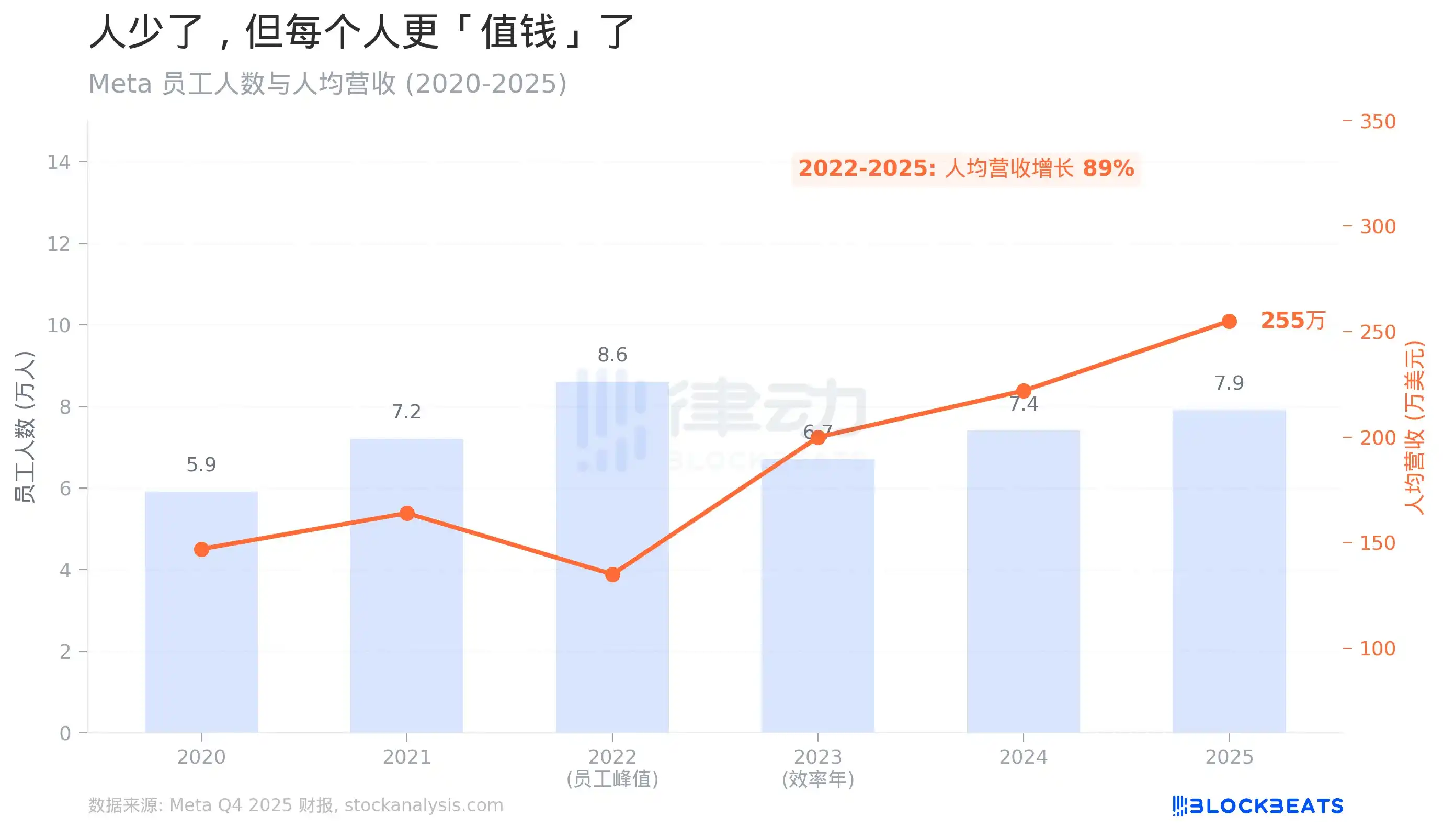
The meaning of these numbers is straightforward. Meta is making more money with fewer people. In 2022, the marginal revenue brought by each additional employee was declining. By 2024 and 2025, the revenue increase corresponding to each employee reduction was expanding. This is the typical scale effect of a technology company, but Meta accelerated this process through layoffs.

This is the background for this round of 700 layoffs in March 2026. According to The Register, this is already Meta's second round of layoffs this year, with about 1,000 people cut from Reality Labs in January. NBC News, citing informed sources, reported that there may be larger cuts later, potentially involving up to 20% of the total workforce, or about 15,000 people, which would bring Meta's total employee count back to 2021 levels.

Zuckerberg's exact words in the January earnings call were plans to "flatten teams," allowing excellent individual contributors to complete projects that previously required large teams. Meta's spokesperson's response was also templated, saying "teams periodically undergo restructuring or adjustments to ensure they are in the best position to achieve their goals."

Continuing to Bet on the AI Arms Race

Where did the money saved from the laid-off employees go? A look at capital expenditures makes it clear.

According to Q4 2025 earnings reports and public guidance from various companies, the combined capital expenditures of Amazon, Google, Microsoft, and Meta in 2026 will reach approximately $650 billion, a year-on-year increase of about 130%. This includes Amazon at about $200 billion (up 167%), Google at about $175 to $185 billion (up 140%), Microsoft annualized at about $145 billion (up 127%), and Meta at $115 to $135 billion (up 73%).

According to CNBC, this is the largest single-year capital expenditure in the history of the tech industry. The four companies' investment in AI infrastructure in one year exceeds Sweden's annual GDP.
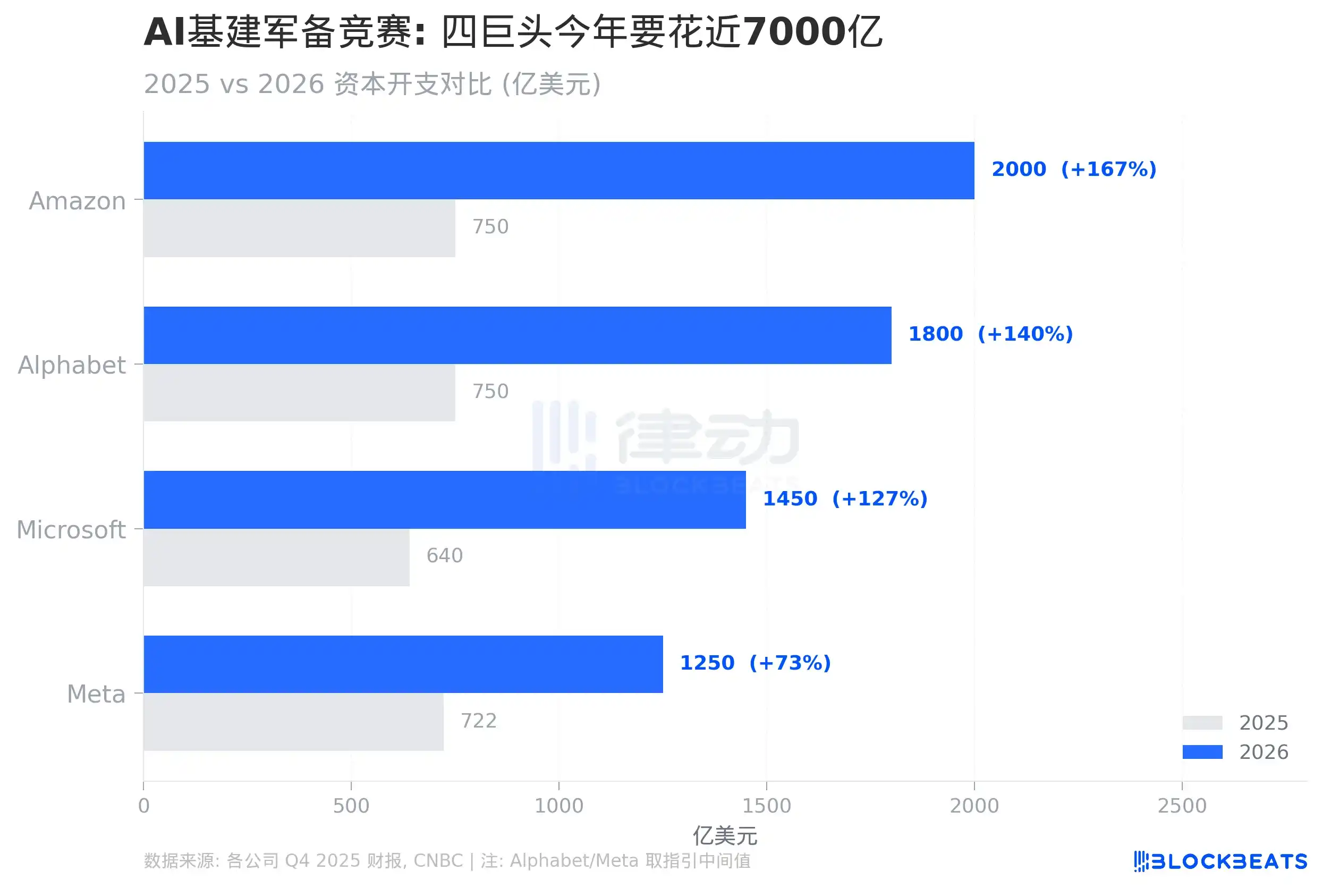
Meta's absolute value ranks fourth, but relative to its own size, the density of this investment is staggering. Calculated at the midpoint of $125 billion, Meta's AI infrastructure investment per employee is about $1.59 million, close to 62% of the revenue per employee ($2.55 million). Put another way, for every $100 Meta earns, it invests $62 into data centers.

The cost of this money is also direct. According to CNBC, citing Barclays analysts' estimates, Meta's free cash flow in 2026 will decline by nearly 90%. Amazon is even more aggressive; Morgan Stanley expects Amazon to have approximately negative $17 billion in free cash flow in 2026. All four giants are doing the same thing: trading today's cash flow for tomorrow's AI infrastructure.

The $9 Trillion Bet

Now look at the option plan. According to the SEC disclosure documents and analysis by Motley Fool, this plan covers 6 executives, including CTO Bosworth, CPO Cox, COO Olivan, CFO Susan Li, CLO Mahoney, and Vice Chairman McCormick. Zuckerberg is not on the list; his super-voting shares already make additional incentives unnecessary.

The option's exercise conditions are designed with tiered price thresholds. According to Motley Fool, the lowest exercise price is $1,116 per share, requiring the stock price to rise 88% from the current ~$615. The highest tier is $3,727 per share, corresponding to a market cap of about $9 trillion, six times the current $1.5 trillion. There is a five-year window for vesting before 2031. If Meta actually reaches a $9 trillion market cap, according to Motley Fool's calculations, the top four executives (Bosworth, Cox, Olivan, Susan Li) could each see potential gains of approximately $2.7 billion.

The signal of this plan is clear. Meta is not giving executives a bonus; it is using options to tie the core team to an extremely aggressive growth target. The current market cap is $1.5 trillion, the goal is $9 trillion. The difference of $7.5 trillion – Meta is betting that AI can create this value.
For a sense of scale: $9 trillion is roughly equivalent to the combined current market capitalization of Apple and Nvidia. No company in the world has ever reached this market cap. Meta has given its core executives five years to try and reach a number that doesn't exist in human commercial history.

One Formula

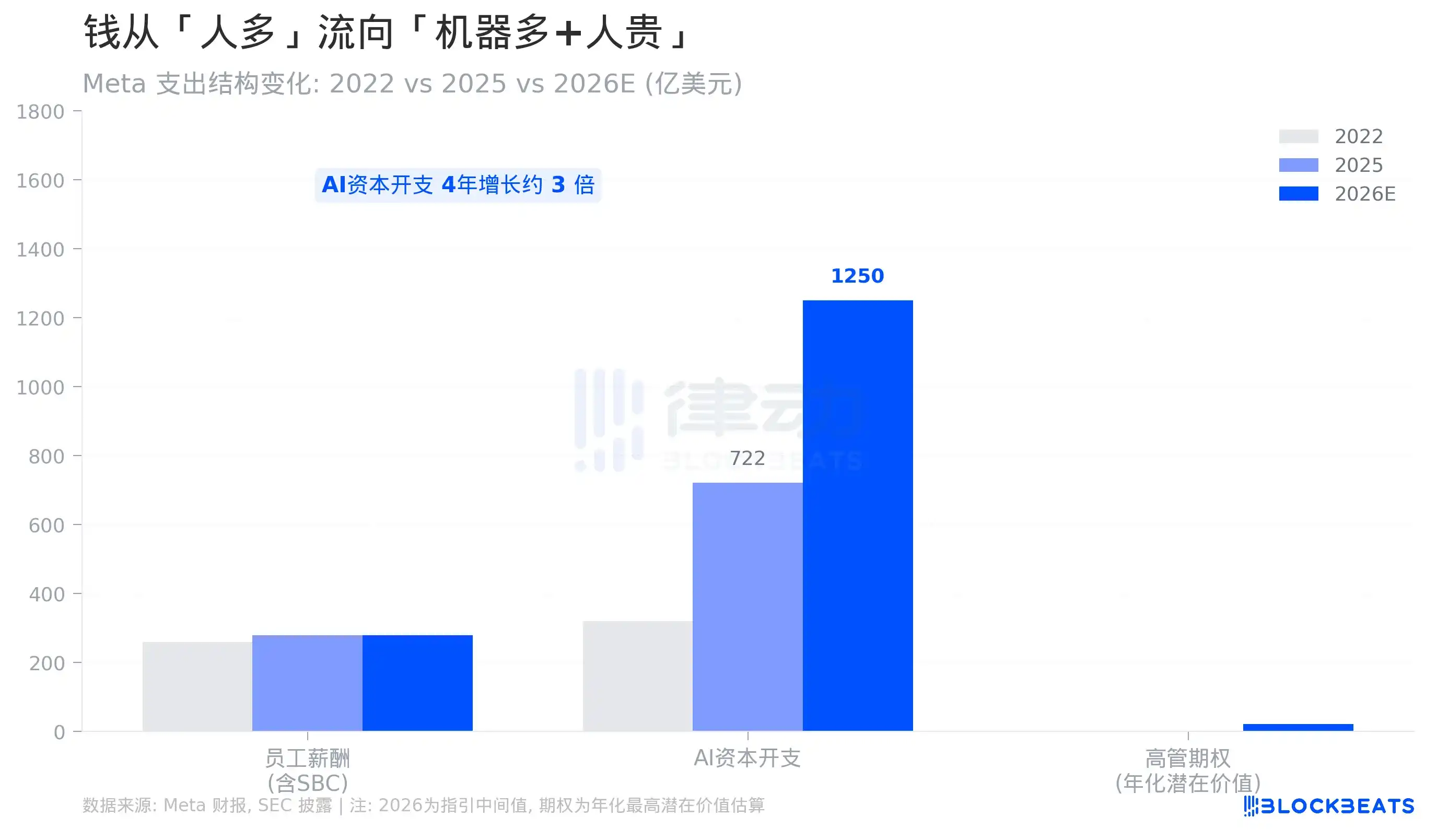
Looking at these three things together, Meta's logic is a simple resource allocation formula. Total employee compensation (including equity incentives) remained largely flat between 2022 and 2026, around $26 to $28 billion. But AI capital expenditures soared from $32 billion to $125 billion, a roughly 3-fold increase in four years. At the same time, a brand new executive option pool has appeared, locking the six most core people into the next five years.

According to Benzinga, Meta's stock-based compensation expense in 2025 was approximately $42 billion, already consuming most of its free cash flow. Signing bonuses for AI researchers have reached nine figures, with reports of researchers poached from OpenAI receiving packages in the $100 million range. The contrast between these numbers and the 700 laid-off employees makes Meta's pricing logic for "people" clear without any need for commentary.

The money saved from laying off 700 people is roughly equivalent to a day and a half of Meta's AI infrastructure spending.


Pertanyaan Terkait

QWhat is the significance of Meta's dual actions on March 25th: laying off 700 employees while announcing a $9 trillion stock option plan for executives?

AThese actions represent two sides of the same strategic shift. Meta is reallocating resources from a larger, less focused workforce to massive AI infrastructure investments and highly compensated, elite talent. The layoffs improve efficiency (as seen in rising revenue per employee), while the unprecedented executive期权 plan aligns top leadership with an extremely aggressive growth target tied to AI's potential value creation.

QHow did Meta's employee count and financial performance change between its 2022 peak and the end of 2025?

AMeta's employee count decreased from a peak of 86,482 in 2022 to 78,865 by the end of 2025, a reduction of nearly 8,000 people. However, its annual revenue grew 72%, from $116.6 billion to $201.0 billion. Consequently, revenue per employee surged 89%, from $1.35 million to $2.55 million, demonstrating significantly improved efficiency.

QWhat are the scale and implications of the capital expenditure plans by major tech companies like Meta for 2026?

AAmazon, Google, Microsoft, and Meta plan a combined capital expenditure of approximately $650 billion in 2026, a 130% year-over-year increase. This represents the largest single-year capex in tech industry history, exceeding Sweden's GDP. For Meta specifically, its planned $115-135 billion capex translates to about $1.59 million in AI infrastructure investment per employee, which is roughly 62% of its revenue per employee.

QWhat are the specific terms and potential payouts of the new executive stock option plan at Meta?

AThe plan covers 6 core executives (excluding Zuckerberg). It features tiered exercise prices. The lowest tier requires the stock price to rise 88% from ~$615 to $1,116 per share. The highest tier is set at $3,727 per share, which would give Meta a market capitalization of approximately $9 trillion—six times its current $1.5 trillion value. If this top target is met within the 5-year window (by 2031), the top four executives could each see potential gains of around $2.7 billion.

QHow does Meta's resource allocation formula illustrate its new strategic priority towards AI?

AMeta's resource allocation has fundamentally shifted. Total employee compensation (including stock awards) remained flat at around $26-28 billion between 2022 and 2026. Meanwhile, AI capital expenditure skyrocketed nearly 3x, from $32 billion to $125 billion. This shows a massive reallocation of cash flow from human resources to AI infrastructure. Furthermore, the new executive期权 pool and reports of nine-figure signing bonuses for top AI researchers highlight a focus on investing in a smaller number of 'more expensive' people critical to AI development.

Bacaan Terkait

GensynAI : Jangan Biarkan AI Mengulangi Kesalahan Internet

Beberapa bulan terakhir, banyak talenta dari industri kripto beralih ke AI karena pesatnya perkembangan industri kecerdasan buatan. Para peneliti yang bergerak di kedua bidang ini terus mengeksplorasi satu pertanyaan yang belum terjawab: **Bisakah blockchain menjadi bagian dari infrastruktur AI?** Proyek yang menggabungkan AI dan Crypto, seperti AI Agent, on-chain reasoning, pasar data, dan penyewaan daya komputasi, telah banyak bermunculan. Namun, sebagian besar masih berada di "lapisan aplikasi AI" dan belum membentuk closed-loop bisnis yang nyata. Berbeda dengan itu, **Gensyn** justru menyasar lapisan paling inti dan mahal dalam industri AI: **pelatihan model**. Gensyn bertujuan untuk mengorganisir sumber daya GPU yang tersebar secara global menjadi jaringan pelatihan AI terbuka. Pengembang dapat mengirimkan tugas pelatihan, node menyediakan daya komputasi, dan jaringan bertugas memverifikasi hasil pelatihan serta mendistribusikan insentif. Nilai utama di balik ini bukan semata-mata "desentralisasi", melainkan solusi atas masalah mendesak dalam industri AI: **sumber daya komputasi (GPU) yang semakin terkonsentrasi di tangan segelintir raksasa teknologi.** Kelangkaan pasokan H100, kenaikan harga layanan cloud, dan persaingan ketat untuk mengunci sumber daya komputasi menunjukkan bahwa kepemilikan GPU kini menjadi penentu kecepatan pengembangan AI, terutama di era model besar (large models). **Mengapa Gensyn Menarik Perhatian?** 1. **Menyasar Lapisan Infrastruktur Inti AI:** Gensyn langsung masuk ke dalam proses pelatihan model, bagian yang paling menantang secara teknis dan paling banyak mengonsumsi sumber daya. Ini adalah lapisan yang mudah membentuk hambatan platform (platform壁垒). Jika jaringan pelatihannya mencapai skala, ia berpotensi menjadi pintu masuk penting bagi pengembangan AI di masa depan. 2. **Menawarkan Model Kolaborasi Komputasi yang Lebih Terbuka:** Berbeda dengan ketergantungan pada platform cloud terpusat yang biayanya terus naik, Gensyn mengusung model yang memanfaatkan GPU menganggur dan menjadwalkan sumber daya komputasi secara dinamis. Ini dapat meningkatkan efisiensi penggunaan daya komputasi secara keseluruhan dan mengurangi hambatan inovasi bagi tim AI kecil-menengah. 3. **Tingkat Kesulitan Teknis sebagai Keunggulan:** Tantangan sebenarnya bukan sekadar menghubungkan GPU, tetapi **cara memverifikasi hasil pelatihan, memastikan kejujuran node, dan menjaga keandalan pelatihan di lingkungan terdistribusi.** Gensyn fokus pada solusi teknis ini (seperti mekanisme verifikasi probabilistik, model distribusi tugas), menjadikannya lebih mirip perusahaan infrastruktur teknologi mendalam (deep tech). 4. **Memiliki Closed-Loop Bisnis Nyata:** Kebutuhan akan pelatihan AI adalah pasar nyata yang terus berkembang, dengan celah pasokan GPU yang berkelanjutan. Gensyn tidak sekadar menambahkan blockchain untuk kepentingannya sendiri, tetapi menjawab kebutuhan industri akan sistem penjadwalan sumber daya yang lebih fleksibel dan terbuka. Singkatnya, batas antara Crypto (sistem finansial) dan AI (sistem teknologi) semakin kabur. AI membutuhkan koordinasi sumber daya, mekanisme insentif, dan kolaborasi global—hal-hal yang menjadi keahlian Crypto. Gensyn mewakili upaya untuk membuka akses kemampuan pelatihan, yang selama ini dikuasai sedikit perusahaan besar, menjadi sistem yang lebih terbuka dan dapat dikolaborasikan. Inisiatif ini tidak lagi sekadar cerita konsep, tetapi berkembang menuju infrastruktur AI nyata, di mana perusahaan paling bernilai di era AI sering kali lahir dari lapisan infrastruktur.

marsbit10j yang lalu

GensynAI : Jangan Biarkan AI Mengulangi Kesalahan Internet

marsbit10j yang lalu

Mengapa AI China Berkembang Begitu Cepat? Jawabannya Tersembunyi di Dalam Laboratorium

Pengarang mencatat bahwa laboratorium AI China telah menjadi kekuatan yang semakin sulit diabaikan dalam kompetisi model besar global. Keunggulannya tidak hanya terletak pada banyaknya talenta, kemampuan rekayasa yang kuat, dan iterasi cepat, tetapi juga berasal dari cara organisasi yang sangat realistis: lebih banyak fokus pada pembuatan model daripada konsep, lebih menekankan eksekusi tim daripada individu bintang, dan lebih memilih menguasai tumpukan teknologi inti sendiri daripada bergantung pada layanan eksternal. Dari kunjungan ke sejumlah laboratorium AI terkemuka China, penulis menemukan ekosistem AI China tidak sepenuhnya sama dengan AS. AS lebih menekankan orisinalitas, investasi modal, dan pengaruh ilmuwan puncak, sedangkan China lebih mahir dalam mengejar cepat arah yang sudah ada. Melalui sumber terbuka, optimasi rekayasa, dan kontribusi banyak peneliti muda, China mendorong kemampuan model ke garis depan dengan cepat. Yang paling menarik untuk diperhatikan bukanlah apakah AI China telah melampaui AS, melainkan dua jalur pengembangan berbeda yang terbentuk: AS lebih seperti kompetisi garis depan yang digerakkan modal dan laboratorium bintang, sedangkan China lebih seperti kompetisi industri yang didorong oleh kemampuan rekayasa, ekosistem sumber terbuka, dan kesadaran penguasaan teknologi mandiri. Ini berarti kompetisi AI di masa depan tidak hanya soal peringkat model, tetapi juga kemampuan organisasi, ekosistem pengembang, dan eksekusi industri. Perubahan nyata AI China terletak pada cara mereka berpartisipasi dalam garis depan global dengan caranya sendiri, bukan hanya meniru Silicon Valley. Penulis juga menyoroti beberapa perbedaan utama dalam ekosistem AI China: permintaan AI domestik mulai muncul, banyak pengembang terpengaruh Claude, perusahaan memiliki mentalitas kepemilikan teknologi, ada dukungan pemerintah meski skalanya belum jelas, industri data kurang berkembang dibanding Barat, dan ada kebutuhan kuat akan chip NVIDIA lebih banyak. Penutupnya menekankan pentingnya ekosistem global yang terbuka dan kolaboratif untuk menciptakan AI yang lebih aman, mudah diakses, dan bermanfaat bagi dunia.

marsbit12j yang lalu

Mengapa AI China Berkembang Begitu Cepat? Jawabannya Tersembunyi di Dalam Laboratorium

marsbit12j yang lalu

3 Tahun 5 Kali Lipat, Pabrik Kaca Berusia Satu Abad Dibangkitkan Kembali

Menurut CRU, permintaan serat optik untuk pusat data AI meningkat 75.9% per tahun, dan kesenjangan pasokan-meningkat dari 6% menjadi 15%. Harga serat optik melonjak lebih dari 3 kali lipat dalam beberapa bulan, dan kapasitas produksi tidak dapat mengimbangi. Inilah alasan NVIDIA berinvestasi di Corning dan mempercepat ekspansi kapasitas serat optik, dengan total investasi $45 miliar dalam tiga perusahaan di seluruh rantai optik. Corning, perusahaan kaca berusia 175 tahun dari New York, melihat sahamnya naik 316.81% dalam setahun terakhir, mencapai kapitalisasi pasar $160 miliar. NVIDIA memilih Corning karena keahliannya dalam serat optik khusus berkinerja tinggi yang penting untuk pusat data AI, seperti serat dengan kehilangan sinyal ultra-rendah (0.15 dB/km), kepadatan tinggi, dan ketahanan tekuk yang baik. Penghasilan Corning dari segmen komunikasi optik untuk perusahaan (Enterprise) melonjak dari $1.3 miliar pada 2023 menjadi lebih dari $3 miliar pada 2025. Perusahaan telah mengamankan kontrak pasokan jangka panjang bernilai miliaran dolar dari klien seperti Meta dan NVIDIA. Meskipun bukan produsen serat optik terbesar secara global, keunggulan teknis Corning di pasar serat canggih untuk AI, ditambah dengan investasi R&D tahunan sebesar $1 miliar, memberinya posisi unik. Percepatan adopsi teknologi **CPO (Co-Packaged Optics)** oleh NVIDIA, yang dijadwalkan mulai produksi massal pada paruh kedua 2026, menjadi katalis penting bagi permintaan serat optik premium Corning. Namun, valuasi sahamnya yang telah melonjak pesat dan potensi keterlambatan dalam eksekusi pesanan menjadi faktor risiko yang perlu diperhatikan.

marsbit12j yang lalu

3 Tahun 5 Kali Lipat, Pabrik Kaca Berusia Satu Abad Dibangkitkan Kembali

marsbit12j yang lalu

Trading

Spot
Futures
活动图片




