Hyperliquid Infringement Dispute: Technological Rights Protection or Opportunistic Marketing?

marsbitDipublikasikan tanggal 2026-02-04Terakhir diperbarui pada 2026-02-04

Abstrak

Hyperliquid, a high-performance decentralized exchange (DEX), faces patent infringement allegations from Cypherium, a competing RWA blockchain project. The dispute centers on US Patent 11,411,721 B2, held by Cypherium, which covers systems for dynamically selecting and reconfiguring validator committees using mechanisms like aggregated signatures and two-phase reconfiguration in a Proof-of-Stake (PoS) environment. Cypherium’s founder, Sky Guo, claims Hyperliquid’s core consensus engine, HyperCore—a custom variant of the HotStuff algorithm—illegally uses this patented technology to achieve its high throughput and sub-second finality. The controversy arises as Hyperliquid’s native token, HYPE, surged over 40% amid a broader market downturn and the launch of its new prediction market proposal, HIP-4. Critics question the timing of the allegations, noting coinciding promotions for Cypherium’s upcoming project, "G-Exchange," suggesting potential "clickbait marketing." Hyperliquid has not yet publicly responded to the legal claims. With Hyperliquid’s code remaining closed-source, external verification of the infringement is challenging. The situation highlights tensions between protecting proprietary tech and maintaining decentralization trust. Additionally, HYPE is set to unlock 9.92 million tokens (2.79% of supply) on February 6, worth approximately $357 million at current prices.

Original Author: Sanqing, Foresight News

On February 2, Hyperliquid announced that the HIP-4 proposal had gone live on the testnet on February 2. This proposal aims to build a prediction market infrastructure by introducing "Outcome Trading." Additionally, from late January to early February 2026, the cryptocurrency market showed weakness, with Bitcoin's price falling below the $75,000 mark, leading to a broad market correction. However, Hyperliquid's native token HYPE bucked the trend, rising over 40% in the past week.
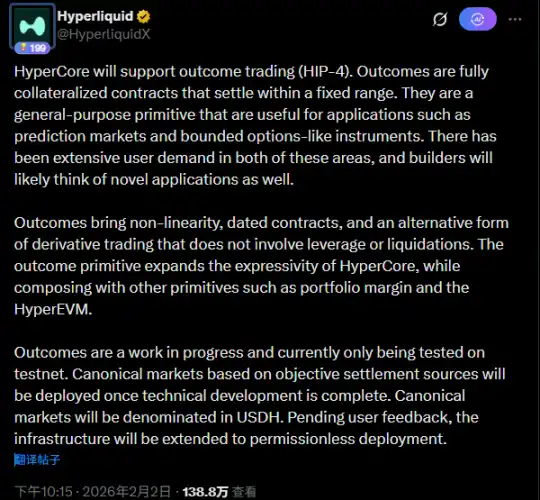
Image Source: Hyperliquid Tweet

However, as Hyperliquid expands its business, it has encountered allegations of technological infringement from a peer. On February 2, Sky Guo, founder of the RWA public chain project Cypherium, publicly accused Hyperliquid of infringing on its patented technology on social media. Sky Guo claimed that Hyperliquid's underlying consensus engine, HyperCore, uses a patented optimized version of the PoS-based HotStuff algorithm and demanded that Hyperliquid cease the infringement.
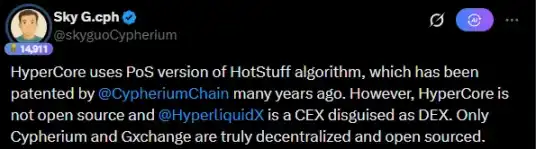
Image Source: Sky Guo Tweet


Core Dispute: The Technical Boundaries of Patent US 11,411,721 B2

The core of this dispute revolves around a formal patent issued by the United States Patent and Trademark Office (USPTO) on August 9, 2022, with the number US 11,411,721 B2. The assignee of this patent is Cypherium Blockchain Inc., and its title is "Systems and methods for selecting and utilizing a committee of validator nodes in a distributed system."

The patent details a mechanism for dynamically selecting and reconfiguring a validator committee, supporting node election through PoW, PoS, or PoA, and emphasizes the use of Aggregate Signatures to enhance consensus efficiency and fault tolerance. The patent also proposes specific implementation paths such as Two-phase Reconfiguration and Tree-structured Hierarchy.

Cypherium believes that these technologies are key to implementing HotStuff in large-scale, high-performance networks (such as Hyperliquid's 200,000 TPS), and this constitutes the core barrier of the patent rights.
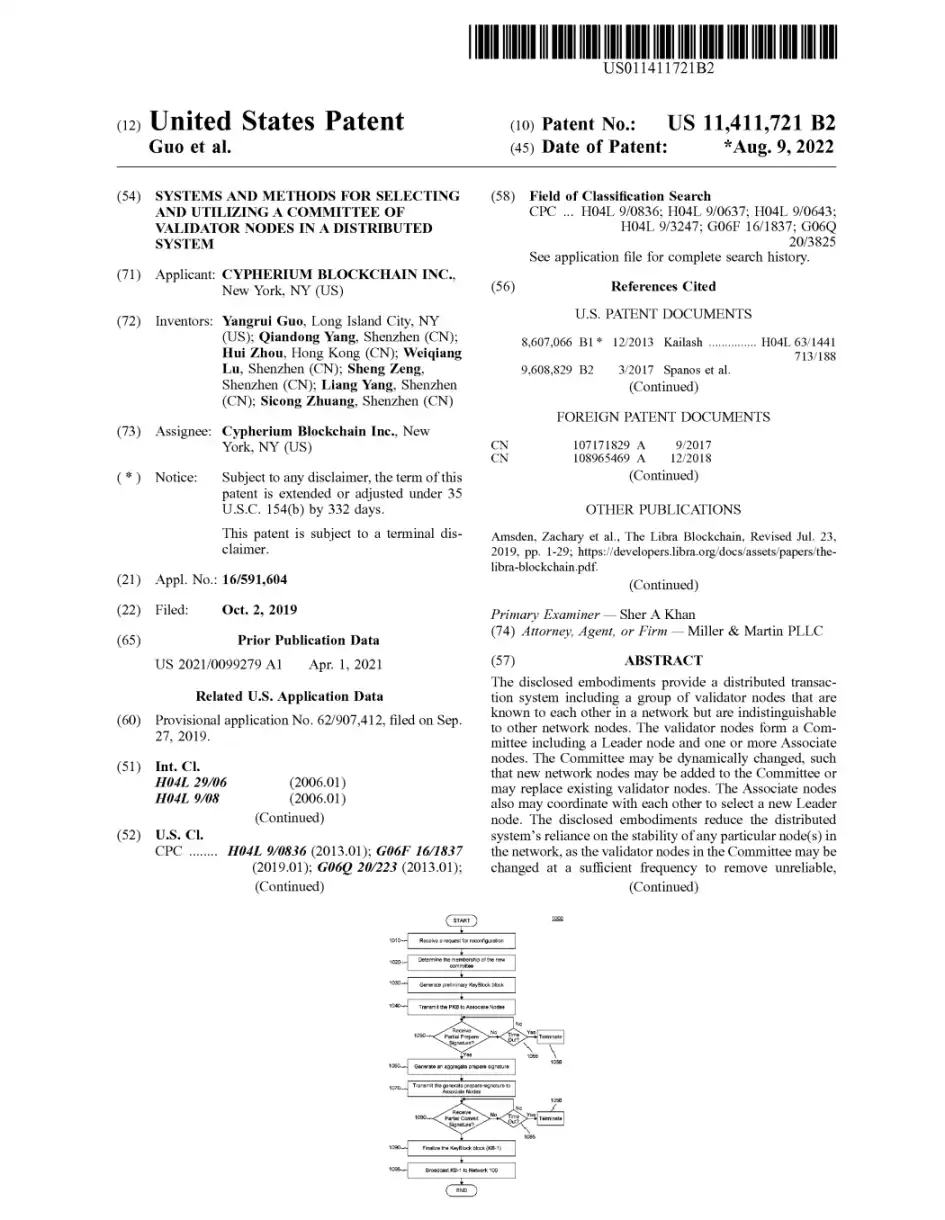
First Page of Cypherium Patent US 11,411,721 B2 | Image Source: Google Patents

The technical dispute centers on both parties' improvements and applications of the consensus algorithm HotStuff, but HotStuff itself is an open-source consensus protocol published in academia between 2018 and 2019.

Cypherium's CypherBFT combines HotStuff with PoW to achieve permissionless operation, while Hyperliquid's HyperBFT is a custom variant optimized for low-latency transactions.

However, Cypherium claims that its patent covers specific enhancement logic for HotStuff in a PoS environment. Hyperliquid has not yet responded regarding whether HyperBFT uses the unique claims covered by the patent.

Escalation of Accusations: From Questioning Transparency to Alleging Infringement

Prior to this infringement allegation, Sky Guo's criticism of Hyperliquid primarily focused on code transparency.

Image Source: Sky Guo Tweet

This lack of transparency, on one hand, protects Hyperliquid's commercial advantage in high-concurrency processing; on the other hand, it makes it difficult for the project to prove its innocence through public audits when facing external technical质疑 (questioning/doubt).

Sky Guo believes that it is precisely because HyperCore borrowed the dynamic committee selection logic described in his patent that it achieved its sub-second finality.

Sky Guo claims to have sent a legal letter to the Hyperliquid team and relevant responsible persons, accusing them of using the patented technology without permission. He stated that the Hyperliquid side is currently avoiding the issue and has not responded to the legal correspondence.

Solid Evidence or Ambush Marketing?

From a superficial legal and technical logic perspective, the US patent US 11,411,721 B2 held by Cypherium is indeed a formally issued legal document. Its scope of protection确实涵盖 (does indeed cover) key aspects of consensus mechanisms such as dynamic committee selection, signature aggregation, and two-phase reconfiguration.

According to Hyperliquid's publicly available technical documentation, the underlying HyperCore engine确实运行 (does indeed run) on a custom variant of the HotStuff algorithm called HyperBFT. HotStuff is precisely the technology改良对象 (improvement target) heavily involved in the claims of this patent.
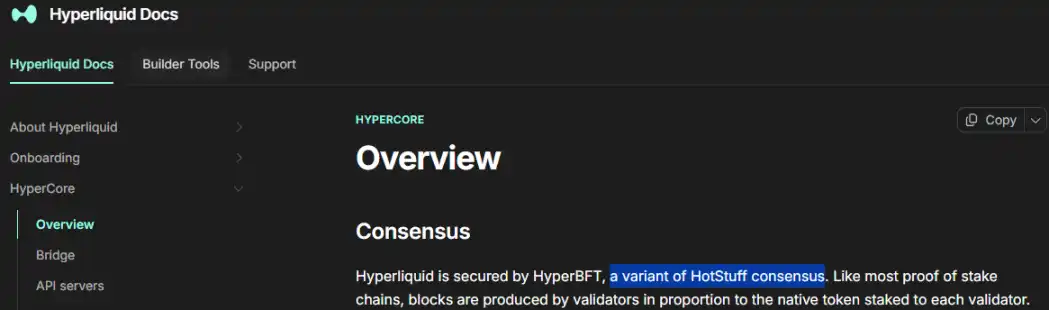
Image Source:Hyperliquid Docs

Furthermore, since Hyperliquid's core codebase is currently closed-source, this black-box属性 (attribute) makes it difficult for the outside world to determine whether its specific implementation path avoids the relevant patent through public code audits.

However, in reality, HotStuff and its variants are hardly new in the high-performance Layer 1 race. From Meta's (formerly Facebook) aborted Libra/Diem, to the currently prominent Aptos (AptosBFT), Monad (MonadBFT), and even early research iterations of Sui's core consensus, all have been significantly influenced by HotStuff's linear communication complexity and responsive design.

Additionally, the timing and context of the accusation are thought-provoking. Sky Guo published the infringement allegation at 12:00 on February 3, coinciding with strong market performance of the HYPE token and the热度 (heat/buzz) surrounding the HIP-4 proposal for the prediction market.

On social platforms, some KOLs expressed support for this rights protection action, but the comment sections of related posts featured疑似推广内容 (suspected promotional content) about "G-Exchange." "G-Exchange" is an upcoming new project within the Cypherium ecosystem. The coincidence in the timeline between this technical accusation and the预热 (pre-launch warm-up) of a new project makes this series of维权动作 (rights protection actions)疑似 (suspected of being) ambush marketing to generate buzz for the new business.
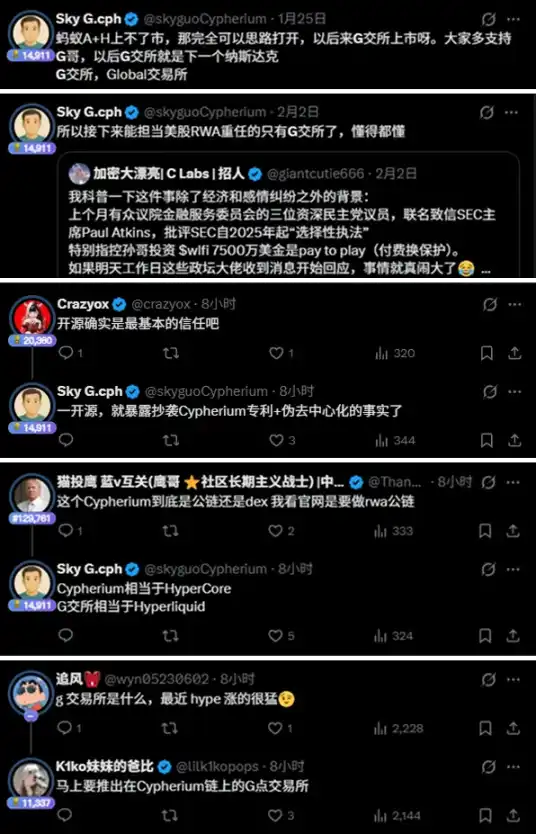
Image Source: Sky Guo and other X account tweets

Whether the accusation is a "real hammer" (solid evidence) or "ambush marketing," Hyperliquid seems to have reached a crossroads. As its business expands, community calls for increased transparency are growing. Faced with infringement质疑 (doubts/questions), will Hyperliquid insist on its black-box advantage, or will it prove its innocence through partial open-sourcing or third-party audits? This concerns the trust foundation of its decentralization narrative.

Note: 9.92 million HYPE tokens are scheduled to be unlocked on February 6, accounting for 2.79% of the circulating supply, with a value of approximately $357 million (based on a price of $36).


Pertanyaan Terkait

QWhat is the core patent technology that Cypherium accuses Hyperliquid of infringing upon?

ACypherium accuses Hyperliquid of infringing upon US Patent No. 11,411,721 B2, which covers systems and methods for dynamically selecting and reconfiguring a committee of validator nodes in a distributed system, utilizing mechanisms like aggregate signatures and two-phase reconfiguration to enhance consensus efficiency and fault tolerance.

QHow did Hyperliquid's native token HYPE perform in the market amidst the broader cryptocurrency downturn mentioned?

ADespite a broader market correction where Bitcoin fell below $75,000, Hyperliquid's native token HYPE experienced significant growth, rising over 40% in the past week.

QWhat specific technical feature does Sky Guo claim Hyperliquid's HyperCore engine borrowed from Cypherium's patent?

ASky Guo claims that Hyperliquid's HyperCore engine borrowed the dynamic committee selection logic from Cypherium's patent, which is key to achieving its sub-second finality.

QWhy is it difficult to verify the patent infringement claims against Hyperliquid through public code audit?

AIt is difficult to verify the infringement claims because Hyperliquid's core codebase is currently closed-source and non-transparent, making it impossible for external parties to conduct a public code audit to determine if the implementation avoids the patented technology.

QWhat coincidental timing suggests that Cypherium's infringement accusation might be a form of 'clickbait marketing'?

AThe accusation was made just as HYPE token was performing strongly and the HIP-4 proposal was generating prediction market hype. Additionally, promotional content for Cypherium's new project 'G-Exchange' appeared in related social media discussions, suggesting the timing may be strategic for marketing purposes.

Bacaan Terkait

Analis yang Memprediksi Jatuhnya Bitcoin dari $82.000 Mengungkapkan Apa yang Akan Terjadi Selanjutnya

Analis kripto Tony, yang berhasil memprediksi penurunan Bitcoin dari puncak lokal sekitar $82.000, mengungkapkan pandangannya tentang pergerakan aset kriptu terdepan ini. Dalam posting di X, ia menyatakan bahwa BTC kemungkinan akan terus menurun dan berpotensi mencetak rekor rendah baru dalam beberapa bulan mendatang, sebelum akhirnya mencapai titik terendah dalam siklus bear ini. Tony merujuk pada level Resistance Rata-rata Bergerak 200 hari (200 MA) dan level Fibonacci 0,5 serta 0,618 sebagai alasan di balik penurunan harga. Ia juga menguraikan dua skenario: penurunan langsung atau "jebakan" berupa fake breakout di atas $85.000 untuk menjerat trader retail, yang kemudian akan diikuti oleh penjualan besar-besaran. Bagaimanapun, ia menegaskan tren utama masih bearish. Chart yang dibagikannya menunjukkan potensi penurunan Bitcoin hingga sekitar $50.000 pada Juli, bahkan mungkin di bawah $40.000. Analis lain, Colin, menambahkan bahwa area $65.000-$66.000 mungkin menjadi level support untuk koreksi jangka pendek yang bisa berlangsung beberapa minggu atau bulan. Namun, ia setuju bahwa retest ke level $60.000 dan potensi breakout ke bawah tahun ini masih sangat mungkin. Colin mencatat bahwa kerugian Bitcoin dalam siklus bear ini belum mencapai 70% seperti pada siklus sebelumnya, mengisyaratkan ruang untuk penurunan lebih lanjut. Pada saat penulisan, harga Bitcoin diperdagangkan di sekitar $66.300, turun lebih dari 6% dalam 24 jam terakhir. Kedua analis sepakat bahwa meski koreksi jangka pendek mungkin terjadi, pasar bull tidak akan segera dimulai, dan rekor rendah baru untuk tahun ini masih menjadi ekspektasi utama.

bitcoinist1j yang lalu

Analis yang Memprediksi Jatuhnya Bitcoin dari $82.000 Mengungkapkan Apa yang Akan Terjadi Selanjutnya

bitcoinist1j yang lalu

The Rally That Wasn't

Pasar Bitcoin mengalami tekanan tajam, dengan harga turun 13% ke kisaran $67,000, didorong oleh kondisi makro yang lebih ketat dan aliran keluar besar-besaran dari ETF spot AS. Analisis on-chain mengonfirmasi pasar masih dalam rezim bearish, dengan harga gagal bertahan di atas True Market Mean ($77.8k) dan bergerak menuju Realized Price ($53.9k). Basis biaya pemegang jangka pendek ($76.4k) kini berada di bawah rata-rata kunci, menunjukkan akumulasi oleh pembeli baru di level rendah, pola khas fase akhir bear market. Tekanan kerugian meningkat pesat, dengan rasio profit/rugi yang direalisasikan anjlok, mencerminkan dominasi realisasi rugi. Pemegang baru yang membeli di dekat puncak lokal ($78k-$82k) kini menghadapi tekanan terbesar. Selain itu, pemegang jangka panjang juga mulai menyerah, merealisasikan kerugian dalam jumlah signifikan. Di pasar off-chain, harga Bitcoin ditolak di sekitar basis biaya agregat ETF ($83k), mengubah level support sebelumnya menjadi resistance. Aliran permintaan spot telah mengering dan berbalik negatif, menunjukkan dominasi penjual. Meskipun likuidasi futures besar ($400M+) membantu membersihkan leverage berlebih, belum ada tanda pemulihan permintaan spot yang berkelanjutan. Pasar opsi mencerminkan sikap waspada, dengan premi volatilitas tinggi dan permintaan perlindungan downside yang tetap mengemuka, meski tanpa kepanikan ekstrem. Kesimpulannya, pasar Bitcoin tetap rapuh dengan tekanan jual dari berbagai kohor investor dan ketiadaan permintaan spot yang kuat. Pemulihan berkelanjutan memerlukan perbaikan dalam aliran spot, reklamasi profitabilitas oleh investor ETF, dan berkurangnya tekanan penjualan.

insights.glassnode2j yang lalu

The Rally That Wasn't

insights.glassnode2j yang lalu

Trading

Spot
Futures
活动图片