
Author: Wan Zhou, Wall Street Insights
Expectations for an ultra-strong El Niño in 2026 continue to heat up, and weather disturbances have already begun to affect key agricultural production regions like Southeast Asia and India. However, historical experience shows that a strong El Niño does not necessarily lead to a comprehensive reduction in staple grain output.
What's truly worth noting is that fertilizer market activity has started before grain prices: urea is supported by exports and high overseas prices, phosphate fertilizers are constrained by resources, sulfur, and shipping, and potash supply is tightening.
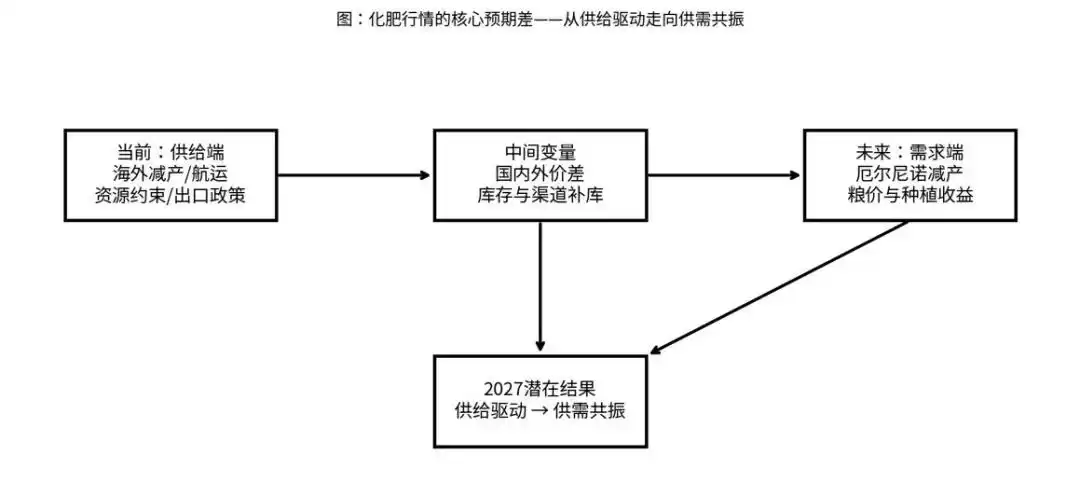
If weather impacts further push up grain prices and planting returns in 2027, will the current fertilizer market trend, driven by supply, enter a second stage of demand-supply resonance?
What Happened? — El Niño is Still Intensifying, But the Fertilizer Market Has Already Moved First
1. An Ultra-strong El Niño Approaches, But Agricultural Impacts First Manifest as "Structural Reductions"
The 2026 El Niño has transitioned from meteorological forecasts to real-world impact phase. Since June, sea surface temperatures in the central-eastern equatorial Pacific have continued to rise, and market expectations for a strong to ultra-strong El Niño in Q4 have significantly heated up. The period of strong influence is highly likely to fall in the autumn and winter of 2026 and extend into early 2027.
Abnormal weather such as a weak Indian monsoon, insufficient rainfall in parts of Southeast Asia, high temperatures in Europe, and heavy rain in southern China have already emerged. Climatic risks are gradually transmitting from sea temperature indicators to crop production.
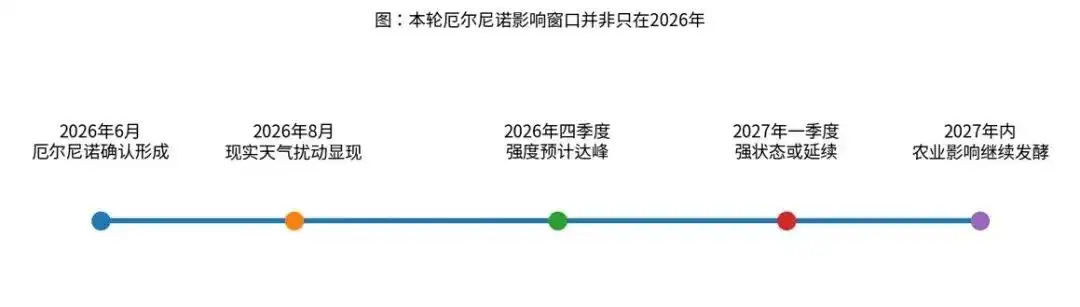
However, three buffers—crop distribution, inventories, and policy—still lie between "ultra-strong El Niño" and "global food shortage."
Historical statistics show that varieties highly concentrated in specific production areas and sensitive to moisture conditions—such as natural rubber, palm oil, and cocoa—are more prone to sustained supply shocks. Globally planted varieties like soybeans and corn have cross-regional substitution, and production may even increase in some parts of South America due to improved rainfall. China's corn and wheat have high self-sufficiency rates, and their prices are also influenced by policy, inventories, and domestic supply-demand regulation.
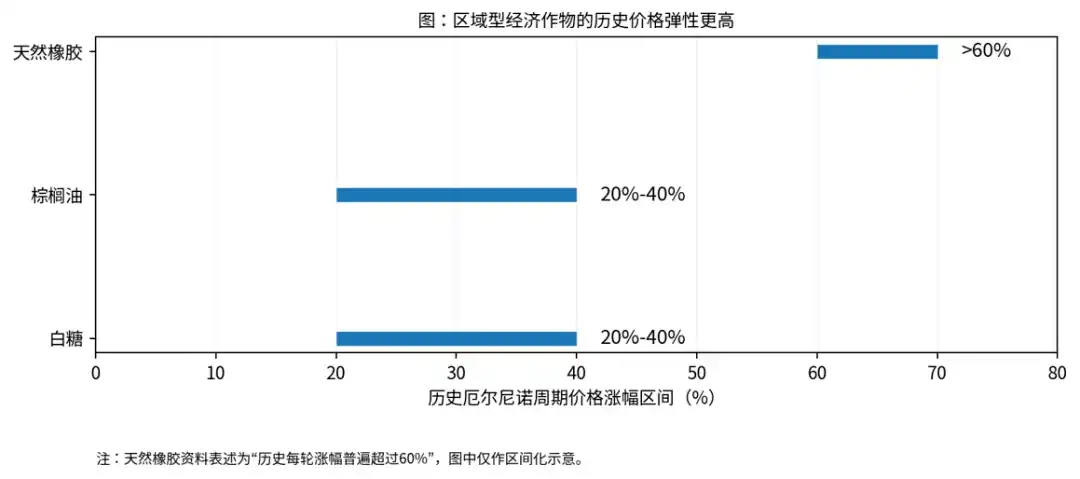
Therefore, the current situation is closer to a round of structural agricultural inflation: weather-sensitive varieties first gain risk premiums, while staple grains still need confirmation from actual yield, inventory, and trade data.
This distinction is crucial because it means the current fertilizer market trend cannot be simply explained by "El Niño -> surging grain prices -> rising fertilizer prices."
2. While Grains Haven't Risen Across the Board, Fertilizer Has Already Started Its Own Cycle
Urea best illustrates this dislocation.
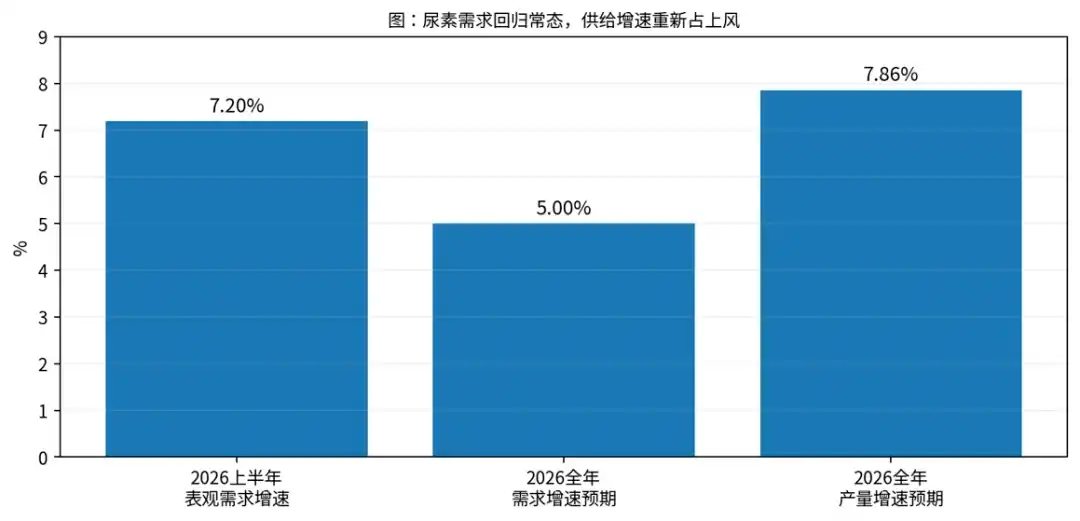
In H1 2026, apparent urea demand grew by approximately 7.2%, with growth reaching 7.8% from January to April; considering hidden inventory and other factors, actual demand growth may have once reached 8-10%. During the spring planting season, enterprise inventories dropped to about 570,000 tonnes by mid-May. Urea's price advantage relative to phosphate and potash fertilizers, along with improving grain price expectations, jointly strengthened grassroots fertilization enthusiasm.
Entering the second half of the year, fundamentals began to reverse. Agricultural demand entered a seasonal off-season, high-nitrogen compound fertilizer production was notably front-loaded previously, and industrial demand also struggled to form new elasticity. At the same time, new urea plants with an annual capacity of about 5.11 million tonnes are still expected to come online in H2, with full-year capacity additions projected at ~6.45 million tonnes/year. Full-year production is estimated at ~78.1 million tonnes, a year-on-year increase of 7.86%.
Therefore, the core contradiction for urea has now shifted from domestic agricultural demand to whether exports can absorb the new supply. By late July, China's daily urea output was ~215,600 tonnes, with enterprise inventories rising to near the 76th percentile of the past three years. During the same period, Persian Gulf small-granule urea was priced at ~$445/tonne, equivalent to ~RMB 3,021/tonne, while the domestic average price was ~RMB 1,747/tonne—a theoretical price difference exceeding RMB 1,200/tonne, indicating significant theoretical export arbitrage space.
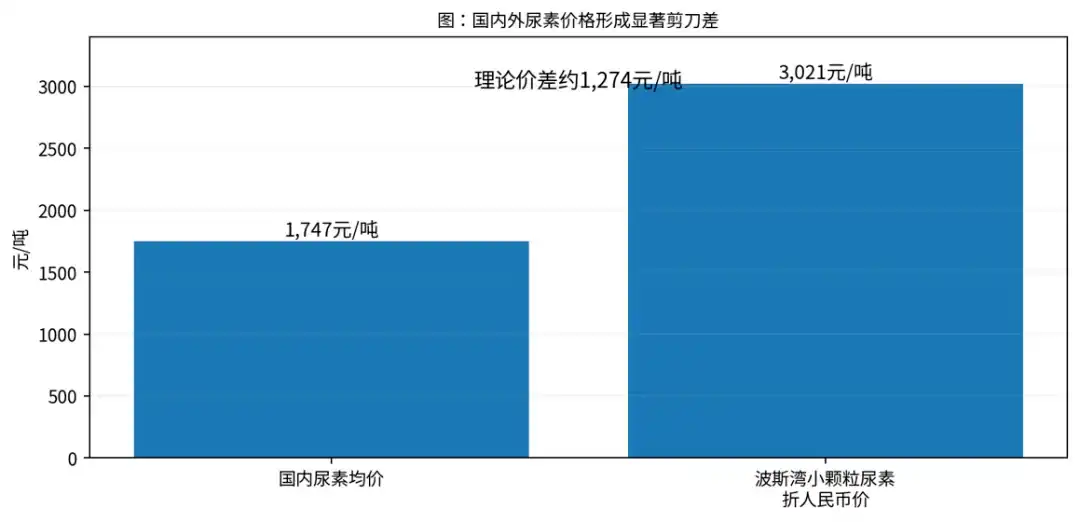
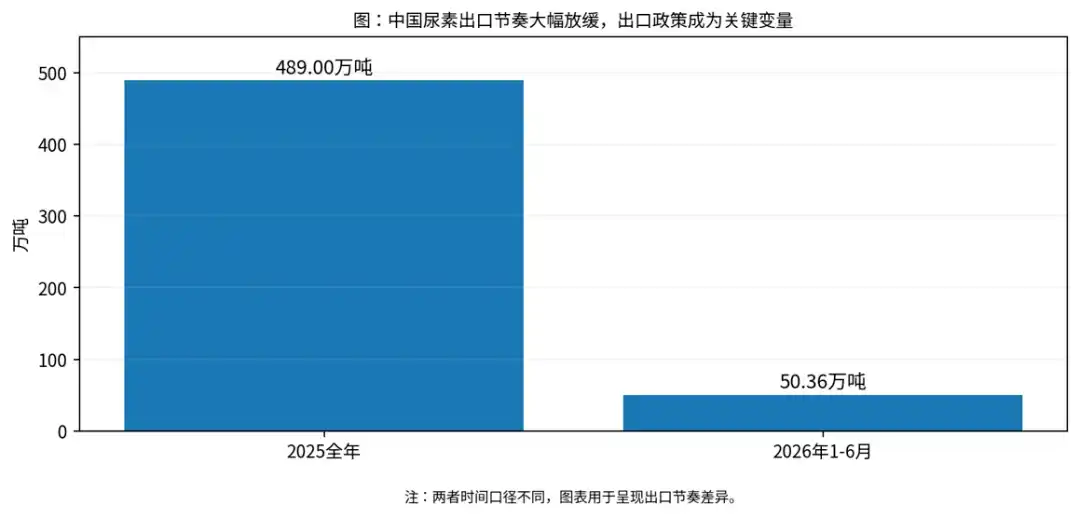
The problem is, a price difference does not equate to realizable profit. China exported 4.89 million tonnes of urea in 2025, but only 503,600 tonnes from January to June 2026. Export quotas, guidance prices, Indian tender volumes, and the overseas market's actual absorption capacity determine whether the urea market trend is a short-term spike or a sustained recovery.
Why Is This Important? — Fertilizer Is Transitioning from Supply Logic to a Triple-Driver Model of "Resources, Trade, and Weather"
1. Phosphate Fertilizer Enters a Rare "Supply-Side Dominated" Cycle
Compared to urea, the medium-term logic for phosphate fertilizer is more solid.
Current overseas phosphate fertilizer tightness goes beyond pure cost-push. Companies like Vietnam's Vinachem and Lithuania's Lifosa plan to cut phosphate production due to sulfur shortages; Red Sea and Middle East shipping risks further reduce effective supply. Shipping phosphate diammonium (DAP) from Saudi Arabia's Yanbu to India via Africa increases freight costs by about $50/tonne compared to traditional routes.
Even if the Strait of Hormuz resumes normal traffic, reduced plant operating rates caused by raw material shortages cannot be repaired immediately. The market is shifting from "cost-based pricing" to "availability-based pricing."
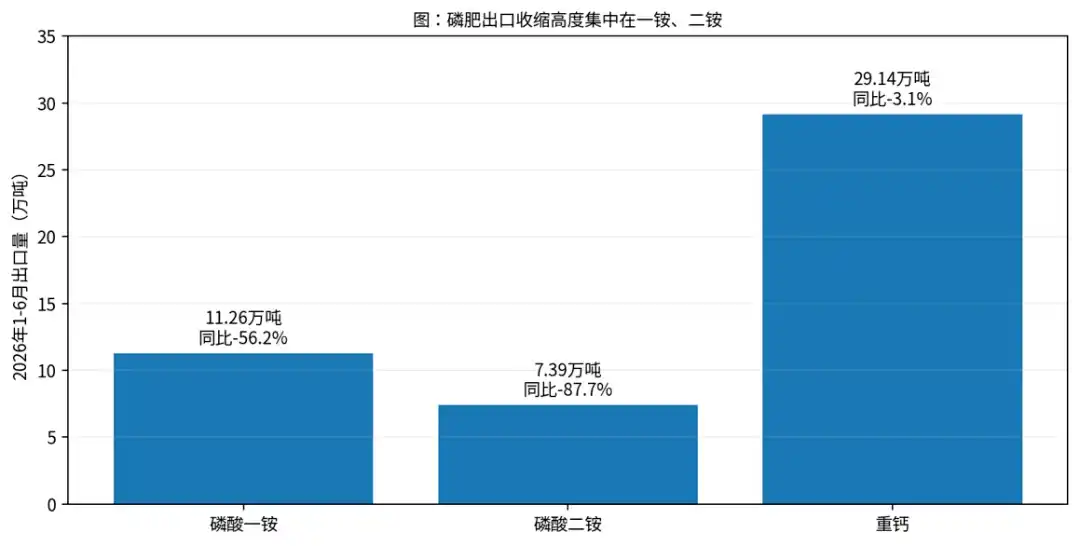
China holds a key position in the global phosphate fertilizer supply system. In H1 2026, China's monoammonium phosphate (MAP) and DAP exports were only 112,600 tonnes and 73,900 tonnes respectively, down 56.2% and 87.7% year-on-year; triple superphosphate (TSP) exports were 291,400 tonnes, down only 3.1% year-on-year.
The export contraction is primarily related to domestic supply-guarantee policies. With the spring planting season over and winter storage not yet started, domestic demand is at a seasonal low point. Marginal changes in export policy have become the most direct catalyst for profitability.
There exists an easily underestimated price gap logic: overseas faces shortages, China has capacity, but exports are constrained. Once small varieties like TSP, which are less sensitive to supply-guarantee concerns, gain export flexibility first, integrated enterprises possessing phosphate rock resources, sulfuric acid supply capabilities, and overseas channels may see significantly higher profit elasticity than ordinary producers. Phosphate fertilizer thus possesses dual attributes of a resource product and an agricultural input.
2. Potash is Closer to a Typical Resource Cycle; Short-Term Weakness and Mid-Term Strength Can Coexist
Potash supply constraints are more purely resource-based.
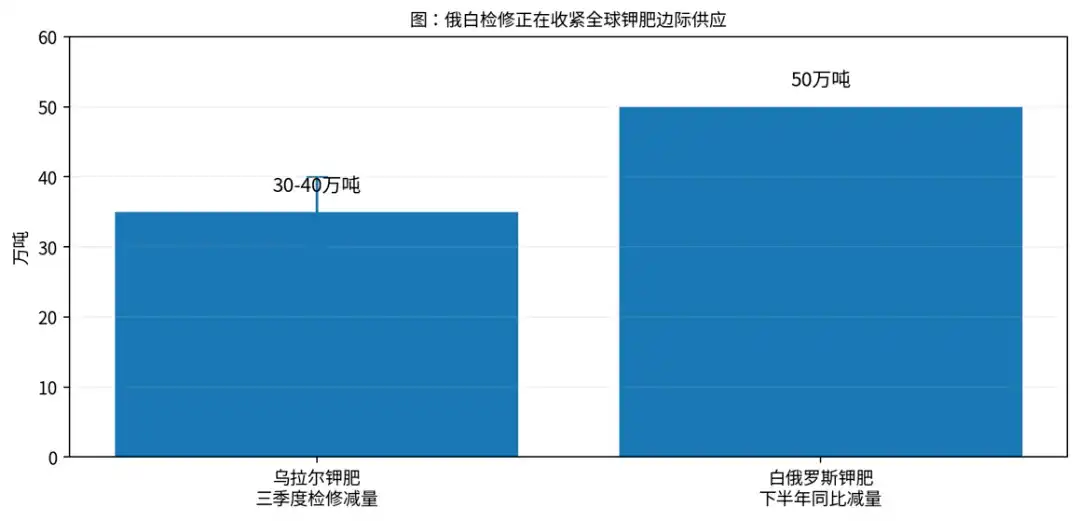
Scheduled maintenance at Russia's Uralkali in Q3 is expected to reduce granular MOP production by 300,000-400,000 tonnes, and Belarusian Potash Company expects H2 output to decrease by ~500,000 tonnes year-on-year. These two disruptions total ~800,000-900,000 tonnes. The global potash resource distribution is highly concentrated, new mine development cycles are long, and the grade changes and maintenance cycles of existing mines directly impact global marginal supply.
At the same time, China's MOP market in July remained in a state of "strong supply, weak demand," with high-priced cargoes facing difficult transactions and holders actively reducing prices to destock.
Short-term spot weakness and medium-term international supply contraction are not contradictory: the former reflects off-season and inventory, the latter determines the medium-term price floor for a resource product. If El Niño further pushes up prices of high-value crops like palm oil, sugar, etc., potash's demand elasticity may actually be more direct than for staple grains.
3. What El Niño Really Alters is the Tail Probability for 2027 Demand
El Niño's direct contribution to the current fertilizer market trend is limited, but it may significantly alter the demand distribution in 2027.
Fertilizer demand relates to planted area, yield targets, and planting returns. When agricultural product prices rise, the potential yield increase gain from adding one unit of fertilizer increases; extreme weather can also intensify the input demand for "protecting yields." Weather impacts may thus transmit along the chain "agricultural product price -> planting returns -> fertilization willingness -> channel restocking" to the agricultural input end.
More caution-worthy is the two-way feedback: rising fertilizer and energy costs increase planting costs; if farmers reduce fertilization, it may further suppress yields; when grain prices subsequently rise, fertilization demand recovers.
The scenario that could truly propel the market into a second stage is the simultaneous occurrence of persistent extreme weather, declining grain inventories, high energy costs, and tight fertilizer supply. Only then might the current supply-side-driven market trend have a chance to upgrade into genuine demand-supply resonance.
What's Next? — Food Security Elevates Strategic Attributes; Phosphate/Potash Resources and Export Elasticity Determine Profit Slope
If one only interprets this round of fertilizer market activity as El Niño-driven, it's easy to overestimate weather's explanatory power for short-term fertilizer prices. The more noteworthy medium-term change is that food security is redefining the industrial attributes of fertilizer.
For policymakers, fertilizer is both an agricultural input cost and an indispensable input for stabilizing yields; thus, the policy goal is never to pursue high fertilizer prices, but to ensure control over key resources, stable domestic supply, and dynamic adjustment between domestic supply guarantee and overseas exports.
The significant contraction in phosphate fertilizer exports and the constrained pace of urea exports in H1 2026 already reflect this policy prioritization.
From this perspective, the future investment logic for fertilizer can be divided into three layers: food security determines the strategic status and policy floor; global resources and supply patterns determine the profit floor; El Niño and agricultural product price increases determine the cyclical upside elasticity.
Different fertilizer types are in different positions; phosphate and potash have more prominent resource security attributes, while urea relies more on the domestic capacity cycle and export adjustments.
1. Phosphate Fertilizer: Extending from a Cyclical Product to a Strategic Resource; Export Elasticity Could Become the Near-Term Catalyst
Among the three major straight fertilizers, phosphate fertilizer currently has the most complete medium-term logic. Moreover, within the food security framework, its resource value is more noteworthy than pure fertilizer price increases.
Upstream phosphate rock development cycles are long, with strong constraints from new mining rights, safety/environmental regulations, and resource control; overseas phosphate fertilizer is also affected by sulfur shortages, plant production cuts, and Middle East shipping disruptions. Simultaneously, China's MAP and DAP exports in H1 2026 were only 112,600 tonnes and 73,900 tonnes respectively, down 56.2% and 87.7% year-on-year, clearly prioritizing domestic supply guarantee over exports.
Food security creates a special "dual constraint" here: On one hand, the domestic market needs to maintain sufficient phosphate fertilizer supply and reasonable prices, which means exports cannot be fully marketized; on the other hand, China is also a major global phosphate fertilizer supplier. Once overseas shortages persist, the domestic-international price gap will accumulate, and marginal policy relaxation could release significant profit elasticity.
With the spring planting season over and winter storage not yet started, domestic phosphate fertilizer demand has entered a seasonal low point, significantly reducing supply guarantee pressure compared to spring. Compared to core supply-guarantee varieties like MAP and DAP, small varieties like TSP, which account for a relatively lower proportion of domestic consumption, have relatively lower policy sensitivity and may first reflect export elasticity.
In the longer cycle, the value of phosphate fertilizer enterprises can no longer be measured solely by "phosphate price × sales volume." Enterprises possessing phosphate rock resources, sulfuric acid and synthetic ammonia integration, phosphate fertilizer capacity, and new energy material extension capabilities connect food security, resource security, and new material demand simultaneously. Integrated resource-based enterprises are more likely to obtain higher profit stability than ordinary cyclical products.
2. Potash: One of the Purest Resource Products in Food Security Logic
Potash's food security attribute is arguably even more direct than that of phosphate.
China can achieve full self-sufficiency in urea and has a strong resource base in phosphate rock, but potash resources are highly concentrated globally, new mine development cycles are long, and domestic resource endowment is limited. Therefore, potash is both an agricultural necessity and carries obvious resource security attributes. For China, improving domestic potash resource security and expanding overseas potash resource rights are integral parts of the food security system.
New marginal changes have already emerged on the supply side. Scheduled Q3 maintenance at Russia's Uralkali is expected to reduce granular MOP production by 300,000-400,000 tonnes, and Belarusian Potash Company expects H2 output to decrease by ~500,000 tonnes year-on-year. These two disruptions total ~800,000-900,000 tonnes. The high concentration of global potash supply gives this scale of production cuts a strong influence on marginal prices.
Short-term domestic market pressures from off-season inventory persist, with high-priced cargoes trading weakly, but this does not contradict the medium-term resource logic. Potash's price floor is more determined by global supply concentration and resource scarcity, while agricultural product prosperity determines the upside.
If El Niño further pushes up prices of palm oil, sugar, rubber, and even some grains, as planting returns for high-value crops improve, farmers' ability to pay for and willingness to apply potash may simultaneously increase.
Thus, potash can be understood as an asset where "food security provides the long-term logic, resource constraints provide the price floor, and agricultural prosperity provides the call option."
Resource volume, low costs, and new capacity realization capability are the core metrics.
3. Urea: Supply Guarantee Attribute Stronger Than Resource Scarcity; Short-Term Payout Depends on Export Realization
Urea is also a crucial foundational material for food security, but its investment logic differs significantly from phosphate and potash: China's coal-chemical system grants urea strong self-sufficiency capability. Therefore, its strategic value is more manifested in stabilizing domestic supply and regulating the global market, rather than resource scarcity.
Urea demand performance was strong in H1 2026, with apparent demand growing ~7.2% year-on-year, reaching 7.8% from January to April. Considering hidden inventory, actual growth may have reached 8-10%; but this included factors such as front-loaded spring planting demand, urea's price advantage relative to phosphate/potash, melamine exports, and some disguised exports.
H2 faces opposite pressures. Orient Futures estimates full-year urea demand growth will fall to ~5%, lower than the expected year-on-year production growth of 7.86%.
Therefore, the real key variable for urea currently remains exports. International prices are significantly higher than domestic ones, India maintains strong import demand, and if export quotas and actual flow rates increase, it could effectively alleviate domestic surplus and allow China's coal-based urea enterprises, positioned on the left side of the global cost curve, to share in high overseas prices.
However, food security means export policy must always find a balance between corporate profits, the international market, and domestic supply guarantee; export space will not simply equal the theoretical price gap.
This also determines that urea is more suitable as a high-elasticity variety, rather than the most stable medium-term allocation direction among the three major fertilizers.
Conclusion
Overall, food security may become a more enduring medium-term investment theme for the fertilizer industry over the next few years than El Niño.
It reinforces the strategic attributes of upstream resources like phosphate rock and potash, and also makes domestic supply guarantee, export policy, and industrial chain integration important variables affecting corporate profitability.
In 2026, the industry first traded on resource constraints, geopolitical conflicts, overseas supply, and domestic-foreign price gaps; what El Niño determines is whether the demand side can take the baton in 2027.
If agricultural product prices further reflect weather-induced yield reduction risks over the next six months, the fertilizer industry could undergo a second round of logic shift: phosphate fertilizer moving from "resources + exports" to tight supply and demand, potash transitioning from a resource cycle into agricultural prosperity resonance, while urea needs to observe whether demand improvement can offset new capacity.
By then, a more complete framework for understanding this agricultural chemical cycle might be: food security providing the valuation base, resource constraints determining the profit floor, and El Niño/grain prices determining the upside elasticity.