Escalation of US-Iran Conflict: How Did Prediction Markets Price War Risk Ahead of Oil Prices?

marsbitDipublikasikan tanggal 2026-03-05Terakhir diperbarui pada 2026-03-05

Abstrak

The article analyzes how the escalation of U.S.-Iran tensions—triggered by reports of Ayatollah Khamenei’s death and military actions—was rapidly priced into global markets, despite occurring during a weekend when traditional markets were closed. Crypto assets and on-chain commodity contracts (e.g., oil and gold perpetuals) saw immediate volatility, reflecting early risk sentiment. Prediction markets like Polymarket and Opinion played a key role by quantifying event probabilities—such as leadership changes or military strikes—in real time, with significant trading volumes. When traditional markets reopened, oil, gold, and equities adjusted to reflect the risk premium already established on-chain. The event illustrates a structural shift: digital, 24/7 markets now facilitate real-time financialization of geopolitical risk, often ahead of traditional exchanges. Risk pricing is migrating from reactive post-event adjustments to continuous, probabilistic markets that participate in shaping outcomes.

CoinW Research Institute

Abstract

This article takes the escalation of the US-Iran conflict as a starting point to analyze how a geopolitical event is rapidly transformed into a global risk variable in the contemporary financial system. Since the event occurred over the weekend when traditional financial markets were closed, on-chain markets were still operating. Crypto assets and on-chain commodity contracts experienced sharp fluctuations first, completing the initial expression of risk; prediction markets directly probabilized war and political changes, achieving real-time pricing of the event path. After traditional markets opened on Monday, energy, the US dollar, US bonds, and risk assets completed systemic confirmation, with risk premiums transmitted layer by layer along the macro chain. The article points out that in the 24/7 operating environment of digital markets, risk is no longer priced only at the opening bell. Geopolitics is being financialized in real time; markets are not just passively reacting to events but are participating in the pricing of risk itself during the development of events.

1. Conflict Escalation: How a Geopolitical Event Becomes a Global Risk Variable

Recently, tensions between the US and Iran escalated sharply. Multiple media reports indicated that Iran's Supreme Leader Ayatollah Ali Khamenei was killed in an airstrike, leading to a rapid deterioration of the regional situation. Military actions and strong statements combined quickly turned the situation from a regional friction point into a global focus.

Subsequently, the Islamic Revolutionary Guard Corps of Iran announced restrictions on ship passage through the Strait of Hormuz. As one of the world's most important energy transport channels, this key hub, which long carries about one-fifth of global crude oil and liquefied natural gas shipments, faced severe restrictions, with several shipping companies suspending passage or choosing detours.

The impact of the conflict is no longer limited to the military level. The Middle East is the core region for global energy supply, and disturbances in the Strait of Hormuz directly push up energy risk premiums, which are quickly transmitted to global markets through oil prices, inflation expectations, and capital flows.

Thus, this conflict has become a systemic global risk variable. It affects not only the regional security landscape but also the energy supply-demand balance, the US dollar liquidity environment, and the valuation system of risk assets.

When war escalates into a systemic risk, where is the risk traded first? In a structure where traditional markets operate on a time-bound basis while on-chain markets operate 24/7, the timing sequence of price discovery is changing.

2. Weekend Time Frame: On-Chain Markets Complete the First Round of Price Discovery

Notably, this conflict occurred over the weekend. When the news broke, most global traditional financial markets were closed: spot gold paused quotes, crude oil futures halted trading, and stock markets were closed. Risk had emerged, but the traditional system could not price it immediately. However, on-chain markets were still operating, and risk sentiment shifted to a still-open pricing venue.

Crypto Assets Lead with Sharp Fluctuations

After the conflict news emerged, Bitcoin's price briefly approached $63,000 before rebounding to around $66,000, completing significant volatility in a short time. This volatility was not simply safe-haven buying or panic selling but a concentrated gamble on risk expectations in the absence of traditional anchors like gold and crude oil. When other assets were untradeable, the crypto market became an outlet for risk expression.

On-Chain Commodity Contracts: Risk Premiums Form Instantly

Over the weekend, multiple media reports indicated that on the Hyperliquid platform, perpetual contracts linked to crude oil, gold, and silver showed significant increases: crude oil perpetual contracts rose about 5% to approximately $70.6/barrel; gold perpetual contracts rose about 1.3% to around $5,323/ounce; silver perpetual contracts rose about 2% to about $94.9/ounce. Trading volumes also expanded. The 24-hour trading volume for silver contracts exceeded $227 million, and gold contracts reached about $173 million, showing real capital participation. These were prices truly formed in the 24/7 on-chain market, reflecting the immediate judgment of market participants on supply risks and geopolitical premiums during the closure of traditional markets.

Monday Opening: Traditional Markets "Catch Up"

When traditional markets reopened, prices quickly adjusted in the direction of the weekend on-chain movements. International oil prices opened higher on Monday, with Brent crude rising to $82.37/barrel at one point and WTI crude jumping above $75; spot gold broke through $5,300/ounce; major global stock index futures generally weakened, with risk assets under pressure. The price sequence was clear: risk emerged over the weekend; on-chain markets fluctuated first; traditional markets completed larger-scale confirmation and diffusion on Monday.

During the time window when traditional markets were closed, on-chain markets assumed the function of the first wave of risk expression. This structural time difference is changing the pricing rhythm of global risk events.

3. Prediction Markets: War Is Probabilized in Real Time for the First Time

Polymarket: Explosive Pricing of Conflict Nodes

During this event, the trading volume of contracts related to the conflict escalation on the on-chain prediction platform Polymarket significantly expanded.

The series of contracts on "Will the US or Israel strike Iran by a certain date?" accumulated a trading volume of over $500 million, with the trading volume on the day of the airstrike alone reaching about $90 million, making it one of the largest geopolitical markets in the platform's history.

After the confirmation of the leader's death, contracts related to "Will Khamenei lose his position as Supreme Leader of Iran by March 31?" were quickly settled, with a trading volume of about $57 million. The implied probability of long-term political direction contracts like "Will the Iranian regime collapse by June 30?" once rose to nearly 50%, indicating that the market had begun pricing deeper institutional risks. These data show that betting was not scattered behavior but formed concentrated and high-intensity capital participation.
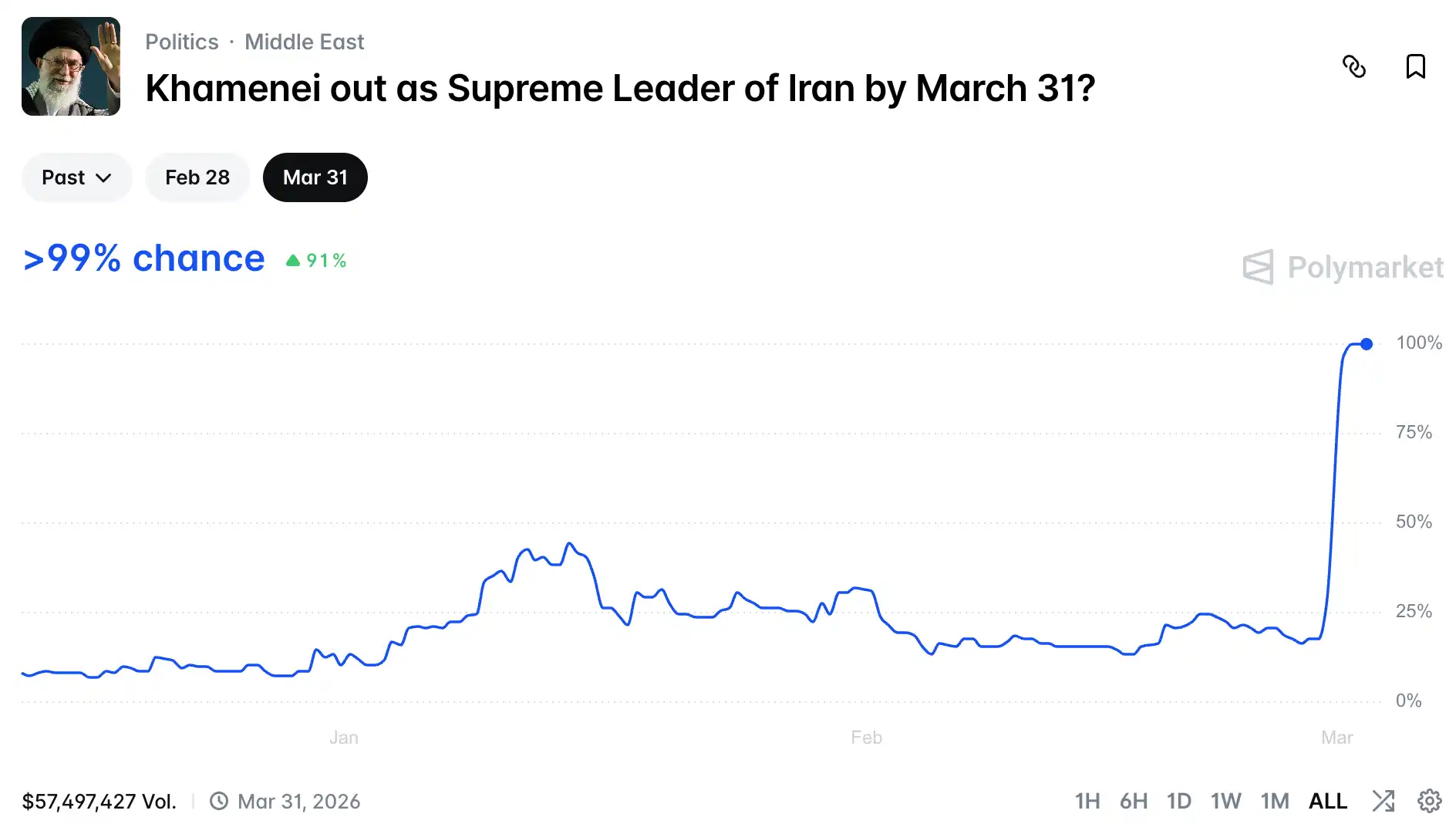
Source: https://polymarket.com/event/khamenei-out-as-supreme-leader-of-iran-by-march-31

Opinion: Multi-Dimensional Pricing of Conflict Paths and Institutional Risks

On Opinion, contracts related to the US-Iran conflict also showed high activity. One type of market precisely defines military triggers. For example, "Will the US strike Iran by a certain date?" specifies that it is only judged as Yes if the US military actually hits Iranian territory or official embassies with drones, missiles, or airstrikes; intercepted weapons or other forms of military action are not counted. The trading volume of this contract has exceeded $12.6 million, showing the market's high attention to specific military trigger conditions.
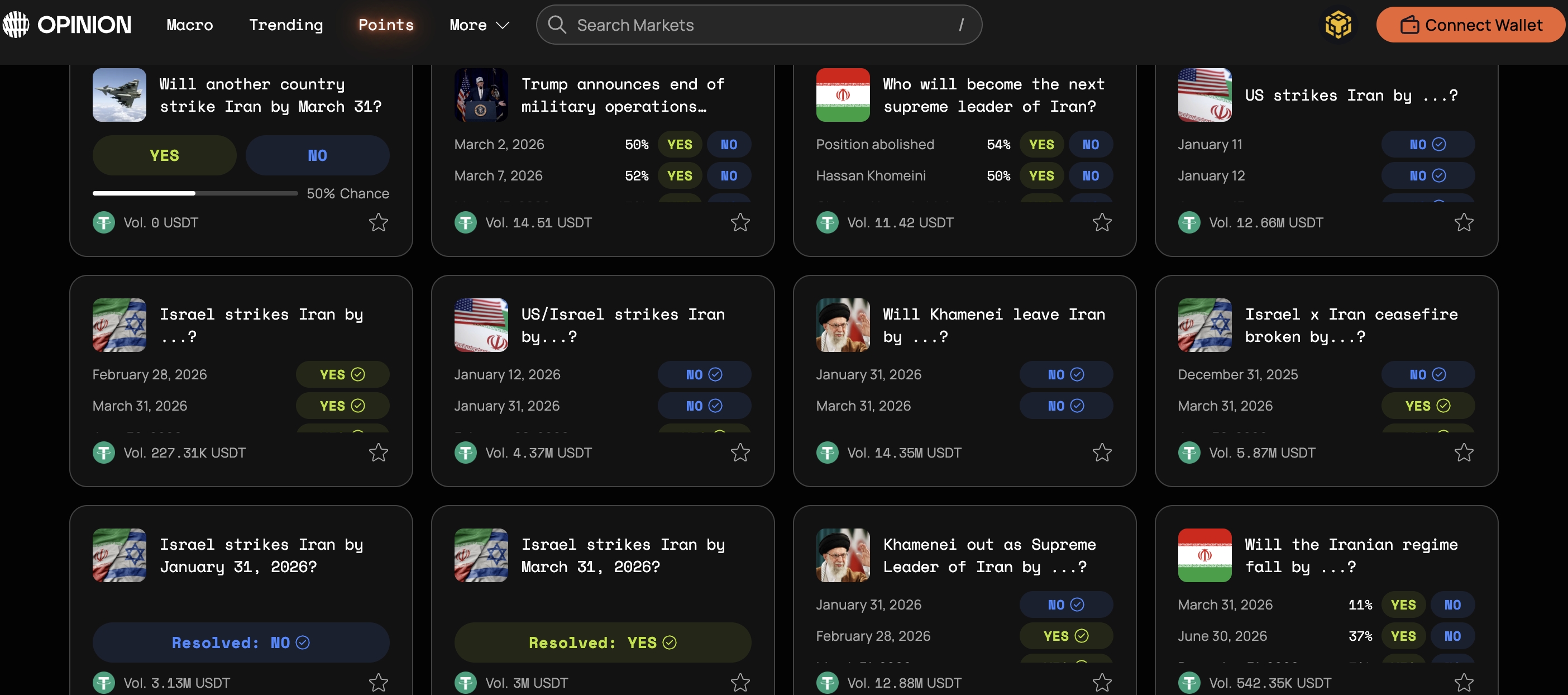
Source:https://app.opinion.trade/search?q=Iran

Another type of market turns to institutional layer risks. "Khamenei out as Supreme Leader of Iran by ...?" prices whether Iran's Supreme Leader Ali Khamenei loses power within a specific time window. The rules include resignation, detention, loss of position, or inability to perform duties as judgment standards and use credible media consensus as the settlement basis, with a trading volume of about $12.9 million. Additionally, markets like "Will the Iranian regime collapse by XX date?" and "Will the ceasefire between Israel and Iran be broken by XX date?" probabilistically express regime stability and ceasefire sustainability, respectively.

Although the number of related contracts and overall trading scale are still lower than Polymarket, Opinion presents a clearer risk stratification structure: military actions, ceasefire status, leader retention, and regime direction are decomposed into multiple independent variables for parallel pricing. Thus, war is no longer just a single-point question of "whether it happens" but a risk path that can be segmented, quantified, and continuously corrected. Prediction markets here serve as real-time measurement tools for sovereign risk and institutional stability.

Probability Curve as a "Risk Thermometer"

Unlike crude oil or gold, prediction markets do not indirectly express risk through assets but directly probabilistically price "whether an event will happen." When the probability of conflict escalation rises, odds jump; when the situation eases, the probability falls. The odds curve itself becomes an immediate scale of risk sentiment. Some analysis pointed out that a few hours before the airstrike news spread widely, a small number of new wallets concentrated on buying related contracts and profited after the event was confirmed. This phenomenon sparked discussions on whether information entered the market early, making the time sensitivity of prediction markets particularly prominent.

Traditional markets typically reflect outcomes through rising oil prices or falling stock markets; prediction markets directly trade "whether it escalates" and "whether it spreads." The former prices the impact, the latter prices the path. When traditional markets are not yet open, risk is already quantified and bet on on-chain.

4. Traditional Asset Opening Confirmation: How Are Risk Premiums Transmitted?

When on-chain markets fluctuate first, true cross-asset linkage occurs after traditional markets reopen.

Energy: The First Stop for Risk Premiums

Energy remains the first stop for risk premiums. The Strait of Hormuz carries about 20% of global crude oil shipments. As long as the market worries that supply may be hindered, oil prices will提前计入 risk premiums. Conflict escalation pushes oil prices up, thereby boosting inflation expectations and affecting interest rate policies and corporate cost structures.

US Dollar and US Bonds: Tug-of-War Between Safety and Inflation

When uncertainty rises, funds usually flow to the most liquid assets, so the US dollar and US bonds benefit short-term. The dollar strengthens, and US bond yields fall temporarily, reflecting increased safe-haven demand. But if the conflict continues and pushes up inflation expectations, US bond yields may face a tug-of-war between safe-haven buying and inflationary pressure.

Positioning of Risk Assets and Bitcoin

Gold serves the traditional safe-haven function, crude oil embodies risk premiums, and US bonds provide a liquidity safety net. Bitcoin's performance is closer to a high-elasticity risk asset. In the initial stage of the conflict, it did not rise unilaterally but fluctuated sharply, showing its high sensitivity to liquidity and risk appetite. Therefore, in the initial stage of extreme uncertainty, Bitcoin behaves more like a high-beta risk asset than a pure safe-haven tool.

Overall, on-chain markets express risk first, prediction markets probabilize risk, and traditional assets complete systemic confirmation after opening. Risk premiums are transmitted layer by layer along energy, interest rates, and asset valuations, eventually forming a联动 reaction in global markets.

5. Structural Changes: Is the Risk Pricing Mechanism Migrating?

The significance of this event may lie not only in the conflict itself but in how risk was priced.

Geopolitics Is Being Financialized in Real Time

In the past, geopolitics remained more at the news and diplomatic levels; now, it is being financialized in real time. Whether war escalates, whether sanctions are implemented, and how election results evolve can all be bet on, hedged, and probabilized in the market. Risk is no longer only interpreted after the fact but is traded during its occurrence.

On-Chain Markets Become 24/7 Risk Buffers

On-chain markets are beginning to assume a new function. Traditional markets have weekend closures and holiday breaks. When major events happen during this gap, prices cannot reflect sentiment immediately. But on-chain markets operate 24/7, becoming buffers for the first wave of sentiment release. Prices and probabilities fluctuate there first, and then traditional markets reopen for larger-scale confirmation and diffusion.

Price Discovery Rights Are Marginally Migrating

This time structure difference is bringing a deeper change: the marginal migration of price discovery rights. If on-chain contracts fluctuate first, if the odds curve of prediction markets jumps before oil prices and stock indices, will institutional investors start monitoring these data? Will macro models incorporate on-chain fluctuations as reference variables? Will media and traders regard prediction market probabilities as early warning signals for risk?

These questions are not yet settled, but the direction is clear. The "first expression" of risk is shifting from the opening bell of traditional exchanges to digital markets that operate 24/7. When war can be traded in real time, markets are no longer just passively responding to the outcomes of events but are participating in the pricing process of risk itself.


Pertanyaan Terkait

QHow did the crypto and on-chain markets react to the escalation of the US-Iran conflict during the weekend when traditional markets were closed?

ACrypto assets like Bitcoin experienced significant volatility, and on-chain perpetual contracts for commodities such as crude oil, gold, and silver saw price increases and high trading volumes, completing the first round of risk pricing.

QWhat role did prediction markets like Polymarket and Opinion play in pricing the geopolitical risk of the conflict?

APrediction markets provided real-time, probability-based pricing on specific event outcomes, such as military strikes, leadership changes, and regime stability, allowing for the quantification and trading of conflict pathways before traditional markets opened.

QHow did traditional markets respond when they reopened after the weekend, following the initial price discovery in on-chain markets?

ATraditional markets 'caught up' by adjusting prices in the direction of the weekend's on-chain movements, with oil prices gapping higher, gold rising, and risk assets like equities coming under pressure, confirming the risk premium.

QWhat structural change in global risk pricing does the article suggest is occurring due to 24/7 digital markets?

AThe article suggests that price discovery is marginally migrating to always-on digital markets, which now act as a risk buffer and complete the first expression of risk, forcing traditional markets to respond and confirm when they open.

QHow was the function of Bitcoin characterized in the initial phase of the conflict, and how does it differ from traditional safe-haven assets?

ABitcoin was characterized not as a pure safe-haven asset like gold but as a high-beta risk asset, highly sensitive to liquidity and risk sentiment, evidenced by its sharp volatility rather than a unilateral rise.

Bacaan Terkait

"Gergaji Musim Panas" Berlanjut: Breakout $67.000 Akan Menjadi Awal Kenaikan Bitcoin

Harga Bitcoin terus terkonsolidasi dalam kisaran $58.000–$67.000 sejak awal Juni, dengan harga terkini di sekitar $62.217 pada 1 Agustus. Para analis pasar mempertimbangkan beberapa skenario kunci. Secara teknis, pergerakan di atas $66.000 dianggap penting untuk mengubah momentum. Beberapa trader seperti Crypto Candy memprediksi kemungkinan penurunan menuju $60.000 jika level $66.000 tidak tertembus. Trader lain, Jelle, menggambarkan situasi ini sebagai "gergaji musim panas" yang berkepanjangan dan mempertahankan strategi rata-rata biaya dengan pembelian berkala. Di sisi lain, skenario breakout ke atas tetap ada. Daan Crypto Trades menekankan bahwa keberhasilan menembus $67.000 sangat penting untuk menghindari fase konsolidasi yang berlarut-larut. Roman bahkan memperkirakan bahwa breakout dengan volume yang kuat dapat mendorong harga dengan cepat ke zona $70.000–$80.000. Dari perspektif jangka panjang, analis Gert van Lagen melihat fase ini sebagai periode akumulasi, dengan Bitcoin menguji pola grafik besar "cangkir dengan pegangan". Dia mencatat bahwa pemegang jangka panjang masih enggan menjual, yang ditunjukkan oleh metrik NUPL mereka yang masih jauh dari zona kapitulasi. Kesimpulannya, pasar Bitcoin saat ini berada dalam fase akumulasi yang menentukan. Level $60.000 dan $67.000 menjadi kunci, dan breakout dari level mana pun kemungkinan akan menentukan arah tren berikutnya. Skenario AI dalam artikel juga mempertanyakan apakah konsolidasi saat ini dapat membentuk fondasi yang lebih kuat, atau apakah setiap ujian di level $67.000 akan terus menghadapi hambatan psikologis yang sama dari pemegang aset jangka pendek.

cryptonews.ru12m yang lalu

"Gergaji Musim Panas" Berlanjut: Breakout $67.000 Akan Menjadi Awal Kenaikan Bitcoin

cryptonews.ru12m yang lalu

Perhatian Wajib Pekan Depan|Undang-Undang CLARITY Diperkirakan Akan Masuk ke Pemungutan Suara Senat; SpaceX dan Circle Umumkan Laporan Keuangan (3-9 Agustus)

**Ringkasan Acara Penting Pekan Depan (3-9 Agustus)** Pekan depan diwarnai sejumlah pengumuman keuangan penting dan perkembangan regulasi kripto di AS. **Laporan Keuangan & Acara Perusahaan:** * **SpaceX** akan merilis laporan keuangan Q2 2026 pada 4 Agustus, diikuti gelombang pencairan saham internal pertama (hingga 12%) pada 6 Agustus. * **Circle** (penerbit USDC) dan **Hut 8** (penambang Bitcoin) masing-masing akan mengumumkan laporan kuartalan pada 5 Agustus dan 4 Agustus. * **American Bitcoin (ABTC)**, perusahaan tambang kripto yang dikaitkan dengan keluarga Trump, merilis laporan Q2 pada 3 Agustus. * Perusahaan robotika **宇树科技 (Unitree Robotics)** akan melakukan penawaran saham perdana (IPO) di pasar STAR China, dengan hari penentuan harga awal pada 5 Agustus. **Regulasi Kripto AS:** * **CLARITY Act**, undang-undang kerangka kerja federal untuk aset kripto, berpeluang dilakukan pemungutan suara penuh di Senat AS minggu ini. Para negosiator harus merampungkan aturan tentang konflik kepentingan sebelum masa reses 7 Agustus. RUU ini memerlukan 60 suara untuk disetujui. **Pengumuman Data & Teknologi:** * **Laporan Non-Farm AS** untuk Juli akan dirilis pada 7 Agustus, menjadi fokus pasar. * **Grok AI** versi 4.6 (dengan 1,5 triliun parameter) diperkirakan diluncurkan sekitar 7 Agustus, diikuti versi 4.7 yang lebih kuat beberapa minggu setelahnya. * **XRP Ledger** versi 3.3.0 dengan lima fitur baru, termasuk transaksi batch, dijadwalkan rilis minggu depan. **Penutupan & Perubahan Layanan:** * Beberapa layanan kripto akan berhenti beroperasi: **Zapper** (pelacak portofolio DeFi) dan **Ctrl Wallet** pada 3 Agustus, serta **LayerZero** akan menghentikan relayernya untuk v1 pada tanggal yang sama. Bursa Korea **Upbit** akan menghapus perdagangan pasangan **AQT** dan **AERGO** pada 3 Agustus. **Acara Lainnya:** * **BIP-110**, sebuah proposal peningkatan jaringan Bitcoin, akan memulai fase pengiriman sinyal wajib sekitar 8 Agustus.

marsbit50m yang lalu

Perhatian Wajib Pekan Depan|Undang-Undang CLARITY Diperkirakan Akan Masuk ke Pemungutan Suara Senat; SpaceX dan Circle Umumkan Laporan Keuangan (3-9 Agustus)

marsbit50m yang lalu

Saham Jatuh Lebih Parah daripada Kripto, Ke Mana Uangnya Pergi?

Penulis: Cathy,白话区块链 Pada 28 dan 29 Juli di Seoul, indeks Kospi memicu *circuit breaker* dua hari berturut-turut, suatu peristiwa yang belum pernah terjadi dalam sejarah pasar saham Korea. Saham-saham semikonduktor global, termasuk SK Hynix yang turun sekitar 23% dalam dua hari, mengalami penurunan drastis. Penarikan dana (pullback) Kospi pada Juli mencapai 40% dari titik tertinggi Juni, menjadikannya bulan terburuk yang tercatat. Produk leverage seperti ETF 2x Long SK Hynix bahkan anjlok hingga 83%, menghapus lebih dari 1 triliun HKD dalam nilai pasar. Ironisnya, Bitcoin justru naik hampir 15% dari titik terendah Juli, menunjukkan perilaku yang tidak biasa: **saham yang jatuh seperti aset kripto, sementara Bitcoin relatif stabil.** Penurunan ini bukan kepanikan pasar luas, melainkan "peledakan tertarget" terhadap perdagangan yang paling ramai (*crowded trades*), dipicu oleh laporan keuangan SK Hynix yang meski mencetak rekor laba tetapi di bawah perkiraan, serta IPO besar-besaran ChangXin Memory (CXMT) dari China. Ditambah dengan potensi likuidasi posisi *carry trade* Yen Jepang yang masif, pasar mengalami de-leverage paksa. Lalu, apakah uang yang keluar dari saham mengalir ke Bitcoin? Jawabannya tidak. Bitcoin tampak "tahan jatuh" karena sudah mengalami koreksi lebih dulu—jatuh sekitar 21% selama periode arus keluar ETF berkelanjutan pada Mei-Juni. Uang yang mencari perlindungan justru mengalir ke emas, yang harganya naik lebih dari 20% secara tahunan. Koefisien korelasi Bitcoin dengan emas mencapai -0.88, mengindikasikan bahwa institusi kini memandangnya sebagai aset yang berbeda: **emas untuk perlindungan, Bitcoin untuk potensi pertumbuhan.** Agar aliran dana besar-besaran benar-benar masuk ke Bitcoin, diperlukan tiga kondisi: tekanan likuidasi global mereda, The Fed menurunkan suku bunga tanpa memicu resesi, dan disahkannya RUU CLARITY di AS untuk memberikan kejelasan regulasi. Meski RUU tersebut tertunda di Senat, arahnya sudah jelas. **Harga saham teknologi ditentukan oleh pengeluaran modal AI dan laba perusahaan, sedangkan harga Bitcoin ditentukan oleh likuiditas global.** Ketidakselarasan ini justru menciptakan daya tarik bagi institusi yang ingin mendiversifikasi portofolio mereka. Kesimpulannya, Bitcoin saat ini bukan tempat perlindungan (*safe haven*), melainkan aset yang sudah terkoreksi lebih dulu dan sudah berada di posisi yang siap. **Dana belum datang, tetapi posisinya sudah dipersiapkan.** Ketika badai berlalu dan modal global mencari tempat baru untuk dialokasikan, Bitcoin berada di urutan terdepan dalam antrian.

marsbit50m yang lalu

Saham Jatuh Lebih Parah daripada Kripto, Ke Mana Uangnya Pergi?

marsbit50m yang lalu

Dialog dengan Ray Dalio: Saat Ini Berada dalam Gelembung AI, 1% Portofolio Investasi Adalah Bitcoin

Sumber: The Diary Of A CEO Ray Dalio, pendiri Bridgewater Associates yang meramalkan krisis keuangan 2008, memperingatkan bahwa ledakan AI saat ini menunjukkan tanda-tanda klasik gelembung ekonomi yang dapat pecah dan memicu resesi. Dalam wawancara podcast, dia menjelaskan dinamika "siklus besar" yang didorong oleh ketimpangan kekayaan, defisit pemerintah, dan perubahan geopolitik. Dalio mengidentifikasi pola di mana antusiasme berlebihan terhadap teknologi revolusioner baru, seperti AI, menyebabkan harga aset melambung dan pinjaman berlebihan. Ketika kondisi berubah (seperti kenaikan suku bunga atau kebutuhan tunai), gelembung ini dapat pecah, menyebabkan penurunan harga aset, kerugian luas, dan kontraksi ekonomi. Untuk melindungi kekayaan di masa ketidakpastian, Dalio sangat menekankan pentingnya **diversifikasi portofolio**—termasuk saham, obligasi, emas, dan real estat—daripada mengandalkan uang tunai saja. Dia mengungkapkan bahwa sekitar **1% portofolionya adalah Bitcoin**, yang diakuinya sebagai aset keras, tetapi dia lebih menyukai **emas fisik** karena sejarahnya sebagai penyimpan nilai dan aset bebas liabilitas. Mengenai dampak AI, Dalio percaya bahwa teknologi ini akan menggantikan tidak hanya tenaga fisik tetapi juga kemampuan kognitif manusia, berpotensi memperlebar kesenjangan antara pemilik modal dan pekerja. Masa depan akan menguntungkan mereka yang dapat memadukan kecerdasan manusia (seperti emosi dan intuisi) dengan kemitraan AI. Secara geopolitik, Dalio menggambarkan dunia yang memasuki fase "penurunan" dalam tatanan global, dengan Amerika Serikat menghadapi tantangan internal dan eksternal, termasuk konflik seperti di Iran yang mengungkap kelemahannya. Dia memprediksi dunia mungkin menjadi lebih terregionalisasi di masa depan. Secara keseluruhan, kunci untuk navigasi melalui periode kompleks ini adalah pemahaman akan pola sejarah, adaptasi, dan diversifikasi yang cermat.

marsbit4j yang lalu

Dialog dengan Ray Dalio: Saat Ini Berada dalam Gelembung AI, 1% Portofolio Investasi Adalah Bitcoin

marsbit4j yang lalu

Rekor! Beli Bersih Asing 7,2 Triliun Won dalam Sehari, Wall Street: Tekanan Likuiditas di Pasar Saham Korea Telah Mereda

**Ringkasan: Rekor Pembelian Asing dan Peningkatan Likuiditas di Pasar Saham Korea** Aliran modal asing menunjukkan perubahan signifikan di pasar saham Korea (KOSPI). Pada 31 Juli, investor asing melakukan pembelian bersih rekor sebesar 7,2 triliun Won Korea dalam sehari, menandai pembalikan dari tren penjualan bersih besar-besaran dalam beberapa bulan terakhir. Secara bulanan, penjualan bersih asing menyusut drastis menjadi 9,8 triliun Won di Juli, turun dari 48,4 triliun dan 44,5 triliun Won pada Juni dan Mei. Tekanan penjualan dari lembaga domestik juga mereda. Dana pensiun dan reksa dana domestik justru menjadi pembeli bersih 1,0 triliun Won di Juli, setelah dua bulan sebelumnya menjadi penjual bersih. Faktor pendukung lainnya adalah peraturan baru dari Komisi Jasa Keuangan (FSC) yang memberlakukan syarat lebih ketat bagi investor ritel untuk masuk ke ETF leverage saham tunggal, yang langsung mengurangi volume perdagangan instrumen tersebut hingga sekitar 50%. Kebijakan ini diperkirakan dapat menekan volatilitas pasar. Citigroup mempertahankan target indeks KOSPI di level 10.000 poin, menyoroti memudarnya angin penentu likuiditas. Analis mereka menilai faktor fundamental seperti industri chip memori yang solid, valuasi historis yang rendah, fundamental ekonomi Korea yang kuat, dan dukungan kebijakan berpotensi menjadi pendorong bagi pasar.

marsbit4j yang lalu

Rekor! Beli Bersih Asing 7,2 Triliun Won dalam Sehari, Wall Street: Tekanan Likuiditas di Pasar Saham Korea Telah Mereda

marsbit4j yang lalu

Trading

Spot
活动图片




