Earning Millions Daily in a Sluggish Market: Is Pump.fun's Revenue Real?

marsbitDipublikasikan tanggal 2026-03-21Terakhir diperbarui pada 2026-03-21

Abstrak

Despite a perceived market downturn, pump.fun remains a top revenue-generating crypto-native application, ranking fourth in earnings behind only Tether, Circle, and Hyperliquid across various timeframes. Its daily income consistently exceeds one million USD, derived from three primary sources: a 0.95% protocol fee on bonding curve transactions, a token’s "graduation" fees on Pumpswap, and revenue from its acquired multi-chain trading platform, Terminal (formerly Padre). On-chain analysis confirms the bonding curve revenue is authentic, with no evidence of fake transfers or data manipulation. However, questions arise about the organic nature of this activity. While Solana’s daily active addresses range between 1.2-2.2 million, pump.fun sees about 150,000, with roughly 30,000 new tokens deployed daily. Data suggests a significant portion of tokens are launched by a small group of sophisticated deployers, not organic users. Moreover, research indicates that 98.6% of tokens on pump.fun are pump-and-dump schemes, turning the platform into a low-cost, high-efficiency "casino" where deployers profit at the expense of retail investors. Despite pump.fun using nearly all its income to buy back its native token, $PUMP, the price continues to fall due to a lack of buyer confidence and organic demand. The fundamental issue is not revenue authenticity but the platform's role in facilitating a predatory ecosystem, making it unattractive to long-term institutional investment.

Author: BlockBeats

"What other crypto-native applications can still make money?"

When it comes to this question, you might instinctively think—stablecoins, CEXs, Perp DEXs, on-chain Pokémon cards...

And pump.fun, this application that was once infinitely glorious during the meme frenzy and created one of the largest IPOs in cryptocurrency history, is starting to be easily forgotten. Even in some conversations, I heard questions like:

"Is pump.fun still alive? Can they still make money?"

pump.fun not only can still make money, but it remains a top-tier "money printer" among crypto-native applications. Statistics on DefiLlama show that across any time frame—24 hours, 7 days, 30 days, or 1 year—pump.fun's revenue is firmly in 4th place, only behind Tether, Circle, and Hyperliquid.
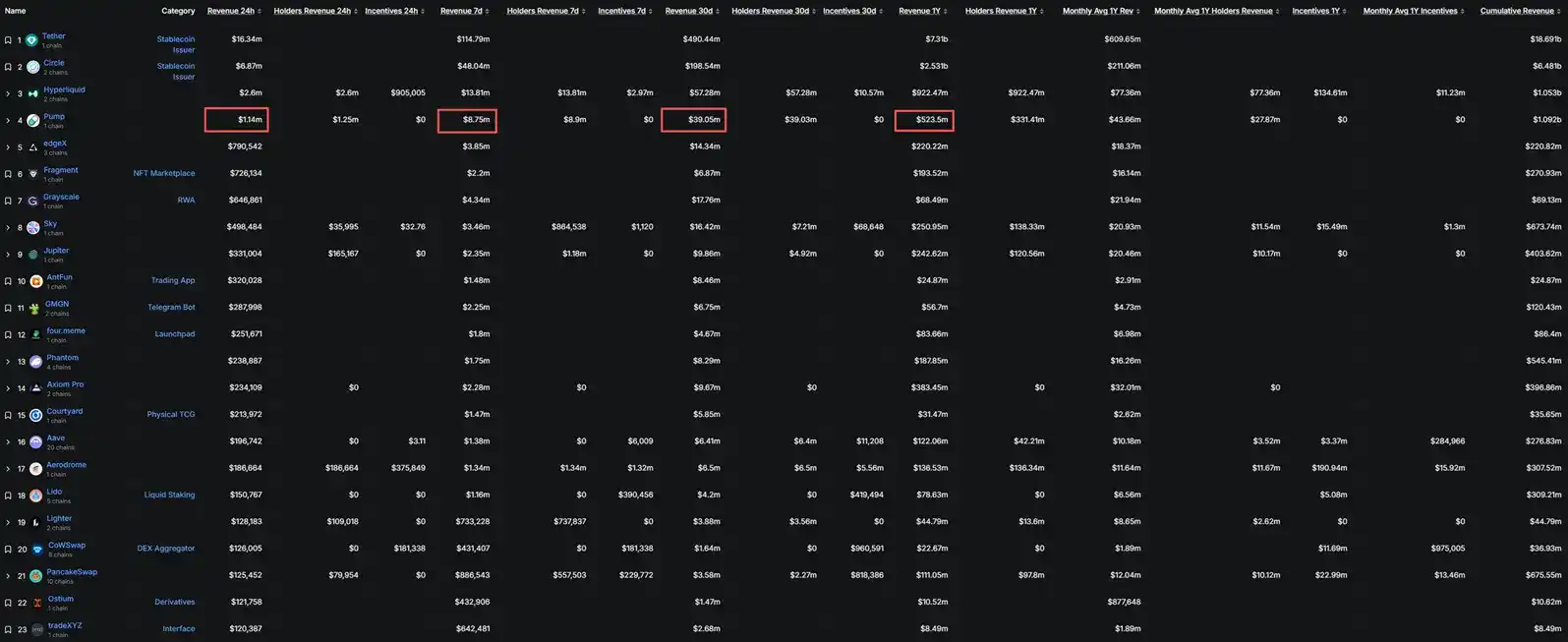
Although various "dog coin hunting" chat groups are冷冷清清, many with not a single message for days, pump.fun's average revenue over the past 7 or 30 days still exceeds one million dollars per day.

Is this real revenue, or is pump.fun faking it?

Is pump.fun's revenue real?

First, according to pump.fun's official revenue dashboard, its current revenue consists of three parts:

- Bonding curve revenue: Transaction fee income before a new token "graduates." pump.fun charges a 0.95% protocol fee on these transactions.

- Pumpswap revenue: For new tokens that have successfully graduated (migrated to the Pumpswap AMM for trading), a 0.93% protocol fee is charged on transactions for tokens with a market cap of 0-420 SOL.

- Terminal (Padre) revenue: pump.fun acquired the trading terminal Padre in October last year and rebranded it as the multi-chain trading platform Terminal. Revenue from this trading platform is now also counted as pump.fun revenue.

- Revenue is net of referral rebates and trading cashback.

For protocol revenue from the bonding curve phase, the Solana address used by pump.fun official to receive this portion of revenue is CebN5WGQ4jvEPvsVU4EoHEpgzq1VV7AbicfhtW4xC9iM. The bonding curve revenue aggregated to this address is hardcoded into the contract. If fake revenue were being created by externally transferring funds to this address, there would necessarily be external addresses directly calling the System Program's Transfer instruction. After analyzing the transactions for this address, we found no evidence of any伪造收入的行为 through simple, external SOL transfers.

This means that the bonding curve revenue确实完全来自于真实合约调用的协议手续费抽成。

DefiLlama's pump.fun bonding curve revenue data is obtained by directly calling pump.fun's official API, which is why we first conducted an on-chain analysis of pump.fun's official bonding curve revenue address. However, DefiLlama's calculations for Pumpswap and Terminal (Padre) revenue are done through Dune SQL queries of on-chain Solana data,完全不依赖 pump.fun 官方的 API,具有极高的链上客观性和不可篡改性。

At this point, we have ruled out the suspicion that pump.fun is faking revenue through "external transfers" or "falsifying data" in a simple and crude manner. However, the possibility remains that they could be generating fake revenue through "wash trading" using bots or internal wallets. Therefore, we must ask further—given the current overall sluggish state of the cryptocurrency market, with meme coin热度更是大幅退潮, is pump.fun's revenue real and organic?

The reasonableness of pump.fun's revenue in the current market environment?

According to data on Token Terminal, during the first quarter of this year, the daily active address count on Solana stabilized between 1.2 million and 2.2 million, while on pump.fun it was approximately 150,000.

Simultaneously, according to data from Dune's pump.fun related statistical dashboard, these 150,000 addresses correspond to approximately 30,000 new token deployments per day.

This means that if all 30,000 new tokens per day were deployed spontaneously by different real users, then about 20% of pump.fun's active users are launching new coins every day. However, according to a paper titled "Predicting the success of new crypto-tokens: the Pump.fun case" published last month by Giulio Marino et al., from September 1, 2025, to October 1, 2025, a total of 655,770 new tokens were deployed on pump.fun, yet the number of addresses deploying tokens was only 243,123.
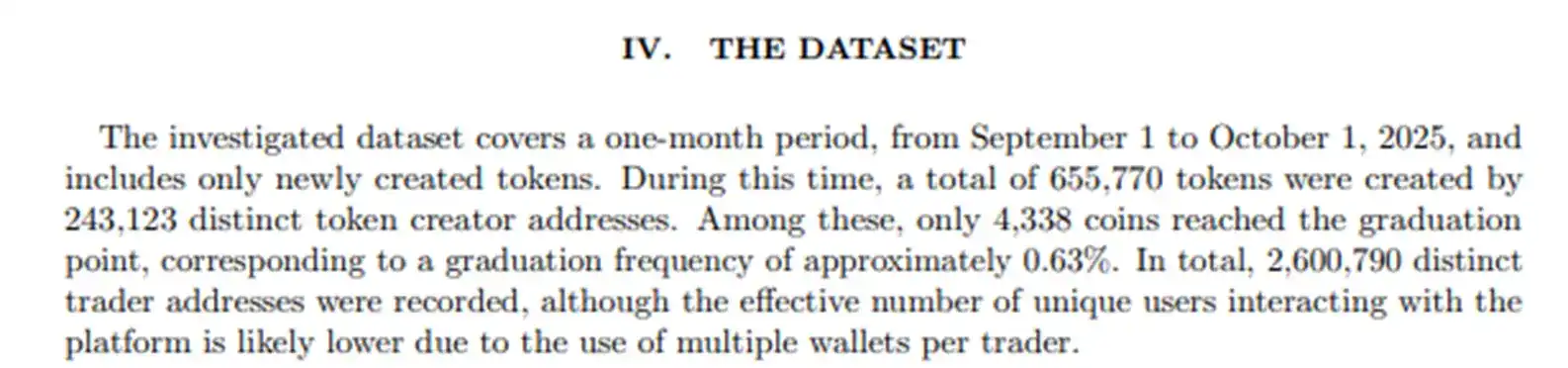
And the current daily number of token deployments is even higher than last September:

Combined with the current market environment, this data is somewhat "counter-intuitive"—on social media, it feels like cryptocurrency is almost finished, yet on pump.fun, so many new tokens are still being deployed every day. Also, the number of active addresses over the past month is about 10% higher than last September.

In pump.fun's daily million-dollar revenue, Pumpswap and Terminal (Padre) still account for a relatively "small portion." Taking the data from March 18 as an example, the revenue from Pumpswap and Terminal (Padre) on that day was approximately $284,000 and $58,000 respectively, while the revenue from the bonding curve was about $795,000, roughly 2.3 times the sum of the former two.

The new token graduation rate has recently even reached more than twice that of last September:
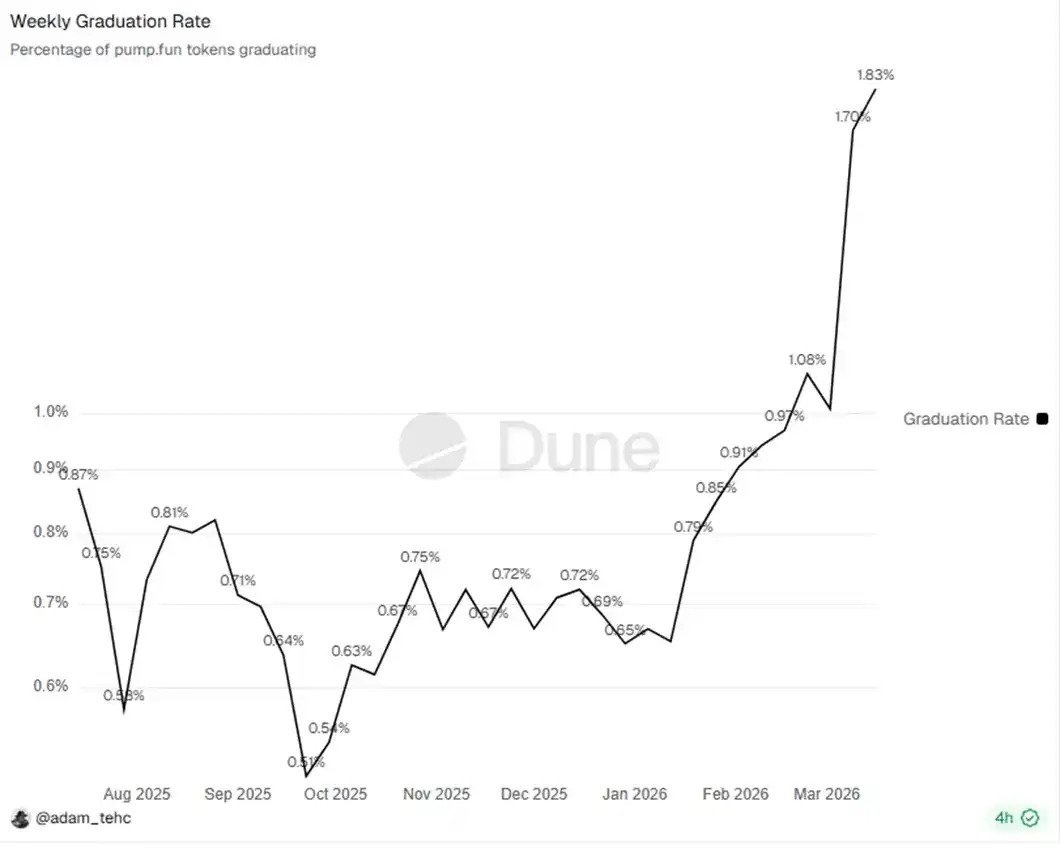
Simultaneously, approximately 26,000 new tokens were deployed on pump.fun that day. To achieve $795,000 in bonding curve revenue, a bonding curve trading volume of $795,000 / 0.95% (the protocol fee rate charged by the bonding curve) ≈ $83,684,200 is required. Averaged across each newly deployed token, each newly deployed token needs to contribute an average of about $3,218 in trading volume before successfully graduating.

If we combine the above data, an average of just over $3,000 in trading volume per new token doesn't sound that difficult; in fact, it seems quite normal, because even in September of last year, when the data was全面落后, pump.fun was still able to achieve this goal. If calculated in SOL terms, they are earning more SOL now than in September last year, it's just that the USD-denominated revenue has decreased.

But at this point, we still have questions: Since last August, pump.fun has been using almost its entire daily revenue to回购 $PUMP. To date, they have repurchased over 10% of the total supply and over 30% of the current circulating supply of $PUMP. Why then does the price of $PUMP keep falling? Although on-chain data shows that the repurchased $PUMP, worth over $300 million, remains untouched in wallets, could it be that they are creating fake revenue through wash trading, "repurchasing" on one hand while secretly selling off through分散的地址?

Where did the $PUMP go?

Let's look at the $PUMP token release schedule:
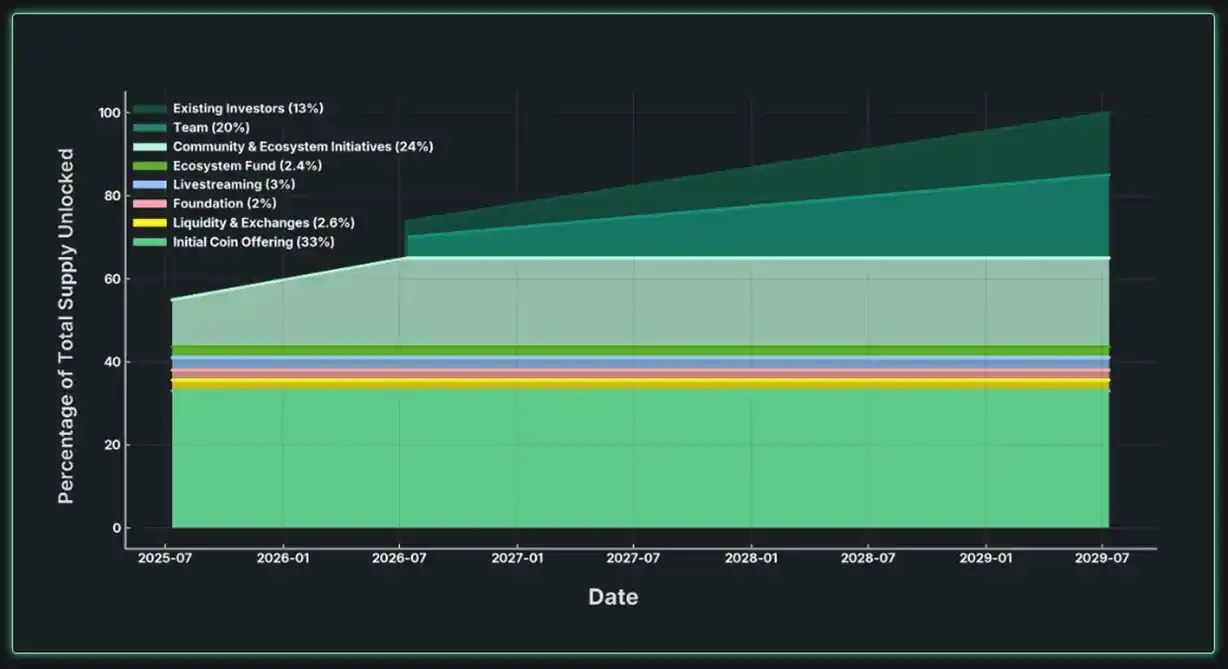
So far, the circulation of $PUMP is as follows:

- ICO: 33%, fully unlocked at TGE.

- Team: 20%, still locked.

- Investors: 13%, still locked.

- LP and Exchanges: 2.6%, fully unlocked at TGE.

- Ecosystem Fund: 2.4%, fully unlocked at TGE.

- Live Streaming Support: 3%, fully unlocked at TGE.

- Foundation: 2%, fully unlocked at TGE.

- Community and Ecosystem Incentives: 24%, approximately 50% unlocked at TGE, the remaining portion unlocks linearly over 1 year. Currently, 65.27% of this portion has been unlocked.

The $PUMP multi-sig custodial wallet with the address Cfq1ts1iFr1eUWWBm8eFxUzm5R3YA3UvMZznwiShbgZt currently holds approximately 36.5% of the total supply of $PUMP.

This does not match the $PUMP token release schedule. What we can明确的是 is that after TGE, all $PUMP was transferred to the multi-sig custodial wallet for distribution. The theoretical maximum transferable amount is only about 58.67% of the total supply (ICO 33% + LP and Exchanges 2.6% + Ecosystem Fund 2.4% + Live Streaming Support 3% + Foundation 2% + Community and Ecosystem Incentives unlocked portion ~15.67%). The $PUMP balance in the multi-sig custodial wallet should not be lower than approximately 41.33%. The difference is about 4.83%.

Where did this 4.83% go? We don't know. We don't even know where the $PUMP for the other parts, which have clearly defined用途 in the description, are located beyond the ICO sale distribution. Although by comparing on-chain data, we did find that approximately 24% of the total supply of $PUMP was transferred in large amounts to various addresses and has remained silent ever since, roughly corresponding to the portions other than the ICO sale distribution, pump.fun official has never disclosed the storage addresses corresponding to the funds for each part of the wallet.

Especially for the community and ecosystem incentives part, the only community and ecosystem incentive activities we can publicly know about are大概只有 the Glass Full Foundation (which bought approximately $1.7 million worth of meme coins within the pump.fun ecosystem), grants of $10,000 each to 6 meme coin communities (totaling $60,000), and a hackathon that funded 12 projects with $25,000 each (totaling $300,000 promised but only 6 winners announced so far).

And yet, this part is already the most clear...

But even with this transparency issue, even if the 4.83% was secretly sold off, pump.fun official's large-scale repurchase of over 10% of the total supply and over 30% of the current circulating supply should be able to offset this selling pressure. Why then is the price performance of $PUMP still languishing?

A possible reason is that $PUMP truly lacks sufficient buy-side demand. In the face of a lack of market recognition, even large-scale repurchases are like mud牛入海 (a Chinese idiom meaning something disappears without a trace).

The Unrecognized "Casino"

When talking about Hyperliquid, we affirm its leading position in Perp DEX and narrative potential. But for pump.fun's meme coin track, even retail investors mostly consider it a scam, unsustainable.

In the earlier part of the article, we acknowledged the authenticity of pump.fun's revenue. Now we need to look at some other data. This data can show that the poor perception of meme coins is not just simple感性厌恶 from retail investors experiencing the剧烈波动 of meme coins, but also creates理性抗拒 among institutional investors.

As early as last April, research by Medallion Analytics showed that over a 180-day statistical period, among approximately 178,000 deployers who launched multiple tokens, 85.3% of them were profitable. Within 180 days, these deployers launched a total of approximately 3.59 million tokens, and the profitable deployers launched about 3.07 million of them, a proportion of about 85.5%.

During the statistical period, the top 10 profitable deployers profited approximately 365,000 SOL, while the 10中等 deployers in terms of profitability could only profit 47.3 SOL, a difference of about 7720 times. For the top deployers, the average interval between new token issuances was only 0.11 hours, while for medium deployers it was as long as 10.96 hours.

Solidus Labs studied the performance of newly deployed tokens on pump.fun between January 2024 and March 2025. The analysis pointed out that a staggering 98.6% of the tokens were pump-and-dump scams.
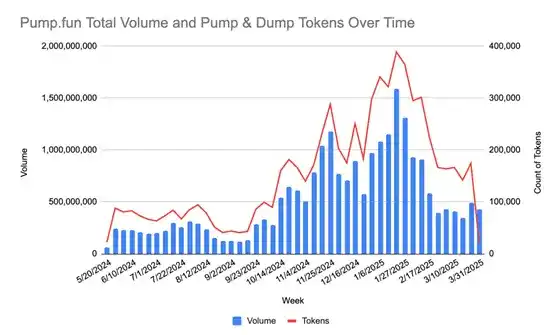
Meme coin issuance has long ceased to be a competition of creativity, but an assembly line for issuing coins and profiting. Top deployers, after making extremely short-cycle rapid profits, can then invest funds into facilities related to automatic coin issuance, making their harvesting speed even faster.

pump.fun has driven the cost of issuing new meme coins on Solana down to $2 or even less, which is indeed a technological advancement. However, they have not guided the meme coin track towards a benign development direction, making retail and institutional investors believe that meme coins are indeed a cultural or even belief-based asset. They tried to broaden the track to直播币, ICM coins, and recently AI Agent coins, but none of these attempts have been successful.

The data is there. The money they make the most is still earned by providing "low-cost harvesting tools," just like a casino taking a cut.

For pump.fun, deployers earn a risk-free 0.95% return for every new coin they issue and for every bit of fake volume they wash trade before the token graduates. If you want your token to get more exposure, you need to wash trade even more volume, providing pump.fun with even more revenue. The funds in this ecosystem are real, the revenue is real, but the ecosystem itself is non-organic, and retail investors are hurt. For institutional investors, such an ecosystem lacks a healthy, sustainable long-term foundation, which is perhaps the fundamental reason for pump.fun's depressed token price.

In the end, we have one more question:

Since pump.fun's repurchases cannot boost the token price, wouldn't using the daily revenue for staking rewards be better than the current repurchase strategy?

Maybe, or maybe they just don't care anymore.

Pertanyaan Terkait

QIs pump.fun's daily revenue of over a million dollars real, and how is it verified?

AYes, pump.fun's revenue is real and verified through on-chain analysis. The bonding curve revenue is collected via a smart contract address with no external SOL transfers, and the Pumpswap and Terminal(Padre) revenues are calculated from immutable Solana on-chain data via Dune SQL, independent of pump.fun's API.

QWhat are the main sources of pump.fun's revenue?

Apump.fun's revenue comes from three main sources: 0.95% protocol fees from bonding curve transactions before a token graduates, 0.93% protocol fees from trades of graduated tokens on Pumpswap (for tokens with a market cap of 0-420 SOL), and revenue from the Terminal (formerly Padre) multi-chain trading platform acquired in October.

QWhy is the price of $PUMP token performing poorly despite significant buybacks?

AThe $PUMP token price remains low primarily due to a lack of buy-side demand and market recognition. Despite the team buying back over 10% of the total supply (over 30% of the circulating supply), the ecosystem is seen as a non-organic 'casino' for meme coin scams, which discourages institutional and long-term investor interest.

QWhat does the data say about the legitimacy and success rate of tokens launched on pump.fun?

AData from Solidus Labs indicates that 98.6% of tokens launched on pump.fun from January 2024 to March 2025 were pump-and-dump scams. While a small percentage of deployers (largely automated, top-tier ones) are highly profitable, the vast majority of tokens are designed for rapid, short-term exploitation rather than genuine community or cultural value.

QHow does the current activity and token deployment on pump.fun compare to market sentiment?

ADespite a bearish overall market sentiment, on-chain data shows that pump.fun's activity has increased. Daily active addresses are up about 10% compared to September, with approximately 30,000 new tokens deployed daily. However, this high volume is largely driven by automated, profit-focused deployers rather than organic user growth, creating a disparity between on-chain metrics and negative public perception.

Bacaan Terkait

Perhatian Wajib Pekan Depan|Undang-Undang CLARITY Diperkirakan Akan Masuk ke Pemungutan Suara Senat; SpaceX dan Circle Umumkan Laporan Keuangan (3-9 Agustus)

**Ringkasan Acara Penting Pekan Depan (3-9 Agustus)** Pekan depan diwarnai sejumlah pengumuman keuangan penting dan perkembangan regulasi kripto di AS. **Laporan Keuangan & Acara Perusahaan:** * **SpaceX** akan merilis laporan keuangan Q2 2026 pada 4 Agustus, diikuti gelombang pencairan saham internal pertama (hingga 12%) pada 6 Agustus. * **Circle** (penerbit USDC) dan **Hut 8** (penambang Bitcoin) masing-masing akan mengumumkan laporan kuartalan pada 5 Agustus dan 4 Agustus. * **American Bitcoin (ABTC)**, perusahaan tambang kripto yang dikaitkan dengan keluarga Trump, merilis laporan Q2 pada 3 Agustus. * Perusahaan robotika **宇树科技 (Unitree Robotics)** akan melakukan penawaran saham perdana (IPO) di pasar STAR China, dengan hari penentuan harga awal pada 5 Agustus. **Regulasi Kripto AS:** * **CLARITY Act**, undang-undang kerangka kerja federal untuk aset kripto, berpeluang dilakukan pemungutan suara penuh di Senat AS minggu ini. Para negosiator harus merampungkan aturan tentang konflik kepentingan sebelum masa reses 7 Agustus. RUU ini memerlukan 60 suara untuk disetujui. **Pengumuman Data & Teknologi:** * **Laporan Non-Farm AS** untuk Juli akan dirilis pada 7 Agustus, menjadi fokus pasar. * **Grok AI** versi 4.6 (dengan 1,5 triliun parameter) diperkirakan diluncurkan sekitar 7 Agustus, diikuti versi 4.7 yang lebih kuat beberapa minggu setelahnya. * **XRP Ledger** versi 3.3.0 dengan lima fitur baru, termasuk transaksi batch, dijadwalkan rilis minggu depan. **Penutupan & Perubahan Layanan:** * Beberapa layanan kripto akan berhenti beroperasi: **Zapper** (pelacak portofolio DeFi) dan **Ctrl Wallet** pada 3 Agustus, serta **LayerZero** akan menghentikan relayernya untuk v1 pada tanggal yang sama. Bursa Korea **Upbit** akan menghapus perdagangan pasangan **AQT** dan **AERGO** pada 3 Agustus. **Acara Lainnya:** * **BIP-110**, sebuah proposal peningkatan jaringan Bitcoin, akan memulai fase pengiriman sinyal wajib sekitar 8 Agustus.

marsbit3m yang lalu

Perhatian Wajib Pekan Depan|Undang-Undang CLARITY Diperkirakan Akan Masuk ke Pemungutan Suara Senat; SpaceX dan Circle Umumkan Laporan Keuangan (3-9 Agustus)

marsbit3m yang lalu

Saham Jatuh Lebih Parah daripada Kripto, Ke Mana Uangnya Pergi?

Penulis: Cathy,白话区块链 Pada 28 dan 29 Juli di Seoul, indeks Kospi memicu *circuit breaker* dua hari berturut-turut, suatu peristiwa yang belum pernah terjadi dalam sejarah pasar saham Korea. Saham-saham semikonduktor global, termasuk SK Hynix yang turun sekitar 23% dalam dua hari, mengalami penurunan drastis. Penarikan dana (pullback) Kospi pada Juli mencapai 40% dari titik tertinggi Juni, menjadikannya bulan terburuk yang tercatat. Produk leverage seperti ETF 2x Long SK Hynix bahkan anjlok hingga 83%, menghapus lebih dari 1 triliun HKD dalam nilai pasar. Ironisnya, Bitcoin justru naik hampir 15% dari titik terendah Juli, menunjukkan perilaku yang tidak biasa: **saham yang jatuh seperti aset kripto, sementara Bitcoin relatif stabil.** Penurunan ini bukan kepanikan pasar luas, melainkan "peledakan tertarget" terhadap perdagangan yang paling ramai (*crowded trades*), dipicu oleh laporan keuangan SK Hynix yang meski mencetak rekor laba tetapi di bawah perkiraan, serta IPO besar-besaran ChangXin Memory (CXMT) dari China. Ditambah dengan potensi likuidasi posisi *carry trade* Yen Jepang yang masif, pasar mengalami de-leverage paksa. Lalu, apakah uang yang keluar dari saham mengalir ke Bitcoin? Jawabannya tidak. Bitcoin tampak "tahan jatuh" karena sudah mengalami koreksi lebih dulu—jatuh sekitar 21% selama periode arus keluar ETF berkelanjutan pada Mei-Juni. Uang yang mencari perlindungan justru mengalir ke emas, yang harganya naik lebih dari 20% secara tahunan. Koefisien korelasi Bitcoin dengan emas mencapai -0.88, mengindikasikan bahwa institusi kini memandangnya sebagai aset yang berbeda: **emas untuk perlindungan, Bitcoin untuk potensi pertumbuhan.** Agar aliran dana besar-besaran benar-benar masuk ke Bitcoin, diperlukan tiga kondisi: tekanan likuidasi global mereda, The Fed menurunkan suku bunga tanpa memicu resesi, dan disahkannya RUU CLARITY di AS untuk memberikan kejelasan regulasi. Meski RUU tersebut tertunda di Senat, arahnya sudah jelas. **Harga saham teknologi ditentukan oleh pengeluaran modal AI dan laba perusahaan, sedangkan harga Bitcoin ditentukan oleh likuiditas global.** Ketidakselarasan ini justru menciptakan daya tarik bagi institusi yang ingin mendiversifikasi portofolio mereka. Kesimpulannya, Bitcoin saat ini bukan tempat perlindungan (*safe haven*), melainkan aset yang sudah terkoreksi lebih dulu dan sudah berada di posisi yang siap. **Dana belum datang, tetapi posisinya sudah dipersiapkan.** Ketika badai berlalu dan modal global mencari tempat baru untuk dialokasikan, Bitcoin berada di urutan terdepan dalam antrian.

marsbit3m yang lalu

Saham Jatuh Lebih Parah daripada Kripto, Ke Mana Uangnya Pergi?

marsbit3m yang lalu

Dialog dengan Ray Dalio: Saat Ini Berada dalam Gelembung AI, 1% Portofolio Investasi Adalah Bitcoin

Sumber: The Diary Of A CEO Ray Dalio, pendiri Bridgewater Associates yang meramalkan krisis keuangan 2008, memperingatkan bahwa ledakan AI saat ini menunjukkan tanda-tanda klasik gelembung ekonomi yang dapat pecah dan memicu resesi. Dalam wawancara podcast, dia menjelaskan dinamika "siklus besar" yang didorong oleh ketimpangan kekayaan, defisit pemerintah, dan perubahan geopolitik. Dalio mengidentifikasi pola di mana antusiasme berlebihan terhadap teknologi revolusioner baru, seperti AI, menyebabkan harga aset melambung dan pinjaman berlebihan. Ketika kondisi berubah (seperti kenaikan suku bunga atau kebutuhan tunai), gelembung ini dapat pecah, menyebabkan penurunan harga aset, kerugian luas, dan kontraksi ekonomi. Untuk melindungi kekayaan di masa ketidakpastian, Dalio sangat menekankan pentingnya **diversifikasi portofolio**—termasuk saham, obligasi, emas, dan real estat—daripada mengandalkan uang tunai saja. Dia mengungkapkan bahwa sekitar **1% portofolionya adalah Bitcoin**, yang diakuinya sebagai aset keras, tetapi dia lebih menyukai **emas fisik** karena sejarahnya sebagai penyimpan nilai dan aset bebas liabilitas. Mengenai dampak AI, Dalio percaya bahwa teknologi ini akan menggantikan tidak hanya tenaga fisik tetapi juga kemampuan kognitif manusia, berpotensi memperlebar kesenjangan antara pemilik modal dan pekerja. Masa depan akan menguntungkan mereka yang dapat memadukan kecerdasan manusia (seperti emosi dan intuisi) dengan kemitraan AI. Secara geopolitik, Dalio menggambarkan dunia yang memasuki fase "penurunan" dalam tatanan global, dengan Amerika Serikat menghadapi tantangan internal dan eksternal, termasuk konflik seperti di Iran yang mengungkap kelemahannya. Dia memprediksi dunia mungkin menjadi lebih terregionalisasi di masa depan. Secara keseluruhan, kunci untuk navigasi melalui periode kompleks ini adalah pemahaman akan pola sejarah, adaptasi, dan diversifikasi yang cermat.

marsbit3j yang lalu

Dialog dengan Ray Dalio: Saat Ini Berada dalam Gelembung AI, 1% Portofolio Investasi Adalah Bitcoin

marsbit3j yang lalu

Rekor! Beli Bersih Asing 7,2 Triliun Won dalam Sehari, Wall Street: Tekanan Likuiditas di Pasar Saham Korea Telah Mereda

**Ringkasan: Rekor Pembelian Asing dan Peningkatan Likuiditas di Pasar Saham Korea** Aliran modal asing menunjukkan perubahan signifikan di pasar saham Korea (KOSPI). Pada 31 Juli, investor asing melakukan pembelian bersih rekor sebesar 7,2 triliun Won Korea dalam sehari, menandai pembalikan dari tren penjualan bersih besar-besaran dalam beberapa bulan terakhir. Secara bulanan, penjualan bersih asing menyusut drastis menjadi 9,8 triliun Won di Juli, turun dari 48,4 triliun dan 44,5 triliun Won pada Juni dan Mei. Tekanan penjualan dari lembaga domestik juga mereda. Dana pensiun dan reksa dana domestik justru menjadi pembeli bersih 1,0 triliun Won di Juli, setelah dua bulan sebelumnya menjadi penjual bersih. Faktor pendukung lainnya adalah peraturan baru dari Komisi Jasa Keuangan (FSC) yang memberlakukan syarat lebih ketat bagi investor ritel untuk masuk ke ETF leverage saham tunggal, yang langsung mengurangi volume perdagangan instrumen tersebut hingga sekitar 50%. Kebijakan ini diperkirakan dapat menekan volatilitas pasar. Citigroup mempertahankan target indeks KOSPI di level 10.000 poin, menyoroti memudarnya angin penentu likuiditas. Analis mereka menilai faktor fundamental seperti industri chip memori yang solid, valuasi historis yang rendah, fundamental ekonomi Korea yang kuat, dan dukungan kebijakan berpotensi menjadi pendorong bagi pasar.

marsbit3j yang lalu

Rekor! Beli Bersih Asing 7,2 Triliun Won dalam Sehari, Wall Street: Tekanan Likuiditas di Pasar Saham Korea Telah Mereda

marsbit3j yang lalu

Pembaruan! AI Generasi Berikut OpenAI Pecahkan 10 Masalah Kelas Medali Fields

**OpenAI Model Astra Pecahkan 10 Masalah Matematika Kelas Fields Medal!** OpenAI mengumumkan terobosan besar dari model internal terbarunya, Astra. Model ini dilaporkan telah membuat kemajuan signifikan dalam **10 masalah matematika yang belum terpecahkan**, dengan biaya komputasi hanya sekitar **$2000**. Hasilnya dipublikasikan dalam makalah setebal 249 halaman. Beberapa pencapaian utama meliputi: 1. **Menyelesaikan masalah "non-sofic group"** yang diajukan Mikhail Gromov tahun 1999, dengan membangun contoh kelompok yang tak hingga dan finitely presented yang bukan sofic. Ini dianggap sebagai kemajuan bersejarah. 2. **Memecahkan batas lama dalam masalah pengepakan bola berdimensi tinggi** (sphere packing), meningkatkan batas yang telah bertahan sejak 1978 untuk dimensi tak hingga. 3. **Menyangkal dugaan "Connes Rigidity"** dengan membangun keluarga tak terhitung dari kelompok berbeda yang menghasilkan aljabar von Neumann yang sama persis. Semua bukti telah diverifikasi menggunakan asisten pembuktian formal Lean 4, memastikan ketepatannya. Para ahli matematika menyebut temuan ini sebagai **momen bersejarah**, setara dengan prestasi penghargaan Fields Medal, dan menandai kemampuan AI untuk melakukan penalaran matematika mendalam di berbagai bidang. OpenAI juga membagikan proses penalaran model, menunjukkan langkah maju yang besar menuju AGI (Artificial General Intelligence).

marsbit5j yang lalu

Pembaruan! AI Generasi Berikut OpenAI Pecahkan 10 Masalah Kelas Medali Fields

marsbit5j yang lalu

Trading

Spot
活动图片





