Double Whammy: Circle's Growth Logic Is Being 'Dismantled' Simultaneously by Legislation and Competitors

marsbitDipublikasikan tanggal 2026-03-25Terakhir diperbarui pada 2026-03-25

Abstrak

U.S. stablecoin issuer Circle (CRCL) experienced its largest single-day drop, falling over 20% on March 24, following the leak of a draft version of the Clarity Act. The bill aims to prohibit digital asset service providers from paying yields—directly or indirectly—on stablecoin holdings, including any structure “economically or functionally equivalent to interest.” This directly impacts Circle’s key partner Coinbase, which currently shares most of the reserve interest earnings from USDC holdings with users through its “USDC Rewards” program. The proposed rule could significantly slow USDC’s growth, which has been partly driven by its use as a high-yield savings alternative. Without yield incentives, demand for USDC may decline, undermining Circle’s revenue model built on scale expansion. On the same day, rival Tether announced it had hired a Big Four accounting firm to conduct a full financial audit—including its USDT reserves. This move enhances Tether’s credibility and could diminish Circle’s competitive edge in transparency and compliance, which had previously driven its growth. The draft legislation reinforces a regulatory stance that stablecoins should function primarily as payment instruments rather than interest-bearing assets, challenging Circle’s core growth strategy.

Original Author: Sanqing, Foresight News

On March 24 (Eastern Time), the share price of stablecoin issuer Circle (CRCL) closed at $101.17 on the New York Stock Exchange, marking a single-day drop of over 20%, its largest single-day decline since going public. Its largest distribution partner, Coinbase (COIN), also fell nearly 10% in sync, closing at $181.04 on the Nasdaq.

The trigger for the sell-off was the leaked details of the latest draft text of the Clarity Act. The draft intends to prohibit digital asset service providers from "directly or indirectly" paying yields on stablecoin balances, and also bans any structural arrangements that are "economically or functionally equivalent to interest."
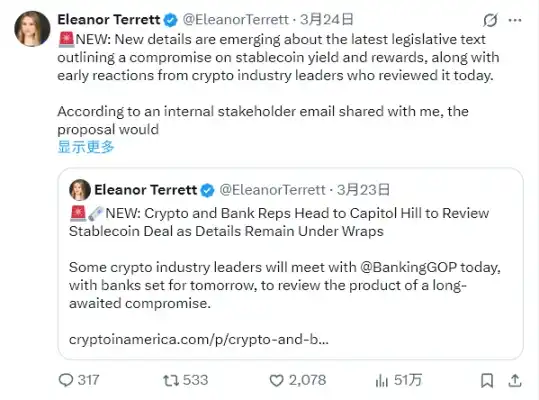
Image Source: Tweet by Eleanor Terrett, host of Crypto in America and former Fox Business reporter

On the same day, its competitor Tether announced that it had hired one of the Big Four accounting firms to conduct its first full financial audit (including the USDT reserves).

"Directly or Indirectly": Who Do These Five Words Block?

The draft text was submitted to crypto industry representatives for review in a closed-door meeting on March 24, with banking representatives to follow for review the next day. Reporter Eleanor Terrett disclosed the draft details on X, citing a related email.

USDC itself has never paid interest, and Circle, as the issuer, has never paid any yield to holders. So, what does the draft's prohibition on issuers paying interest have to do with Circle?

The draft's "scope" extends beyond the issuer. The entity actually paying yields to users is Coinbase.

According to the revenue-sharing structure disclosed in Circle's prospectus, 100% of the reserve interest for USDC held by users on the Coinbase platform belongs to Coinbase; for USDC circulating outside the platform, 50% of the reserve interest belongs to Coinbase.

Coinbase passes on the vast majority of the reserve proceeds obtained on-platform to users in the form of "USDC Rewards." According to an analysis by Columbia Law School, Coinbase's profit margin on USDC Rewards is extremely thin, retaining only about 20 to 25 basis points.

The "directly or indirectly" and "economically or functionally equivalent to interest" clauses in the Clarity Act draft are precisely designed to block this loophole.

This ban may have a limited financial impact on Coinbase, or could even be positive. Coinbase is both a shareholder of Circle and holds a pure profit share of 50% of the reserve income from off-platform USDC. Its commercial incentive to promote USDC will not disappear because of this.

However, USDC's competitors are not only USDT but also the US dollar itself.

USDC Rewards allowed USDC to play the de facto role of a "digital high-yield savings account." This has also been one of the drivers behind USDC's growth rate outpacing USDT's for two consecutive years. Once this channel is closed, users holding USDC would see yields drop to zero, reducing their willingness to hold it.

The path of demand contraction points to Circle. Weakened holding motivation on the retail end leads to a slowdown in the growth of the total circulating supply of USDC. The speed at which the reserve pool thickens subsequently decreases, and Circle's revenue growth story, built on the expectation of scale expansion, begins to loosen.

The draft also preserves an exemption for "activity-based rewards." Rewards linked to payments, transfers, or platform usage are still permitted. But this is a completely different product from the current "hold-to-earn" model.

Furthermore, the standard phrasing "economically or functionally equivalent to interest" is overly vague, leaving significant room for interpretation by future regulators. The boundaries of activity-based rewards also face the risk of being tightened.

Another Pressure on the Same Day

If the Clarity Act draft is dismantling Circle's growth flywheel, then the audit announcement made by Tether on the same day targets another competitive advantage of Circle.

USDC's long-term differentiation narrative has largely been built on compliance.

Circle regularly undergoes reserve attestations from top-tier accounting firms. During the years when regulatory uncertainty weighed on Tether, "We are the transparent and compliant one" was an extremely effective card for institutional clients and compliance-sensitive exchanges.

Tether, on the other hand, relied on quarterly attestations rather than full audits to respond to the outside world. S&P Global had previously assigned USDT a "weak" credit rating in 2025, warning of under-collateralization risks if Bitcoin prices fell further.

Additionally, the GENIUS Act requires large stablecoin issuers to undergo annual independent audits. Tether's hiring of a Big Four firm seems more like a response to this legal obligation. Regardless of the motive, the timing of this signal was enough to add to the market's negative sentiment.

USDC's growth rate has outpaced USDT's for two consecutive years. The narrative of compliance and transparency has been one of the most important drivers of this growth. Tether's hiring of a Big Four auditor has not yet begun, and the results are far from known. But if the audit is completed successfully, it is obvious that the compliance premium that Circle relies on to maintain its growth advantage will be compressed.
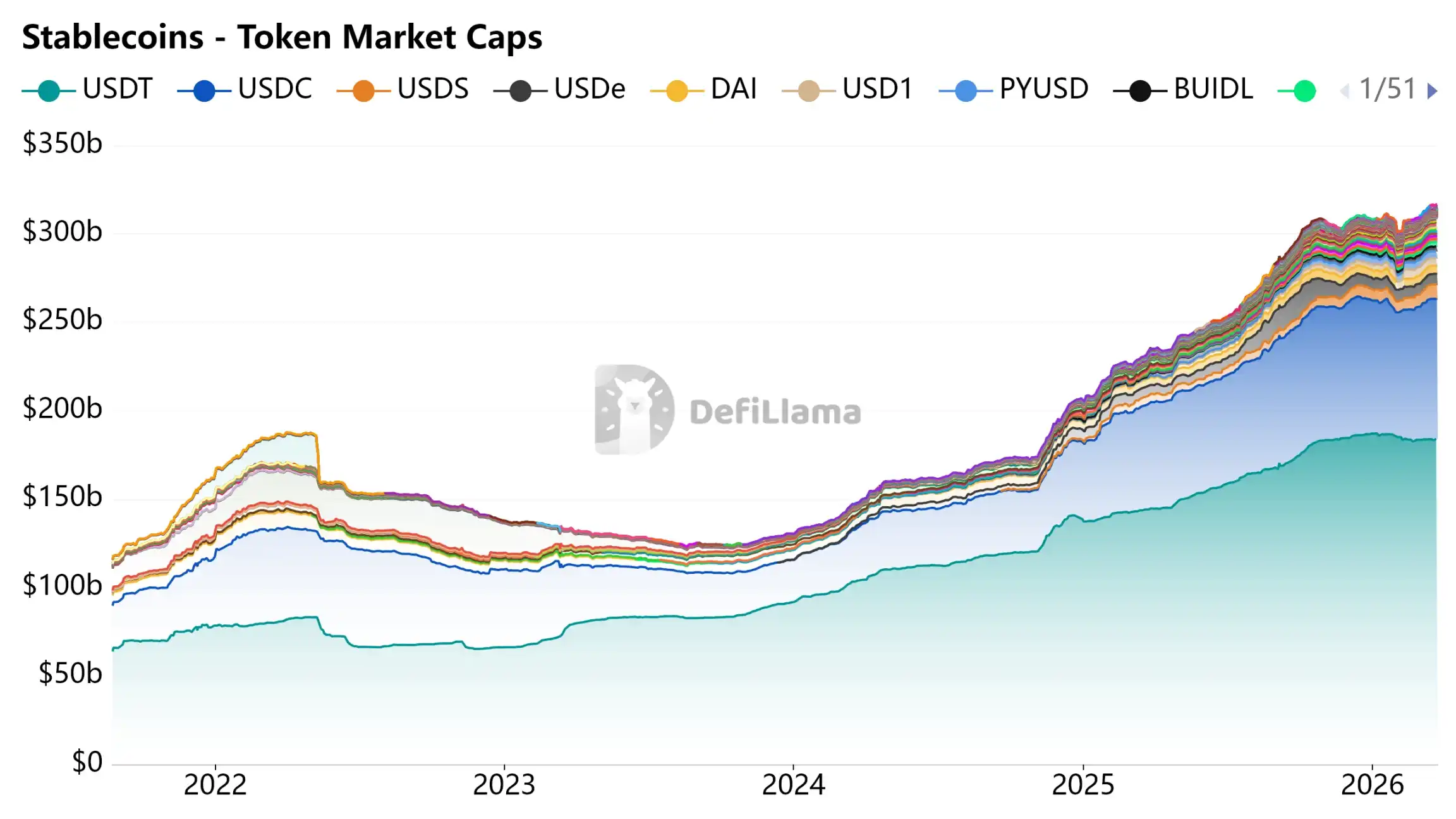
Image Source: DeFiLlama - Stablecoins

Payment Tool, Not Savings Account

Circle's value benefits from its growth model: yield incentives drive users to hold USDC, scale expansion leads to a thickening reserve pool, and reserve interest supports revenue growth. For this model to work, the premise is that stablecoins are allowed to play the role of an interest-bearing asset or savings deposit.

The Clarity Act draft is negating this premise at the legislative level.

Without yield incentives, the growth of USDC's scale must instead rely on natural penetration through real payment scenarios. This path is not impassable, but it is much slower and far more uncertain than yield-driven growth.

Compliance preserves Circle's license, but it does not preserve its growth model. The bankers' answer is clear: stablecoins can exist, but they cannot bear interest.


Pertanyaan Terkait

QWhat caused Circle's stock price to drop by over 20% on March 24th?

AThe sharp decline in Circle's stock price was triggered by the leaked details of the Clarity Act draft, which proposes to prohibit digital asset service providers from paying yields, directly or indirectly, on stablecoin balances, including any structure economically or functionally equivalent to interest.

QHow does the Clarity Act draft impact Coinbase's USDC Rewards program?

AThe Clarity Act draft, with its 'direct or indirect' and 'economically or functionally equivalent to interest' clauses, is designed to close the loophole that allowed Coinbase to pay 'USDC Rewards' to users. This program, funded by the interest earned on USDC reserves, would likely be prohibited, removing a key incentive for users to hold USDC on the platform.

QWhat is the significance of Tether announcing a full financial audit on the same day?

ATether's announcement of hiring a Big Four accounting firm for its first full financial audit (including USDT reserves) challenges Circle's key competitive advantage of transparency and compliance. If completed successfully, this audit could compress the 'compliance premium' that has been a major driver of USDC's growth advantage over USDT in recent years.

QWhat was the core growth model for Circle and USDC that is being challenged?

ACircle's growth model was driven by yield incentives encouraging users to hold USDC, leading to an expansion of its circulating supply. This growth thickened the reserve pool, and the interest earned on those reserves supported revenue growth. The Clarity Act draft legislatively challenges this model by aiming to prevent stablecoins from functioning as interest-bearing savings accounts.

QWhat alternative path for USDC's growth does the article suggest if the yield incentive is removed?

AIf the yield incentive is removed, USDC's growth would have to rely solely on organic penetration into real payment use cases. The article states that this path is viable but will be much slower and more uncertain compared to the previous model driven by收益激励 (yield incentives).

Bacaan Terkait

Dialog dengan Ray Dalio: Saat Ini Berada dalam Gelembung AI, 1% Portofolio Investasi Adalah Bitcoin

Sumber: The Diary Of A CEO Ray Dalio, pendiri Bridgewater Associates yang meramalkan krisis keuangan 2008, memperingatkan bahwa ledakan AI saat ini menunjukkan tanda-tanda klasik gelembung ekonomi yang dapat pecah dan memicu resesi. Dalam wawancara podcast, dia menjelaskan dinamika "siklus besar" yang didorong oleh ketimpangan kekayaan, defisit pemerintah, dan perubahan geopolitik. Dalio mengidentifikasi pola di mana antusiasme berlebihan terhadap teknologi revolusioner baru, seperti AI, menyebabkan harga aset melambung dan pinjaman berlebihan. Ketika kondisi berubah (seperti kenaikan suku bunga atau kebutuhan tunai), gelembung ini dapat pecah, menyebabkan penurunan harga aset, kerugian luas, dan kontraksi ekonomi. Untuk melindungi kekayaan di masa ketidakpastian, Dalio sangat menekankan pentingnya **diversifikasi portofolio**—termasuk saham, obligasi, emas, dan real estat—daripada mengandalkan uang tunai saja. Dia mengungkapkan bahwa sekitar **1% portofolionya adalah Bitcoin**, yang diakuinya sebagai aset keras, tetapi dia lebih menyukai **emas fisik** karena sejarahnya sebagai penyimpan nilai dan aset bebas liabilitas. Mengenai dampak AI, Dalio percaya bahwa teknologi ini akan menggantikan tidak hanya tenaga fisik tetapi juga kemampuan kognitif manusia, berpotensi memperlebar kesenjangan antara pemilik modal dan pekerja. Masa depan akan menguntungkan mereka yang dapat memadukan kecerdasan manusia (seperti emosi dan intuisi) dengan kemitraan AI. Secara geopolitik, Dalio menggambarkan dunia yang memasuki fase "penurunan" dalam tatanan global, dengan Amerika Serikat menghadapi tantangan internal dan eksternal, termasuk konflik seperti di Iran yang mengungkap kelemahannya. Dia memprediksi dunia mungkin menjadi lebih terregionalisasi di masa depan. Secara keseluruhan, kunci untuk navigasi melalui periode kompleks ini adalah pemahaman akan pola sejarah, adaptasi, dan diversifikasi yang cermat.

marsbit3j yang lalu

Dialog dengan Ray Dalio: Saat Ini Berada dalam Gelembung AI, 1% Portofolio Investasi Adalah Bitcoin

marsbit3j yang lalu

Rekor! Beli Bersih Asing 7,2 Triliun Won dalam Sehari, Wall Street: Tekanan Likuiditas di Pasar Saham Korea Telah Mereda

**Ringkasan: Rekor Pembelian Asing dan Peningkatan Likuiditas di Pasar Saham Korea** Aliran modal asing menunjukkan perubahan signifikan di pasar saham Korea (KOSPI). Pada 31 Juli, investor asing melakukan pembelian bersih rekor sebesar 7,2 triliun Won Korea dalam sehari, menandai pembalikan dari tren penjualan bersih besar-besaran dalam beberapa bulan terakhir. Secara bulanan, penjualan bersih asing menyusut drastis menjadi 9,8 triliun Won di Juli, turun dari 48,4 triliun dan 44,5 triliun Won pada Juni dan Mei. Tekanan penjualan dari lembaga domestik juga mereda. Dana pensiun dan reksa dana domestik justru menjadi pembeli bersih 1,0 triliun Won di Juli, setelah dua bulan sebelumnya menjadi penjual bersih. Faktor pendukung lainnya adalah peraturan baru dari Komisi Jasa Keuangan (FSC) yang memberlakukan syarat lebih ketat bagi investor ritel untuk masuk ke ETF leverage saham tunggal, yang langsung mengurangi volume perdagangan instrumen tersebut hingga sekitar 50%. Kebijakan ini diperkirakan dapat menekan volatilitas pasar. Citigroup mempertahankan target indeks KOSPI di level 10.000 poin, menyoroti memudarnya angin penentu likuiditas. Analis mereka menilai faktor fundamental seperti industri chip memori yang solid, valuasi historis yang rendah, fundamental ekonomi Korea yang kuat, dan dukungan kebijakan berpotensi menjadi pendorong bagi pasar.

marsbit3j yang lalu

Rekor! Beli Bersih Asing 7,2 Triliun Won dalam Sehari, Wall Street: Tekanan Likuiditas di Pasar Saham Korea Telah Mereda

marsbit3j yang lalu

Pembaruan! AI Generasi Berikut OpenAI Pecahkan 10 Masalah Kelas Medali Fields

**OpenAI Model Astra Pecahkan 10 Masalah Matematika Kelas Fields Medal!** OpenAI mengumumkan terobosan besar dari model internal terbarunya, Astra. Model ini dilaporkan telah membuat kemajuan signifikan dalam **10 masalah matematika yang belum terpecahkan**, dengan biaya komputasi hanya sekitar **$2000**. Hasilnya dipublikasikan dalam makalah setebal 249 halaman. Beberapa pencapaian utama meliputi: 1. **Menyelesaikan masalah "non-sofic group"** yang diajukan Mikhail Gromov tahun 1999, dengan membangun contoh kelompok yang tak hingga dan finitely presented yang bukan sofic. Ini dianggap sebagai kemajuan bersejarah. 2. **Memecahkan batas lama dalam masalah pengepakan bola berdimensi tinggi** (sphere packing), meningkatkan batas yang telah bertahan sejak 1978 untuk dimensi tak hingga. 3. **Menyangkal dugaan "Connes Rigidity"** dengan membangun keluarga tak terhitung dari kelompok berbeda yang menghasilkan aljabar von Neumann yang sama persis. Semua bukti telah diverifikasi menggunakan asisten pembuktian formal Lean 4, memastikan ketepatannya. Para ahli matematika menyebut temuan ini sebagai **momen bersejarah**, setara dengan prestasi penghargaan Fields Medal, dan menandai kemampuan AI untuk melakukan penalaran matematika mendalam di berbagai bidang. OpenAI juga membagikan proses penalaran model, menunjukkan langkah maju yang besar menuju AGI (Artificial General Intelligence).

marsbit5j yang lalu

Pembaruan! AI Generasi Berikut OpenAI Pecahkan 10 Masalah Kelas Medali Fields

marsbit5j yang lalu

Bagaimana Membuat Diri Sendiri Tak Tergantikan oleh Kecerdasan Buatan

**Ringkasan: Bagaimana Membuat Diri Anda Tak Tergantikan oleh AI** Artikel ini membahas ancaman nyata dalam era AI: bukan kehilangan pekerjaan, tetapi "perbudakan gaji"—ketergantungan pada sistem dan orang lain untuk bertahan hidup. Solusinya adalah menjadi "individu super" yang "tak bisa dipekerjakan" dengan membangun bisnis atau karya sendiri. Kunci untuk bertahan dan berkembang di masa depan bukan sekadar keterampilan teknis, tetapi menguasai lima elemen yang sulit digantikan AI: 1. **Otonomi (Agency):** Kemampuan bertindak tanpa menunggu perintah. 2. **Rasa (Taste):** Pengalaman untuk mengetahui apa yang bernilai untuk ditawarkan. 3. **Kemampuan Persuasi (Persuasion):** Keterampilan menarik perhatian dan pengakuan. 4. **Ketekunan (Persistence):** Memahami bahwa kegagalan adalah bagian dari proses. 5. **Iterasi (Iteration):** Kemampuan memperbaiki kesalahan berdasarkan umpan balik. Lima elemen ini dapat dikembangkan dengan **membuat konten** (media). Dibandingkan pemrograman (code), konten lebih unggul karena nilainya subjektif, membutuhkan penilaian manusia, dan merupakan alat distribusi yang ampuh untuk membangun koneksi dan otoritas. Untuk memulai transformasi: 1. **Ubah lingkungan** Anda secara drastis untuk memicu perubahan identitas. 2. **Gali "bahan mentah"** Anda: Identifikasi pengetahuan mendalam, masalah yang pernah Anda selesaikan, dan minat unik masa kecil Anda. 3. **Temukan "poros pemikiran balik"**: Tentukan pendapat kontra-intuitif atau keyakinan Anda yang bertentangan dengan arus utama dalam bidang Anda. 4. **Luncurkan ide pertama** Anda besok. Gabungkan jawaban dari langkah 2 dan 3, lalu publikasikan. Umpan balik nyata dari dunia adalah guru terbaik. Intinya, bangunlah *karier seumur hidup* yang autentik berdasarkan pengalaman dan sudut pandang unik Anda. Dengan memanfaatkan AI sebagai alat dan fokus pada pengembangan diri yang tak tergantikan, Anda dapat mengambil kendali atas hidup dan masa depan Anda.

marsbit5j yang lalu

Bagaimana Membuat Diri Sendiri Tak Tergantikan oleh Kecerdasan Buatan

marsbit5j yang lalu

Kunci Bitcoin Disimpan Offline Berkat Lemparan Dadu, Tetapi Tidak Semua Orang Akan Melakukannya

Berdasarkan insiden kerentanan generator angka acak pada perangkat hardware wallet Coldcard, artikel ini membahas metode pembuatan kunci Bitcoin menggunakan dadu untuk menghasilkan entropi mandiri. Claude Shannon mengukur ketidakpastian dengan konsep entropi, di mana satu lemparan dadu enam sisi setara dengan sekitar 2,585 bit. Praktik melempar dadu 50 hingga 99 kali dapat menghasilkan frasa pemulihan 12 kata yang aman (128 bit entropi), melampaui ketergantungan pada generator perangkat. Namun, insiden Coldcard mengungkap bahwa meskipun seed utama dibuat dari dadu aman, fungsi lain seperti dompet kertas, kunci kloning, dan password masih berpotensi menggunakan generator cacat. Peneliti keamanan Kevin Loaec menekankan bahwa perlindungan hanya berlaku untuk seed utama, bukan keseluruhan sistem. Proses manual ini membutuhkan ketelitian tinggi, rentan kesalahan, dan tidak praktis bagi kebanyakan pengguna baru. Oleh karena itu, meski kuat secara matematis, metode ini lebih cocok untuk pengguna berpengalaman. Artikel menyarankan pemilik Coldcard untuk memperbarui firmware, memeriksa fungsi yang pernah digunakan, dan mempertimbangkan skema multisignature dengan perangkat dari produsen berbeda untuk mitigasi risiko. Tujuan jangka panjang adalah perangkat yang dapat menghasilkan keacakan kuat secara mandiri, tanpa memerlukan prosedur rumit dari pengguna.

cryptonews.ru8j yang lalu

Kunci Bitcoin Disimpan Offline Berkat Lemparan Dadu, Tetapi Tidak Semua Orang Akan Melakukannya

cryptonews.ru8j yang lalu

Trading

Spot
活动图片




