Can the Dual Currency Win Strategy Really Weather Bull and Bear Markets? A 6-Year Backtest Provides the Answer

marsbitDipublikasikan tanggal 2026-02-27Terakhir diperbarui pada 2026-02-27

Abstrak

"Can the Dual Currency Win (Wheel Strategy) truly weather bull and bear markets? A 6-year backtest (2020-2026) on Bitcoin and Ethereum provides the answer. The study compared two approaches: the 'Standard Rolling Strike' method, which dynamically sells covered calls at 105% of the current spot price, and the 'Fixed Anchor' method, which stubbornly sells calls at the original, higher cost basis after a drop, refusing to sell at a loss. Key findings reveal a significant performance gap. The Standard method, while sacrificing some upside, demonstrated superior risk-adjusted returns. For a 50/50 BTC/ETH portfolio, it achieved a +1347.32% total return with a -49.9% max drawdown and a Sharpe Ratio of 0.983, outperforming both Buy & Hold (+1665.52%, -77.8% drawdown, 0.85 Sharpe) on risk metrics and crushing the Fixed Anchor method (+592.77%, -61.8% drawdown, 0.766 Sharpe). The data shows the Standard strategy's strength lies in its dynamic adjustment mechanism, continuously resetting its strike price to balance income generation with participation in bullish trends. Conversely, the Fixed Anchor strategy's poor performance highlights the costly pitfall of the 'anchoring bias'—the human tendency to fixate on the entry price. This psychological trap cripples the ability to collect meaningful premium during bear markets and causes investors to miss subsequent bull runs when positions are called away at breakeven. The conclusion is clear: discipline and adaptability are far more valua...

Author: Michel Athayde

Can the Dual Currency Win Strategy Really Weather Bull and Bear Markets?

Using real market data from 2020-2026 for backtesting, we discovered:

Even with the same Dual Currency Win strategy, just by changing how the Calls are sold, the final profit difference can be nearly double.

The data tells us the problem isn't the strategy, it's human nature.

In the crypto market, the "Dual Currency Win" (Wheel Strategy) is often seen as a tool for collecting rent through bull and bear markets. But how do different underlying execution logics reshape long-term profit distribution?

To find the truth, we backtested Bitcoin and Ethereum over a complete bull-bear cycle from 2020-2026. In this sample, which includes crashes and an epic bull market, we compared two截然不同的双币赢玩法:

  • Standard Dual Currency Win (Rolling Strike): Follows the market. After taking delivery of the spot asset, each time a Covered Call is sold dynamically at 105% of the current price.

  • Break-even Type Dual Currency Win (Fixed Anchor): Anchors to cost. Once taking delivery at a high price, no matter how far the price falls, it stubbornly sells Calls at the "last delivery strike price," refusing to give up the chips until breaking even.

This is no longer a simple contest of "selling strategy vs. holding spot," but a deep test of "how trading psychology changes long-term profit distribution."

Core Data: Re-evaluating Risk and Return

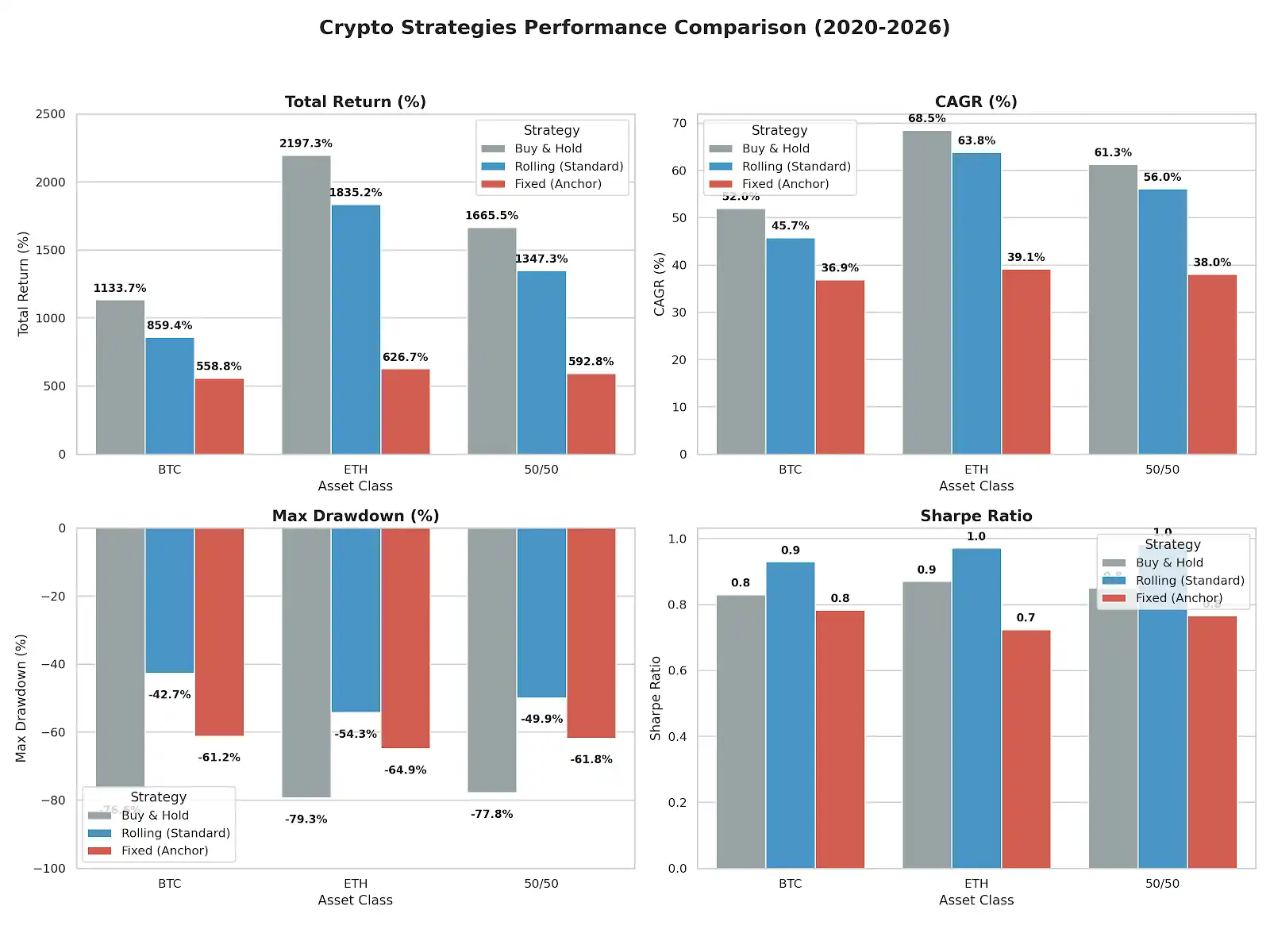
(Note: Backtest span 2020-2026, Puts priced at 30% annualized, Calls at 25% annualized, 7-day cycles)

Investment Strategy Total Return Annualized (CAGR) Max Drawdown Sharpe Ratio
BTC HODL (Buy & Hold) +1133.73% 51.95% 0.83
BTC Standard (Rolling) +859.43% 45.72% -42.74% 0.929
BTC Break-even (Fixed) +558.81% 36.88% -61.19% 0.783
--- --- --- --- ---
ETH HODL (Buy & Hold) +2197.31% 68.52% -79.30% 0.87
ETH Standard (Rolling) +1835.21% 63.78% -54.27% 0.971
ETH Break-even (Fixed) +626.74% 39.13% -64.87% 0.724
--- --- --- --- ---
50/50 HODL Portfolio +1665.52% 61.30% -77.80% 0.85
50/50 Standard Portfolio +1347.32% 56.05% -49.90% 0.983
50/50 Break-even Portfolio +592.77% 38.03% -61.80% 0.766

Faced with this real data, we need to re-examine two core propositions in trading.
The Risk-Return Balancing Act of the Standard Dual Currency Win

Many mistakenly believed the standard strategy would severely underperform in bull markets, but the data proves that with just a 5% upside buffer (spot price * 1.05), it exhibits极强的 risk-return balancing ability over a full cycle.

In the 50/50 portfolio, its Sharpe Ratio (0.983) thoroughly crushed buy-and-hold (0.85) and drastically compressed the nearly -78% abysmal drawdown to -49.9%.

Its advantage doesn't come from predicting the market, but from the mechanism of "continuously dynamically raising the strike price."

With every price change, the standard version relentlessly adjusts its target. Rolling本质上是在牛市中不断“重置成本”,而 Fixed Anchor 却是在不断“确认错误”. The standard version sacrifices a极小部分 of potential暴利上限,换取来了平滑资金曲线的巨大战略纵深.

"Anchoring to Cost" is the Most Expensive Psychological Placebo

The most thought-provoking part of the data is the comprehensive failure of the "Break-even (Fixed Anchor)" type. It fell far short of the standard version in both return and drawdown control.

This exposes the most common weakness in human trading psychology: Anchoring Effect. If you took delivery at a high of 60k, and stubbornly hang a Call at 60k when the price drops to 30k, you not only lose the "bleeding stop" ability of option premiums during the long bear market, but also risk having your chips called away at 60k during a V-shaped market reversal, completely missing the subsequent main upward浪.

The break-even strategy seems conservative, but it's actually using time to fight the trend. And in a trend-driven market, time is often on the side of the trend. Obsessing over "not selling at a loss" is ironically the fastest way to perfectly miss out on major cycle红利.

Conclusion

Markets are full of volatility, but data doesn't lie.

In trending assets like Bitcoin and Ethereum, the real risk is not drawdown, but being limited on the upside by your own psychological anchor.

The standard Dual Currency Win tells us:

As long as you keep adjusting dynamically and rolling continuously, a selling strategy can also coexist with the trend.

And the break-even strategy reminds us:

The market won't change direction because of your cost basis.

Discipline is far more important than breaking even.

Pertanyaan Terkait

QWhat is the main finding of the 6-year backtest (2020-2026) comparing the two versions of the Wheel Strategy?

AThe backtest revealed that the standard 'Rolling Strike' version significantly outperformed the 'Fixed Anchor' version, with the performance gap being nearly double in some cases. The key difference lies not in the strategy itself, but in the human psychology of anchoring to a cost basis.

QHow does the 'Rolling Strike' (Standard) version of the Wheel Strategy manage risk and return compared to simply holding the asset (Buy & Hold)?

AThe 'Rolling Strike' version demonstrated superior risk-adjusted returns. For the 50/50 portfolio, it achieved a higher Sharpe Ratio (0.983 vs 0.85 for Buy & Hold) and significantly reduced the maximum drawdown (-49.9% vs -77.8% for Buy & Hold), while still capturing substantial upside.

QWhy did the 'Fixed Anchor' version of the strategy perform poorly in the backtest?

AThe 'Fixed Anchor' strategy performed poorly because it falls victim to the 'anchoring effect' in behavioral finance. By stubbornly selling calls at the original, higher cost basis during a bear market, it loses the ability to collect meaningful premium ('stop the bleeding') and risks having the asset called away at the break-even point, missing out on a subsequent major bull run.

QAccording to the article, what is the most significant risk when investing in trend assets like Bitcoin and Ethereum using such strategies?

AThe most significant risk is not the price drawdown itself, but the psychological limitation of one's upside potential by being anchored to a specific cost price, which can cause an investor to miss out on major market trends.

QWhat is the core lesson about discipline from the article's conclusion?

AThe core lesson is that maintaining discipline by dynamically adjusting and rolling positions (as in the standard version) is far more important than the psychological desire to simply 'break even' on a trade. The market will not change direction based on an individual's cost basis.

Bacaan Terkait

Tak Perlu Ctrl+F Lagi, Alat Makalah AI Baru Bantu Anda Menyelami Lautan Literatur

Tidak perlu lagi Ctrl+F, alat AI makalah baru membantu Anda "menyaring jarum di tumpukan jerami" literatur asli. Alat ini, bernama **Open Academic Paper Gen**, menawarkan alur kerja multi-agen untuk menghasilkan draft awal makalah akademik. Tidak hanya menghasilkan draft dengan referensi, fitur utamanya adalah **memverifikasi kutipan dengan memeriksa teks lengkap** sumber aslinya. Hal ini untuk memastikan bahwa pernyataan dalam makalah benar-benar didukung oleh konteks dari literatur yang dikutip, bukan sekadar mengonfirmasi keberadaan artikelnya. Alur kerjanya mencakup sembilan tahap: menentukan ruang lingkup penelitian, pencarian literatur, pembersihan dan penyaringan, analisis tren, pencarian sudut pandang, pembuatan kerangka, penulisan, verifikasi, dan ekspor. Setelah mengumpulkan literatur relevan (dari sumber seperti OpenAlex, arXiv), alat ini membuat tabel bukti, menganalisis tren, dan bahkan melakukan **diagnosis inovasi** untuk mengidentifikasi celah penelitian dan potensi kritik dari reviewer. Proses verifikasi kutipannya terdiri dari tiga lapis: 1) Memastikan kutipan ada dalam kumpulan literatur yang terkumpul. 2) Memverifikasi metadata (DOI, judul, penulis) dengan database seperti Crossref. 3) **Langkah kritis**: Saat teks lengkap tersedia, AI akan menemukan bagian yang relevan dan menilai apakah benar-benar mendukung pernyataan dalam draft. Jika ada nomor halaman, alat akan menandainya untuk pemeriksaan manual lebih lanjut. Dengan pendekatan ini, alat ini bertujuan mengurangi "halusinasi" AI dalam penulisan akademik dengan memberikan peneliti titik awal yang lebih dapat diperiksa dan diverifikasi. Proyek ini mendukung OpenAI dan GLM, dengan beberapa fitur verifikasi tetap memerlukan OpenAI API.

marsbit17m yang lalu

Tak Perlu Ctrl+F Lagi, Alat Makalah AI Baru Bantu Anda Menyelami Lautan Literatur

marsbit17m yang lalu

Samsung HBM, Berhasil Menyalip?

Persaingan HBM generasi berikutnya semakin meluas dari performa chip DRAM ke proses packaging canggih. Menurut laporan Damnang (7/10), Samsung Electronics dikabarkan telah mulai mengirimkan sampel HBM dengan teknologi hybrid bonding ke pelanggan. Namun, informasi ini belum dikonfirmasi resmi oleh perusahaan. Sementara itu, SK Hynix pada 18 Juni menyatakan telah mengirimkan sampel HBM4E 12-layer (48GB) ke pelanggan utama menggunakan teknologi Advanced MR-MUF yang ada, dengan perbaikan thermal resistance 17% dibandingkan HBM4. Ini menunjukkan bahwa meskipun menghadapi tantangan dalam pengembangan hybrid bonding, SK Hynix tetap maju dengan rute packaging saat ini. Hybrid bonding menjadi penting untuk HBM masa depan karena memungkinkan koneksi langsung antara struktur tembaga chip, mengurangi jarak dan meningkatkan densitas interkoneksi, serta berpotensi meningkatkan manajemen termal untuk stacking 16-layer atau lebih. Namun, proses manufakturnya sangat menantang, memerlukan kontrol presisi tinggi pada planarisasi permukaan (CMP), kebersihan, dan pengelolaan warpage chip tipis. Kesulitan utama terletak pada konsistensi dan pengulangan proses untuk mencapai yield produksi massal yang stabil. Pilihan antara metode Wafer-to-Wafer dan Die-to-Wafer juga mempengaruhi yield dan efisiensi. Jika laporan tentang sampel Samsung akurat, keuntungan mereka terletak pada progres validasi pelanggan yang lebih awal. Namun, keunggulan kompetitif sejati akan ditentukan oleh kemajuan sertifikasi pelanggan, yield produksi massal, biaya, dan kemampuan pasokan. Pada akhirnya, persaingan HBM kini menjadi perlombaan sistemik yang mencakup desain memori, teknologi bonding, manajemen termal, dan packaging canggih. Nilai hybrid bonding akan ditentukan oleh kemampuan menerjemahkan keunggulan teknis menjadi kemampuan produksi yang andal dan ekonomis. Latar belakang lain adalah peningkatan pangsa pasar HBM Samsung yang signifikan. Data Counterpoint Research menunjukkan pangsa Samsung naik dari 21% (Q1) menjadi 33% (Q2), mengurangi pangsa SK Hynix. Diperkirakan pangsa ini akan terus berkembang dengan dimulainya pengiriman HBM4.

marsbit28m yang lalu

Samsung HBM, Berhasil Menyalip?

marsbit28m yang lalu

Dari Mulai Sampai Menyerah: Mengapa Saya Tidak Lagi Melakukan Pembayaran Web3

Penulis, sebelumnya seorang pengamat Web3, mencoba terjun ke industri pembayaran Web3 selama setengah tahun. Setelah melakukan penelitian langsung di tempat seperti Yiwu, Shuibei, Putian, dan Meksiko, serta mencoba membangun MVP dan alat pembayaran, dia menyadari bahwa industri ini bukan sekadar masalah produk yang bagus. Inti dari pembayaran terletak pada hubungan perbankan, lisensi, efisiensi modal, dan pengelolaan risiko jangka panjang. Banyak bisnis yang tampak menguntungkan sebenarnya menghasilkan premi risiko, bukan premi kemampuan. Penulis melihat bahwa adopsi pembayaran Web3 di lapangan masih terfragmentasi, belum menjadi jalur utama yang standar. Tantangan terbesar adalah "saluran" yang stabil dan patuh untuk konversi mata uang fiat ke kripto. Membangun ini memerlukan akumulasi kredit, pengalaman, dan kemampuan yang mendalam, yang sulit dicapai tim startup dalam waktu singkat. Penulis menyimpulkan bahwa meskipun peluang di industri pembayaran besar, itu membutuhkan sumber daya dan kemampuan khusus yang tidak dimiliki timnya saat ini. Oleh karena itu, dia memutuskan untuk berhenti membangun produk pembayaran Web3. Namun, dia tetap optimis tentang masa depan industri ini, melihatnya sebagai peningkatan infrastruktur backend jangka panjang. Dia beralih fokus ke area lain dalam ekosistem, seperti memahami dan mengelola aset di rantai blok, memberikan kejelasan tentang risiko dan peluang bagi pengguna ketika lebih banyak modal mengalir di ruang Web3.

marsbit1j yang lalu

Dari Mulai Sampai Menyerah: Mengapa Saya Tidak Lagi Melakukan Pembayaran Web3

marsbit1j yang lalu

Trading

Spot
活动图片