Anthropic Refuses Access to China's Think Tank for Most Powerful AI Model Mythos, Intensifying US-China AI Competition

marsbitDipublikasikan tanggal 2026-05-13Terakhir diperbarui pada 2026-05-13

Abstrak

Anthropic rejects Chinese think tank request for access to its most advanced AI model, Claude Mythos, escalating US-China AI competition. The request was made informally at a Carnegie Endowment meeting in Singapore, prompting concern within the U.S. National Security Council. Mythos, released in April 2026 under the "Project Glasswing" initiative, is described as "digital weapon-grade" technology for its unprecedented ability to discover zero-day vulnerabilities. Access is limited to about 40 US and UK entities in cybersecurity, finance, and tech, with China explicitly excluded as an "adversarial nation." While the official Chinese response has been muted, the incident highlights China's exclusion from cutting-edge AI defense tools despite its critical infrastructure running on software Mythos can analyze. The Chinese cybersecurity market anticipates massive growth and domestic model development, but a significant capability gap remains. The event coincides with internal Trump administration debates on pre-release AI model security assessments and an upcoming presidential visit to China, where AI dialogue is expected. Analysts caution that past US-China AI safety talks have seen China more focused on information gathering than substantive collaboration.

Author: Claude, Deep Tide TechFlow

Deep Tide Intro: According to a May 12 report by *The New York Times*, at a closed-door meeting organized by the Carnegie Endowment for International Peace in Singapore last month, a representative from a Chinese think tank requested that Anthropic grant access to the Claude Mythos model. The request was refused on the spot.

The incident subsequently reached the White House, triggering high alert within the U.S. National Security Council.

Mythos is the most powerful AI model released by Anthropic in April this year. Its offensive and defensive capabilities in the cybersecurity field are seen as "digital weapon-grade" technology. It is currently accessible to only about 40 U.S. and U.K. institutions. This event occurred as the Trump administration is brewing an executive order on AI regulation. He will also lead a business delegation to China this week to discuss AI-related issues.
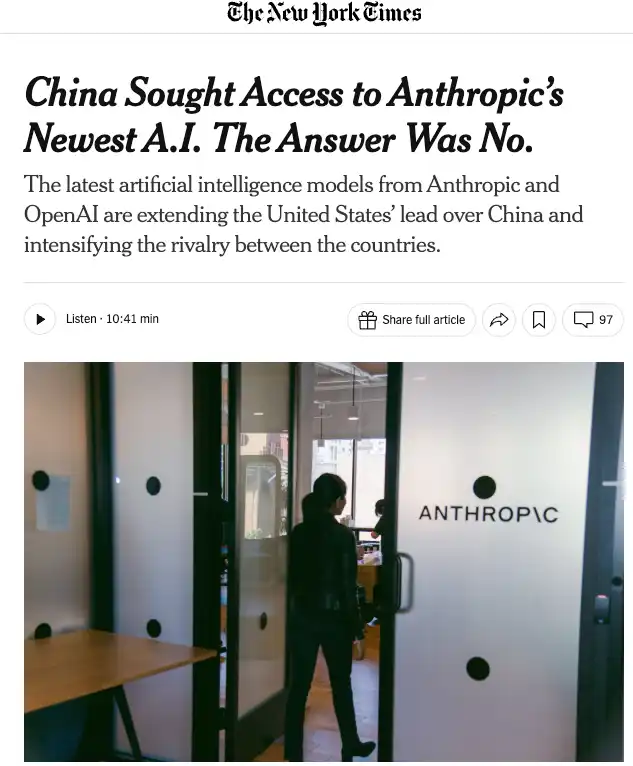
A closed-door conversation in Singapore is becoming the latest flashpoint in the US-China AI competition.

According to *The New York Times* on May 12, at a non-public meeting organized by the Carnegie Endowment for International Peace in Singapore last month, a Chinese think tank representative approached Anthropic officials during a break and made a request: hoping the company would relax its policy to allow Chinese access to its newest and most powerful AI model, Claude Mythos.

Anthropic refused on the spot.

This was not a formal diplomatic request from the Chinese government. However, according to reports from multiple media outlets, the incident triggered high alert from officials in the Trump administration's National Security Council (NSC) upon reaching Washington, seen as another signal of China's continued pressure in the AI field.

Mythos: A 'Digital Weapon' with Capabilities Far Surpassing Predecessors, Restrictively Released

To understand the weight of this event, one must look at Mythos itself.

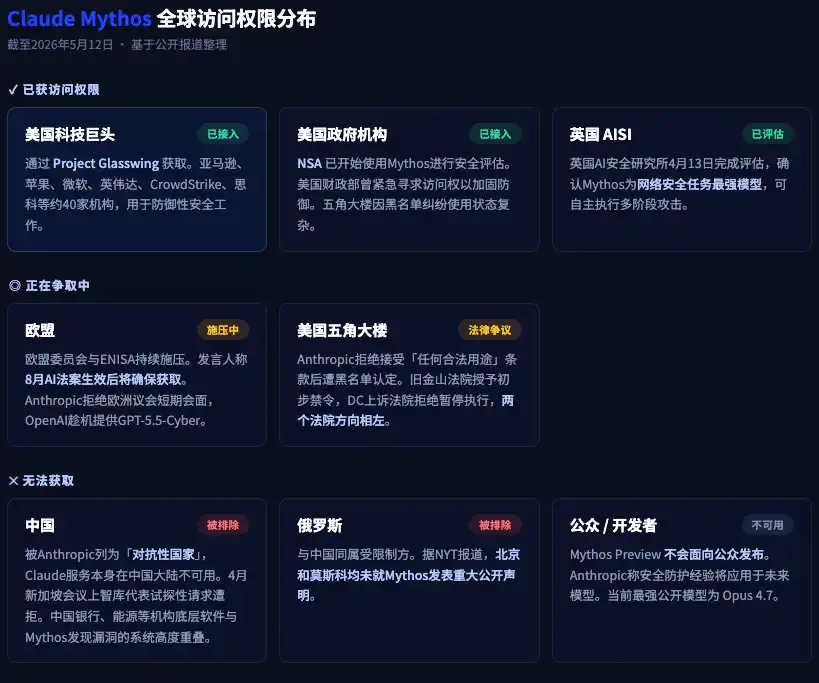
Claude Mythos Preview was officially released on April 7, 2026, but not to the public. Anthropic limited its access within a framework called the "Project Glasswing" cybersecurity defense initiative, granting access to only about 40 institutions. Partners include Amazon, Apple, Microsoft, CrowdStrike, Cisco, Nvidia, JPMorgan Chase, and the Linux Foundation.

According to Anthropic's official blog and a TechCrunch report on April 7, during internal testing, Mythos autonomously discovered thousands of zero-day vulnerabilities (i.e., security flaws previously unknown to developers), covering all major operating systems and mainstream browsers. Some vulnerabilities had existed for up to 27 years. In cybersecurity evaluations like CyberGym, Mythos's performance significantly surpassed the previous-generation model Claude Opus 4.6. Its validation score on SWE-bench reached 93.9%, compared to Opus 4.6's 80.8%.

China Excluded, Labeled an 'Adversarial Nation'

Anthropic lists China as an "adversarial nation." Its services are generally unavailable in mainland China, and the restricted release of Mythos explicitly excludes Chinese institutions.

According to a three-part series in *South China Morning Post* from late April to early May, China's reaction to the Mythos incident presents a complex picture. The official level has been relatively restrained, with no major public statements or strong responses. Some within China's AI community even questioned whether Anthropic was using security risks as a marketing gimmick to restrict model access to U.S. companies.
However, reactions within the cybersecurity industry have been starkly different. After the release of Mythos, stock prices of Chinese cybersecurity listed companies like Qi An Xin Group, Sangfor Technologies, and 360 Security Technology rose for several consecutive days, as markets anticipated accelerated demand for AI-driven cybersecurity.

IDC China Senior Research Manager Austin Zhao, in an interview with *SCMP*, stated that a Chinese model at the Mythos level "will definitely appear," but currently, the overall capabilities of domestic cybersecurity models are "still far from Mythos." However, the capabilities of Chinese models are also improving rapidly, a trend deemed irreversible. IDC predicts the scale of China's AI cybersecurity industry will grow from 1.58 billion yuan in 2025 to 59.35 billion yuan (approx. $8.7 billion) in 2030, an increase of over 37 times.

The practical dilemma is that the underlying software running in many Chinese banks, energy companies, and government agencies overlaps heavily with the systems where Mythos discovered vulnerabilities. But currently, China has no seat at this defense-upgraded table.

White House Alert and Policy Game: Executive Order Brewing, Trump Visiting China This Week

The alert triggered by the Singapore closed-door meeting adds to a series of larger policy games.

According to a May 11 report by *The Washington Post*, sharp disagreements have emerged within the Trump administration regarding AI regulation. On one hand, national security officials (including the NSA and the Office of the Director of National Intelligence) are pushing for security assessments of AI models by intelligence agencies before public release. On the other hand, the Commerce Department system prefers to keep the assessment authority within its own jurisdiction. White House National Economic Council Director Kevin Hassett revealed in a Fox Business interview last week that the government is studying the issuance of an executive order to provide a clear roadmap for the safety assessment process of AI models, similar to the FDA's pre-market review mechanism for drugs.

Simultaneously, Trump is scheduled to visit China this week, with AI-related issues expected to be on the agenda.

According to an Axios report on May 12, U.S. officials expressed hope to "use the leaders' meeting to open a dialogue, to see if a communication channel for AI affairs should be established." However, Melanie Hart, Senior Director of the Global China Hub at the Atlantic Council, cautioned that during the Biden administration, China mainly "collected U.S. information, rather than seriously discussing AI safeguards" in AI safety dialogues, and those attending the talks were often Foreign Ministry officials lacking AI technical expertise.
Pertanyaan Terkait

QWhat is Claude Mythos and why is it considered a significant model by Anthropic?

AClaude Mythos is Anthropic's latest and most powerful AI model, released in April 2026. It is considered significant due to its exceptional capabilities in the cybersecurity field, where it has demonstrated the ability to autonomously discover thousands of previously unknown zero-day vulnerabilities across major operating systems and browsers. Its performance in cybersecurity benchmarks far surpasses previous models like Claude Opus 4.6. Because of this advanced defensive (and potentially offensive) capability, it is sometimes referred to as 'digital weapon-grade' technology.

QWhat was the specific request made by the Chinese think tank representative at the Singapore meeting, and what was the response?

AAt a closed-door meeting organized by the Carnegie Endowment for International Peace in Singapore, a representative from a Chinese think tank asked Anthropic officials to grant Chinese access to its Claude Mythos AI model. Anthropic officials rejected the request on the spot.

QHow did the US government react to the news of the request and its rejection?

AThe news of the request and its rejection was relayed to Washington, where it triggered a high level of alert within the US National Security Council (NSC) under the Trump administration. US officials viewed the incident as another signal of China's continued pressure in the AI domain.

QWhat is Project Glasswing and which entities have access to Mythos?

AProject Glasswing is a cybersecurity defense initiative framework within which Anthropic has released the Claude Mythos Preview. Access to the model is highly restricted, granted only to approximately 40 US and UK-based institutions. These partners include major technology and financial companies such as Amazon, Apple, Microsoft, CrowdStrike, Cisco, Nvidia, JPMorgan Chase, and the Linux Foundation.

QWhat is the broader context of US-China AI competition mentioned in the article, particularly regarding upcoming diplomatic and policy events?

AThe incident occurs against a backdrop of escalating US-China AI competition and policy formulation. Domestically, the Trump administration is reportedly drafting an executive order to establish an AI regulatory framework, including potential pre-release security reviews akin to FDA drug approvals. Internationally, President Trump is scheduled to visit China this week, where AI-related issues are expected to be on the agenda. US officials hope to establish communication channels on AI matters, though past experiences suggest such dialogues have been challenging.

Bacaan Terkait

"Gergaji Musim Panas" Berlanjut: Breakout $67.000 Akan Menjadi Awal Kenaikan Bitcoin

Harga Bitcoin terus terkonsolidasi dalam kisaran $58.000–$67.000 sejak awal Juni, dengan harga terkini di sekitar $62.217 pada 1 Agustus. Para analis pasar mempertimbangkan beberapa skenario kunci. Secara teknis, pergerakan di atas $66.000 dianggap penting untuk mengubah momentum. Beberapa trader seperti Crypto Candy memprediksi kemungkinan penurunan menuju $60.000 jika level $66.000 tidak tertembus. Trader lain, Jelle, menggambarkan situasi ini sebagai "gergaji musim panas" yang berkepanjangan dan mempertahankan strategi rata-rata biaya dengan pembelian berkala. Di sisi lain, skenario breakout ke atas tetap ada. Daan Crypto Trades menekankan bahwa keberhasilan menembus $67.000 sangat penting untuk menghindari fase konsolidasi yang berlarut-larut. Roman bahkan memperkirakan bahwa breakout dengan volume yang kuat dapat mendorong harga dengan cepat ke zona $70.000–$80.000. Dari perspektif jangka panjang, analis Gert van Lagen melihat fase ini sebagai periode akumulasi, dengan Bitcoin menguji pola grafik besar "cangkir dengan pegangan". Dia mencatat bahwa pemegang jangka panjang masih enggan menjual, yang ditunjukkan oleh metrik NUPL mereka yang masih jauh dari zona kapitulasi. Kesimpulannya, pasar Bitcoin saat ini berada dalam fase akumulasi yang menentukan. Level $60.000 dan $67.000 menjadi kunci, dan breakout dari level mana pun kemungkinan akan menentukan arah tren berikutnya. Skenario AI dalam artikel juga mempertanyakan apakah konsolidasi saat ini dapat membentuk fondasi yang lebih kuat, atau apakah setiap ujian di level $67.000 akan terus menghadapi hambatan psikologis yang sama dari pemegang aset jangka pendek.

cryptonews.ru22m yang lalu

"Gergaji Musim Panas" Berlanjut: Breakout $67.000 Akan Menjadi Awal Kenaikan Bitcoin

cryptonews.ru22m yang lalu

Perhatian Wajib Pekan Depan|Undang-Undang CLARITY Diperkirakan Akan Masuk ke Pemungutan Suara Senat; SpaceX dan Circle Umumkan Laporan Keuangan (3-9 Agustus)

**Ringkasan Acara Penting Pekan Depan (3-9 Agustus)** Pekan depan diwarnai sejumlah pengumuman keuangan penting dan perkembangan regulasi kripto di AS. **Laporan Keuangan & Acara Perusahaan:** * **SpaceX** akan merilis laporan keuangan Q2 2026 pada 4 Agustus, diikuti gelombang pencairan saham internal pertama (hingga 12%) pada 6 Agustus. * **Circle** (penerbit USDC) dan **Hut 8** (penambang Bitcoin) masing-masing akan mengumumkan laporan kuartalan pada 5 Agustus dan 4 Agustus. * **American Bitcoin (ABTC)**, perusahaan tambang kripto yang dikaitkan dengan keluarga Trump, merilis laporan Q2 pada 3 Agustus. * Perusahaan robotika **宇树科技 (Unitree Robotics)** akan melakukan penawaran saham perdana (IPO) di pasar STAR China, dengan hari penentuan harga awal pada 5 Agustus. **Regulasi Kripto AS:** * **CLARITY Act**, undang-undang kerangka kerja federal untuk aset kripto, berpeluang dilakukan pemungutan suara penuh di Senat AS minggu ini. Para negosiator harus merampungkan aturan tentang konflik kepentingan sebelum masa reses 7 Agustus. RUU ini memerlukan 60 suara untuk disetujui. **Pengumuman Data & Teknologi:** * **Laporan Non-Farm AS** untuk Juli akan dirilis pada 7 Agustus, menjadi fokus pasar. * **Grok AI** versi 4.6 (dengan 1,5 triliun parameter) diperkirakan diluncurkan sekitar 7 Agustus, diikuti versi 4.7 yang lebih kuat beberapa minggu setelahnya. * **XRP Ledger** versi 3.3.0 dengan lima fitur baru, termasuk transaksi batch, dijadwalkan rilis minggu depan. **Penutupan & Perubahan Layanan:** * Beberapa layanan kripto akan berhenti beroperasi: **Zapper** (pelacak portofolio DeFi) dan **Ctrl Wallet** pada 3 Agustus, serta **LayerZero** akan menghentikan relayernya untuk v1 pada tanggal yang sama. Bursa Korea **Upbit** akan menghapus perdagangan pasangan **AQT** dan **AERGO** pada 3 Agustus. **Acara Lainnya:** * **BIP-110**, sebuah proposal peningkatan jaringan Bitcoin, akan memulai fase pengiriman sinyal wajib sekitar 8 Agustus.

marsbit1j yang lalu

Perhatian Wajib Pekan Depan|Undang-Undang CLARITY Diperkirakan Akan Masuk ke Pemungutan Suara Senat; SpaceX dan Circle Umumkan Laporan Keuangan (3-9 Agustus)

marsbit1j yang lalu

Saham Jatuh Lebih Parah daripada Kripto, Ke Mana Uangnya Pergi?

Penulis: Cathy,白话区块链 Pada 28 dan 29 Juli di Seoul, indeks Kospi memicu *circuit breaker* dua hari berturut-turut, suatu peristiwa yang belum pernah terjadi dalam sejarah pasar saham Korea. Saham-saham semikonduktor global, termasuk SK Hynix yang turun sekitar 23% dalam dua hari, mengalami penurunan drastis. Penarikan dana (pullback) Kospi pada Juli mencapai 40% dari titik tertinggi Juni, menjadikannya bulan terburuk yang tercatat. Produk leverage seperti ETF 2x Long SK Hynix bahkan anjlok hingga 83%, menghapus lebih dari 1 triliun HKD dalam nilai pasar. Ironisnya, Bitcoin justru naik hampir 15% dari titik terendah Juli, menunjukkan perilaku yang tidak biasa: **saham yang jatuh seperti aset kripto, sementara Bitcoin relatif stabil.** Penurunan ini bukan kepanikan pasar luas, melainkan "peledakan tertarget" terhadap perdagangan yang paling ramai (*crowded trades*), dipicu oleh laporan keuangan SK Hynix yang meski mencetak rekor laba tetapi di bawah perkiraan, serta IPO besar-besaran ChangXin Memory (CXMT) dari China. Ditambah dengan potensi likuidasi posisi *carry trade* Yen Jepang yang masif, pasar mengalami de-leverage paksa. Lalu, apakah uang yang keluar dari saham mengalir ke Bitcoin? Jawabannya tidak. Bitcoin tampak "tahan jatuh" karena sudah mengalami koreksi lebih dulu—jatuh sekitar 21% selama periode arus keluar ETF berkelanjutan pada Mei-Juni. Uang yang mencari perlindungan justru mengalir ke emas, yang harganya naik lebih dari 20% secara tahunan. Koefisien korelasi Bitcoin dengan emas mencapai -0.88, mengindikasikan bahwa institusi kini memandangnya sebagai aset yang berbeda: **emas untuk perlindungan, Bitcoin untuk potensi pertumbuhan.** Agar aliran dana besar-besaran benar-benar masuk ke Bitcoin, diperlukan tiga kondisi: tekanan likuidasi global mereda, The Fed menurunkan suku bunga tanpa memicu resesi, dan disahkannya RUU CLARITY di AS untuk memberikan kejelasan regulasi. Meski RUU tersebut tertunda di Senat, arahnya sudah jelas. **Harga saham teknologi ditentukan oleh pengeluaran modal AI dan laba perusahaan, sedangkan harga Bitcoin ditentukan oleh likuiditas global.** Ketidakselarasan ini justru menciptakan daya tarik bagi institusi yang ingin mendiversifikasi portofolio mereka. Kesimpulannya, Bitcoin saat ini bukan tempat perlindungan (*safe haven*), melainkan aset yang sudah terkoreksi lebih dulu dan sudah berada di posisi yang siap. **Dana belum datang, tetapi posisinya sudah dipersiapkan.** Ketika badai berlalu dan modal global mencari tempat baru untuk dialokasikan, Bitcoin berada di urutan terdepan dalam antrian.

marsbit1j yang lalu

Saham Jatuh Lebih Parah daripada Kripto, Ke Mana Uangnya Pergi?

marsbit1j yang lalu

Dialog dengan Ray Dalio: Saat Ini Berada dalam Gelembung AI, 1% Portofolio Investasi Adalah Bitcoin

Sumber: The Diary Of A CEO Ray Dalio, pendiri Bridgewater Associates yang meramalkan krisis keuangan 2008, memperingatkan bahwa ledakan AI saat ini menunjukkan tanda-tanda klasik gelembung ekonomi yang dapat pecah dan memicu resesi. Dalam wawancara podcast, dia menjelaskan dinamika "siklus besar" yang didorong oleh ketimpangan kekayaan, defisit pemerintah, dan perubahan geopolitik. Dalio mengidentifikasi pola di mana antusiasme berlebihan terhadap teknologi revolusioner baru, seperti AI, menyebabkan harga aset melambung dan pinjaman berlebihan. Ketika kondisi berubah (seperti kenaikan suku bunga atau kebutuhan tunai), gelembung ini dapat pecah, menyebabkan penurunan harga aset, kerugian luas, dan kontraksi ekonomi. Untuk melindungi kekayaan di masa ketidakpastian, Dalio sangat menekankan pentingnya **diversifikasi portofolio**—termasuk saham, obligasi, emas, dan real estat—daripada mengandalkan uang tunai saja. Dia mengungkapkan bahwa sekitar **1% portofolionya adalah Bitcoin**, yang diakuinya sebagai aset keras, tetapi dia lebih menyukai **emas fisik** karena sejarahnya sebagai penyimpan nilai dan aset bebas liabilitas. Mengenai dampak AI, Dalio percaya bahwa teknologi ini akan menggantikan tidak hanya tenaga fisik tetapi juga kemampuan kognitif manusia, berpotensi memperlebar kesenjangan antara pemilik modal dan pekerja. Masa depan akan menguntungkan mereka yang dapat memadukan kecerdasan manusia (seperti emosi dan intuisi) dengan kemitraan AI. Secara geopolitik, Dalio menggambarkan dunia yang memasuki fase "penurunan" dalam tatanan global, dengan Amerika Serikat menghadapi tantangan internal dan eksternal, termasuk konflik seperti di Iran yang mengungkap kelemahannya. Dia memprediksi dunia mungkin menjadi lebih terregionalisasi di masa depan. Secara keseluruhan, kunci untuk navigasi melalui periode kompleks ini adalah pemahaman akan pola sejarah, adaptasi, dan diversifikasi yang cermat.

marsbit4j yang lalu

Dialog dengan Ray Dalio: Saat Ini Berada dalam Gelembung AI, 1% Portofolio Investasi Adalah Bitcoin

marsbit4j yang lalu

Trading

Spot
活动图片





