Author: Trend Research

On Thursday, U.S. stocks rebounded across the board, led by the Nasdaq Composite's 1.57% gain to 26,541.352 points. The S&P 500 rose 0.72% to 7,730.99 points, and the Dow Jones Industrial Average increased 0.20% to 53,569.44 points. The VIX fell 1.65% to 14.90. The Philadelphia Semiconductor Index advanced 2.33% to 11,882.17 points, while the Nasdaq 100 climbed 1.43% to 29,641.56 points. The core driver behind the market's rise was a full-scale resurgence of AI trading enthusiasm. Nvidia soared nearly 9% on its first trading day post-earnings, with its market value surging by nearly $3 trillion overnight. Software stocks also rallied collectively, with Salesforce posting its best performance in six years. However, U.S. Treasury yields continued to climb, with the 10-year yield rising to 4.68%. Three Federal Reserve officials warned on the same day that interest rates might still be too accommodative, and inflationary pressures need to be addressed. Tonight's speech by Fed Chair Wash at the Jackson Hole Symposium will be key for the market in judging the interest rate path for September.
Nvidia Leads Tech Stocks Higher; AI Trading Enthusiasm Fully Reignites
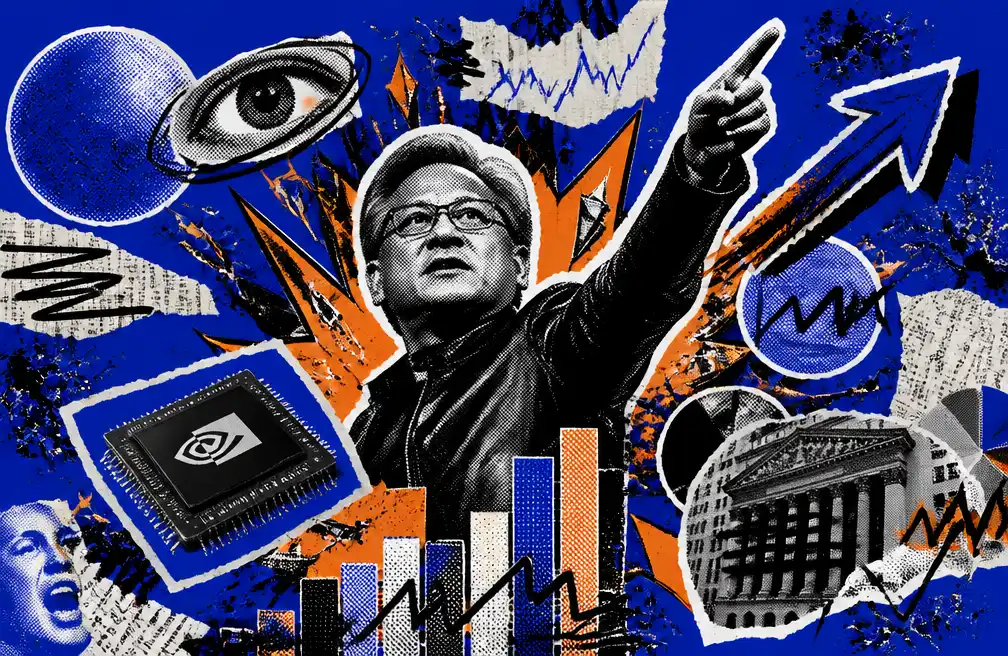
Nvidia was the core market driver on Thursday. On its first trading day after reporting Q2 revenue of $96.2 billion that exceeded expectations, providing next-quarter guidance that exceeded $100 billion for the first time, and projecting a 70% revenue growth for the next fiscal year, capital continued to pour in, boosting its market value by approximately $3 trillion in a single day. While the earnings beat itself is one thing, what truly spurred the sustained inflow of capital was the 70% revenue growth guidance for the next fiscal year, indicating that demand for AI chips has not yet reached an inflection point.
The chip index rose over 2%, outperforming the broader market. Marvell Technology reported second-quarter results, with revenue increasing 37% year-over-year to $2.74 billion and data center revenue growing 46% to $2.2 billion. Its third-quarter revenue guidance of $3.15 billion far exceeded expectations. However, with Marvell's stock already up 184% year-to-date and market expectations pushed to extremely high levels, its stock dipped about 1.7% in after-hours trading. Beating earnings without a corresponding stock price increase is a common issue the AI hardware supply chain is facing—valuations are running ahead of fundamentals.
The "Magnificent Seven" stocks all closed higher overnight. Nvidia jumped 8.93% to $228.39, Apple gained 0.40%, Microsoft rose 0.15%, Google climbed 0.35%, Amazon advanced 1.52%, Meta increased 0.74%, and Tesla rose 1.29%. The seven giants collectively gained about 1.5%, in line with the Nasdaq's direction.
Software Stocks Surge Collectively; Salesforce Posts Best Performance in Six Years
Beyond AI hardware, the software sector was another independent main theme on Thursday. Salesforce closed up nearly 23%, marking its best performance in six years. Its third-quarter guidance exceeded expectations, and the announcement of an expanded partnership with Anthropic directly dispelled market worries about a "software doomsday." Okta surged nearly 30%, and CrowdStrike jumped over 20%. With software stocks rallying collectively, capital flowed simultaneously into AI hardware, the application layer, and software services.
Hugging Face released its "Made in China" open-source robot Microduck, priced at $399. Standing about 25 centimeters tall and weighing less than 800 grams, it can walk, roller skate, and learn new skills through reinforcement learning. After opening for pre-orders, it was selling at a rate of one unit every 4 seconds at one point. Nvidia's acquisition of Hugging Face for $129 billion, valuing it at roughly 80 times its annualized revenue, aims to control a core node in the open-source ecosystem. SoftBank plans to invest $6 billion for a controlling stake in humanoid robotics company 1X, with Masayoshi Son positioning "physical AI" as SoftBank's next strategic frontier.
The AI narrative is unfolding simultaneously across three levels: chips, models, and applications, with capital being deployed in all three directions.
Geopolitical Easing and Supply Concerns Intertwine; Oil Prices Rebound but Still Down Over 6% for the Week
Oil prices took a trajectory opposite to the previous trading day. Reports that the White House refused to reinstate a preliminary ceasefire agreement with Iran reached in June pushed both crude oil and the 10-year Treasury yield to fresh intraday highs. Brent crude once again topped $90, gaining nearly 3%, and together with WTI, broke a three-day losing streak. WTI crude futures settled up 1.58% at $83.53 per barrel, while Brent crude futures closed 2.12% higher at $89.70 per barrel.
Geopolitical signals are becoming complex. Diplomatic mediation involving Iran and Oman has shown initial effectiveness, with shipping traffic through the Strait of Hormuz recovering to 75% of pre-war levels. However, the news about the White House rejecting the ceasefire agreement offset some easing expectations. The U.S. was reported to be close to a "large-scale" deal targeting equity in Venezuelan oil fields holding 90 million barrels of reserves. Brent crude is still down over 6% this week, indicating that the overall trend of geopolitical risk premium is still downward.
There is a linkage between the oil price rebound and rising Treasury yields. The oil price increase has reignited inflation concerns, further pushing up long-term interest rates. The logic of macro-economic pressure has not disappeared due to AI's strength; the two main themes are pulling against each other.
Three Fed Officials Intensify Hawkish Stance; Besant and Fed Independence Tested
Pressure on the interest rate front is accumulating simultaneously. The 10-year Treasury yield rose about 3 basis points to 4.683%, while the 2-year yield increased about 2 basis points to 4.232%.
Three Federal Reserve officials issued hawkish signals on the same day. Kansas City Fed President Schmid stated that current short-term interest rates "may be in an accommodative range," bluntly adding, "We have more work to do." Cleveland Fed President Hammack said the current interest rate level does not sufficiently restrain the economy to bring inflation down on its own, and policymakers should "act now." Boston Fed President Collins indicated that without evidence of sustained disinflation, she would support a rate hike.
"New Fed Whisperer" Nick Timiraos noted that Treasury Secretary Besant is gradually encroaching on the Fed's traditional policy domain through measures like expanding long-term Treasury repurchases and suppressing yields, raising concerns about central bank independence. The timing of Besant's operations has been criticized as "price management," and it creates additional pressure when combined with internal Fed disagreements on rate hikes. The Treasury's "market-rescue" operations and the Fed's signals for rate hikes are canceling each other out, sending conflicting guidance to the market.
Bitcoin Surpasses $80,000 Again; Ethereum Also Rises
Bitcoin climbed above $80,000 during the session, rising over 3% from the day's low. Ethereum traded around $2,515, up about 3.3%. Crypto assets continued to strengthen, driven by both AI trading enthusiasm and a weaker dollar.
Spot gold rebounded, gaining over 1% at one point. COMEX gold futures settled up 0.25% at $4,609.7 per ounce. Gold is consolidating around the $4,600 level, suppressed by rising Treasury yields but supported by geopolitical uncertainty and a softer dollar.
Tonight's Focus
Federal Reserve Chair Wash delivers the keynote speech at the Jackson Hole Symposium (10 PM Beijing Time, August 28). Coming after three Fed officials just intensified their hawkish stance and with the PCE exceeding expectations, Wash's speech will be the most crucial signal ahead of the September FOMC meeting. The market is watching how Wash responds to Treasury Secretary Besant's intervention in the long-term bond market. If Wash emphasizes the Fed's independence and hints at the need for further rate hikes to combat inflation, Treasury yields may continue to rise, putting pressure on tech stock valuations. If Wash focuses more on downside economic risks and fiscal constraints, the market might interpret this as a signal of moderation in the rate hike path.
The core signal from overnight U.S. stocks is the full-scale resurgence of AI trading enthusiasm. However, rising Treasury yields and hawkish Fed signals have not retreated. The independent upward logic of AI and the macro interest rate suppression logic are running simultaneously. Which will dominate depends on the direction of Wash's speech tonight.