Kaito Revives 'Talk-to-Earn' Economy, But Many Are Hesitant to Install the New Plugin

marsbitDipublikasikan tanggal 2026-08-21Terakhir diperbarui pada 2026-08-21

Abstrak

Kaito AI has launched a new browser extension called Kaito Pulse, aiming to integrate users' discussions on X (formerly Twitter) with their on-chain activities and social influence to build a new "attention + behavior verification" scoring system. The plugin displays users' public trading positions from platforms like Polymarket directly on the X timeline, allowing others to assess if their statements align with their actual market behavior. This move is seen as reviving "influence-to-earn" incentives. However, the launch sparked significant privacy concerns. Critics, including an analysis by "Ultra," allege the extension collects extensive data, such as device fingerprints (via GPU, hardware info), X user behavior (browsing paths, clicks), and may access sensitive data from third-party accounts (e.g., ChatGPT, trading platforms). This raised debates about trading privacy for verified influence. In response, Kaito founder Yu Hu stated the design follows data minimization principles, aiming to generate verification proofs without collecting or storing raw user data, using technologies like zkTLS. He acknowledged some permission descriptions could be misleading and promised improvements. The controversy highlights a core dilemma for social finance (SocialFi) platforms: as fake engagement and AI content grow, more user data is needed to verify genuine influence, but this risks encroaching on user privacy and trust.

Author | Asher(@Asher_ 0210)

Your X feed might soon be flooded with 'talk-to-earn' projects again.

On August 18th, Kaito AI announced the launch of its browser plugin, Kaito Pulse, further tying users' discussion behavior on X, on-chain activity, and social influence together. Simultaneously, Kaito revealed its first post-relaunch partnership with Axis Robotics, restarting the incentive model centered around content creators and community contributors.

Unlike the simple content incentives previously centered around Yaps, what Kaito aims to do this time is not just 'reward posting,' but to establish a new scoring system based on 'attention + behavior verification.'

What is Kaito Pulse?

Kaito Pulse is a browser plugin launched by Kaito, designed to add more 'on-chain identity' information to the X timeline, allowing users to not only see the views expressed by an X account but also understand the real market behavior behind it.
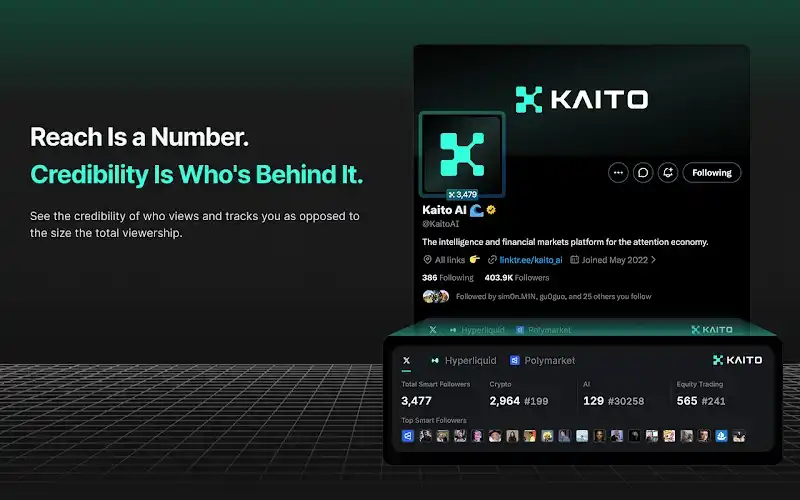
After installing the plugin, users can directly view other users' on-chain activity information within the X timeline, including public trading positions from platforms like Polymarket and Hyperliquid, thereby further assessing whether an account's views align with its actual actions.

By combining social influence with on-chain behavior, Kaito hopes to transform X from a mere information dissemination platform into a social layer that integrates 'views, identity, and trading behavior.'

This is also an evolution for Kaito from Yaps to Pulse.

Previously, Kaito primarily tracked the popularity of crypto discussions on X, creating content influence leaderboards, and incentivized user participation around KAITO. However, as many accounts began mass-producing content, the problem of measuring influence solely based on discussion volume became apparent. Therefore, Pulse further incorporates dimensions such as content influence, community interaction, and on-chain behavior verification, while introducing a new scoring system called Aura to measure user influence and verified on-chain behavior.

Previously, Kaito focused on who generated the most discussion; now, Kaito is more concerned with whose discussion is worth believing.

Plugin Requires Extensive Permissions, Sparking 'Data Collection' Controversy Post-Launch

The launch of Kaito Pulse sparked lively community discussion, with many feeling that as market conditions recover, a new wave of 'talk-to-earn' economy is imminent. However, Kaito Pulse quickly ignited a debate within the community regarding privacy permissions.

Kaito Pulse Plugin Accused of Multiple Deep Data Collection Practices

Ultra stated in an X post that by analyzing the Pulse plugin code, it was found that it may involve multiple data collection behaviors, including device fingerprinting, X platform behavior tracking, and third-party account verification.

Among these, the most concerning is the device identification issue. Ultra stated that Kaito Pulse might generate a device fingerprint using information such as GPU rendering results, hardware models, and hardware test audio, linking this information to X accounts, potentially compromising anonymity for multi-account users and community matrix accounts.

Beyond device information, Ultra also questioned the scope of user X behavior data collection by Kaito Pulse. The plugin may record certain user behaviors on the X platform, including browsing paths, content dwell time, click behavior, and follow status, and use periodic requests to determine if a user is active.

Furthermore, third-party account verification is another focal point of controversy. Ultra pointed out that Pulse involves verification processes for ChatGPT, Claude, and multiple trading platform accounts, suggesting these processes might access sensitive data such as user subscription status, usage quotas, and trading account information.

Community Divided: Verifying Authenticity or Sacrificing Privacy?

In the Yaps era, Kaito primarily relied on discussion popularity on X to measure influence. However, as mass content production by numerous accounts became prevalent, the community gradually began questioning: does high popularity equal real influence?

By incorporating more dimensions like on-chain behavior and external account verification, Kaito Pulse aims to reduce the room for gaining rankings solely through posting and interactions, making the influence score closer to a user's real contribution.

But more verification mechanisms also mean users need to grant more data permissions. Consequently, the community has formed two different views on Kaito Pulse:

  • Supporters believe that the biggest problem with InfoFi is farming and fake influence, and only by adding identity and behavior verification can a more credible incentive system be built;
  • Skeptics argue that platforms should not infinitely expand data collection scope just to improve scoring accuracy, and a new balance needs to be found between user privacy and incentive rewards.

Official Response to Privacy Controversy: Kaito Pulse Does Not Collect User Raw Data

Facing community skepticism, Kaito founder Yu Hu later responded.

Yu Hu stated that Kaito Pulse's design principle is data minimization. The product goal is not to collect user data, but, under active user authorization, to prove certain identities or behaviors through verification mechanisms.

Addressing community concerns about account information, Kaito Pulse does not obtain complete account content from users, nor does it store user raw data. The related processes are primarily used to generate verification results; the platform receives proof information, not the underlying user data.

Regarding the controversy sparked by external account verification, Kaito Pulse uses verification technologies, including zkTLS, hoping to allow users to prove they possess certain off-chain identities or behavior records without exposing the original data.

Simultaneously, Yu Hu acknowledged that the presentation scope of certain permissions might be prone to misunderstanding, and future versions will further optimize permission descriptions and user prompts.

The Next Step for the 'Talk-to-Earn' Economy: Verify Influence, or Surrender Privacy?

The discussion sparked by Kaito Pulse is essentially an unavoidable data dilemma in the InfoFi sector.

In the past, platforms judged an account's value primarily based on follower count, engagement data, and content popularity. However, as AI-generated content, batch accounts, and matrix operations become increasingly common, mere 'discussion volume' has become less and less representative of real influence.

Therefore, Kaito attempts to introduce more verification dimensions, and controversy follows—when a platform wants to further prove 'who you are' and 'whether your views are credible,' users need to surrender more and more information.

For users, installing the plugin to participate in the next wave of the 'talk-to-earn' economy also means they need to reconsider: for the sake of rankings, points, and potential rewards, how much data are they actually willing to open up? Platforms need more data to distinguish real influence from fake hype; but users also need assurance that this data is truly used only for verification and does not become a new digital profile.

Kaito Pulse wants to verify user influence, but as it masters more and more data on devices, behaviors, and accounts, Kaito itself becomes the subject of scrutiny.


Kripto yang Sedang Tren

Pertanyaan Terkait

QWhat is Kaito Pulse and what does it aim to achieve?

AKaito Pulse is a browser plugin launched by Kaito AI. It aims to enhance the X (Twitter) timeline by displaying users' on-chain activity information, such as public trading positions from platforms like Polymarket and Hyperliquid. The goal is to bind users' discussion behavior, on-chain activity, and social influence to help others assess if an account's opinions align with their actual actions, thereby transforming X into a social layer that integrates viewpoints, identity, and trading behavior.

QWhat were the main privacy concerns raised by the community regarding the Kaito Pulse plugin?

AThe community raised several privacy concerns, including potential device fingerprinting (collecting GPU rendering results, hardware models, and test audio), tracking user behavior on X (browsing paths, content dwell time, clicks, follow status), and accessing sensitive data from third-party account verification processes (like ChatGPT, Claude, and trading platforms). Critics feared this compromised user anonymity and privacy.

QHow did Kaito's founder, Yu Hu, respond to the privacy controversy?

AYu Hu responded that Kaito Pulse operates on a principle of data minimization and does not aim to collect user data. He stated that the plugin verifies identities or behaviors only with active user authorization, and it does not access or store users' complete account content or raw underlying data. He acknowledged that some permission descriptions could be misleading and promised optimizations in future versions.

QWhat is the core dilemma highlighted by the article regarding platforms like Kaito in the InfoFi (Information Finance) space?

AThe core dilemma is balancing the need for data verification against user privacy. Platforms need more data (like on-chain behavior and account verification) to distinguish real influence from fake hype generated by AI or bot accounts. However, requiring users to provide more personal data raises significant privacy concerns. Users must decide how much data they are willing to share for potential rewards and rankings.

QHow did Kaito's approach to measuring user influence change from its Yaps era to the Pulse era?

ADuring the Yaps era, Kaito primarily measured user influence based on the volume of crypto-related discussions on X. The shift to the Pulse era involves moving beyond simple discussion metrics. Kaito Pulse introduces a more comprehensive scoring system called Aura, which evaluates content influence, community interaction, and verified on-chain behavior. The focus has shifted from 'who creates the most discussion' to 'whose discussion is credible and backed by real actions.'

Bacaan Terkait

Dengan Peralihan ke Pengeluaran Nyata oleh Agen AI, XRP Bisa Memasuki Fase Baru

**Ringkasan:** **Judul: Dengan Transisi Agen AI ke Pengeluaran Nyata, XRP Dapat Memasuki Tahap Baru** Artikel ini membahas potensi tahap baru bagi XRP seiring dengan evolusi agen kecerdasan buatan (AI) otonom dari hanya membeli aset digital menjadi melakukan tugas komersial nyata. Chandler Fang, mantan eksekutif Ripple dan co-founder startup t54, menjelaskan ekonomi agen ini, menekankan pada adopsi XRP Ledger (XRPL). **Poin-poin Penting:** 1. **Transaksi Mesin ke Mesin Sudah Nyata:** Agen AI telah melakukan lebih dari satu juta transaksi tanpa campur tangan manusia di XRPL, membuktikan kelayakan penyelesaian antar mesin. 2. **Tiga Tahap Adopsi Komersial:** * **Tahap 1 (Digital):** Agen membeli dan menggunakan produk digital seperti layanan API, komputasi, dan model AI. Ripple's XRPL AI Starter Kit sudah mendukung pembayaran ini dengan XRP atau Ripple USD (RLUSD). * **Tahap 2 (Pengeluaran Terbatas):** Agen diberi wewenang terbatas untuk melakukan pembelian fisik atau jasa berdasarkan aturan anggaran dan persetujuan yang ditetapkan pengguna. Program Mastercard "Agent Pay for Machines" dan keterlibatan RippleX memperluas model ini. * **Tahap 3 (Integrasi Tersembunyi):** Agen terintegrasi penuh ke dalam platform seperti treasuri, logistik, dan aplikasi keuangan. Pengguna tidak perlu berinteraksi langsung dengan XRPL; agen memilih infrastruktur blockchain di latar belakang untuk efisiensi. 3. **Peran XRP dan RLUSD:** XRP dan RLUSD dianggap saling melengkapi, bukan bersaing. XRP dapat menangani pembayaran langsung, perutean, atau penyelesaian akhir, sementara RLUSD memberikan nilai stabil dalam dolar untuk pembelian tertentu. 4. **Pengukuran Adopsi yang Lebih Baik:** Volume transaksi saja tidak cukup. Metrik yang lebih berarti termasuk aktivitas berulang, pendapatan pedagang, kepatuhan terhadap aturan anggaran, pengiriman yang berhasil, dan penyelesaian sengketa yang efisien. 5. **Masa Depan yang Mulus:** Adopsi jangka panjang mungkin tidak terlihat jelas oleh pengguna akhir, mirip dengan peluncuran ChatGPT di mana infrastruktur yang dibangun bertahun-tahun tiba-tiba menjadi mainstream. Fokusnya adalah pada aktivitas ekonomi nyata yang dilakukan melalui XRPL, bukan sekadar kemampuannya digunakan. **Kesimpulan:** Masa depan XRPL terletak pada kemampuannya untuk mendukung aktivitas ekonomi yang bermakna dan otomatis oleh agen AI, dengan adopsi yang semakin tersembunyi dan terintegrasi ke dalam sistem bisnis yang ada.

cryptonews.ru3j yang lalu

Dengan Peralihan ke Pengeluaran Nyata oleh Agen AI, XRP Bisa Memasuki Fase Baru

cryptonews.ru3j yang lalu

Trading

Spot

Artikel Populer

Cara Membeli KAITO

Selamat datang di HTX.com! Kami telah membuat pembelian Kaito (KAITO) menjadi mudah dan nyaman. Ikuti panduan langkah demi langkah kami untuk memulai perjalanan kripto Anda.Langkah 1: Buat Akun HTX AndaGunakan alamat email atau nomor ponsel Anda untuk mendaftar akun gratis di HTX. Rasakan perjalanan pendaftaran yang mudah dan buka semua fitur.Dapatkan Akun SayaLangkah 2: Buka Beli Kripto, lalu Pilih Metode Pembayaran AndaKartu Kredit/Debit: Gunakan Visa atau Mastercard Anda untuk membeli Kaito (KAITO) secara instan.Saldo: Gunakan dana dari saldo akun HTX Anda untuk melakukan trading dengan lancar.Pihak Ketiga: Kami telah menambahkan metode pembayaran populer seperti Google Pay dan Apple Pay untuk meningkatkan kenyamanan.P2P: Lakukan trading langsung dengan pengguna lain di HTX.Over-the-Counter (OTC): Kami menawarkan layanan yang dibuat khusus dan kurs yang kompetitif bagi para trader.Langkah 3: Simpan Kaito (KAITO) AndaSetelah melakukan pembelian, simpan Kaito (KAITO) di akun HTX Anda. Selain itu, Anda dapat mengirimkannya ke tempat lain melalui transfer blockchain atau menggunakannya untuk memperdagangkan mata uang kripto lainnya.Langkah 4: Lakukan trading Kaito (KAITO)Lakukan trading Kaito (KAITO) dengan mudah di pasar spot HTX. Cukup akses akun Anda, pilih pasangan perdagangan, jalankan trading, lalu pantau secara real-time. Kami menawarkan pengalaman yang ramah pengguna baik untuk pemula maupun trader berpengalaman.

415 Total TayanganDipublikasikan pada 2025.02.21Diperbarui pada 2026.06.02

Cara Membeli KAITO

Diskusi

Selamat datang di Komunitas HTX. Di sini, Anda bisa terus mendapatkan informasi terbaru tentang perkembangan platform terkini dan mendapatkan akses ke wawasan pasar profesional. Pendapat pengguna mengenai harga KAITO (KAITO) disajikan di bawah ini.

活动图片