From Cold War Nuclear Wasteland to an 8-Gigawatt AI Superfactory: Huang Renxun Bets $1.5B, OpenAI Secures Exclusive 20-Year Deal

marsbitDipublikasikan tanggal 2026-08-18Terakhir diperbarui pada 2026-08-18

Abstrak

A Cold War-era uranium enrichment site in Ohio, once used for atomic bomb production, is being transformed into the world's largest AI supercomputing facility. NVIDIA, OpenAI, and SoftBank are leading this project, which plans an ultimate power capacity of 8 gigawatts—nearly two-thirds of the total power used by 82 of the world's top AI data centers today. NVIDIA's CEO Jensen Huang has committed $1.5 billion in funding and a 20-year credit guarantee for the infrastructure. OpenAI has signed a 20-year lease to fully utilize the facility's computing power. SoftBank is investing heavily in land acquisition, construction, and grid upgrades, promising to add 1 gigawatt of new power generation. Huang argues that the next major bottleneck for AI advancement is no longer chip supply, but the availability of land, power, and data center space—resources that new AI companies often lack the long-term credibility to secure. By leveraging NVIDIA's market position and credit to lock down these critical physical resources for decades, the company ensures a steady, long-term demand for its GPUs within the facility. The infrastructure, with a 20-year lifespan, will host new generations of NVIDIA hardware every few years, creating recurring revenue streams. Analysts estimate this project alone could represent a $600 billion revenue opportunity for NVIDIA from OpenAI by 2030. This move signifies a strategic shift in the AI race: competition is expanding from semiconductor technology to secur...

It's surreal.

In Ohio, USA, lies a piece of land abandoned for over half a century, once a uranium enrichment plant for atomic bombs during the Cold War. The machinery stopped long ago, the buildings rusted, and the land was unwanted.

Then, this morning, Silicon Valley exploded with major news—

NVIDIA, OpenAI, and SoftBank, three industry titans, are joining forces to transform this nuclear wasteland into the world's largest AI superfactory!
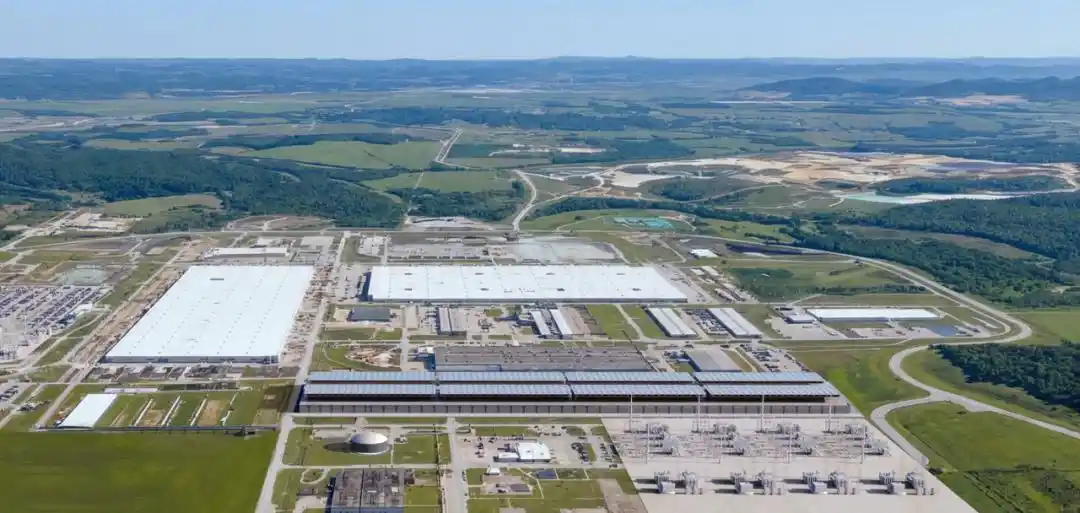
The site is roughly the size of 4.5 Central Parks in New York, large enough to hold nearly 590 supercarriers.

Seventy years ago, this land roared day and night refining uranium capable of destroying the world; today, the same land will simultaneously power 1.5 million GPUs.

Huang's View: The Next Bottleneck in the AI Era

The ultimate power plan for this superfactory is 8 gigawatts!

The required electricity would need the output of several large nuclear power plants, enough to power millions of households, approaching one-seventh of the global data center electricity consumption last year. Currently, the world's largest AI computing center is xA's Colossus 2, with a computing power of less than 1 gigawatt.

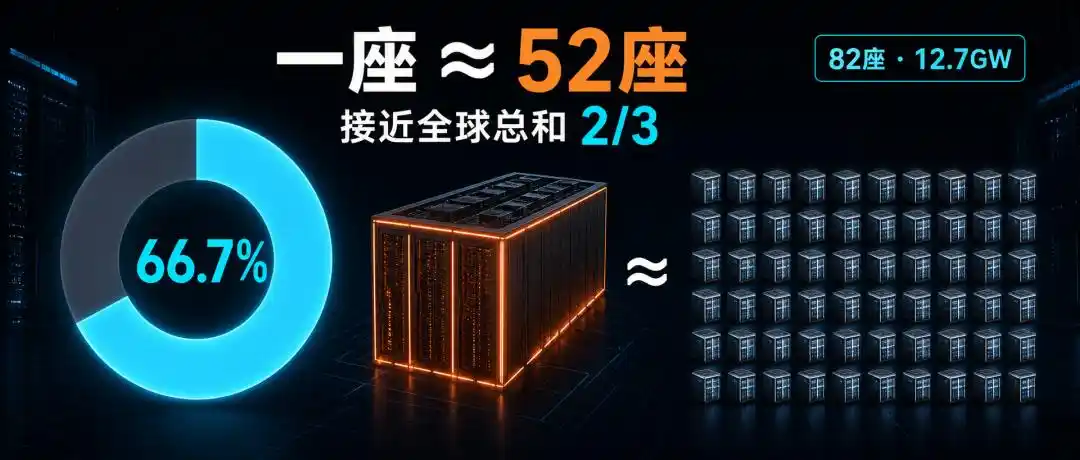
According to Epoch AI's tracking, the 82 largest AI-dedicated data centers globally have a total power infrastructure capacity of about 12.7 gigawatts.

This means that at full capacity, it will possess nearly two-thirds of the combined computing power of the current 82 top-tier AI data centers worldwide.

If measured against the average size of these 82 centers, the picture is even more staggering: you'd need to line up about 52 top-tier AI supercomputing centers to match this single one.
But 8 gigawatts is "just the beginning for AI."
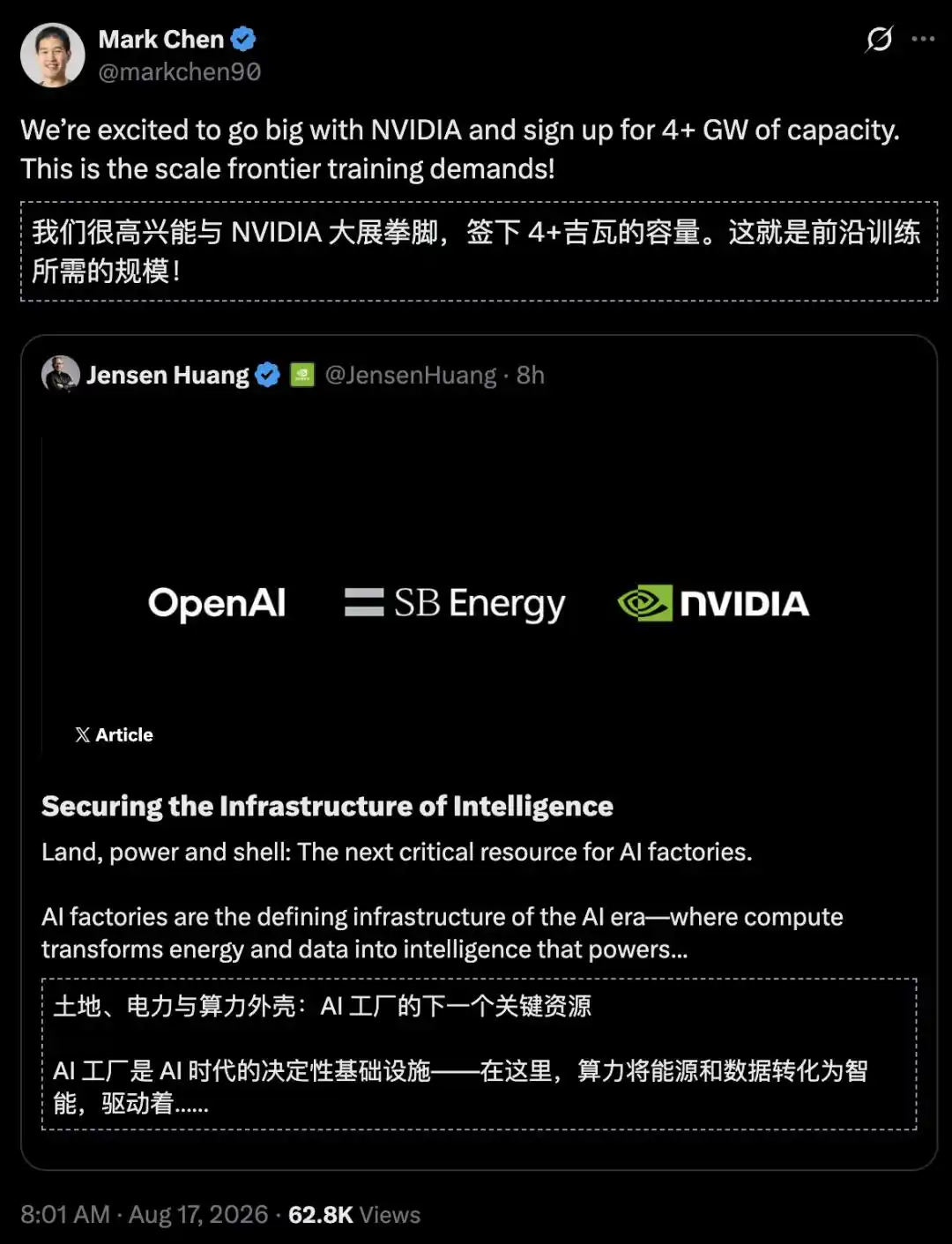
OpenAI's Chief Research Officer put it this way

To this end, Huang announced that NVIDIA will directly invest $1.5 billion into a SoftBank subsidiary and provide a 20-year credit guarantee.

OpenAI signed an unprecedentedly long 20-year lease, securing all the computing power here. Additionally, they will provide up to $84 million in Codex credits for 844,000 students in Ohio.

Masayoshi Son committed heavy investment, promising to bring in 1 gigawatt of new power generation capacity and spending $4.2 billion to upgrade the local aging power grid.

Why have Silicon Valley moguls suddenly transformed into "real estate developers" and "grid construction workers"?

Because Huang Renxun just published a post admitting a harsh truth: the next life-or-death bottleneck for AI isn't chips at all—it's whether there is land, electricity, and facilities.
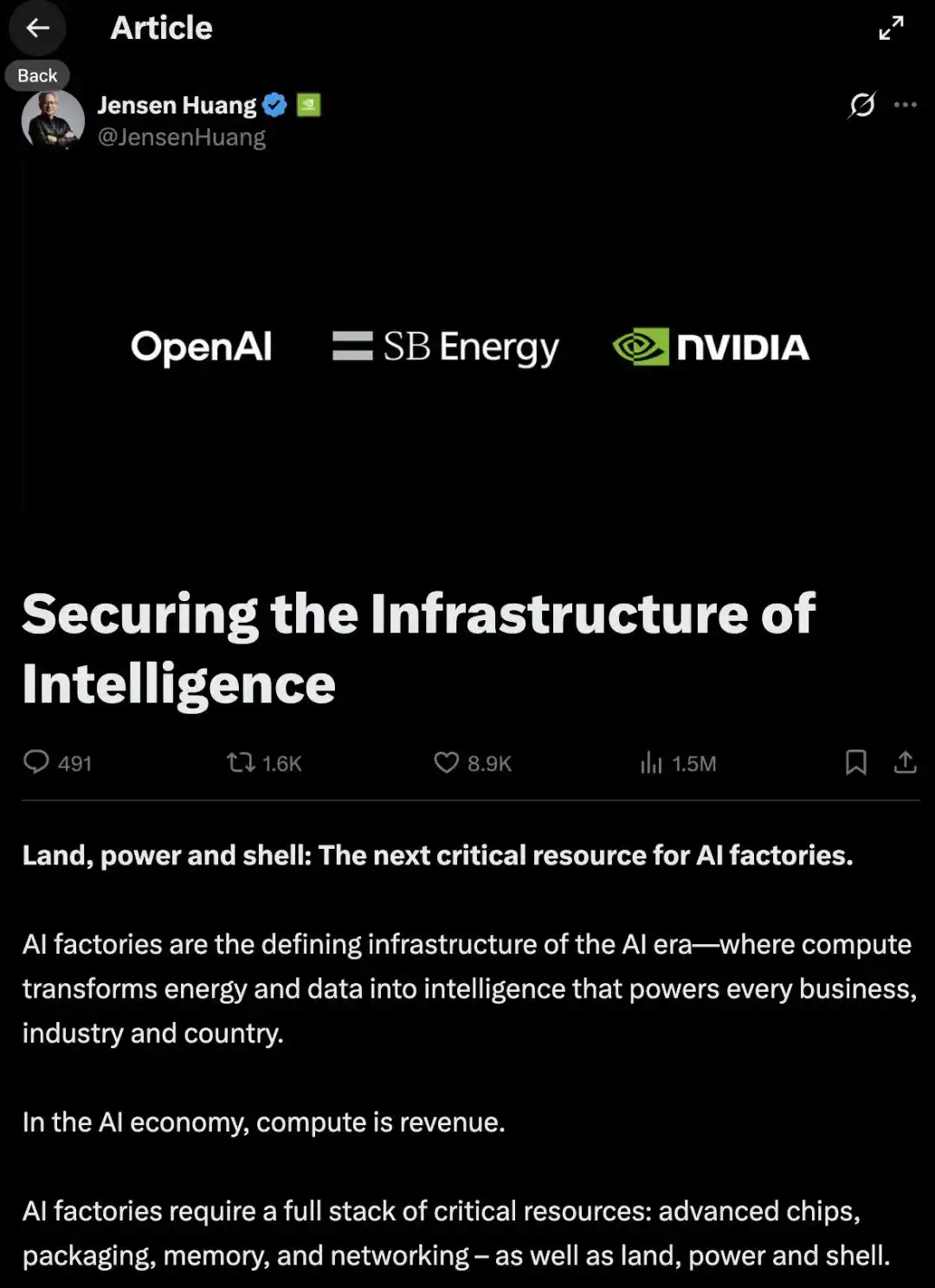
From Competing for Chips to Scrambling for Land and Power

Over the past few years, everyone was fixated on TSMC's capacity, on memory supply, thinking that as long as NVIDIA made GPUs fast enough, AI would race straight to AGI.

But Huang's words reveal the reality.

He said in his blog that a truly functional AI factory doesn't just need advanced chips; it requires three fundamental things—land, electricity, and buildings.

And this is precisely the Achilles' heel for AI newcomers like OpenAI.

Although OpenAI has the technology and ambition, when power grid companies and real estate developers look at them, they think: why should a company just a few years old be sold electricity and land for the next 20 years?

This is the most awkward situation in the AI world right now: the real bottleneck is on the construction site.

They have models with hundreds of billions of parameters, and billions in funding, but they can't support the decades-long infrastructure bills.

Who steps in to settle this?

Only the "big brother" with a $2 trillion market cap—NVIDIA.

Huang's "Master Plan": Investing $1.5B as Guarantor, What's the Goal?

The division of labor among the three parties in this deal is particularly interesting.

SoftBank (the doer): Buys land, constructs buildings, lays power lines, builds server rooms—pure manual labor.

OpenAI (the payer): Signs a 20-year lease, pays rent monthly, and fully utilizes the computing power.

NVIDIA (the guarantor): Invests $1.5 billion for equity and provides a 20-year credit guarantee for the infrastructure project.
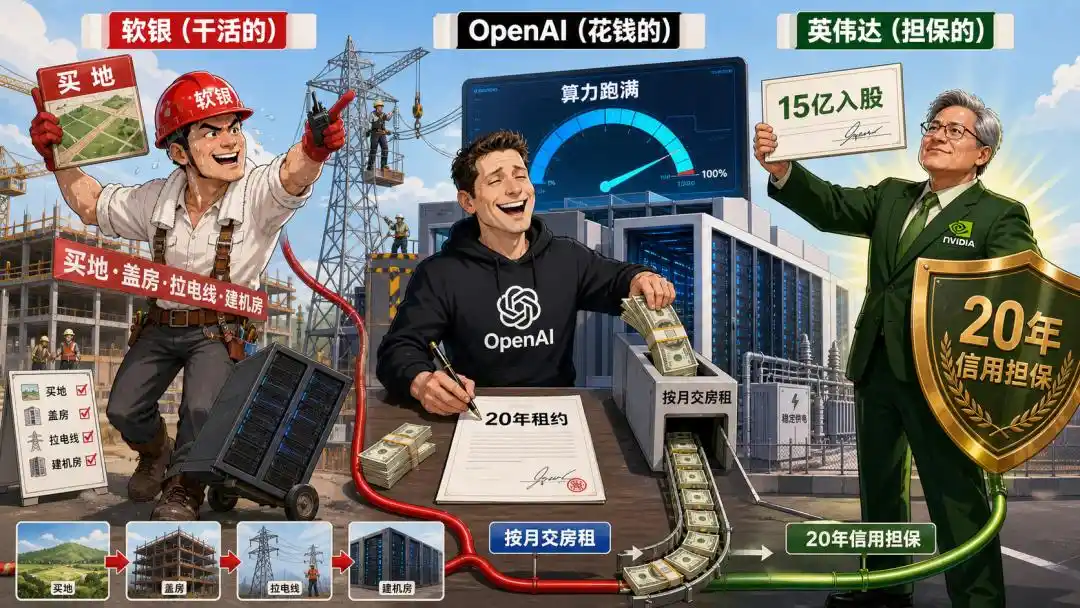
Many people's first reaction: Has Huang gone mad? Why should a GPU seller guarantee its client? Isn't this the "self-guaranteeing" Wall Street despises most?

But Huang responded with remarkable audacity in his blog: "OpenAI pays the rent itself; I'm not subsidizing a single cent."

So what's his angle?

Actually, this is a "lock-in strategy" he's deployed countless times—back when chips were scarce, he locked down TSMC's capacity and ASML's lithography machines with long-term orders and prepayments.

Now he's applying the same playbook to land and electricity.

He's betting that in the coming years, "large plots of land with electricity access" will be scarcer than "silicon wafers capable of making chips."

So he's making a preemptive move, using his $2 trillion market cap's credit to secure the world's best AI locations and power resources, with one stipulation—this facility can only use NVIDIA's chips.
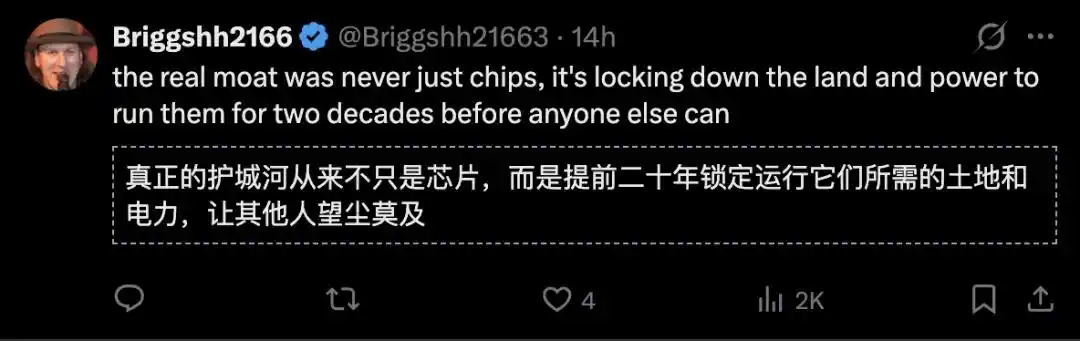
As netizens aptly put it: The real moat is never just the chips, but locking down the land and electricity needed to run them twenty years in advance, leaving others in the dust.

So, is this a bad deal?

Running the Numbers: Why This is a Sure Bet

Why is this deal guaranteed to be profitable?

Do a simple calculation, and it becomes clear.

Based on the announcement data:

The first phase targets 4.25 gigawatts.

Each generation of the system can house about 1.5 million top-tier GPUs.

Hardware sales revenue per generation is roughly between $150 billion and $200 billion.

OpenAI's existing and planned orders already account for 12 gigawatts of NVIDIA's computing capacity, with potential expansion to 16 gigawatts.

The conclusion is, by 2030, OpenAI alone could present a $600 billion revenue opportunity for NVIDIA!
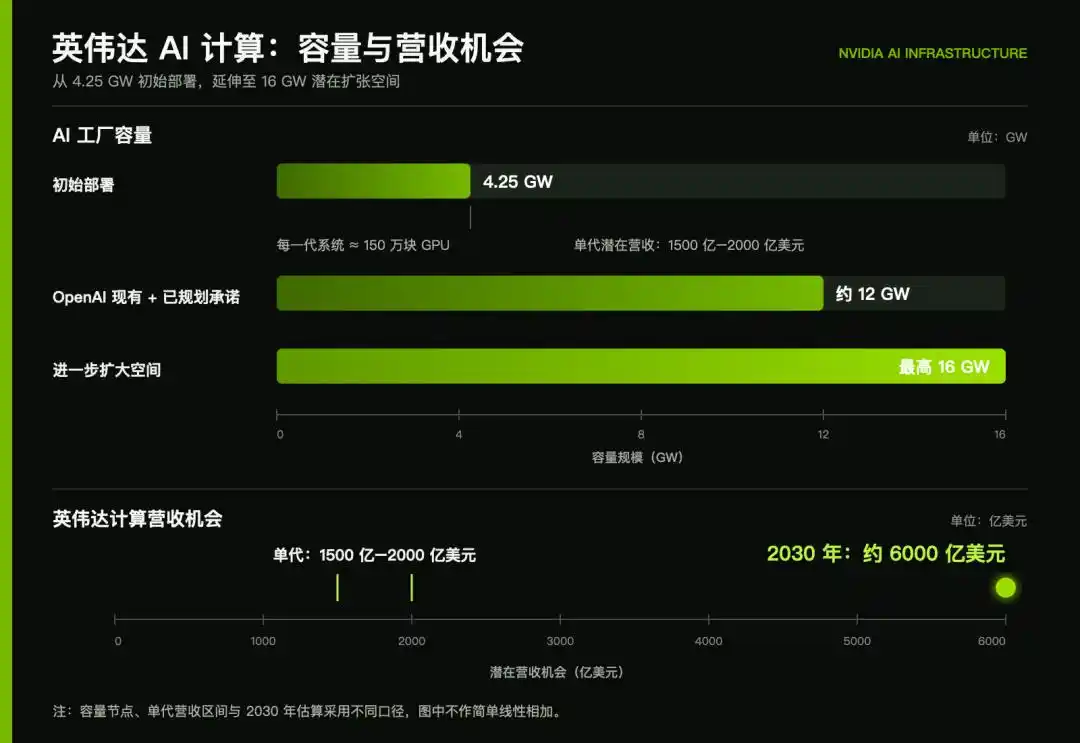
The key lies here: the buildings and power grid have a 20-year lifespan, but chips are replaced every two to three years.

Land is permanent, power lines are durable, server rooms can be upgraded repeatedly, but the NVIDIA GPUs installed inside—each generation represents tens to hundreds of billions in pure incremental revenue.

What if OpenAI can't pay the rent someday?

Huang already has an exit strategy. NVIDIA's CUDA platform is the industry standard, usable worldwide.

If OpenAI backs out, these server rooms, power lines, and even the installed GPUs can be sublet instantly to other cloud providers, large corporations, or startups. There's no worry about finding takers.

This is the true moat: You pay rent, I profit; you leave, I profit even more.

A Game with No Way Back

The entire logic is now crystal clear:

Better infrastructure → Larger models → Smarter AI → More revenue → Build even larger infrastructure

This accelerating flywheel is also a one-way street.

When the AI race expands from nanometer-scale chip fabrication to square-kilometer-scale land grabs, from wafer fabs to abandoned nuclear plants.

The path to AGI ultimately hinges on electricity and land.

And Huang Renxun has already used $1.5 billion to stake his claim on the game table for the next 20 years.

The most terrifying part isn't that he won this round, but that he has redefined the rules of the game—

To be a true AI titan, you must learn to build, wire, and secure land.

This article is from the WeChat public account "新智元", author: ASI启示录

Kripto yang Sedang Tren

Pertanyaan Terkait

QWhat is the total planned power capacity of the AI 'super factory' being built on the Cold War nuclear site in Ohio, and how does it compare to existing global AI data centers?

AThe planned ultimate power capacity of the AI 'super factory' is 8 gigawatts (GW). This is immense compared to existing AI data centers. It is stated to be close to 1/7th of the total global data center power consumption from the previous year. Specifically, when fully operational, it will possess nearly two-thirds (about 2/3) of the combined computing power of the world's 82 largest AI-specific data centers, which have a total infrastructure power of about 12.7 GW.

QWhy does Nvidia's CEO, Jensen Huang, believe the critical bottleneck for AI development has shifted?

AJensen Huang believes the critical bottleneck for AI development has shifted from semiconductor chips to the availability of three fundamental physical resources: land, electricity, and buildings (facilities). He argues that while companies like OpenAI have the technology and ambition, they lack the long-term credibility with utility companies and real estate developers to secure the decades-long commitments required for large-scale power and land, which are now the primary constraints.

QWhat are the specific roles and contributions of Nvidia, OpenAI, and SoftBank in this joint project?

ASoftBank's role is as the developer and builder: purchasing the land, constructing the buildings, installing power lines, and building the data center facilities. OpenAI's role is as the tenant and consumer: signing a 20-year lease and paying rent to use the full computing capacity of the facility. Nvidia's role is as the financial guarantor and technology provider: investing $1.5 billion into a SoftBank subsidiary, providing a 20-year credit guarantee for the infrastructure project, and ensuring the facility is equipped with its GPUs.

QWhat is Jensen Huang's strategic rationale for Nvidia's $1.5 billion investment and long-term guarantee in this infrastructure project?

AJensen Huang's strategic rationale is to 'lock in' critical and increasingly scarce resources—specifically, large plots of land with access to massive power—for the next 20 years. By using Nvidia's financial credibility to secure these resources, he ensures they are dedicated for use with Nvidia's chips. This creates a powerful moat, as future AI competitors will struggle to find equivalent power and land. Furthermore, the infrastructure has a long lifespan, while the GPUs inside will be upgraded every few years, generating recurring revenue for Nvidia.

QAccording to the article's calculations, what is the potential revenue opportunity for Nvidia from OpenAI's demand by 2030?

ABased on the article's calculations and stated data (OpenAI's current and planned orders occupying 12 GW of Nvidia's capacity, expandable to 16 GW), Nvidia's potential revenue opportunity from OpenAI alone could reach $600 billion by 2030. This projection is derived from the scale of hardware (GPUs) required to fill such massive data center capacity over multiple upgrade cycles.

Bacaan Terkait

Ketua CFTC Membuka Kartu: Langkah Selanjutnya, Pasar Kripto, Pasar Daya Komputasi, dan Pasar Prediksi

CFTC, badan pengawas derivatif komoditas AS, mengumumkan peta jalan untuk tiga bidang keuangan baru: aset kripto, pasar komputasi AI (tenaga komputasi), dan pasar prediksi. Di sektor kripto, CFTC masih memprioritaskan undang-undang struktur pasar dari Kongres (seperti CLARITY Act). Namun, jika RUU tersebut mandek, CFTC siap menggunakan wewenangnya yang ada untuk membuat kerangka regulasi sendiri, termasuk kemungkinan menunjuk pertukaran kripto sebagai "Pasar Aset Kripto" khusus yang diatur. CFTC juga akan berdiskusi langsung dengan pengembang protokol DeFi tentang cara operasi yang sesuai aturan. Untuk AI, fokus CFTC bukan pada modelnya, tetapi pada *compute* (tenaga komputasi GPU) sebagai aset komoditas baru. Mereka melihat potensi pembentukan pasar spot, forward, dan derivatif untuk tenaga komputasi, memungkinkan penemuan harga dan lindung nilai risiko. CFTC telah memulai konsultasi publik mengenai hal ini. Di pasar prediksi, CFTC beralih dari debat "legal atau tidak" ke tahap "bagaimana mengaturnya". Mereka mengusulkan perubahan aturan (Rule 40.11) untuk memperjelas kriteria kontrak yang diizinkan, merancang ulang sistem pelaporan data, dan akan memperbarui aturan inti untuk listing produk. Poin kuncinya adalah perlindungan konsumen ritel, tata kelola produk, dan desain pasar. Ketegangan muncul dalam diskusi panel tentang pasar prediksi, menyoroti perlunya aturan yang jelas untuk mencegah manipulasi. Inti dari peta jalan ini adalah keinginan CFTC untuk secara proaktif membangun kerangka peraturan yang jelas untuk inovasi keuangan baru, alih-alih menunggu hingga kontroversi mereda.

marsbit23m yang lalu

Ketua CFTC Membuka Kartu: Langkah Selanjutnya, Pasar Kripto, Pasar Daya Komputasi, dan Pasar Prediksi

marsbit23m yang lalu

Kementerian Keuangan Secara Langsung Turun Tangan Tekan Suku Bunga Jangka Panjang

Treasury AS secara langsung menekan suku bunga jangka panjang melalui operasi pembelian kembali (repo) obligasi pemerintah. Langkah ini, meski bukan YCC konvensional, mencerminkan intervensi pemerintah dalam biaya pendanaan. Pembicaraan mendatang di Jackson Hole oleh Federal Reserve (The Fed) menjadi kritis, karena perbedaan pendapat muncul antara mendukung disiplin moneter (suku bunga tinggi) versus mendorong pertumbuhan ekonomi untuk mengatasi defisit anggaran. Kekhawatiran jangka panjang adalah defisit AS yang tinggi. Solusi utama diharapkan dari pertumbuhan ekonomi, terutama melalui sektor teknologi, karena sektor tradisional dinilai tidak mampu. Intervensi Treasury saat ini mirip dengan operasi likuiditas tahun 2000-2002 atau Operation Twist, namun skala dan tujuannya berbeda. Jika The Fed bergabung, ini akan menandakan pergeseran kebijakan yang signifikan. Intinya, intervensi teknis seperti ini hanya solusi sementara. Masalah mendasar AS adalah ekonomi K-shaped, di mana sebagian populasi masih berjuang, dan ketergantungan pada narasi teknologi baru. Tanpa peningkatan produktivitas riil, kebijakan moneter hanya akan berputar-putar. Emas mungkin terdampak fluktuasi jangka pendek tergantung respons The Fed, tetapi prospek jangka panjangnya tetap kuat jika kebijakan longgar untuk stimulus pertumbuhan yang muncul. Artikel juga menyentuh tantangan struktural AS yang lebih dalam, di mana reformasi yang sulit namun diperlukan seringkali terhambat. Pendekatan "usaha minimal, hasil maksimal" seperti intervensi Treasury ini dikritik mirip dengan mentalitas mencari jalan pintas, yang mungkin tidak berkelanjutan untuk masalah mendasar negara. Titik kunci ke depan adalah apakah The Fed akan mendukung langkah Treasury ini, yang bisa menjadi katalis untuk diskusi lebih luas tentang masa depan kebijakan ekonomi AS.

marsbit29m yang lalu

Kementerian Keuangan Secara Langsung Turun Tangan Tekan Suku Bunga Jangka Panjang

marsbit29m yang lalu

Interpretasi Laporan Riset JPMorgan: Uji INT Moderna Mencapai Tujuan, Namun Pasar Sudah Harga di Muka

Laporan riset JPMorgan pada 19 Agustus menyoroti bahwa uji klinis Fase III terapi INT Moderna (kerja sama dengan Merck) untuk melanoma tahap adjuvan mencapai titik akhir primer (peningkatan signifikan dalam kelangsungan hidup bebas kekambuhan) dan titik akhir sekunder kunci (kelangsungan hidup bebas metastasis jauh). Namun, hasil ini telah sesuai ekspektasi pasar dan diperkirakan telah diperhitungkan dalam harga saham sebelumnya. JPMorgan mempertahankan peringkat "Underweight" dan target harga $40 untuk Moderna, mengindikasikan potensi penurunan 36% dari harga sekitar $63. Logika intinya adalah kesuksesan INT pada melanoma adjuvan telah dihargai penuh. Nilai Moderna selanjutnya akan bergantung pada kemampuan INT untuk meniru kesuksesan ini pada indikasi kanker yang lebih luas, seperti kanker paru-paru dan ginjal. Laporan menilai bahwa kenaikan harga saham sebelum pasar lebih mencerminkan penutupan posisi short dan sentimen perdagangan jangka pendek, bukan perubahan mendasar. Target harga $40 didasarkan pada model valuasi DCF, yang mencakup nilai produk komersial saat ini dan nilai pipeline yang disesuaikan risiko. Risiko naik mencakup data INT yang lebih baik dari perkiraan di luar melanoma, sementara risiko turun meliputi kegagalan klinis, penundaan regulasi, dan peluncuran komersial yang di bawah ekspektasi. Kesimpulan: JPMorgan mempertahankan pandangan bearish. Nilai klinis INT pada melanoma sudah jelas, tetapi sudah tercermin penuh dalam harga. Moderna perlu membuktikan bahwa platform INT efektif pada lebih banyak jenis kanker untuk mendukung valuasi saat ini.

marsbit29m yang lalu

Interpretasi Laporan Riset JPMorgan: Uji INT Moderna Mencapai Tujuan, Namun Pasar Sudah Harga di Muka

marsbit29m yang lalu

Trading

Spot

Artikel Populer

Cara Membeli WAR

Selamat datang di HTX.com! Kami telah membuat pembelian WAR (WAR) menjadi mudah dan nyaman. Ikuti panduan langkah demi langkah kami untuk memulai perjalanan kripto Anda.Langkah 1: Buat Akun HTX AndaGunakan alamat email atau nomor ponsel Anda untuk mendaftar akun gratis di HTX. Rasakan perjalanan pendaftaran yang mudah dan buka semua fitur.Dapatkan Akun SayaLangkah 2: Buka Beli Kripto, lalu Pilih Metode Pembayaran AndaKartu Kredit/Debit: Gunakan Visa atau Mastercard Anda untuk membeli WAR (WAR) secara instan.Saldo: Gunakan dana dari saldo akun HTX Anda untuk melakukan trading dengan lancar.Pihak Ketiga: Kami telah menambahkan metode pembayaran populer seperti Google Pay dan Apple Pay untuk meningkatkan kenyamanan.P2P: Lakukan trading langsung dengan pengguna lain di HTX.Over-the-Counter (OTC): Kami menawarkan layanan yang dibuat khusus dan kurs yang kompetitif bagi para trader.Langkah 3: Simpan WAR (WAR) AndaSetelah melakukan pembelian, simpan WAR (WAR) di akun HTX Anda. Selain itu, Anda dapat mengirimkannya ke tempat lain melalui transfer blockchain atau menggunakannya untuk memperdagangkan mata uang kripto lainnya.Langkah 4: Lakukan trading WAR (WAR)Lakukan trading WAR (WAR) dengan mudah di pasar spot HTX. Cukup akses akun Anda, pilih pasangan perdagangan, jalankan trading, lalu pantau secara real-time. Kami menawarkan pengalaman yang ramah pengguna baik untuk pemula maupun trader berpengalaman.

478 Total TayanganDipublikasikan pada 2024.12.11Diperbarui pada 2026.06.02

Cara Membeli WAR

Diskusi

Selamat datang di Komunitas HTX. Di sini, Anda bisa terus mendapatkan informasi terbaru tentang perkembangan platform terkini dan mendapatkan akses ke wawasan pasar profesional. Pendapat pengguna mengenai harga WAR (WAR) disajikan di bawah ini.

活动图片