Why do people like Luke still want to fork Bitcoin despite having no support? BIP-100 has already been declared a failure!

marsbitDipublikasikan tanggal 2026-08-11Terakhir diperbarui pada 2026-08-11

Abstrak

On August 8th, the Bitcoin network experienced a contentious fork triggered by BIP-110, despite the proposal having only 2.53% miner signaling support in the prior period. Led primarily by developer Luke Dashjr and based on his Bitcoin Knots implementation (not merged into Bitcoin Core), this User-Activated Soft Fork (UASF) aimed to impose strict new limits on non-financial data (like Ordinals inscriptions) within blocks to reduce long-term node costs. The fork activated at block height 961632, with BIP-110 nodes rejecting blocks without the required signaling. This created two chains: the dominant original chain continuing normally, and a low-hashrate BIP-110 chain which quickly fell behind. The core conflict is between those viewing block space as a fee market open to all data and those prioritizing Bitcoin as a monetary network, seeking to ban what they see as blockchain "spam." BIP-110's strategy relied on economic nodes (exchanges, wallets) adopting the new rules first, hoping to force miners to follow. However, this has not materialized. The BIP-110 chain now faces severe challenges: extremely slow block times potentially stretching over 1.9 years before its rules would even activate, a lack of broad economic support, and no automatic replay protection. For most users, Bitcoin's main chain operates unchanged. The immediate technical impact is limited to services running BIP-110 software, which now see a different blockchain. The event highlights ongoing ideological d...

Author:Bitcoin Orange Trader

With only 2.53% support, BIP-110 still forked Bitcoin: Can it succeed?
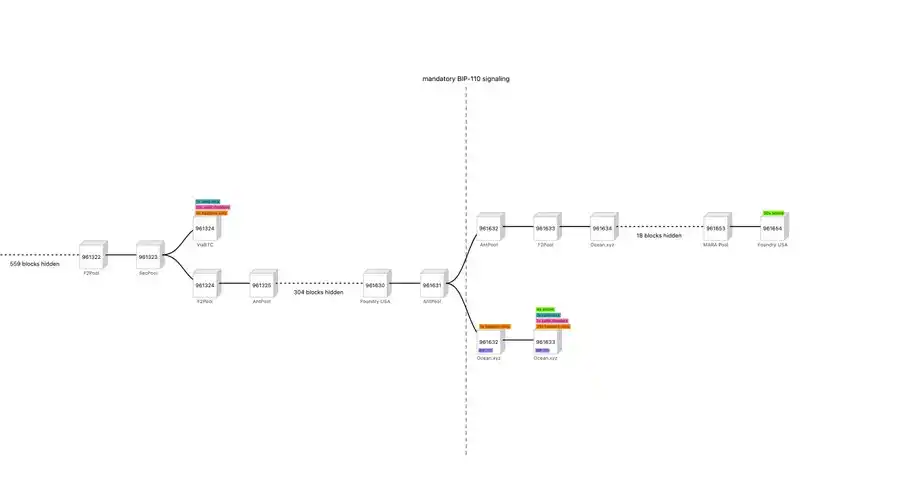
On August 8, the Bitcoin network split into two mutually incompatible chains.

What was even more unusual was that BIP-110, which drove this fork, had only received signaling support from 51 blocks in the previous 2016-block cycle, representing a mere 2.53% support rate. However, after block height 961632, nodes running BIP-110 followed the predetermined rules and began rejecting all blocks that did not signal bit 4.

The majority of miners did not support it and continued to mine blocks under the original rules. The minority of nodes and miners executing BIP-110 remained on the other chain. As of 9:00 AM Beijing Time on August 9, the main chain with higher cumulative proof-of-work had reached block 961654, while the BIP-110 execution chain was stuck at 961633, lagging by 21 blocks. In the first 23 blocks of the new cycle, not a single one signaled support for BIP-110 on the main chain.

This is not an evenly matched hash power battle. The main chain is progressing normally, while the BIP-110 chain, due to its low hash power, is significantly lagging in block production speed.

Who is driving this fork?

BIP-110 was proposed by pseudonymous developer Dathon Ohm, with Luke Dashjr participating in early drafts and technical advice. Its reference implementation is based on Bitcoin Knots maintained by Luke, and it was not merged into Bitcoin Core, nor did it gain support from a majority of miners.
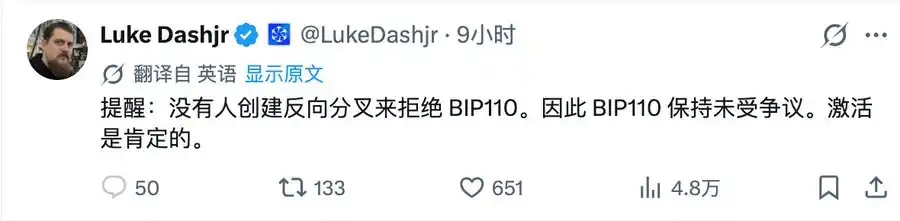
It is not part of Bitcoin Core's mainnet upgrade roadmap. The actual drivers are some Knots node operators and a minority of miners. This is a UASF attempt: even if miners do not achieve sufficient signaling support, nodes can still proactively tighten the rules for the blocks they accept, forcing the network to make a choice.

Why are these people insisting on pushing BIP-110?

The background remains the ongoing controversy over inscriptions spanning several years.

Ordinals, BRC-20, and Runes write image, text, and token data into Bitcoin blocks. Supporters of these use cases believe that block space is essentially a fee market; miners can include whatever people are willing to pay for. Supporters of BIP-110, on the other hand, believe that Bitcoin should primarily be a monetary and payment network, and that large amounts of arbitrary data increase blockchain size, imposing long-term storage, bandwidth, verification, and propagation costs on all full nodes.

Data publishers pay a fee only once, but once the data enters a block, nodes worldwide must store it permanently. The publisher and miner complete a transaction, but the subsequent costs are left to the entire network. BIP-110 aims to turn this conflict from a policy issue of "whether nodes are willing to relay, whether mining pools are willing to include" into a consensus rule.

It plans to be temporarily enforced for about one year upon activation. Most new output scripts cannot exceed 34 bytes, the OP_RETURN limit becomes 83 bytes, data pushes and some witness elements cannot exceed 256 bytes, and certain Taproot constructions that could be used to carry data are disabled. Old UTXOs are exempt, and regular payment transactions are mostly unaffected.

Opponents are concerned about more than just whether inscriptions can still be created. BIP-110 turns some transaction uses from a fee market issue into a consensus judgment of valid or invalid, which could affect Miniscript, BitVM, and future protocols using Taproot. It also cannot completely eliminate on-chain data; users can still split data and change encodings, albeit at higher costs and with more complex operations.
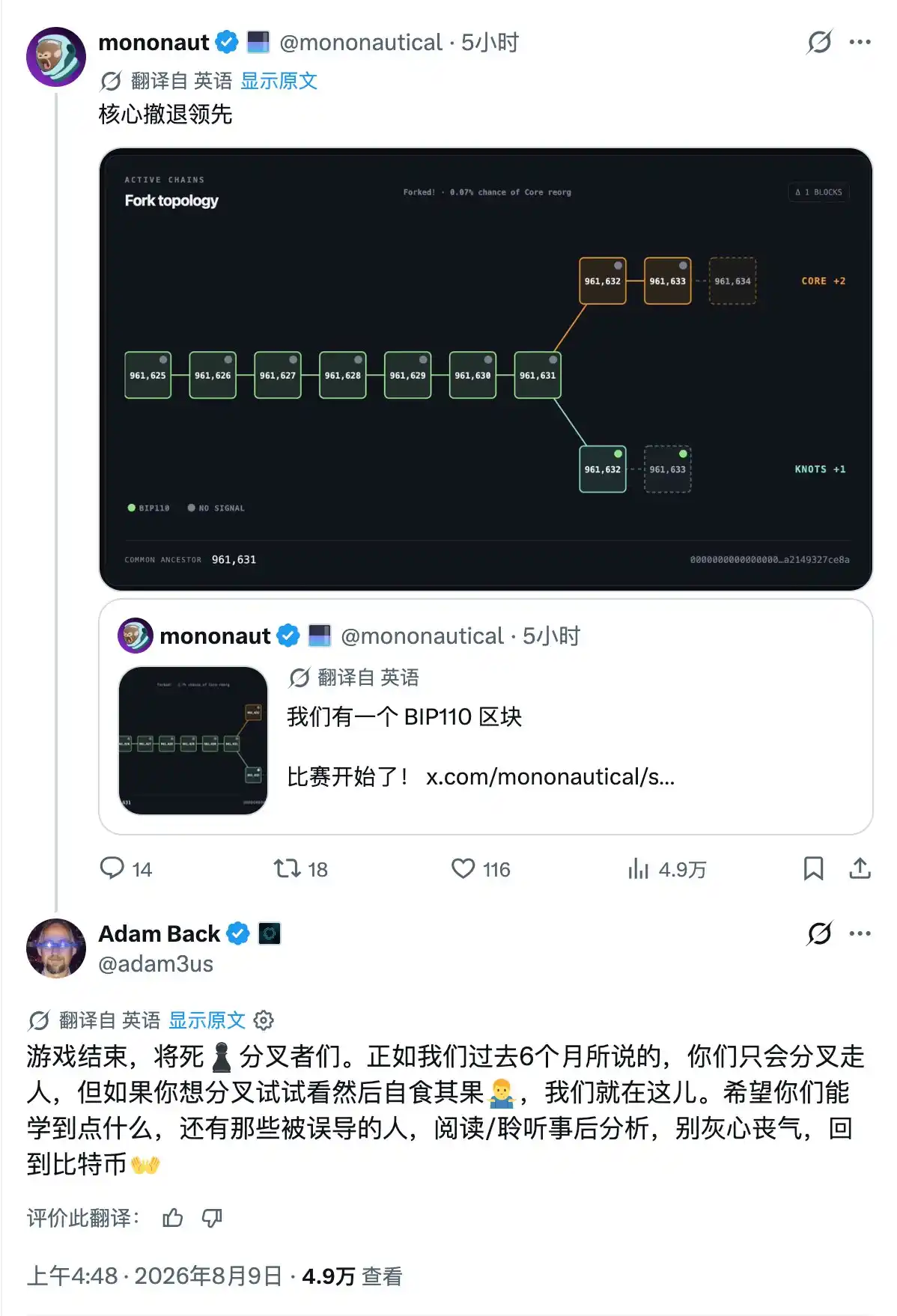
Why push so hard despite such low support?

Because BIP-110 supporters do not believe miner signaling equals a final vote. In the logic of a UASF, nodes have the right to decide what blocks are valid; if enough users, wallets, exchanges, and payment services adopt the new rules, miners will ultimately follow to avoid mining blocks that no one accepts.

BIP-110 sets the miner lock-in threshold at 55%, lower than the traditional BIP9 common 95%. The more radical part comes later: even if the threshold is not met in the long term leading up to it, the period from block 961632 to 963647 will still enter a mandatory signaling period. BIP-110 nodes will consider blocks not signaling bit 4 as invalid. Their chain will lock in after block 963648, go through another 2016-block cycle, and plan to formally enforce data restrictions at block 965664.

It bets that nodes and economic actors will take sides first, forcing hash power to follow. Current on-chain results show this bet has not paid off yet. The majority of miners continue to extend the original chain, while nodes running BIP-110 can only wait for their blocks on a low-hash-power branch.

What is currently happening is only a signaling rule fork. The data limits of 34, 83, and 256 bytes have not taken effect on the Bitcoin mainnet; the BIP-110 chain hasn't even reached the formal lock-in and enforcement stage yet.

Is success still possible?

We need to look at two separate things.

As long as there are miners willing to produce blocks, the BIP-110 chain can continue to exist and will eventually activate its rules at its own chain height. However, for it to become the Bitcoin main chain in economic terms, it requires sustained hash power and collective recognition from exchanges, wallets, custody platforms, Lightning services, and coin holders. Nodes can reject main chain blocks, but rejection alone cannot make others recognize their chain.

Time is also a significant hard barrier. When the BIP-110 chain forked, it inherited the mainnet's mining difficulty. Bitcoin adjusts difficulty only every 2016 blocks, with a maximum downward adjustment of 4x per period. Roughly estimating the execution chain's hash power using the previous 2.53% signaling rate, completing its first cycle might take about 553 days; after difficulty adjustment, reaching the formal activation would take another approximately 138 days, totaling nearly 690 days, or about 1.9 years.
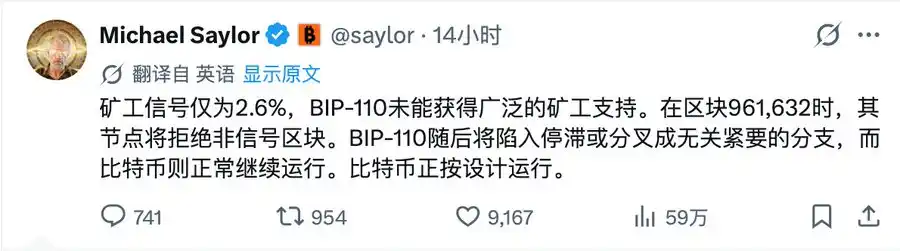
This is not a fixed date. The timeframe can be significantly shortened with the addition of new hash power. However, it illustrates that BIP-110, even if it can activate on its own chain, might first experience a very long period of slow progress. The wait before activation could even be longer than the rule's originally planned one-year enforcement period.

Ordinary coin holders currently do not need to interpret this as "Bitcoin's rules have already changed."

The main chain with the highest cumulative proof-of-work still operates under the original rules. The 21 million coin cap, existing balances, and daily payments remain unchanged. The risks are primarily concentrated on nodes, wallets, and service providers using the BIP-110 backend: the two chains see different confirmation states, and this fork lacks dedicated replay protection, meaning a single regular transaction might be valid on both sides.

The current outcome: BIP-110 has not activated on the Bitcoin mainnet; it first created a low-hash-power execution chain.


Kripto yang Sedang Tren

Pertanyaan Terkait

QWhat is the BIP-110 fork described in the article, and what was its goal?

AThe BIP-110 fork was a recent attempt to split the Bitcoin network, initiated on August 8th. Its primary goal was to impose new consensus rules limiting the size of non-financial data, such as inscriptions (Ordinals, BRC-20, Runes), within Bitcoin blocks. Proponents argued this data imposes long-term storage and bandwidth costs on all nodes. The change aimed to enforce stricter limits on script sizes and certain Taproot constructs to curb these uses.

QWhy did BIP-110 proceed with the fork despite having very low miner support (2.53%)?

ABIP-110 proceeded based on a UASF (User-Activated Soft Fork) philosophy. Its supporters believe that nodes (users, exchanges, wallets) ultimately decide which blocks are valid, not just miners. They enforced new signaling rules starting at block 961632, rejecting blocks that did not signal support for BIP-110. The strategy was to force a network choice, hoping economic actors would adopt the new rules and miners would eventually follow to avoid having their blocks rejected.

QWhat is the current state of the BIP-110 chain compared to the main Bitcoin chain?

AAs of the article's reporting, the BIP-110 chain has effectively split off but is struggling. It lags significantly behind the main chain in block height (21 blocks behind at one point) due to having very low hashrate support. The main chain continues normally with overwhelming miner support, while the BIP-110 chain experiences slow block production. The new data-limiting rules have not yet activated on either chain; currently, only the signaling rules differ.

QAccording to the article, what are the main arguments for and against BIP-110's proposed rules?

A**For BIP-110:** Supporters argue Bitcoin should prioritize being a currency and payment network. Inscriptions and similar data create a negative externality where data publishers pay a one-time fee, but the cost of storing and propagating that data indefinitely is borne by all network nodes. The rules aim to protect the network from bloating with non-monetary data. **Against BIP-110:** Opponents argue that block space is a fee market, and miners should be free to include any paying transaction. They also worry the rules could negatively impact other legitimate uses of Bitcoin's scripting capabilities, such as Miniscript, BitVM, and future Taproot-based protocols. Furthermore, they believe such rules cannot eliminate on-chain data entirely but only make it more cumbersome to publish.

QWhat challenges does the BIP-110 chain face in becoming the economically dominant Bitcoin chain?

AThe BIP-110 chain faces significant challenges: 1) **Extremely low hashrate**, leading to very slow block times until the next difficulty adjustment (which could take over 1.5 years at current levels). 2) **Lack of broad economic adoption** from exchanges, wallets, payment processors, and holders, who continue to recognize the original chain. 3) **No automatic replay protection**, creating risks for users. 4) **Time constraint**: The chain's planned ~1-year activation period for data rules may be shorter than the time it takes to even activate them on its own low-hashrate chain.

Bacaan Terkait

Trader Institusi Memainkan Peran yang Lebih Signifikan dalam Pembentukan Harga Bitcoin

Pelaku perdagangan institusional kini memainkan peran yang lebih signifikan dalam pembentukan harga Bitcoin. Data dari Wintermute menunjukkan porsi klien institusional (seperti hedge fund dan perusahaan manajemen aset) dalam perdagangan spot over-the-counter (OTC) meningkat dari 59% pada semester pertama 2025 menjadi 72% pada paruh pertama 2026. Dominasi ini berarti institusi dapat lebih mempengaruhi fluktuasi harga, bukan hanya mengikutinya. Perilaku mereka yang cenderung lebih cepat keluar dari posisi setelah puncak harga dibandingkan investor ritel dapat mempersingkat periode rally dan mengurangi gelombang pergerakan pada aset kripto lainnya (altcoin). Volatilitas Bitcoin pun dilaporkan turun, didorong oleh pendekatan yang lebih hati-hati dan strategis dari pelaku besar. Aliran dana ke ETF spot Bitcoin, terutama dari BlackRock dan Fidelity, tetap kuat meski harga turun, mengindikasikan permintaan institusional yang berkelanjutan. Motivasi kepemilikan aset digital juga bergeser, dengan diversifikasi portofolio dan permintaan klien menjadi alasan utama (63%), mengalahkan spekulasi murni (15%). Dominasi likuiditas oleh institusi dapat mengarah pada pasar yang lebih selektif, di mana hanya segelintir token besar yang mendapat perhatian, sementara altcoin yang lebih kecil mungkin semakin bergantung pada spekulasi investor ritel untuk pertumbuhannya.

cryptonews.ru6m yang lalu

Trader Institusi Memainkan Peran yang Lebih Signifikan dalam Pembentukan Harga Bitcoin

cryptonews.ru6m yang lalu

Pembelian USDT: Bank Mulai Meminta Penjelasan dari Perusahaan atas Operasi Kripto

Pembelian USDT: Bank Mulai Minta Penjelasan Perusahaan soal Operasi Kripto Bank-bank Rusia yang melayani kegiatan ekonomi luar negeri semakin memperhatikan transaksi pembelian USDT. Belakangan ini, sejumlah lembaga kredit telah mengirim permintaan kepada klien korporat untuk mengungkap detail operasi dengan kriptoaset. Bank tidak hanya menanyakan hal standar berdasarkan Undang-Undang Anti-Pencucian Uang No. 115-FZ, tetapi juga meminta penjelasan mengenai makna ekonomi pembelian USDT dan konfirmasi status mitra kontra pihak yang mentransfer kripto tersebut. Klien diminta menunjukkan bukti bahwa mitra tersebut terdaftar di daftar operator pertukaran mata uang digital Bank Sentral Rusia. Namun, masalah utamanya adalah daftar itu sendiri belum ada karena bank sentral masih menyiapkan regulasi turunannya. Permintaan ini dianggap sebagai langkah antisipasi sebelum regulasi baru berlaku. Para ahli menghubungkan peningkatan pemeriksaan ini dengan kekhawatiran bank bahwa sebagian bursa kripto saat ini mungkin tidak mendapatkan lisensi dan beralih ke zona abu-abu. Operasi kripto, termasuk yang menggunakan Tether (USDT) yang sering dipakai dalam pembayaran internasional, tetap dikategorikan berisiko tinggi oleh bank. Ahli hukum menyarankan perusahaan untuk tidak mengabaikan permintaan bank. Mengabaikan atau memberikan jawaban formal dapat dengan cepat menyebabkan pembatasan layanan perbankan. Meskipun keberadaan mitra dalam daftar resmi belum menjadi syarat wajib sebelum undang-undang baru berlaku, bank tetap dapat mengevaluasi seluruh rangkaian transaksi dan mengambil keputusan berdasarkan informasi yang tersedia. USDT (Tether) adalah aset kripto yang dipatok pada dolar AS, sering digunakan untuk mengurangi dampak fluktuasi pasar, transfer cepat, dan perdagangan kripto. Di Rusia, USDT biasanya dibeli melalui bursa kripto, platform peer-to-peer (P2P), atau bot. Pembayarannya dapat dilakukan dengan kartu, transfer bank, atau metode digital seperti Apple/Google Pay. Risiko utama bagi perusahaan Rusia saat ini bukan pada pembelian USDT itu sendiri, tetapi pada kontrol perbankan terkait status mitra dan pembuktian operasi. Untuk keamanan, disarankan menggunakan platform terpercaya, memeriksa alamat dompet dan jaringan dengan cermat (seperti ERC-20, TRC-20), serta menyimpan aset di dompet yang sesuai, terutama untuk jumlah besar.

cryptonews.ru9m yang lalu

Pembelian USDT: Bank Mulai Meminta Penjelasan dari Perusahaan atas Operasi Kripto

cryptonews.ru9m yang lalu

Trading

Spot

Artikel Populer

Cara Membeli PEOPLE

Selamat datang di HTX.com! Kami telah membuat pembelian ConstitutionDAO (PEOPLE) menjadi mudah dan nyaman. Ikuti panduan langkah demi langkah kami untuk memulai perjalanan kripto Anda.Langkah 1: Buat Akun HTX AndaGunakan alamat email atau nomor ponsel Anda untuk mendaftar akun gratis di HTX. Rasakan perjalanan pendaftaran yang mudah dan buka semua fitur.Dapatkan Akun SayaLangkah 2: Buka Beli Kripto, lalu Pilih Metode Pembayaran AndaKartu Kredit/Debit: Gunakan Visa atau Mastercard Anda untuk membeli ConstitutionDAO (PEOPLE) secara instan.Saldo: Gunakan dana dari saldo akun HTX Anda untuk melakukan trading dengan lancar.Pihak Ketiga: Kami telah menambahkan metode pembayaran populer seperti Google Pay dan Apple Pay untuk meningkatkan kenyamanan.P2P: Lakukan trading langsung dengan pengguna lain di HTX.Over-the-Counter (OTC): Kami menawarkan layanan yang dibuat khusus dan kurs yang kompetitif bagi para trader.Langkah 3: Simpan ConstitutionDAO (PEOPLE) AndaSetelah melakukan pembelian, simpan ConstitutionDAO (PEOPLE) di akun HTX Anda. Selain itu, Anda dapat mengirimkannya ke tempat lain melalui transfer blockchain atau menggunakannya untuk memperdagangkan mata uang kripto lainnya.Langkah 4: Lakukan trading ConstitutionDAO (PEOPLE)Lakukan trading ConstitutionDAO (PEOPLE) dengan mudah di pasar spot HTX. Cukup akses akun Anda, pilih pasangan perdagangan, jalankan trading, lalu pantau secara real-time. Kami menawarkan pengalaman yang ramah pengguna baik untuk pemula maupun trader berpengalaman.

827 Total TayanganDipublikasikan pada 2024.12.12Diperbarui pada 2026.06.02

Cara Membeli PEOPLE

Diskusi

Selamat datang di Komunitas HTX. Di sini, Anda bisa terus mendapatkan informasi terbaru tentang perkembangan platform terkini dan mendapatkan akses ke wawasan pasar profesional. Pendapat pengguna mengenai harga PEOPLE (PEOPLE) disajikan di bawah ini.

活动图片