On L1 Value Capture from Two Solana Proposals

marsbitDipublikasikan tanggal 2026-08-05Terakhir diperbarui pada 2026-08-05

Abstrak

The article, "Discussing L1 Value Capture Through Two Solana Proposals," by Max Resnick, explores how Layer 1 (L1) blockchain tokens derive their fundamental value, drawing parallels to traditional asset pricing theory. Resnick argues that L1 token value, like stock value, stems from claims on future income streams for holders, not merely from network activity or technological promise. This value is captured when fees are either burned (economically akin to a buyback) or distributed to stakers (akin to dividends). Inflationary staking rewards, by contrast, redistribute value among holders rather than creating it. The core challenge is the quality and defensibility of fee-based revenue. High-quality fees come from sustainable, recurring demand for the network's economic utility (e.g., long-term financial activity), not from transient speculation (e.g., meme coins, airdrops). The strength of a blockchain's network effects—liquidity, applications, users—can make its revenue more defensible and grant it greater pricing power than often assumed. The article proposes a foundational valuation framework for L1s, separating revenue (fees captured for token holders), costs, and total token supply. A key accounting principle is that inflationary rewards should not be counted as a cost unless the newly minted tokens are symmetrically counted as a value input; otherwise, it misrepresents profitability. Finally, Resnick discusses the economics of increasing protocol fees to boost reven...

Author: Max Resnick, Chief Economist at Anza

Compiled by: Jiahuan, ChainCatcher

I am publishing this article as SIMD 550 (doubling the rate of inflation reduction) and SIMD 553 (resource costs) are about to enter the voting stage. This piece is not a specific commentary on these two proposals; I have already left my comments on the respective GitHub proposals. Here, I primarily discuss how the problems these proposals aim to address relate to the valuation of L1s.

Part 1: The Establishment of Asset Pricing Theory

Before asset pricing theory was formally established, investors were not short of methods to value companies. Some focused on hard assets and liquidation value, others emphasized profits, dividends, growth, management quality, or market psychology. There were many metrics available; what was truly missing was a rigorous framework to explain exactly which metrics determine value and how these metrics should be weighed against each other.

By the late 1920s, on the eve of the Great Depression, this ambiguity had become dangerous. Investors could cite facts like profit growth, market expansion, new technologies, and improved corporate governance, but these facts were often used to justify market prices rather than to derive asset value.

Graham and Dodd (1934) later described that era as one where analysis gave way to "potential and prophecy." Even when data was presented, it became "pseudo-analysis to support the illusions of the moment."

Anyone who frequently indulges in Crypto Twitter should find this scene familiar. Today's discussions around L1 tokens are similarly filled with the potential, prophecy, and pseudo-analysis that characterized the stock market of the late 1920s.

The number of people participating in blockchain development is at a record high. Transaction activity is at an all-time peak. Tokens will become currency, collateral, digital oil, or a call option betting on the future financial system.

Some of these claims may be true and could even imply upside for the underlying network. But if they cannot explain how these factors translate into token holder surplus, they do not constitute a coherent valuation framework.

John Burr Williams was the first to push asset pricing towards rigor. In "The Theory of Investment Value," Williams (1938) argued that value is "the present worth of future dividends, or of future coupons and principal in the case of a bond."

Gordon (1959) later expressed the same idea more succinctly: "A stock, like any other asset, is worth to a buyer only the benefits he expects to receive from it in the future."

Equity has value not because a company is impressive, active, important, or technologically irreplaceable. It has value because equity grants shareholders a claim on future income.

For L1 tokens, value can accrue in two ways. The first is fee burning, which economically resembles a buyback. The second is distributing fees to stakers, which economically resembles a dividend.

Staking rewards funded by issuance are different. They are neither income created by the network nor a cost borne by the network. The protocol creates new tokens and distributes them to stakers while diluting the holdings of non-stakers.

This mechanism may be necessary to secure the network and may determine who gradually comes to own the network over time. But from the perspective of all token holders, it neither creates nor destroys value.

A blockchain can process millions of transactions while creating almost no value for token holders because the surplus may be captured by users, applications, validators, or other intermediaries. Conversely, a chain with less activity may be more valuable if it converts a larger proportion of economic activity into token holder value.

But not all fees are created equal. The 'R' in ARR stands for recurring, meaning sustainable and repeatable income. Dichev, Graham, Harvey, and Rajgopal (2013) noted that high-quality earnings should be "sustainable and repeatable." The same standard applies to L1 fees.

One dollar of fees generated by long-term financial activity is not the same as one dollar generated by airdrops, meme coin mania, cascading liquidations, or temporary network congestion.

Some fees come from users' ongoing demand for scarce block space. Others are merely exhaust from speculative cycles. Once incentives disappear, volatility subsides, or users run out of money, these activities also vanish.

Fee quality depends on persistence and defensibility.

Are users paying because the chain provides long-term economic utility, or because a short-term activity happens to be on this chain? Can the protocol continue to charge these fees without driving users, applications, or order flow elsewhere? Can the token continue to capture these profits, or will this value eventually be competed away by validators, applications, searchers, block builders, users, or other chains?

Historically, crypto investors have often made two opposite errors regarding earnings quality simultaneously.

On one hand, they overestimated earnings quality because much crypto activity is speculative, reflexive, and episodic.

On the other hand, they underestimated earnings quality because they did not fully appreciate the strength of L1 network effects. Liquidity, applications, wallets, infrastructure, users, developers, assets, and order flow reinforce each other.

These network effects may make certain fees harder for competitors to capture than they initially appear. They also suggest that dominant blockchains like Solana and Ethereum may have stronger pricing power than the market generally believes, potentially benefiting from raising fees.

Part 2: Accounting Standards for Revenue, Inflation, and Total Supply

The next step is to specify a minimal fundamental model for L1s that can lead to valuation multiples.

It may be premature to call it the "standard model" now. There is currently no universally accepted standard model for L1 valuation. But the categorization below is the form I believe a standard model should take. It intentionally mirrors the methods stock analysts use to value companies.

The reason this needs to be explicitly written down is that there isn't even consensus on the most basic accounting objects.

I've discussed this framework with some of the smartest people I know, and they often disagree on fundamental questions. Are validator rewards funded by inflation considered a cost? Should foundation expenditures be treated as operating expenses? Should the unspent portion of foundation tokens be included in the token supply? Should MEV paid to validators count as protocol revenue, validator revenue, or neither?

Some of the confusion may stem from the fact that there can be more than one correct way to write a valuation model. Accounting classifications are not unique. As long as the corresponding offsetting items are also adjusted, you can move an item from one side of the ledger to the other while keeping the model correct.

But this flexibility is also dangerous. Many models are internally consistent, but many are not. Having multiple correct methods does not mean there are fewer incorrect ones.

Inflation rewards are the simplest example.

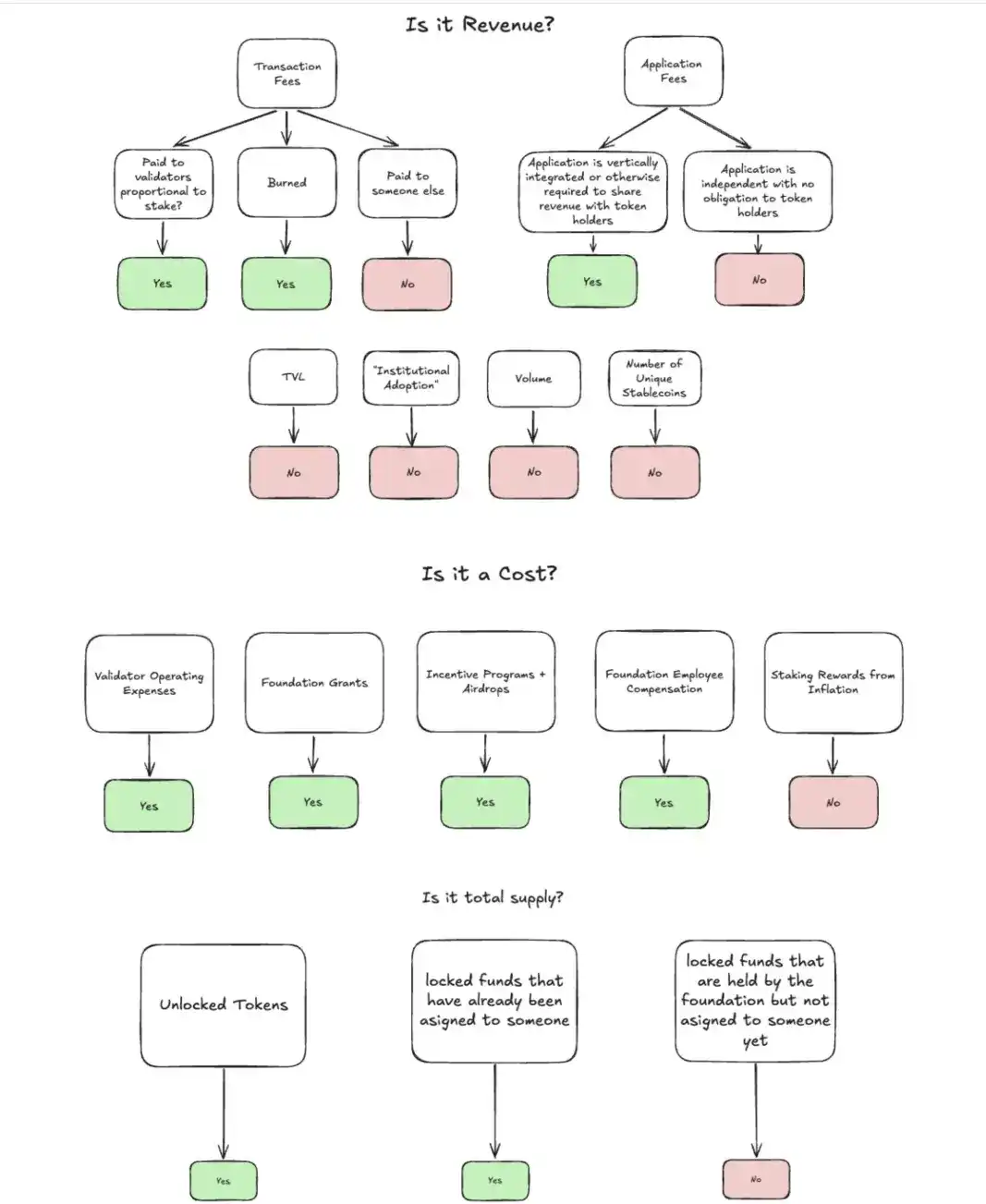
Staking rewards funded by issuance are essentially rewards paid by token holders to stakers via dilution. From the perspective of all token holders combined, the two offset each other. The protocol does not earn revenue when it mints new tokens, nor does it incur a real external cost when distributing these tokens to stakers.
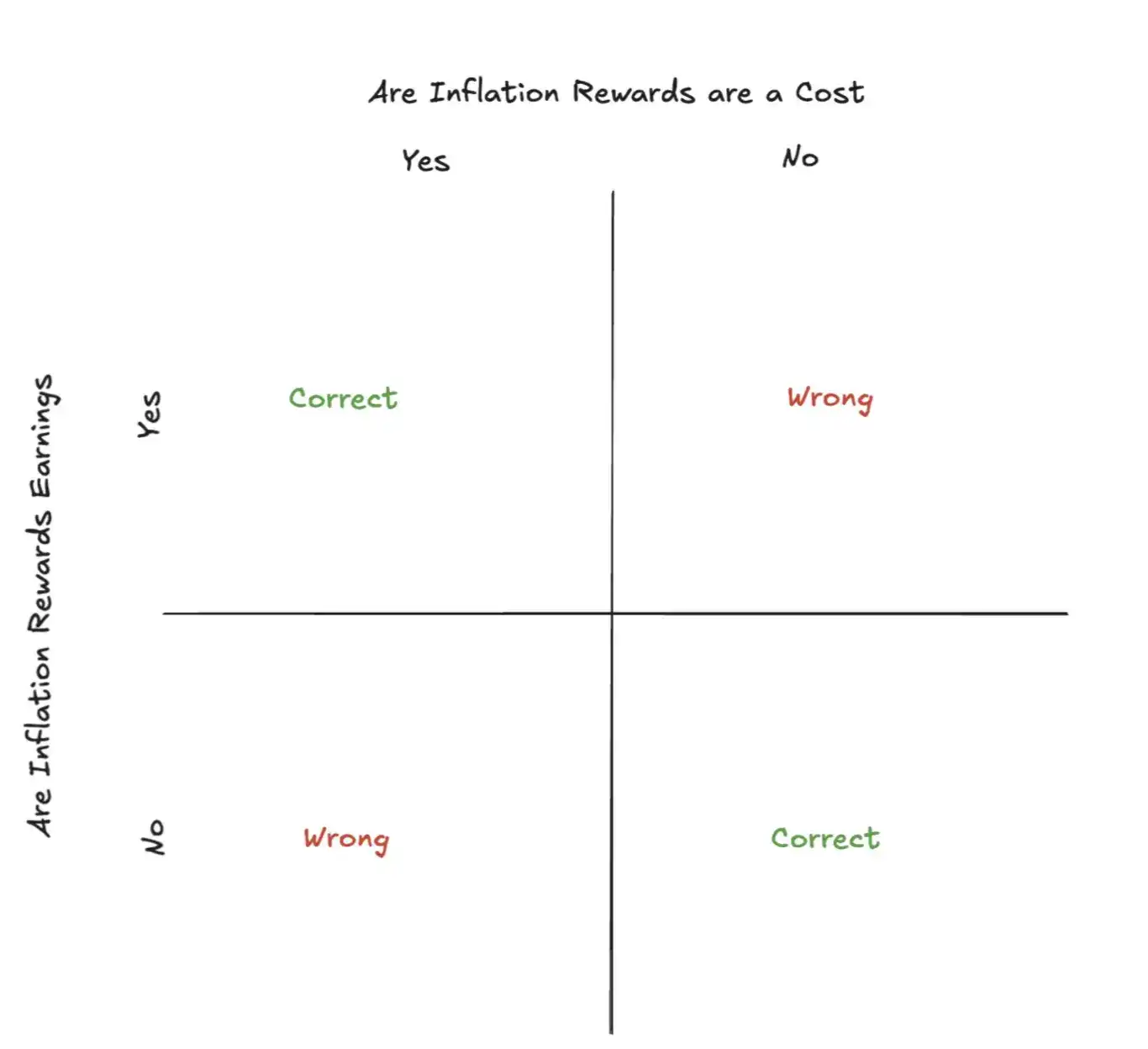
You can create a correct model that treats inflation rewards as a cost, but only if you simultaneously count newly issued tokens as a source of value to offset that cost. Otherwise, the model leads to absurd conclusions, such as Solana being unprofitable because it pays large staking rewards.

The categorization below is my proposed baseline. It separates three objects: revenue, costs, and total supply.

I believe these definitions most closely resemble the models stock analysts are already familiar with, making them easier to understand and reason about.

Other classifications may be correct, but deviations from this one must have clear justification. Proprietary models come with two costs.

First, they are harder for others to understand. Second, it is easy to miss dependencies between items.

For example, if foundation expenditures are classified as a cost, then the unspent portion of foundation tokens cannot also be included in the total supply, or it would be double-counted. If inflation rewards are classified as a cost, newly issued tokens must be treated symmetrically.
Part 3: Supply, Demand, and Price

Recently, several blockchains have explicitly raised fees with the goal of increasing revenue. However, revenue equals price multiplied by quantity.

Raising fees increases the revenue contributed by transactions that remain, but it also causes some transactions to disappear. Therefore, the net effect of a fee increase on revenue is uncertain; it hinges on the price elasticity of demand for transactions.

To understand the reasoning behind these adjustments, I spoke with some of the decision-makers involved. They believed the fees on these chains were originally too low, so demand was relatively inelastic within that price range.

This argument might apply to specific cases but is not universally true.

I have done some past research utilizing randomness in EIP-1559 pricing. The analysis showed that the price elasticity of gas demand is roughly between 0.6 and 0.8. That is, a 10% price increase leads to a 6% to 8% decrease in quantity demanded.

Moreover, this data only reflects short-term price fluctuations and does not capture the aggregate effects of applications migrating off-chain or optimizing their programs.
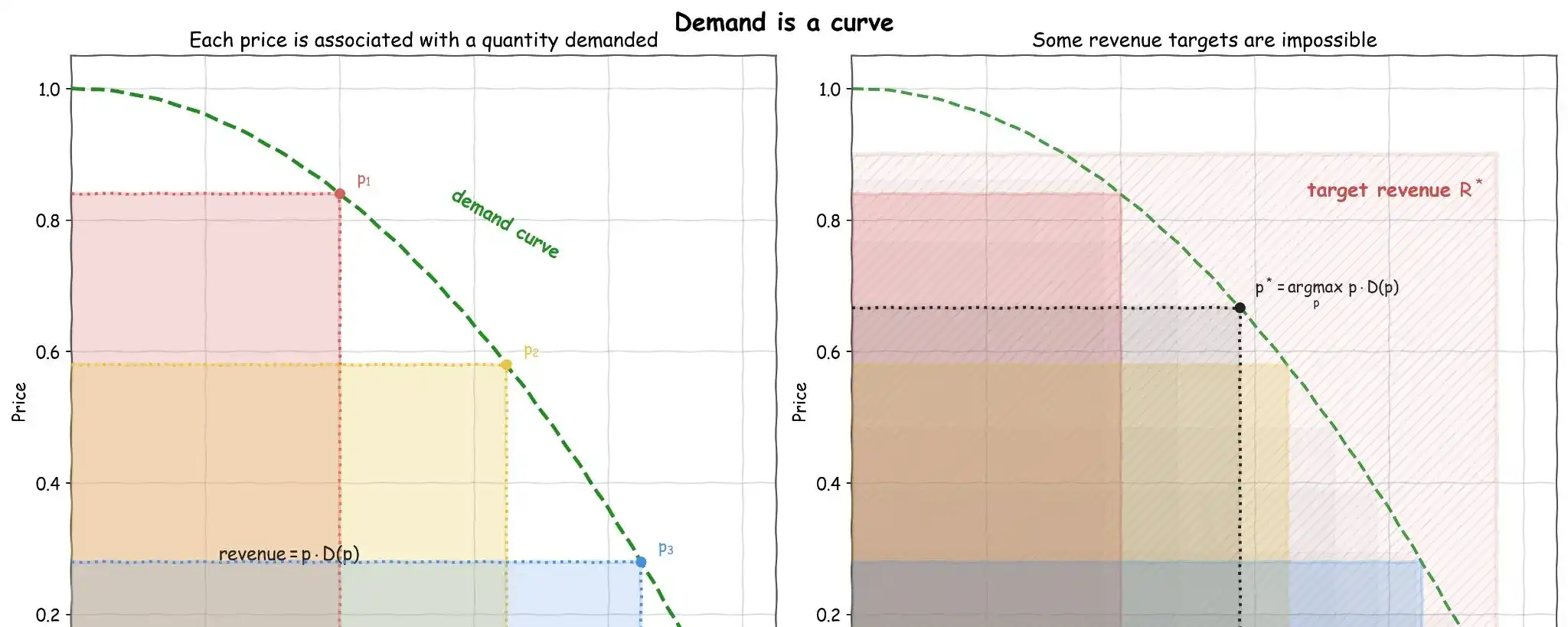
Therefore, a flat fee is a rather blunt instrument for generating revenue. Different types of on-chain transactions have different willingness to pay.

A small wallet transfer, a large stablecoin transfer, and a liquidation may consume the same block space, but they generate different total surplus and have different willingness to pay.
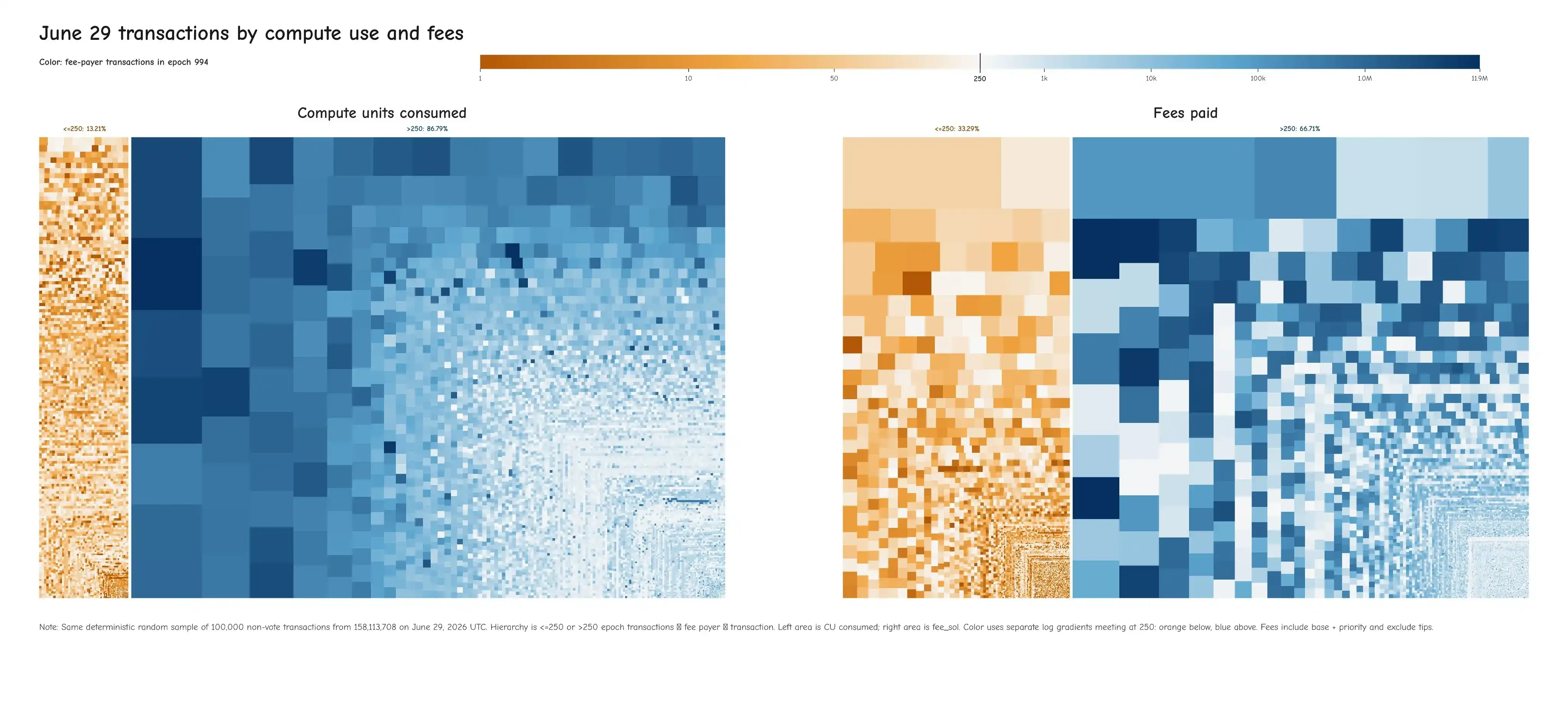
Note: Blue dots represent fee payers who initiated more than 250 transactions in the period, suggesting they are more likely to be bots and thus have higher price elasticity. Bots typically have thin profit margins, so they tend to reduce resource consumption significantly when prices rise.

Protocols want to charge higher fees for transactions with a higher willingness to pay. Computation-based fees are a step in this direction but not thorough enough.

For financial activity, the nominal transaction amount is often a better indicator of willingness to pay than computational load. This is why exchanges typically charge fees based on basis points.

Token programs can provide a way to charge fees proportional to transaction value. By modifying token programs, a small percentage-based fee can be levied on token transfers. This way, even if a high-value transfer uses similar computational resources as a low-value one, the high-value transfer still pays more.


Kripto yang Sedang Tren

Pertanyaan Terkait

QAccording to the article, what are the two primary ways that value can be aggregated to L1 token holders, and how do they differ economically from staking rewards funded by inflation?

AAccording to the article, value can be aggregated to L1 token holders in two primary ways: 1) Burning fees, which is economically equivalent to a share buyback, and 2) Distributing fees to stakers, which is economically equivalent to paying a dividend. These differ from staking rewards funded by inflation, which are neither network income nor a real external cost. They represent a redistribution from non-stakers to stakers through dilution, not the creation of value for token holders as a whole.

QWhat is the key difference between 'high-quality' fees and lower-quality fees for an L1 blockchain, as discussed in the article?

AThe key difference lies in the sustainability and defensibility of the fees. High-quality fees are recurring and repeatable, stemming from persistent demand for scarce block space due to long-term economic utility. Lower-quality fees are temporary and non-recurring, often generated by speculative activities like airdrop farming, memecoin frenzies, liquidations, or temporary network congestion that can disappear when incentives fade or volatility subsides.

QIn the author's proposed 'standard model' for L1 accounting, how should inflationary staking rewards and new token issuance be treated, and why?

AIn the author's proposed standard model, inflationary staking rewards should not be treated as a network cost, and newly issued tokens should not be treated as network income. This is because, from the perspective of all token holders, they are offsetting internal transfers—the dilution from new issuance is the 'cost' paid by holders to fund the staking rewards. Treating them as a cost without a corresponding income entry would incorrectly suggest the network is unprofitable.

QWhat caution does the article offer regarding the strategy of increasing protocol fees to raise revenue, and what economic concept is central to this caution?

AThe article cautions that increasing protocol fees does not automatically lead to higher revenue because revenue equals price multiplied by quantity. Raising fees can reduce the quantity of transactions. The central economic concept is the price elasticity of demand. If demand is elastic, a fee increase will lead to a proportionally larger drop in transactions, reducing total revenue. The article cites research suggesting Ethereum gas demand has a price elasticity between 0.6 and 0.8, meaning it is somewhat elastic.

QWhat is the proposed alternative to a uniform fee structure that the author suggests could better capture value from high-willingness-to-pay transactions?

AThe author suggests that a more effective alternative to a uniform fee structure would be to implement fees based on the nominal transaction value, similar to how exchanges charge basis points. This could be done by modifying token programs to levy a small proportional fee on token transfers. This way, a high-value transfer pays more than a low-value transfer even if they consume similar computational resources, better capturing value from transactions with a higher willingness to pay.

Bacaan Terkait

Untuk Pertama Kalinya dalam Sejarah: ETF yang Memperdagangkan Bitcoin di Pasar Spot Memutuskan untuk Ditutup!

Manajer aset kripto Hashdex mengumumkan keputusan untuk menutup dan melikuidasi ETF Hashdex Bitcoin (DEFI) yang diperdagangkan di AS. Ini menjadikan DEFI sebagai ETF spot bitcoin pertama yang ditutup di AS. Berdasarkan dokumen yang diajukan ke SEC, aset yang dikelola dana tersebut per 30 Juli 2026 bernilai sekitar $14,7 juta. Hashdex menyatakan keputusan likuidasi didasarkan pada evaluasi faktor seperti ukuran dana, likuiditas, biaya operasional, permintaan investor, dan strategi produk perusahaan. Rencana likuidasi menyebutkan bahwa aset bersih dana yang rendah dibandingkan biaya operasional membuat kelangsungan DEFI tidak layak secara ekonomi dalam jangka panjang. ETF Hashdex Bitcoin adalah dana yang berinvestasi langsung di bitcoin di pasar spot untuk memberikan akses investor pada fluktuasi harga harian bitcoin. Portofolionya hanya terdiri dari bitcoin yang disimpan secara fisik dan kas untuk kebutuhan operasional. Investor dapat menjual saham DEFI di bursa NYSE Arca hingga penutupan perdagangan pada 17 Agustus 2026. Setelah tanggal tersebut, dana tidak akan menerima permintaan pembuatan saham baru. Hashdex akan melikuidasi portofolio dengan menjual bitcoin yang tersisa setelah 17 Agustus. Investor yang belum menjual sahamnya akan menerima pembayaran tunai setara dengan nilai aset bersih saham mereka pada tanggal likuidasi, diharapkan sekitar 28 Agustus 2026. Jumlah distribusi akan bergantung pada harga jual bitcoin, biaya penutupan, dan potensi fluktuasi harga selama proses likuidasi.

cryptonews.ru9m yang lalu

Untuk Pertama Kalinya dalam Sejarah: ETF yang Memperdagangkan Bitcoin di Pasar Spot Memutuskan untuk Ditutup!

cryptonews.ru9m yang lalu

Investor Mulai 'Berganti Meja'

Investor Mulai ‘Berganti Meja’: Beralih dari Reksa Dana ke Perusahaan Di tengah panasnya pasar modal tahap awal, terutama di sektor teknologi keras seperti AI dan robotika, semakin banyak investor yang memilih untuk meninggalkan pekerjaan di perusahaan modal ventura atau reksa dana dan beralih bekerja langsung di perusahaan rintisan (startup). Fenomena ini berbeda dengan periode sebelumnya. Dulu, perpindahan seringkali dipicu oleh tekanan pasar yang lesu. Kini, justru terjadi saat pasar sedang bersemangat, dengan aliran dana yang meningkat pesat. Investor senior dan berpengalaman kini secara proaktif mencari peran di perusahaan, seperti Wakil Presiden, Kepala Keuangan (CFO), atau bahkan Pendiri Bersama. Mereka banyak bergabung dengan perusahaan-perusahaan unggulan di bidang AI, kecerdasan buatan, dan dirgantara. Perpindahan ini didorong oleh dua faktor utama. Pertama, perusahaan teknologi terkemuka yang sedang gencar mencari pendanaan membutuhkan tenaga ahli yang memahami seluk-beluk pasar modal untuk mengelola proses pendanaan yang cepat dan kompleks. Kedua, para investor melihat peluang karir yang lebih baik, termasuk imbalan dan kepastian yang lebih tinggi, dibandingkan dengan tekanan kompetisi dan ketidakpastian hasil investasi di dunia reksa dana. Meski menawarkan peluang baru, transisi ini bukan tanpa tantangan. Investor yang beralih harus beradaptasi dari peran analitis ke peran eksekutif operasional yang lebih menuntut implementasi langsung. Beberapa kasus menunjukkan kesulitan dalam penyesuaian ini. Namun, tren ini jelas menunjukkan pelebaran batasan karier bagi para profesional investasi di Tiongkok.

marsbit1j yang lalu

Investor Mulai 'Berganti Meja'

marsbit1j yang lalu

Trading

Spot

Artikel Populer

Apa Itu SOLANA

HarryPotterWifHatMyroWynn10Inu,$solana: Sebuah Penyelaman ke dalam Proyek Koin Meme yang Trendy Pendahuluan Dalam lanskap cryptocurrency yang terus berkembang, proyek-proyek inovatif terus muncul, menangkap imajinasi para investor dan penggemar. Salah satu proyek tersebut adalah HarryPotterWifHatMyroWynn10Inu,$solana, sebuah koin meme yang telah mulai menciptakan ceruknya sendiri di dalam komunitas kripto. Artikel ini bertujuan untuk memberikan gambaran komprehensif tentang proyek ini, menjelaskan tujuannya, arsitekturnya, penciptanya, investor, dan tonggak-tonggak penting sepanjang perjalanan. Apa itu HarryPotterWifHatMyroWynn10Inu,$solana? Gambaran Umum HarryPotterWifHatMyroWynn10Inu,$solana adalah proyek koin meme yang terstruktur di atas blockchain Solana – sebuah platform yang terkenal karena skalabilitas dan kecepatannya. Bertujuan untuk membawa kegembiraan dan kreativitas ke dalam ruang kripto, proyek ini tidak hanya berfungsi sebagai token perdagangan tetapi juga sebagai katalisator untuk generasi dan berbagi konten meme. Komunitas di inti proyek ini didorong untuk berpartisipasi secara aktif, menyediakan ekosistem dinamis di mana kreativitas dan kolaborasi berkembang. Tujuan dan Sasaran Pada intinya, proyek ini bertujuan untuk mendorong lingkungan di mana para penggemar meme dapat berkumpul, berbagi, dan menciptakan konten meme yang baru. Pendekatan yang berbasis narasi ini menambahkan kegembiraan di dalam komunitas, mendorong keterlibatan sekaligus menjelaskan fungsionalitas kuat yang melekat pada blockchain Solana. Dengan membangun proyek yang berfokus pada komunitas, HarryPotterWifHatMyroWynn10Inu,$solana juga ingin mengeksplorasi dampak sosial dari mata uang digital sebagai sarana ekspresi. Siapa Pencipta HarryPotterWifHatMyroWynn10Inu,$solana? Identitas pencipta di balik HarryPotterWifHatMyroWynn10Inu,$solana tetap diselimuti misteri. Proyek ini disusun sedemikian rupa sehingga kepemilikan telah ditolak; oleh karena itu, proyek ini berkembang sebagai inisiatif yang dipimpin oleh komunitas. Desentralisasi ini mendorong transparansi dan partisipasi demokratis di antara semua pemangku kepentingan yang terlibat. Pendekatan semacam ini semakin populer di dunia koin meme, di mana keterlibatan komunitas sangat penting. Siapa Investor dari HarryPotterWifHatMyroWynn10Inu,$solana? Hingga saat ini, tidak ada informasi yang tersedia untuk umum mengenai investor khusus atau yayasan yang mendukung HarryPotterWifHatMyroWynn10Inu,$solana. Ketidakadaan investor yang dikenal semakin menekankan etos berorientasi komunitas dari proyek ini, karena proyek ini berdiri independen dari kerangka keuangan tradisional. Kebebasan ini memungkinkan proyek untuk mengembangkan identitasnya tanpa tekanan eksternal, bergantung pada minat kolektif dari basis penggunanya. Bagaimana Cara Kerja HarryPotterWifHatMyroWynn10Inu,$solana? Model Ekonomi Proyek ini menerapkan model ekonomi unik yang mendasari fungsionalitas dan keterlibatan pengguna. Transaksi dalam HarryPotterWifHatMyroWynn10Inu,$solana dirancang untuk menguntungkan semua pihak yang terlibat. Setiap perdagangan dikenakan biaya, yang kemudian didistribusikan kembali di antara pemegang saat ini sambil secara bersamaan meningkatkan kolam likuiditas. Komponen utama dari model ini mencakup: Mekanisme Refleksi: Sebagian dari biaya transaksi dikembalikan kepada pemegang, mendorong investasi jangka panjang dalam token. Perekrutan Kolam Likuiditas: Dana dialokasikan untuk meningkatkan likuiditas, memastikan bahwa operasi beli dan jual dapat dilaksanakan dengan lancar. Mekanisme Pembakaran: Sebagian token dapat dibakar untuk menciptakan kelangkaan, yang berpotensi meningkatkan nilai seiring dengan meningkatnya permintaan. Desain ini mendorong ekosistem yang berkelanjutan yang bergantung pada interaksi komunitas dan investasi. Keterlibatan Komunitas Di jantung HarryPotterWifHatMyroWynn10Inu,$solana adalah nilai yang diberikan pada keterlibatan komunitas. Dengan memungkinkan pengguna untuk berpartisipasi dalam pengembangan proyek melalui berbagai kegiatan, seperti pembuatan meme dan promosi, proyek ini mendorong ekosistem yang vibran di mana kreativitas dapat berkembang. Timeline HarryPotterWifHatMyroWynn10Inu,$solana Trajectory HarryPotterWifHatMyroWynn10Inu,$solana menampilkan beberapa peristiwa penting yang telah membentuk posisinya saat ini dalam komunitas kripto: Penciptaan: Tanggal spesifik penciptaan tetap tidak diungkapkan, tetapi awal proyek ini berakar pada budaya meme yang mer permeasi era digital. Pengambilalihan Komunitas: Setelah penolakan kepemilikan oleh penciptanya, proyek ini beralih ke model yang dipimpin oleh komunitas, memungkinkan semua peserta memiliki bagian dalam kesuksesannya. Audit dan Koleksi NFT: Dalam upaya untuk meningkatkan kredibilitas, proyek ini melakukan audit menyeluruh, sekaligus meluncurkan koleksi NFT yang berfungsi untuk mewujudkan etos centris meme-nya. Kemitraan dan Pengembangan: Proyek ini saat ini sedang dalam proses menjajaki kemitraan potensial dengan token lainnya dan mengorganisir pengembangan situs web unik serta opsi merchandising berdasarkan meme legendanya. Poin Kunci Secara ringkas, HarryPotterWifHatMyroWynn10Inu,$solana berdiri sebagai pemain penting dalam sektor koin meme cryptocurrency. Berikut adalah beberapa hal penting yang perlu diperhatikan: Inisiatif yang Dipimpin Komunitas: Proyek ini berkembang sebagai usaha kolaboratif, mendorong kontribusi aktif dari anggota komunitasnya sambil terlepas dari klaim kepemilikan. Model Ekonomi Inovatif: Menggunakan refleksi, akuisisi likuiditas, dan mekanisme pembakaran, menciptakan lingkungan keuangan yang kokoh dan menarik bagi pengguna. Keterlibatan NFT dan Merchandise: Dengan peluncuran koleksi NFT, proyek ini berusaha untuk memperdalam keterlibatan di seluruh komunitasnya, memperkuat ikatan antara budaya meme dan mata uang digital. Eksplorasi Kemitraan: Inisiatif ini tidak stagnan – perkembangan yang sedang berlangsung dan kemitraan potensial menunjukkan pendekatan yang berpikiran ke depan yang bertujuan untuk pertumbuhan berkelanjutan. Kesimpulan Seiring HarryPotterWifHatMyroWynn10Inu,$solana terus mendapatkan traction dalam lanskap cryptocurrency, perpaduan unik antara keterlibatan komunitas, struktur ekonomi inovatif, dan integrasi budaya meme menggambarkan potensi jalannya ke depan. Meskipun masih ada misteri seputar asal-usul dan afiliasi investornya, proyek ini menangkap kisah menarik yang berbicara tentang esensi inovasi terdesentralisasi. Dalam dunia di mana cryptocurrency sering dilihat melalui lensa finansial semata, HarryPotterWifHatMyroWynn10Inu,$solana menunjukkan bahwa gerakan kripto menggabungkan kreativitas, komunitas, dan kolaborasi. Apakah Anda seorang investor berpengalaman atau pendatang baru, perjalanan yang berkembang dari proyek koin meme ini pasti menjadi studi kasus yang menarik dan layak untuk diperhatikan.

1.2k Total TayanganDipublikasikan pada 2024.04.04Diperbarui pada 2024.12.03

Apa Itu SOLANA

Apa Itu SOLANA 2.0

BarbieCrashBandicootRFK777Inu, $SOLANA 2.0: Pemain Baru di Lanskap Kripto Pengenalan ke BarbieCrashBandicootRFK777Inu, $SOLANA 2.0 Dalam lanskap cryptocurrency yang terus berkembang, calon baru terus menarik perhatian investor dan penggemar. Di antara proyek-proyek yang muncul adalah BarbieCrashBandicootRFK777Inu, yang diwakili oleh simbol cryptocurrency $SOLANA 2.0. Inisiatif unik ini menggabungkan elemen glamor, petualangan, dan budaya meme, berupaya untuk menantang ekspektasi di arena yang sangat kompetitif. Dengan aspirasi pertumbuhan dan inovasi, proyek ini menangkap semangat sebagai underdog yang melawan raksasa yang sudah mapan. Apa itu BarbieCrashBandicootRFK777Inu, $SOLANA 2.0? Pada intinya, BarbieCrashBandicootRFK777Inu adalah proyek cryptocurrency yang terinspirasi oleh berbagai referensi budaya ikonik. Termasuk keanggunan dan pesona yang terkait dengan Barbie, energi dinamis dari Crash Bandicoot, dan dorongan tanpa henti yang diwakili oleh RFK, proyek ini bertujuan untuk menawarkan pengalaman yang multifaset dalam dunia cryptocurrency. Tujuan utama dari proyek BarbieCrashBandicootRFK777Inu adalah menggabungkan elemen-elemen yang berbeda ini menjadi ekosistem yang kohesif yang menarik bagi audiens yang luas. Dengan merangkul keanehan budaya meme sambil tetap berpegang pada prinsip desentralisasi dan pemberdayaan finansial, proyek ini telah memposisikan dirinya sebagai opsi menarik bagi investor berpengalaman maupun pendatang baru di dunia kripto. Siapa Pencipta BarbieCrashBandicootRFK777Inu, $SOLANA 2.0? Meskipun minat terhadap BarbieCrashBandicootRFK777Inu terus berkembang, informasi mengenai penciptanya tetap sebagian besar tidak diketahui. Anonimitas pendiri atau tim pengembangnya menimbulkan pertanyaan tentang struktur dan tata kelola proyek ini. Di dunia cryptocurrency, tidak jarang proyek beroperasi tanpa pencipta yang terlihat di publik. Kekurangan informasi ini mungkin akan menghalangi beberapa calon investor, sementara yang lain mungkin melihatnya sebagai kesempatan untuk merangkul semangat desentralisasi yang mendasari banyak inisiatif cryptocurrency. Siapa Investor BarbieCrashBandicootRFK777Inu, $SOLANA 2.0? Saat ini, sangat sedikit informasi yang tersedia mengenai fondasi investasi atau organisasi yang mendukung BarbieCrashBandicootRFK777Inu. Kurangnya dukungan investasi yang terperinci untuk proyek ini menyoroti sifat independen dari banyak cryptocurrency. Dalam hal ini, masih harus dilihat apakah pendanaan proyek akan berasal dari dukungan komunitas akar rumput atau dukungan entitas keuangan yang lebih besar. Bagaimana Cara Kerja BarbieCrashBandicootRFK777Inu, $SOLANA 2.0? BarbieCrashBandicootRFK777Inu dirancang dengan sejumlah fitur yang berkontribusi pada keunikannya di dalam ruang kripto yang padat. Meskipun rincian teknis tertentu masih dirahasiakan, proyek ini diharapkan menggabungkan fungsi yang bertujuan untuk meningkatkan keterlibatan pengguna dan mendorong pertumbuhan komunitas. Kombinasi berbagai pengaruh—dari mode dan petualangan hingga permainan—mendorong suasana inklusif yang memenuhi berbagai minat. Selain itu, hubungan proyek dengan ekosistem $SOLANA 2.0 menunjukkan potensi keunggulan teknologi. Ini dapat mencakup kecepatan transaksi yang inovatif, skalabilitas, dan biaya yang efektif, selaras dengan kapasitas teknis dari blockchain Solana. Pendiri proyek tampaknya sedang memanfaatkan fondasi teknologi ini untuk menciptakan pengalaman komunitas yang berkelanjutan dan penawaran produk yang substansial. Jadwal Timeline BarbieCrashBandicootRFK777Inu, $SOLANA 2.0 Perjalanan BarbieCrashBandicootRFK777Inu mencakup beberapa tonggak penting, memberikan wawasan tentang perkembangan proyek hingga saat ini: Konseptualisasi Proyek: Ide awal muncul seputar penggabungan glamor, petualangan, dan budaya meme, memberikan kerangka kerja untuk konsep unik proyek ini. Penciptaan Token: Token simbolis $SOLANA 2.0 didirikan, dirancang untuk mewujudkan aspirasi proyek dan menarik minat dari calon investor. Pembangunan Proyek: Saat ini, proyek sedang mengalami pengembangan lebih lanjut, dengan penekanan pada tantangan terhadap pemain yang sudah mapan di ruang kripto dan memberikan penawaran yang inovatif. Tonggak-tonggak ini mencerminkan trajektori pertumbuhan proyek sambil menyoroti komitmennya untuk mengembangkan pengalaman cryptocurrency yang pionir. Poin-Poin Penting tentang BarbieCrashBandicootRFK777Inu, $SOLANA 2.0 Konsep Unik: BarbieCrashBandicootRFK777Inu menonjol dengan menggabungkan elemen glamor, petualangan, dan budaya meme dalam satu proyek cryptocurrency. Semangat Underdog: Proyek ini merangkul persona underdog, bertujuan untuk menantang proyek cryptocurrency yang sudah mapan dan menciptakan ceruk di industri. Fase Pengembangan: Upaya pengembangan aktif sedang berlangsung, dengan niat untuk menyediakan penawaran baru dan inovatif yang selaras dengan harapan komunitas dan investor. Kesimpulan BarbieCrashBandicootRFK777Inu, diwakili oleh simbol $SOLANA 2.0, adalah pendatang baru yang menarik di pasar cryptocurrency. Campuran unik dari referensi budaya dan visi ambisiusnya mungkin bisa bergema dengan mereka yang mencari nilai alternatif proyek dalam lanskap kripto. Sementara status penciptanya yang tidak diketahui dan investor mungkin menimbulkan tanda tanya, penekanan proyek pada pesona dan petualangan menghadirkan narasi yang menarik yang memperluas batasan apa yang dapat dihadirkan oleh cryptocurrency. Saat proyek ini terus berkembang, akan menarik untuk mengamati evolusinya di dalam lanskap kripto yang lebih luas dan bagaimana ia memposisikan diri di antara pesaingnya. Bagi mereka yang terlibat, BarbieCrashBandicootRFK777Inu dapat membuka pengalaman mengejutkan yang mendefinisikan kembali keterlibatan dengan aset digital. Untuk saat ini, saat proyek ini terus maju, perjalanannya menjadi pengingat bahwa inovasi dalam ruang kripto tidak mengenal batas, menawarkan semuanya mulai dari kegembiraan dan hiburan hingga potensi untuk pemberdayaan finansial.

307 Total TayanganDipublikasikan pada 2024.04.05Diperbarui pada 2024.12.03

Apa Itu SOLANA 2.0

Cara Membeli SOL

Selamat datang di HTX.com! Kami telah membuat pembelian Solana (SOL) menjadi mudah dan nyaman. Ikuti panduan langkah demi langkah kami untuk memulai perjalanan kripto Anda.Langkah 1: Buat Akun HTX AndaGunakan alamat email atau nomor ponsel Anda untuk mendaftar akun gratis di HTX. Rasakan perjalanan pendaftaran yang mudah dan buka semua fitur.Dapatkan Akun SayaLangkah 2: Buka Beli Kripto, lalu Pilih Metode Pembayaran AndaKartu Kredit/Debit: Gunakan Visa atau Mastercard Anda untuk membeli Solana (SOL) secara instan.Saldo: Gunakan dana dari saldo akun HTX Anda untuk melakukan trading dengan lancar.Pihak Ketiga: Kami telah menambahkan metode pembayaran populer seperti Google Pay dan Apple Pay untuk meningkatkan kenyamanan.P2P: Lakukan trading langsung dengan pengguna lain di HTX.Over-the-Counter (OTC): Kami menawarkan layanan yang dibuat khusus dan kurs yang kompetitif bagi para trader.Langkah 3: Simpan Solana (SOL) AndaSetelah melakukan pembelian, simpan Solana (SOL) di akun HTX Anda. Selain itu, Anda dapat mengirimkannya ke tempat lain melalui transfer blockchain atau menggunakannya untuk memperdagangkan mata uang kripto lainnya.Langkah 4: Lakukan trading Solana (SOL)Lakukan trading Solana (SOL) dengan mudah di pasar spot HTX. Cukup akses akun Anda, pilih pasangan perdagangan, jalankan trading, lalu pantau secara real-time. Kami menawarkan pengalaman yang ramah pengguna baik untuk pemula maupun trader berpengalaman.

2.8k Total TayanganDipublikasikan pada 2024.12.12Diperbarui pada 2026.06.02

Cara Membeli SOL

Diskusi

Selamat datang di Komunitas HTX. Di sini, Anda bisa terus mendapatkan informasi terbaru tentang perkembangan platform terkini dan mendapatkan akses ke wawasan pasar profesional. Pendapat pengguna mengenai harga SOL (SOL) disajikan di bawah ini.

活动图片