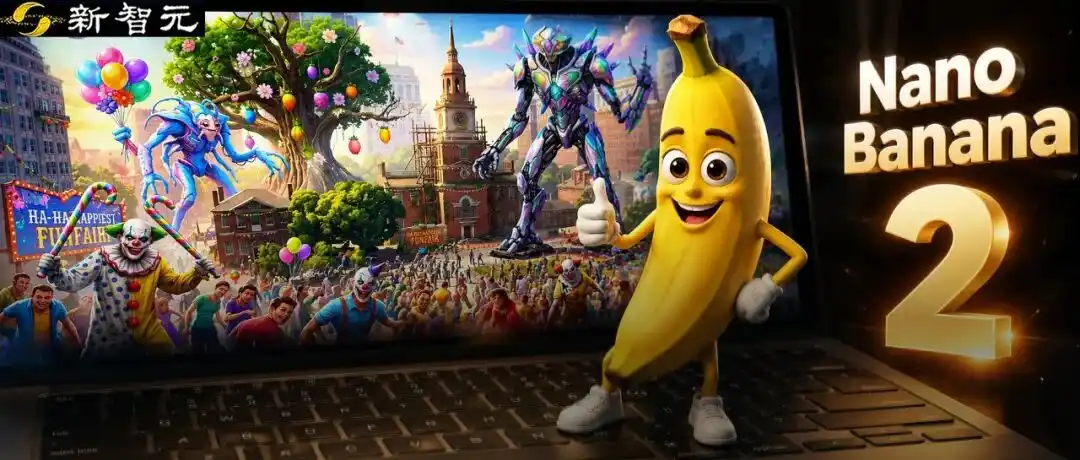
Breaking: Google Earth Urgently Pulls Back Nano Banana 2 Image Generation Feature!

marsbitDipublikasikan tanggal 2026-08-01Terakhir diperbarui pada 2026-08-01

Abstrak

Google Earth's newly launched "Create image" feature, powered by the Nano Banana 2 AI image generation model, was abruptly withdrawn shortly after its release due to being "played" by users. The feature allowed users to generate and overlay AI-created visuals directly onto real-world satellite and 3D maps in Google Earth. The tool enabled creative applications like historical recreations (e.g., visualizing ancient Pompeii), generating informational graphics for landmarks, and envisioning architectural projects or futuristic cityscapes on real terrain. It operated under "geospatial grounding," meaning the AI respected the underlying geography, topography, and perspective of the chosen map view. The model also integrated with Gemini to retrieve relevant factual information. However, upon release, users quickly tested its limits. A prominent example involved reimagining Philadelphia's historic Independence Hall as a post-apocalyptic ruin overrun by "happy" zombies, evil clowns, and giant alien mechs. This highlighted both the feature's playful potential and its risks regarding the generation of inappropriate or misleading content on realistic maps, leading to its swift temporary removal. Google stated it would re-release the feature after implementing "enhanced guardrails." Analysts note this move strategically leverages Google's vast proprietary geospatial data, positioning its AI not just for artistic generation but for spatially accurate world visualization—a unique advant...

Cyber 'Words as Law' has reached a whole new level!

Yesterday, Google officially integrated the latest image generation model, Nano Banana 2, into the web version of Google Earth.
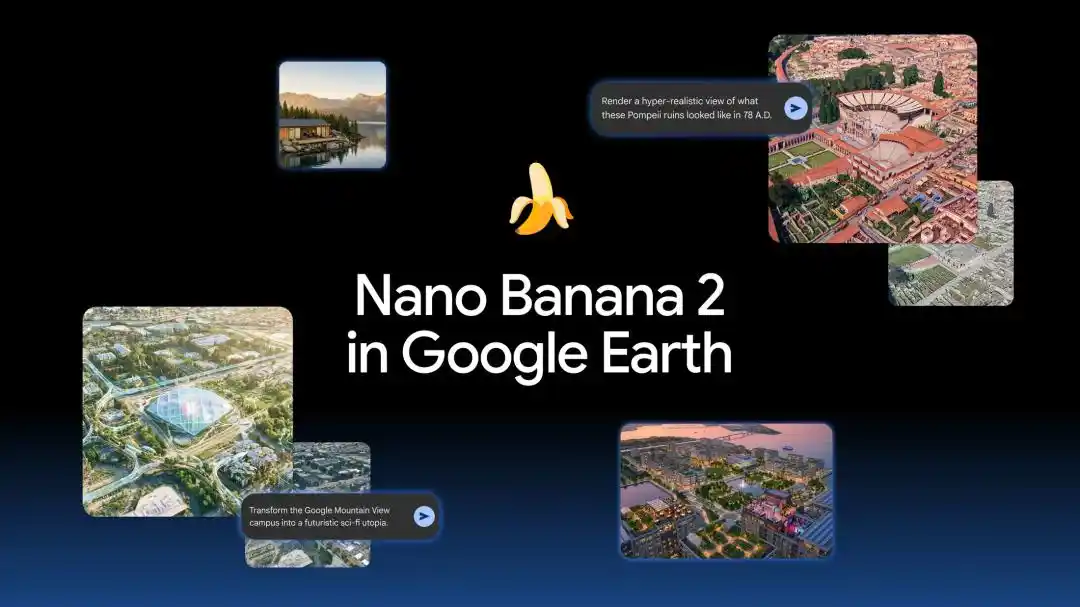
Who would have thought that overnight, the new feature got out of hand, and Google urgently pulled it back!
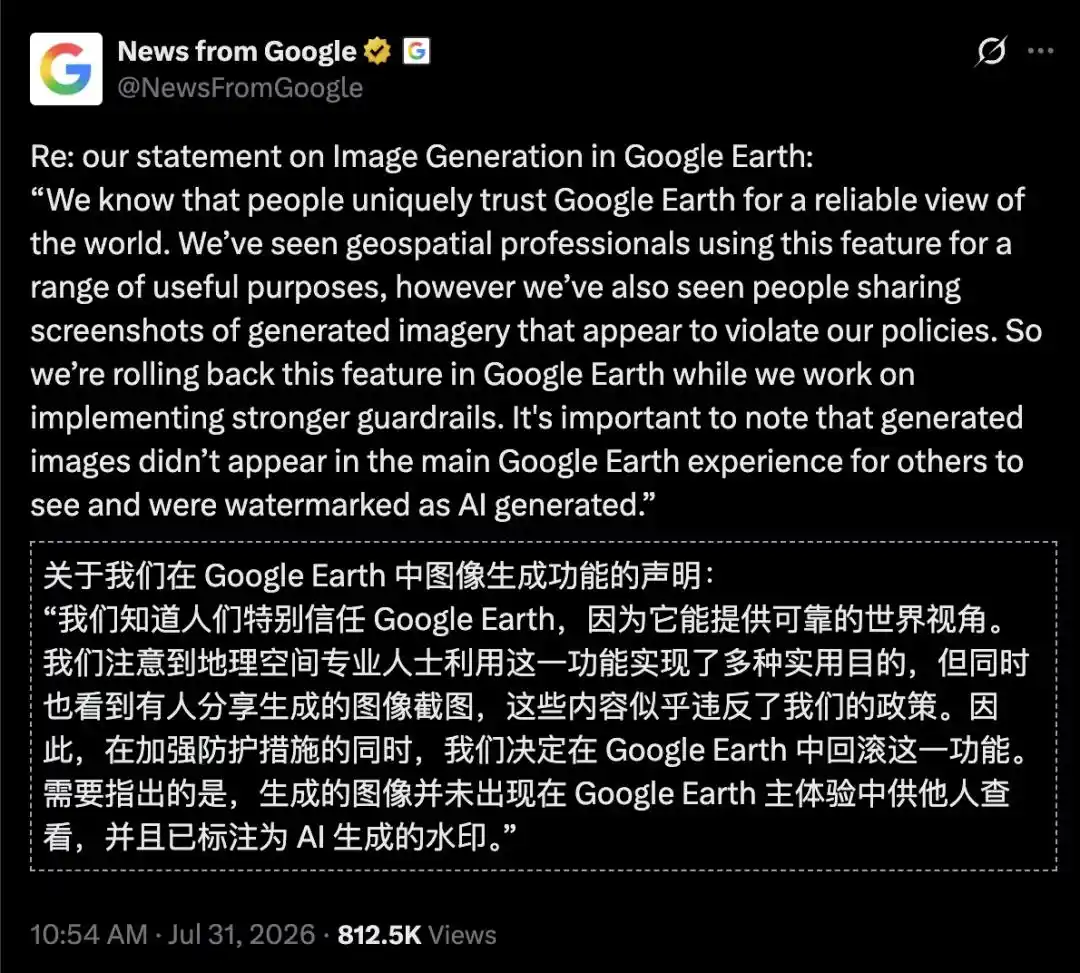
As a result, the effects were too realistic. After strong opposition from experts, Google urgently withdrew the new feature, and then re-released it after "strengthening protective measures."
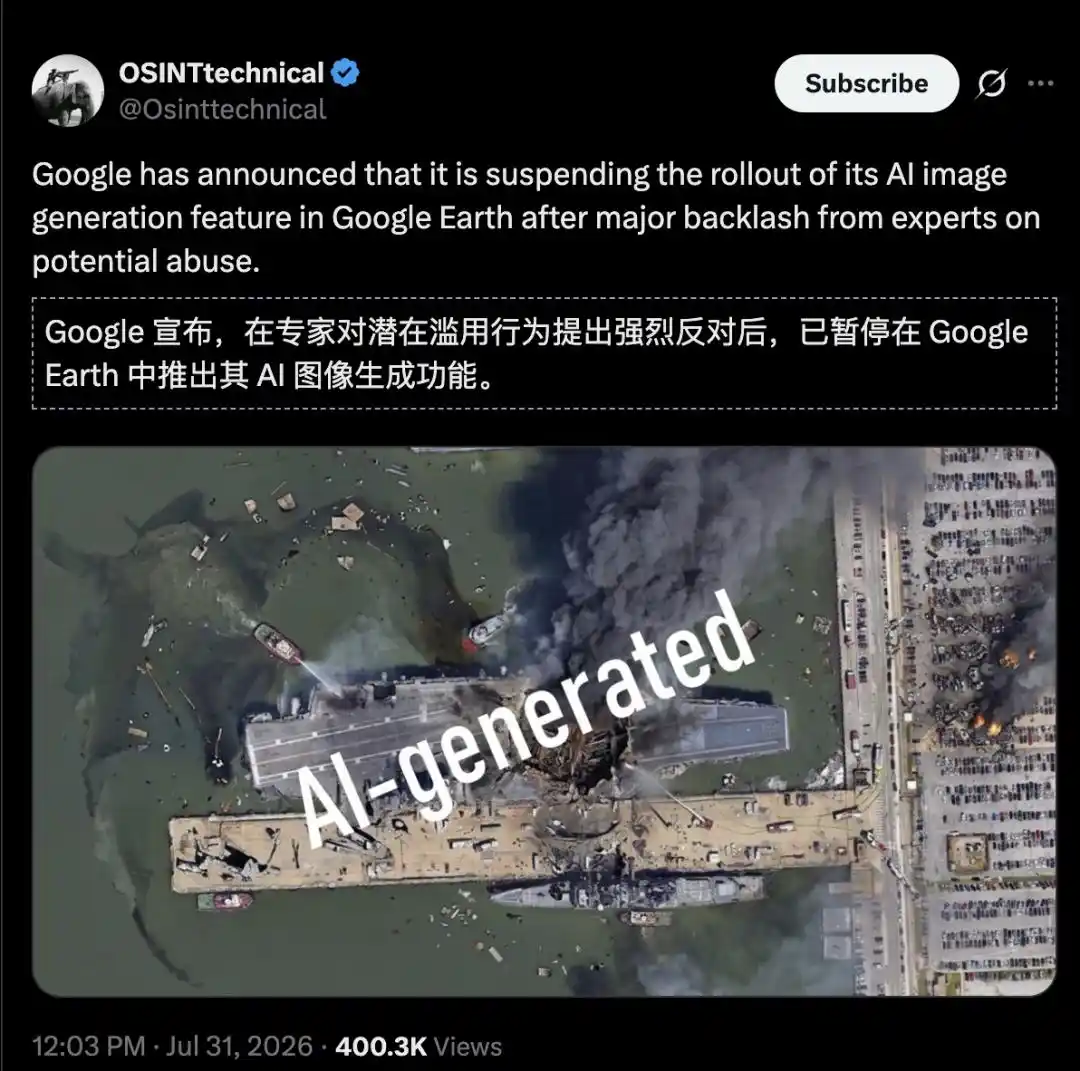
New Ways to Play with Nano Banana 2: A Visual Feast for Netizens

You open Google Earth in your browser and skillfully zoom down to the old street where you played as a child. You don't open complex Photoshop, nor do you copy a screenshot to another AI chat tool.

You simply click the brand-new, slightly glowing 'Create image' button in the upper right corner.
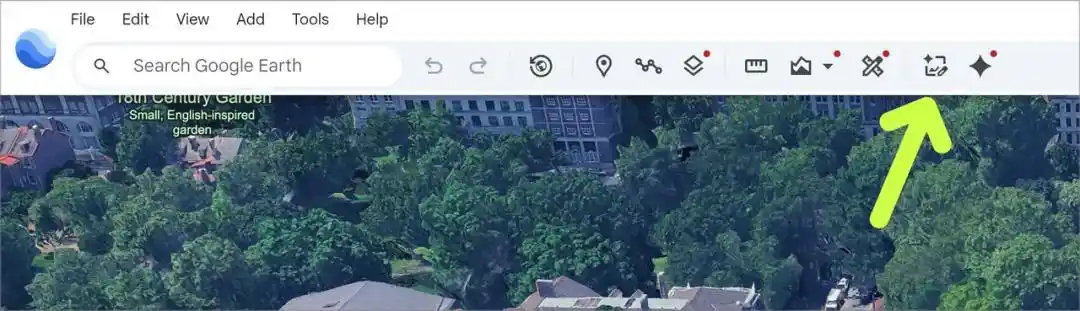
First, look at a few examples from Google.

Turn Back Time, Recreate History

Helping students not just read about history, but truly "see" the past.

Teachers can display a historical site in the classroom, then input: "Generate a photorealistic image showing the original appearance of the Pompeii archaeological site in AD 78."

The modern ruins instantly transform into a bustling, colorful ancient Roman street scene, allowing students to visually see the world from two thousand years ago.

Virtual Tour Guide: Explore and Learn Deeply

Create customized infographics to gain a deeper understanding of a place without leaving Google Earth.

Input: "Create an easy-to-understand infographic about the Statue of Liberty, labeling key historical facts."

In the background, Gemini retrieves relevant historical information, and Nano Banana generates the corresponding visual chart within seconds.

'Dream City Transformer': Create Professional Real Estate Planning Proposals

Presenting real estate projects becomes much simpler when clients can see the final outcome directly.

Architects and urban planners can now present design plans with a single sentence: "Reimagine this vacant lot in Tokyo as a vibrant shopping and commercial district, featuring open public spaces."

The originally barren concrete lot is replaced with a high-quality 3D rendered modern urban oasis, helping clients see future possibilities.

Visualize Project Results Before Construction Begins

Whether it's a dream backyard studio or a lakeside home, it's often hard to imagine what it will look like when completed.

Now, you can quickly turn it into a reality preview.

Zoom in on an empty plot of land, then input: "Add a modern lakeside cabin built using locally sourced sustainable materials."

The system generates a photorealistic rendering, perfectly integrating the future home into the actual terrain.

Give Your Favorite Place a Future Makeover

Sometimes, letting your imagination run wild is its own kind of fun.

If you want to see what a place might look like a hundred years from now, input: "Transform the Google Mountain View campus into a futuristic sci-fi utopia, with glowing walkways, glass eco-domes, flying transit pods, and trees growing around the buildings."

Soon, the entire area gradually morphs into a cinematic cyberpunk metropolis.

Users Exclaim 'Oh My God'

Technology editor David Gewirtz once spent hours exploring on Google Earth, captivated by its ability to travel the world without leaving home. Street View, though somewhat intrusive, also fascinated him, and still does to this day.

Upon hearing the news, he immediately tested the new feature, resulting in "a lot of laughs."
Independence Hall is a U.S. National Historic Landmark and a UNESCO World Heritage Site. On July 4, 1776, the Declaration of Independence was adopted there.
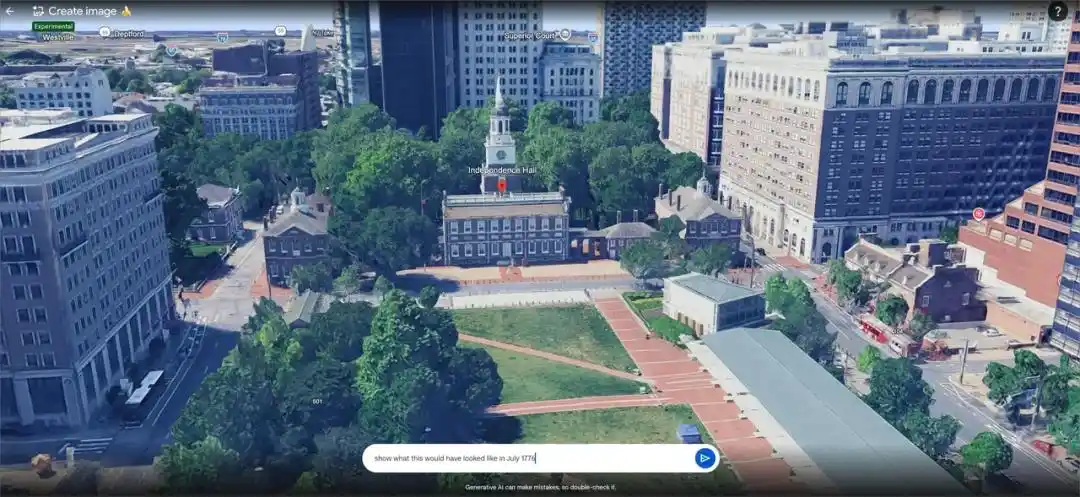
Undoubtedly, this holds significant historical and cultural value for the United States.

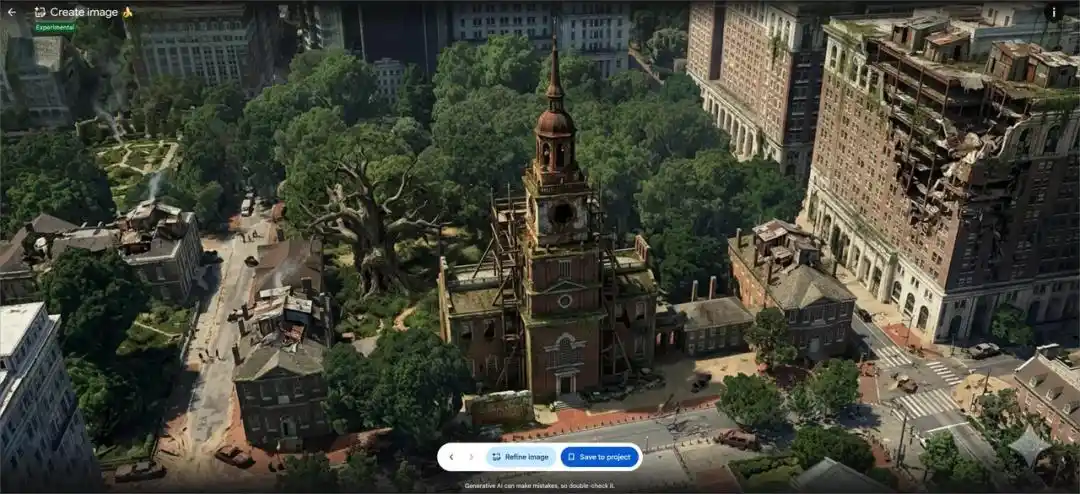
But David Gewirtz had a wild idea: "Imagine this in a post-apocalyptic dystopian future, 500 years from now."

With that one prompt, the former hall was directly transformed into a "post-apocalyptic ruin."
One of Philadelphia's most iconic traditions is the annual Mummers Parade, the oldest folk parade in the U.S., a New Year's tradition since 1901.

This got him thinking: Philadelphia in the future would need a post-apocalyptic dystopian Mummers Parade.

So, he added the prompt, "Now, have it overrun by zombies, evil clowns, and giant alien mechs."
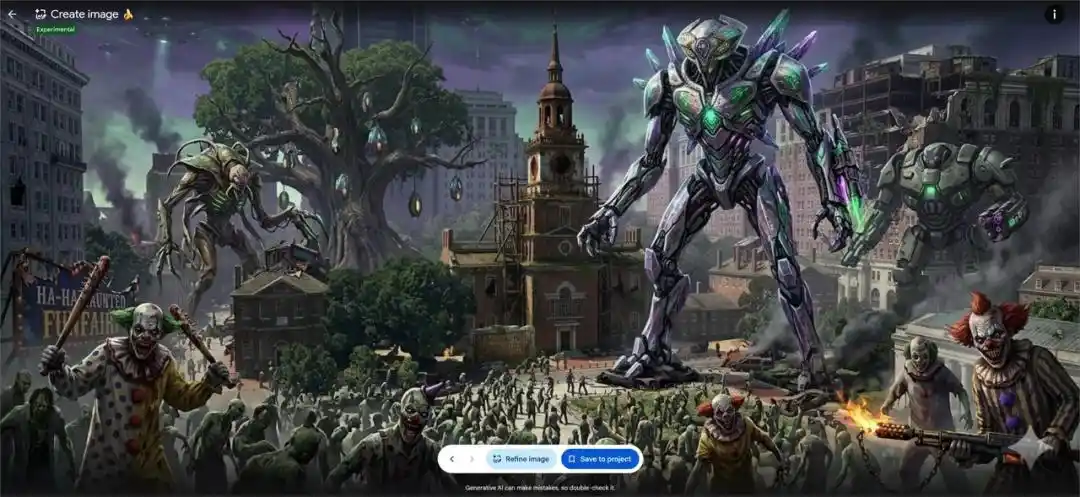
Zombies, evil clowns, and giant alien mechs, oh my!

The zombies, evil clowns, and giant alien mechs seemed a bit tense, the atmosphere off. But one more prompt would make it perfect. He told the AI, "Make them all cheerful."
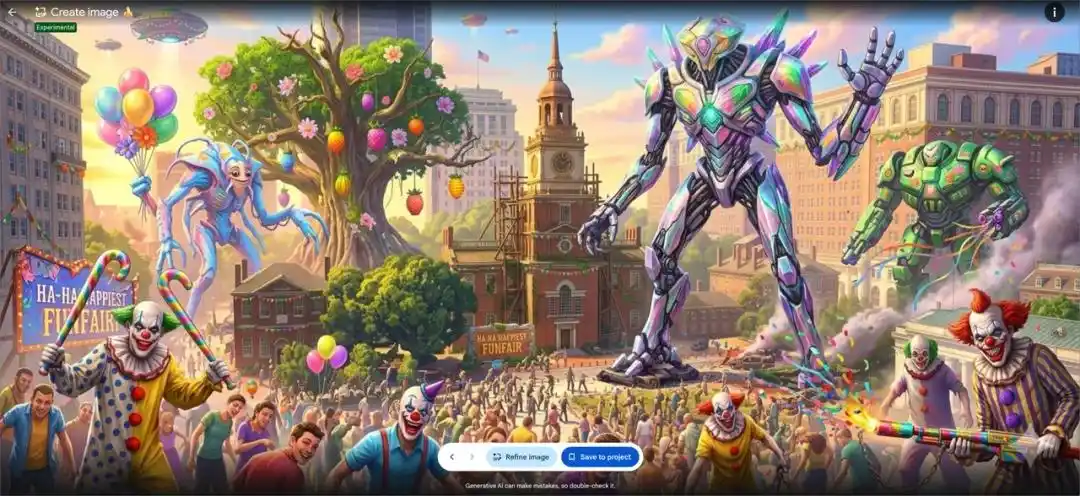
Now, he thinks: "This is a believable future Philadelphia, especially on January 1st."

Note, he also cautioned: "While this can lead to some fun experiments, it's clearly not yet a reliable and practical tool."
Currently, the new feature does not support direct use in "Street View" at all, directly reducing both practicality and fun, which is regrettable.

Some media outlets have mercilessly criticized it: For professional developers or architects, this kind of painting that cannot guarantee spatial geometric rigor and is purely stitched together by probability is nothing more than a refined "AI Slop."

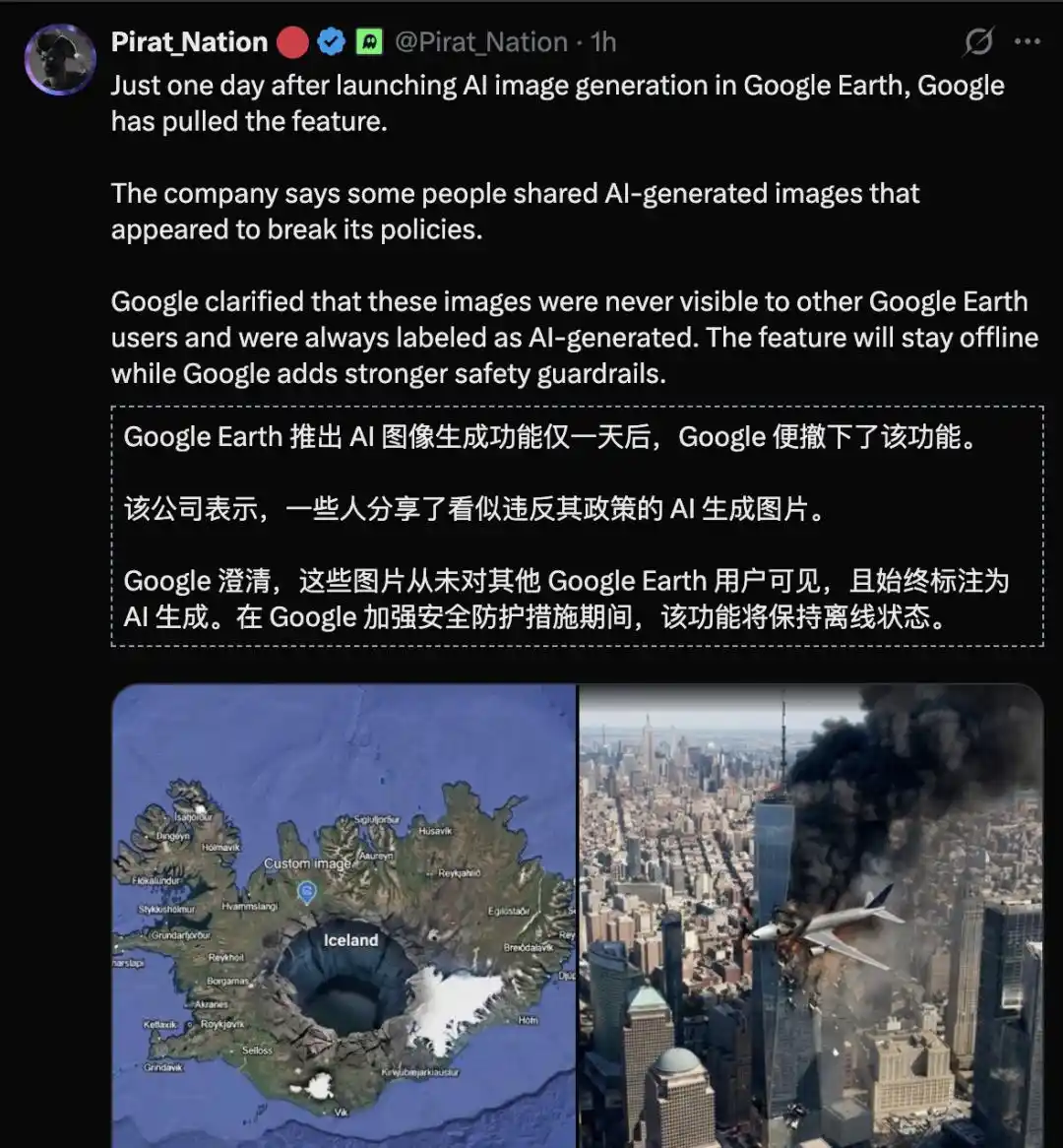
It was taken down by netizens in less than a day! Google urgently pulls back the new feature!
Technical Decryption

From "Creating from Nothing" to "Geospatial Grounding"

In the early logic of AI drawing, AI played with pixels like a game.

You give it a prompt, and it pieces together a picture from a vast probability distribution. It doesn't care about gravity, let alone whether the building in the image actually exists in reality.

But Nano Banana 2, integrated into Google Earth, has completely changed the game. This is a brand-new attempt called "Geospatial Grounding."

At the technical core, it relies on Gemini's powerful multimodal and retrieval-augmented (Search Grounding) capabilities:

First, real-time capture of the physical base map.

The underlying input Nano Banana 2 receives is not just an ordinary top-down view; it's a composite constraint matrix of "the current viewport's satellite/aerial original image + 3D elevation and terrain mesh + spatial camera parameters."

It is speculated that its generation tasks are strictly anchored:

Terrain cannot be altered: The folds of mountains, the baseline of lake edges, the precise location and scale of building foundations must strictly conform to geographical facts.

Perspective and spatial relationships must match: Newly generated buildings, vegetation, or scene elements must be nested into the real 3D terrain and existing structures, not float in mid-air.

Subject consistency: Nano Banana 2 supports powerful consistency rendering for up to 5 main subjects and 14 objects, ensuring new cities or communities don't suffer obvious visual collapse when switching perspectives.

This is conditioned generation under real geographic constraints. The cost is that each image in Google Earth takes up to two minutes to generate.

Second, real-time retrieval from a world knowledge base.

Nano Banana 2 is not just an image generator; it's connected to Google's vast search engine and geographic knowledge base. When you try to "restore history" or "label landmarks," it actively retrieves the cultural background and geographic knowledge of that landmark.

For example, a user requests to generate a "Statue of Liberty infographic."
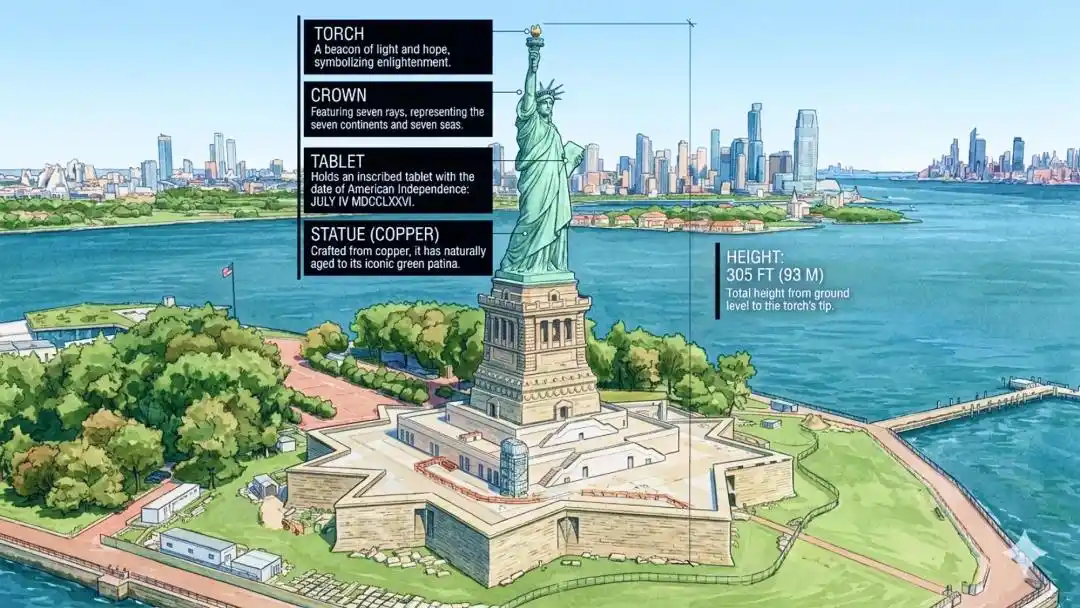
The model not only draws the image but also calls upon Gemini's world knowledge base to automatically populate: year of construction, materials used, architectural dimensions, historical information, etc.

However, whether the retrieved information is completely accurate is another issue that requires careful consideration.

The fact that AI can generate seemingly professional infographics does not mean all facts are absolutely reliable.

Third, high-fidelity detail and precise text.

Nano Banana 2 supports high-fidelity 2K or even 4K image output and possesses powerful text rendering capabilities. This means you can directly see clearly laid-out, non-garbled text signs or informational explanations within the generated scenes. You can even "hand-draw" an infographic with real historical facts directly onto a landmark.

At the operational level, Google has compressed this complex technology to the extreme: During generation, you can go forward/backward to see changes, click "Refine image" to add prompts for further iteration, and the interface provides an intuitive before/after experience.

This directly eliminates the cumbersome workflow for the average person of "screenshot - export - input to another AI - re-paste," enabling the seamless, native fusion of "creativity" and "real-world geography."

After you're satisfied, click "Save to Project." The generated image is permanently pinned to your personal project layer as a Placemark, preserving the camera view. Anyone who clicks on this coordinate can see your "alternate possibility."

Will the Virtual Earth Help Google Gemini Break Through the Crowd?

The significance of Nano Banana entering Google Earth likely goes far beyond a new feature.

The AI image generator track is in a state of intense competition.

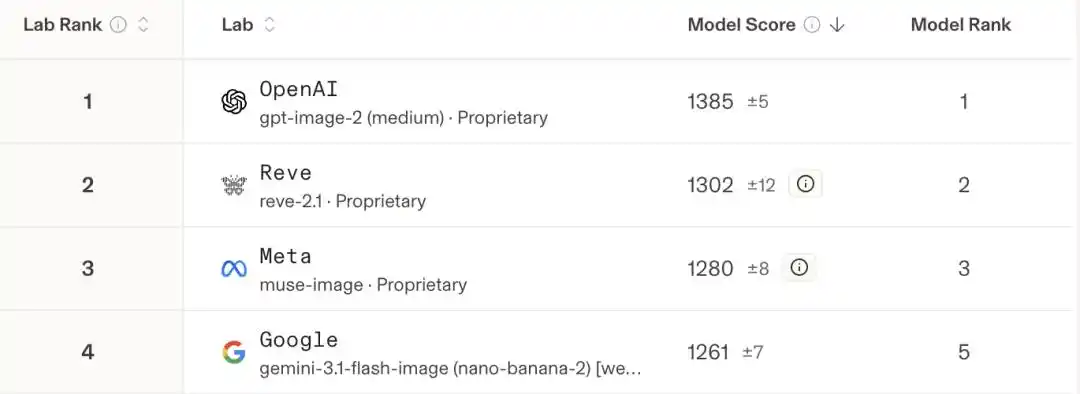
OpenAI's GPT-image-2 leads the Arena rankings, while Nano Banana 2 Lite ranks fifth. Adobe Firefly, Midjourney, and others are all vying for the same pool of users.
Google has taken a completely different path.

Its ace card isn't the algorithm; it's the data. Two decades of accumulated satellite imagery, aerial photos, plus 3D terrain modeling covering hundreds of cities in over 40 countries—this proprietary spatial dataset is a moat that any purely text-based model will never reach.

By grafting Nano Banana 2 onto this dataset, Google has created a brand-new category: AI visualization based on real geographic coordinates, possessing spatial credibility.

It's not competing with Midjourney over who can paint more beautifully, but over who can paint more "realistically"—real enough to have latitude, longitude, altitude, and physical perspective.

Kevin Kelly once predicted that the physical world would have a strictly corresponding "Mirrorworld" in the digital world. Today, Google is using Nano Banana 2 to lightly apply a layer of "digital skin that can be arbitrarily rewritten by prompts" onto this mirror world.

Google has directly shifted the battlefield from "painting beautifully" to "transforming the Earth." In this war, others don't even have a ticket to get in.

References:

https://blog.google/products-and-platforms/products/earth/nano-banana-google-earth-image-generation/

https://www.zdnet.com/article/google-earth-added-nano-banana-and-i-immediately-reimagined-philly-with-zombies-and-evil-clowns/

https://www.techtimes.com/articles/322272/20260730/google-earth-gets-ai-image-generator-grounded-satellite-data-web-only.htm

https://x.com/googleearth/status/2082818165503902043

https://x.com/Google/status/2082834786310123787

Editor: David

This article is from the WeChat public account "New Zhiyuan", author: ASI启示录

Kripto yang Sedang Tren

Pertanyaan Terkait

QWhat is the main news announced in the article?

AGoogle Earth urgently rolled back its newly integrated image generation feature powered by the Nano Banana 2 model after users 'broke' it with creative prompts, leading to concerns. Google plans to re-release it with 'enhanced protective measures'.

QWhat are some of the key new functionalities introduced by the Nano Banana 2 feature in Google Earth?

AKey functionalities include visualizing historical scenes (e.g., reconstructing ancient Pompeii), creating virtual information guides for landmarks, generating professional architectural and urban planning previews, and allowing users to imagine future transformations of real-world locations.

QWhat is 'Geospatial Grounding' as mentioned in the article's technical explanation?

A'Geospatial Grounding' is a technical approach where the AI image generation (Nano Banana 2) is constrained by real geographic data. This includes the satellite/ aerial base map, 3D elevation and terrain mesh, and spatial camera parameters, ensuring generated elements adhere to real-world topography, perspective, and spatial relationships.

QWhy did Google Earth's new feature face criticism according to the article?

AThe feature faced criticism for being an 'AI Slop'—a term used to describe visually polished but spatially and geometrically inaccurate AI-generated content, making it unreliable for professional architects or developers. It also lacks support for the Street View perspective, limiting its utility.

QHow does Google's integration of Nano Banana 2 into Google Earth differ from competitors like Midjourney, according to the article?

AGoogle's strategy differs by leveraging its unique asset: two decades of proprietary satellite imagery, aerial photos, and 3D terrain data. Instead of competing on artistic beauty alone, it focuses on creating spatially credible visualizations anchored to real geographic coordinates, essentially aiming to 'remodel the Earth' in a way competitors cannot easily replicate.

Bacaan Terkait

Perhatian Wajib Pekan Depan|Undang-Undang CLARITY Diperkirakan Akan Masuk ke Pemungutan Suara Senat; SpaceX dan Circle Umumkan Laporan Keuangan (3-9 Agustus)

**Ringkasan Acara Penting Pekan Depan (3-9 Agustus)** Pekan depan diwarnai sejumlah pengumuman keuangan penting dan perkembangan regulasi kripto di AS. **Laporan Keuangan & Acara Perusahaan:** * **SpaceX** akan merilis laporan keuangan Q2 2026 pada 4 Agustus, diikuti gelombang pencairan saham internal pertama (hingga 12%) pada 6 Agustus. * **Circle** (penerbit USDC) dan **Hut 8** (penambang Bitcoin) masing-masing akan mengumumkan laporan kuartalan pada 5 Agustus dan 4 Agustus. * **American Bitcoin (ABTC)**, perusahaan tambang kripto yang dikaitkan dengan keluarga Trump, merilis laporan Q2 pada 3 Agustus. * Perusahaan robotika **宇树科技 (Unitree Robotics)** akan melakukan penawaran saham perdana (IPO) di pasar STAR China, dengan hari penentuan harga awal pada 5 Agustus. **Regulasi Kripto AS:** * **CLARITY Act**, undang-undang kerangka kerja federal untuk aset kripto, berpeluang dilakukan pemungutan suara penuh di Senat AS minggu ini. Para negosiator harus merampungkan aturan tentang konflik kepentingan sebelum masa reses 7 Agustus. RUU ini memerlukan 60 suara untuk disetujui. **Pengumuman Data & Teknologi:** * **Laporan Non-Farm AS** untuk Juli akan dirilis pada 7 Agustus, menjadi fokus pasar. * **Grok AI** versi 4.6 (dengan 1,5 triliun parameter) diperkirakan diluncurkan sekitar 7 Agustus, diikuti versi 4.7 yang lebih kuat beberapa minggu setelahnya. * **XRP Ledger** versi 3.3.0 dengan lima fitur baru, termasuk transaksi batch, dijadwalkan rilis minggu depan. **Penutupan & Perubahan Layanan:** * Beberapa layanan kripto akan berhenti beroperasi: **Zapper** (pelacak portofolio DeFi) dan **Ctrl Wallet** pada 3 Agustus, serta **LayerZero** akan menghentikan relayernya untuk v1 pada tanggal yang sama. Bursa Korea **Upbit** akan menghapus perdagangan pasangan **AQT** dan **AERGO** pada 3 Agustus. **Acara Lainnya:** * **BIP-110**, sebuah proposal peningkatan jaringan Bitcoin, akan memulai fase pengiriman sinyal wajib sekitar 8 Agustus.

marsbit36m yang lalu

Perhatian Wajib Pekan Depan|Undang-Undang CLARITY Diperkirakan Akan Masuk ke Pemungutan Suara Senat; SpaceX dan Circle Umumkan Laporan Keuangan (3-9 Agustus)

marsbit36m yang lalu

Saham Jatuh Lebih Parah daripada Kripto, Ke Mana Uangnya Pergi?

Penulis: Cathy,白话区块链 Pada 28 dan 29 Juli di Seoul, indeks Kospi memicu *circuit breaker* dua hari berturut-turut, suatu peristiwa yang belum pernah terjadi dalam sejarah pasar saham Korea. Saham-saham semikonduktor global, termasuk SK Hynix yang turun sekitar 23% dalam dua hari, mengalami penurunan drastis. Penarikan dana (pullback) Kospi pada Juli mencapai 40% dari titik tertinggi Juni, menjadikannya bulan terburuk yang tercatat. Produk leverage seperti ETF 2x Long SK Hynix bahkan anjlok hingga 83%, menghapus lebih dari 1 triliun HKD dalam nilai pasar. Ironisnya, Bitcoin justru naik hampir 15% dari titik terendah Juli, menunjukkan perilaku yang tidak biasa: **saham yang jatuh seperti aset kripto, sementara Bitcoin relatif stabil.** Penurunan ini bukan kepanikan pasar luas, melainkan "peledakan tertarget" terhadap perdagangan yang paling ramai (*crowded trades*), dipicu oleh laporan keuangan SK Hynix yang meski mencetak rekor laba tetapi di bawah perkiraan, serta IPO besar-besaran ChangXin Memory (CXMT) dari China. Ditambah dengan potensi likuidasi posisi *carry trade* Yen Jepang yang masif, pasar mengalami de-leverage paksa. Lalu, apakah uang yang keluar dari saham mengalir ke Bitcoin? Jawabannya tidak. Bitcoin tampak "tahan jatuh" karena sudah mengalami koreksi lebih dulu—jatuh sekitar 21% selama periode arus keluar ETF berkelanjutan pada Mei-Juni. Uang yang mencari perlindungan justru mengalir ke emas, yang harganya naik lebih dari 20% secara tahunan. Koefisien korelasi Bitcoin dengan emas mencapai -0.88, mengindikasikan bahwa institusi kini memandangnya sebagai aset yang berbeda: **emas untuk perlindungan, Bitcoin untuk potensi pertumbuhan.** Agar aliran dana besar-besaran benar-benar masuk ke Bitcoin, diperlukan tiga kondisi: tekanan likuidasi global mereda, The Fed menurunkan suku bunga tanpa memicu resesi, dan disahkannya RUU CLARITY di AS untuk memberikan kejelasan regulasi. Meski RUU tersebut tertunda di Senat, arahnya sudah jelas. **Harga saham teknologi ditentukan oleh pengeluaran modal AI dan laba perusahaan, sedangkan harga Bitcoin ditentukan oleh likuiditas global.** Ketidakselarasan ini justru menciptakan daya tarik bagi institusi yang ingin mendiversifikasi portofolio mereka. Kesimpulannya, Bitcoin saat ini bukan tempat perlindungan (*safe haven*), melainkan aset yang sudah terkoreksi lebih dulu dan sudah berada di posisi yang siap. **Dana belum datang, tetapi posisinya sudah dipersiapkan.** Ketika badai berlalu dan modal global mencari tempat baru untuk dialokasikan, Bitcoin berada di urutan terdepan dalam antrian.

marsbit37m yang lalu

Saham Jatuh Lebih Parah daripada Kripto, Ke Mana Uangnya Pergi?

marsbit37m yang lalu

Dialog dengan Ray Dalio: Saat Ini Berada dalam Gelembung AI, 1% Portofolio Investasi Adalah Bitcoin

Sumber: The Diary Of A CEO Ray Dalio, pendiri Bridgewater Associates yang meramalkan krisis keuangan 2008, memperingatkan bahwa ledakan AI saat ini menunjukkan tanda-tanda klasik gelembung ekonomi yang dapat pecah dan memicu resesi. Dalam wawancara podcast, dia menjelaskan dinamika "siklus besar" yang didorong oleh ketimpangan kekayaan, defisit pemerintah, dan perubahan geopolitik. Dalio mengidentifikasi pola di mana antusiasme berlebihan terhadap teknologi revolusioner baru, seperti AI, menyebabkan harga aset melambung dan pinjaman berlebihan. Ketika kondisi berubah (seperti kenaikan suku bunga atau kebutuhan tunai), gelembung ini dapat pecah, menyebabkan penurunan harga aset, kerugian luas, dan kontraksi ekonomi. Untuk melindungi kekayaan di masa ketidakpastian, Dalio sangat menekankan pentingnya **diversifikasi portofolio**—termasuk saham, obligasi, emas, dan real estat—daripada mengandalkan uang tunai saja. Dia mengungkapkan bahwa sekitar **1% portofolionya adalah Bitcoin**, yang diakuinya sebagai aset keras, tetapi dia lebih menyukai **emas fisik** karena sejarahnya sebagai penyimpan nilai dan aset bebas liabilitas. Mengenai dampak AI, Dalio percaya bahwa teknologi ini akan menggantikan tidak hanya tenaga fisik tetapi juga kemampuan kognitif manusia, berpotensi memperlebar kesenjangan antara pemilik modal dan pekerja. Masa depan akan menguntungkan mereka yang dapat memadukan kecerdasan manusia (seperti emosi dan intuisi) dengan kemitraan AI. Secara geopolitik, Dalio menggambarkan dunia yang memasuki fase "penurunan" dalam tatanan global, dengan Amerika Serikat menghadapi tantangan internal dan eksternal, termasuk konflik seperti di Iran yang mengungkap kelemahannya. Dia memprediksi dunia mungkin menjadi lebih terregionalisasi di masa depan. Secara keseluruhan, kunci untuk navigasi melalui periode kompleks ini adalah pemahaman akan pola sejarah, adaptasi, dan diversifikasi yang cermat.

marsbit4j yang lalu

Dialog dengan Ray Dalio: Saat Ini Berada dalam Gelembung AI, 1% Portofolio Investasi Adalah Bitcoin

marsbit4j yang lalu

Rekor! Beli Bersih Asing 7,2 Triliun Won dalam Sehari, Wall Street: Tekanan Likuiditas di Pasar Saham Korea Telah Mereda

**Ringkasan: Rekor Pembelian Asing dan Peningkatan Likuiditas di Pasar Saham Korea** Aliran modal asing menunjukkan perubahan signifikan di pasar saham Korea (KOSPI). Pada 31 Juli, investor asing melakukan pembelian bersih rekor sebesar 7,2 triliun Won Korea dalam sehari, menandai pembalikan dari tren penjualan bersih besar-besaran dalam beberapa bulan terakhir. Secara bulanan, penjualan bersih asing menyusut drastis menjadi 9,8 triliun Won di Juli, turun dari 48,4 triliun dan 44,5 triliun Won pada Juni dan Mei. Tekanan penjualan dari lembaga domestik juga mereda. Dana pensiun dan reksa dana domestik justru menjadi pembeli bersih 1,0 triliun Won di Juli, setelah dua bulan sebelumnya menjadi penjual bersih. Faktor pendukung lainnya adalah peraturan baru dari Komisi Jasa Keuangan (FSC) yang memberlakukan syarat lebih ketat bagi investor ritel untuk masuk ke ETF leverage saham tunggal, yang langsung mengurangi volume perdagangan instrumen tersebut hingga sekitar 50%. Kebijakan ini diperkirakan dapat menekan volatilitas pasar. Citigroup mempertahankan target indeks KOSPI di level 10.000 poin, menyoroti memudarnya angin penentu likuiditas. Analis mereka menilai faktor fundamental seperti industri chip memori yang solid, valuasi historis yang rendah, fundamental ekonomi Korea yang kuat, dan dukungan kebijakan berpotensi menjadi pendorong bagi pasar.

marsbit4j yang lalu

Rekor! Beli Bersih Asing 7,2 Triliun Won dalam Sehari, Wall Street: Tekanan Likuiditas di Pasar Saham Korea Telah Mereda

marsbit4j yang lalu

Pembaruan! AI Generasi Berikut OpenAI Pecahkan 10 Masalah Kelas Medali Fields

**OpenAI Model Astra Pecahkan 10 Masalah Matematika Kelas Fields Medal!** OpenAI mengumumkan terobosan besar dari model internal terbarunya, Astra. Model ini dilaporkan telah membuat kemajuan signifikan dalam **10 masalah matematika yang belum terpecahkan**, dengan biaya komputasi hanya sekitar **$2000**. Hasilnya dipublikasikan dalam makalah setebal 249 halaman. Beberapa pencapaian utama meliputi: 1. **Menyelesaikan masalah "non-sofic group"** yang diajukan Mikhail Gromov tahun 1999, dengan membangun contoh kelompok yang tak hingga dan finitely presented yang bukan sofic. Ini dianggap sebagai kemajuan bersejarah. 2. **Memecahkan batas lama dalam masalah pengepakan bola berdimensi tinggi** (sphere packing), meningkatkan batas yang telah bertahan sejak 1978 untuk dimensi tak hingga. 3. **Menyangkal dugaan "Connes Rigidity"** dengan membangun keluarga tak terhitung dari kelompok berbeda yang menghasilkan aljabar von Neumann yang sama persis. Semua bukti telah diverifikasi menggunakan asisten pembuktian formal Lean 4, memastikan ketepatannya. Para ahli matematika menyebut temuan ini sebagai **momen bersejarah**, setara dengan prestasi penghargaan Fields Medal, dan menandai kemampuan AI untuk melakukan penalaran matematika mendalam di berbagai bidang. OpenAI juga membagikan proses penalaran model, menunjukkan langkah maju yang besar menuju AGI (Artificial General Intelligence).

marsbit6j yang lalu

Pembaruan! AI Generasi Berikut OpenAI Pecahkan 10 Masalah Kelas Medali Fields

marsbit6j yang lalu

Trading

Spot

Artikel Populer

Cara Membeli BANANA

Selamat datang di HTX.com! Kami telah membuat pembelian Banana Gun (BANANA) menjadi mudah dan nyaman. Ikuti panduan langkah demi langkah kami untuk memulai perjalanan kripto Anda.Langkah 1: Buat Akun HTX AndaGunakan alamat email atau nomor ponsel Anda untuk mendaftar akun gratis di HTX. Rasakan perjalanan pendaftaran yang mudah dan buka semua fitur.Dapatkan Akun SayaLangkah 2: Buka Beli Kripto, lalu Pilih Metode Pembayaran AndaKartu Kredit/Debit: Gunakan Visa atau Mastercard Anda untuk membeli Banana Gun (BANANA) secara instan.Saldo: Gunakan dana dari saldo akun HTX Anda untuk melakukan trading dengan lancar.Pihak Ketiga: Kami telah menambahkan metode pembayaran populer seperti Google Pay dan Apple Pay untuk meningkatkan kenyamanan.P2P: Lakukan trading langsung dengan pengguna lain di HTX.Over-the-Counter (OTC): Kami menawarkan layanan yang dibuat khusus dan kurs yang kompetitif bagi para trader.Langkah 3: Simpan Banana Gun (BANANA) AndaSetelah melakukan pembelian, simpan Banana Gun (BANANA) di akun HTX Anda. Selain itu, Anda dapat mengirimkannya ke tempat lain melalui transfer blockchain atau menggunakannya untuk memperdagangkan mata uang kripto lainnya.Langkah 4: Lakukan trading Banana Gun (BANANA)Lakukan trading Banana Gun (BANANA) dengan mudah di pasar spot HTX. Cukup akses akun Anda, pilih pasangan perdagangan, jalankan trading, lalu pantau secara real-time. Kami menawarkan pengalaman yang ramah pengguna baik untuk pemula maupun trader berpengalaman.

209 Total TayanganDipublikasikan pada 2024.12.11Diperbarui pada 2026.06.02

Cara Membeli BANANA

Diskusi

Selamat datang di Komunitas HTX. Di sini, Anda bisa terus mendapatkan informasi terbaru tentang perkembangan platform terkini dan mendapatkan akses ke wawasan pasar profesional. Pendapat pengguna mengenai harga BANANA (BANANA) disajikan di bawah ini.

活动图片













