Now the Greatest Regret Is to My Family: Crypto Experts Took a Stumble in the Stock Market

marsbitDipublikasikan tanggal 2026-07-30Terakhir diperbarui pada 2026-07-30

Abstrak

Summary: This article examines the significant losses recently suffered by cryptocurrency traders and influencers who ventured into the stock market, specifically by heavily investing in AI-related and semiconductor storage stocks. The narrative centers on the dramatic reversal in the Korean and US equity markets in late July, with stocks like SK Hynix and related leveraged ETFs experiencing historic plunges, erasing massive gains. The analysis highlights several key factors behind the "flip." Traders, accustomed to crypto's high volatility and frustrated by a stagnant market, chased the apparent momentum in AI-themed equities. Many made fatal mistakes: applying high-leverage strategies common in crypto (e.g., 2x ETFs, on-chain perpetual contracts) to stocks, and failing to understand the distinct rules of different stock markets (like Korean pre-market trading). This led to widespread liquidations, especially when a thin Korean pre-market trade triggered a cascading flash crash on a decentralized exchange. Post-crash reflections from prominent figures reveal deep regret and self-criticism. They acknowledge misjudging their expertise, overestimating their edge against sophisticated institutional players, and the dangers of leverage. The article concludes that while such setbacks are part of trading, surviving long-term requires recognizing one's limitations and the inherent risks of cross-market strategies.

"Now, the greatest regret is to my family."

Lately, the frequency of hearing this phrase is no less than that of "Do you believe in the light?" and "You should stand in the light, not let the light stand there" from two months ago.

These two short sentences encapsulate a 180-degree reversal in the market and a landscape of shattered hearts.

According to public data, South Korean stock SK Hynix has halved from its June high, erasing over 1,000 trillion won (approximately $800 billion) in market capitalization. The KOSPI index has retreated about 30% from its peak and has experienced 9 trading halts this year.

On July 28th, SK Hynix fell over 10%. U.S. memory stocks also plunged collectively, with SanDisk, Western Digital, Seagate, and Micron dropping 8% to 13% in a single day.

On July 29th, SK Hynix fell sharply again, dropping nearly 20% intraday, while a 2x long Hynix ETF plummeted over 30%, both setting their largest single-day declines in history.
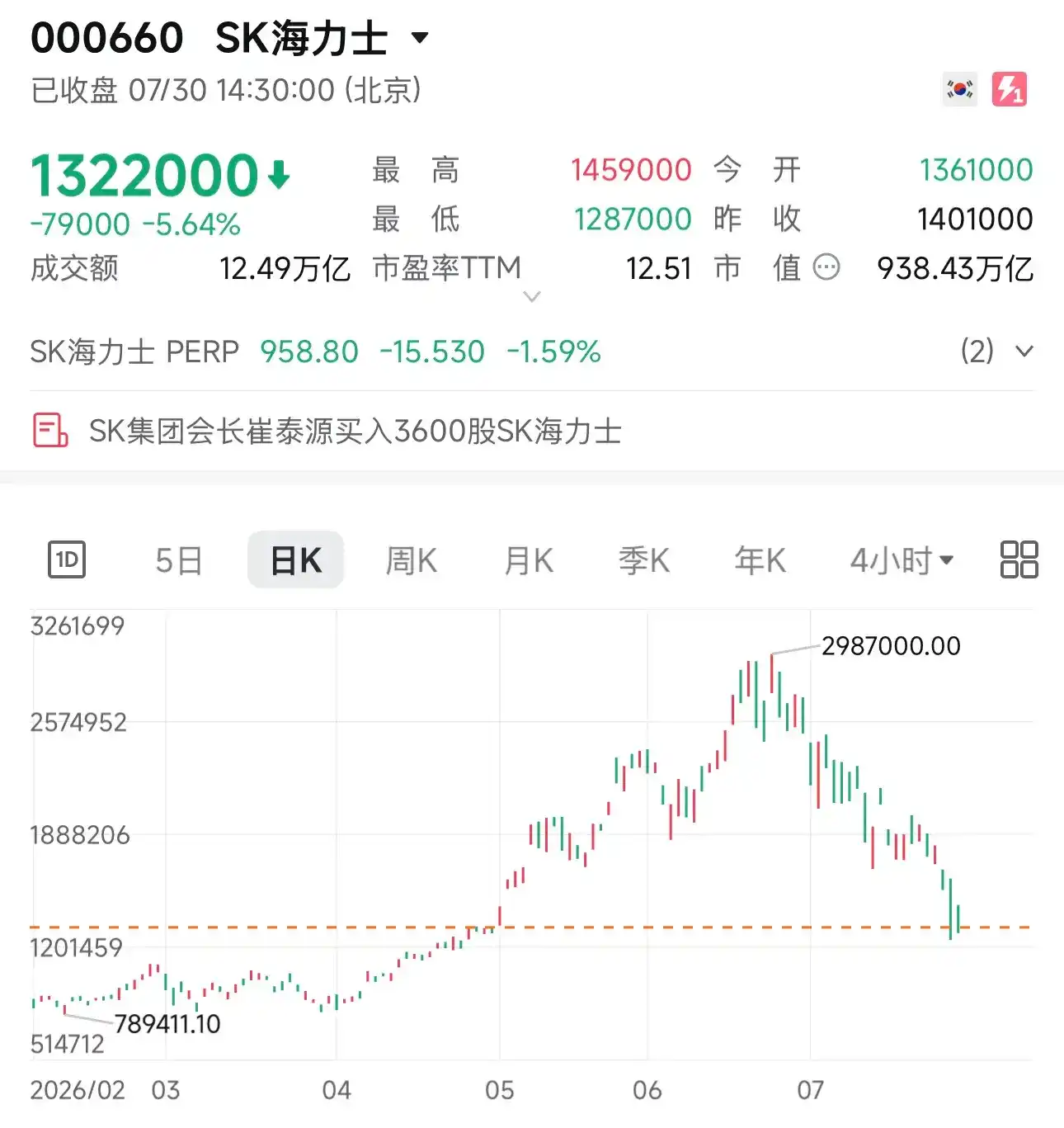
A cross-market bloodbath thus unfolded. The extreme volatility flushed out numerous big V's and traders from the crypto circle. Among them were those who had earned their first pot of gold in the crypto market and those who had already achieved financial freedom. Now, all that's left are reflections and declarations of leaving the scene.

Half Market Conditions, Half Human Nature

Perhaps because the crypto market had been too quiet for too long, memory stocks became the best destination for active capital.

Dp Dapeng (@Dp520888) posted that from the end of last year to the first half of this year, the crypto market was in a constant downtrend. Bitcoin barely caught its breath around $60,000, while South Korean and U.S. stock markets soared on the AI narrative during the same period. Major exchanges, in their efforts to expand markets, had also opened up stock trading access.

He noted that he saw many crypto peers painfully cut losses on their crypto assets and go all-in on Micron and SanDisk at highs, only to lose over 30% subsequently. Had this money stayed in crypto, they could have at least held on until Bitcoin fell to $40,000.

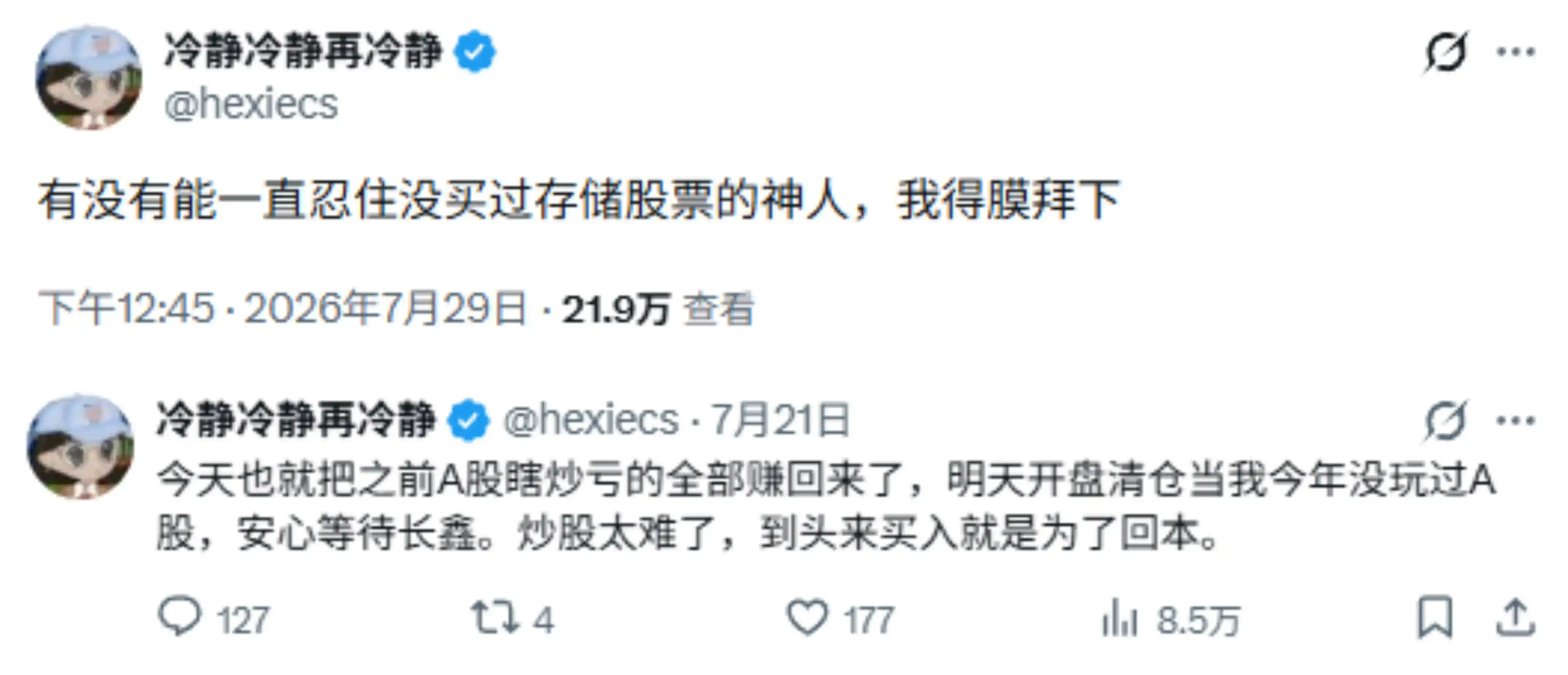
People accustomed to high volatility and tormented by the lack of profit-making opportunities for over half a year found it hard to resist chasing the market that seemed more lucrative. As @hexiecs posted, "Is there any god who has always resisted buying memory stocks? I need to worship them."
However, narratives like AI, GPU, and storage come and go quickly in capital markets. Nvidia's stock price peaked in May and has already wiped out this year's gains, with its total market cap recently overtaken again by Apple. Now it's just storage's turn.

So, the starting point of this crash is half market conditions, half human nature.

Why the Crash This Time?

People transitioning from the crypto circle to the stock market are prone to culture shock.

On one hand, it's the leverage habit. Many start with 2x long positions or add even higher leverage via on-chain perpetual contracts. The same bearish candle that represents a mere pullback in a spot account becomes a liquidation event in a leveraged account.

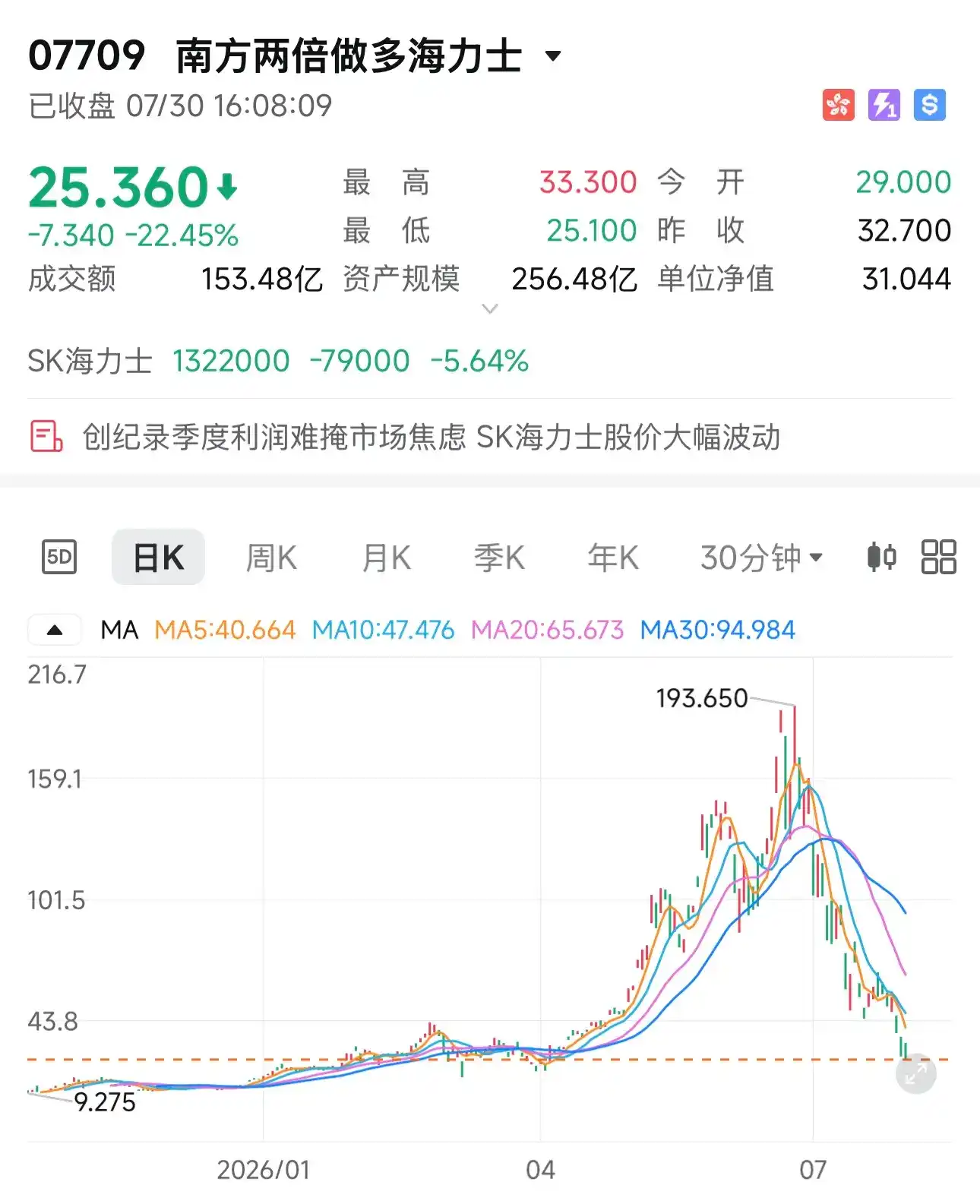
How severe the damage to leveraged products was this round can be seen by looking at the South Korean 2x Long Hynix ETF. This fund was once the world's largest single-stock leveraged product, with peak assets around 130 billion HKD. Its cumulative decline since July has exceeded 80%, with assets now down to 25.6 billion HKD. Another 2x Long Samsung Electronics ETF also fell about 70% this month.
According to Hyperliquid data, on July 29th, the combined 24-hour trading volume for Hynix-related contracts SKHX and SKHY on the platform reached $1.765 billion, becoming the most actively traded asset on the platform, with heat and volume even surpassing BTC.

On the other hand, it's the rule differences. The stock market itself has several sets of rules: U.S. stocks have after-hours trading, South Korean stocks have NXT pre-market, A-shares have price limits, Hong Kong stocks have another set, each with its own trading hours, price bands, and settlement rhythms.

When these underlying assets are packaged into on-chain perpetual contracts, the extreme rules of other markets are bundled in as well. The wick on Hyperliquid on July 28th is a living example.

It is reported that on that day, only one lot of SK Hynix traded in the South Korean pre-market at around $868, about 30% lower than the previous close, right near the lower limit of the price band. This less than $900 real transaction was fed into the chain via the oracle, causing the SKHX perpetual contract to flash crash about 18% in one minute.

According to on-chain data, approximately $80 million was liquidated in the subsequent four hours, with open interest evaporating about $150 million.
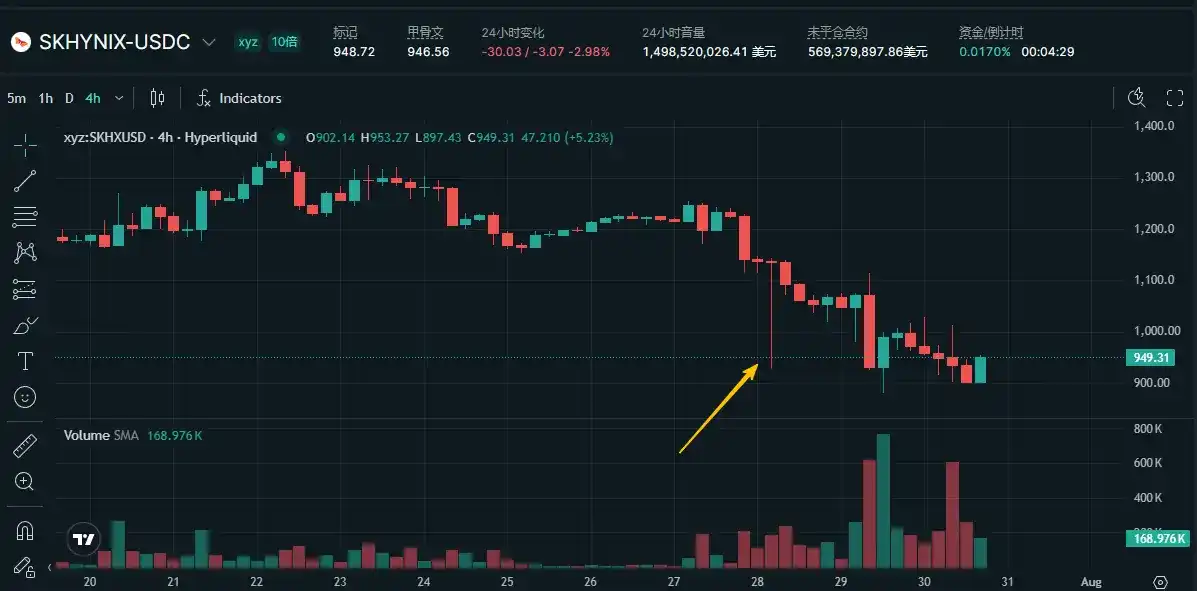
Trade.xyz announced that this price was synchronized from that real transaction in the South Korean pre-market, with the oracle operating according to specifications and no technical error. Although Trade.xyz decided to fully compensate for the liquidation losses this time, it specifically stated this does not constitute a guarantee for similar situations in the future.

Reflections After the Bloodbath

After this bloodbath, many big V's on X began to reflect. Their review focus largely fell on whether the methods they had relied on to make money over the years were still effective after switching markets.

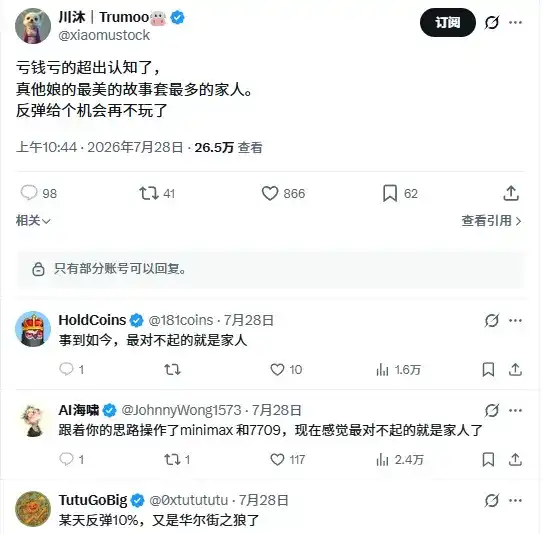
Chuanmu (@xiaomustock) stated that he made and lost money on storage stocks this year. The reason Buffett has survived in the capital market for so long is inseparable from his style of avoiding leverage, not going all-in, and always holding significant idle cash. Ordinary people either lose sleep from anxiety over using leverage to get rich quickly, or continue using leverage after making money, anxious in both profit and loss.
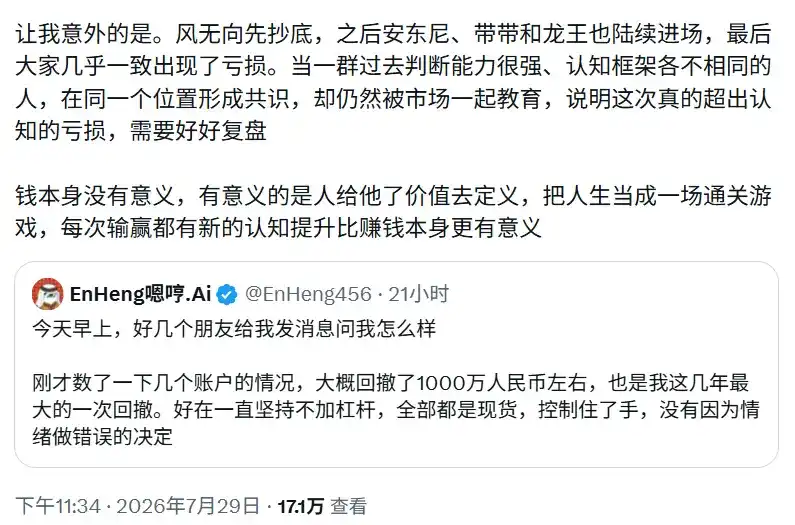
KOL En Heng (@EnHeng456) recounted his three major losses since entering the industry, with this storage wave being the heaviest, resulting in a combined drawdown of over ten million across several accounts, but fortunately, it was all spot trading with no leverage.

He also pointed out that multiple traders with consistently strong judgment and different cognitive frameworks successively entered the market, yet almost all ended up losing. When such a group forms a consensus at the same position but is collectively taught a lesson by the market, it indicates that this loss indeed exceeded their original understanding.
Zishi (@silverfang888), who claimed to have been liquidated for $20 million in semiconductors, also said his biggest regret was moving from crypto to trading stocks. In his view, he is merely a crypto player with limited insight, sitting across from people in the U.S. stock market arena whose cognition and capital far surpass his own.

After being liquidated, many fell into intense self-negation, attributing the losses of these months to their own shallow insight and low cognition. The concentrated outbreak of such emotions also serves as a reminder to everyone using leverage as an amplifier: what the market takes is never just the principal.

Some offered comfort, saying whose trading career hasn't experienced a few such drawdowns? Money lost can be treated as tuition paid. As long as one is still here with spirit intact, there will always be another journey ahead.

In truth, there are very few who can consistently win in the market. Those who can journey a bit further are often those who can still see their own boundaries at different stages.


Kripto yang Sedang Tren

Pertanyaan Terkait

QAccording to the article, what is the main reason behind the significant losses of crypto traders in the stock market?

AThe main reasons are a combination of market conditions and human nature. Crypto traders, accustomed to high volatility, moved to the AI-driven stock market for better returns. However, they faced issues like improper use of leverage and unfamiliarity with the different trading rules of stock markets (like pre-market sessions and price bands), which led to severe losses when the storage sector crashed.

QHow did the specific event on Hyperliquid on July 28th cause major liquidations?

AOn July 28th, a single SK Hynix share traded for around $868 in the Korean pre-market, about 30% lower than the previous close. This price, fed into the chain via an oracle, caused the SKHX perpetual contract on Hyperliquid to flash-crash by about 18% in one minute. This led to approximately $80 million in liquidations and a $150 million drop in open interest over the next four hours.

QWhat is one key trading habit from the crypto world that proved detrimental in the stock market?

AOne key detrimental habit was the immediate use of high leverage. Many traders started with 2x leveraged ETFs or even higher leverage on perpetual contracts. This meant that a price decline that would be a simple drawdown in a spot account resulted in margin calls and liquidations in leveraged positions.

QWhat major reflection did trader '川沐' (@xiaomustock) share after the losses?

ATrader '川沐' reflected that his gains and losses this year both came from the storage sector. He noted that Warren Buffett's longevity in the market is tied to his style of avoiding leverage, not going all-in, and always keeping a large amount of cash on hand. In contrast, ordinary people either lose sleep over leverage-driven anxiety to get rich or continue using leverage after profits, leading to anxiety in both winning and losing.

QWhat was the final attitude or lesson some traders expressed after the market crash?

AAfter the crash, some traders expressed a lesson in humility and recognizing one's boundaries. They acknowledged that moving from the crypto circle to the stock market meant competing against players with far superior knowledge and capital. While some fell into self-doubt, others offered comfort, stating that such drawdowns are part of a trading career, and as long as one's spirit remains, there will always be another opportunity.

Bacaan Terkait

Bitcoin di Agustus: Ahli Menantikan Pengujian Rentang, Bukan Pembalikan Cepat

Bitcoin pada Agustus, menurut para analis, kemungkinan akan tetap berada di bawah tekanan. Setelah pemulihan di bulan Juli, pasar tampaknya belum siap untuk pertumbuhan berkelanjutan, dengan risiko penurunan di bawah $60.000 masih ada. Pada akhir Juli, bitcoin diperdagangkan sekitar $63.500, turun sekitar 50% dari rekor tertingginya pada Oktober 2025. Para ahli menyebut kombinasi kondisi makroekonomi yang sulit sebagai faktor penekan, termasuk suku bunga tinggi di AS, inflasi yang tetap tinggi, dan dolar AS yang kuat. Tingkat bunga yang tinggi membuat instrumen pendapatan tetap lebih menarik, sehingga mengalihkan modal dari aset berisiko seperti kripto. Selain itu, aliran keluar bersih dari ETF berbasis bitcoin pada paruh pertama tahun ini menandakan lemahnya permintaan kelembagaan saat ini. Secara historis, Agustus bukanlah bulan yang kuat untuk pasar kripto. Secara teknis, bitcoin terus bergerak dalam kisaran sempit $60.000–$65.000. Para analis memberikan beberapa skenario untuk bulan ini: skenario dasar adalah pergerakan dalam kisaran $58.000–$68.000 (probabilitas 50%), skenario negatif adalah penurunan ke $50.000–$55.000 (probabilitas 30%), dan skenario positif adalah kenaikan ke $71.000–$75.000 (probabilitas 20%). Saran untuk investor adalah fokus pada akumulasi bertahap pada level saat ini untuk jangka panjang, karena harga dianggap menarik. Namun, kewaspadaan diperlukan terhadap potensi penurunan jangka pendek di bawah $60.000. Pergerakan yang lebih signifikan kemungkinan baru akan terjadi pada kuartal IV tahun ini. Faktor kunci yang perlu dipantau meliputi keputusan suku bunga Fed, inflasi, dinamika ETF, dan minat terhadap aset berisiko.

cryptonews.ru1j yang lalu

Bitcoin di Agustus: Ahli Menantikan Pengujian Rentang, Bukan Pembalikan Cepat

cryptonews.ru1j yang lalu

Dompet Perangkat Keras Coldcard Diretas: Peretas Menarik 594 Bitcoin dalam 25 Menit

Dompet perangkat keras Coldcard berhasil diretas: peretas menarik 594 bitcoin dalam 25 menit. Insiden ini merusak reputasi dompet perangkat keras sebagai metode penyimpanan mata uang digital teraman. Pada 30 Juli 2026, penyerang berhasil menarik 594,5 BTC (sekitar $40 juta) dari 500 alamat. Akar masalahnya adalah bug perangkat lunak yang tak terdeteksi selama lima tahun. Kesalahan pengetikan dalam sebuah makro secara tidak sengaja menonaktifkan fungsi chip khusus untuk menghasilkan angka acak yang benar-benar aman di dompet Coldcard sejak Maret 2021. Alih-alih, perangkat menghasilkan kunci berdasarkan data yang dapat diprediksi, seperti nomor seri prosesor dan waktu sistem, sehingga sangat mengurangi keamanan kriptografinya. Peretas tidak memerlukan akses fisik. Mereka hanya perlu memahami parameter generator yang bermasalah ini dan melakukan pencarian brute-force secara offline untuk menghasilkan kemungkinan frasa seed, menemukan alamat dengan saldo di blockchain publik, dan menandatangani transaksi penarikan. Perusahaan di balik Coldcard, Coinkite, awalnya menyatakan versi baru tidak rentan, tetapi kemudian mengakui semua perangkat yang menjalankan firmware yang terpengaruh berisiko. CEO mereka meminta maaf namun mengecualikan kompensasi finansial kepada korban. Pemilik yang terdampak harus segera: 1. Memperbarui firmware ke versi aman (4.2.0 untuk Mk3, 5.6.0 untuk Mk4/Mk5, atau 1.5.0Q untuk model Q). 2. Menghasilkan frasa seed baru yang benar-benar acak pada perangkat yang telah diperbarui. 3. Memindahkan semua dana ke alamat baru yang dibuat dari frasa seed tersebut. Penggunaan frasa sandi BIP-39 dapat membantu, tetapi tidak menggantikan kebutuhan membuat kunci baru. Insiden ini menyoroti bahwa bahkan perangkat keras khusus memerlukan audit kode independen yang berkelanjutan, terutama untuk fungsi kriptografi. Beberapa lanalisis, termasuk dari Galaxy Research, memperkirakan total dana yang dicuri bisa mencapai 1.000 BTC. Kasus ini mengingatkan pada insiden serupa di masa lalu, seperti bug OpenSSL di Debian, dan mempertanyakan apakah audit otomatis oleh AI dapat sepenuhnya menggantikan tinjauan manusia pada kode kritis.

cryptonews.ru1j yang lalu

Dompet Perangkat Keras Coldcard Diretas: Peretas Menarik 594 Bitcoin dalam 25 Menit

cryptonews.ru1j yang lalu

Trading

Spot

Artikel Populer

Cara Membeli T

Selamat datang di HTX.com! Kami telah membuat pembelian Threshold Network Token (T) menjadi mudah dan nyaman. Ikuti panduan langkah demi langkah kami untuk memulai perjalanan kripto Anda.Langkah 1: Buat Akun HTX AndaGunakan alamat email atau nomor ponsel Anda untuk mendaftar akun gratis di HTX. Rasakan perjalanan pendaftaran yang mudah dan buka semua fitur.Dapatkan Akun SayaLangkah 2: Buka Beli Kripto, lalu Pilih Metode Pembayaran AndaKartu Kredit/Debit: Gunakan Visa atau Mastercard Anda untuk membeli Threshold Network Token (T) secara instan.Saldo: Gunakan dana dari saldo akun HTX Anda untuk melakukan trading dengan lancar.Pihak Ketiga: Kami telah menambahkan metode pembayaran populer seperti Google Pay dan Apple Pay untuk meningkatkan kenyamanan.P2P: Lakukan trading langsung dengan pengguna lain di HTX.Over-the-Counter (OTC): Kami menawarkan layanan yang dibuat khusus dan kurs yang kompetitif bagi para trader.Langkah 3: Simpan Threshold Network Token (T) AndaSetelah melakukan pembelian, simpan Threshold Network Token (T) di akun HTX Anda. Selain itu, Anda dapat mengirimkannya ke tempat lain melalui transfer blockchain atau menggunakannya untuk memperdagangkan mata uang kripto lainnya.Langkah 4: Lakukan trading Threshold Network Token (T)Lakukan trading Threshold Network Token (T) dengan mudah di pasar spot HTX. Cukup akses akun Anda, pilih pasangan perdagangan, jalankan trading, lalu pantau secara real-time. Kami menawarkan pengalaman yang ramah pengguna baik untuk pemula maupun trader berpengalaman.

981 Total TayanganDipublikasikan pada 2024.12.10Diperbarui pada 2026.06.02

Cara Membeli T

Diskusi

Selamat datang di Komunitas HTX. Di sini, Anda bisa terus mendapatkan informasi terbaru tentang perkembangan platform terkini dan mendapatkan akses ke wawasan pasar profesional. Pendapat pengguna mengenai harga T (T) disajikan di bawah ini.

活动图片