Hyperliquid First Discloses HIP-4 Permissionless Deployment Specifications: Threshold Aligns with HIP-3, but Adds a Template Approval Layer

Foresight NewsDipublikasikan tanggal 2026-07-20Terakhir diperbarui pada 2026-07-20

Abstrak

Hyperliquid founder Jeff Yan announced plans for permissionless deployment of HIP-4 outcome markets in a future network upgrade, moving from testnet to mainnet. This follows the initial, validator-voted deployment phase on mainnet that began in May. The announcement details key mechanisms for the permissionless phase. The staking requirement is set at 500,000 HYPE (locked for 6 months), matching HIP-3. A core new feature is a "template system": validators will vote on and store standardized market templates on-chain, and deployers can only create markets by instantiating these pre-approved templates. This aims to ensure market quality and clarity. Deployers will also have an initial quota of 100 outcomes (200 tokens), which refreshes after settlements. The reasoning for permissionless deployment is the vast potential universe of tradable events for prediction markets, which far exceeds the finite assets available for perpetual contracts. While HIP-4 has seen $370M in volume over 78 days, its market share remains small compared to established players. The model mirrors HIP-3's successful expansion of perpetual contracts after opening deployment. Rules include slashing stakes for unclear definitions or incorrect/delayed settlements. This incentivizes short-duration markets, as long-term settlements would lock capital and quota for extended periods. The template system addresses definition clarity but does not prevent potential liquidity fragmentation or market concentration,...


Author:angelilu, Foresight News


Hyperliquid founder Jeff Yan posted an announcement about HIP-4 on his Discord, stating that outcome markets will support permissionless deployment in an upcoming network upgrade, first on testnet and then on mainnet.


The wording of the announcement is that, just like the deployment of spot and perpetual contracts, this outcome markets technology needs to undergo sufficient real-world testing in an environment deployed by validators before it can be expanded to permissionless deployment.
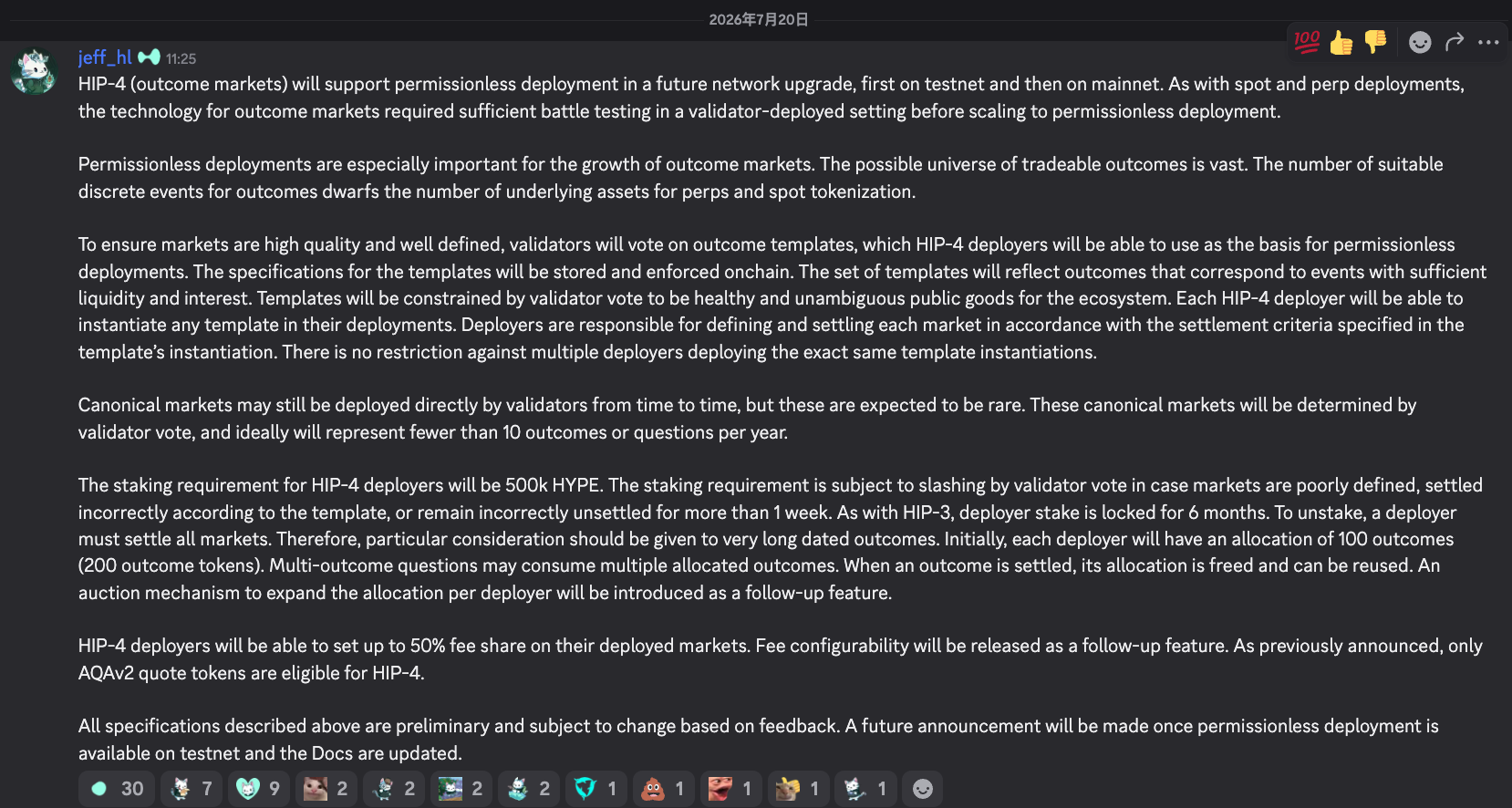


The announcement did not give a specific date and noted at the end that all specifications are preliminary and may be adjusted based on feedback. However, it disclosed a set of mechanism details that had not been made public in detail before.


What Stage Has HIP-4 Reached Now?


On February 2, 2026, the Hyperliquid team announced HIP-4, introducing a new primitive called "Outcome Trading." According to the official documentation definition, outcome contracts are fully collateralized, with settlement prices falling within a fixed range. They are suitable for prediction markets and bounded option-like instruments, introducing nonlinear characteristics and dated contracts, and involve no leverage or liquidation. Each outcome market has two directions, each corresponding to a token, typically labeled Yes and No, with their order books merged to share liquidity. A "question" is a collection of outcomes, where exactly one outcome will settle as Yes.


In the same month, HIP-4 went live on testnet. On May 2nd, it officially launched on mainnet, with the first market being a cyclic binary outcome market, settling daily at 06:00 UTC based on the BTC mark price on HyperCore, with zero fees for opening positions. Subsequently, Hyperliquid extended outcome markets to off-chain events, with the first off-chain market being "May CPI YoY."


However, this mainnet phase is "validator-deployed." Which markets to open are decided by validator votes, and external parties cannot launch markets themselves. Therefore, this new announcement is about the upcoming next phase.


Why Is Permissionless Deployment Necessary?


The reason given by Hyperliquid founder Jeff Yan in the announcement is straightforward: within outcome markets, the universe of tradable outcomes is extremely vast. The number of discrete events suitable for outcome contracts far exceeds the number of underlying assets for perpetual contracts and spot tokenization. The underlying assets for perpetual contracts are finite - coins, stocks, commodities, indices - they can be counted. However, real-world events that can be bet on are infinite. Relying on validators to vote on listing them one by one can never keep up with supply and demand.


To understand the urgency of permissionless deployment, one must first look at the actual performance of HIP-4 on mainnet over these two and a half months.


Over 78 days since HIP-4 launch, cumulative trading volume reached $370 million, with a cumulative number of trades reaching 7 million. The peak daily volume occurred on June 27th, at $12.96 million.

https://hl.eco/hip4
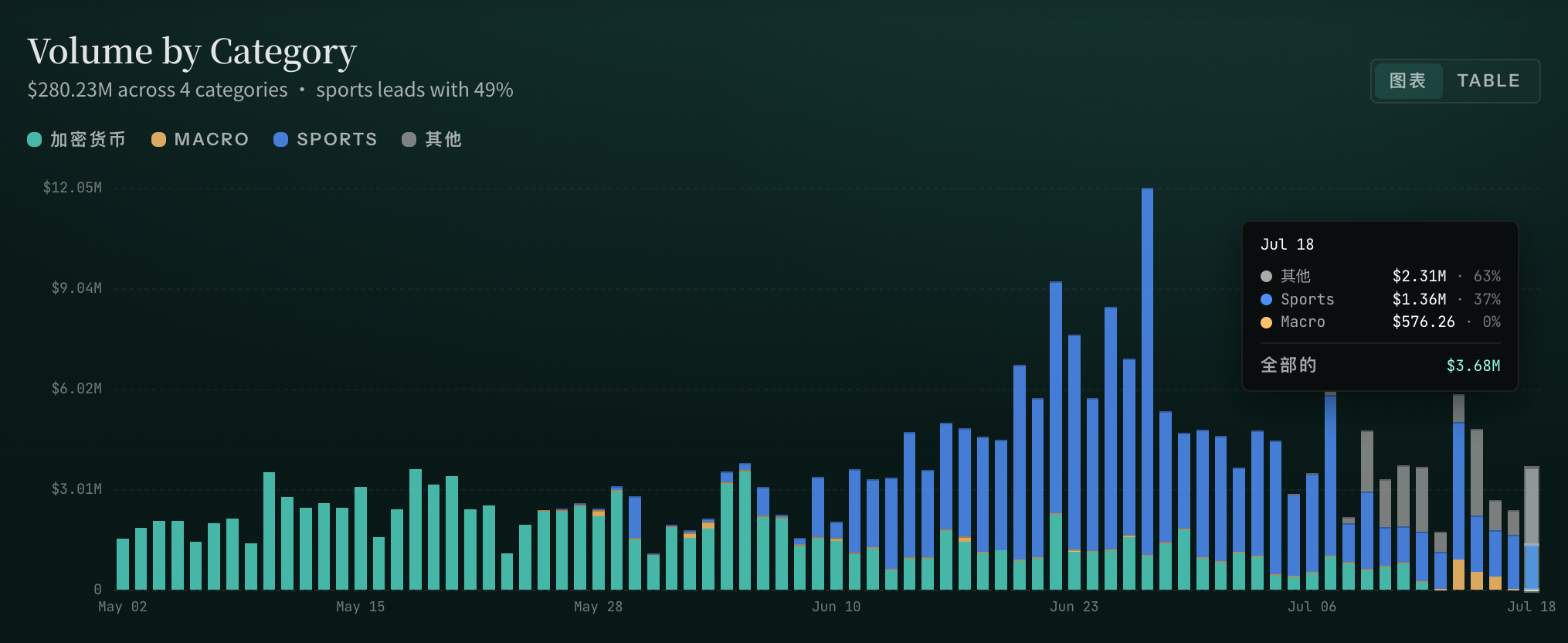

From May 2nd to early June, trading was almost entirely from cryptocurrency categories, with daily volume between $1 million and $3.5 million. When the World Cup started on June 11th, sports categories instantly took over, pushing volume to three to four times the previous baseline.
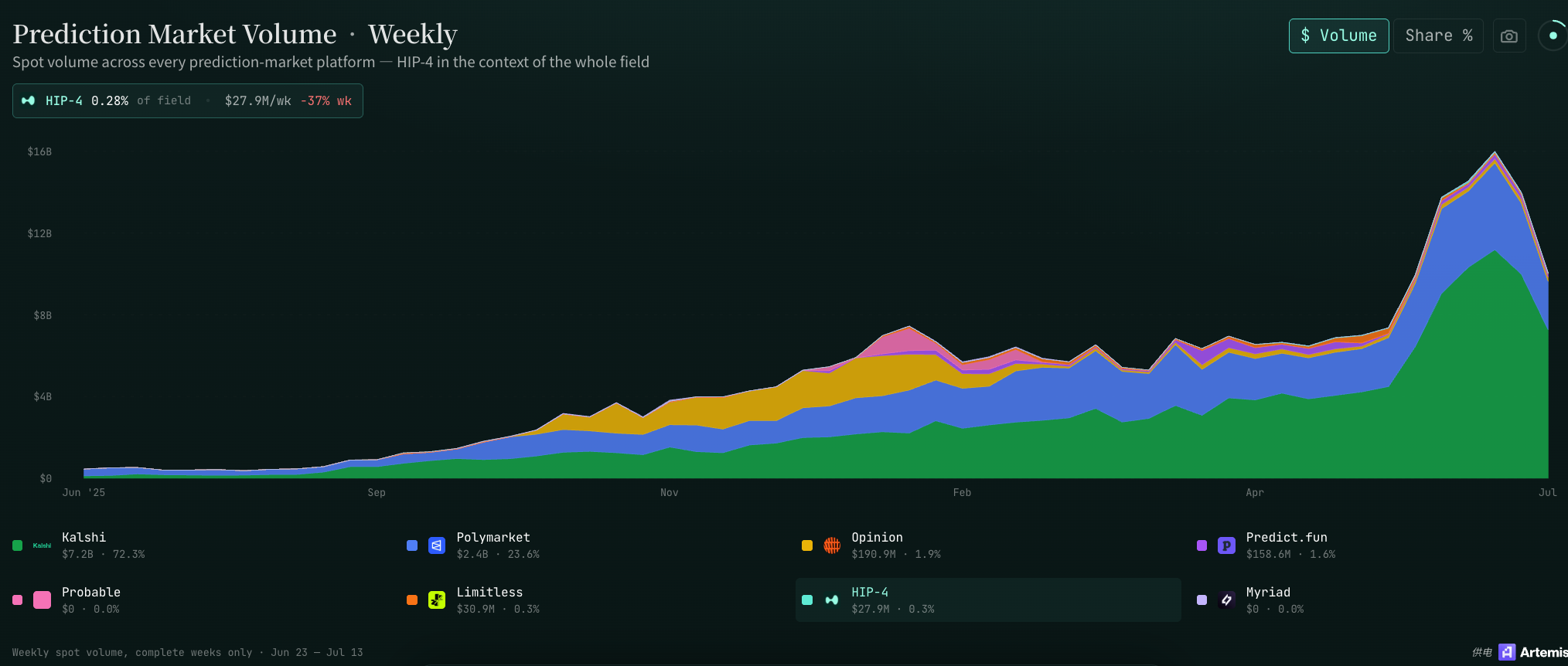


The figures from competitors during the same period are of another order of magnitude. Taking weekly data as an example, for the week of July 13th (during the World Cup), the weekly trading volumes for Kalshi and Polymarket were $7.2 billion and $2.4 billion respectively, while HIP-4's trading volume was $27.9 million. HIP-4's market share in prediction markets was only 0.3%.


But this logic has already been successfully validated once on Hyperliquid. HIP-3 allowed anyone to deploy perpetual contract markets after staking HYPE. It launched on October 13, 2025, and subsequently listed Nvidia, Tesla, gold, crude oil, S&P 500, and other underlying assets.


According to HIP-3 Ecosystem data, as of the time of writing, HIP-3's historical trading volume is $387.72 billion, and open interest has grown from about $790 million in January 2026 to $3.43 billion in July; HIP-3's share of Hyperliquid's trading volume reached 47.2% at the time of writing. Opening up the supply side indeed brought explosive growth.


Several New Mechanisms for HIP-4


Therefore, at the end of the World Cup, when all prediction markets are exploring new underlying assets, Hyperliquid announced several new mechanisms for HIP-4 at this time.


Staking Threshold is 500,000 HYPE Tokens


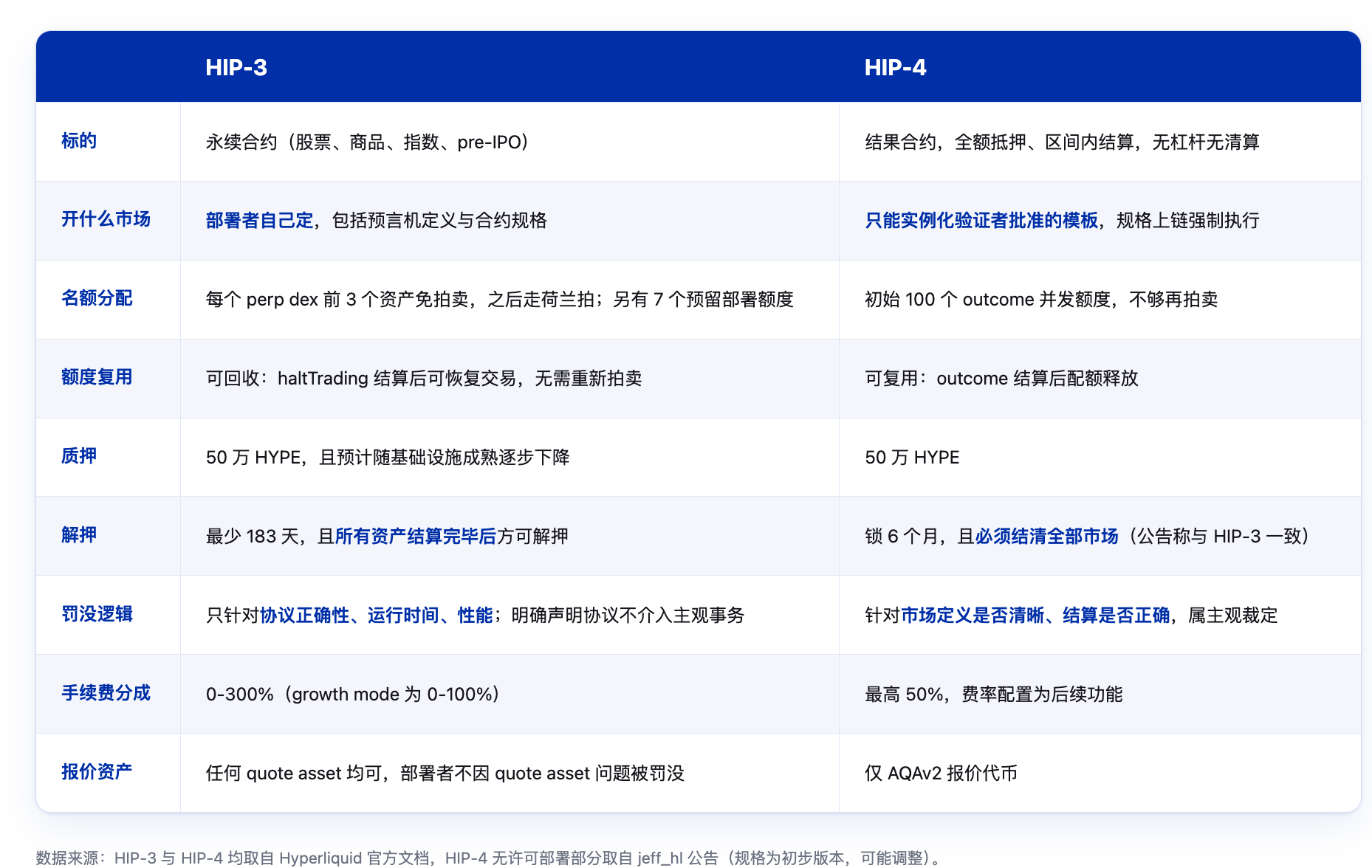
As for the staking threshold for HIP-4 deployers, this announcement is the first time Hyperliquid has publicly explained the staking requirements for HIP-4 permissionless deployment. Previously, community speculation placed the number at 1 million HYPE, twice that of HIP-3. This announcement states it's 500,000 HYPE, aligning with HIP-3. Staked tokens will be locked for 6 months and may be slashed if market definitions are unclear or settlements are delayed.


Template System


The template system is the core of this design. To ensure market quality and clear definitions, validators will vote on "outcome templates." Template specifications are stored on-chain and enforced. HIP-4 deployers can only perform permissionless deployment based on these templates, filling in parameters themselves to instantiate specific markets. The announcement requires that templates must be "healthy and unambiguous public goods for the ecosystem" and that corresponding events must have sufficient liquidity and attention. Deployers are responsible for defining and settling each market according to the settlement criteria specified when instantiating the template. The announcement explicitly does not restrict multiple deployers from deploying identical template instances.


Why add this layer? It's related to the product form. Perpetual contracts have continuous prices; if the market is off, it corrects itself. Outcome contracts settle at a definite value upon expiration; once the settlement is judged incorrectly, money is directly awarded to the wrong side.


Quota System


The quota system is another new element. Each deployer is initially allocated 100 outcomes (200 outcome tokens). One outcome corresponds to YES and NO two tokens. Multi-outcome questions consume multiple outcomes; for example, a five-choice question is split into five binary outcomes, occupying five. The quota is released and can be reused after an outcome settles; this is a concurrent upper limit, not a lifetime limit. The announcement states that an auction mechanism will be introduced later to expand an individual deployer's quota.


Slashing and Locking


Slashing and locking determine what this market will ultimately become. Stakes can be slashed by validator vote for three reasons: unclear market definition, failure to settle correctly according to the template, and failure to settle correctly for over a week. As with HIP-3, deployer stakes are locked for 6 months, and all markets must be settled before unstaking. The announcement itself warns that special caution is needed for very long-term outcomes.


The consequence of this rule is very practical. Launching a market that settles two years later means 500,000 HYPE is locked for two years, and the quota is also occupied the entire time. Rational deployers will only create markets with short cycles and frequent settlements. The difference in product form between HIP-4 and Polymarket is not entirely a strategic choice; it's also a result pushed by the mechanism.


Additionally, deployers can set up to 50% fee share for the markets they deploy; fee rate configuration will be released as a subsequent feature; only AQAv2 quote tokens can be used for HIP-4; validators may still occasionally deploy outcome markets directly, but it is expected to be very rare, aiming for fewer than 10 outcomes or questions per year.


Issues Not Addressed by the Template System


From the HIP-3 experience, there are aspects worth HIP-4 being cautious about.


hl.eco shows HIP-3 currently has 8 active deployers and 204 markets, but Trade.XYZ alone accounts for over 90% of all HIP-3 open interest. Some analyses indicate that this high concentration by a single deployer may constitute a structural/centralization risk for Hyperliquid.
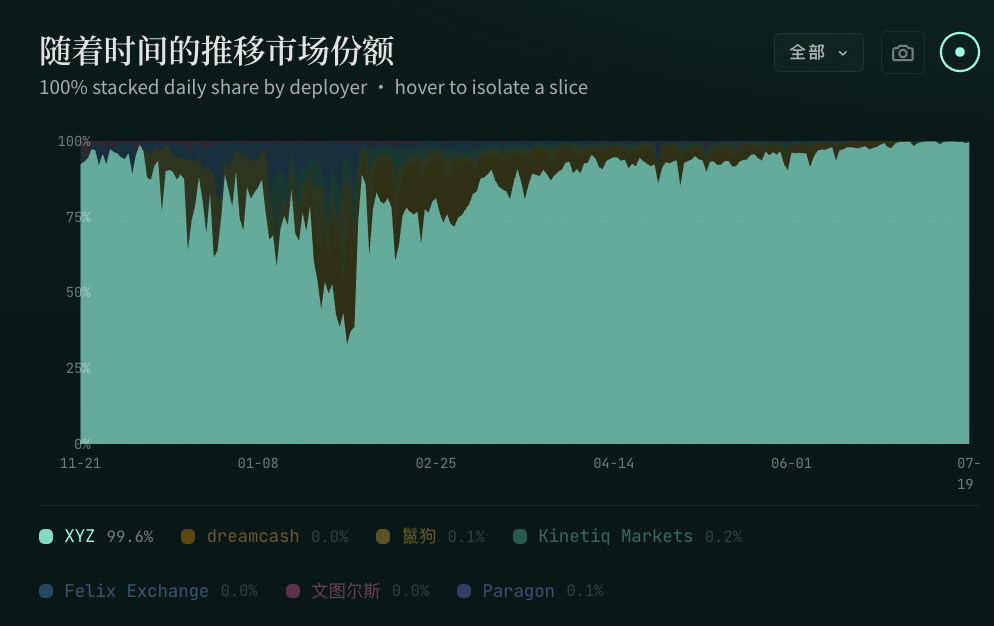


The template system in these new HIP-4 rules governs market quality, not market share. Where users trade depends on depth. HIP-4 explicitly allows multiple deployers to instantiate identical templates, which sounds like encouraging competition. However, if the same question is opened as five identical markets, liquidity will only be further fragmented, ultimately still converging towards the deepest pool.


Kripto yang Sedang Tren

Pertanyaan Terkait

QWhat is the main announcement regarding HIP-4 made by Hyperliquid founder Jeff Yan?

AJeff Yan announced that Outcome Markets (HIP-4) will support permissionless deployment in an upcoming network upgrade, first on testnet and then on mainnet. This will allow external users to deploy their own markets.

QWhat are the two key reasons provided in the article for HIP-4 needing permissionless deployment?

AFirst, the universe of tradable outcomes for prediction markets is vast and practically infinite, far exceeding the finite number of underlying assets for perpetual contracts. Second, the success of HIP-3's permissionless deployment for perpetual contracts demonstrated that opening up the supply side leads to explosive growth.

QWhat is the staking requirement for a HIP-4 deployment, and how does it compare to HIP-3?

AThe staking requirement for HIP-4 permissionless deployment is 500,000 HYPE, which is the same as the requirement for HIP-3. The staked tokens will be locked for 6 months and are subject to slashing for issues like unclear market definitions or delayed settlements.

QWhat is the 'template system' for HIP-4, and what is its primary purpose?

AThe template system requires validators to vote on and approve 'outcome templates' which are stored on-chain. HIP-4 deployers can then use these approved templates to create specific markets by filling in parameters. Its purpose is to ensure market quality, definition clarity, and that events have sufficient liquidity and attention.

QAccording to the article, what is a potential issue that the new HIP-4 rules do not solve, based on experience with HIP-3?

AThe new rules, including the template system, focus on market quality but do not address the potential problem of market concentration. Similar to HIP-3 where a single deployer dominates the open interest, liquidity in HIP-4 might still consolidate into a few deep markets even if multiple identical markets are allowed, leading to fragmented liquidity.

Bacaan Terkait

Setelah Tiga Kuartal Berturut-Turut Turun, Bisakah Pasar Kripto Menyambut Jendela Stabilitas di Kuartal Ketiga?

Pasar kripto mengalami kuartal terburuk sejak 2022, dengan kapitalisasi pasar turun 12.6% menjadi $2.1 triliun, didorong oleh keluarnya modal dan penurunan volume perdagangan. Bitcoin dan Ethereum masing-masing jatuh 14.2% dan 25.4% di kuartal kedua. Aliran keluar bersih dari ETF Bitcoin AS mencapai $4.67 miliar, menandakan tekanan jual yang berkelanjutan. Faktor utama meliputi terputusnya hubungan dengan saham AS, kebijakan moneter Federal Reserve yang ketat, dan pelepasan aset oleh perusahaan seperti Strategy. Proses legislasi UU CLARITY yang akan memberikan kejelasan regulasi terhambat, meningkatkan premi risiko di sektor ini. Namun, ada tanda-tanda potensi stabilisasi. Aliran keluar ETF yang besar secara historis sering terjadi di akhir fase penurunan, dan para pemegang Bitcoin jangka panjang mulai menambah kepemilikan lagi. Sementara sebagian besar sektor menyusut, pasar prediksi dan aset koleksi yang ditokenisasi mencatat pertumbuhan signifikan. Pandangan untuk kuartal ketiga sangat bergantung pada pertemuan Fed akhir Juli. Sinyal kebijakan yang lunak dapat mendukung pemulihan Bitcoin, sementara sikap yang hawkish dapat memicu konsolidasi lebih lanjut. Meskipun tantangan regulasi tetap ada, indikator teknis seperti harga Bitcoin yang mendekati rata-rata bergerak 200-mingguannya menunjukkan dasar jangka panjang belum rusak. Logika pasar telah bergeser dari mengandalkan narasi ke faktor fundamental seperti kebijakan dan ekspektasi suku bunga.

marsbit35m yang lalu

Setelah Tiga Kuartal Berturut-Turut Turun, Bisakah Pasar Kripto Menyambut Jendela Stabilitas di Kuartal Ketiga?

marsbit35m yang lalu

The SpaceX Trade, Terbuka: SPCXON Mulai Diperdagangkan di WEEX

SpaceX meluncurkan IPO terbesar dalam sejarah pada Juni 2026, namun akses bagi banyak pedagang terhambat oleh batasan regional dan prosedur broker. WEEX kini menghadirkan SPCXON/USDT di pasar spotnya, sebuah instrumen tokenisasi yang memungkinkan paparan terhadap pergerakan harga SpaceX melalui akun kripto yang diselesaikan dengan USDT, tanpa memerlukan broker AS atau pembiayaan bank. SPCXON adalah produk tokenisasi yang mencerminkan ekonomi kepemilikan SpaceX bagi pedagang yang memenuhi syarat di luar AS, dengan dividen diinvestasikan kembali. Aset ini diperdagangkan di WEEX sebagai pasangan spot dengan USDT, tersedia selama jam pasar, memberikan akses mudah bagi trader kripto. Kasus investasi untuk SpaceX didasarkan pada pertumbuhan pendapatan Starlink dan pencapaian Starship, meskipun valuasinya yang tinggi (sekitar 90-110 kali pendapatan) telah memperhitungkan eksekusi sempurna selama bertahun-tahun. Faktor seperti jumlah saham publik yang terbatas dan masa buka kunci (unlock) insider pertama menjadi pertimbangan penting. Penting untuk diingat bahwa SPCXON memberikan paparan, bukan kepemilikan langsung atas saham atau hak suara. Harganya dapat diperdagangkan pada premium atau diskon terhadap nilai aset bersih. WEEX menawarkan akses ke berbagai aset TradFi yang ditokenisasi seperti ini dalam satu akun terpadu, bersama dengan pasar futures dan kampanye perdagangan dengan pool hadiah.

TheNewsCrypto42m yang lalu

The SpaceX Trade, Terbuka: SPCXON Mulai Diperdagangkan di WEEX

TheNewsCrypto42m yang lalu

Momen Perdagangan BIT: BTC Masih Tertekan oleh EMA 200 Mingguan, Setelah Ditolak Mungkin Kembali Turun, Saham Penyimpanan dan Semikonduktor yang Melonjak Malam Kemudian Mulai Anjlok di Pasar Malam

**PASAR KRIPTO & SAHAM: BTC Hadapi Resistensi, Saham Semikonduktor Turun di Perdagangan Malam** Pasar kripto melanjutkan pemulihan, dengan harga Bitcoin bertahan di sekitar $66,000 setelah rebound lebih dari 15% dari titik terendah Juli. Namun, BTC menghadapi **tembok resistensi kuat di dekat $68,000**, yang bertepatan dengan biaya rata-rata investor selama lima bulan terakhir dan titik gagalnya rebound pertengahan Juni. Secara teknis, perhatian tertuju pada **200 EMA mingguan (~$68,328) sebagai level kunci**. Jika BTC ditolak di level ini, potensi penurunan menuju support $63,000 terbuka. Analis menyoroti volume rendah dan penurunan open interest futures di CME, menandakan rebound ini lebih dipicu likuiditas rendah musim panas daripada awal bull run penuh. Di pasar saham AS, **indeks futures utama turang** setelah sesi kemarin yang kuat. Sektor semikonduktor dan penyimpanan (storage), yang melonjak pada hari Selasa (contoh: Micron +12%), **mengalami koreksi di perdagangan malam (night trading)**. ETF semikonduktor turun 2,22% dan saham Micron turun 2,29%. Meski begitu, ada sorotan positif seperti **Super Micro Computer (SMCI)** yang naik lebih dari 15% setelah melaporkan pandangan pendapatan yang kuat dan pesanan baru yang sangat besar, mengonfirmasi permintaan server AI tetap solid. Kekhawatiran makro muncul dari **kenaikan harga minyak mentah (di atas $91)** akibat ketegangan geopolitik dan **lonjakan imbal hasil (yield) obligasi pemerintah AS**, dengan imbal hasil 10-tahun mencapai sekitar 4,64%. Faktor-faktor ini dapat menambah tekanan inflasi dan membatasi ruang gerak pasar saham. Saham terkait kripto seperti Coinbase dan Robinhood naik kuat didorong oleh perkembangan regulasi yang lebih jelas di AS. Di Asia, **Korea Selatan** dan **Jepang** menunjukkan kinerja beragam. Indeks KOSPI Korea naik didukung pemulihan saham semikonduktor, sementara pasar Jepang melemah dengan **Yen terus melemah ke level terendah sejak 1986**, meningkatkan kekhawatiran akan intervensi bank sentral. **Yang Perlu Diperhatikan Selanjutnya:** * **22 Juli:** Acara AI AMD, rilis laporan keuangan dari Google (Alphabet), Tesla, IBM. * **23 Juli:** Keputusan suku bunga Bank Sentral Eropa (ECB), data klaim pengangguran AS, laporan keuangan Intel. * Perkembangan lebih lanjut dari **harga minyak, imbal hasil obligasi, dan dinamika Yen Jepang** akan menjadi penentu sentimen pasar risiko secara keseluruhan.

marsbit43m yang lalu

Momen Perdagangan BIT: BTC Masih Tertekan oleh EMA 200 Mingguan, Setelah Ditolak Mungkin Kembali Turun, Saham Penyimpanan dan Semikonduktor yang Melonjak Malam Kemudian Mulai Anjlok di Pasar Malam

marsbit43m yang lalu

Mantan Ketua CFTC dan Presiden Circle, Tarbert: Satu Pihak Menasihati Anda untuk Berpikir Jangka Panjang, di Sisi Lain Menguangkan $30 Juta Sendiri

Penulis: Zen, PANews Heath Tarbert, mantan Ketua CFTC dan Presiden Circle, baru-baru ini menyerukan kepada investor untuk mengadopsi pandangan jangka panjang terhadap saham Circle, meskipun harganya telah turun 70% dari puncaknya. Namun, ia sendiri secara konsisten menjual saham CRCL sejak perusahaan go public, menguangkan sekitar $30 juta tanpa pernah membeli saham tambahan di pasar terbuka. Tarbert, yang bergabung dengan Circle pada Juli 2023 dan menjadi Presiden pada awal 2025, dikenal sebagai pendukung kuat narasi "jangka panjang" perusahaan. Namun, sehari sebelum IPO Circle, ia menetapkan rencana perdagangan 10b5-1 untuk menjual hingga 353.290 saham dalam setahun. Dalam 13 bulan setelah IPO, ia menjual lebih dari 360.000 saham, termasuk penjualan tunggal senilai $11,5 juta pada Maret 2026. Ia bahkan menetapkan rencana 10b5-1 kedua untuk menjual hingga 160.000 saham lagi pada akhir tahun 2026. Langkah Tarbert ini menuai kecaman karena dianggap tidak konsisten dengan pesan "jangka panjang" yang ia sampaikan kepada publik. Perjalanan kariernya sering dikaitkan dengan "revolving door" antara regulator dan dunia keuangan. Setelah mengundurkan diri sebagai Ketua CFTC pada Maret 2021, ia bergabung dengan Citadel Securities hanya 27 hari kemudian sebagai Kepala Penasihat Hukum, tepat saat perusahaan itu menghadapi pengawasan ketat terkait peristiwa GameStop. Di Citadel, ia juga mendukung undang-undang yang memperluas wewenang CFTC atas pasar crypto, sementara Citadel diketahui berencana berekspansi ke aset kripto. Tarbert kemudian pindah ke Circle pada 2023, membantu perusahaan mengatasi tantangan regulasi dan akhirnya go public melalui IPO langsung. Meskipun sangat berharga bagi perusahaan, tindakannya menjual saham dalam jumlah besar sambil mendorong investor untuk bertahan menimbulkan pertanyaan tentang komitmennya yang sebenarnya terhadap masa depan jangka panjang Circle.

marsbit1j yang lalu

Mantan Ketua CFTC dan Presiden Circle, Tarbert: Satu Pihak Menasihati Anda untuk Berpikir Jangka Panjang, di Sisi Lain Menguangkan $30 Juta Sendiri

marsbit1j yang lalu

Gate Research Institute: Produk Keuangan Kripto Menggulirkan Gelombang "Wall Street-ization", Kompetisi atau Integrasi?

**Ringkasan: Gelombang "Wall Street-ization" Produk Keuangan Kripto: Kompetisi atau Integrasi?** Artikel ini membahas fenomena konvergensi antara keuangan tradisional (TradFi) dan keuangan kripto (Crypto). Meskipun Bitcoin awalnya dirancang sebagai sistem peer-to-peer yang terdesentralisasi dan bebas dari perantara seperti bank, pasar kripto kini semakin diintegrasikan ke dalam infrastruktur keuangan tradisional. **Tren "Wall Street-ization":** Dimulai dengan disetujuinya ETF spot Bitcoin pada 2024, aset kripto kini dikemas menjadi produk seperti ETF (oleh BlackRock, Fidelity, dll.), futures, dan sekuritisasi aset riil (RWA) seperti obligasi pemerintah yang ditokenisasi. Ini memberikan akses yang mudah dan teregulasi bagi investor institusional, tetapi juga berarti kekuasaan atas penerbitan, penentuan harga, kustodian, dan distribusi aset kripto semakin bergeser ke lembaga keuangan besar. **Dua Jalur Konvergensi (1+1>2):** Artikel ini menyoroti dua arah integrasi: 1. **Dari CEX ke TradFi:** Dilambangkan oleh **Gate.io**, yang berkembang dari bursa kripto menjadi platform multi-aset. Gate kini menawarkan perdagangan saham nyata (AS, Hong Kong, Korea) menggunakan USDT, menyediakan akses tanpa batas waktu ke pasar tradisional. 2. **Dari TradFi ke Crypto:** Dilambangkan oleh **Robinhood**, platform broker tradisional yang memperluas layanannya ke aset kripto (termasuk melalui akuisisi Bitstamp) dan mengembangkan produk seperti token saham di blockchain. **Tujuan Bersama: Akun Keuangan "Super" Terpadu:** Kedua jalur ini bertujuan menciptakan **akun keuangan generasi berikutnya yang terpadu**. Pengguna di masa depan mungkin dapat memperdagangkan Bitcoin, saham Apple, ETF, emas, dan obligasi pemerintah yang ditokenisasi dalam satu antarmuka yang sama, menggunakan stablecoin sebagai lapisan dana. **RWA dan Obligasi Pemerintah di On-Chain sebagai Lapisan Tengah:** Tokenisasi aset dunia nyata, terutama obligasi pemerintah AS, menyediakan aset berpenghasilan rendah risiko di ekosistem on-chain. Pasar ini tumbuh pesat (naik 40% pada paruh pertama 2026) meskipun pasar kripto turun, menunjukkan permintaan nyata. **Kesimpulan:** "Wall Street-ization" bukanlah pengambilalihan sepihak, melainkan **transformasi timbal balik**. TradFi dan Crypto saling melengkapi: Crypto mendapatkan akses ke likuiditas, kepatuhan, dan jaringan distribusi yang luas, sementara TradFi mengadopsi efisiensi, kecepatan, dan pasar 24/7 dari Crypto. Hasil akhirnya adalah pembentukan **pasar modal terpadu yang lebih efisien dan global**, di mana batas antara aset tradisional dan kripto semakin kabur.

marsbit1j yang lalu

Gate Research Institute: Produk Keuangan Kripto Menggulirkan Gelombang "Wall Street-ization", Kompetisi atau Integrasi?

marsbit1j yang lalu

Trading

Spot

Artikel Populer

Cara Membeli 4

Selamat datang di HTX.com! Kami telah membuat pembelian 4 (4) menjadi mudah dan nyaman. Ikuti panduan langkah demi langkah kami untuk memulai perjalanan kripto Anda.Langkah 1: Buat Akun HTX AndaGunakan alamat email atau nomor ponsel Anda untuk mendaftar akun gratis di HTX. Rasakan perjalanan pendaftaran yang mudah dan buka semua fitur.Dapatkan Akun SayaLangkah 2: Buka Beli Kripto, lalu Pilih Metode Pembayaran AndaKartu Kredit/Debit: Gunakan Visa atau Mastercard Anda untuk membeli 4 (4) secara instan.Saldo: Gunakan dana dari saldo akun HTX Anda untuk melakukan trading dengan lancar.Pihak Ketiga: Kami telah menambahkan metode pembayaran populer seperti Google Pay dan Apple Pay untuk meningkatkan kenyamanan.P2P: Lakukan trading langsung dengan pengguna lain di HTX.Over-the-Counter (OTC): Kami menawarkan layanan yang dibuat khusus dan kurs yang kompetitif bagi para trader.Langkah 3: Simpan 4 (4) AndaSetelah melakukan pembelian, simpan 4 (4) di akun HTX Anda. Selain itu, Anda dapat mengirimkannya ke tempat lain melalui transfer blockchain atau menggunakannya untuk memperdagangkan mata uang kripto lainnya.Langkah 4: Lakukan trading 4 (4)Lakukan trading 4 (4) dengan mudah di pasar spot HTX. Cukup akses akun Anda, pilih pasangan perdagangan, jalankan trading, lalu pantau secara real-time. Kami menawarkan pengalaman yang ramah pengguna baik untuk pemula maupun trader berpengalaman.

794 Total TayanganDipublikasikan pada 2025.10.20Diperbarui pada 2026.06.02

Cara Membeli 4

Diskusi

Selamat datang di Komunitas HTX. Di sini, Anda bisa terus mendapatkan informasi terbaru tentang perkembangan platform terkini dan mendapatkan akses ke wawasan pasar profesional. Pendapat pengguna mengenai harga 4 (4) disajikan di bawah ini.

活动图片