Founder of Baixing.com: The Notion That Large Language Models Will Devour Everything, I Believe Half of It

marsbitDipublikasikan tanggal 2026-07-07Terakhir diperbarui pada 2026-07-07

Abstrak

Founder of Baixing.com: I Only Half-Believe the Saying “Large Language Models Will Devour Everything” Author: Wang Jianshuo, Founder of Baixing.com Many proclaim that large models are everything, but the author is skeptical. He argues that such sweeping claims often stem from a limited understanding of the future. Drawing parallels to past technologies like electricity and the internet—which were predicted to “devour everything” but didn’t—he suggests that large language models (LLMs) are better seen as a foundational base. Like electricity, this base is essential for modern development, but its real value emerges only when applied to specific scenarios through various “machines” or “tools” (e.g., Claude Code for programming, Claude Design for design). The author acknowledges that LLMs may indeed replace many existing software systems built on rigid rules, workflows, and forms (e.g., CRMs, SaaS tools), as these are precisely what LLMs excel at processing. However, he emphasizes that beyond software, elements like customer data, execution capabilities (e.g., booking a flight), trust, and physical-world interactions will not be “devoured.” Instead, he foresees that after streamlining existing software, LLMs will open up a larger space for innovative, next-generation applications. These new tools will likely feature fluid interfaces and rely less on fixed rules, unleashing greater creativity. The author cautions against short-sightedness, recalling how in 2004 many believed ...

Author: Wang Jianshuo, Founder of Baixing.com

Many people readily proclaim, "Large models are everything." I don't quite buy it.

Every time I hear phrases like "devour everything," I feel it's mostly because our understanding of the future hasn't reached that level, hence we casually throw out such a broad statement. Otherwise, how could one thing devour everything? Take the internet—it's been shouting about devouring everything for years, has it truly devoured everything now? So which one is it, the internet devours everything, or large models devour everything? Both are devouring, leaving nothing behind?

So I'd rather put it differently: it is a very important foundation. Without this foundation, the whole world can't develop, just like the internet without its underlying backbone network, or like using electricity without power plants. That, I acknowledge.

But after the foundation is in place, that's where the real excitement happens above.

Take electricity. As soon as electricity was generated, what was the first application people saw? The light bulb. Thomas Edison lit the first one, and it just kept shining, shining, shining. If the world stopped there, with only a light bulb, then I could completely say: the power plant is the core of the whole world, the power plant devours everything.

But that's not how things went. Later came motors, to drive machines; and then you find that once a fundamental thing like electricity exists, countless appliances grow on top of it to utilize it. Washing machines are for washing clothes, televisions are for watching TV, vacuum cleaners are for vacuuming—they are all applications of electricity. Without electricity, none of these things would exist. But if you say "electricity devours everything," I don't believe it.

It's the same with large models. They provide foundational intelligence. But this intelligence must be placed into a specific, scenario-oriented "machine" or "device" before it can play its role and truly change the world.
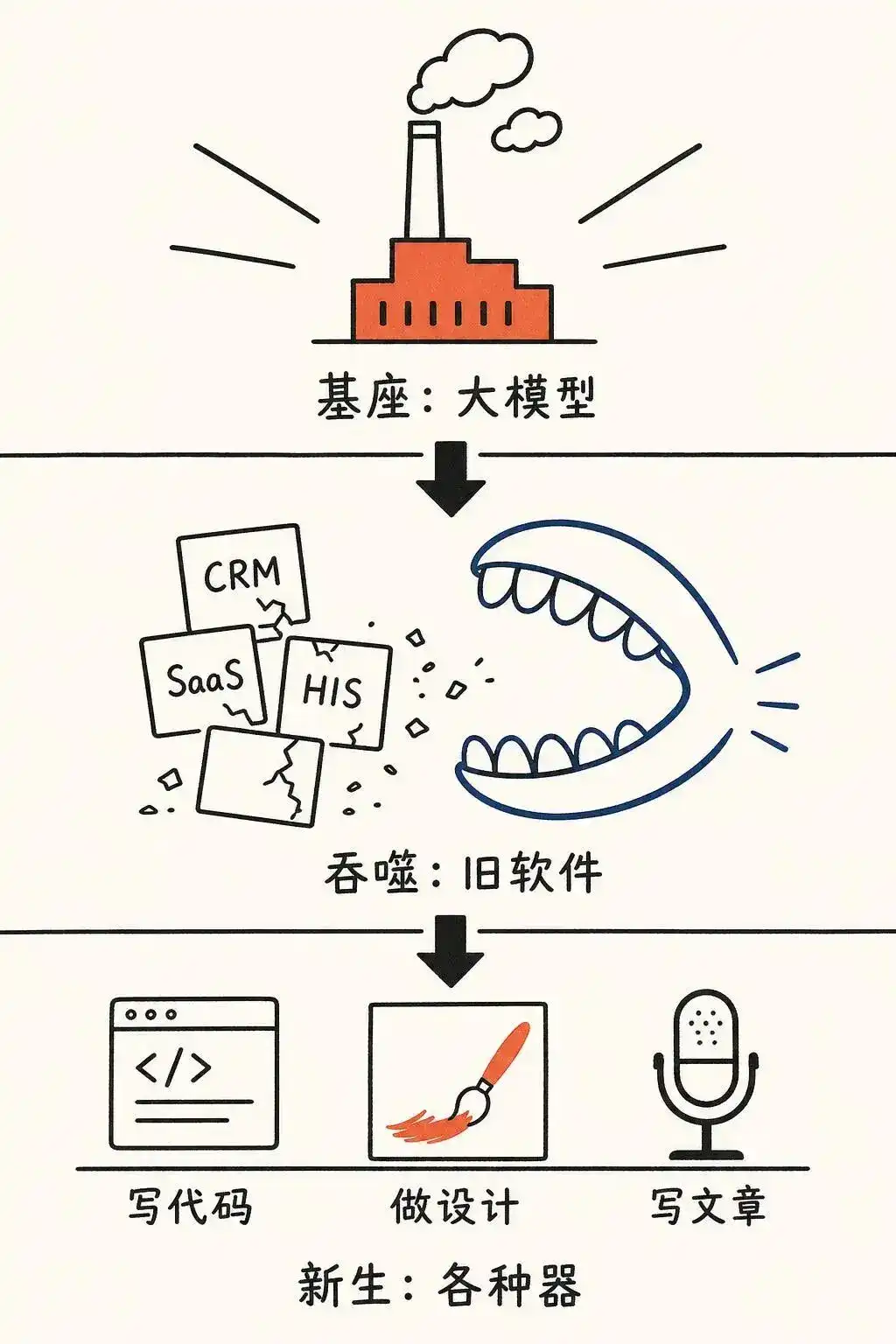
Claude Code is for writing code, Claude Design is for design, VoiceDrop is for writing articles. Using the same large model, placed into different devices, solves completely different problems.

With only electricity, only water, without a washing machine, clothes still can't be washed. Imagine, a power plant produces a massive amount of electricity, electricity is very powerful, and then what? Without a washing machine, can this pile of electricity wash clothes by itself?

Intelligence is great, but most things in the world require the combination of multiple elements to work, just as a washing machine needs to combine elements like electricity, water, and even a tub; large models might be able to replace a lot in the field of software, but application scenarios in the world that require only one element are not many.

Here's a current example. Now we have large models, but having just a large model isn't enough. There needs to be a layer above it called Harness—this layer has only recently emerged—it interacts with code, and finally forms something truly usable. A large model by itself can't write code. Of course, the core of Claude Code, frankly, I could write it with a little over fifty lines; a bit longer with a few more lines, and it can run and write programs. But you have to see: with only a large model and without this outer layer, it's still not easy to use—that is, the intelligence of a large model, if not combined with the code execution capabilities provided by the operating system, relying on the large model for calculations isn't economical, and sometimes even impossible.

The core value of this interface layer is to help us put that intelligence, which is like electricity or water, into a specific application scenario, turning it into a machine that can solve specific problems.

Now, of course, the logic behind "devour everything," I don't completely disbelieve it either.

What it primarily refers to is existing software. So far, we have built up a very, very large layer of software—things pieced together by many rules, forms, buttons, workflows, a lot of it. Massive numbers of filters, fixed templates, a bunch of backend operations, many SaaS detection features. And all the various things we used to know as "M" systems, whether CRM, or HIS (hospital information system), all sorts of so-called "systems," "software," and the like, a whole pile.

This layer, I believe large language models will indeed devour quite a bit of.

Why? Because these original software programs were, by nature, clear, computer-executable instructions, solidified and repeatedly executed—we call this software. And this is precisely what large language models are most adept at chewing through.

But.

Within this layer, besides software, there are many other things. Customer information. Execution capabilities—like when you book a flight ticket, the actual capability to move a plane, to transport a person from here to there. Also trust. Many things in the physical world. These, I don't think will be devoured.

After devouring that layer, it actually opens up a much larger space—the new type of software on top of it.

The interface of the new software will certainly be flow-based, it likely won't solidify as many rules as before. After handing all those rules to AI, think about it, the CRM we could achieve like Salesforce before, that was already the pinnacle of human effort, using all possible strength. But if this part becomes relatively easier to solve, then what everyone will do next is to unleash even more imagination and possibilities on top of it—and that part is precisely what we haven't seen yet.

This is where we often make mistakes. When a new technology arrives, because we can't see the bigger road beyond it, we can only stare at the part in front of us. The leaf blocks the view, obscuring the mountain.

Let alone this kind of trend judgment. I remember back in 2004, a group of friends were complaining, saying that the entire internet could no longer produce companies bigger than Sina, Sohu, and NetEase, that the internet was nearly over, and they would monopolize everything. And look how many years have passed since then? The world turned upside down. We would be crying at our own shortsightedness back then.

So my proposition is this: Are large models important? Yes, they are the foundation, the main driving force in recent times. But once they become stable, continuously provided things, then various kinds of "machines" and "devices" on top are needed to solve specific problems. That thick layer—where it's used, how it's used—is precisely the mainstream of the second wave of this trend.

The phrase "devour everything" is too imprecise. In this world, which thing, which social form, which technology has ever truly devoured everything?

Finding opportunities in the places it does devour—that's the truly important thing.

Kripto yang Sedang Tren

Pertanyaan Terkait

QWhat is the core viewpoint of the author, the founder of Baixing.com, regarding the statement 'Large language models will devour everything'?

AHe believes it only half. He views large language models as a crucial foundational platform, like electricity or the internet, but argues that they alone cannot 'devour everything.' True value and transformation come from applying this foundational intelligence to specific scenarios through various 'machines' or applications built on top of it.

QHow does the author use the analogy of electricity to explain the role of large language models?

AThe author compares large language models to electricity. Electricity itself is a foundational utility (like a power plant), but it doesn't 'devour everything.' Its real-world impact comes from the diverse array of appliances (like washing machines, TVs) built on top of it to solve specific problems. Similarly, LLMs provide base intelligence, but they need to be integrated into specific applications (like Claude Code for programming) to be truly useful and transformative.

QAccording to the article, what specific layer of existing technology does the author believe large language models are likely to 'devour' or replace?

AThe author believes large language models are likely to replace a significant portion of existing, rule-based, fixed-template software systems, such as many CRM, HIS, and various SaaS applications. These systems are composed of clear, computer-executable instructions, which is precisely what LLMs are good at handling and generating.

QWhat does the author identify as elements that will NOT be 'devoured' by large language models, even as software systems change?

AThe author identifies several elements that will not be devoured: customer information, execution capabilities (like physically moving people or goods), trust, and many aspects of the physical world. These components are essential and exist alongside or beyond the software logic that LLMs might replace.

QWhat is the 'second wave' of the AI浪潮 (wave/tide) that the author predicts will follow the establishment of large language models as a stable foundation?

AThe author predicts the 'second wave' will be focused on the thick layer of applications built *on top* of the large language model foundation. This involves creating the various 'machines' and 'tools' that leverage the base intelligence to solve concrete, specific problems in different domains. This application layer is where the next major phase of innovation and opportunity lies.

Bacaan Terkait

Zuckerberg Mulai Bertaruh pada Pasar Prediksi, Sementara Negara-negara Asia Masih Menganggapnya sebagai Perjudian

Mark Zuckerberg mulai berinvestasi di pasar prediksi, sementara negara-negara Asia masih menganggapnya sebagai perjudian. Pasar prediksi telah berkembang menjadi industri utama dengan volume perdagangan bulanan mencapai $14 miliar, didukung oleh mekanisme sederhana: kontrak diselesaikan sebesar $1 jika suatu peristiwa terjadi, dan $0 jika tidak, sehingga harga mencerminkan probabilitas real-time. Pasar ini awalnya digunakan secara informal di abad ke-18 dan dikembangkan secara akademis pada 1988. Saat ini, mereka mencakup berbagai topik seperti olahraga, politik, dan keuangan. Harga terbentuk melalui buku pesanan, dan hasilnya ditentukan oleh oracle. Mekanisme "skin in the game" membedakannya dari survei tradisional, karena peserta rugi jika prediksi salah, meningkatkan keandalan informasi. Di AS, pasar ini diatur sebagai bagian dari sistem keuangan, sementara di Asia sering dianggap sebagai perjudian. Kebijakan Asia yang membatasi partisipasi menyebabkan tiga masalah: arbitrase regulasi, hilangnya kedaulatan informasi, dan kurangnya perlindungan pengguna. Daripada menghalangi pasar ini, penting untuk memikirkan cara memanfaatkan datanya secara bertanggung jawab dalam sistem formal. Diskusi konstruktif diperlukan untuk mengintegrasikannya ke dalam kerangka transparan dan mengembalikan data yang dihasilkan sebagai aset nasional.

Foresight News3m yang lalu

Zuckerberg Mulai Bertaruh pada Pasar Prediksi, Sementara Negara-negara Asia Masih Menganggapnya sebagai Perjudian

Foresight News3m yang lalu

Lebih Dari Sekadar Kunci Pribadi: Dari Dompet, L2 hingga Rantai Pasokan, Bagaimana Melindungi Batas Keamanan Web3?

Juni lalu, dunia kripto mengalami serangkaian insiden keamanan yang melibatkan berbagai aspek ekosistem Web3. Serangan tidak hanya berfokus pada satu titik, tetapi meluas ke beberapa lapisan pertahanan. Ada tiga area utama yang terdampak: 1. **Keamanan Dompet di Luar Penyimpanan Kunci Pribadi**: Insiden pada dompet SecondFi di Cardano menunjukkan bahwa kelemahan dalam implementasi tanda tangan (signing) di tingkat perangkat lunak dompet dapat membocorkan kunci pribadi, meskipun pengguna tidak memberikan frasa pemulihan. Hal ini menekankan pentingnya komponen inti dompet yang bersumber terbuka (open-source) dan diperiksa ketat, serta kebiasaan memisahkan aset besar (di cold wallet) dari dompet untuk interaksi harian. 2. **Kompleksitas dan Risiko di Lapisan 2 (L2)**: Beberapa serangan pada L2 seperti Aztec dan Taiko menunjukkan bahwa keamanan L2 tidak hanya tentang biaya transaksi yang lebih murah. Risiko muncul dari kerumitan sistem, seperti celah dalam sirkuit bukti tanpa pengetahuan (ZK-proof) atau kompromi dalam proses verifikasi berbasis perangkat keras (SGX). Jaringan seperti Base juga mengalami gangguan ketersediaan. Pengguna disarankan untuk memahami mekanisme penyelesaian, menggunakan jembatan resmi, dan tidak menyimpan aset besar secara berlebihan pada L2 yang masih sangat baru. 3. **Serangan Rantai Pasok melalui Layanan Pihak Ketiga**: Kasus Polymarket mengungkap bahwa meskipun kontrak pintar aman, frontend atau dependensi pihak ketiga yang diretas dapat menyuntikkan skrip jahat ke situs web yang sah, mencuri aset pengguna. Ini menunjukkan bahwa "URL yang benar" tidak menjamin keamanan seluruh jalur interaksi. Pengguna harus menggunakan dompet terpisah untuk berinteraksi dengan DApp, selalu memeriksa detail transaksi sebelum menandatangani, dan waspada terhadap permintaan yang tidak biasa di situs web. Kesimpulannya, keamanan Web3 kini adalah tentang melindungi seluruh jalur interaksi, dari pembuatan kunci hingga penyelesaian di rantai. Kebiasaan keamanan terbaik melibatkan: **mengisolasi aset jangka panjang, menggunakan jumlah kecil untuk interaksi harian, memberikan izin (approval) minimum ke DApp asing, dan selalu memverifikasi operasi berisiko tinggi.** Pertahanan harus berkembang dari sekadar menjaga kunci pribadi menjadi serangkaian kebiasaan yang lengkap.

marsbit1j yang lalu

Lebih Dari Sekadar Kunci Pribadi: Dari Dompet, L2 hingga Rantai Pasokan, Bagaimana Melindungi Batas Keamanan Web3?

marsbit1j yang lalu

Apakah OpenAI Akhirnya Bisa Menguntungkan?

OpenAI dan Anthropic, dua raksasa model AI, bernilai hampir triliun dolar, mencerminkan ekspektasi tinggi investor terhadap prospek keuntungan mereka. Namun, pertumbuhan pendapatan tidak secara otomatis menghasilkan keuntungan. Sampai saat ini, tidak ada satu pun perusahaan model AI besar yang benar-benar menghasilkan laba bersih yang independen dari bisnis inti modelnya. Penelitian menunjukkan bahwa pasar API model AI saat ini berada dalam struktur kompetisi monopolistik. Jumlah pemain sangat banyak, konsentrasi pasar rendah, dan meskipun permintaan tumbuh pesat, pasokan juga meluas dengan cepat. Hal ini mengakibatkan persaingan harga yang ketat dan membuat sulit bagi perusahaan untuk mencapai profitabilitas berkelanjutan hanya dengan menjual token. Beberapa perusahaan mungkin meraih keuntungan jangka pendek melalui diferensiasi produk, tetapi hambatan teknologi terbatas, elastisitas harga permintaan tinggi, dan loyalitas pengguna rendah membuat keuntungan tersebut sulit dipertahankan. Dalam jangka panjang, pemain yang terus merugi akan tersingkir, mendorong pasar menuju struktur oligopoli. Namun, dalam pasar oligopoli, kemampuan untuk menghasilkan laba tetap tidak pasti. Hal ini bergantung pada apakah perusahaan bersaing melalui harga atau kuantitas. Tanpa koordinasi strategi atau diferensiasi yang efektif, laba berkelanjutan mungkin tetap sulit diraih. Kesimpulannya, meskipun nilai teknologi dan pertumbuhan permintaan model AI tidak diragukan, model bisnis "menjual token" murni tidak menjamin profitabilitas jangka panjang. Investor perlu mencermati valuasi perusahaan model AI dengan hati-hati. Perusahaan perlu memilih model bisnis dan segmen pasar secara strategis. Model seperti "AI+", yang menyematkan kemampuan AI ke dalam produk atau layanan yang sudah ada untuk meningkatkan nilai dan loyalitas pelanggan, mungkin menawarkan jalur menuju keuntungan yang lebih berkelanjutan.

marsbit1j yang lalu

Apakah OpenAI Akhirnya Bisa Menguntungkan?

marsbit1j yang lalu

Trading

Spot

Artikel Populer

Cara Membeli PEOPLE

Selamat datang di HTX.com! Kami telah membuat pembelian ConstitutionDAO (PEOPLE) menjadi mudah dan nyaman. Ikuti panduan langkah demi langkah kami untuk memulai perjalanan kripto Anda.Langkah 1: Buat Akun HTX AndaGunakan alamat email atau nomor ponsel Anda untuk mendaftar akun gratis di HTX. Rasakan perjalanan pendaftaran yang mudah dan buka semua fitur.Dapatkan Akun SayaLangkah 2: Buka Beli Kripto, lalu Pilih Metode Pembayaran AndaKartu Kredit/Debit: Gunakan Visa atau Mastercard Anda untuk membeli ConstitutionDAO (PEOPLE) secara instan.Saldo: Gunakan dana dari saldo akun HTX Anda untuk melakukan trading dengan lancar.Pihak Ketiga: Kami telah menambahkan metode pembayaran populer seperti Google Pay dan Apple Pay untuk meningkatkan kenyamanan.P2P: Lakukan trading langsung dengan pengguna lain di HTX.Over-the-Counter (OTC): Kami menawarkan layanan yang dibuat khusus dan kurs yang kompetitif bagi para trader.Langkah 3: Simpan ConstitutionDAO (PEOPLE) AndaSetelah melakukan pembelian, simpan ConstitutionDAO (PEOPLE) di akun HTX Anda. Selain itu, Anda dapat mengirimkannya ke tempat lain melalui transfer blockchain atau menggunakannya untuk memperdagangkan mata uang kripto lainnya.Langkah 4: Lakukan trading ConstitutionDAO (PEOPLE)Lakukan trading ConstitutionDAO (PEOPLE) dengan mudah di pasar spot HTX. Cukup akses akun Anda, pilih pasangan perdagangan, jalankan trading, lalu pantau secara real-time. Kami menawarkan pengalaman yang ramah pengguna baik untuk pemula maupun trader berpengalaman.

668 Total TayanganDipublikasikan pada 2024.12.12Diperbarui pada 2026.06.02

Cara Membeli PEOPLE

Diskusi

Selamat datang di Komunitas HTX. Di sini, Anda bisa terus mendapatkan informasi terbaru tentang perkembangan platform terkini dan mendapatkan akses ke wawasan pasar profesional. Pendapat pengguna mengenai harga PEOPLE (PEOPLE) disajikan di bawah ini.

活动图片