Completely Free, Open-Source Alternative to Claude Science, Use DeepSeek/GLM as You Like

marsbitDipublikasikan tanggal 2026-07-07Terakhir diperbarui pada 2026-07-07

Abstrak

Free, Open-Source Alternative to Claude Science: OpenScience Lets Researchers Use Any AI Model Like DeepSeek or GLM Shortly after Anthropic launched Claude Science, a specialized AI workbench for scientific research, the open-source community responded with its own solution: OpenScience. Developed by YC-backed Synthetic Sciences, this platform offers a full AI research workflow covering literature review, hypothesis generation, code experimentation, and paper writing. Unlike Claude Science, which is restricted to macOS/Linux, paid users, and only Claude models, OpenScience is model-agnostic and free. Researchers can use any AI model—DeepSeek, GLM, Claude, GPT, or local models via Ollama—simply by providing their own API keys, keeping data private. OpenScience features over 250 editable research skill packs, more than four times Claude Science's initial offering, and supports one-command installation. It emphasizes openness, arguing that scientific AI tools should not be controlled by a single company. The project includes a clear disclaimer of no affiliation with Anthropic, reflecting caution in the open-source community.

Researchers are ecstatic!!

Less than a week after Anthropic's Claude Science launched, the open-source community has presented its own answer.

An AI research team incubated by YC, has delivered 'the open-source alternative to Claude Science' — OpenScience.

It's also a full-process AI research workbench covering literature search, hypothesis generation, code experiments to paper writing, but it is not tied to any single model provider.

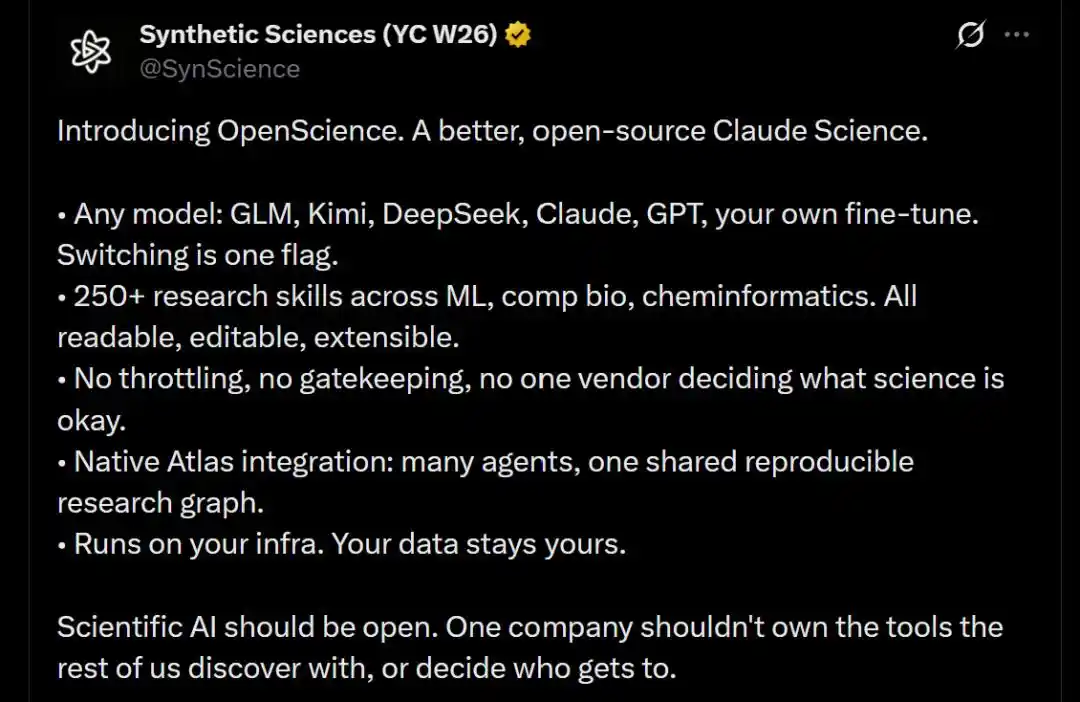
DeepSeek, GLM, Claude, GPT... regardless of domestic or international, use whichever one you want.

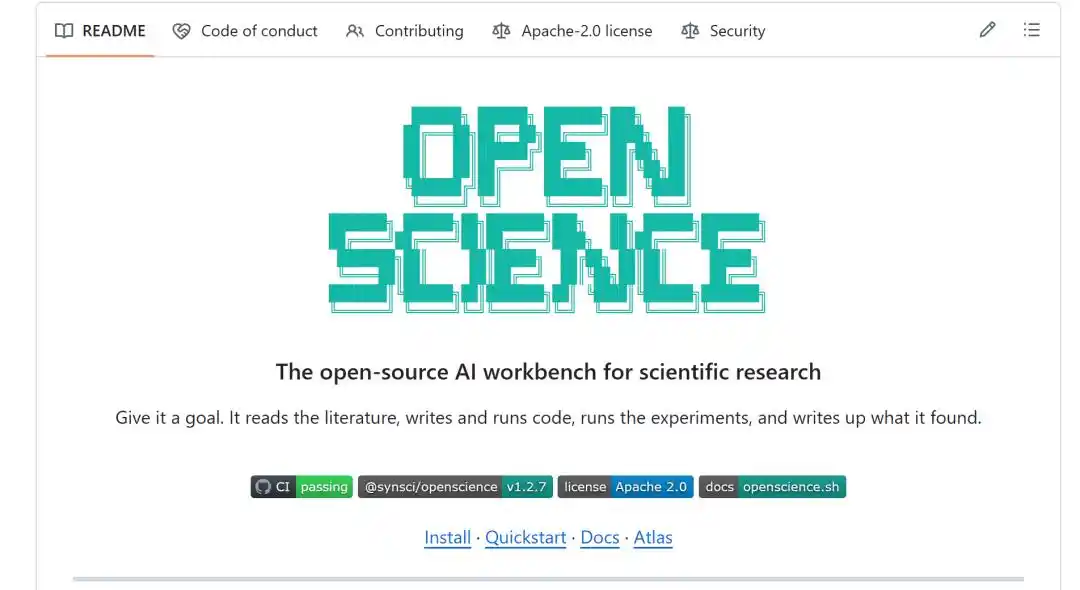
Moreover, the project adopts the developer-friendly Apache 2.0 license and can be installed with just one command.

Once the news broke, the project directly trended on X. People bluntly stated:

This is what scientific AI should look like. (Anthropic: Just say my name.)

Claude Science is powerful, but it's unusable...

About 5 days ago, Anthropic officially launched Claude Science at a closed-door event by MIT Technology Review.

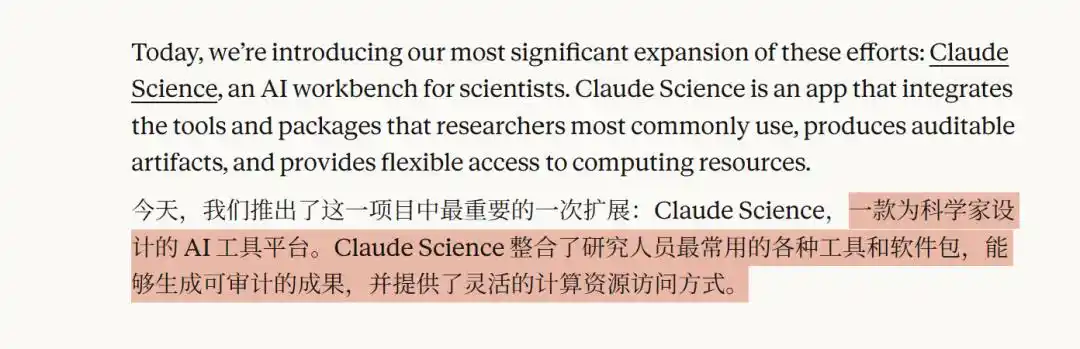
This is an AI workbench specifically for scientists, providing various tools and software packages most commonly used by researchers.
For example, previously, a researcher completing a study had to search literature on PubMed, write code in Jupyter, run statistics in R, connect to a cluster via SSH to submit tasks, and then use various tools to create charts and write papers.

Switching between a dozen windows, the mere 'transitions' between tools consumed a huge amount of energy.

What Claude Science aims to do is bundle all of this into the same workbench.

Specifically, it achieves several key integrations:

At the database and toolchain level, it comes with built-in connectors to over 60 scientific databases and pre-configured skill packages, covering common research fields like genomics, single-cell analysis, proteomics, structural biology, chemoinformatics, etc.

You ask in natural language, and specialized Agents automatically perform cross-database queries — no need to manually search databases like UniProt, PDB, Ensembl, ChEMBL, GEO one by one.

It also integrates with NVIDIA's BioNeMo Agent Toolkit, allowing direct connection to life science models like Evo 2, Boltz-2, OpenFold3.
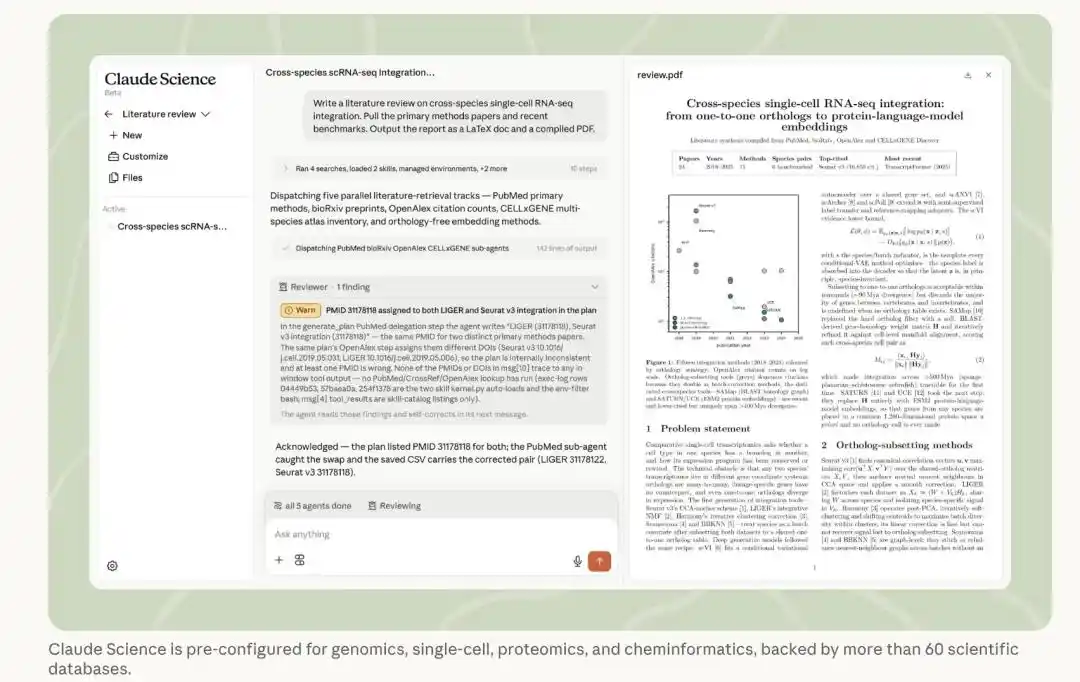
At the execution level, it introduces a multi-agent architecture.

The main Agent handles overall planning, sub-agents process different tasks in parallel, and there is a Reviewer Agent specifically responsible for fact-checking, such as verifying citations, validating calculation results, and flagging potential errors.

The generated output is not just text. It can natively render content like 3D protein structures, genome browser tracks, chemical structure formulas.

Moreover, each chart retains the generation code, runtime environment, natural language description, and complete conversation history.

In some scenarios, scientists can even modify charts with a single sentence, and the system automatically rewrites the underlying code.

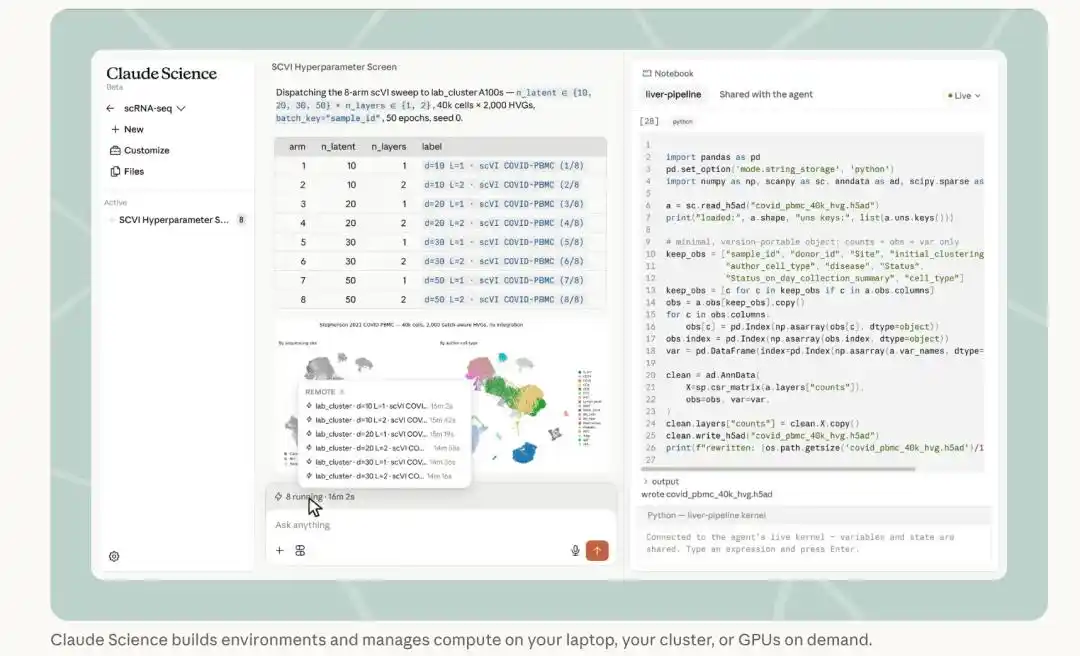
At the computing power level, Claude Science can directly interface with your lab's existing infrastructure.

Be it notebooks, Linux servers, or HPC cluster login nodes, it can connect via SSH or use a Modal account to call cloud GPUs on demand, scaling from a single GPU to hundreds.

Large-scale datasets only need to be loaded once; sensitive data never leaves your own system. Only the context needed for each step of analysis is sent to Claude.
Early beta users have already produced some practical cases.

Jerome Lecoq, a neuroscientist at the Allen Institute, used it to build a multi-agent 'computational review template' containing about 20 custom skills, letting sub-agents read thousands of papers, extract core viewpoints and quantitative data, and then generate review chapters one by one.

To put it simply, writing a review used to take two years; now he has about 10 drafts in hand —

Many exceed 100 pages, and all citations have been verified by the Reviewer Agent.

Stephen Francis from the UCSF Brain Tumor Center used it for molecular epidemiological studies of glioma, running germline variant analysis.

He said Claude Science compressed the previously required time to one-tenth, and his team independently validated the results, confirming the analysis was both fast and reliable.

Combined with the evaluation of AI research capabilities by Harvard physicist Matthew Schwartz this past March, Claude's current level is roughly equivalent to a second-year graduate student.

He published a guest post titled "Vibe Physics: The AI Grad Student" on the Anthropic official blog, documenting his entire process of using Claude Opus 4.5 to complete a theoretical physics paper.

His conclusion at the time was:

Current AI research capability is roughly equivalent to a second-year grad student — can work, doesn't complain about being tired, but needs a supervisor to monitor every step.

This assessment was later incorporated by Anthropic into the Claude Science technical documentation as a calibration point for the product's positioning.

However, Claude Science currently has several hard limitations:

Only supports macOS and Linux

Only available to Pro/Max/Team/Enterprise paying users

Only Claude's own models can be used on the platform

These thresholds stacked together, especially for domestic research teams in China, make Claude Science something "visible but out of reach."

Good News: An Open-Source Alternative is Here

Targeting the above limitations, the open-source project OpenScience emerged.

The team behind it is called Synthetic Sciences, founded in San Francisco in 2025, and just graduated from the YC Winter 2026 batch this year.

The founding team's ambition is not small: to build a platform that lets scientists directly delegate complex research tasks to "AI co-scientists," enabling AI to autonomously run the entire chain from literature review to hypothesis generation to experiment execution to paper writing.

They have an internal core belief:

Scientific foundation models need to possess genuine 'research taste,' and this taste cannot be achieved by simply scaling parameters. It must be a two-pronged approach: product and model. Use the product to collect high-quality scientific process data, then use this data to train models with taste.

OpenScience is the first product landing on this path.
Although OpenScience's mission is the same as Claude Science's, they have a fundamental difference:

Model-agnostic.

In Synthetic Sciences' own words:

Scientific AI should be open. The tools humans use for exploration and discovery should not be monopolized by one company, nor should that company decide who is qualified to use them.

Therefore, on this platform, Anthropic, OpenAI, Google, DeepSeek, GLM... as long as you have an API Key, you can connect directly.

You can even run local models, deploy via Ollama, without a single byte of your data leaving your machine.

Your Key stays locally, requests go directly to the model provider, not passing through any intermediate server.

Moreover, OpenScience supports switching models per request.

Within the same workbench, you can use Claude for this step, then switch to DeepSeek for the next, without changing any configuration.
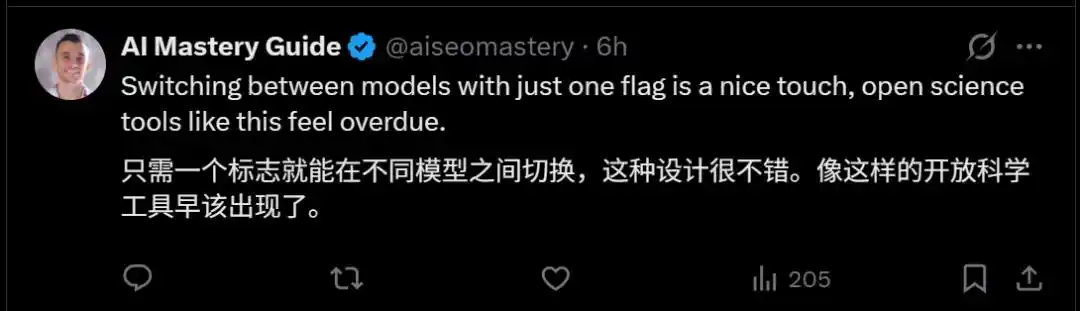
Feature-wise, OpenScience is even more aggressive than Claude Science —

Built-in with over 250 research skill packages, more than 4 times that of Claude Science, covering ML, computational biology, chemoinformatics, etc., and all are readable, editable, and extensible.
Installation is also simple, just one command in the terminal:

Open and use immediately, the workbench automatically pops up in the browser. On first run, select a model source, fill in the API Key, and you can start working.

You can also install it globally:

If configuring Keys is troublesome, the team also provides a hosted platform called Atlas —

Top up a wallet to directly call various cutting-edge models without configuring Keys one by one, plus persistent research graphs and cloud computing power.

But Atlas is not mandatory. You can use OpenScience fully for free with your own Keys, no barrier.

One More Thing

Interestingly, if you scroll to the very bottom of OpenScience's GitHub page, you'll see a statement added specifically:

OpenScience is an independent project. It is not affiliated with, endorsed by, or sponsored by Anthropic. “Claude” is a trademark of Anthropic, PBC, used here only to describe compatibility.
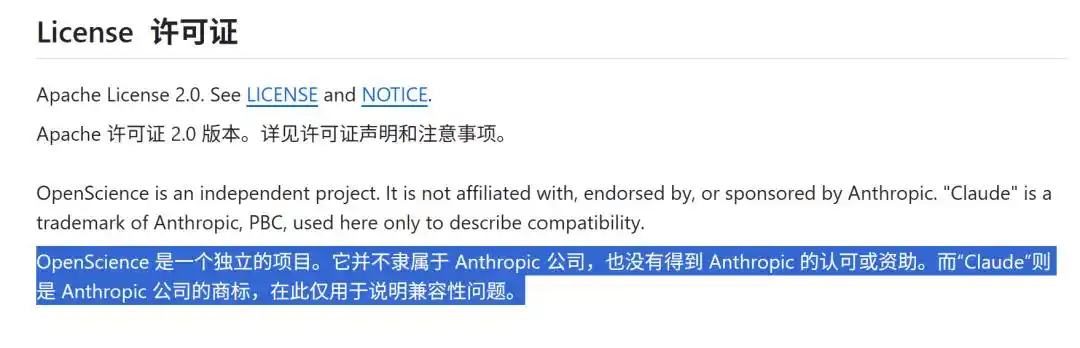
Translation: We are an independent project, with no relation to Anthropic whatsoever. Mentioning "Claude" is purely about describing compatibility, don't read too much into it.

It seems the impression left by the "lobster" incident on the entire open-source community is still too profound.

With OpenClaw changing names several times before, OpenScience this time directly welded the disclaimer onto the first version of the README.

Nothing else — survive first, then talk about being an alternative (doge).

Open-source address:

https://x.com/i/trending/2073904804829741364?s=20

Reference links:

[1]https://x.com/SynScience/status/2073829478393086311?s=20

[2]https://x.com/i/trending/2073904804829741364?s=20

[3]https://www.openscience.sh/

[4]https://www.anthropic.com/news/claude-science-ai-workbench

This article is from WeChat official account "QbitAI", author: Yi Shui

Kripto yang Sedang Tren

Pertanyaan Terkait

QWhat is OpenScience and how does it compare to Claude Science?

AOpenScience is an open-source AI scientific research workbench that serves as a free alternative to Anthropic's Claude Science. Unlike Claude Science, which is proprietary and limited to Claude models for paid users, OpenScience is model-agnostic, allowing users to freely choose and switch between various AI models like DeepSeek, GLM, Claude, or GPT via API keys or local deployments. It is released under the Apache 2.0 license and offers more than 250 research skill packages, significantly more than Claude Science's 60+.

QWhat are the key limitations of Claude Science mentioned in the article?

AClaude Science has several key limitations: 1) It only supports macOS and Linux operating systems. 2) It is exclusively available to Pro, Max, Team, and Enterprise paying users. 3) Users are restricted to using only Anthropic's proprietary Claude models on the platform. These restrictions, especially the payment requirement and model lock-in, make it inaccessible to many researchers, particularly in certain regions.

QHow does OpenScience address data privacy and local deployment?

AOpenScience prioritizes data privacy and flexibility by supporting local model deployment. Users can run models locally using tools like Ollama, ensuring that sensitive research data never leaves their own machines. API keys are also stored locally, and requests are sent directly to the model provider without passing through any intermediate servers, giving researchers full control over their data and computational environment.

QWhat was the early user feedback on Claude Science's capabilities?

AEarly internal testers reported positive results. A neuroscientist at the Allen Institute used Claude Science to create a multi-agent computational review template, enabling the generation of lengthy, citation-verified review papers in a fraction of the traditional time (e.g., producing ~10 papers over 100 pages each that previously would have taken years). A researcher at UCSF's Brain Tumor Center used it for molecular epidemiology studies, reducing the required time for germline variant analysis to one-tenth while maintaining result accuracy verified by his team.

QWhat is the stated long-term vision of the Synthetic Sciences team behind OpenScience?

AThe Synthetic Sciences team aims to build a platform where scientists can delegate complex research tasks to 'AI co-scientists' that autonomously handle the entire research pipeline from literature review to hypothesis generation, experiment execution, and paper writing. They believe that truly capable scientific foundation models require 'research taste,' which cannot be achieved by merely scaling model parameters. Instead, it requires a product-model co-development approach, where the product collects high-quality research process data to train models with genuine scientific intuition.

Bacaan Terkait

Menyelami Susunan Mitra Open USD: Melihat Siapa yang Masuk, Bisa Membaca Kemana Arus Dana Mengalir

**Ringkasan: Mengungkap Aliran Modal Melalui Jaringan Mitra Open USD** Open USD diluncurkan dengan lebih dari 140 mitra pendiri dari berbagai sektor, membentuk aliansi luas yang justru lebih penting daripada teknologi tokennya sendiri. Kehadiran mereka mengindikasikan pergeseran paradigma: stablecoin tidak lagi dilihat sebagai produk proprietary, tetapi sebagai infrastruktur keuangan bersama yang kritis. **Motivasi Beragam di Balik Partisipasi:** * **Manajer Aset (BlackRock):** Mengincar hak mengelola cadangan (reserve) senilai miliaran dolar yang akan diinvestasikan dalam instrumen pasar uang, sumber pendapatan fee yang besar dan stabil. * **Merchant & Platform (Shopify):** Mencari solusi untuk mengurangi biaya transaksi (seperti interchange fee) sekaligus mendapatkan imbal hasil dari saldo tunai yang menganggur. * **Bank (Bank of New York Mellon, dll):** Bergerak defensif. Daripada kehilangan deposit ke stablecoin eksternal, lebih baik bergabung untuk mempertahankan peran dalam penitipan aset, penyelesaian transaksi, dan mendapatkan bagian dari pendapatan cadangan. * **Perusahaan Teknologi (Google, IBM):** Memperkirakan masa depan di mana pembayaran otomatis mesin-ke-mesin membutuhkan dolar yang dapat diprogram dan dikelola oleh aliansi terbuka, bukan satu perusahaan pesaing. * **Perusahaan Kripto (Ripple, Aave, MetaMask):** Menyediakan likuiditas lintas batas, pasar pinjaman, distribusi pengguna, dan penjagaan kepatuhan. Bergabung dengan aliansi arus utama ini adalah jalur legitimasi yang telah lama mereka kejar. * **Jaringan Pembayaran (Visa, Mastercard):** Meski stablecoin mengancam model biaya transaksi tradisional mereka, bergabung memungkinkan mereka tetap relevan dengan menawarkan layanan baru seperti penyelesaian dan anti-penipuan di "rel" baru ini. **Pesan Utama dari Daftar Mitra:** Daftar ini menunjukkan bahwa ketakutan untuk ditinggalkan dalam infrastruktur stablecoin masa depan mengalahkan keengganan untuk berbagi dengan pesaing. Ini adalah sinyal ancaman serius bagi pemain stablecoin independen seperti Circle dan Tether, karena calon klien utama mereka justru bersatu membangun alternatif bersama. Aliansi ini mencerminkan konsensus bahwa kepemilikan bersama atas infrastruktur stablecoin lebih menguntungkan daripada menyewanya dari pihak lain atau tidak memilikinya sama sekali.

Foresight News19m yang lalu

Menyelami Susunan Mitra Open USD: Melihat Siapa yang Masuk, Bisa Membaca Kemana Arus Dana Mengalir

Foresight News19m yang lalu

IOSG: Hitung Mundur Q-Day, Akankah Komputasi Kuantum Mengakhiri Mata Uang Kripto?

"Kripto vs. Komputasi Kuantum: Skenario dan Langkah Antisipasi" Komputasi kuantum merupakan ancaman sistematis terhadap kriptografi kunci publik yang menjadi dasar blockchain. Algoritma Shor berpotensi memecah enkripsi berbasis kurva elips (ECC/RSA) yang melindungi aset kripto. Titik kritis (Q-Day), saat komputer kuantum toleran kesalahan (CRQC) dapat melakukan serangan praktis, diperkirakan antara 2030-2045. Ini menciptakan "utang keamanan" yang harus diselesaikan. Risiko terbesar ada pada aset dengan kunci publik yang sudah terekspos di rantai (misal, beberapa UTXO Bitcoin awal atau alamat yang telah digunakan). Algoritma kuantum lain, Grover, hanya mengurangi margin keamanan hash secara gradual, sehingga tidak separah ancaman Shor. Solusinya terletak pada migrasi ke Kriptografi Pasca-Kuantum (PQC) seperti algoritma berbasis kisi (ML-DSA) atau berbasis hash (SLH-DSA). Tantangan utamanya bukan teknis semata, melainkan koordinasi ekosistem dan konsensus sosial. - **Bitcoin**: Risiko tertinggi pada UTXO warisan. Migrasi memerlukan soft-fork, tetapi terkendala oleh pembengkakan ukuran tanda tangan PQC (hingga 49KB) dan dilema tata kelola: membiarkan aset warisan terekspos atau memaksa pembekuan yang melanggar prinsip "tidak dapat diubah". - **Ethereum**: Mengembangkan "ketangkasan kriptografi" melalui jalur paralel: akun abstrak untuk pengguna, mengganti tanda tangan konsensus BLS dengan leanXMSS, dan merekonstruksi lapisan data. Lapisan-2 (L2) menjadi lahan uji coba. Jalur lain termasuk blockchain native-PQC seperti QRL. Namun, ekosistem utama (BTC/ETH) menghadapi kompleksitas migrasi menyeluruh yang memerlukan koordinasi node, dompet, bursa, dan penyimpanan aset. Kesimpulannya, komputasi kuantum bukan akhir dari kripto, tetapi ujian berat. Jendela waktu untuk migrasi terkoordinasi diperkirakan 5-8 tahun. Kegagalan mencapai konsensus dapat memicu krisis kepercayaan dan penilaian ulang risiko aset blockchain sebelum Q-Day benar-benar tiba.

marsbit45m yang lalu

IOSG: Hitung Mundur Q-Day, Akankah Komputasi Kuantum Mengakhiri Mata Uang Kripto?

marsbit45m yang lalu

Trading

Spot

Artikel Populer

Cara Membeli GLM

Selamat datang di HTX.com! Kami telah membuat pembelian Golem (GLM) menjadi mudah dan nyaman. Ikuti panduan langkah demi langkah kami untuk memulai perjalanan kripto Anda.Langkah 1: Buat Akun HTX AndaGunakan alamat email atau nomor ponsel Anda untuk mendaftar akun gratis di HTX. Rasakan perjalanan pendaftaran yang mudah dan buka semua fitur.Dapatkan Akun SayaLangkah 2: Buka Beli Kripto, lalu Pilih Metode Pembayaran AndaKartu Kredit/Debit: Gunakan Visa atau Mastercard Anda untuk membeli Golem (GLM) secara instan.Saldo: Gunakan dana dari saldo akun HTX Anda untuk melakukan trading dengan lancar.Pihak Ketiga: Kami telah menambahkan metode pembayaran populer seperti Google Pay dan Apple Pay untuk meningkatkan kenyamanan.P2P: Lakukan trading langsung dengan pengguna lain di HTX.Over-the-Counter (OTC): Kami menawarkan layanan yang dibuat khusus dan kurs yang kompetitif bagi para trader.Langkah 3: Simpan Golem (GLM) AndaSetelah melakukan pembelian, simpan Golem (GLM) di akun HTX Anda. Selain itu, Anda dapat mengirimkannya ke tempat lain melalui transfer blockchain atau menggunakannya untuk memperdagangkan mata uang kripto lainnya.Langkah 4: Lakukan trading Golem (GLM)Lakukan trading Golem (GLM) dengan mudah di pasar spot HTX. Cukup akses akun Anda, pilih pasangan perdagangan, jalankan trading, lalu pantau secara real-time. Kami menawarkan pengalaman yang ramah pengguna baik untuk pemula maupun trader berpengalaman.

194 Total TayanganDipublikasikan pada 2024.12.10Diperbarui pada 2026.06.02

Cara Membeli GLM

Diskusi

Selamat datang di Komunitas HTX. Di sini, Anda bisa terus mendapatkan informasi terbaru tentang perkembangan platform terkini dan mendapatkan akses ke wawasan pasar profesional. Pendapat pengguna mengenai harga GLM (GLM) disajikan di bawah ini.

活动图片












