Can Ethereum’s $150B stablecoin liquidity help ETH bulls reclaim control?

ambcryptoDipublikasikan tanggal 2026-07-07Terakhir diperbarui pada 2026-07-07

Abstrak

Ethereum has established itself as a leading infrastructure for digital dollars, now holding over $150 billion in on-chain stablecoin liquidity, a sign of real economic activity. Despite trading at $1,748.47 with an 11% weekly gain, it faces a key resistance zone between $1,750 and $1,800, where selling pressure has historically capped rallies. However, recent inflows into ETH ETFs and a potential technical "double bottom" pattern suggest buyers may be regaining momentum. Analysts link long-term bullish prospects, with price targets as high as $8,500 by mid-2027, to the growth of stablecoins and real-world asset (RWA) tokenization on Ethereum. The ongoing "Lean Ethereum" protocol redesign further underscores the network's evolving utility beyond speculation.

According to a recent update, Ethereum has already taken the lead in the financial infrastructure for digital dollars and tokenized assets, and this is not just hype.

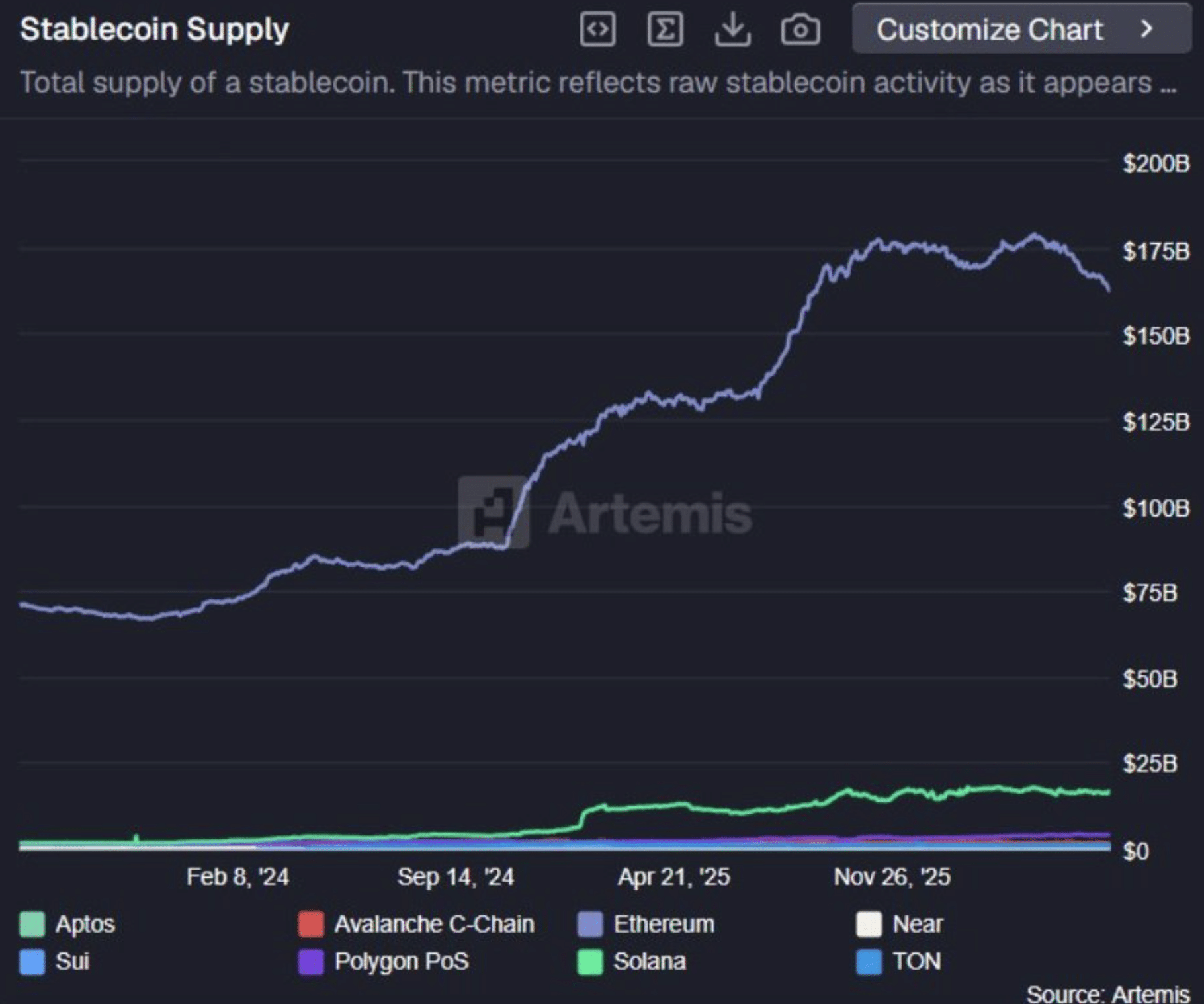
Artemis reported that Ethereum has more than $150 billion in on-chain stablecoin liquidity. This is noteworthy because stablecoins represent actual economic activity rather than speculative activity.
Source: Whale Factor/X

Ethereum’s market dynamics

This occurred at a time when the price of Ethereum [ETH] was trading at $1,748.47 at press time, following an 11% increase over the previous week.
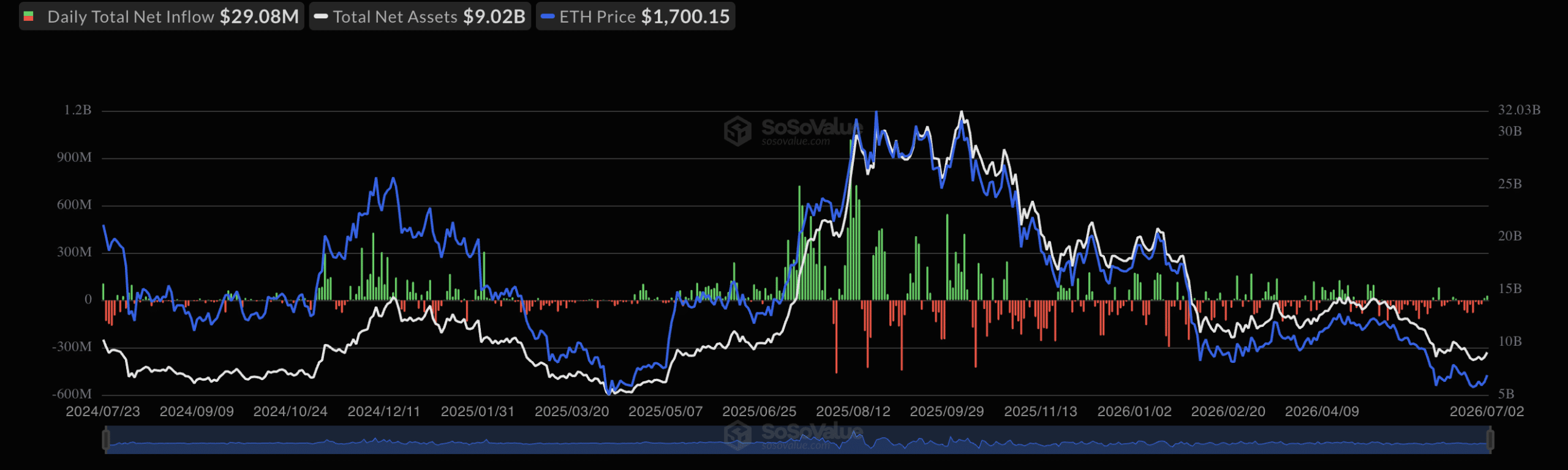
Source: SoSo Value

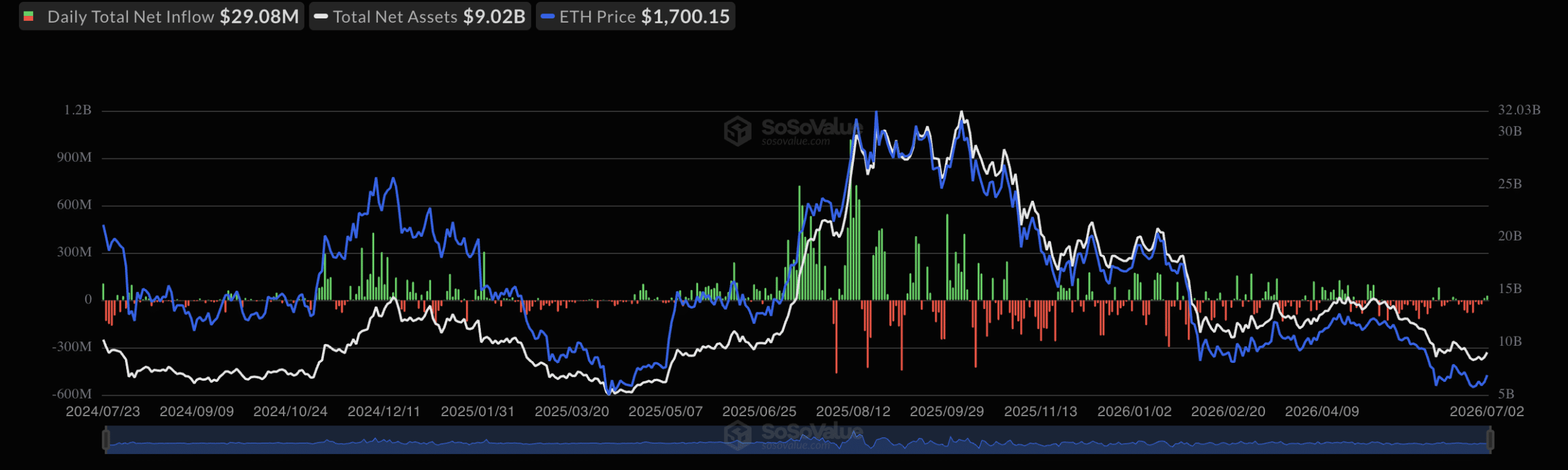
The ETH ETF, on the other hand, has been experiencing a prolonged period of outflows with a few exceptions.

However, on the 1st and 2nd of July, ETH ETFs recorded inflows worth $14.8 million and $29 million, respectively, highlighting renewed momentum.

Is buying momentum slowly rearing or ETH?

At the same time, many analysts are eyeing the $1,750–$1,800 range as a critical level because it has frequently served as a barrier where sellers have intervened to stop additional gains.

Ethereum has retreated in price every time it has approached this zone lately due to increased selling pressure from traders aiming to short the asset or take profits.

This shows that at those levels, supply has outpaced demand. However, Ethereum has the potential to indicate that buyers have absorbed the available selling pressure, provided it were to hold above $1,750–$1,800 with strong trading volume.

Community sentiments echo bullish notions for the altcoin

Interestingly, echoing somewhat similar sentiment, another analyst added,

ETH just double bottomed.

In other words, a double bottom occurs when the price of Ethereum hits a support level, bounces back, falls back to about the same level without breaking lower, and then rises once more. It is often seen as an indication that buyers are starting to regain control despite the selling pressure trying to barge in.

Therefore, the analyst predicted it best when he added,

~8,500 for ETH by mid 2027, thanks to stablecoins and RWA moving onchain.

What’s more?

Meanwhile, Ethereum has also entered a new stage of development with Lean Ethereum, a multi-year plan to completely redesign the network’s core protocol over the course of the next three to four years.

Ergo, as the gap between speculative capital inflow and network utility becomes more pronounced, it may result in further price appreciation.


Final Summary

  • Ethereum’s on-chain stablecoin liquidity skyrockets with its price trading at $1,748.47, and ETH ETF, experiencing a prolonged period of outflows.
  • Analysts consider the $1,750–$1,800 range as a critical price zone because it has frequently served as a barrier where sellers have intervened to stop additional gains.

Pertanyaan Terkait

QAccording to the article, what is the significance of Ethereum's $150 billion on-chain stablecoin liquidity?

AThe significance is that stablecoins represent actual economic activity rather than just speculative activity, highlighting Ethereum's role in the financial infrastructure for digital dollars and tokenized assets.

QWhat was the price of Ethereum (ETH) at the time of writing, and what was its recent weekly performance?

AAt press time, Ethereum's price was $1,748.47, following an 11% increase over the previous week.

QWhy do analysts consider the $1,750–$1,800 price range as a critical level for Ethereum?

AAnalysts consider the $1,750–$1,800 range as critical because it has frequently acted as a barrier where sellers have intervened to stop additional gains, indicating supply has outpaced demand at those levels.

QWhat is a 'double bottom' pattern in technical analysis, and what does the analyst suggest it indicates for ETH?

AA 'double bottom' occurs when an asset's price hits a support level, bounces back, falls back to a similar level without breaking lower, and then rises again. The analyst suggests it indicates that buyers are starting to regain control despite selling pressure.

QWhat future development plan for Ethereum, mentioned in the article, aims to redesign its core protocol?

AThe future development plan is called 'Lean Ethereum,' which is a multi-year initiative aiming to completely redesign the network's core protocol over the next three to four years.

Bacaan Terkait

Menyelami Susunan Mitra Open USD: Melihat Siapa yang Masuk, Bisa Membaca Kemana Arus Dana Mengalir

**Ringkasan: Mengungkap Aliran Modal Melalui Jaringan Mitra Open USD** Open USD diluncurkan dengan lebih dari 140 mitra pendiri dari berbagai sektor, membentuk aliansi luas yang justru lebih penting daripada teknologi tokennya sendiri. Kehadiran mereka mengindikasikan pergeseran paradigma: stablecoin tidak lagi dilihat sebagai produk proprietary, tetapi sebagai infrastruktur keuangan bersama yang kritis. **Motivasi Beragam di Balik Partisipasi:** * **Manajer Aset (BlackRock):** Mengincar hak mengelola cadangan (reserve) senilai miliaran dolar yang akan diinvestasikan dalam instrumen pasar uang, sumber pendapatan fee yang besar dan stabil. * **Merchant & Platform (Shopify):** Mencari solusi untuk mengurangi biaya transaksi (seperti interchange fee) sekaligus mendapatkan imbal hasil dari saldo tunai yang menganggur. * **Bank (Bank of New York Mellon, dll):** Bergerak defensif. Daripada kehilangan deposit ke stablecoin eksternal, lebih baik bergabung untuk mempertahankan peran dalam penitipan aset, penyelesaian transaksi, dan mendapatkan bagian dari pendapatan cadangan. * **Perusahaan Teknologi (Google, IBM):** Memperkirakan masa depan di mana pembayaran otomatis mesin-ke-mesin membutuhkan dolar yang dapat diprogram dan dikelola oleh aliansi terbuka, bukan satu perusahaan pesaing. * **Perusahaan Kripto (Ripple, Aave, MetaMask):** Menyediakan likuiditas lintas batas, pasar pinjaman, distribusi pengguna, dan penjagaan kepatuhan. Bergabung dengan aliansi arus utama ini adalah jalur legitimasi yang telah lama mereka kejar. * **Jaringan Pembayaran (Visa, Mastercard):** Meski stablecoin mengancam model biaya transaksi tradisional mereka, bergabung memungkinkan mereka tetap relevan dengan menawarkan layanan baru seperti penyelesaian dan anti-penipuan di "rel" baru ini. **Pesan Utama dari Daftar Mitra:** Daftar ini menunjukkan bahwa ketakutan untuk ditinggalkan dalam infrastruktur stablecoin masa depan mengalahkan keengganan untuk berbagi dengan pesaing. Ini adalah sinyal ancaman serius bagi pemain stablecoin independen seperti Circle dan Tether, karena calon klien utama mereka justru bersatu membangun alternatif bersama. Aliansi ini mencerminkan konsensus bahwa kepemilikan bersama atas infrastruktur stablecoin lebih menguntungkan daripada menyewanya dari pihak lain atau tidak memilikinya sama sekali.

Foresight News20m yang lalu

Menyelami Susunan Mitra Open USD: Melihat Siapa yang Masuk, Bisa Membaca Kemana Arus Dana Mengalir

Foresight News20m yang lalu

IOSG: Hitung Mundur Q-Day, Akankah Komputasi Kuantum Mengakhiri Mata Uang Kripto?

"Kripto vs. Komputasi Kuantum: Skenario dan Langkah Antisipasi" Komputasi kuantum merupakan ancaman sistematis terhadap kriptografi kunci publik yang menjadi dasar blockchain. Algoritma Shor berpotensi memecah enkripsi berbasis kurva elips (ECC/RSA) yang melindungi aset kripto. Titik kritis (Q-Day), saat komputer kuantum toleran kesalahan (CRQC) dapat melakukan serangan praktis, diperkirakan antara 2030-2045. Ini menciptakan "utang keamanan" yang harus diselesaikan. Risiko terbesar ada pada aset dengan kunci publik yang sudah terekspos di rantai (misal, beberapa UTXO Bitcoin awal atau alamat yang telah digunakan). Algoritma kuantum lain, Grover, hanya mengurangi margin keamanan hash secara gradual, sehingga tidak separah ancaman Shor. Solusinya terletak pada migrasi ke Kriptografi Pasca-Kuantum (PQC) seperti algoritma berbasis kisi (ML-DSA) atau berbasis hash (SLH-DSA). Tantangan utamanya bukan teknis semata, melainkan koordinasi ekosistem dan konsensus sosial. - **Bitcoin**: Risiko tertinggi pada UTXO warisan. Migrasi memerlukan soft-fork, tetapi terkendala oleh pembengkakan ukuran tanda tangan PQC (hingga 49KB) dan dilema tata kelola: membiarkan aset warisan terekspos atau memaksa pembekuan yang melanggar prinsip "tidak dapat diubah". - **Ethereum**: Mengembangkan "ketangkasan kriptografi" melalui jalur paralel: akun abstrak untuk pengguna, mengganti tanda tangan konsensus BLS dengan leanXMSS, dan merekonstruksi lapisan data. Lapisan-2 (L2) menjadi lahan uji coba. Jalur lain termasuk blockchain native-PQC seperti QRL. Namun, ekosistem utama (BTC/ETH) menghadapi kompleksitas migrasi menyeluruh yang memerlukan koordinasi node, dompet, bursa, dan penyimpanan aset. Kesimpulannya, komputasi kuantum bukan akhir dari kripto, tetapi ujian berat. Jendela waktu untuk migrasi terkoordinasi diperkirakan 5-8 tahun. Kegagalan mencapai konsensus dapat memicu krisis kepercayaan dan penilaian ulang risiko aset blockchain sebelum Q-Day benar-benar tiba.

marsbit46m yang lalu

IOSG: Hitung Mundur Q-Day, Akankah Komputasi Kuantum Mengakhiri Mata Uang Kripto?

marsbit46m yang lalu

Trading

Spot
活动图片