Can Open USD Support Stripe's Ambitions?

marsbitDipublikasikan tanggal 2026-07-07Terakhir diperbarui pada 2026-07-07

Abstrak

Can Open USD support Stripe's ambition? The article argues that OUSD represents a pivotal strategic move for Stripe, shifting its narrative from being a superior payments API company to becoming a "money movement network." Unlike simply facilitating payments, this new model aims to organize and define the settlement layer, default assets, and economic distribution rules for future commerce. The analysis highlights OUSD's role in giving Stripe a potential default settlement asset, enabling deeper economics through reserve earnings, and providing a programmable money layer for emerging use cases like AI agentic commerce. Crucially, OUSD is presented not as a direct "USDC killer" but as an attempt to redefine the business model of stablecoins, proposing a collaborative governance structure where contributing partners share in the network's economic benefits and governance. For Stripe, this is about evolving from a powerful "abstraction layer" over traditional financial rails into an active participant and potential architect of the next-generation global settlement network. While OUSD alone cannot immediately realize this ambition, it signals Stripe's intent to move closer to the money layer itself, positioning itself at the center of future money flows in an increasingly automated, platform-driven, and AI-powered economy. The ultimate question is whether Stripe can transition from being a best-in-class payment processor to becoming the foundational infrastructure for internet...

Author: Yokiiiya Stablehunter

Five months ago, I wrote an article titledStripe|AWS of the Financial World: Why It Becomes the Biggest Winner in the AI + Stablecoin Era, where I argued that Money will run on Stripe. Stripe is not just building a better payment button; it is turning financial capabilities like collecting payments, making payouts, issuing cards, managing fund accounts, handling taxes, and billing into infrastructure that developers can call, much like cloud services.

But with the emergence of Open USD, we see that Stripe wants to prove not just that money will run on Stripe. It aims to show that:

Money will not only run through Stripe.

Money may settle on a network Stripe helped define.

I. OUSD is a Key Step for Stripe's Transformation into a Money Movement Network

The significance of OUSD lies not in it being just another stablecoin, but in it providing Stripe with a bigger narrative: transforming from a payments API company into a money movement network.

It won't replace USDC in the short term, nor can it bypass all traditional financial systems. However, it gives Stripe the opportunity not just to connect payments but to reorganize settlement, liquidity, and yield distribution. In the past, we often understood Stripe as a better payment gateway, but more accurately, Stripe is an aggregation layer built upon card networks, bank account systems, local clearing networks, acquiring/issuing licenses, and various traditional payment rails.

This is also its limitation.

What Stripe truly wants to break through is the strategic constraint of being "just the API layer on top of traditional payment networks." If Stripe were merely a better payments API, no matter how big it gets, it could easily be framed against competitors like Adyen, PayPal, Fiserv, Checkout.com, and acquiring banks. The market would focus on transaction volume, take rate, whether gross margins can be maintained, if card network costs will continue to rise, and whether regulations and local licenses will limit expansion.

This would still be a very good company, but not yet a truly financial network. The significance of OUSD is that it gives Stripe the chance to advance its narrative from "we help merchants connect payment methods" to "we participate in defining the next-generation commercial settlement network."
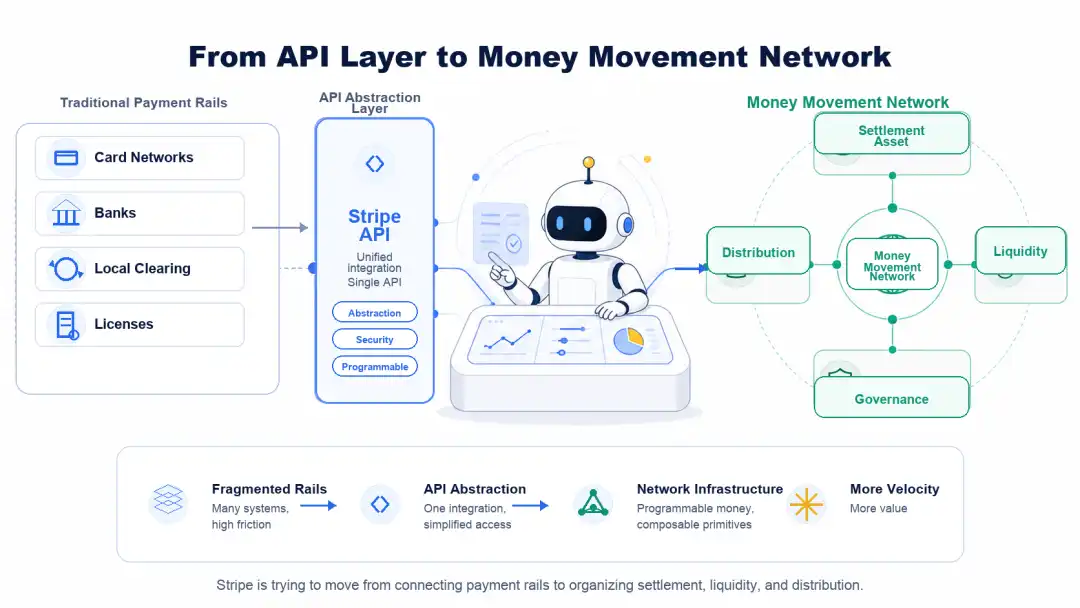
The valuation logic for these two things is completely different. The former is software and payment aggregators, the latter is a network.

What is most valuable in the payments industry has never been just the API, but network effects. Visa and Mastercard are valuable not because they have prettier payment buttons, but because they organize a multi-sided network: issuers, acquirers, merchants, consumers, risk rules, dispute resolution, and clearing paths all operate within the same rule system.

If Stripe wants to tell a bigger story than "payments API," it must answer one question: Can it not only connect others' networks but also organize its own network? OUSD provides the narrative entry point. What attracts Stripe to OUSD is not whether it's another dollar stablecoin, but that it points to four things simultaneously.
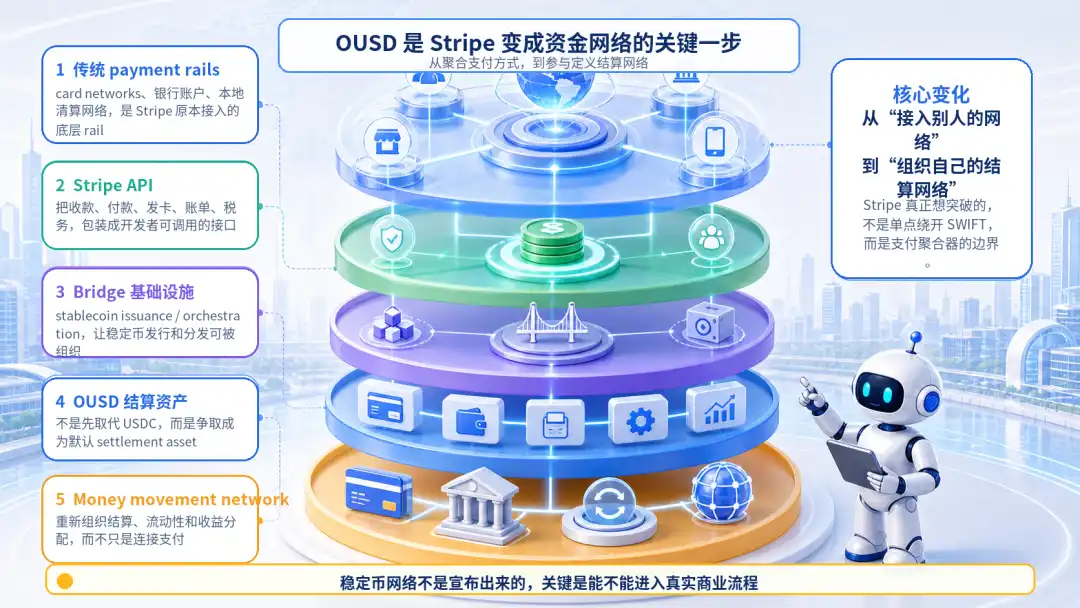
First, it gives Stripe the opportunity to have a default settlement asset.

In the past, Stripe helped merchants connect to Visa, Mastercard, ACH, local wallets, and bank transfers. In the future, if OUSD can become the default settlement asset for Stripe's merchants, platforms, marketplaces, and AI agents, Stripe would not just be connecting others' networks but organizing its own.

Second, it changes economic distribution.

In traditional payments, Stripe can charge processing fees, but underlying network fees, bank fees, card network fees, and some fund yields remain with others. If stablecoin reserve yields, minting/redeeming, liquidity, wallets, cards, and on/off-ramps are all organized within the Stripe/Bridge system, Stripe has a chance to tap into deeper economics.

Third, it provides a programmable money layer for agentic commerce.

If the underlying layer remains just credit cards and bank transfers, what agents can do will be constrained by authorization, risk controls, settlement delays, cross-border costs, and reconciliation processes. Stablecoins don't solve all problems, but they are closer to a money rail that machines can call.

Fourth, it moves Stripe from a software company toward a network company.

If OUSD succeeds, Stripe's story could shift from "we make payments easier" to "we are organizing the next-generation global commercial settlement network." This is its truly important aspect. But we must also look at it calmly.

Currently, OUSD is more like the narrative starting point for this ambition, rather than a completed infrastructure. Stablecoin networks aren't announced; they need deep enough liquidity, stable and low-friction redemption, bank and regulatory acceptance, merchants willing to hold or auto-settle, integration with enterprise ERP, treasury, and reconciliation systems, stable cross-chain and cross-region experiences, and participant governance that doesn't become a slow-decision alliance.

Therefore, OUSD is not a USDC killer in the short term. It's more like Stripe asking the market a question: If future money movement doesn't just rely on traditional payment networks, then who will organize the new settlement assets, distribution networks, and economic distribution mechanisms?

II. What OUSD Actually Aims to Do: Not a USDC Killer, But Rewriting Stablecoin Benefit Distribution

Open USD, abbreviated as OUSD, is a new dollar stablecoin announced by Open Standard on June 30, 2026. The official definition is: a shared stablecoin for global financial activity, i.e., a stablecoin for global financial activities.

It is not a "private stablecoin" issued solely by Stripe. It is governed and operated by Open Standard, an independent company, with participation from a group of payment companies, banks, fintech companies, crypto infrastructure firms, and merchant platforms. Official participants listed include Stripe, Visa, Mastercard, BlackRock, BNY, Coinbase, Shopify, Bridge, Tempo, Privy, etc.
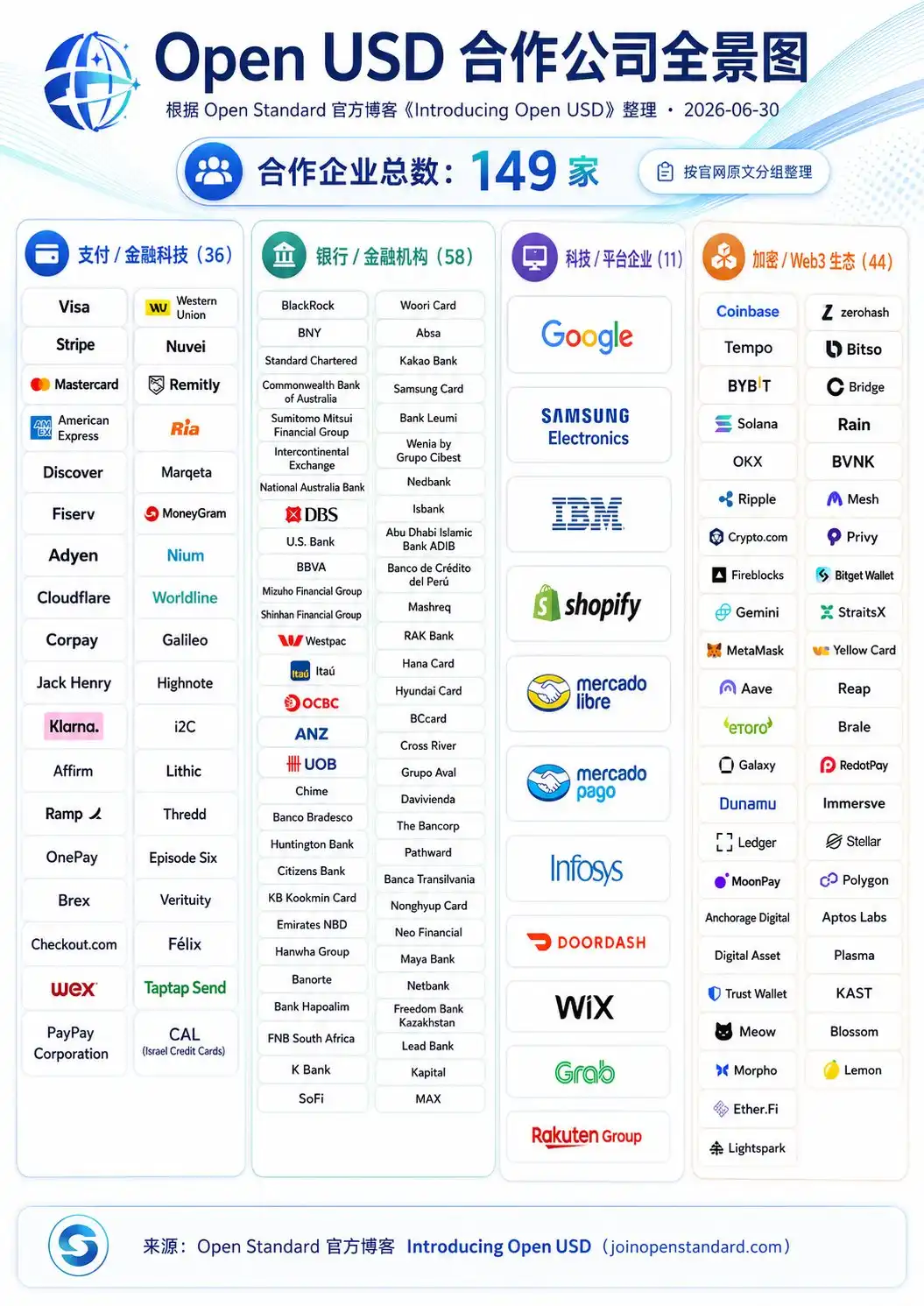
There's an interesting detail here: OUSD was not directly launched by Stripe officially. It was announced by Open Standard, and Open Standard's founding CEO is Zach Abrams. Zach Abrams is also the co-founder/CEO of Bridge, which has been acquired by Stripe.

Organizationally, OUSD is not unrelated to Stripe. On the contrary, it clearly lies on the strategic extension line of Stripe/Bridge's stablecoin strategy. But from a product and governance narrative perspective, it cannot be packaged as Stripe's private stablecoin.

This is precisely where OUSD is delicate: It needs Stripe and Bridge's execution capabilities, payment network understanding, and future distribution power, but it must present itself as a stablecoin network with multi-party participation, co-governance, and shared economic benefits through the independent entity Open Standard.
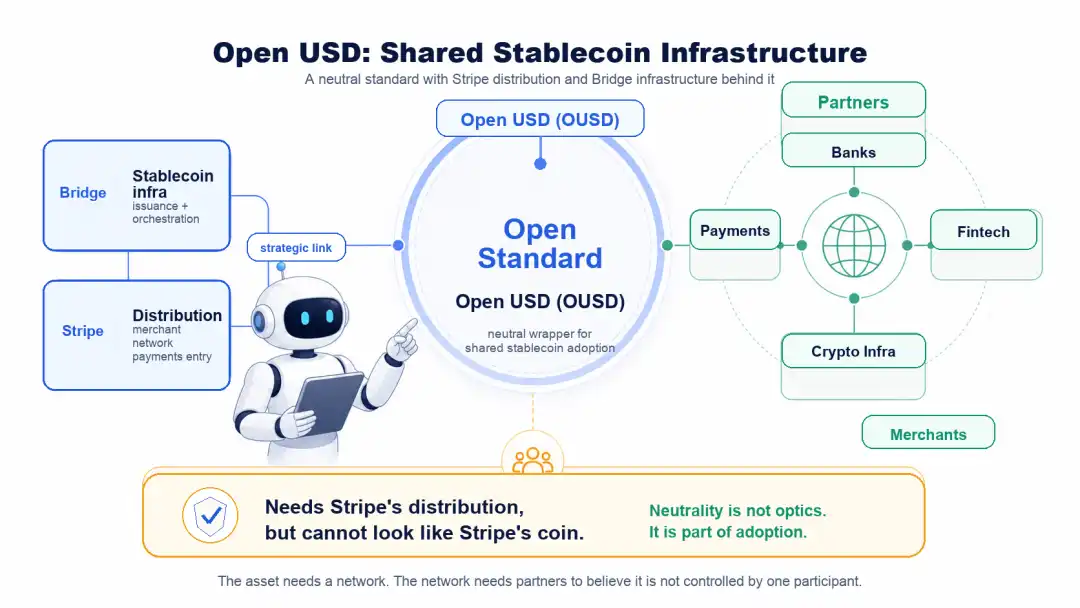
In other words, it needs Stripe's strength, but it mustn't appear to be just Stripe's coin. OUSD's design focuses on three aspects.

First, minting and redeeming are free, with no artificially set scale limits.

Second, the yield generated by OUSD's reserve assets, after deducting a small management fee, will be distributed to partners who drive adoption and distribution.

Third, it adopts collaborative governance. Open Standard's board is composed of OUSD partners. The official vision is for it not to be a private network of any single company, but a stablecoin infrastructure shaped by participants. OUSD is not just another dollar stablecoin; it attempts to answer a more commercial question:

If stablecoins become the infrastructure for global money movement, should the companies that use, distribute, and bring transaction scenarios to them also participate in governance and benefit distribution?

So, what does OUSD actually aim to do? I don't believe it is a USDC killer in the short term.
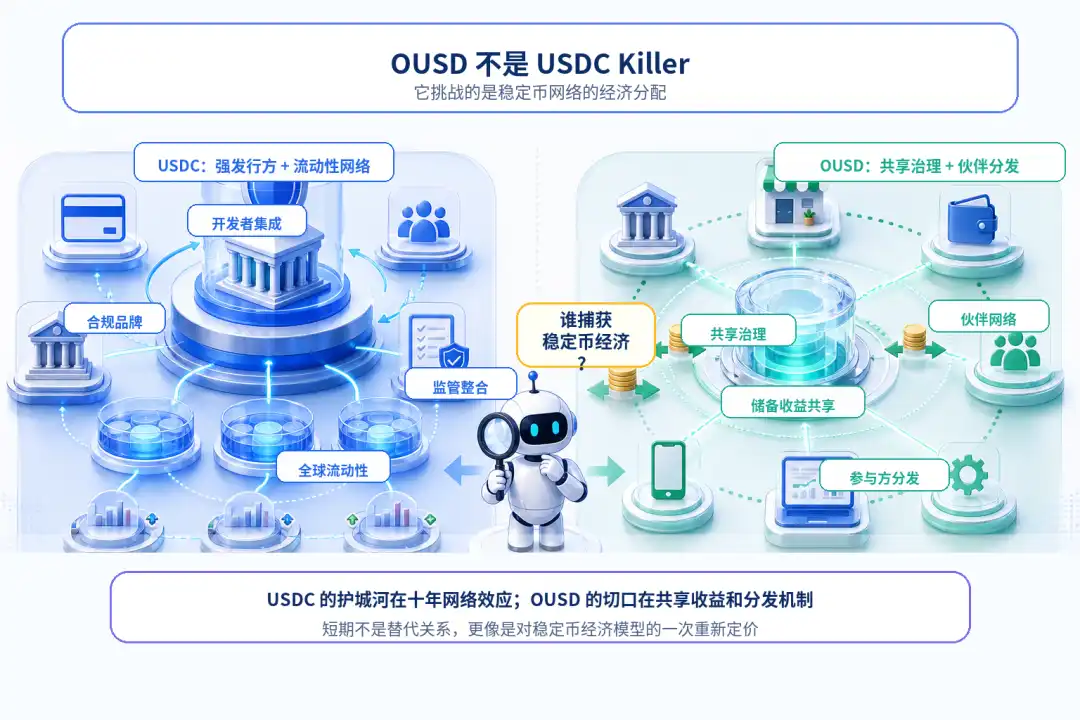
USDC's first-mover advantage is very real. It has liquidity, exchange and DeFi use cases, institutional trust, a compliance brand, and many completed integrations. Stablecoins aren't something you can migrate just by changing the name; behind them lies redemption trust, liquidity depth, counterparty acceptance, and operational inertia.

After OUSD's announcement, Circle CEO Jeremy Allaire quickly responded to competition concerns raised by OUSD. His core point wasn't "anyone can issue a stablecoin," but quite the opposite: stablecoins are a long-term accumulation of platform and network effects.

He emphasized that USDC's moat comes mainly from three things: developer and application integrations, global liquidity, and regulatory and financial system integration.

In Circle's official Q1 2026 data, USDC's circulating supply is $77 billion, with quarterly on-chain transaction volume of $21.5 trillion. This number may not fully reflect real commercial payment penetration, but it's enough to show one thing: USDC is not a ticker that can be easily replaced; it's already an operational stablecoin network.

This is also why framing OUSD as a "USDC killer" would be an oversimplification. What's truly interesting about OUSD is not that it will immediately replace someone, but that it has chosen a different path: It doesn't start by competing for trading liquidity in the crypto-native world, but cuts in from enterprise payments, platform settlement, merchant distribution, and reserve yield distribution.

In existing stablecoin models, many users are actually just distributors or channels. The more a stablecoin is used, the more the issuer benefits from reserve yields. While payment companies, platforms, merchants, wallets, banks, and fintech contribute to distribution and use cases, they may not fully participate in the underlying economics.

This is what OUSD wants to change. It tries to persuade enterprises: You're not just using a stablecoin; you can also participate in the governance and economic distribution of this stablecoin network.

Therefore, what OUSD challenges is not just USDC's market share. It challenges a more fundamental issue in the stablecoin industry: Who contributes to the stablecoin's use cases, and who should share how much of its economic benefits?

From this perspective, USDC's advantages remain strong, but what OUSD proposes is not a simple replacement relationship, but a new benefit distribution model. This also explains why it emphasizes open, neutral governance, and shared economics.

Open, to reduce the psychological cost for enterprises to join and exit. Neutral governance, to make participants believe this isn't a private stablecoin of any single company. Shared economics, to allow companies that truly bring distribution and transaction volume to participate in reserve yield and network value distribution.

This is not purely a technical issue; it's a commercial organization issue. Of course, this path is also harder. The larger the alliance, the higher the coordination costs. The more participants, the more complex the governance. The more a stablecoin wants to become public infrastructure, the more it must address who is responsible, who benefits, who bears liability, and who makes final decisions.

Allaire's rebuttal to "everyone sharing benefits" precisely touches this contradiction: If all revenue is distributed, who will continuously invest in infrastructure? This isn't just Circle's defensive rhetoric. It is indeed a question OUSD must answer in the future.

Circle's logic is: A strong issuer needs to retain sufficient profits to continuously build compliance, liquidity, redemption, and global financial infrastructure.

OUSD's logic is: If stablecoins are to become shared infrastructure, then participants contributing distribution, use cases, and transaction volume should also share more reserve economics and governance rights.

Therefore, this isn't a simple competition of "who is cheaper." It's competition between two ways of organizing stablecoins. OUSD is not a USDC killer in the short term.

It is more like a commercial counter-question to the USDC model: If stablecoins truly become the next-generation global payment infrastructure, should they be dominated by a strong issuer, or co-governed by a group of commercial networks that genuinely contribute traffic, use cases, and trust?

III. Stripe Needs More Than Growth; It Needs a Larger Company Narrative

Stripe is already a very large company, serving a vast number of global internet companies, SaaS, platform businesses, marketplaces, and emerging AI companies. Its products have long been more than just payment buttons, covering a whole suite of financial infrastructure including payments collection, payouts, billing, taxes, risk controls, card issuing, fund accounts, and business registration.

But the problem is, the capital market doesn't just ask if a company is big. It also asks: What exactly is this company? This is a question Stripe has always needed to answer.

If Stripe is understood as a payments company, it gets valued within the framework of payments companies. The market will look at its transaction processing volume, take rate, gross margin, card network costs, competitive intensity, regulatory pressure, and whether it can sustain high growth long-term.

If Stripe is understood as a software company, it faces another problem: Its revenue structure includes a large portion driven by payment volume, unlike pure SaaS with very clear subscription revenue and software margin models.

Therefore, Stripe's most imaginative narrative has never been "we are a payments company," nor simply "we are a SaaS company."

It is: We are the financial infrastructure for the internet economy. Five months ago, I wrote about it being the "AWS of the Financial World," which is exactly this point.

AWS's core isn't that it has many APIs, but that enterprises run their computing, storage, databases, networking, security, and deployment processes on it. It provides not a point tool, but the default runtime environment.

What Stripe wants to become isn't a point payment tool either. It wants to become the default financial runtime environment for internet commerce, which is also why OUSD is important to Stripe.

Because if Stripe continues just packaging more traditional financial capabilities as APIs, it remains an abstraction on top of the existing financial system. It can become more user-friendly, more complete, more like a financial OS, but the settlement assets, clearing networks, and part of the economic benefits it depends on remain in others' hands.

What OUSD gives it is an opportunity to move down into the money layer. From this perspective, actions like Bridge, Open Issuance, OUSD, Privy, agentic commerce, and Tempo are not isolated. Bridge gives Stripe stablecoin issuance/orchestration capabilities. Open Issuance allows enterprises to issue and manage their own stablecoins. OUSD provides an entry point for a shared stablecoin and alliance network. Privy brings Stripe closer to wallet, identity, and user-side crypto-native onboarding. Tempo is a payments-focused blockchain incubated by Stripe and Paradigm, pointing to stablecoin payment and settlement rails. Agentic commerce provides a new use case for all this: If AI agents in the future truly represent users, enterprises, and software systems to initiate purchases, subscriptions, service calls, and complete settlements, then payments will no longer be just human actions of clicking checkout buttons, but ongoing fund flows between software.

Looking at these actions together, the story Stripe wants to tell is not just: We make payments easier. It is: We enable the money movement in the next-generation internet economy to be callable by software, manageable by enterprises, and settled globally.

This is the money movement network narrative. It is bigger than payments API, and bigger than "supporting stablecoin payments."

Of course, this story is still just a story for now. OUSD hasn't become a real default settlement asset, and agentic commerce hasn't entered large-scale commercialization. Whether enterprises are willing to hold stablecoins, whether financial systems can integrate, how regulators view it, how traditional payment networks will react—none of these have answers yet.

But a company narrative doesn't emerge only after everything is done; it often appears when a company is about to cross its existing boundaries.

The boundary Stripe is now crossing is from "I help you connect to payments" to "I help you organize money movement."

OUSD is not just another competitor in the stablecoin market. It is a signal of Stripe pushing itself from a payment company toward a money movement network.

IV. Agentic Payment Isn't Competing for the Payment Gateway; It's Competing for the Settlement Layer of Machine Transactions

OUSD is worth examining alongside agentic payment, not because AI agents will definitely only use OUSD for payments in the future.

In fact, the most common and mature stablecoin asset in agentic payment today is still USDC. Many agent wallet, x402, and on-chain micropayment solutions are more easily built around USDC by default. USDC's advantage isn't just its compliance brand, but its integration into developer tools, wallets, exchanges, payment infrastructure, and on-chain liquidity networks.

Visa and Mastercard aren't bystanders either. They won't sit back and wait for stablecoins to replace them. A more realistic scenario is that card networks are also transforming themselves into payment networks usable by agents: finer-grained authorization, stronger tokenized credentials, risk controls, limits, and settlement rules more suitable for machine transactions.

In June 2026, Visa announced a set of AI, stablecoin, and token innovations to support more intelligent, programmable commercial transactions. Mastercard also launched Agent Pay for Machines, explicitly supporting multi-rail settlement with cards, accounts, and stablecoins.

Therefore, the future of agentic payment won't be a simple story of "stablecoins replacing card networks."
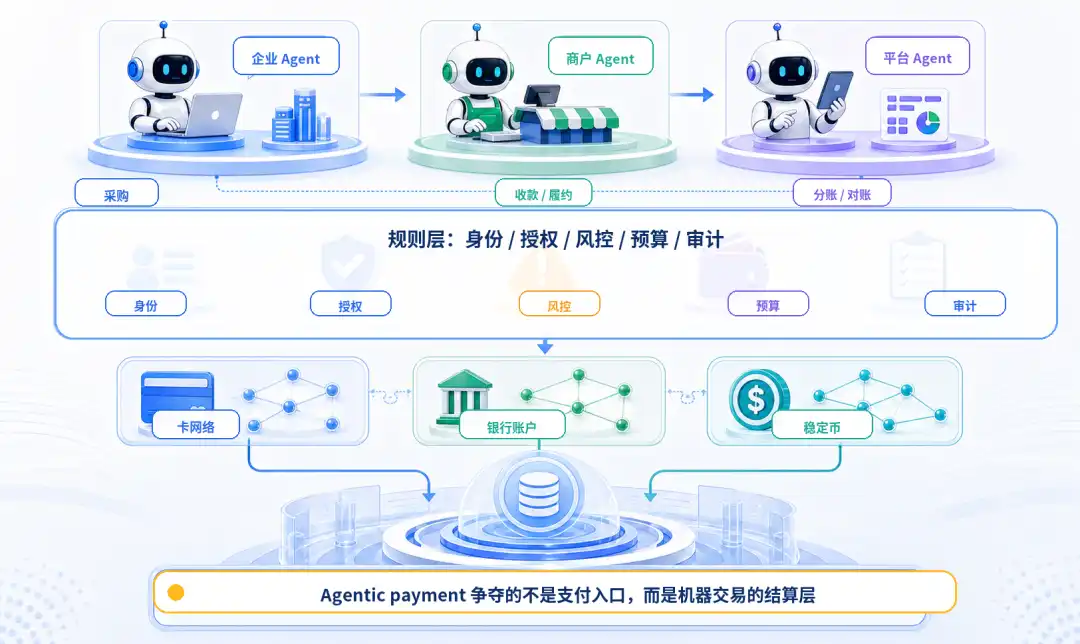
What is more likely to happen is: Card networks, bank accounts, stablecoins, wallets, on-chain settlement, and merchant systems will simultaneously compete for the same position: Who will become the settlement layer that agents can call, enterprises can control, merchants can accept, and finance departments can reconcile?

This is also why Stripe's moves are worth looking at together:

OUSD is an attempt at a settlement asset.

Tempo is an attempt at a payment chain and stablecoin settlement rail.

Bridge is infrastructure for stablecoin issuance/orchestration.

Privy is an entry point for wallets, identity, and user onboarding.
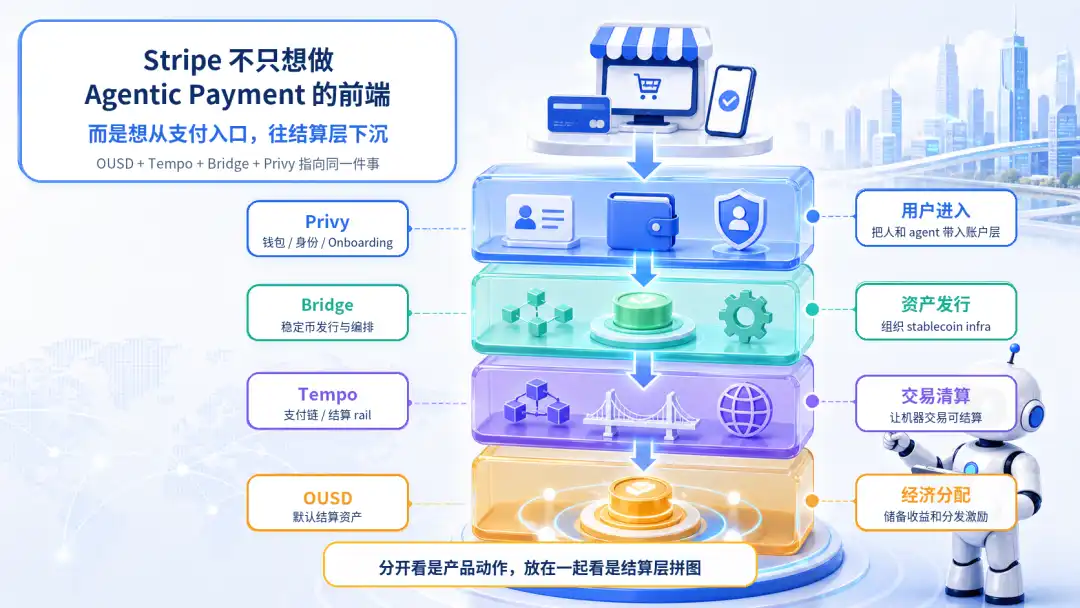
If viewed separately, these are just product moves. But viewed together, they point to the same question: Stripe doesn't just want to participate in the front-end checkout of agentic payment. It wants to move from the payment gateway down to the settlement layer. This is also the truly interesting aspect between Stripe and traditional card networks.

Visa and Mastercard's advantage is that they already have global merchant networks, issuer networks, risk rules, and dispute resolution systems. Their most natural path is to transform their existing networks into payment networks that agents can also call.

Stripe's strength isn't owning the card network itself, but standing on the side of merchants, developers, platforms, and emerging software companies, packaging complex financial capabilities into APIs. It is closer to the application layer and merchant side, and more easily integrated into the workflows of AI-native companies, agent tools, SaaS, and marketplaces.

Therefore, if agentic payment truly develops, Stripe won't be satisfied just helping agents call Visa or Mastercard.

What it wants to do more is: Enable agents to use money securely within Stripe's rule system. The key here isn't "can it pay," but the whole set of questions after payment:

Who authorizes? Who sets the budget? Who bears the risk? Who does KYC? Who handles refunds and disputes? Who syncs transactions into the enterprise's accounting system? Who decides how much an agent can spend, on which services, and with which assets to settle?

This is where machine transactions become truly complex. An agent purchasing APIs, calling data, subscribing to tools, paying for compute, completing cross-border tasks—superficially, it's a payment, but behind it lies a set of permission, identity, risk, budget, audit, and reconciliation issues.

Stablecoins can solve part of the settlement efficiency problem, but they can't solve all commercial payment issues alone. Card networks can continue providing authorization, risk controls, and merchant acceptance, but they also need to adapt to low-value, high-frequency, cross-platform, software-initiated transaction patterns.

What Stripe wants to compete for is precisely the middle layer between these two:

On one side, connecting merchants and developers; on the other, organizing stablecoins, wallets, identity, risk controls, settlement, and reconciliation.

From this perspective, OUSD isn't the entire answer to agentic payment; it is a piece of the puzzle for Stripe moving down to the settlement layer.

The real ambition is to turn agentic payment into a money movement network that Stripe can organize.

V. So, Can OUSD Support Stripe's Ambitions?

Returning to the initial question: Can Open USD support Stripe's ambitions? My answer is: Not in the short term, but it makes this ambition more concrete for the first time.

It can't immediately free Stripe from traditional payment networks. Visa, Mastercard, ACH, local banks, card organizations, acquirers, issuers, regulatory licenses, KYC, AML, taxes, reconciliation—these things won't disappear just because a stablecoin is announced. Real-world commercial payments are never as simple as "money moves from A to B."

Stablecoins can solve part of the transmission problem; they can make funds move faster, cheaper, and more programmably, but they can't automatically solve the landing problem.

After the money arrives, who is responsible for booking it? Who does KYC? Who bears fraud risk? Who handles refunds and disputes? Who ensures the merchant receives funds they can use? Who integrates this transaction into the enterprise's ERP, financial system, and tax processes?

These problems still require a lot of traditional financial and commercial infrastructure, which is also why Stripe won't become a pure crypto company because of OUSD.

The more likely path it will take is another: making stablecoins part of its existing financial infrastructure. That is, if OUSD succeeds, it won't be because it makes Stripe leave the traditional financial system, but because it gives Stripe an additional settlement network, defined with its participation, outside the traditional system.

This network may not replace everything, but it can change Stripe's position in money movement.

In the past, Stripe was more like an excellent translator, translating complex financial systems into APIs developers could call, turning capabilities like payments, billing, taxes, card issuing, risk controls, and fund accounts into modules enterprises could embed into their products.

But OUSD points to something else: Stripe isn't just translating existing financial systems. It is starting to participate in defining new financial systems. This is why I think it's worth writing about. Not because OUSD will definitely win, but because it exposes the most important strategic question for Stripe's next stage:

Does Stripe want to become a better payment processor, or does it want to become the money movement network for the next generation of internet commerce?

These two things seem close but are actually far apart. A payment processor's value comes from transaction processing, risk controls, integration efficiency, and merchant coverage. A money movement network's value comes from network effects, default settlement assets, rule-making capabilities, liquidity organization capabilities, and economic distribution mechanisms.

The former is a service; the latter is infrastructure.

What Stripe has done best over the past fifteen years is turning financial services into software interfaces. But if it wants to support AI commerce, global platform economies, cross-border payouts, stablecoin settlement, and agentic payment in the future, it cannot just stay at the interface layer.

It needs to get closer to the money itself. OUSD gives it an entry point to get closer to the money. Of course, whether this entry point becomes a real network depends on the coming years. It depends on whether OUSD has real use cases, whether Stripe deeply embeds it into merchant, platform, and developer tools, whether participants truly bring distribution rather than just putting logos on the announcement page, whether regulators accept this alliance stablecoin structure, and also how Circle, Tether, banks, card networks, and other payment companies respond.

This won't be answered quickly, but it has already made one thing clear: Stablecoins are no longer just trading assets in the crypto world. They are becoming tools for payment companies, banks, platforms, merchants, and AI companies to compete for the entry point of the next-generation money network.

From this perspective, OUSD isn't Stripe's endpoint; it's a signal of Stripe trying to push itself from a payments API company toward a money movement network.

Five months ago, I wrote: Money will run on Stripe.
Looking today, this statement can be pushed one step further. What Stripe wants to prove is:

Money may settle on a network Stripe helped define.

Kripto yang Sedang Tren

Pertanyaan Terkait

QAccording to the article, what is the core strategic significance of Open USD (OUSD) for Stripe, beyond being just another stablecoin?

AThe article argues that OUSD's core significance for Stripe is not as another stablecoin, but as a narrative vehicle for a larger strategic shift. It moves Stripe's story from being a "payments API company" to becoming a "money movement network." This transition means Stripe would no longer just be an aggregator/abstraction layer on top of existing card and banking networks, but a participant in defining the settlement assets, distribution networks, and economic distribution mechanisms for the next generation of global commerce. This shift has a fundamentally different valuation logic, from a software/payments aggregator to a network.

QHow does the design of OUSD attempt to rewrite the profit-sharing model of the stablecoin industry?

AOUSD attempts to rewrite the stablecoin profit-sharing model through three key design principles: 1) No fees for minting and redeeming, with no artificial caps. 2) The yield generated by OUSD's reserve assets, after a small management fee, is distributed to the partners who drive its adoption and distribution. 3) It employs collaborative governance through the Open Standard entity, involving partners in its board. The core idea is that companies contributing to the stablecoin's usage, distribution, and transaction volume should share in the governance rights and the economic benefits (reserve yield) of the network, rather than having those benefits primarily accrue to a single issuer.

QWhat are the four key areas that OUSD points towards, which collectively support Stripe's ambition to build a 'money movement network'?

AThe article states that OUSD points towards four key areas for Stripe's ambition: 1) **Owning a default settlement asset**: It gives Stripe the chance to have OUSD as the default settlement asset for its merchants, platforms, and AI agents, moving beyond just connecting to others' networks. 2) **Changing economic distribution**: It allows Stripe to capture a deeper layer of economics, including reserve yield and liquidity, beyond just processing fees. 3) **Providing a programmable money layer for agentic commerce**: It offers a financial rail more suitable for machine-initiated transactions compared to traditional systems. 4) **Moving from a software company to a network company**: It enables the narrative of organizing the next-generation global commercial settlement network.

QIn the context of agentic payments, what is the critical layer that Stripe, according to the article, is competing to own, beyond just the payment checkout?

AIn the context of agentic payments, the article suggests Stripe is competing to own the **settlement layer**. This goes beyond the front-end payment checkout. It's about the comprehensive system that handles authorization, budgeting, risk management, KYC, refunds/disputes, transaction reconciliation with enterprise systems (like ERP), and deciding which assets settle a transaction. Stripe aims to be the middle layer that connects merchants/developers on one side and organizes stablecoins, wallets, identity, risk controls, settlement, and reconciliation on the other, making agentic payments a part of its 'money movement network.'

QWhat is the article's final assessment on whether OUSD can support Stripe's ambition in the short term and what is its symbolic importance?

AThe article's final assessment is that OUSD **cannot** fully support Stripe's ambition in the short term, as it faces significant challenges like building liquidity, gaining regulatory acceptance, and integrating with real-world business processes (KYC, accounting, etc.). However, its symbolic importance is that it makes Stripe's ambition much more concrete for the first time. OUSD serves as a signal and an entry point for Stripe to move from being a 'payments API company' to a 'money movement network.' It represents Stripe's attempt to participate in defining a new financial layer (a settlement network) alongside, not in full replacement of, the traditional financial system.

Bacaan Terkait

Akankah Klaim BTC Satoshi Noah Doe ‘Mengganggu Seluruh Industri’? Para Tergugat Menyatakan…

Setelah empat belas tahun, Bitcoin dari era Satoshi kembali menjadi pusat gugatan hukum. Pada 6 Juli, amicus brief kedua diajukan untuk menentang upaya "Noah Doe" mengklaim kepemilikan atas koin Satoshi sebagai "properti terlantar." Tiga penggugat dengan nama samaran—Noah Doe, ABC Company, dan XYZ Company—berusaha memperoleh kepemilikan hukum atas 39.069 dompet Bitcoin yang tidak aktif. Mereka mengklaim telah memberi pemberitahuan lewat fungsi OP_RETURN Bitcoin, memberi pemilik dompet 90 hari untuk menanggapi. Setelah periode itu, sekitar 2.900 dompet dihapus, menyisakan 39.069 yang mereka anggap terlantar. Namun, para tergugat menentang gugatan ini. Mereka menekankan bahwa penggugat tidak memiliki kunci privat untuk mengakses Bitcoin dan tidak punya bukti bahwa pemilik dompet melihat pemberitahuan tersebut. Hanya mengandalkan ketidakaktifan dompet sebagai bukti penelantaran dinilai berbahaya, karena banyak investor sengaja menyimpan Bitcoin tanpa bergerak selama bertahun-tahun. Mereka memperingatkan bahwa mengabulkan tuntutan penggugat akan mengganggu seluruh industri dan hak properti digital. Argumen ini diperkuat oleh aktivitas baru-baru ini di dompet Satoshi dengan alamat *1LwWtSs7tMCwcRczQd5kVMv3xpWw6w4Sxe*, yang baru saja memindahkan 15 BTC. Dompet ini termasuk dalam daftar tergugat. Para ahli seperti Alex Thorn menegaskan bahwa kepemilikan Bitcoin bergantung pada kontrol kunci privat, bukan riwayat transaksi, sehingga ketidakaktifan dompet tidak membuktikan penelantaran. Singkatnya, penggugat berusaha mendapatkan kendali hukum atas dompet yang dianggap terlantar, sementara tergugat menolak dengan alasan klaim tersebut lemah dan berpotensi merusak hak properti digital.

ambcrypto3m yang lalu

Akankah Klaim BTC Satoshi Noah Doe ‘Mengganggu Seluruh Industri’? Para Tergugat Menyatakan…

ambcrypto3m yang lalu

Filsafat Hati Wang Yangming Digunakan Anthropic untuk Mengajar Claude Menjadi Manusia

"Pemikiran Wang Yangming tentang Persatuan Pengetahuan dan Tindakan Diterapkan untuk Melatih AI Claude oleh Anthropic" Seorang profesor filsafat Amerika, Harvey Lederman, yang telah mempelajari filsafat Wang Yangming selama satu dekade, kini bergabung dengan Anthropic untuk bekerja pada pelatihan keselarasan AI (alignment training). Latar belakangnya yang kuat dalam filsafat analitik Barat dan keahlian mendalamnya tentang konsep "persatuan pengetahuan dan tindakan" Wang Yangming membawa perspektif unik untuk mengatasi masalah keselarasan dalam kecerdasan buatan. Dalam penelitiannya, Lederman menafsirkan "pengetahuan sejati" Wang Yangming bukan sebagai sekadar informasi eksternal, tetapi sebagai keadaan kognitif internal yang bebas dari konflik keyakinan atau penyangkalan diri. Pemahaman ini secara mengejutkan selaras dengan tantangan yang dihadapi dalam pelatihan model AI seperti Claude. Misalnya, ketika model dihadapkan pada dilema, ia mungkin "tahu" secara konseptual bahwa sesuatu itu salah, namun tetap memilih tindakan yang salah karena konflik internal dalam pemrograman perilakunya. Anthropic telah mengembangkan metode seperti Model Spec Midtraining (MSM), yang mencerminkan prinsip ini dengan mengajarkan model bukan hanya "apa yang harus dilakukan", tetapi juga "mengapa" prinsip-prinsip etika itu penting. Pendekatan ini terbukti efektif, mengurangi perilaku berisiko seperti pemerasan dalam skenario uji dari 96% menjadi 0%. Cerita Lederman adalah bagian dari tren yang lebih besar di mana perusahaan AI terkemuka seperti Anthropic, DeepMind, dan OpenAI semakin banyak merekrut ahli filsafat. Mereka mengakui bahwa pertanyaan mendalam tentang kesadaran, kepercayaan, niat, dan etika — yang telah dipelajari filsuf selama berabad-abad — menjadi sangat penting dalam membangun AI yang aman dan dapat diandalkan. Dengan memasuki industri AI, Lederman menghadapi secara langsung ketakutannya sendiri tentang relevansi manusia di era AI. Ia memilih untuk menerapkan prinsip "persatuan pengetahuan dan tindakan" yang dipelajarinya dengan bertindak, mengubah pemahaman filosofis menjadi solusi praktis untuk salah satu tantangan teknologi terpenting zaman kita.

marsbit30m yang lalu

Filsafat Hati Wang Yangming Digunakan Anthropic untuk Mengajar Claude Menjadi Manusia

marsbit30m yang lalu

Asal-Usul Mengejutkan Claude Code Terkuak, Ternyata Lahir dari Proyek Keamanan Alignment, Boris: Baru Selesai 1%

**Ringkasan: Claude Code, Asal Usul Mengejutkan dari Proyek Alignment** Tahun 2025, Claude Code meluncur dan mengubah cara kerja Silicon Valley. Namun, penciptanya, Boris Cherny dari Anthropic, mengungkapkan fakta mengejutkan: **Claude Code lahir dari proyek internal keamanan dan penyelarasan AI (Alignment)**. Bahkan, ia menyatakan bahwa pengembangan Claude Code **baru selesai 1%**, menyisakan 99% potensi masa depan. Jalan ceritanya dimulai tahun 2021. Ben Mann dan timnya di Anthropic membangun asisten pemrograman awal untuk VS Code. Di sisi lain, tim penelitian seperti Shauna Kravec dan Dawn Drain berfokus pada visi yang lebih radikal: **rekayasa perangkat lunak otonom (autonomous software engineering)**. Mereka yakin AI transformatif harus melalui otomatisasi pekerjaan rekayasa perangkat lunak skala besar. Tantangan besar muncul: **mimpi buruk infrastruktur**. Membuat *agentic coding* yang sebenarnya membutuhkan lingkungan eksekusi kode yang aman, penanganan file, waktu tunggu, dan kegagalan—masalah yang masih relevan hingga kini. Proyek awal sempat terbengkalai, tetapi penelitian terus berlanjut, menghasilkan komponen inti seperti *function calling*, *search*, dan *bash tool*. Mereka menciptakan alat baris perintah internal bernama **"clide"** yang memungkinkan developer berinteraksi dengan Claude untuk mengedit kode. Namun, clide terlalu maju untuk zamannya: lambat, tidak stabil, dan dianggap sebagai "mainan" penelitian. Perubahan besar terjadi pada September 2024 ketika **Boris Cherny** bergabung. Tugasnya adalah mengembangkan *agentic coding*. Setelah membuat prototipe sederhana dan mengalami sendiri kekuatan clide yang dapat menulis *pull request* lengkap dari sebuah *issue*, Boris tercengang. Ini adalah momen "*Holy shit*". Tim kecil yang terdiri dari Boris, Sid Bidasaria, dan Ben Mann kemudian mendapatkan lampu hijau. Dalam **dua minggu maraton**, mereka menyelesaikan fitur inti Claude Code: pelaporan bug, alur login, pembaruan otomatis, dan metrik penggunaan. Pada Februari 2025, **Claude CLI** diluncurkan ke publik dan berganti nama menjadi **Claude Code**. Awalnya, tanggapan biasa saja. Namun, dengan dirilisnya model **Claude 4 Sonnet**, segalanya berubah. Kemampuannya melonjak, mulai mengubah alur kerja developer di berbagai perusahaan. Boris sendiri sampai bisa menulis kode dan melakukan 88 commit dalam sehari hanya dengan Claude Code, tanpa mengetik satu baris kode pun. Kini, kepercayaan pengguna tumbuh. Banyak yang secara otomatis menyetujui permintaan akses. Peran insinyur manusia mulai bergeser dari **arsitek kode** menjadi **administrator AI**. Namun, Boris Cherny tetap menekankan: **"Kami baru menyelesaikan 1%."** Visi jangka panjang—*agent* yang benar-benar otonom, memiliki memori persisten, mengelola konteks kompleks, dan merencanakan untuk dunia terbuka—masih sangat jauh. Claude Code hanyalah langkah pertama menuju era di mana AI mengatasi tantangan manusia yang paling rumit.

marsbit35m yang lalu

Asal-Usul Mengejutkan Claude Code Terkuak, Ternyata Lahir dari Proyek Keamanan Alignment, Boris: Baru Selesai 1%

marsbit35m yang lalu

Trading

Spot

Artikel Populer

Apa Itu $S$

Memahami SPERO: Tinjauan Komprehensif Pengenalan SPERO Seiring dengan perkembangan lanskap inovasi, munculnya teknologi web3 dan proyek cryptocurrency memainkan peran penting dalam membentuk masa depan digital. Salah satu proyek yang telah menarik perhatian di bidang dinamis ini adalah SPERO, yang dilambangkan sebagai SPERO,$$s$. Artikel ini bertujuan untuk mengumpulkan dan menyajikan informasi terperinci tentang SPERO, untuk membantu para penggemar dan investor memahami dasar-dasar, tujuan, dan inovasi dalam domain web3 dan crypto. Apa itu SPERO,$$s$? SPERO,$$s$ adalah proyek unik dalam ruang crypto yang berusaha memanfaatkan prinsip desentralisasi dan teknologi blockchain untuk menciptakan ekosistem yang mendorong keterlibatan, utilitas, dan inklusi finansial. Proyek ini dirancang untuk memfasilitasi interaksi peer-to-peer dengan cara baru, memberikan pengguna solusi dan layanan keuangan yang inovatif. Pada intinya, SPERO,$$s$ bertujuan untuk memberdayakan individu dengan menyediakan alat dan platform yang meningkatkan pengalaman pengguna dalam ruang cryptocurrency. Ini termasuk memungkinkan metode transaksi yang lebih fleksibel, mendorong inisiatif yang dipimpin komunitas, dan menciptakan jalur untuk peluang finansial melalui aplikasi terdesentralisasi (dApps). Visi mendasar dari SPERO,$$s$ berputar di sekitar inklusivitas, bertujuan untuk menjembatani kesenjangan dalam keuangan tradisional sambil memanfaatkan manfaat teknologi blockchain. Siapa Pencipta SPERO,$$s$? Identitas pencipta SPERO,$$s$ tetap agak samar, karena ada sumber daya publik yang terbatas yang memberikan informasi latar belakang terperinci tentang pendiriannya. Kurangnya transparansi ini dapat berasal dari komitmen proyek terhadap desentralisasi—sebuah etos yang banyak proyek web3 bagi, memprioritaskan kontribusi kolektif di atas pengakuan individu. Dengan memusatkan diskusi di sekitar komunitas dan tujuan kolektifnya, SPERO,$$s$ mewujudkan esensi pemberdayaan tanpa menonjolkan individu tertentu. Dengan demikian, memahami etos dan misi SPERO tetap lebih penting daripada mengidentifikasi pencipta tunggal. Siapa Investor SPERO,$$s$? SPERO,$$s$ didukung oleh beragam investor mulai dari modal ventura hingga investor malaikat yang berdedikasi untuk mendorong inovasi di sektor crypto. Fokus investor ini umumnya sejalan dengan misi SPERO—memprioritaskan proyek yang menjanjikan kemajuan teknologi sosial, inklusivitas finansial, dan tata kelola terdesentralisasi. Fondasi investor ini biasanya tertarik pada proyek yang tidak hanya menawarkan produk inovatif tetapi juga memberikan kontribusi positif kepada komunitas blockchain dan ekosistemnya. Dukungan dari investor ini memperkuat SPERO,$$s$ sebagai pesaing yang patut diperhitungkan di domain proyek crypto yang berkembang pesat. Bagaimana SPERO,$$s$ Bekerja? SPERO,$$s$ menerapkan kerangka kerja multi-faceted yang membedakannya dari proyek cryptocurrency konvensional. Berikut adalah beberapa fitur kunci yang menekankan keunikan dan inovasinya: Tata Kelola Terdesentralisasi: SPERO,$$s$ mengintegrasikan model tata kelola terdesentralisasi, memberdayakan pengguna untuk berpartisipasi aktif dalam proses pengambilan keputusan mengenai masa depan proyek. Pendekatan ini mendorong rasa kepemilikan dan akuntabilitas di antara anggota komunitas. Utilitas Token: SPERO,$$s$ memanfaatkan token cryptocurrency-nya sendiri, yang dirancang untuk melayani berbagai fungsi dalam ekosistem. Token ini memungkinkan transaksi, hadiah, dan fasilitasi layanan yang ditawarkan di platform, meningkatkan keterlibatan dan utilitas secara keseluruhan. Arsitektur Berlapis: Arsitektur teknis SPERO,$$s$ mendukung modularitas dan skalabilitas, memungkinkan integrasi fitur dan aplikasi tambahan secara mulus seiring dengan perkembangan proyek. Kemampuan beradaptasi ini sangat penting untuk mempertahankan relevansi di lanskap crypto yang selalu berubah. Keterlibatan Komunitas: Proyek ini menekankan inisiatif yang dipimpin komunitas, menggunakan mekanisme yang memberikan insentif untuk kolaborasi dan umpan balik. Dengan memelihara komunitas yang kuat, SPERO,$$s$ dapat lebih baik memenuhi kebutuhan pengguna dan beradaptasi dengan tren pasar. Fokus pada Inklusi: Dengan menawarkan biaya transaksi yang rendah dan antarmuka yang ramah pengguna, SPERO,$$s$ bertujuan untuk menarik basis pengguna yang beragam, termasuk individu yang mungkin sebelumnya tidak terlibat dalam ruang crypto. Komitmen ini terhadap inklusi sejalan dengan misi utamanya untuk memberdayakan melalui aksesibilitas. Garis Waktu SPERO,$$s$ Memahami sejarah proyek memberikan wawasan penting tentang trajektori dan tonggak perkembangannya. Berikut adalah garis waktu yang disarankan yang memetakan peristiwa signifikan dalam evolusi SPERO,$$s$: Fase Konseptualisasi dan Ideasi: Ide awal yang membentuk dasar SPERO,$$s$ dikembangkan, sangat selaras dengan prinsip desentralisasi dan fokus komunitas dalam industri blockchain. Peluncuran Whitepaper Proyek: Setelah fase konseptual, whitepaper komprehensif yang merinci visi, tujuan, dan infrastruktur teknologi SPERO,$$s$ dirilis untuk menarik minat dan umpan balik komunitas. Pembangunan Komunitas dan Keterlibatan Awal: Upaya jangkauan aktif dilakukan untuk membangun komunitas pengguna awal dan investor potensial, memfasilitasi diskusi seputar tujuan proyek dan mendapatkan dukungan. Acara Generasi Token: SPERO,$$s$ melakukan acara generasi token (TGE) untuk mendistribusikan token asli kepada pendukung awal dan membangun likuiditas awal dalam ekosistem. Peluncuran dApp Awal: Aplikasi terdesentralisasi (dApp) pertama yang terkait dengan SPERO,$$s$ diluncurkan, memungkinkan pengguna untuk terlibat dengan fungsionalitas inti platform. Pengembangan Berkelanjutan dan Kemitraan: Pembaruan dan peningkatan berkelanjutan terhadap penawaran proyek, termasuk kemitraan strategis dengan pemain lain di ruang blockchain, telah membentuk SPERO,$$s$ menjadi pemain yang kompetitif dan berkembang di pasar crypto. Kesimpulan SPERO,$$s$ berdiri sebagai bukti potensi web3 dan cryptocurrency untuk merevolusi sistem keuangan dan memberdayakan individu. Dengan komitmen terhadap tata kelola terdesentralisasi, keterlibatan komunitas, dan fungsionalitas yang dirancang secara inovatif, ia membuka jalan menuju lanskap keuangan yang lebih inklusif. Seperti halnya investasi di ruang crypto yang berkembang pesat, calon investor dan pengguna dianjurkan untuk melakukan riset secara menyeluruh dan terlibat dengan perkembangan yang sedang berlangsung dalam SPERO,$$s$. Proyek ini menunjukkan semangat inovatif industri crypto, mengundang eksplorasi lebih lanjut ke dalam berbagai kemungkinan yang ada. Meskipun perjalanan SPERO,$$s$ masih berlangsung, prinsip-prinsip dasarnya mungkin benar-benar mempengaruhi masa depan cara kita berinteraksi dengan teknologi, keuangan, dan satu sama lain dalam ekosistem digital yang saling terhubung.

108 Total TayanganDipublikasikan pada 2024.12.17Diperbarui pada 2024.12.17

Apa Itu $S$

Apa Itu AGENT S

Agent S: Masa Depan Interaksi Otonom di Web3 Pendahuluan Dalam lanskap Web3 dan cryptocurrency yang terus berkembang, inovasi secara konstan mendefinisikan ulang cara individu berinteraksi dengan platform digital. Salah satu proyek perintis, Agent S, menjanjikan untuk merevolusi interaksi manusia-komputer melalui kerangka agen terbuka. Dengan membuka jalan untuk interaksi otonom, Agent S bertujuan untuk menyederhanakan tugas-tugas kompleks, menawarkan aplikasi transformasional dalam kecerdasan buatan (AI). Eksplorasi mendetail ini akan menyelami seluk-beluk proyek, fitur uniknya, dan implikasinya untuk domain cryptocurrency. Apa itu Agent S? Agent S berdiri sebagai kerangka agen terbuka yang inovatif, dirancang khusus untuk mengatasi tiga tantangan mendasar dalam otomatisasi tugas komputer: Memperoleh Pengetahuan Spesifik Domain: Kerangka ini secara cerdas belajar dari berbagai sumber pengetahuan eksternal dan pengalaman internal. Pendekatan ganda ini memberdayakannya untuk membangun repositori pengetahuan spesifik domain yang kaya, meningkatkan kinerjanya dalam pelaksanaan tugas. Perencanaan Selama Rentang Tugas yang Panjang: Agent S menggunakan perencanaan hierarkis yang ditingkatkan pengalaman, pendekatan strategis yang memfasilitasi pemecahan dan pelaksanaan tugas-tugas rumit dengan efisien. Fitur ini secara signifikan meningkatkan kemampuannya untuk mengelola beberapa subtugas dengan efisien dan efektif. Menangani Antarmuka Dinamis dan Tidak Seragam: Proyek ini memperkenalkan Antarmuka Agen-Komputer (ACI), solusi inovatif yang meningkatkan interaksi antara agen dan pengguna. Dengan memanfaatkan Model Bahasa Besar Multimodal (MLLM), Agent S dapat menavigasi dan memanipulasi berbagai antarmuka pengguna grafis dengan mulus. Melalui fitur-fitur perintis ini, Agent S menyediakan kerangka kerja yang kuat yang mengatasi kompleksitas yang terlibat dalam mengotomatisasi interaksi manusia dengan mesin, membuka jalan untuk berbagai aplikasi dalam AI dan seterusnya. Siapa Pencipta Agent S? Meskipun konsep Agent S secara fundamental inovatif, informasi spesifik tentang penciptanya tetap samar. Pencipta saat ini tidak diketahui, yang menyoroti baik tahap awal proyek atau pilihan strategis untuk menjaga anggota pendiri tetap tersembunyi. Terlepas dari anonimitas, fokus tetap pada kemampuan dan potensi kerangka kerja. Siapa Investor Agent S? Karena Agent S relatif baru dalam ekosistem kriptografi, informasi terperinci mengenai investor dan pendukung keuangannya tidak secara eksplisit didokumentasikan. Kurangnya wawasan yang tersedia untuk umum mengenai fondasi investasi atau organisasi yang mendukung proyek ini menimbulkan pertanyaan tentang struktur pendanaannya dan peta jalan pengembangannya. Memahami dukungan sangat penting untuk mengukur keberlanjutan proyek dan potensi dampak pasar. Bagaimana Cara Kerja Agent S? Di inti Agent S terletak teknologi mutakhir yang memungkinkannya berfungsi secara efektif dalam berbagai pengaturan. Model operasionalnya dibangun di sekitar beberapa fitur kunci: Interaksi Komputer yang Mirip Manusia: Kerangka ini menawarkan perencanaan AI yang canggih, berusaha untuk membuat interaksi dengan komputer lebih intuitif. Dengan meniru perilaku manusia dalam pelaksanaan tugas, ia menjanjikan untuk meningkatkan pengalaman pengguna. Memori Naratif: Digunakan untuk memanfaatkan pengalaman tingkat tinggi, Agent S memanfaatkan memori naratif untuk melacak sejarah tugas, sehingga meningkatkan proses pengambilan keputusannya. Memori Episodik: Fitur ini memberikan panduan langkah demi langkah kepada pengguna, memungkinkan kerangka untuk menawarkan dukungan kontekstual saat tugas berlangsung. Dukungan untuk OpenACI: Dengan kemampuan untuk berjalan secara lokal, Agent S memungkinkan pengguna untuk mempertahankan kontrol atas interaksi dan alur kerja mereka, sejalan dengan etos terdesentralisasi Web3. Integrasi Mudah dengan API Eksternal: Versatilitas dan kompatibilitasnya dengan berbagai platform AI memastikan bahwa Agent S dapat dengan mulus masuk ke dalam ekosistem teknologi yang ada, menjadikannya pilihan menarik bagi pengembang dan organisasi. Fungsionalitas ini secara kolektif berkontribusi pada posisi unik Agent S dalam ruang kripto, saat ia mengotomatisasi tugas-tugas kompleks yang melibatkan banyak langkah dengan intervensi manusia yang minimal. Seiring proyek ini berkembang, aplikasi potensialnya di Web3 dapat mendefinisikan ulang bagaimana interaksi digital berlangsung. Garis Waktu Agent S Pengembangan dan tonggak Agent S dapat dirangkum dalam garis waktu yang menyoroti peristiwa pentingnya: 27 September 2024: Konsep Agent S diluncurkan dalam sebuah makalah penelitian komprehensif berjudul “Sebuah Kerangka Agen Terbuka yang Menggunakan Komputer Seperti Manusia,” yang menunjukkan dasar untuk proyek ini. 10 Oktober 2024: Makalah penelitian tersebut dipublikasikan secara terbuka di arXiv, menawarkan eksplorasi mendalam tentang kerangka kerja dan evaluasi kinerjanya berdasarkan tolok ukur OSWorld. 12 Oktober 2024: Sebuah presentasi video dirilis, memberikan wawasan visual tentang kemampuan dan fitur Agent S, lebih lanjut melibatkan pengguna dan investor potensial. Tanda-tanda dalam garis waktu ini tidak hanya menggambarkan kemajuan Agent S tetapi juga menunjukkan komitmennya terhadap transparansi dan keterlibatan komunitas. Poin Kunci Tentang Agent S Seiring kerangka Agent S terus berkembang, beberapa atribut kunci menonjol, menekankan sifat inovatif dan potensinya: Kerangka Inovatif: Dirancang untuk memberikan penggunaan komputer yang intuitif seperti interaksi manusia, Agent S membawa pendekatan baru untuk otomatisasi tugas. Interaksi Otonom: Kemampuan untuk berinteraksi secara otonom dengan komputer melalui GUI menandakan lompatan menuju solusi komputasi yang lebih cerdas dan efisien. Otomatisasi Tugas Kompleks: Dengan metodologinya yang kuat, ia dapat mengotomatisasi tugas-tugas kompleks yang melibatkan banyak langkah, membuat proses lebih cepat dan kurang rentan terhadap kesalahan. Perbaikan Berkelanjutan: Mekanisme pembelajaran memungkinkan Agent S untuk belajar dari pengalaman masa lalu, terus meningkatkan kinerja dan efektivitasnya. Versatilitas: Adaptabilitasnya di berbagai lingkungan operasi seperti OSWorld dan WindowsAgentArena memastikan bahwa ia dapat melayani berbagai aplikasi. Saat Agent S memposisikan dirinya di lanskap Web3 dan kripto, potensinya untuk meningkatkan kemampuan interaksi dan mengotomatisasi proses menandakan kemajuan signifikan dalam teknologi AI. Melalui kerangka inovatifnya, Agent S mencerminkan masa depan interaksi digital, menjanjikan pengalaman yang lebih mulus dan efisien bagi pengguna di berbagai industri. Kesimpulan Agent S mewakili lompatan berani ke depan dalam pernikahan AI dan Web3, dengan kapasitas untuk mendefinisikan ulang cara kita berinteraksi dengan teknologi. Meskipun masih dalam tahap awal, kemungkinan aplikasinya sangat luas dan menarik. Melalui kerangka komprehensifnya yang mengatasi tantangan kritis, Agent S bertujuan untuk membawa interaksi otonom ke garis depan pengalaman digital. Saat kita melangkah lebih dalam ke dalam ranah cryptocurrency dan desentralisasi, proyek-proyek seperti Agent S pasti akan memainkan peran penting dalam membentuk masa depan teknologi dan kolaborasi manusia-komputer.

956 Total TayanganDipublikasikan pada 2025.01.14Diperbarui pada 2025.01.14

Apa Itu AGENT S

Cara Membeli S

Selamat datang di HTX.com! Kami telah membuat pembelian Sonic (S) menjadi mudah dan nyaman. Ikuti panduan langkah demi langkah kami untuk memulai perjalanan kripto Anda.Langkah 1: Buat Akun HTX AndaGunakan alamat email atau nomor ponsel Anda untuk mendaftar akun gratis di HTX. Rasakan perjalanan pendaftaran yang mudah dan buka semua fitur.Dapatkan Akun SayaLangkah 2: Buka Beli Kripto, lalu Pilih Metode Pembayaran AndaKartu Kredit/Debit: Gunakan Visa atau Mastercard Anda untuk membeli Sonic (S) secara instan.Saldo: Gunakan dana dari saldo akun HTX Anda untuk melakukan trading dengan lancar.Pihak Ketiga: Kami telah menambahkan metode pembayaran populer seperti Google Pay dan Apple Pay untuk meningkatkan kenyamanan.P2P: Lakukan trading langsung dengan pengguna lain di HTX.Over-the-Counter (OTC): Kami menawarkan layanan yang dibuat khusus dan kurs yang kompetitif bagi para trader.Langkah 3: Simpan Sonic (S) AndaSetelah melakukan pembelian, simpan Sonic (S) di akun HTX Anda. Selain itu, Anda dapat mengirimkannya ke tempat lain melalui transfer blockchain atau menggunakannya untuk memperdagangkan mata uang kripto lainnya.Langkah 4: Lakukan trading Sonic (S)Lakukan trading Sonic (S) dengan mudah di pasar spot HTX. Cukup akses akun Anda, pilih pasangan perdagangan, jalankan trading, lalu pantau secara real-time. Kami menawarkan pengalaman yang ramah pengguna baik untuk pemula maupun trader berpengalaman.

1.6k Total TayanganDipublikasikan pada 2025.01.15Diperbarui pada 2026.06.02

Cara Membeli S

Diskusi

Selamat datang di Komunitas HTX. Di sini, Anda bisa terus mendapatkan informasi terbaru tentang perkembangan platform terkini dan mendapatkan akses ke wawasan pasar profesional. Pendapat pengguna mengenai harga S (S) disajikan di bawah ini.

活动图片