Analysis of the Latest Portfolio Adjustment by the "Top Player" in the U.S. Stock Market: $9 Billion Short on NVIDIA, Shifting Focus to Power and Memory Sectors

marsbitDipublikasikan tanggal 2026-06-20Terakhir diperbarui pada 2026-06-20

Abstrak

AI investor Leopold Aschenbrenner has made a significant portfolio shift, taking a $9 billion nominal short position against top AI infrastructure stocks like NVIDIA, ASML, and Oracle. Simultaneously, he is redirecting capital towards what he sees as the next critical bottlenecks in the AI boom: power, memory, and data center networking, alongside private investments in AI model companies like Anthropic. This move is interpreted not as a call that the AI bubble has burst, but as a rotation within the infrastructure stack. The analysis highlights NVIDIA's recent $25 billion bond issuance as a potential signal, questioning why a cash-rich company would seek external debt despite high profits and increased dividends/buybacks. The core investment thesis is that the initial, crowded "picks and shovels" trade in semiconductors is maturing. The next wave of capital is expected to flow into the physical and logistical constraints of AI expansion: electricity supply, memory chip capacity, data center construction, and enabling technologies like optical networking (fiber) for high-bandwidth communication, where copper remains crucial for short distances. Aschenbrenner's substantial (approx. 20% of fund) private stake in Anthropic is noted as a key part of his strategy—investing directly in the "mine" (AI models) rather than just the "shovels." The discussion concludes that while certain segments may be overvalued, the overarching AI infrastructure demand driven by real product usage...

Leopold Aschenbrenner, regarded as one of the world's most aggressive AI investors, has established nominal short positions of approximately $9 billion in public markets against NVIDIA, ASML, and Oracle, while reallocating capital towards deeper layers of AI infrastructure and model assets such as power, memory, data center networks, and companies like Anthropic.

The two hosts believe this does not signal the bursting of the AI bubble, but rather indicates a rotation within infrastructure trades from a "chip-first" approach to one prioritizing "energy, networks, and data center construction." Especially following NVIDIA's recent $25 billion bond financing and the soaring valuation of Anthropic, the market implications of this judgment are rapidly amplifying.

Key Takeaways

Leopold's Core Trading Logic

· "The classic 'selling picks and shovels' trade in AI has become too crowded, and Leopold's recent portfolio changes convey precisely this signal."

· "His judgment is not that AI infrastructure has peaked, but that certain tiers within the infrastructure stack, particularly semiconductors and traditional popular stocks, have become excessively crowded."

· "If the question becomes where the money will flow next, there are two answers. The first and most direct is flow into the next genuine infrastructure bottlenecks, namely power, memory, and data center network segments. The second answer is that mysterious investment exposed just a few weeks ago."

· "His bets have always been very infrastructure-oriented, investing in both these optical companies and power-related companies."

· "If he is cautious on NVIDIA, then capital will move to areas like power and memory; at the same time, he also wants to invest directly in the 'mine' itself, rather than continuing to only buy the 'shovels.' Anthropic is his favorite 'mine.'"

The Signal from NVIDIA's Financing

· "The issue isn't whether NVIDIA will continue to make money, but why a company with extremely high profit margins and already large cash reserves would borrow an additional $25 billion externally."

· "If a company simultaneously engages in massive stock buybacks and significantly increases dividends while also borrowing money in the same month, it's clearly not borrowing due to a cash shortage. A more reasonable explanation is that this is cheap capital, and the financing methods within this AI cycle are undergoing a slight shift."

The Next Wave of AI Infrastructure Benefits

· "The real bottlenecks are no longer just GPUs, but power, memory, data center networks, and the actual capability to build these things."

· "Even if you raise endless amounts of money, you cannot build data centers fast enough, expand memory chip capacity sufficiently, or immediately expand the power grid, transmission lines, and related infrastructure. There aren't enough people on the ground, and permitting, regulation, and various procedures are also hindering progress."

· "Whoever can build the data centers will take the profits."

Optical Modules, Copper, and Fiber Optics

· "As GPU clusters grow larger, copper wires will get hotter, energy losses will increase, and efficiency will suffer. In this scenario, fiber optics become the next upgrade direction."

· "For many high-bandwidth, short-distance transmission scenarios, copper is almost the only material everyone truly wants to use. Only when it becomes unsuitable, such as over long distances or with excessive heat, do they switch to fiber optics. Therefore, the combined market demand for copper and fiber optics is currently very strong."

· "The recent strength in copper futures is essentially because everyone needs it; it's the most critical foundational material for short-distance, high-bandwidth transmission, and fiber optics is the next step."

· "Copper remains the most critical material for short-distance, high-bandwidth transmission, but once distances increase or heat becomes too high, a switch to fiber optics is necessary."

· "The next wave of capital will land on infrastructure companies that don't sound particularly sexy."

Why Energy is the Safest Bet

· "I've always been bullish on energy because, even if AI demand slows, energy itself remains a global necessity, and this demand will only increase."

· "The single trend that continues to rise regardless of the scenario is our demand for energy, electricity, and power. These companies are the ones I am most willing to be long-term long on."

· "The companies I most want to follow are those Jensen is investing in that also intersect with Leopold's logic. So, the company I'm currently closest to tailing is Marvell."

· "The best long-term positions are not necessarily the hottest chip companies, but the power infrastructure companies that are indispensable in any macroeconomic scenario."

Leopold's AI Investment Portfolio

Josh Kale:Leopold Aschenbrenner, this 24-year-old focused on AI investing, is now almost regarded by the market as the world's strongest AI investor. External rumors suggest the nominal size of his fund's positions now exceeds $20 billion. When we looked at Ejaaz's post a month ago, the fund size was only $13.7 billion, essentially doubling every quarter.

This time, we've obtained several significant new changes in his recent investment moves. Last episode, we discussed his portfolio, and the most surprising point then was that he was actually shorting a company almost everyone knows—NVIDIA, the world's highest market cap and hottest AI stock. Many couldn't understand why he placed over $9 billion in short exposure against such a company.

Now we have a new clue that might explain this. NVIDIA is actually raising capital, and through debt issuance. On the surface, this seems illogical. Why would a company of NVIDIA's immense size and extremely high profit margins take on an additional $25 billion in cash from a recently completed financing? Today, we want to combine this with Leopold's portfolio to discuss why he has made so much money, what he's looking at next, and what NVIDIA's financing truly means.

Ejaaz Ahamadeen: First, some background. Leopold Aschenbrenner was a former OpenAI researcher who raised a fund about a year and a half to two years ago. The initial size wasn't large, I recall around $200 million. But judging from his latest 13F filing, the fund's public holdings are now worth $13.7 billion.

So naturally, the market wants to know which positions he's taken, what his core investment logic is, and where his next big trade will land.

To understand this, you must first know that until about a month ago, Leopold was very optimistic about the entire AI sector, particularly bullish on the "selling picks and shovels" logic, i.e., GPU and upstream hardware suppliers like NVIDIA.

But about a month ago, the market discovered he wasn't as bullish on the semiconductor line. He remains bullish on the real bottleneck areas like memory and power, and likely also on new types of cloud providers, but he is notably not bullish on the world's most valuable company, NVIDIA. More specifically, he has placed a total of roughly $9 billion in bearish exposure against several companies seen as core AI infrastructure beneficiaries, including NVIDIA, ASML, and Oracle.

The Logic Behind Shorting NVIDIA

Ejaaz Ahamadeen: When this emerged, many started worrying, thinking the AI bubble might be about to burst. On the surface, NVIDIA's GPUs are still selling massively, and demand hasn't noticeably weakened. So where's the problem?

Later, we dug up several new clues, the most important being that NVIDIA just raised $25 billion externally through bond financing. This means it's not simply using its own cash but adding external leverage. So the question arises: Why would the world's most profitable, highest-margin, strongest-cash-flow company go out and borrow $25 billion?
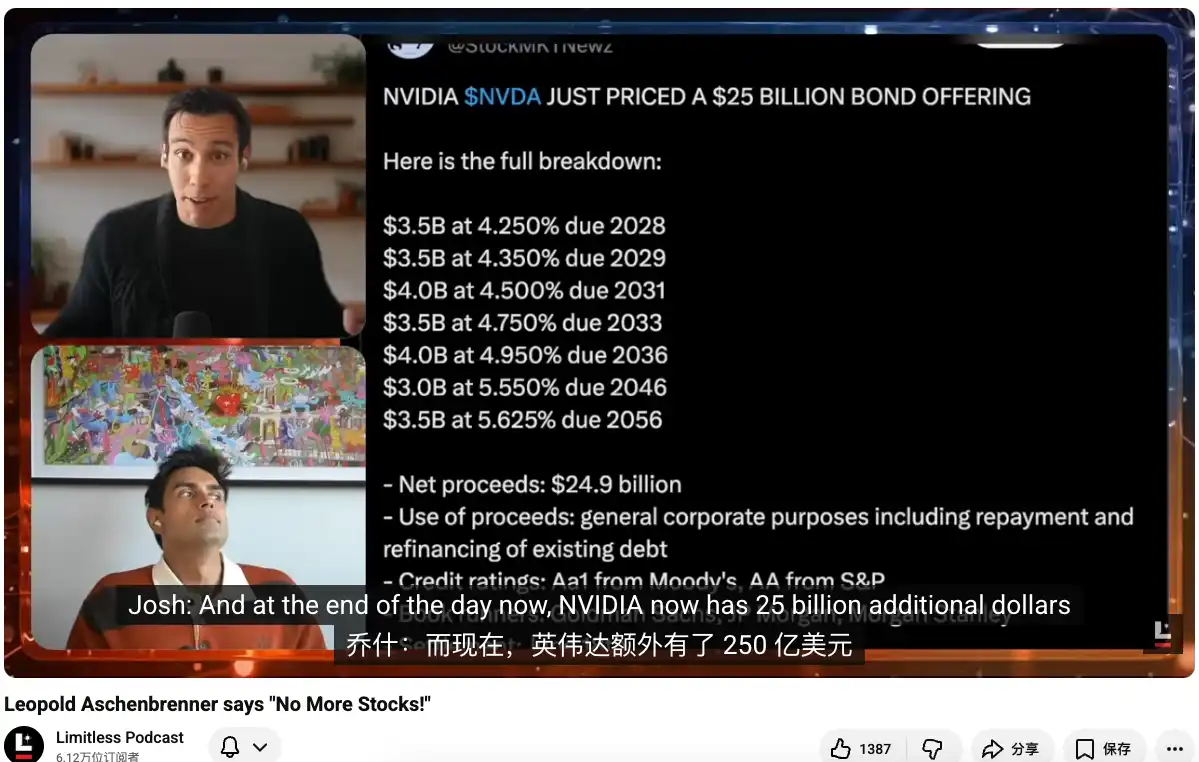
Josh Kale: Furthermore, they initially intended to raise only $20 billion but ended up expanding to $25 billion, with subscriptions exceeding three times the amount. Last episode, when discussing this portfolio, we said not to worry about a bubble just yet because although these companies have massive capital expenditures, their revenues are high enough to theoretically support expansion with their own balance sheets.

But this is NVIDIA's first significant move to finance off its balance sheet since 2021, rather than directly using its cash. I recall it currently has around $12 billion in cash on hand. Putting all this together creates a strange tension: on one side, Leopold is shorting; on the other, NVIDIA, seemingly with infinite cash and profits, is issuing debt. So what's happening?

Breaking Down NVIDIA's Bond Financing

Josh Kale: Ejaaz, can you break down this transaction itself for us? Because this isn't ordinary financing; it's a bond issuance. Ultimately, NVIDIA's balance sheet now has an additional $25 billion, and the interest rates likely appear very low.

Ejaaz Ahamadeen: I'll present both explanations. NVIDIA originally had about $13.7 billion in cash, meaning it could have just spent its own money. So why raise external capital? The simplest analogy is buying a house. Many people choose a mortgage even if they have the full amount because their own capital can be used elsewhere, and if the borrowing cost is low enough, it's actually more economical.

The interest rate environment hasn't been friendly in recent years, but if you're NVIDIA, one of the world's most valuable and sought-after companies, you can borrow on very favorable terms. This $25 billion bond issuance has maturities ranging from 2 to 30 years and can almost be considered very cheap money, with interest rates approaching US Treasury yields.

Moreover, the offering was roughly oversubscribed by 4 times. In other words, there was $85 billion in market demand chasing the $25 billion offering; NVIDIA could practically pick its investors. If you only look at the official statement, NVIDIA's explanation is that this is primarily for financial arrangements, to repay and refinance some existing debt. Google did something very similar a few weeks ago and also in February this year. So you can certainly accept this explanation, viewing it as financial optimization.

But the other side is hard to ignore: Over the past month and a half, NVIDIA, Amazon, Google, and several other hyperscale cloud providers have almost all been increasing external financing. Some via debt, some via equity sales. Leopold's view might not be entirely without merit—could this be a sign of the bubble starting to loosen, the house of cards beginning to wobble? However, if you look solely at the financial structure, it doesn't yet clearly point to danger.

Josh Kale: I see it similarly. $9 billion short on NVIDIA is a truly massive position. But during our research, we saw something else: on May 18th, NVIDIA's board authorized an additional $80 billion for share buybacks and increased the dividend from $0.01 per share to $0.25, a 25-fold increase.

If a company simultaneously engages in massive stock buybacks, significantly increases dividends, and also borrows money in the same month, it's clearly not borrowing due to a cash shortage. A more reasonable explanation is that this is cheap capital, and the financing methods within this AI cycle are undergoing a slight shift. Everyone wants to participate in these capital moves, and NVIDIA realizes borrowing via debt is even cheaper than other financing methods, so it just goes ahead. For now, at least, NVIDIA itself is still doing very well.

Why He Adjusted the Portfolio

Josh Kale: This brings us to another question. What exactly is Leopold thinking? Why has his judgment changed? The stock chart you just showed also indicates NVIDIA's recent performance hasn't been particularly strong, but it's not terrible either. It's still the world's largest company by market cap, nearing $5 trillion, down only about 7% in a month—nothing significant amidst the surge of other AI stocks.
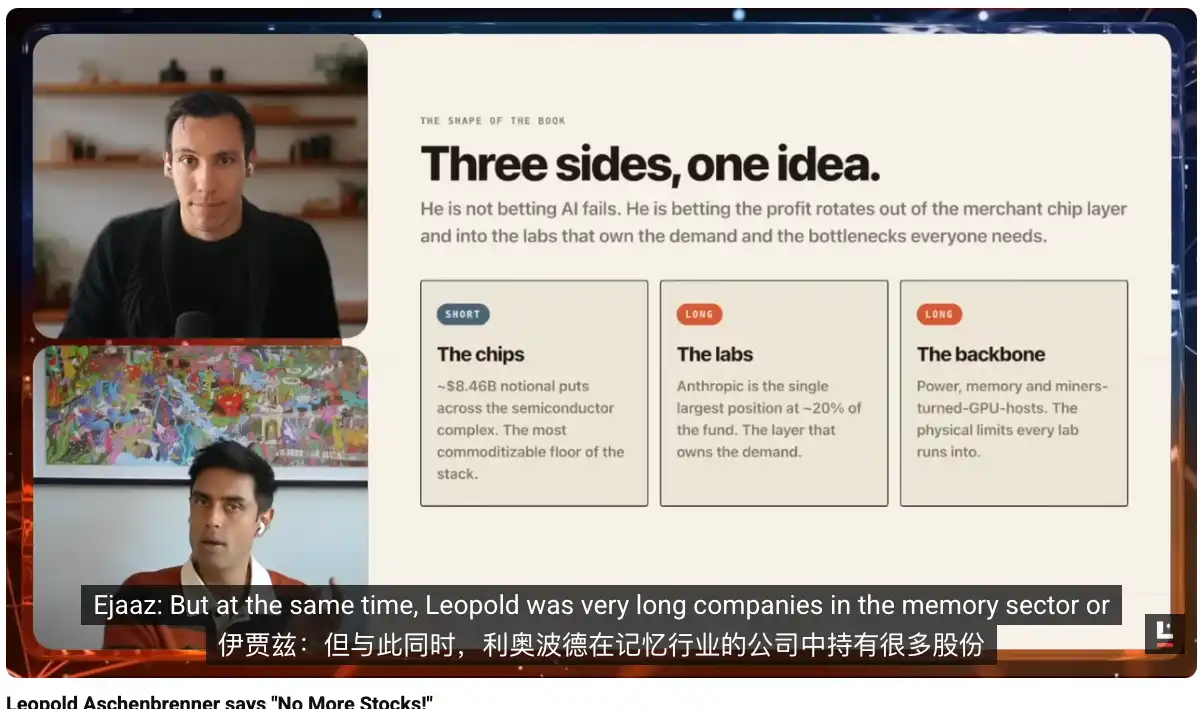
Ejaaz Ahamadeen: I don't think NVIDIA will disappear. Its GPUs, including the CPU product line launched a few weeks ago, I believe will perform very well. AI product demand is currently in exponential surplus, and NVIDIA remains the primary core machine supplier capable of meeting this demand.

But I do think the classic 'selling picks and shovels' trade in AI has become too crowded, and Leopold's recent portfolio changes convey precisely this signal. Looking at his recent 13F, his bearish exposure is clearly skewed against the semiconductor line, such as NVIDIA, ASML, Oracle, and other infrastructure-level companies.

Yet simultaneously, he is heavily invested in directions like memory, power, and new types of cloud. This indicates his judgment is not that AI infrastructure has peaked, but that certain tiers within the infrastructure stack, particularly semiconductors and traditional popular stocks, have become excessively crowded.

If the question becomes where the money will flow next, there are two answers. The first is the most direct: flow into the next genuine infrastructure bottlenecks, namely power, memory, and data center network segments. The second answer is that mysterious investment exposed just a few weeks ago.

The Unexpectedly Exposed Anthropic Position

Josh Kale: This was the most surprising to me. I only learned about it yesterday from you, and my first reaction was disbelief. Could it be that Leopold's fund, 'Situational Awareness,' has approximately 20% allocated to Anthropic equity? Current external rumors suggest this company constitutes about one-fifth of Leopold's fund. The Wall Street Journal and several other media outlets have reported this, and sources very close to the transaction have confirmed it.

This becomes a completely unexpected card in his portfolio.

Because 13F filings only disclose public market holdings, not private equity, and Anthropic happens to be a large piece of non-public equity. This is also why people have begun to understand why external estimates value his portfolio at $20 billion.
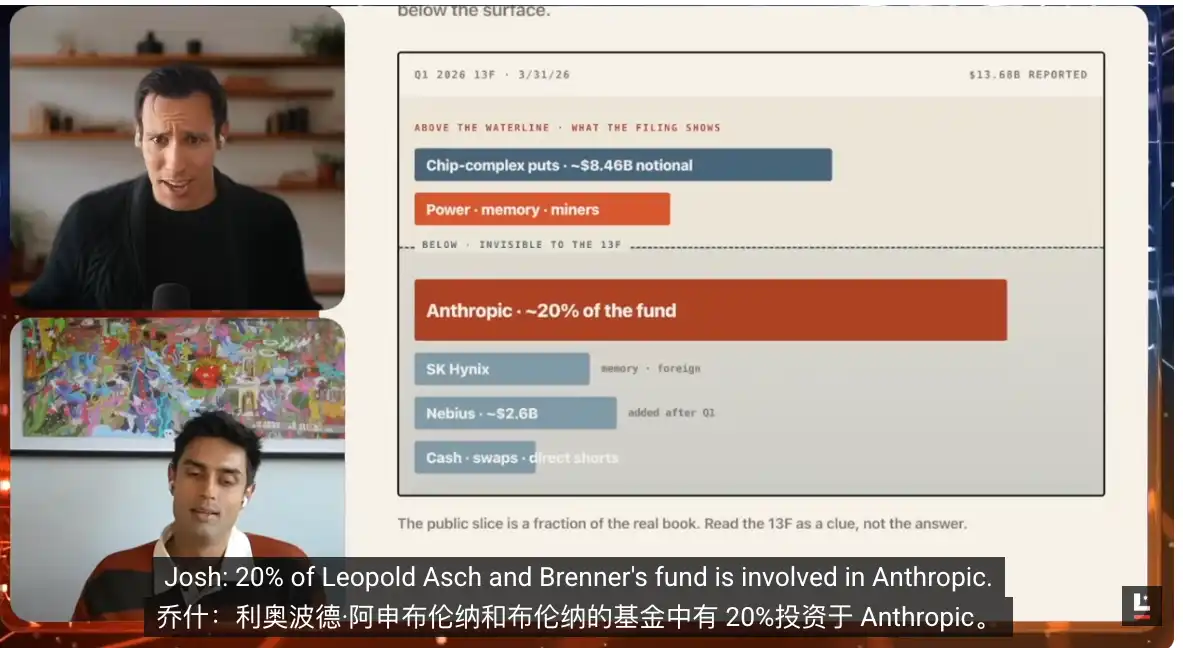
If 20% of the fund is Anthropic, and he invested around early 2025, then the returns on Anthropic over that year have been akin to seven years' worth. This change forces a significant revision in our understanding of his entire investment portfolio.

Ejaaz Ahamadeen: Yes. His first investment in Anthropic via private channels or the fund was around March 2025, when Anthropic's valuation was approximately $60 billion. Now, based on the latest funding round, it's valued at $96.5 billion.

This represents nearly a 15x increase. According to the algorithm presented in our show today, his latest 13F disclosed liquid portfolio value is $13.7 billion. If we add the Anthropic portion reported by The Wall Street Journal, roughly an additional $7 billion, the total fund management size reaches $20 billion.

How exaggerated is this? Bill Ackman, a top investor with three to four decades in the market, runs Pershing Capital at a similar size of around $20 billion. Leopold has been in this game for only a year and a half, he's 24, and has virtually no real investment experience.

Yet he has made some incredibly prescient calls. What's crazy is that he practically wrote all of this out in advance. When he launched the fund a year and a half ago, he published a 65-page AI essay titled 'Situational Awareness,' almost completely laying out the entire logic, including how capital would rotate from semiconductors and certain infrastructure segments to other bottleneck constraints. The market is now developing along these lines, which is truly astonishing.

The Next Wave of Infrastructure Trends

Ejaaz Ahamadeen: So this also tells me where the next money will flow. If he is cautious on NVIDIA, then capital will move to areas like power and memory; at the same time, he also wants to invest directly in the 'mine' itself, rather than continuing to only buy the 'shovels.' Anthropic is his favorite 'mine.'

Josh Kale: This indeed looks like a new trend, and again, he is earlier than most. For the past 12 months, everyone has been searching for AI's bottlenecks—rare metals, memory, RAM, etc.—and the market chased each wave. Those judgments weren't wrong because that wave of gains did happen.

But now, the valuations of directions seen as bottlenecks are gradually becoming rationalized. People already understand these companies' business models, market potential, and future revenues better, so much of the value is already priced in. In the next round, we care more about where the subsequent money will continue to flow.

The direction you mentioned—land, power, enclosures, physical infrastructure—seems correct. Because if we think about what's truly most important for AI, the answer increasingly seems to be physical construction capability. Look at xAI, or more accurately, look at SpaceX, which is now public. Its revenue core isn't rockets themselves but AI infrastructure construction.
Consider its recent deals with Anthropic and Google, which have created value exceeding the combined sum of Starlink, Starship, and the entire satellite business. There is clearly immense demand and value here. So the question becomes, who can actually build these things?

SpaceX is clearly one answer. Last night after hours, its stock was around $230, implying a valuation of about $3.1 trillion. We'll dedicate an episode to SpaceX this week because its recent run is simply too extreme. It just completed the acquisition of Cursor, its valuation has reached $3 trillion, and Elon Musk made more money in one day than Warren Buffett earned in his entire career.

Who Will Capture the Next Round of Profits

Josh Kale: We care about which companies are best at this hardware infrastructure, at developing those 'machines that build machines.' Combining Leopold's direction and the broader trend, we think the next wave of capital will move here. So Ejaaz, in reality, which companies will this rotation land on?

Ejaaz Ahamadeen: Many will be those unsexy-sounding infrastructure companies. A name frequently mentioned recently is Marvell. A few weeks ago at Computex in Taiwan, Jensen Huang directly stated on stage that this would be the next trillion-dollar company.

And just three months before he made that statement, NVIDIA had invested $1.5 billion in Marvell. I'm starting to wonder if this counts as insider trading or market manipulation, because after he said that, the stock rose another 70%.

I think it's easy now to directly claim AI infrastructure has peaked. But if you compare it to historical financial crises, like 2008, that flavor of high leverage, financial engineering, and systemic manipulation hasn't fully emerged this time.

There are two key differences. First, the products these companies are making today are genuinely being purchased. There wasn't such solid real demand during the dot-com bubble or the financial crisis. Second, constrained by physical laws, we can't infinitely add leverage now because the entire system is constrained by manpower and construction capability.

Even if you raise endless amounts of money, you cannot build data centers fast enough, expand memory chip capacity sufficiently, or immediately expand the power grid, transmission lines, and related infrastructure. There aren't enough people on the ground, and permitting, regulation, and various procedures are also hindering progress.

So I actually think this gives investors an advantage. Since you already know the hottest chip and 'pick and shovel' trades are too crowded, then the next money will flow into power, data networks (companies like Astera Labs), and other related segments.

What you really need to think about is when these contracts start to materialize, when these fabs are actually built, when SpaceX rockets can launch AI satellites, and even when they can start using solar energy to train AI models.

The timeline determines the betting rhythm. At least that's the framework I'm investing by, though this is not investment advice. I see it this way because over the past year and a half, we've witnessed firsthand how capital flowed from general AI stocks to semiconductors and infrastructure trades.

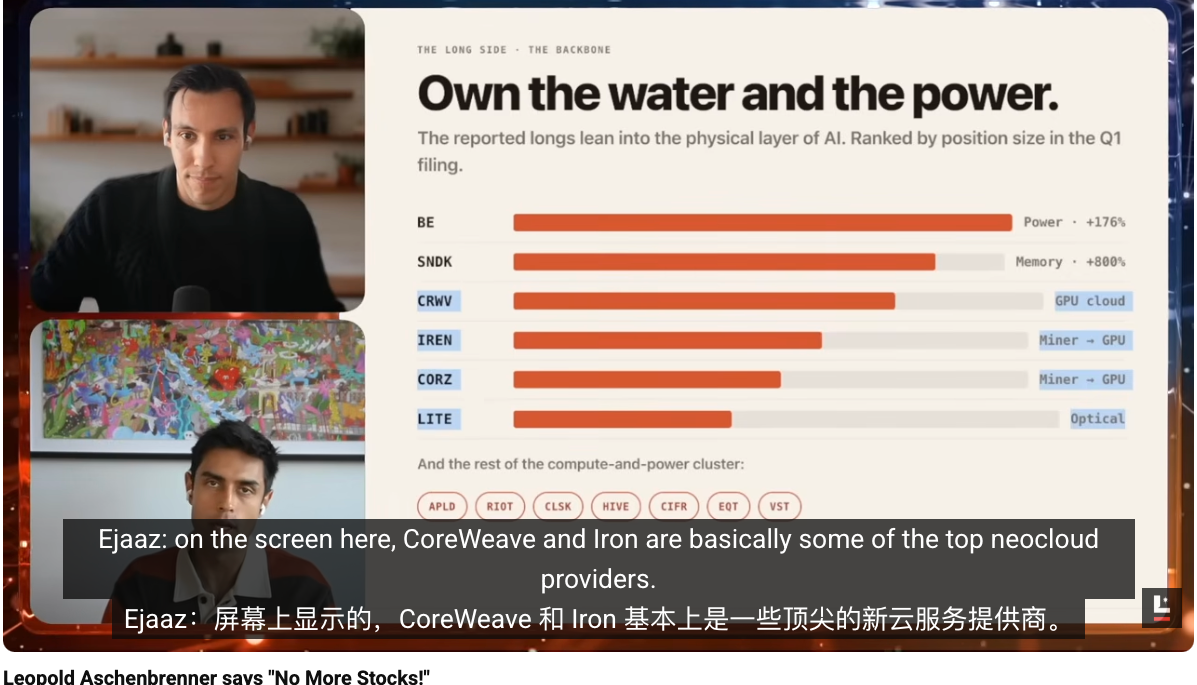
Josh Kale: If you continue looking at this portfolio chart, you'll see this story is clearly written into his holdings structure. By category, what is his largest allocation? Power and energy. Next is memory, followed by cloud and GPU miners—the most tangible infrastructure.

He wants to hold new cloud providers like CoreWeave and also miners who have pivoted to cloud compute. What he wants to own is this physical infrastructure because he believes this is where the real bottlenecks are. As you mentioned, there are many finer details, like the immense difficulty of actual construction, hardware manufacturing, and data center building itself.

If we ask where the biggest bottlenecks are, even permitting might be one. Who is solving these problems? SpaceX wants to move data centers to space, Tesla wants humanoid robots to address labor shortages. But both are far off. In the short to medium term, there exist vast blank opportunities, and this is precisely where Leopold is betting.

The Advantages of Optical Modules and Fiber Optics

Josh Kale: I want to add one detail we didn't expand on earlier. For those wanting to dig deeper and find more alpha, many of his clues lie in optics and deeper layers of the tech stack. Ejaaz, you've been researching this lately. Can you explain his thinking?

Ejaaz Ahamadeen: If you look at the positions on his screen, CoreWeave and Iron are essentially top-tier new cloud service providers. Simply put, they are somewhat like Amazon Web Services, except AWS provides cloud services to internet companies, while these companies provide ready-made GPU infrastructure to AI companies.

They handle setting up GPUs, networks, deployment—all so AI companies don't have to worry about underlying infrastructure and can directly train models and access compute. CoreWeave and Iron have been among his largest concentrated positions since inception and have delivered the highest returns.

Notably, he still holds these two companies among his largest positions today. This also indicates one thing: in his view, this trade is far from over. Furthermore, he has privately invested in Core Scientific, a company that can help unlock CoreWeave's infrastructure supply capacity. In a sense, he's adding another layer of leverage to CoreWeave.

Beyond these, look at companies like Coherent and Lumentum; they are essentially suppliers related to fiber optic and optical connectivity. To explain in the simplest terms, for semiconductors and GPUs to communicate with each other, traditional methods often rely heavily on copper wires.

The issue is, as GPU clusters grow larger, copper wires will get hotter, energy losses will increase, and efficiency will suffer. In this scenario, fiber optics become the next upgrade direction. It enables faster data transfer, is more cost-efficient, and allows companies providing inference and training compute to earn more. So you'll notice his bets have always been very infrastructure-oriented, investing in both these optical companies and power-related companies. It may not sound sexy, but in my view, this is where the money is truly flowing now.

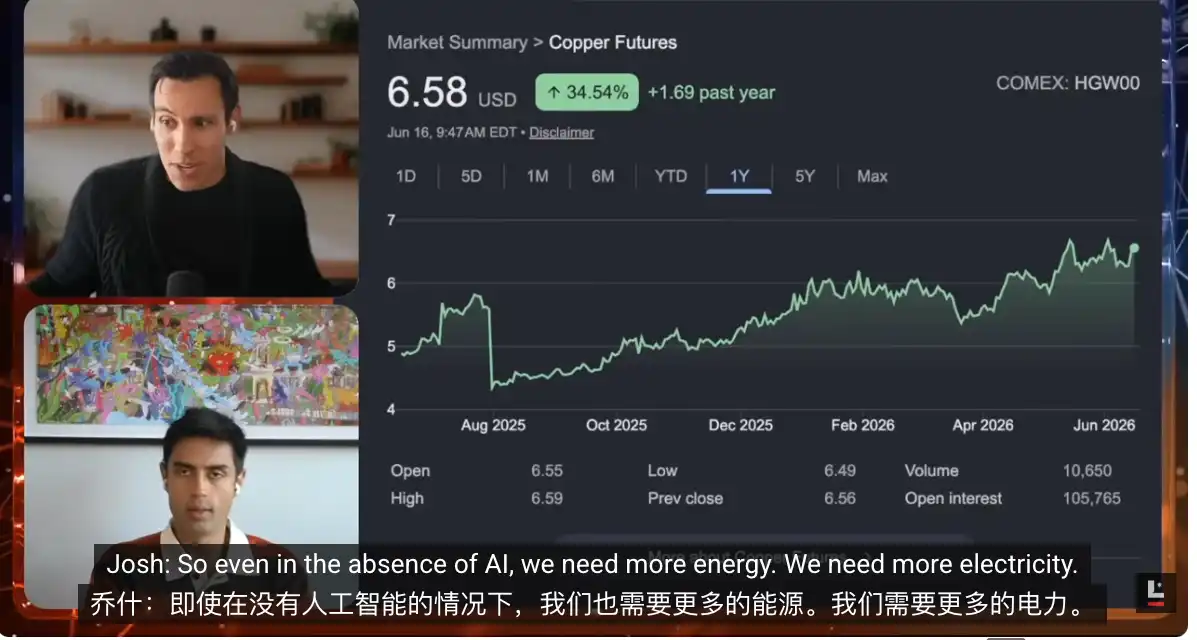
Josh Kale: The copper aspect is also interesting to me because I only recently realized how critical it is for short-distance data transmission. For many high-bandwidth, short-distance transmission scenarios, copper is almost the only material everyone truly wants to use. Only when it becomes unsuitable, such as over long distances or with excessive heat, do they switch to fiber optics. So the combined market demand for copper and fiber optics is currently very strong, which is why observing the copper trade is interesting.

The recent strength in copper futures is essentially because everyone needs it; it's the most critical foundational material for short-distance, high-bandwidth transmission, and fiber optics is the next step.

Thinking at an even more fundamental level, the materials angle has always been interesting. The absolute bottom layer beneath all layers is essentially the raw materials most core to achieving intelligence. Copper is one, lithium is another, and many others. We really should do a dedicated episode on materials. Perhaps Leopold hasn't reached that layer yet, and we might see the next rotation before he does.

Josh Kale: If you keep going down the stack, you could even look directly at copper mines to see how these materials are produced. But returning to the core judgment, I think the next rotation indeed shifts from seemingly smaller bottlenecks to the truly difficult things: hardware and large-scale data center construction.

Whoever can build the data centers will take the profits. We've already seen how much SpaceX is earning due to immense data center demand. Whoever can bring more data centers online faster, provide sufficient power and GPUs, will earn the most. This is essentially what Leopold is betting on now.

Is a Bubble Forming?

Josh Kale: To summarize, we don't believe we are in a bubble-bursting phase yet. Leopold's portfolio seems more like a rotation than a full-scale retreat. So, should we still follow his lead?

Ejaaz Ahamadeen: I admit, when I first saw his 13F, my initial reaction was: this guy is shorting the world's most valuable company with demand booked until 2029? That's outrageous. But now, seeing this financing, I'm starting to think if NVIDIA continues to add external debt in the future, or even potentially sells equity, if this trend persists, then Leopold might be right once again.

If that happens, his fund could ultimately surpass the world's top traders and best investment funds. He has been consistently winning; it's hard not to respect that.

Josh Kale: However, another important point: his life so far has almost always been long-only; he hasn't truly been tested by large-scale selling. We mentioned Bill Ackman earlier—achieving 30x returns and surviving in the market for 30 years are two different things.

If he can maintain this growth trajectory and also learn when to press the sell button, how to manage risk, how to use hedges for protection, that would be even more formidable. We are starting to see the embryonic form of this capability. That $9 billion short isn't achieved by directly shorting $9 billion in cash but through options and leverage, not a one-to-one naked short. Regardless, this is all worth continued observation.

Energy is the Core Bet

Josh Kale: If you had to pick one stock from his entire portfolio that you most want to buy yourself, which would it be?

My own answer is energy stocks. I've always been bullish on energy because, even if AI demand slows, energy itself remains a global necessity, and this demand will only increase.

Even completely ignoring AI, we need more energy, more electricity. Companies like Bloom Energy that can enhance power supply and transmission capacity excite me most because they resemble a hedge-like bet. The single trend that continues to rise regardless of the scenario is our demand for energy, electricity, and power. These companies are the ones I am most willing to be long-term long on.

Ejaaz Ahamadeen: My answer is a bit of a cheat. The companies I most want to follow are those Jensen is investing in that also intersect with Leopold's logic. So the company I'm currently closest to tailing is Marvell. While not a public holding of Leopold's, it aligns very well with his bets on fiber optics and power, and Jensen has already invested $1.5 billion of real money.
I've observed a phenomenon: whenever Jensen invests in a company through NVIDIA, whether it's Intel, CoreWeave, or others, it mostly keeps rising afterward. So my current positioning is roughly here. I also hold some CoreWeave myself because both Jensen and Leopold are extremely bullish on it.

Josh Kale: Marvell is up 270% over the past 6 months. This might genuinely be a good rule of thumb: when influential figures like Jensen, or even someone with enormous sway like Trump, publicly say to buy a certain stock, you probably should take a serious look.

Past instances have repeatedly shown such signals often have substantial realization potential. Whether Intel or Marvell, these cases show that, on one hand, they truly understand what they're talking about, and on the other, they have the ability to influence these companies' outcomes. So this market run is truly insane.

I hope it continues. Based on current evidence, it likely will. At least for now, we remain bullish and optimistic, and will continue making judgments daily based on changes.

Josh Kale: Any final thoughts you want to add regarding Leopold's portfolio update?

Ejaaz Ahamadeen: I'd really like to hear what skeptics think. If after listening to our analysis, you think we're completely wrong or have misinterpreted something, feel free to point it out directly.

Yesterday, I stared at NVIDIA's $25 billion financing news for a long time, intending to find flaws. But if you look purely at financial logic, it does make sense.

Why not borrow this almost risk-free cheap money? Using borrowed money for expansion is clearly more rational than selling your own equity because you retain more future earnings.


Kripto yang Sedang Tren

Pertanyaan Terkait

QAccording to the article, what is Leopold Aschenbrenner's core trading logic behind his recent portfolio adjustments?

AHis core logic is a rotation within the AI infrastructure stack. He believes the classic 'pick-and-shovel' trades (like investing in NVIDIA) have become too crowded. Therefore, he is shifting capital towards what he sees as the next true infrastructure bottlenecks: power, memory, and data center networking. He is also moving to invest directly in the 'mines' (AI models like Anthropic) rather than just the 'shovels' (hardware suppliers).

QWhy does the article highlight NVIDIA's recent $25 billion bond offering as a significant signal?

AThe bond offering is significant because NVIDIA, a highly profitable company with substantial cash reserves, is choosing to raise external debt. The hosts interpret this not as a sign of financial need, but as a signal of a subtle shift in financing for the AI boom—accessing cheap capital. This action, coupled with Leopold's massive short position, prompts questions about potential market saturation or a strategic rotation of capital away from the most crowded 'pick-and-shovel' plays.

QWhat are identified as the next major bottlenecks for AI infrastructure, beyond GPUs?

AThe next major bottlenecks identified are power/electricity, memory, data center networking, and the physical ability to build out data center capacity (including land, construction, and regulatory approvals). The article argues that these physical and logistical constraints are becoming more critical than just GPU supply.

QHow does Leopold Aschenbrenner's portfolio reflect his view on the durability of the energy/utilities sector?

AHis portfolio shows a major allocation to energy and power companies. The hosts view this as a highly durable bet because energy demand is a global necessity that will continue to rise regardless of AI market fluctuations. Investing in companies that enhance power generation and transmission is seen as a 'hedged' long-term position that benefits from a secular trend of increasing power consumption.

QWhat is the strategic significance of the materials copper and fiber optics in the context of advancing AI data centers?

ACopper remains the critical material for short-distance, high-bandwidth connections within data center racks due to its cost-effectiveness. However, as GPU clusters grow larger, heat and energy loss from copper wires increase, making them less efficient for longer distances. Fiber optics are positioned as the next upgrade step, offering higher speeds and better efficiency for these scaling demands. Therefore, strong demand is expected for both materials, representing another infrastructure layer for investment.

Bacaan Terkait

TechFlow Intel: Peluang IPO Anthropic Lebih dari 80%, Iran Tutup Lagi Selat Hormuz Picu Gejolak Harga Minyak

Market memperkirakan Anthropic akan mengumumkan IPO sebelum November 2026, dengan valuasi yang ditargetkan mencapai triliunan dolar. Namun, pertanyaannya adalah apakah valuasi sebesar itu dapat selaras dengan janji keamanan AI inti mereka. Sementara itu, militer Iran kembali mengumumkan penutupan Selat Hormuz, menyebabkan gejolak harga minyak, meskipun data pelacakan kapal menunjukkan beberapa kapal masih melintas. Di sisi lain, Iran melanjutkan pemuatan minyak di Pulau Kharg, dengan hingga 20 juta barel minyak akan memasuki pasar. Di sektor teknologi, merek-merek mulai menggunakan influencer virtual AI untuk pemasaran produk. Elon Musk berbicara tentang menghabiskan "septillion dolar" untuk penelitian antimateri untuk perjalanan antariksa. Goldman Sachs memperingatkan bahwa belanja modal AI senilai $5,3 triliun mendekati titik jenuh kredit. Cloudflare meluncurkan fitur akun sementara untuk agen AI. Google melaporkan lalu lintas IPv6-nya melebihi 50% untuk pertama kalinya. Hyundai Motor Group berencana mengakuisisi 9,65% saham Boston Dynamics. Di pasar saham, investor ritel membeli saham SpaceX senilai $370 juta dalam tiga hari. Di Eropa, terjadi default ekuitas CLO pasca-krisis pertama, menyalakan alarm di pasar kredit. Garis bawah hari ini: Tiga berita tentang Iran, default CLO Eropa, dan peringatan Goldman Sachs semuanya menunjukkan logika dasar yang sama: likuiditas global sedang menyempit dan biaya marginal meningkat di berbagai sektor. Namun, pada saat yang sama, modal masih mencari narasi baru, seperti yang terlihat pada rencana IPO Anthropic, antusiasme ritel terhadap SpaceX, dan visi antimateri Musk.

marsbit35m yang lalu

TechFlow Intel: Peluang IPO Anthropic Lebih dari 80%, Iran Tutup Lagi Selat Hormuz Picu Gejolak Harga Minyak

marsbit35m yang lalu

Pemburu Jadi Mangsa, MEV Bot yang Paling Cuan Diretas

Penyerang MEV Bot yang Terkenal, Jaredfromsubway.eth, Kehilangan Lebih dari $7,5 Juta dalam Serangan 'Perangkap Madu'. Alamat MEV Bot Ethereum yang terkenal dan sangat aktif, Jaredfromsubway.eth, mengalami serangan rantai yang sangat bertarget pada hari Sabtu, yang mengakibatkan kerugian lebih dari $7,5 juta. Menurut investigasi Blockaid, serangan ini bukanlah serangan phishing tradisional atau eksploitasi kerentanan kontrak pintar, melainkan serangan 'perangkap madu MEV balik' (counter-MEV honeypot attack) yang dirancang khusus untuk mengeksploitasi logika perilaku MEV Bot. Penyerang telah menyebarkan 66 kontrak token palsu dan kumpulan likuiditas palsu selama beberapa minggu sebelumnya. Aset-aset ini disamarkan sebagai aset stabil utama seperti WETH, USDC, dan USDT, dan membangun jalur perdagangan arbitrase yang tampak nyata. Rantai serangan berkembang: kumpulan likuiditas palsu menciptakan sinyal 'kesenjangan harga yang dapat diarbitrase'; bot MEV secara otomatis mengidentifikasi peluang dan mengeksekusi perdagangan; bot memberikan otorisasi ke kontrak bantu yang dikendalikan penyerang selama proses perdagangan; otorisasi ini tidak dicabut tepat waktu, menciptakan paparan izin yang terus-menerus; akhirnya, penyerang memanggil logika 'pintu belakang' yang telah dipasang sebelumnya dalam satu transaksi, secara langsung mentransfer aset ETH, USDC, dan USDT yang dipegang oleh alamat MEV bot tersebut. Jaredfromsubway.eth adalah salah satu bot MEV paling aktif dan menguntungkan di jaringan Ethereum, yang terkenal karena menjalankan serangan 'sandwich' secara sistematis untuk menangkap keuntungan dari pergerakan harga. Cointelegraph Research menunjukkan bahwa sekitar 70% dari sekitar 60.000 hingga 90.000 serangan sandwich bulanan di Ethereum antara November 2024 dan Oktober 2025 terkait dengan strateginya. Diperkirakan bot ini telah menghasilkan puluhan juta dolar AS. Peristiwa ini menjadi peringatan keras tentang meningkatnya ancaman keamanan di ekosistem crypto. Bahkan pemain tingkat atas seperti Jaredfromsubway.eth, yang biasanya berada di sisi 'predator', kini menjadi target dari serangan canggih yang mengeksploitasi logika operasional otomatis mereka sendiri. Selain itu, setelah peretasan, sebuah akun X tidak dikenal dengan 94.000 pengikut mengubah namanya menjadi Jaredfromsubway.eth dan secara palsu mengklaim akan menawarkan hadiah $1 juta untuk pengembalian dana, memicu peringatan dari pengembang agar pengguna tetap waspada terhadap kemungkinan penipuan.

marsbit1j yang lalu

Pemburu Jadi Mangsa, MEV Bot yang Paling Cuan Diretas

marsbit1j yang lalu

Pemburu Dikepung, MEV Bot yang Paling Bisa Hasilkan Uang Diretas

Alamat bot MEV terkenal di Ethereum, Jaredfromsubway.eth, baru-baru ini menjadi korban serangan yang sangat tersasar dan kehilangan lebih dari $7.5 juta. Serangan ini bukanlah phising atau eksploitasi kerentanan kontrak pintar biasa, melainkan serangan "counter-MEV honeypot" yang dirancang khusus untuk mengeksploitasi logika operasional bot MEV. Penyerang dengan sabar menyiapkan puluhan kontrak token dan pool likuiditas palsu selama beberapa minggu, yang menyamar sebagai aset seperti WETH, USDC, dan USDT. Mereka membuat sinyal arbitrase yang tampak menguntungkan. Saat bot Jaredfromsubway.eth mendeteksi dan mencoba mengeksekusi peluang arbitrase ini, bot tersebut secara tidak sengaja memberikan izin (approval) ke kontrak bantu milik penyerang. Izin ini kemudian dieksploitasi dalam satu transaksi untuk menguras aset ETH, USDC, dan USDT dari dompet bot. Jaredfromsubway.eth sendiri adalah salah satu bot MEV paling aktif dan menguntungkan di Ethereum, yang terkenal terutama karena sering melakukan "serangan sandwich" untuk mengambil keuntungan dari selisih harga. Peristiwa ini menunjukkan bahwa bahkan pemain yang biasanya berperan sebagai "predator" di ekosistem crypto pun rentan terhadap ancaman keamanan yang semakin canggih. Setelah serangan, muncul akun palsu di X yang mengaku sebagai Jaredfromsubway.eth dan menawarkan pengembalian dana, yang telah diperingatkan oleh pengembang sebagai potensi penipuan.

Odaily星球日报2j yang lalu

Pemburu Dikepung, MEV Bot yang Paling Bisa Hasilkan Uang Diretas

Odaily星球日报2j yang lalu

Kondisi Pembayaran di Amerika Latin Tak Sesuai dengan yang Anda Bayangkan

**Ringkasan: Kondisi Pembayaran di Amerika Latin Berbeda dari Bayangan Anda** Penulis menghabiskan hampir sebulan di Amerika Latin, melakukan riset lapangan selama 500 jam dan berbicara dengan lebih dari 100 pengguna lokal serta regulator. Temuannya mengejutkan dan berbeda dari narasi umum. 1. **Kartu Kripto**: Volume transaksi sebenarnya berasal dari profesional bergaji tinggi yang menerima gaji dalam dolar AS atau stablecoin (seperti USDT), lalu mengonversinya ke mata uang lokal via Pix (Brazil), bukan dari transaksi ritel kecil seperti membeli kopi. 2. **Dominasi QR Code**: Pembayaran QR sedang menguasai pasar pembayaran negara berkembang. Di Brasil, Pix memproses >60 miliar transaksi/bulan. Peta global menunjukkan negara berpenduduk padat (China, India, Brasil, dll) didominasi QR, sementara negara kaya (AS, Eropa Barat) masih bertahan dengan kartu. 3. **Peluang Besar**: Interoperabilitas internasional antar sistem pembayaran instan lokal (seperti Pix, UPI, CoDi) masih terpecah-pecah. Ini adalah peluang besar yang belum terbangun. 4. **Persaingan Bergeser**: Persaingan bukan lagi sekadar akuisisi pengguna, tetapi memperebutkan infrastruktur penyelesaian (settlement). Perusahaan pembayaran terkemuka mulai mengakuisisi bank untuk efisiensi biaya dan kepatuhan. 5. **Amerika Latin Bukan Satu Pasar**: Setiap negara (Brasil, Argentina, Meksiko, dll) memiliki dinamika mata uang, regulasi, dan pola ekonomi informal yang sangat berbeda. Memperlakukan mereka sebagai satu kesatuan adalah kesalahan. 6. **Neobank Beralih ke Valas**: Bisnis stablecoin untuk transfer lintas batas semakin kompetitif dengan margin yang menyusut cepat, mendorong perusahaan untuk menjadikannya produk pintu masuk ke layanan lain. 7. **Ekspansi Lintas Batas adalah Kunci**: Startup pembayaran generasi berikutnya perlu memiliki identitas merek dan teknologi yang dapat diskalakan secara internasional sejak hari pertama, bukan hanya fokus mendalam di satu koridor. 8. **Brasil & Meksiko Sudah Jenuh**: Koridor yang kurang diperhatikan seperti "Lima Negara yang Terlupakan" (Republik Dominika, Guatemala, Honduras, Nikaragua, El Salvador) justru menerima arus remitansi besar dengan kompetisi yang jauh lebih rendah. 9. **Segmentasi Pasar yang Tepat**: Misalnya di Brasil, setidaknya ada 5 segmen pengguna dengan aliran dana dan kebutuhan berbeda (turis, ekspatriat, digital nomad, pengguna dompet digital muda, pengguna kripto asli). Strategi pemasaran harus disesuaikan. 10. **Regulasi Lebih Maju**: Bertentangan dengan persepsi, regulator Amerika Latin (Brasil, Meksiko, Kolombia, dll) seringkali lebih progresif dan jelas dalam mengatur aset kripto dan pembayaran digital dibandingkan AS. Kerangka regulasi seringkali sudah ada. Penutup: Peluang sebenarnya bukan hanya pada saluran konversi mata uang/stablecoin, tetapi pada layanan nilai tambah yang dibangun di atasnya.

链捕手2j yang lalu

Kondisi Pembayaran di Amerika Latin Tak Sesuai dengan yang Anda Bayangkan

链捕手2j yang lalu

Trading

Spot
Futures

Artikel Populer

Apa Itu GROK AI

Grok AI: Merevolusi Teknologi Percakapan di Era Web3 Pendahuluan Dalam lanskap kecerdasan buatan yang terus berkembang dengan cepat, Grok AI menonjol sebagai proyek yang patut diperhatikan yang menjembatani domain teknologi canggih dan interaksi pengguna. Dikembangkan oleh xAI, sebuah perusahaan yang dipimpin oleh pengusaha terkenal Elon Musk, Grok AI berupaya untuk mendefinisikan ulang cara kita berinteraksi dengan kecerdasan buatan. Seiring dengan berkembangnya gerakan Web3, Grok AI bertujuan untuk memanfaatkan kekuatan AI percakapan untuk menjawab pertanyaan kompleks, memberikan pengguna pengalaman yang tidak hanya informatif tetapi juga menghibur. Apa itu Grok AI? Grok AI adalah chatbot AI percakapan yang canggih yang dirancang untuk berinteraksi dengan pengguna secara dinamis. Berbeda dengan banyak sistem AI tradisional, Grok AI menerima berbagai pertanyaan yang lebih luas, termasuk yang biasanya dianggap tidak pantas atau di luar respons standar. Tujuan inti proyek ini meliputi: Penalaran yang Andal: Grok AI menekankan penalaran akal sehat untuk memberikan jawaban logis berdasarkan pemahaman kontekstual. Pengawasan yang Dapat Diskalakan: Integrasi bantuan alat memastikan bahwa interaksi pengguna dipantau dan dioptimalkan untuk kualitas. Verifikasi Formal: Keamanan adalah hal yang utama; Grok AI menggabungkan metode verifikasi formal untuk meningkatkan keandalan output-nya. Pemahaman Konteks Panjang: Model AI unggul dalam mempertahankan dan mengingat riwayat percakapan yang luas, memfasilitasi diskusi yang bermakna dan sadar konteks. Ketahanan Adversarial: Dengan fokus pada peningkatan pertahanannya terhadap input yang dimanipulasi atau berbahaya, Grok AI bertujuan untuk mempertahankan integritas interaksi pengguna. Intinya, Grok AI bukan hanya perangkat pengambilan informasi; ini adalah mitra percakapan yang imersif yang mendorong dialog yang dinamis. Pencipta Grok AI Otak di balik Grok AI tidak lain adalah Elon Musk, seorang individu yang identik dengan inovasi di berbagai bidang, termasuk otomotif, perjalanan luar angkasa, dan teknologi. Di bawah naungan xAI, sebuah perusahaan yang fokus pada kemajuan teknologi AI dengan cara yang bermanfaat, visi Musk bertujuan untuk membentuk kembali pemahaman tentang interaksi AI. Kepemimpinan dan etos dasar sangat dipengaruhi oleh komitmen Musk untuk mendorong batasan teknologi. Investor Grok AI Meskipun rincian spesifik mengenai investor yang mendukung Grok AI masih terbatas, secara publik diakui bahwa xAI, inkubator proyek ini, didirikan dan didukung terutama oleh Elon Musk sendiri. Usaha dan kepemilikan Musk sebelumnya memberikan dukungan yang kuat, lebih lanjut memperkuat kredibilitas dan potensi pertumbuhan Grok AI. Namun, hingga saat ini, informasi mengenai yayasan investasi tambahan atau organisasi yang mendukung Grok AI tidak tersedia secara mudah, menandai area untuk eksplorasi potensial di masa depan. Bagaimana Grok AI Bekerja? Mekanisme operasional Grok AI sama inovatifnya dengan kerangka konseptualnya. Proyek ini mengintegrasikan beberapa teknologi mutakhir yang memfasilitasi fungsionalitas uniknya: Infrastruktur yang Kuat: Grok AI dibangun menggunakan Kubernetes untuk orkestrasi kontainer, Rust untuk kinerja dan keamanan, dan JAX untuk komputasi numerik berkinerja tinggi. Ketiga elemen ini memastikan bahwa chatbot beroperasi secara efisien, dapat diskalakan dengan efektif, dan melayani pengguna dengan cepat. Akses Pengetahuan Real-Time: Salah satu fitur pembeda Grok AI adalah kemampuannya untuk mengakses data real-time melalui platform X—sebelumnya dikenal sebagai Twitter. Kemampuan ini memberikan AI akses ke informasi terbaru, memungkinkannya untuk memberikan jawaban dan rekomendasi yang tepat waktu yang mungkin terlewat oleh model AI lainnya. Dua Mode Interaksi: Grok AI menawarkan pengguna pilihan antara “Mode Menyenangkan” dan “Mode Reguler.” Mode Menyenangkan memungkinkan gaya interaksi yang lebih bermain dan humoris, sementara Mode Reguler fokus pada memberikan respons yang tepat dan akurat. Fleksibilitas ini memastikan pengalaman yang disesuaikan yang memenuhi berbagai preferensi pengguna. Intinya, Grok AI menggabungkan kinerja dengan keterlibatan, menciptakan pengalaman yang kaya dan menghibur. Garis Waktu Grok AI Perjalanan Grok AI ditandai oleh tonggak penting yang mencerminkan tahap pengembangan dan penerapannya: Pengembangan Awal: Fase dasar Grok AI berlangsung selama sekitar dua bulan, di mana pelatihan awal dan penyempurnaan model dilakukan. Rilis Beta Grok-2: Dalam kemajuan signifikan, beta Grok-2 diumumkan. Rilis ini memperkenalkan dua versi chatbot—Grok-2 dan Grok-2 mini—masing-masing dilengkapi dengan kemampuan untuk chatting, coding, dan penalaran. Akses Publik: Setelah pengembangan beta, Grok AI menjadi tersedia untuk pengguna platform X. Mereka yang memiliki akun yang diverifikasi dengan nomor telepon dan aktif selama setidaknya tujuh hari dapat mengakses versi terbatas, membuat teknologi ini tersedia untuk audiens yang lebih luas. Garis waktu ini mencakup pertumbuhan sistematis Grok AI dari awal hingga keterlibatan publik, menekankan komitmennya untuk perbaikan berkelanjutan dan interaksi pengguna. Fitur Utama Grok AI Grok AI mencakup beberapa fitur kunci yang berkontribusi pada identitas inovatifnya: Integrasi Pengetahuan Real-Time: Akses ke informasi terkini dan relevan membedakan Grok AI dari banyak model statis, memungkinkan pengalaman pengguna yang menarik dan akurat. Gaya Interaksi yang Beragam: Dengan menawarkan mode interaksi yang berbeda, Grok AI memenuhi berbagai preferensi pengguna, mengundang kreativitas dan personalisasi dalam berkomunikasi dengan AI. Dasar Teknologi yang Canggih: Pemanfaatan Kubernetes, Rust, dan JAX memberikan proyek ini kerangka kerja yang solid untuk memastikan keandalan dan kinerja optimal. Pertimbangan Diskursus Etis: Penyertaan fungsi penghasil gambar menunjukkan semangat inovatif proyek ini. Namun, hal ini juga menimbulkan pertimbangan etis seputar hak cipta dan penggambaran yang menghormati tokoh-tokoh yang dikenali—diskusi yang sedang berlangsung dalam komunitas AI. Kesimpulan Sebagai entitas perintis di bidang AI percakapan, Grok AI mencakup potensi untuk pengalaman pengguna yang transformatif di era digital. Dikembangkan oleh xAI dan didorong oleh pendekatan visioner Elon Musk, Grok AI mengintegrasikan pengetahuan real-time dengan kemampuan interaksi yang canggih. Ini berupaya untuk mendorong batasan apa yang dapat dicapai oleh kecerdasan buatan sambil tetap fokus pada pertimbangan etis dan keselamatan pengguna. Grok AI tidak hanya mewujudkan kemajuan teknologi tetapi juga mewakili paradigma percakapan baru di lanskap Web3, menjanjikan untuk melibatkan pengguna dengan pengetahuan yang mahir dan interaksi yang menyenangkan. Seiring proyek ini terus berkembang, ia berdiri sebagai bukti apa yang dapat dicapai di persimpangan teknologi, kreativitas, dan interaksi yang mirip manusia.

588 Total TayanganDipublikasikan pada 2024.12.26Diperbarui pada 2024.12.26

Apa Itu GROK AI

Apa Itu ERC AI

Euruka Tech: Gambaran Umum tentang $erc ai dan Ambisinya di Web3 Pendahuluan Dalam lanskap teknologi blockchain dan aplikasi terdesentralisasi yang berkembang pesat, proyek-proyek baru muncul dengan frekuensi tinggi, masing-masing dengan tujuan dan metodologi yang unik. Salah satu proyek tersebut adalah Euruka Tech, yang beroperasi di domain cryptocurrency dan Web3 yang luas. Fokus utama Euruka Tech, khususnya tokennya $erc ai, adalah untuk menghadirkan solusi inovatif yang dirancang untuk memanfaatkan kemampuan teknologi terdesentralisasi yang terus berkembang. Artikel ini bertujuan untuk memberikan gambaran komprehensif tentang Euruka Tech, eksplorasi tujuannya, fungsionalitas, identitas penciptanya, calon investor, dan signifikansinya dalam konteks yang lebih luas dari Web3. Apa itu Euruka Tech, $erc ai? Euruka Tech dicirikan sebagai proyek yang memanfaatkan alat dan fungsionalitas yang ditawarkan oleh lingkungan Web3, dengan fokus pada integrasi kecerdasan buatan dalam operasinya. Meskipun rincian spesifik tentang kerangka proyek ini agak samar, proyek ini dirancang untuk meningkatkan keterlibatan pengguna dan mengotomatiskan proses di ruang crypto. Proyek ini bertujuan untuk menciptakan ekosistem terdesentralisasi yang tidak hanya memfasilitasi transaksi tetapi juga menggabungkan fungsionalitas prediktif melalui kecerdasan buatan, sehingga penamaan tokennya, $erc ai. Tujuannya adalah untuk menyediakan platform intuitif yang memfasilitasi interaksi yang lebih cerdas dan pemrosesan transaksi yang efisien dalam lingkup Web3 yang terus berkembang. Siapa Pencipta Euruka Tech, $erc ai? Saat ini, informasi mengenai pencipta atau tim pendiri di balik Euruka Tech masih tidak ditentukan dan agak tidak jelas. Ketidakhadiran data ini menimbulkan kekhawatiran, karena pengetahuan tentang latar belakang tim sering kali penting untuk membangun kredibilitas dalam sektor blockchain. Oleh karena itu, kami telah mengkategorikan informasi ini sebagai tidak diketahui sampai rincian konkret tersedia di domain publik. Siapa Investor Euruka Tech, $erc ai? Demikian pula, identifikasi investor atau organisasi pendukung untuk proyek Euruka Tech tidak disediakan dengan mudah melalui penelitian yang tersedia. Aspek yang sangat penting bagi pemangku kepentingan atau pengguna potensial yang mempertimbangkan keterlibatan dengan Euruka Tech adalah jaminan yang datang dari kemitraan keuangan yang mapan atau dukungan dari perusahaan investasi yang terkemuka. Tanpa pengungkapan tentang afiliasi investasi, sulit untuk menarik kesimpulan komprehensif tentang keamanan finansial atau keberlangsungan proyek. Sesuai dengan informasi yang ditemukan, bagian ini juga berada pada status tidak diketahui. Bagaimana Euruka Tech, $erc ai Bekerja? Meskipun kurangnya spesifikasi teknis yang mendetail untuk Euruka Tech, penting untuk mempertimbangkan ambisi inovatifnya. Proyek ini berusaha memanfaatkan kemampuan komputasi kecerdasan buatan untuk mengotomatiskan dan meningkatkan pengalaman pengguna dalam lingkungan cryptocurrency. Dengan mengintegrasikan AI dengan teknologi blockchain, Euruka Tech bertujuan untuk menyediakan fitur seperti perdagangan otomatis, penilaian risiko, dan antarmuka pengguna yang dipersonalisasi. Esensi inovatif dari Euruka Tech terletak pada tujuannya untuk menciptakan koneksi yang mulus antara pengguna dan kemungkinan luas yang ditawarkan oleh jaringan terdesentralisasi. Melalui pemanfaatan algoritma pembelajaran mesin dan AI, proyek ini bertujuan untuk meminimalkan tantangan bagi pengguna baru dan menyederhanakan pengalaman transaksional dalam kerangka Web3. Simbiosis antara AI dan blockchain ini menggarisbawahi signifikansi token $erc ai, yang berdiri sebagai jembatan antara antarmuka pengguna tradisional dan kemampuan canggih dari teknologi terdesentralisasi. Garis Waktu Euruka Tech, $erc ai Sayangnya, sebagai akibat dari informasi yang terbatas mengenai Euruka Tech, kami tidak dapat menyajikan garis waktu yang mendetail tentang perkembangan utama atau tonggak dalam perjalanan proyek ini. Garis waktu ini, yang biasanya sangat berharga dalam memetakan evolusi suatu proyek dan memahami trajektori pertumbuhannya, saat ini tidak tersedia. Ketika informasi tentang peristiwa penting, kemitraan, atau penambahan fungsional menjadi jelas, pembaruan pasti akan meningkatkan visibilitas Euruka Tech di dunia crypto. Klarifikasi tentang Proyek “Eureka” Lainnya Penting untuk dicatat bahwa banyak proyek dan perusahaan berbagi nomenklatur serupa dengan “Eureka.” Penelitian telah mengidentifikasi inisiatif seperti agen AI dari NVIDIA Research, yang fokus pada pengajaran robot tugas kompleks menggunakan metode generatif, serta Eureka Labs dan Eureka AI, yang meningkatkan pengalaman pengguna dalam analitik pendidikan dan layanan pelanggan, masing-masing. Namun, proyek-proyek ini berbeda dari Euruka Tech dan tidak boleh disamakan dengan tujuan atau fungsionalitasnya. Kesimpulan Euruka Tech, bersama dengan token $erc ai-nya, mewakili pemain yang menjanjikan namun saat ini masih samar dalam lanskap Web3. Meskipun rincian tentang pencipta dan investor masih belum diungkapkan, ambisi inti untuk menggabungkan kecerdasan buatan dengan teknologi blockchain tetap menjadi titik fokus yang menarik. Pendekatan unik proyek ini dalam mendorong keterlibatan pengguna melalui otomatisasi canggih dapat membedakannya seiring dengan kemajuan ekosistem Web3. Seiring dengan terus berkembangnya pasar crypto, pemangku kepentingan harus memperhatikan kemajuan seputar Euruka Tech, karena pengembangan inovasi yang terdokumentasi, kemitraan, atau peta jalan yang terdefinisi dapat menghadirkan peluang signifikan di masa depan. Saat ini, kami menunggu wawasan yang lebih substansial yang dapat mengungkap potensi Euruka Tech dan posisinya dalam lanskap crypto yang kompetitif.

559 Total TayanganDipublikasikan pada 2025.01.02Diperbarui pada 2025.01.02

Apa Itu ERC AI

Apa Itu DUOLINGO AI

DUOLINGO AI: Mengintegrasikan Pembelajaran Bahasa dengan Inovasi Web3 dan AI Dalam era di mana teknologi membentuk kembali pendidikan, integrasi kecerdasan buatan (AI) dan jaringan blockchain menandai batasan baru untuk pembelajaran bahasa. Masuklah DUOLINGO AI dan cryptocurrency terkaitnya, $DUOLINGO AI. Proyek ini bercita-cita untuk menggabungkan kekuatan pendidikan dari platform pembelajaran bahasa terkemuka dengan manfaat teknologi Web3 yang terdesentralisasi. Artikel ini menggali aspek-aspek kunci dari DUOLINGO AI, menjelajahi tujuannya, kerangka teknologi, perkembangan sejarah, dan potensi masa depan sambil mempertahankan kejelasan antara sumber daya pendidikan asli dan inisiatif cryptocurrency independen ini. Gambaran Umum DUOLINGO AI Pada intinya, DUOLINGO AI berusaha untuk membangun lingkungan terdesentralisasi di mana pelajar dapat memperoleh imbalan kriptografi untuk mencapai tonggak pendidikan dalam kemahiran bahasa. Dengan menerapkan kontrak pintar, proyek ini bertujuan untuk mengotomatiskan proses verifikasi keterampilan dan alokasi token, sesuai dengan prinsip Web3 yang menekankan transparansi dan kepemilikan pengguna. Model ini menyimpang dari pendekatan tradisional dalam akuisisi bahasa dengan sangat bergantung pada struktur tata kelola yang dipimpin oleh komunitas, memungkinkan pemegang token untuk menyarankan perbaikan pada konten kursus dan distribusi imbalan. Beberapa tujuan notable dari DUOLINGO AI meliputi: Pembelajaran Gamified: Proyek ini mengintegrasikan pencapaian blockchain dan token non-fungible (NFT) untuk mewakili tingkat kemahiran bahasa, mendorong motivasi melalui imbalan digital yang menarik. Penciptaan Konten Terdesentralisasi: Ini membuka jalan bagi pendidik dan penggemar bahasa untuk berkontribusi pada kursus mereka, memfasilitasi model pembagian pendapatan yang menguntungkan semua kontributor. Personalisasi Berbasis AI: Dengan menggunakan model pembelajaran mesin yang canggih, DUOLINGO AI mempersonalisasi pelajaran untuk beradaptasi dengan kemajuan belajar individu, mirip dengan fitur adaptif yang ditemukan di platform yang sudah mapan. Pencipta Proyek dan Tata Kelola Hingga April 2025, tim di balik $DUOLINGO AI tetap anonim, praktik yang umum dalam lanskap cryptocurrency terdesentralisasi. Anonimitas ini dimaksudkan untuk mempromosikan pertumbuhan kolektif dan keterlibatan pemangku kepentingan daripada fokus pada pengembang individu. Kontrak pintar yang diterapkan di blockchain Solana mencatat alamat dompet pengembang, yang menandakan komitmen terhadap transparansi terkait transaksi meskipun identitas penciptanya tidak diketahui. Menurut peta jalannya, DUOLINGO AI bertujuan untuk berkembang menjadi Organisasi Otonom Terdesentralisasi (DAO). Struktur tata kelola ini memungkinkan pemegang token untuk memberikan suara pada isu-isu penting seperti implementasi fitur dan alokasi kas. Model ini sejalan dengan etos pemberdayaan komunitas yang ditemukan dalam berbagai aplikasi terdesentralisasi, menekankan pentingnya pengambilan keputusan kolektif. Investor dan Kemitraan Strategis Saat ini, tidak ada investor institusi atau modal ventura yang dapat diidentifikasi secara publik yang terkait dengan $DUOLINGO AI. Sebaliknya, likuiditas proyek ini terutama berasal dari bursa terdesentralisasi (DEX), menandai kontras yang tajam dengan strategi pendanaan perusahaan teknologi pendidikan tradisional. Model akar rumput ini menunjukkan pendekatan yang dipimpin oleh komunitas, mencerminkan komitmen proyek terhadap desentralisasi. Dalam whitepapernya, DUOLINGO AI menyebutkan pembentukan kolaborasi dengan “platform pendidikan blockchain” yang tidak ditentukan yang bertujuan untuk memperkaya penawaran kursusnya. Meskipun kemitraan spesifik belum diungkapkan, upaya kolaboratif ini menunjukkan strategi untuk menggabungkan inovasi blockchain dengan inisiatif pendidikan, memperluas akses dan keterlibatan pengguna di berbagai jalur pembelajaran. Arsitektur Teknologi Integrasi AI DUOLINGO AI menggabungkan dua komponen utama yang didorong oleh AI untuk meningkatkan penawaran pendidikannya: Mesin Pembelajaran Adaptif: Mesin canggih ini belajar dari interaksi pengguna, mirip dengan model kepemilikan dari platform pendidikan besar. Ia secara dinamis menyesuaikan kesulitan pelajaran untuk mengatasi tantangan spesifik pelajar, memperkuat area yang lemah melalui latihan yang ditargetkan. Agen Percakapan: Dengan menggunakan chatbot bertenaga GPT-4, DUOLINGO AI menyediakan platform bagi pengguna untuk terlibat dalam percakapan yang disimulasikan, mendorong pengalaman pembelajaran bahasa yang lebih interaktif dan praktis. Infrastruktur Blockchain Dibangun di atas blockchain Solana, $DUOLINGO AI memanfaatkan kerangka teknologi yang komprehensif yang mencakup: Kontrak Pintar Verifikasi Keterampilan: Fitur ini secara otomatis memberikan token kepada pengguna yang berhasil melewati tes kemahiran, memperkuat struktur insentif untuk hasil pembelajaran yang nyata. Lencana NFT: Token digital ini menandakan berbagai tonggak yang dicapai pelajar, seperti menyelesaikan bagian dari kursus mereka atau menguasai keterampilan tertentu, memungkinkan mereka untuk memperdagangkan atau memamerkan pencapaian mereka secara digital. Tata Kelola DAO: Anggota komunitas yang memiliki token dapat terlibat dalam tata kelola dengan memberikan suara pada proposal kunci, memfasilitasi budaya partisipatif yang mendorong inovasi dalam penawaran kursus dan fitur platform. Garis Waktu Sejarah 2022–2023: Konseptualisasi Landasan untuk DUOLINGO AI dimulai dengan pembuatan whitepaper, menyoroti sinergi antara kemajuan AI dalam pembelajaran bahasa dan potensi terdesentralisasi dari teknologi blockchain. 2024: Peluncuran Beta Peluncuran beta terbatas memperkenalkan penawaran dalam bahasa-bahasa populer, memberikan imbalan kepada pengguna awal dengan insentif token sebagai bagian dari strategi keterlibatan komunitas proyek. 2025: Transisi DAO Pada bulan April, peluncuran mainnet penuh terjadi dengan peredaran token, mendorong diskusi komunitas mengenai kemungkinan ekspansi ke bahasa Asia dan pengembangan kursus lainnya. Tantangan dan Arah Masa Depan Hambatan Teknis Meskipun memiliki tujuan ambisius, DUOLINGO AI menghadapi tantangan signifikan. Skalabilitas tetap menjadi perhatian yang berkelanjutan, terutama dalam menyeimbangkan biaya yang terkait dengan pemrosesan AI dan mempertahankan jaringan terdesentralisasi yang responsif. Selain itu, memastikan penciptaan konten berkualitas dan moderasi di tengah penawaran terdesentralisasi menimbulkan kompleksitas dalam mempertahankan standar pendidikan. Peluang Strategis Melihat ke depan, DUOLINGO AI memiliki potensi untuk memanfaatkan kemitraan mikro-credentialing dengan institusi akademis, menyediakan validasi keterampilan bahasa yang diverifikasi oleh blockchain. Selain itu, ekspansi lintas rantai dapat memungkinkan proyek ini untuk menjangkau basis pengguna yang lebih luas dan ekosistem blockchain tambahan, meningkatkan interoperabilitas dan jangkauannya. Kesimpulan DUOLINGO AI mewakili perpaduan inovatif antara kecerdasan buatan dan teknologi blockchain, menghadirkan alternatif yang berfokus pada komunitas untuk sistem pembelajaran bahasa tradisional. Meskipun pengembangannya yang anonim dan model ekonomi yang muncul membawa risiko tertentu, komitmen proyek terhadap pembelajaran gamified, pendidikan yang dipersonalisasi, dan tata kelola terdesentralisasi menerangi jalan ke depan untuk teknologi pendidikan di ranah Web3. Seiring kemajuan AI dan evolusi ekosistem blockchain, inisiatif seperti DUOLINGO AI dapat mendefinisikan ulang bagaimana pengguna terlibat dengan pendidikan bahasa, memberdayakan komunitas dan memberikan imbalan atas keterlibatan melalui mekanisme pembelajaran yang inovatif.

610 Total TayanganDipublikasikan pada 2025.04.11Diperbarui pada 2025.04.11

Apa Itu DUOLINGO AI

Diskusi

Selamat datang di Komunitas HTX. Di sini, Anda bisa terus mendapatkan informasi terbaru tentang perkembangan platform terkini dan mendapatkan akses ke wawasan pasar profesional. Pendapat pengguna mengenai harga AI (AI) disajikan di bawah ini.

活动图片