Breaking: Google Gemini Co-Head Poached by OpenAI

marsbitDipublikasikan tanggal 2026-06-18Terakhir diperbarui pada 2026-06-18

Abstrak

In a significant industry move, Noam Shazeer, a former DeepMind researcher and co-lead of Google's Gemini project, has officially joined OpenAI as the Lead for Architecture Research. Shazeer is a legendary figure in AI, best known as a core author of the seminal 2017 paper "Attention Is All You Need," which introduced the Transformer architecture foundational to modern models like GPT and Gemini. Shazeer announced his move on social media, expressing excitement to join OpenAI's team while also thanking his former colleagues at Google. His career spans over 18 years at Google, where he contributed to key technologies including the Mixture of Experts (MoE) architecture, Mesh TensorFlow, and the LaMDA model. He left Google in 2021 to co-found the conversational AI company Character.AI, which achieved a multi-billion dollar valuation. In 2024, he returned to Google's DeepMind via a major technology licensing deal to help lead the Gemini project. His departure is viewed as a substantial loss for Google and a major talent acquisition for OpenAI, which is intensifying its competition with rivals like Anthropic. At OpenAI, Shazeer will focus on exploring next-generation AI model architectures and the evolution beyond the current Transformer paradigm. The move underscores the fierce competition for top AI research talent as companies race to develop advanced AI systems.

June 19, ZHIDONGSHE News, Today, Google DeepMind researcher and Gemini co-head Noam Shazeer has officially joined OpenAI, where he will serve as the Lead for Architecture Research. He will be responsible for exploring next-generation AI model architectures and driving the further evolution of the Transformer architecture.

Shazeer himself announced his move to OpenAI in a post on the overseas social platform X, stating: "I'm thrilled to join OpenAI and look forward to working with the exceptional team here."
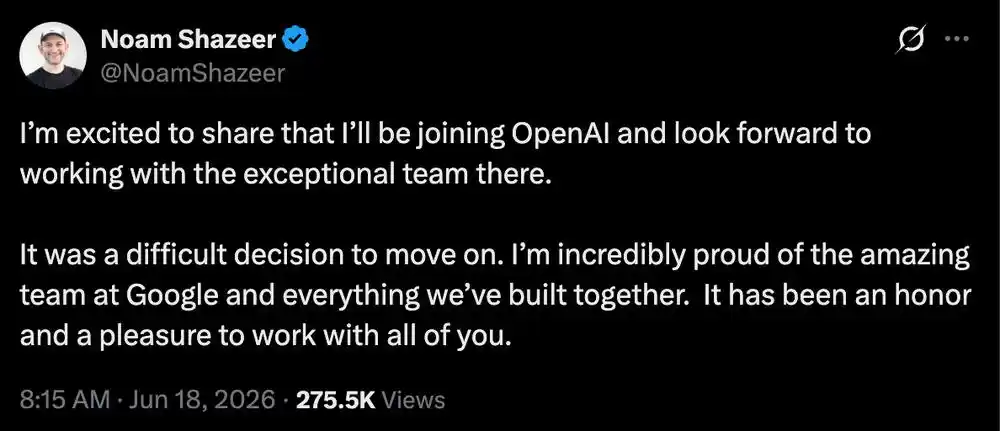
Simultaneously, he expressed gratitude to the Google team: "Leaving was a difficult decision. I'm immensely proud of the Google team and everything we've accomplished together. It has been a privilege to work with you all." A Google spokesperson, in a response to Reuters, stated that the company is grateful for Shazeer's significant contributions over the years and wishes him all the best in his future endeavors.

Noam Shazeer is one of the legendary figures in the AI field. He is one of the core authors of the seminal 2017 paper 'Attention Is All You Need', which first proposed the Transformer architecture, directly establishing the technical foundation for modern large models like the GPT series, Gemini, and Claude.
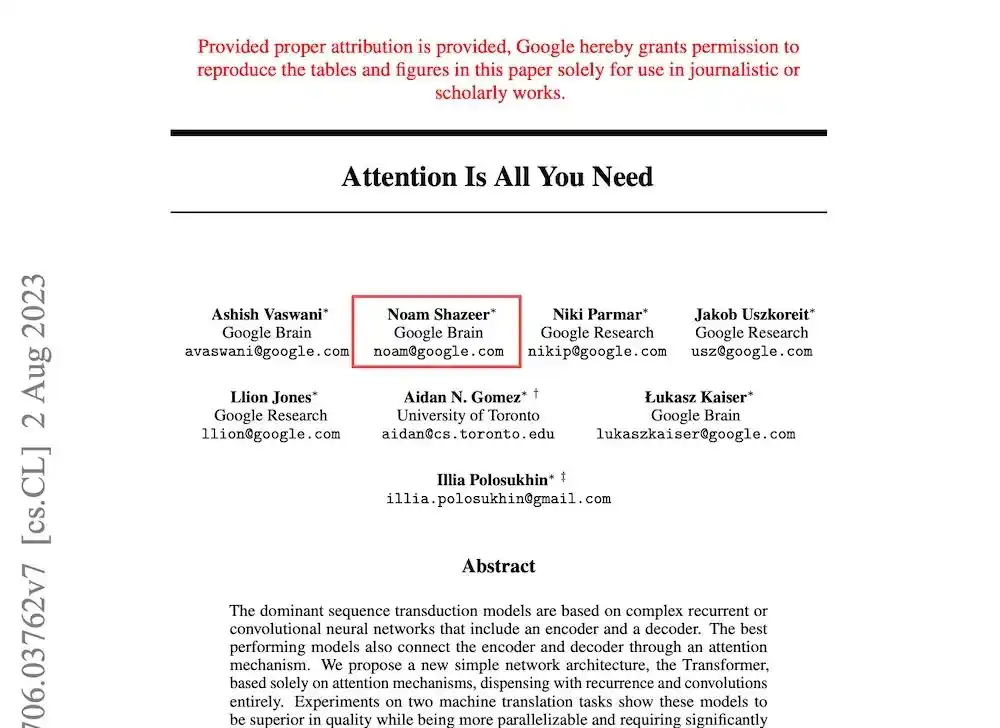
'Attention Is All You Need'

Before joining OpenAI, Shazeer had left Google in 2021 to found Character.AI. In fact, Shazeer is best known as the Co-founder and CEO of Character.AI.

This company bet on the "AI companionship"赛道 even earlier than the ChatGPT explosion, allowing users to engage in long-term conversations with various AI characters. It once became one of the fastest-growing consumer AI applications globally. By 2023, Character.AI's valuation had exceeded $1 billion (approximately RMB 6.765 billion).

In 2024, Google reached a technology licensing agreement with Character.AI valued at approximately $2.7 billion (about RMB 18.266 billion), bringing Noam Shazeer and part of the core team back into DeepMind. Noam Shazeer was appointed as a Gemini co-head, involved in the pre-training R&D of the next-generation Gemini models.

For OpenAI, which is fiercely competing with Anthropic, this is viewed externally as one of the most significant top-tier talent acquisitions in recent years. Following the announcement, OpenAI's senior leadership and several renowned researchers immediately left welcoming messages on X.

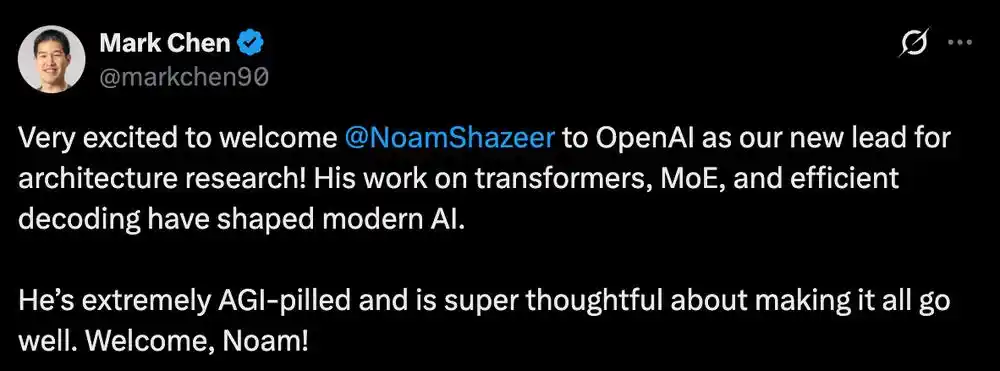
OpenAI's Chief Research Officer, Mark Chen, posted: "Very excited to welcome Noam Shazeer to OpenAI as our Lead for Architecture Research. His work on Transformers, MoE, and efficient decoding has shaped modern AI."
Subsequently, numerous AI researchers also offered congratulations in the comments section, including Google DeepMind researcher and Chinese member of the Gemini Thinking and Coding team, Yuchen Zhuang; OpenAI researcher and core contributor to the o-series reasoning models, Noam Brown; and former Microsoft AI VP, now OpenAI researcher, Sebastien Bubeck, among others.

Google DeepMind Chinese researcher Yuchen Zhuang

OpenAI o-series reasoning model core contributor Noam Brown

OpenAI researcher Sebastien Bubeck

Meanwhile, netizens lamented: "Losing a Transformer author and Gemini co-head is undoubtedly a heavy blow for Google."

01. Renowned Transformer Author, Worked at Google for Nearly 18 Years

From the perspective of the history of generative AI, Noam Shazeer has participated in nearly every key milestone. He joined Google in 2000, serving as a Software Engineer and later Principal Software Engineer, accumulating over 18 years of work experience.
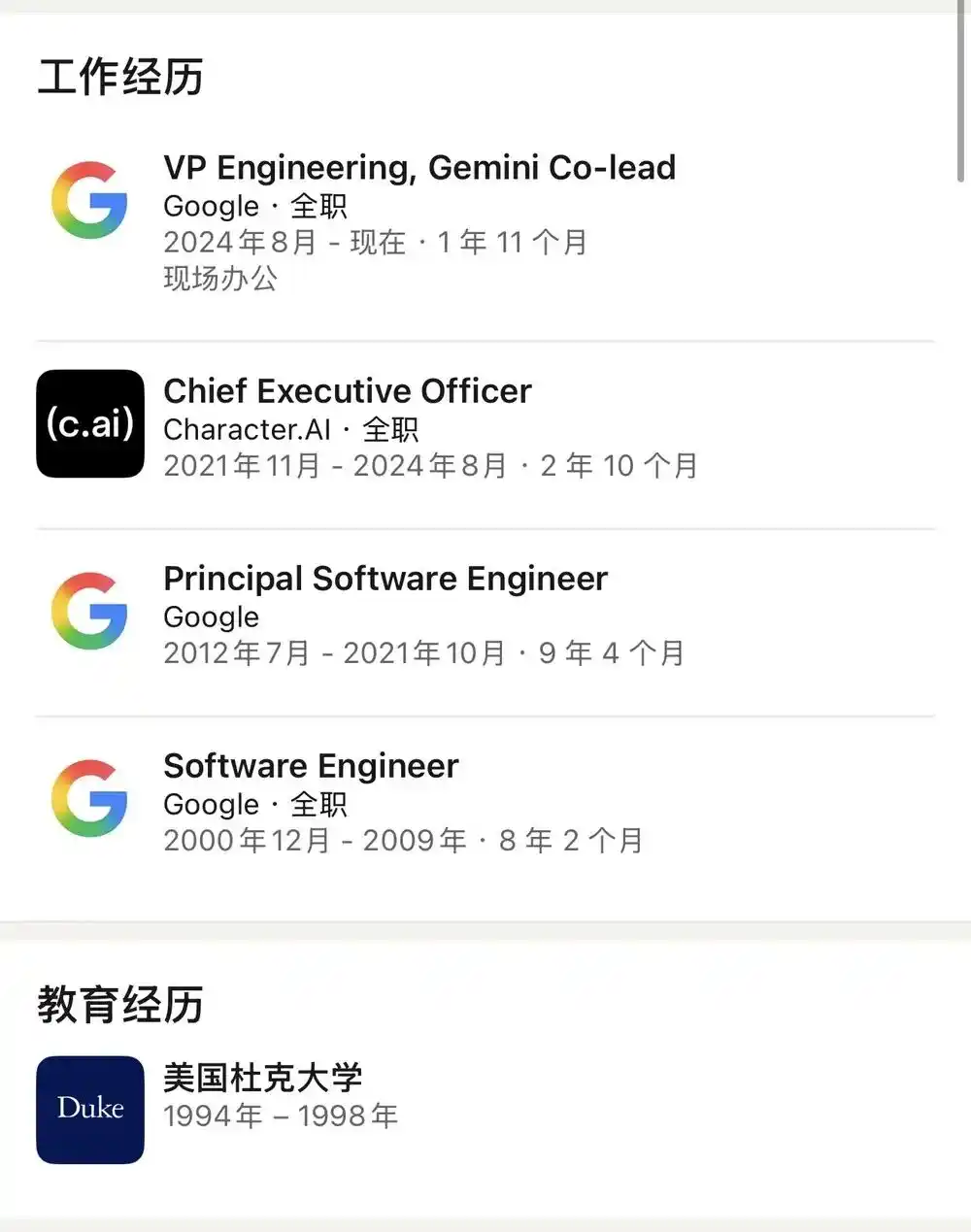
Noam Shazeer's Work Experience and Education Background (Source: LinkedIn)

In 2017, he, along with Ashish Vaswani, Jakob Uszkoreit, and six other Google researchers, co-authored the seminal paper 'Attention Is All You Need', proposing the Transformer architecture. Compared to the then-dominant RNN and LSTM models, the Transformer could process long text more efficiently and possessed greater scalability.

Over the past few years, models such as OpenAI's GPT series, Google's Gemini, Anthropic's Claude, as well as DeepSeek and Llama, are almost all built upon the Transformer architecture at their core. In other words, today's global wave of large models largely rests on the technical foundation laid by this paper.

However, the Transformer is just one of Noam Shazeer's many notable contributions.

During his tenure at Google, he also contributed to the advancement of numerous influential large model technologies. In 2017, as the first author, he proposed the Sparse Gated Mixture of Experts (MoE) architecture, providing crucial technical ideas for later models like GPT-4, Gemini, and DeepSeek-V3; in 2018, he participated in developing Mesh TensorFlow, providing foundational tools for super-large-scale Transformer training; subsequently, he was also involved in key project R&D such as the T5 model and Google's dialogue model LaMDA.

02. Left Google to Start a Company, Then Bought Back for $18.2B

In 2021, Shazeer left Google and co-founded Character.AI with Daniel De Freitas.

At that time, large language models had not yet experienced their "ChatGPT moment," but Character.AI was already pioneering efforts to bring chatbot products to the mass market, rapidly accumulating a large user base.

In 2024, Google reincorporated Shazeer and his core team into the DeepMind ecosystem through a cooperation deal worth approximately $2.7 billion (about RMB 18.266 billion). He subsequently became one of the key leaders of the Gemini project, participating in the pre-training of the next-generation Gemini models.

Shazeer's return coincided with a period of immense pressure on Google's AI business. ChatGPT had exploded in popularity, and Gemini was still in a catch-up phase. After returning to DeepMind, Shazeer participated in model R&D and eventually assumed the role of Gemini co-head, becoming one of the leading figures in Google's AI technology.

Following this, the Gemini 3 series models ranked at the forefront in multiple benchmark tests such as coding and reasoning, becoming a significant asset in Google's competition with OpenAI and Anthropic.

From Google researcher, to entrepreneur, to Gemini co-head, Shazeer has witnessed nearly every major turning point in Google's AI development over the past decade. Therefore, his departure from Google to join OpenAI is regarded by many industry insiders as one of the most significant talent loss events for Google in recent years.

03. OpenAI's Talent Battle Continues to Escalate

Shazeer's joining unfolds against the backdrop of increasingly fierce talent competition in the AI industry.

Over the past year, competition between OpenAI and Anthropic has continued to intensify. The two are not only competing over model capabilities but are also constantly vying for top researchers and core engineers.

The UK's Financial Times reported that OpenAI internally views Shazeer's addition as a major reinforcement. In the future, he will focus on researching new architectural directions beyond the Transformer, and on further enhancing model capabilities.

It's worth noting that the Transformer has dominated the AI field for nearly a decade. With the development of reasoning models, multi-agent systems, and world models, more and more researchers are beginning to ponder: Will the Transformer undergo its next major architectural upgrade?

And Shazeer is precisely one of the most qualified individuals to answer that question.

For Google, this means losing a Transformer author, a Gemini co-head, and one of its most seasoned AI architecture designers. For OpenAI, its laboratory welcomes someone who has personally shaped the modern AI technology stack.

04. Conclusion: A Significant Talent Move in the Transformer Era

As technology gradually approaches the frontier, top researchers themselves have become one of the scarcest resources. The trajectory of Noam Shazeer's career almost connects four key nodes: Transformer, Character.AI, Gemini, and OpenAI.

Now, this Transformer author's departure from Google and joining of OpenAI is not only a talent movement but also reflects the increasingly fierce competitive landscape among current AI giants.

Especially at a time when OpenAI and Anthropic are engaged in a white-hot competition over next-generation models, the enterprise market, and top research talent, and Google is also catching up through Gemini. Losing a Transformer founder and Gemini co-head at this juncture is undoubtedly a significant loss for Google.

For the entire industry, a subsequent question worth following is: When a Transformer author personally researches "architectures beyond the Transformer," where will the next generation of AI models head.

This article is from the WeChat public account "Zhixidongxi" (ID: zhidxcom), author: Jiang Yu, editor: Li Shuiqing

Pertanyaan Terkait

QWho is Noam Shazeer and what is his significance in the AI field?

ANoam Shazeer is a renowned AI researcher, a core author of the seminal 2017 paper 'Attention Is All You Need' which introduced the Transformer architecture, and the former co-lead of Google's Gemini project. His work laid the technical foundation for modern large language models like GPT, Gemini, and Claude.

QWhat new role did Noam Shazeer take at OpenAI and what will he be responsible for?

ANoam Shazeer joined OpenAI as the Lead for Architecture Research. He will be responsible for exploring next-generation AI model architectures and driving the further evolution of the Transformer architecture.

QWhat was the nature of the significant deal between Google and Character.AI involving Shazeer in 2024?

AIn 2024, Google reached a technology licensing deal with Character.AI valued at approximately $2.7 billion (RMB 18.266 billion). This deal brought Noam Shazeer and part of the core team back into Google DeepMind, where he was appointed co-lead of the Gemini project.

QWhy is Shazeer's move to OpenAI considered a significant loss for Google?

AShazeer's departure is considered a significant loss for Google because he is a Transformer author, a former Gemini co-lead, and one of its most senior AI architecture designers. Losing such a key figure in the midst of intense competition with OpenAI and Anthropic is a substantial setback.

QWhat broader industry trend does Shazeer's career move highlight according to the article?

AShazeer's move highlights the increasingly fierce competition for top-tier AI research talent among major tech companies like OpenAI, Google, and Anthropic. As technology pushes the frontier, these researchers themselves become among the most scarce and valuable resources.

Bacaan Terkait

Jangan Hanya Fokus pada PHK, Struktur Baru Ethereum Foundation Lebih Layak Diperhatikan

Penulis: KarenZ, Foresight News Yayasan Ethereum (EF) telah melakukan reorganisasi struktural yang signifikan, dengan fokus pada penentuan ulang batasan dan prioritasnya. Restrukturisasi ini tidak hanya mencakup pengurangan sekitar 54 orang (20% dari staf), tetapi lebih penting, menandai pergeseran strategis dalam alokasi sumber daya. Struktur baru EF terdiri dari delapan klaster, dengan **Lapisan Protokol** sebagai yang terbesar (57 orang), diikuti oleh Lapisan Akses (34 orang). Hal ini menunjukkan konsentrasi sumber daya yang lebih besar pada area inti dan paling sulit untuk dialihdayakan: evolusi protokol, keamanan, privasi, klien, spesifikasi, serta titik masuk bagi pengguna dan institusi ke blockchain. Prioritas teknis utama di Lapisan Protokol termasuk keamanan pasca-kuantum (tim baru dibentuk Januari 2026), zkEVM, verifikasi formal, dan finalitas. Tokoh kunci seperti Vitalik Buterin dan Justin Drake terlibat dalam kelompok arsitektur, menekankan prioritas tinggi pada evolusi protokol jangka panjang. EF juga mengurangi subsidi untuk klien lapisan konsensus dan eksekusi, yang akan berakhir pada 2027. Dari sisi keuangan, anggaran EF tahun ini turun sekitar 40%. Tujuannya adalah beralih dari rata-rata pengeluaran 15% dari dana yang tersisa per tahun (sebelum 2026) menjadi sekitar 5% per tahun setelah 2030, menyerupai model endowment jangka panjang. Restrukturisasi ini juga mendorong munculnya lebih banyak "node" atau organisasi otonom dalam ekosistem Ethereum, seperti EthLabs, Ethereum Apps Guild (EAG), Ethereum Economic Zone (EEZ), dan Argot. Organisasi-organisasi ini diharapkan dapat mengambil alih peran dalam adopsi aplikasi, alat pengembang, narasi ETH, dan koordinasi ekosistem, sehingga EF dapat fokus pada masalah-masalah teknis yang paling mendasar. Singkatnya, reorganisasi EF menandai transisi dari pendekatan "mencakup segalanya" menjadi fokus yang lebih sempit dan mendalam pada masalah teknis yang sulit dan jangka panjang, sambil mendorong desentralisasi tanggung jawab di seluruh ekosistem. Tantangannya ke depan adalah memastikan koordinasi yang efektif dalam struktur multi-node yang baru ini.

Foresight News10m yang lalu

Jangan Hanya Fokus pada PHK, Struktur Baru Ethereum Foundation Lebih Layak Diperhatikan

Foresight News10m yang lalu

Analisis Laporan: Saat CPO Meledak, Apa Langkah yang Dijalankan Coherent?

**Analis J.P. Morgan Samik Chatterjee menegaskan kembali rating 'Overweight' untuk Coherent (COHR). Perusahaan di sektor chip dan komponen komunikasi optik ini dinilai memiliki ruang pertumbuhan yang kurang dihargai pasar, didukung oleh tiga pilar utama:** 1. **Transceiver Data Center:** Permintaan untuk transceiver 1.6T tetap kuat dengan lingkungan harga sehat. Adopsi CPO (Co-Packaged Optics) justru didorong akan meningkatkan permintaan komponen optik canggih, bukan menggantikan transceiver tradisional. 2. **Peluang CPO & OCS:** CPO menjadi fokus industri. Keunggulan COHR terletak pada portofolio komponen optik lengkap (laser, isolator, VCSEL, pendingin termoelektrik), yang meningkatkan nilai yang dapat diperoleh per chip. Untuk Optical Circuit Switch (OCS), pasar potensial $4 miliar, dengan teknologi Liquid Crystal COHR memiliki keunggulan daya tahan dan konsumsi daya dibandingkan pesaing MEMS. 3. **Konsolidasi Hulu & Margin:** Kapasitas produksi InP (Indium Phosphide) akan ditingkatkan 4x dalam dua tahun. Posisi kuat sebagai salah satu dari dua pemasok utama *pump laser* yang langka memungkinkan integrasi ke hulu, menjual sistem/line card lengkap dengan nilai lebih tinggi. Target margin kotor >42% didorong oleh produk premium, efisiensi biaya dari transisi wafer 6-inci, dan produk baru bernilai tinggi seperti CPO. 4. **Bidang Industri:** Pertumbuhan organik 5-10% didukung oleh peralatan proses semikonduktor dan potensi peluang baru dalam sensor 3D (mis., untuk Face ID generasi mendatang). **Kesimpulan:** COHR berada di posisi kunci dalam infrastruktur interkoneksi optik data center. Didorong oleh permintaan komputasi AI, peluang baru di CPO/OCS, pertumbuhan stabil di bidang industri, dan ruang perbaikan margin, prospek perusahaan dinilai positif.

marsbit33m yang lalu

Analisis Laporan: Saat CPO Meledak, Apa Langkah yang Dijalankan Coherent?

marsbit33m yang lalu

Dan Koe: Melarikan Diri dari Takdir Pekerja, Bagaimana Bertahan dalam Gelombang Penggantian AI?

**Ringkasan: Bertahan di Era Penggantian AI dengan Membangun Karier Anda Sendiri** Banyak orang panik tentang AI yang akan mengambil alih pekerjaan, tetapi ancaman sebenarnya adalah ketergantungan finansial dan mental pada orang lain. "Perbudakan gaji" terjadi ketika Anda terjebak dalam pekerjaan tanpa makna hanya untuk bertahan hidup. Solusinya bukan menolak AI, melainkan **membangun bisnis atau karya Anda sendiri**. Untuk bertahan dan berkembang, Anda perlu menguasai lima elemen inti: 1. **Agency**: Kemampuan bertindak tanpa menunggu perintah. 2. **Selera**: Kepekaan untuk membedakan apa yang bernilai. 3. **Kemampuan persuasi**: Meyakinkan orang untuk mendukung usaha Anda. 4. **Ketekunan**: Memahami bahwa kegagalan adalah bagian dari proses. 5. **Iterasi**: Kemampuan memperbaiki diri berdasarkan umpan balik. Lima hal ini dapat disederhanakan menjadi **keterampilan memecahkan masalah dan akumulasi pengalaman**. **Langkah Praktis untuk Memulai:** 1. **Ubah lingkungan dan identitas**: Ganti kebiasaan, konten yang dikonsumsi, dan lingkaran pergaulan untuk memicu pola pikir baru. 2. **Pilih media sebagai alat utama**: Dibandingkan coding, membuat konten (tulisan, video, podcast) lebih berharga karena nilainya subjektif dan membutuhkan selera yang tidak bisa digantikan AI sepenuhnya. 3. **Temukan "bahan mentah" Anda**: Jawab pertanyaan mendalam tentang minat, keahlian alami, dan pengalaman unik Anda. Ini akan menjadi fondasi konten Anda. 4. **Cari sudut pandang "anti-mainstream"**: Identifikasi keyakinan Anda yang bertentangan dengan opini umum di bidang Anda. 5. **Segera publikasikan**: Posting ide pertama Anda besok. Versi pertama mungkin buruk, tetapi umpan balik nyata adalah awal pembelajaran. Kunci utamanya adalah **mulai dari hal kecil, konsisten, dan berani menerima umpan balik untuk terus berimprovisasi.** Dengan memanfaatkan AI sebagai alat bantu dan fokus pada pengembangan diri, Anda dapat menciptakan jalan karier yang bermakna dan mandiri.

marsbit40m yang lalu

Dan Koe: Melarikan Diri dari Takdir Pekerja, Bagaimana Bertahan dalam Gelombang Penggantian AI?

marsbit40m yang lalu

Setelah PHK 20%, Apa Poin Penting dalam Struktur Baru EF?

Menurut pengumuman resmi pada 23 Juni, Ethereum Foundation (EF) telah menyelesaikan restrukturisasi organisasi, mengurangi sekitar 20% stafnya (54 orang), dan membagi ulang timnya menjadi lima klaster kerja inti: Protokol, Akses, Pengguna, Komunitas, dan Institusional. Restrukturisasi ini digambarkan sebagai implementasi dari Mandat 2026 dan Kebijakan Pengelolaan Treasury 2025, dengan tujuan membuat EF lebih ramping dan berfokus pada prinsip-prinsip inti seperti kedaulatan diri, anti-sensor, sumber terbuka, privasi, dan keamanan (CROPS). Klaster Protokol akan terus fokus pada riset dan pengembangan inti protokol Ethereum. Klaster Akses menekankan prinsip "opsi nol" untuk memastikan pengguna dapat mengakses jaringan tanpa bergantung pada perantara. Klaster Pengguna, Komunitas, dan Institusional bertugas menangani keterlibatan eksternal. EF menyediakan paket pesangon di atas standar hukum serta bantuan penempatan ulang di dalam ekosistem bagi karyawan yang terdampak. Meski demikian, alokasi anggaran untuk setiap klaster baru belum diungkapkan. Pengumuman ini muncul di tengah perubahan kepemimpinan dan diskusi eksternal mengenai fragmentasi ekosistem, kompetisi L2, dan tekanan regulasi. EF menegaskan ini adalah langkah untuk lebih memfokuskan misi, sementara pasar melihatnya dalam konteks tekanan tata kelola. Dampak sebenarnya terhadap kecepatan pengembangan, pendanaan ekosistem, dan arah strategis masih perlu dipantau melalui pengungkapan detail lebih lanjut oleh EF dalam beberapa minggu dan bulan ke depan.

marsbit43m yang lalu

Setelah PHK 20%, Apa Poin Penting dalam Struktur Baru EF?

marsbit43m yang lalu

Bot MEV Paling Top, Digasak $7,5 Juta: Apakah Approval Justru Risiko Mematikan yang Paling Diabaikan di On-Chain?

**Intisari Artikel: Bot MEV Paling Top, Kena Bobol 750 Juta Dollar: Apakah Approval Risiko Mematikan yang Paling Terabaikan di Blockchain?** Bot arbitrase MEV terkenal Jaredfromsubway.eth diserang, mengalami kerugian lebih dari 750 juta dollar AS. Serangan ini bukan karena kebocoran kunci pribadi atau kerentanan kontrak pintar biasa, melainkan hasil perburuan terbalik yang dirancang khusus. Penyerang menghabiskan berminggu-minggu untuk menyiapkan jebakan: Mereka membuat banyak token palsu dan kolam likuiditas yang meniru aset populer seperti WETH dan USDC. Lingkungan ini dirancang untuk memancing bot MEV, yang selalu memindai peluang arbitrase, untuk secara otomatis menjalankan jalur perdagangan dan memberikan **persetujuan (approval) ERC-20** ke kontrak jahat. Setelah izin diberikan, penyerang kemudian menarik aset bot yang nyata. Kasus ini mengungkapkan bahaya mendasar dari fitur Approval di blockchain Ethereum/EVM. Approval diperlukan agar kontrak pintar (seperti DEX) dapat mengakses token pengguna untuk swap atau pinjaman. Namun, mirip dengan "pemotongan otomatis" di pembayaran digital, risiko utamanya adalah: 1. **Izin Tak Terbatas (Unlimited Approval):** Pengguna sering mengizinkan akses tak terbatas untuk menghemat biaya gas, membiarkan kontrak menarik semua token di masa depan. 2. **Izin Tidak Hilang dengan Sendirinya:** Memutuskan koneksi dompet atau menutup situs web **tidak membatalkan** approval yang sudah tercatat di blockchain. 3. **Risiko Masa Depan:** Kontrak yang saat ini aman bisa diretas di kemudian hari, menyalahgunakan izin yang sudah diberikan. **Bagaimana Mengelola Risiko Approval:** * **Prinsip Izin Minimum:** Setel jumlah approval mendekati nilai transaksi yang dibutuhkan, hindari unlimited approval. * **Pisahkan Dompet:** Gunakan dompet terpisah untuk penyimpanan jangka panjang dan untuk interaksi dengan DApp/proyek baru. * **Tinjau & Cabut Izin Secara Berkala:** Gunakan alat seperti Revoke.cash atau fitur manajemen izin di dompet (seperti di imToken) untuk memeriksa dan mencabut izin yang tidak lagi digunakan. * **Dukungan dari Dompet:** Dompet harus memberikan peringatan risiko, mem-parsing dan menampilkan data tanda tangan dengan jelas (Clear Signing), serta memudahkan pengelolaan izin. Keselamatan aset tidak hanya tentang melindungi kunci pribadi, tetapi juga secara aktif mengelola izin akses (approval) yang telah diberikan kepada kontrak pintar lainnya.

marsbit48m yang lalu

Bot MEV Paling Top, Digasak $7,5 Juta: Apakah Approval Justru Risiko Mematikan yang Paling Diabaikan di On-Chain?

marsbit48m yang lalu

Trading

Spot
Futures
活动图片