Will UNI Reach $100 in Four Years? Can Standard Chartered's Prediction Come True?

marsbitDipublikasikan tanggal 2026-06-17Terakhir diperbarui pada 2026-06-17

Abstrak

TL;DR: Standard Chartered Bank predicts UNI token will reach $100 by 2030, based on the growth of tokenized assets fueling demand for open DeFi liquidity and Uniswap's potential to capture fees from that trading. However, institutional tokenized products like BlackRock's BUIDL fund show that strict access controls and permissioned systems remain major barriers. Standard Chartered's $100 price target for Uniswap's (UNI) governance token by 2030 projects massive growth from current levels. The bank's thesis hinges on tokenized real-world assets (RWA) reaching trillions in value and a significant portion flowing into open, decentralized markets for trading and liquidity, rather than remaining in closed, permissioned systems. Uniswap's position as a leading decentralized exchange (DEX) infrastructure could allow it to capture a major share of this future trading activity. A key challenge is whether tokenized assets like bonds, funds, and stocks will trade openly on DEXs or be restricted to controlled, institutional platforms. The case of BlackRock's BUIDL fund exemplifies this tension: while it uses Uniswap's technology for settlements, trading is strictly limited to pre-approved, whitelisted institutional participants. This hybrid model provides DeFi efficiency but maintains traditional access barriers. For UNI to achieve such a high valuation, Uniswap must not only see increased trading volume from tokenized assets but also implement effective value-capture mechanisms for to...

Original Author: Liam Akiba Wright

Original Compilation: Luffy, Foresight News

TL;DR:

  • According to reports, Standard Chartered Bank has released a research report on Uniswap, setting a $100 price target for the UNI token by 2030.
  • Standard Chartered's core logic is that tokenized assets will drive demand for open DeFi liquidity, and Uniswap is expected to capture substantial trading volume and earn fees.
  • However, most institutional-grade tokenized products are permissioned. Products like BlackRock's BUIDL demonstrate that access barriers still exist within the DeFi space.

Standard Chartered Bank has set a year-end 2030 price target of $100 for the UNI token. This prediction implies that the price of this leading decentralized exchange governance token will far exceed its current market valuation.

Standard Chartered's argument is that future tokenized assets will require decentralized trading platforms to convert fragmented on-chain financial instruments into tradable liquidity.

Standard Chartered estimates that by 2028, the total size of global tokenized assets could reach $4 trillion; by 2030, the proportion of tokenized assets flowing into the DeFi market is projected to increase from the current ~3.5% to 30%. Based on this estimate, the asset size hosted by the DeFi market in 2030 could exceed $2 trillion.

Currently, banks, asset management firms, transfer agents, and compliance platforms are all entering the asset tokenization space. But if these assets require 24/7 trading, flexible collateralization, and cross-product composability that single institutions' proprietary systems cannot provide, then open, decentralized protocols will capture the liquidity dividend.

Given the current market environment, a core industry question emerges: Will on-chain assets such as tokenized treasuries, funds, stocks, and stablecoins become liquidity assets in open, decentralized markets, or will they remain confined to strictly permissioned, fully controlled closed systems for circulation and settlement?

Growth Prospects Depend on Open Liquidity

Standard Chartered's valuation target is built on layered assumptions: First, the tokenized asset market achieves significant expansion. Second, a considerable portion of tokenized assets evolve beyond merely being compliant, ownership-registered assets sitting on-chain to become actively traded within DeFi markets. Finally, Uniswap can capture enough of the related trading volume, driving up the value of the UNI token. The core of this entire logic shifts the focus from the asset issuance phase to the liquidity trading phase.

Standard Chartered had previously identified asset tokenization as a long-term, major opportunity. In a 2024 report co-published with consultancy Synpulse, it predicted that the global real-world asset tokenization market could reach $30.1 trillion by 2034, with trade finance being a core application area. The report also mentioned that tokenization would spawn new DeFi applications and business models.

Citi's tokenization report from June 2026 had a similar market size projection but also highlighted countervailing factors: its base case forecasted a $5.5 trillion tokenized asset market by 2030, with an optimistic scenario of $8.2 trillion. The report also noted that hybrid models might dominate, with institutions controlling issuance, distribution, and settlement channels.

The divergence between these two paths directly determines Uniswap's growth potential. If the tokenized asset market continues to grow, but value remains locked within bank platforms, transfer agent systems, broker networks, and compliant trading markets, the development space for open DeFi will be very limited.

Conversely, if various tokenized financial instruments, stablecoins, and collateral assets require cross-category free trading, the status of protocols like Uniswap will be greatly elevated.

DeFiLlama data confirms Uniswap's foundational ability to meet this demand. At the time of writing, the protocol's multi-chain total value locked is approximately $2.89 billion, with fee revenue exceeding $50 million over the past 30 days.

Current data only represents the base operational scale but is sufficient to illustrate that Uniswap is positioned as liquidity infrastructure.

For institutions, there is a clear practical difference between the two. Issuing a fund token is one process; building a trading venue that allows that token to be freely exchanged for stablecoins, collateral, and other tokenized assets is a separate, independent business.

The gap between these two processes determines whether automated market makers like Uniswap become essential infrastructure or remain merely peripheral access channels.

This reveals that the choice of trading venue is equally important as asset issuance. Liquidity determines whether tokenized products can form tradable markets, reusable collateral, and settleable assets; otherwise, they remain merely static ownership certificates within compliant systems.

BlackRock's BUIDL: Connecting to DeFi, but Building Access Gates

BlackRock's BUIDL Institutional Digital Liquidity Fund is a current real-world case highlighting this tension. In February this year, Uniswap Labs and compliance platform Securitize jointly announced that BlackRock's USD Institutional Digital Liquidity Fund, BUIDL, was available on the UniswapX trading channel.

This integration uses a request-for-quote (RFQ) mechanism and is open only to whitelisted users and pre-vetted, qualified participants.

Previous CryptoSlate reporting on BUIDL pinpointed the core contradiction: While BUIDL holders can exchange for USDC via UniswapX, trading access has strict eligibility barriers.

The transaction flow relies on DeFi technology, but asset circulation is limited to approved institutional participants.

BlackRock's initial issuance rules for BUIDL fully embody this controlled model: the product is only for accredited investors, with a minimum investment of $5 million; assets can only be transferred to pre-approved parties, and it is not listed for trading on any exchange.

RWA.xyz data shows that as of June 16, BUIDL's total asset size was approximately $2.37 billion, held by only 108 entities.

Combined with the access rules, this paints a picture of the current tokenization industry: large-scale tokenized products can be created on-chain, but participation rights are highly concentrated and subject to full permissioning control.

Standard Chartered's investor roadshow materials from May 2026 also used BUIDL's connection to Uniswap as a case study to argue that decentralized platforms could be used for asset distribution and trading.

Even though the full UNI valuation report hasn't been made public, this roadshow material positions Uniswap as supporting infrastructure for institutional digital assets, which is the foundational support for the $100 price target.
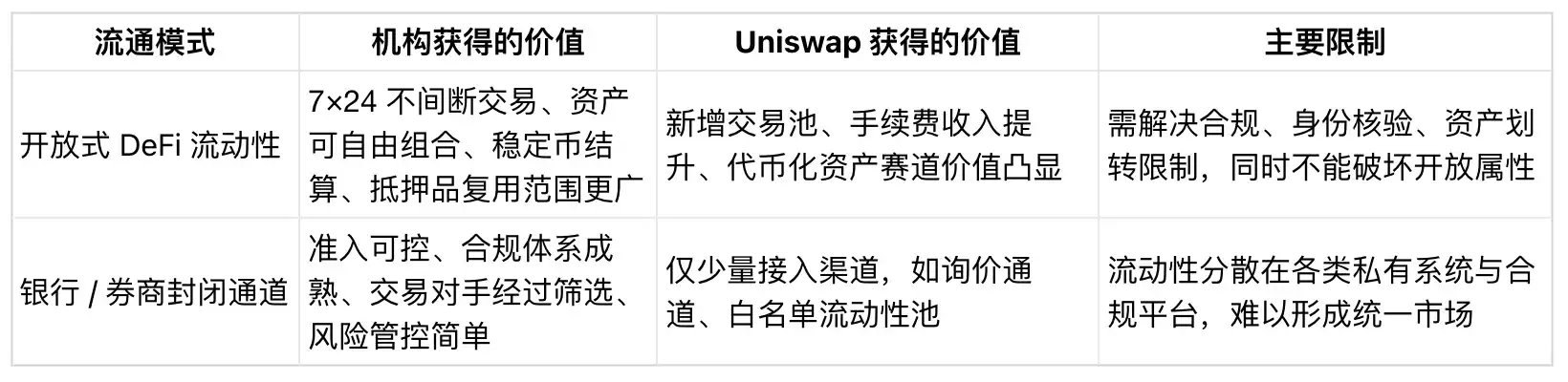
The BlackRock BUIDL model sits between the two extremes, utilizing Uniswap technology at its base but maintaining institutional access controls throughout. This design builds a bridge to DeFi infrastructure without fully immersing tokenized assets into a permissionless, open liquidity pool.

The liquidity solutions acceptable for institutional assets will likely adopt this hybrid model first: leveraging DeFi infrastructure for trading and settlement while imposing hard restrictions on user identity, asset transfers, and counterparties.

UNI Still Lacks a Value Capture Mechanism

Even if Uniswap facilitates more real-world tokenized asset trading, it doesn't guarantee direct benefits for UNI token holders, as the protocol still lacks a stable value capture mechanism.

The UNI tokenomics upgrade proposal passed by the community on the Tally platform previously clarified protocol fee distribution and UNI burn mechanisms while also proposing that Uniswap become the default trading hub for tokenized assets.

This plan provides an implementation path for the valuation logic but hinges on multiple prerequisites: community governance decisions, fee adjustments, institutional commercial partnerships, and real trading volume growth—none of which can be missing.

Standard Chartered's $100 price target not only far exceeds current market levels but even surpasses UNI's all-time high from 2021. This target cannot rely solely on asset issuance growth; it requires real, sustained trading volume, stable fee revenue, and a clear linkage mechanism between protocol development and token value.

The core tension in the institutional tokenization space is that banks and asset managers need decentralized capabilities like on-chain settlement, 24/7 transfers, programmable collateral, and stablecoin payments, yet insist on KYC verification, asset transfer restrictions, designated counterparties, and control over secondary market development.

The Financial Stability Board's research report on tokenization also reflects this cautious stance. It notes that the overall scale of tokenization is still small and that the industry faces multiple issues, including closed access, insufficient cross-platform interoperability, limited settlement assets, and fragmented trading platforms.

These frictions are the core obstacles preventing tokenized assets from becoming general-purpose liquidity assets in DeFi.

If these industry barriers persist long-term, Uniswap will remain merely a peripheral integration channel for institutional tokenization systems. If related pain points gradually ease, the protocol could become a central trading venue for tokenized funds, stablecoins, and native crypto assets.

Ultimately, the core of Standard Chartered's valuation prediction depends on where tokenized liquidity ultimately flows. The $100 target represents significant upside potential, but the more crucial signal is this: a traditional Wall Street investment bank now acknowledges that DeFi protocols have a chance to share in the institutional tokenization wave.

The BlackRock BUIDL case has already proven that asset managers can use DeFi technology while maintaining strict circulation controls; Citi's outlook on tokenization also suggests that Wall Street will likely build hybrid systems, keeping issuance, distribution, and settlement firmly in institutional hands; and the various industry pain points highlighted by the Financial Stability Board emphasize that interoperability and settlement systems remain core industry challenges.

Future market signals will come from more tokenized asset integration cases. If new assets all adopt isolated, whitelisted RFQ channels, open DeFi will only capture a small market share. If cross-asset unified liquidity pools gradually materialize and custom control rules diminish, Uniswap's position in the tokenization space will no longer be confined to native cryptocurrency swaps.


Kripto yang Sedang Tren

Pertanyaan Terkait

QWhat is Standard Chartered Bank's target price for the UNI token by 2030, and what is the core logic behind this prediction?

AStandard Chartered Bank has set a target price of $100 for the UNI token by the end of 2030. The core logic is that the tokenization of assets will drive demand for open DeFi liquidity, with Uniswap well-positioned to capture significant trading volume and earn fees from this influx.

QWhat are the two divergent paths for tokenized assets highlighted in the article, and how do they impact Uniswap's growth potential?

AThe two paths are: 1) Tokenized assets remain largely within closed, permissioned systems controlled by institutions like banks and custodians. 2) Tokenized assets flow into open, decentralized markets requiring cross-asset trading and composability. Uniswap's growth potential is severely limited in the first scenario but significantly enhanced in the second, as it could become a core liquidity hub.

QUsing the example of BlackRock's BUIDL fund, explain the current hybrid approach institutions are taking towards DeFi infrastructure.

ABlackRock's BUIDL fund utilizes UniswapX's technology for its trading mechanism but implements strict permissioned access (e.g., whitelisted users, pre-approved participants). This demonstrates a hybrid approach where institutions leverage DeFi infrastructure for its technical benefits (e.g., 24/7 settlement) while maintaining full control over user access, asset transfers, and counterparty restrictions.

QWhat key challenge does the article identify regarding UNI's ability to capture value from Uniswap's potential growth in tokenized asset trading?

AA key challenge is that Uniswap currently lacks a stable and direct value-capture mechanism for UNI token holders. Even if the protocol processes more transactions from tokenized assets, UNI holders don't automatically benefit. The success of the recently passed UNI tokenomics upgrade proposal, which includes fee distribution and a burn mechanism, is crucial but depends on multiple factors like governance decisions and actual trading volume growth.

QAccording to the article, what is the fundamental factor that will determine whether Standard Chartered's $100 UNI price target is achievable?

AThe fundamental factor is where the liquidity from tokenized assets ultimately flows. The target depends on whether a significant portion of tokenized financial instruments (like tokenized funds, stocks, and stablecoins) move into open, permissionless DeFi liquidity pools rather than being restricted to closed, institutionally controlled systems. The degree of market fragmentation and interoperability issues will be decisive.

Bacaan Terkait

TechFlow Intel: Peluang IPO Anthropic Lebih dari 80%, Iran Tutup Lagi Selat Hormuz Picu Gejolak Harga Minyak

Market memperkirakan Anthropic akan mengumumkan IPO sebelum November 2026, dengan valuasi yang ditargetkan mencapai triliunan dolar. Namun, pertanyaannya adalah apakah valuasi sebesar itu dapat selaras dengan janji keamanan AI inti mereka. Sementara itu, militer Iran kembali mengumumkan penutupan Selat Hormuz, menyebabkan gejolak harga minyak, meskipun data pelacakan kapal menunjukkan beberapa kapal masih melintas. Di sisi lain, Iran melanjutkan pemuatan minyak di Pulau Kharg, dengan hingga 20 juta barel minyak akan memasuki pasar. Di sektor teknologi, merek-merek mulai menggunakan influencer virtual AI untuk pemasaran produk. Elon Musk berbicara tentang menghabiskan "septillion dolar" untuk penelitian antimateri untuk perjalanan antariksa. Goldman Sachs memperingatkan bahwa belanja modal AI senilai $5,3 triliun mendekati titik jenuh kredit. Cloudflare meluncurkan fitur akun sementara untuk agen AI. Google melaporkan lalu lintas IPv6-nya melebihi 50% untuk pertama kalinya. Hyundai Motor Group berencana mengakuisisi 9,65% saham Boston Dynamics. Di pasar saham, investor ritel membeli saham SpaceX senilai $370 juta dalam tiga hari. Di Eropa, terjadi default ekuitas CLO pasca-krisis pertama, menyalakan alarm di pasar kredit. Garis bawah hari ini: Tiga berita tentang Iran, default CLO Eropa, dan peringatan Goldman Sachs semuanya menunjukkan logika dasar yang sama: likuiditas global sedang menyempit dan biaya marginal meningkat di berbagai sektor. Namun, pada saat yang sama, modal masih mencari narasi baru, seperti yang terlihat pada rencana IPO Anthropic, antusiasme ritel terhadap SpaceX, dan visi antimateri Musk.

marsbit7j yang lalu

TechFlow Intel: Peluang IPO Anthropic Lebih dari 80%, Iran Tutup Lagi Selat Hormuz Picu Gejolak Harga Minyak

marsbit7j yang lalu

Pemburu Jadi Mangsa, MEV Bot yang Paling Cuan Diretas

Penyerang MEV Bot yang Terkenal, Jaredfromsubway.eth, Kehilangan Lebih dari $7,5 Juta dalam Serangan 'Perangkap Madu'. Alamat MEV Bot Ethereum yang terkenal dan sangat aktif, Jaredfromsubway.eth, mengalami serangan rantai yang sangat bertarget pada hari Sabtu, yang mengakibatkan kerugian lebih dari $7,5 juta. Menurut investigasi Blockaid, serangan ini bukanlah serangan phishing tradisional atau eksploitasi kerentanan kontrak pintar, melainkan serangan 'perangkap madu MEV balik' (counter-MEV honeypot attack) yang dirancang khusus untuk mengeksploitasi logika perilaku MEV Bot. Penyerang telah menyebarkan 66 kontrak token palsu dan kumpulan likuiditas palsu selama beberapa minggu sebelumnya. Aset-aset ini disamarkan sebagai aset stabil utama seperti WETH, USDC, dan USDT, dan membangun jalur perdagangan arbitrase yang tampak nyata. Rantai serangan berkembang: kumpulan likuiditas palsu menciptakan sinyal 'kesenjangan harga yang dapat diarbitrase'; bot MEV secara otomatis mengidentifikasi peluang dan mengeksekusi perdagangan; bot memberikan otorisasi ke kontrak bantu yang dikendalikan penyerang selama proses perdagangan; otorisasi ini tidak dicabut tepat waktu, menciptakan paparan izin yang terus-menerus; akhirnya, penyerang memanggil logika 'pintu belakang' yang telah dipasang sebelumnya dalam satu transaksi, secara langsung mentransfer aset ETH, USDC, dan USDT yang dipegang oleh alamat MEV bot tersebut. Jaredfromsubway.eth adalah salah satu bot MEV paling aktif dan menguntungkan di jaringan Ethereum, yang terkenal karena menjalankan serangan 'sandwich' secara sistematis untuk menangkap keuntungan dari pergerakan harga. Cointelegraph Research menunjukkan bahwa sekitar 70% dari sekitar 60.000 hingga 90.000 serangan sandwich bulanan di Ethereum antara November 2024 dan Oktober 2025 terkait dengan strateginya. Diperkirakan bot ini telah menghasilkan puluhan juta dolar AS. Peristiwa ini menjadi peringatan keras tentang meningkatnya ancaman keamanan di ekosistem crypto. Bahkan pemain tingkat atas seperti Jaredfromsubway.eth, yang biasanya berada di sisi 'predator', kini menjadi target dari serangan canggih yang mengeksploitasi logika operasional otomatis mereka sendiri. Selain itu, setelah peretasan, sebuah akun X tidak dikenal dengan 94.000 pengikut mengubah namanya menjadi Jaredfromsubway.eth dan secara palsu mengklaim akan menawarkan hadiah $1 juta untuk pengembalian dana, memicu peringatan dari pengembang agar pengguna tetap waspada terhadap kemungkinan penipuan.

marsbit8j yang lalu

Pemburu Jadi Mangsa, MEV Bot yang Paling Cuan Diretas

marsbit8j yang lalu

Trading

Spot
Futures

Artikel Populer

Cara Membeli T

Selamat datang di HTX.com! Kami telah membuat pembelian Threshold Network Token (T) menjadi mudah dan nyaman. Ikuti panduan langkah demi langkah kami untuk memulai perjalanan kripto Anda.Langkah 1: Buat Akun HTX AndaGunakan alamat email atau nomor ponsel Anda untuk mendaftar akun gratis di HTX. Rasakan perjalanan pendaftaran yang mudah dan buka semua fitur.Dapatkan Akun SayaLangkah 2: Buka Beli Kripto, lalu Pilih Metode Pembayaran AndaKartu Kredit/Debit: Gunakan Visa atau Mastercard Anda untuk membeli Threshold Network Token (T) secara instan.Saldo: Gunakan dana dari saldo akun HTX Anda untuk melakukan trading dengan lancar.Pihak Ketiga: Kami telah menambahkan metode pembayaran populer seperti Google Pay dan Apple Pay untuk meningkatkan kenyamanan.P2P: Lakukan trading langsung dengan pengguna lain di HTX.Over-the-Counter (OTC): Kami menawarkan layanan yang dibuat khusus dan kurs yang kompetitif bagi para trader.Langkah 3: Simpan Threshold Network Token (T) AndaSetelah melakukan pembelian, simpan Threshold Network Token (T) di akun HTX Anda. Selain itu, Anda dapat mengirimkannya ke tempat lain melalui transfer blockchain atau menggunakannya untuk memperdagangkan mata uang kripto lainnya.Langkah 4: Lakukan trading Threshold Network Token (T)Lakukan trading Threshold Network Token (T) dengan mudah di pasar spot HTX. Cukup akses akun Anda, pilih pasangan perdagangan, jalankan trading, lalu pantau secara real-time. Kami menawarkan pengalaman yang ramah pengguna baik untuk pemula maupun trader berpengalaman.

896 Total TayanganDipublikasikan pada 2024.12.10Diperbarui pada 2026.06.02

Cara Membeli T

Diskusi

Selamat datang di Komunitas HTX. Di sini, Anda bisa terus mendapatkan informasi terbaru tentang perkembangan platform terkini dan mendapatkan akses ke wawasan pasar profesional. Pendapat pengguna mengenai harga T (T) disajikan di bawah ini.

活动图片