Kelp DAO Vulnerability Triggers Exodus of Hundreds of Billions; Two Major DeFi Lending Pathologies Clash Head-On

marsbitDipublikasikan tanggal 2026-05-29Terakhir diperbarui pada 2026-05-29

Abstrak

Title: Kelp DAO Exploit Triggers $15 Billion Exodus, Exposing a Clash Between Two DeFi Lending Models. In April 2026, a hacker exploited a LayerZero bridge vulnerability in the Kelp DAO project, minting $292 million in fake rsETH tokens. These were deposited into Aave as collateral to borrow real Ethereum, draining the protocol's liquidity. Within three and a half days, Aave saw $15 billion in deposits flee, forcing a costly $160 million bailout. The root cause was identified as Aave's governance, which had previously voted to set rsETH's loan-to-value ratio to a risky 93%, leaving minimal safety margin. This incident starkly contrasts with the experience of Morpho, the second-largest DeFi lending protocol. Some fake rsETH also flowed into Morpho, but the exposure was limited to $1 million across isolated, pre-configured markets, preventing systemic contagion. The event highlights a fundamental divergence in DeFi lending architectures. Aave employs a shared liquidity pool model, where all deposits back all approved collateral assets, governed by DAO vote. This creates systemic risk, as seen when even users who never interacted with rsETH faced frozen funds. Furthermore, Aave's governance, influenced by leveraged borrowers, prioritized their interests during the crisis, even lowering borrowing rates for frozen markets at the expense of safer depositors. Its supplemental insurance mechanism, Umbrella, also failed as providers withdrew capital when needed. Morpho operates on...

Author: Vaidik Mandloi

Compilation: Saoirse, Foresight News

The underlying principles of all lending protocols in DeFi are largely similar: users deposit stablecoins or Ethereum into a shared liquidity pool, and borrowers draw funds from it after pledging assets; decentralized autonomous organizations (DAOs) vote to decide which assets can serve as collateral and their corresponding loan-to-value (LTV) ratios. Aave has developed a deposit scale of $500 billion precisely by relying on this model. For most of DeFi's development, this has been the industry's sole operating model, and its rationality has never been truly questioned.

However, on April 18, 2026, a hacker exploited a vulnerability in the LayerZero cross-chain bridge of the Kelp DAO project to forge rsETH tokens worth $292 million. The hacker deposited these counterfeit tokens into Aave as collateral to borrow real Ethereum. Within hours, the utilization rates of Aave's major mainstream lending markets reached 100%, meaning all available funds within the protocol had been fully borrowed. Over the next three and a half days, the platform lost $15 billion in deposits. Ultimately, Aave had to collaborate with various ecosystem parties to conduct a rescue, raising $160 million to cover the losses.

Although this vulnerability originated from the Kelp DAO project, the root cause of such massive losses lies in Aave's governance mechanism. As early as January of this year, a community vote decided to raise the collateral factor for rsETH to 93%, leaving only a 7% safety margin for such assets. It was this single decision that brewed one of the largest bank runs in the history of DeFi lending.

On the same day, some of the forged rsETH tokens also flowed into Morpho, the second-largest DeFi lending protocol. However, the risk exposure was only $1 million and dispersed across two independent, small isolated markets, failing to trigger a chain-reaction crisis.

Upon conducting in-depth research into this incident, I discovered that behind this event lies far more than a simple security attack.

Core Differences Between the Two Models

To understand why Aave hemorrhaged billions while Morpho remained largely unscathed, we must first clarify the fund placement and operational logic of the two protocol types.

When you deposit USDC into Aave, the funds flow into a single master liquidity pool, supporting lending activities for all community-approved assets like Ethereum and staked tokens. Depositors cannot choose the type of collateral asset their funds correspond to; all related rules are set by DAO votes. Therefore, when rsETH faced collapse risk, even ordinary users who had only deposited USDC and never touched rsETH found their assets frozen—everyone's funds were in the same risk pool, suffering collective losses.
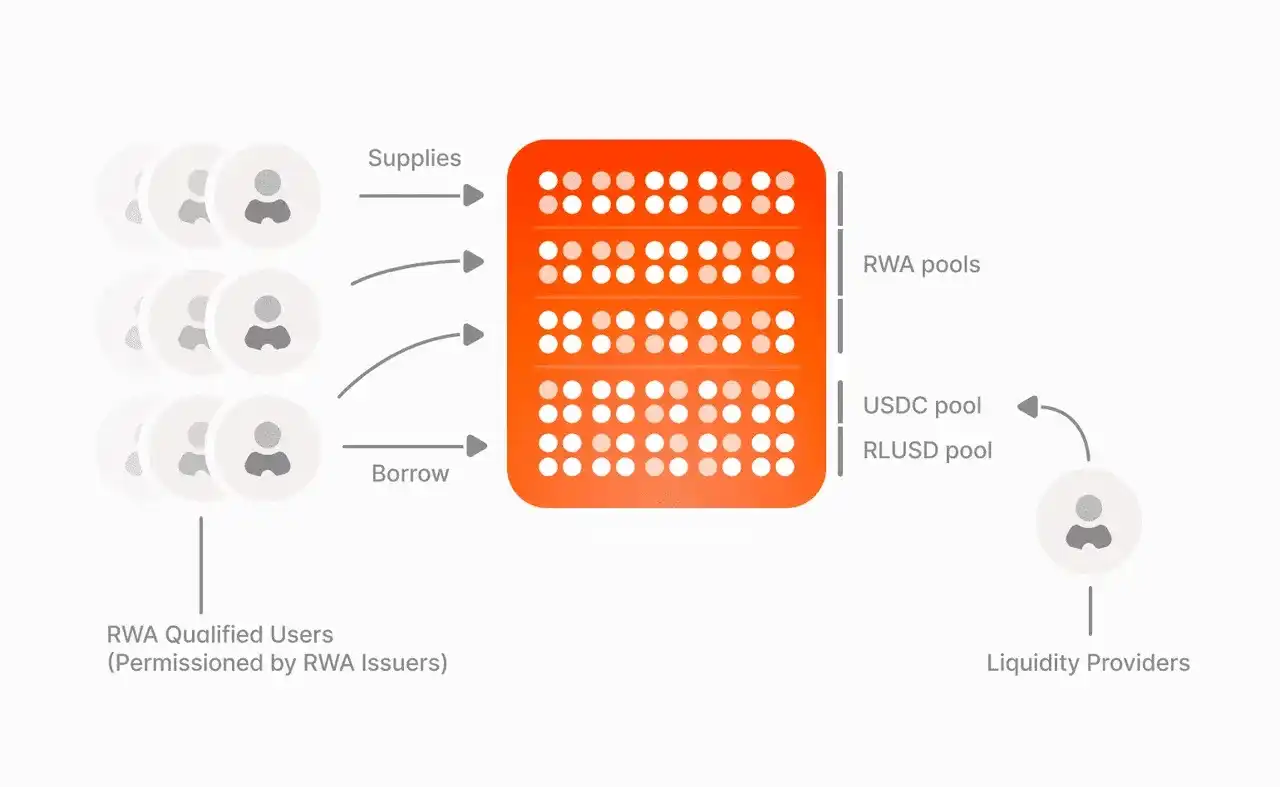
Source: BingX

More critically, while the market was halted and users couldn't withdraw, Aave's governance layer actually lowered the borrowing rates for the frozen Ethereum markets, aiming to protect borrowers who had leveraged rsETH. Since deposit rates are directly linked to borrowing rates, depositors with the lowest risk and principal security saw their deposit yields shrink further.

In traditional credit systems, lenders with the lowest risk enjoy priority in repayment. However, Aave completely inverted this rule. The reason is that borrowers engaged in rsETH leveraged trading are also the most active voting group in community governance. When risk erupts, high-risk participants holding governance power naturally prioritize protecting their own interests.

Aave launched an insurance mechanism called Umbrella in late 2025, attempting to address such bad debt risks. Users could stake Ethereum; if the protocol incurred bad debts, the staked assets would be used for compensation. However, after the Kelp DAO crisis erupted, 18,922 out of 23,507 staked aWETH positions entered an unstaking waiting period, with nearly 80% of the insurance pool's funds withdrawing collectively.

This mechanism ultimately failed completely. On-chain insurance relies on voluntary user participation, and capital providers inevitably choose to exit when real risk materializes—after all, their assets only face substantial loss when a crisis occurs. This leads to such insurance often existing during peaceful times but becoming ineffective precisely when protection is needed.

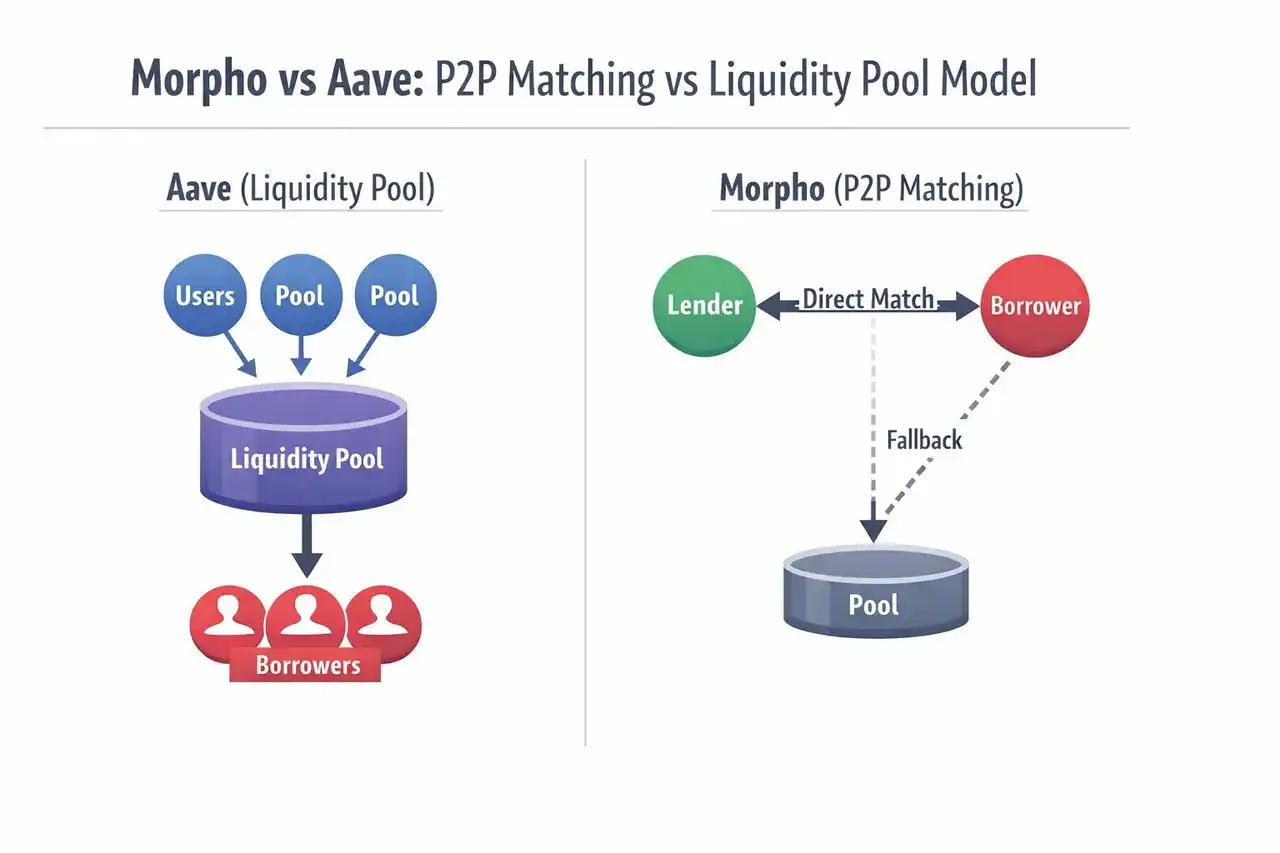
Morpho's operational model is entirely different. It abandons the unified shared liquidity pool. Anyone can create an independent, isolated lending market, pre-setting the loan asset, collateral asset, price oracle, and interest rate model. Once parameters are deployed, they cannot be modified. To adjust risk levels, one can only create a new market.
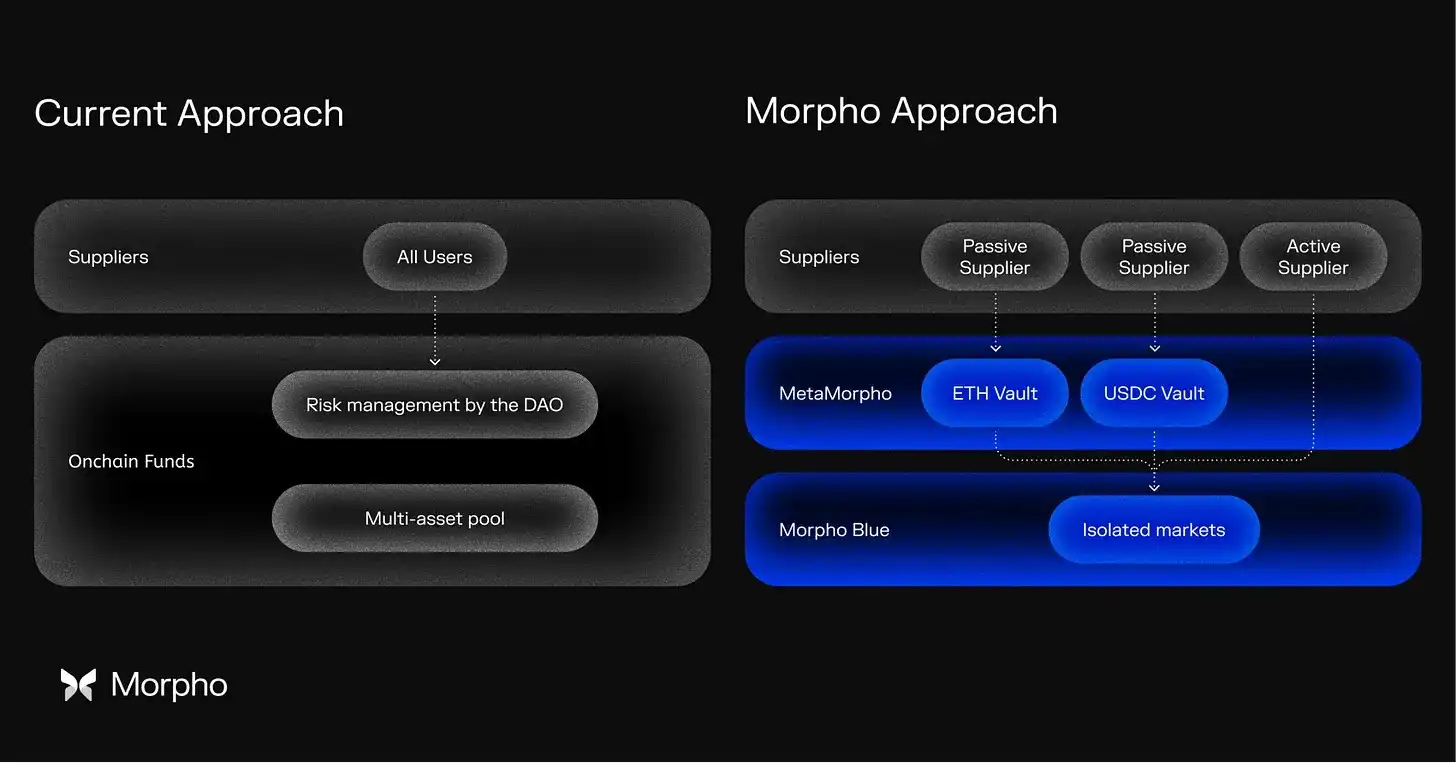
Differences in underlying architecture between the traditional DeFi lending model (represented by Aave) and Morpho's "Morphological" model.

Furthermore, Morpho introduces independent risk management institutions (Stewards), such as Gauntlet and Steakhouse Financial. These entities establish vaults, allocate funds to different markets based on their own analysis, and charge performance fees; if losses occur, they are confined within their own vaults. Gauntlet also provided risk advice for Aave, but in Aave's system, its professional opinions were often overruled by token holders seeking high yields through voting, a situation Morpho prevents at its root.

The Overlooked Hidden Cost

Aave and Morpho are currently the two most widely applied lending models in the crypto space: Aave uses the shared liquidity pool model where all deposits are aggregated, with risk rules set by community votes; Morpho advocates the isolated market model, where each lending pair is independent, with risks managed autonomously by professional institutions.

The Kelp DAO vulnerability exposed the flaws and weaknesses of the shared pool model. But even during stable periods without security incidents, this model harbors a long-overlooked hidden cost. Aave's three core markets on Ethereum (Ethereum, USDT, USDC) contribute 89% of the platform's lending volume. In these three markets, deposit rates are consistently 25% to 35% lower than borrowing rates. This spread essentially represents idle funds lying dormant in the liquidity pool; depositors cannot profit from them, yet borrowers still bear the full borrowing cost.

The interest rate mechanism adjusted based on utilization rates can push rates higher when risk increases but cannot activate idle funds when lending demand is low, leaving large amounts of assets stranded in the pool generating no yield. In these three markets alone, the annual value erosion due to idle funds amounts to approximately $52 million, close to a quarter of Aave's annualized revenue for one quarter. Even zeroing out the reserve ratio and canceling platform fees cannot solve the idle fund issue—it's an inherent shortcoming of the shared pool architecture.

Morpho's interest rate model aims to maintain a utilization rate of around 90%, significantly higher than Aave's 60% to 80% range. This model can sustain high utilization because deposits within the platform are not re-used as collateral for other loans, avoiding chain-liquidation risks at the source and thus eliminating the need to reserve large amounts of capital as a risk buffer. When lending demand is strong and funds are heavily borrowed, rates automatically increase, attracting more depositors; when lending demand is weak, rates decrease, stimulating borrowing. The entire system achieves dynamic balance without requiring community votes.
Source: Gate.com

Actual data confirms its advantage: even after deducting Steward fees, the yield offered to depositors by Morpho's top USDC vaults still exceeds that of Aave and Compound. Currently, Morpho's deposit-to-loan ratio is 41%, while Aave's is 39%, and the former's scale reaches tens of billions of dollars, meaning the yield advantage benefits all depositors on the platform day after day.

Institutional Choice: Which is More Trustworthy?

Surprisingly, all of Coinbase's crypto asset lending services are built on Morpho. The related loan scale has now surpassed $2 billion, and over 100 million platform users are indirectly enjoying the returns provided by Morpho.

Most users aren't even aware they are using DeFi services. Coinbase did not develop its own lending system nor choose another platform. The core reason is that Morpho's underlying architecture allows the platform to independently set risk parameters, select partner risk institutions, and maintain full control over the entire product experience.

Apollo Global Management, a global asset manager with over $1 trillion in assets under management and 30 years of experience in private credit, recently signed a four-year cooperation agreement, planning to acquire up to 90 million MORPHO tokens, accounting for 9% of the total token supply. The institution is connecting its tokenized fund assets to Morpho as collateral, with Gauntlet responsible for vault management and market stress testing.

Beyond that, Anchorage Digital, the first federally chartered native crypto bank in the US, has connected its institutional clients managing hundreds of billions to Morpho vaults; SG-FORGE, the compliant arm of French banking giant Société Générale, is the first licensed bank to implement DeFi lending business through Morpho.

These heavily regulated traditional financial institutions collectively chose Morpho, with a highly consistent core demand: the isolated market model allows them to meet their own compliance and risk control requirements without relying on DAO decisions. In contrast, all market rules in Aave inevitably involve community voting, completely incompatible with institutions' need for autonomous control.

Changes in the regulatory environment have further amplified this trend. The US "GENIUS Act" stipulates that stablecoin issuers cannot directly distribute investment returns, meaning stablecoin institutions require neutral underlying infrastructure to activate vast amounts of idle assets. US-related projections show that by 2028, the scale of stablecoin reserves invested in US Treasury bonds will surge from the current $120 billion to over $1 trillion. This massive pool of capital urgently needs a lending foundation that allows asset custodians to control their own risks, and Morpho is currently the most fitting choice.


Pertanyaan Terkait

QWhat was the root cause of the massive $15 billion deposit outflow from Aave following the Kelp DAO exploit?

AThe root cause was Aave's governance mechanism. Earlier, the community had voted to increase the loan-to-value (LTV) ratio for rsETH to 93%, leaving a very thin safety margin of 7%. When fake rsETH tokens were deposited as collateral, it quickly drained the shared liquidity pool, causing the massive withdrawal.

QWhat is the fundamental difference in the operational models between Aave and Morpho as described in the article?

AAave uses a shared liquidity pool model where all deposits are pooled together to back all approved assets, with rules set by DAO governance. Morpho uses an isolated market model, where each lending market is separate with its own parameters set at creation, managed independently by professional risk stewards.

QWhy did Aave's Umbrella insurance mechanism fail during the crisis, according to the article?

AThe mechanism failed because it relies on voluntary participation. When the crisis hit, nearly 80% of the staked insurance funds (aWETH) entered the unstaking period and were withdrawn. Participants were incentivized to leave to avoid losses, rendering the insurance pool ineffective when it was needed most.

QWhat 'hidden cost' does the shared pool model like Aave's incur during normal market conditions?

AA significant hidden cost is idle capital due to low capital efficiency. In Aave's top three markets, the spread between deposit and borrow rates (25-35%) represents idle funds that earn no yield for depositors but whose cost is still borne by borrowers, leading to an estimated annual value drain of $52 million.

QWhy are regulated traditional financial institutions like Coinbase and Apollo Global Management choosing Morpho over Aave for their DeFi lending operations?

AThey choose Morpho because its isolated market model allows them to set their own risk parameters and choose their risk stewards, giving them full control and compliance. This is essential for meeting regulatory requirements, unlike Aave's model where all market rules are subject to community DAO votes.

Bacaan Terkait

Proposal Pendanaan Yayasan Arbitrum Minta $16 Juta, 1.700 ETH, dan 230 Juta Token ARB

**Ringkasan Proposal Pendanaan Yayasan Arbitrum** Yayasan Arbitrum sedang mengajukan proposal pendanaan besar untuk satu tahun operasional berikutnya melalui proses tata kelola DAO. Proposal yang disebut "Pendanaan Lanjutan untuk Yayasan Arbitrum" ini meminta alokasi senilai $16 juta dalam aset dunia nyata (RWA), 1.700 ETH, dan 230 juta token ARB. Dana tersebut akan digunakan untuk mendukung berbagai fungsi inti yayasan, termasuk pengembangan teknologi, kemitraan, pendanaan ekosistem, serta biaya operasi untuk jaringan Arbitrum One dan Arbitrum Nova. Menariknya, proyeksi biaya menunjukkan bahwa 54% dari total pengeluaran yang diantisipasi pada tahun 2027 akan dialokasikan untuk biaya teknis, menggarisbawahi kompleksitas dan kebutuhan pengembangan berkelanjutan dari jaringan Layer 2. Pemungutan suara on-chain saat ini sedang berlangsung dan dijadwalkan ditutup pada 25 Juni 2026. Hasilnya akan menjadi indikator penting tentang bagaimana komunitas ARB menyeimbangkan kebutuhan pendanaan operasional pusat dengan prinsip desentralisasi dan akuntabilitas. Proposal ini memiliki implikasi langsung bagi pemegang token ARB, karena besarnya permintaan, terutama untuk 230 juta token ARB, dapat memengaruhi persepsi pasar dan tata kelola treasury. Keputusan ini akan membentuk kemampuan Yayasan Arbitrum untuk mendukung pertumbuhan dan daya saing ekosistemnya dalam lanskap penskalaan Ethereum yang kompetitif.

bitcoinist1j yang lalu

Proposal Pendanaan Yayasan Arbitrum Minta $16 Juta, 1.700 ETH, dan 230 Juta Token ARB

bitcoinist1j yang lalu

TRM Memperingatkan Penipu Kripto Tengah Menyebar Perangkap Tiket dan Taruhan Piala Dunia 2026

TL;DR: Menurut TRM Labs, penipu kripto sudah mulai menyiapkan skema penjualan tiket palsu, taruhan, dan meme coin terkait Piala Dunia 2026. Lembaga analisis blockchain TRM Labs telah memperingatkan kemunculan awal penipuan kripto yang menargetkan penggemar sepak bola menjelang Piala Dunia 2026. Dalam laporan 11 Juni, TRM mengidentifikasi empat alamat dompet digital yang terhubung ke tiga operasi penipuan aktif. Meskipun jumlah uang yang berhasil dikumpulkan masih relatif kecil (sekitar $1.700), aktivitas ini dinilai sebagai infrastruktur awal yang perlu diwaspadai. Jenis penipuan yang terdeteksi meliputi: 1. **Portal Tiket Palsu:** Halaman checkout tiruan yang mengalihkan pembayaran ke alamat kripto penipu. Salah satu alamat di jaringan Polygon dilaporkan menerima $1.562. 2. **Skema Taruhan Pertandingan "Dijamin" Menang:** Janji informasi dalam atau hasil yang sudah diatur dengan imbalan pembayaran kripto di muka. 3. **Token Komemoratif Spekulatif:** Token seperti $WORLDCUP yang tidak berafiliasi resmi dengan FIFA dan berisiko tinggi terhadap skema "pump-and-dump". Penipu diduga menggunakan taktik familiar seperti alur pembayaran palsu, akun pertukaran, dan pertukaran antar-rantai (cross-chain swaps) untuk mengaburkan jejak. TRM menekankan bahwa peringatan ini bersifat pencegahan dini. Masyarakat diimbau untuk lebih berhati-hati terhadap permintaan pembayaran kripto untuk tiket, tip taruhan, atau token penggemar tidak resmi seiring dengan meningkatnya hype menjelang turnamen.

bitcoinist3j yang lalu

TRM Memperingatkan Penipu Kripto Tengah Menyebar Perangkap Tiket dan Taruhan Piala Dunia 2026

bitcoinist3j yang lalu

Liquidasi Bitcoin yang Mengguncang Pasar, Trader Memperhatikan Resistance $66K dan Support $61K

**Ringkasan:** Bitcoin (BTC) mengalami volatilitas tinggi, bergerak dari kisaran $64.100 turun ke sekitar $60.700 sebelum naik kembali di atas $63.000 dalam waktu kurang dari 24 jam. Pergerakan dua arah yang tajam ini memicu *liquidasi* leverage besar-besaran di pasar crypto, dengan total sekitar $980 juta untuk posisi long dan short. Peta likuiditas dari Coinglass (melalui CryptoReviewing) menunjukkan dua area konsentrasi utama: **zona atas di $63.500-$66.000** dan **zona bawah di $58.500-$61.000**. Level-level ini bisa menjadi magnet pergerakan harga karena liquidasi paksa cenderung memperkuat tren yang sedang berlangsung. Analisis teknikal dari Trade Nation menetapkan **$66.247 sebagai titik pivot resistensi kunci**. Level support diidentifikasi di **$59.150, $56.900, dan $54.920**. Sementara itu, analis virDeStatera berfokus pada kerangka waktu lebih pendek, menyoroti level **$64.234 sebagai "swept high"** yang perlu diklaim kembali untuk membuka jalan menuju resistensi berikut di **$65.890**. Support intraday terdekat ada di kisaran **$63.127 - $63.354**. **Kesimpulan untuk Trader:** Pasar saat ini terjebak dalam koridor volatilitas antara dua kantong likuiditas setelah reset leverage besar. Sinyal satu arah belum jelas. **Bulls** perlu mendorong harga untuk mengklaim kembali $64.234 dan menuju $65.890-$66.247. **Bears** akan mengincar penurunan di bawah support $63.000-an untuk menuju zona support lebih luas di $59.150-$61.000. Manajemen risiko menjadi sangat krusial mengingat likuiditas yang tinggi dan potensi pergerakan harga yang cepat.

bitcoinist4j yang lalu

Liquidasi Bitcoin yang Mengguncang Pasar, Trader Memperhatikan Resistance $66K dan Support $61K

bitcoinist4j yang lalu

Trading

Spot
Futures

Artikel Populer

Cara Membeli DAO

Selamat datang di HTX.com! Kami telah membuat pembelian DAO Maker (DAO) menjadi mudah dan nyaman. Ikuti panduan langkah demi langkah kami untuk memulai perjalanan kripto Anda.Langkah 1: Buat Akun HTX AndaGunakan alamat email atau nomor ponsel Anda untuk mendaftar akun gratis di HTX. Rasakan perjalanan pendaftaran yang mudah dan buka semua fitur.Dapatkan Akun SayaLangkah 2: Buka Beli Kripto, lalu Pilih Metode Pembayaran AndaKartu Kredit/Debit: Gunakan Visa atau Mastercard Anda untuk membeli DAO Maker (DAO) secara instan.Saldo: Gunakan dana dari saldo akun HTX Anda untuk melakukan trading dengan lancar.Pihak Ketiga: Kami telah menambahkan metode pembayaran populer seperti Google Pay dan Apple Pay untuk meningkatkan kenyamanan.P2P: Lakukan trading langsung dengan pengguna lain di HTX.Over-the-Counter (OTC): Kami menawarkan layanan yang dibuat khusus dan kurs yang kompetitif bagi para trader.Langkah 3: Simpan DAO Maker (DAO) AndaSetelah melakukan pembelian, simpan DAO Maker (DAO) di akun HTX Anda. Selain itu, Anda dapat mengirimkannya ke tempat lain melalui transfer blockchain atau menggunakannya untuk memperdagangkan mata uang kripto lainnya.Langkah 4: Lakukan trading DAO Maker (DAO)Lakukan trading DAO Maker (DAO) dengan mudah di pasar spot HTX. Cukup akses akun Anda, pilih pasangan perdagangan, jalankan trading, lalu pantau secara real-time. Kami menawarkan pengalaman yang ramah pengguna baik untuk pemula maupun trader berpengalaman.

245 Total TayanganDipublikasikan pada 2024.12.11Diperbarui pada 2026.06.02

Cara Membeli DAO

Diskusi

Selamat datang di Komunitas HTX. Di sini, Anda bisa terus mendapatkan informasi terbaru tentang perkembangan platform terkini dan mendapatkan akses ke wawasan pasar profesional. Pendapat pengguna mengenai harga DAO (DAO) disajikan di bawah ini.

活动图片