Anthropic Refuses Access to China's Think Tank for Most Powerful AI Model Mythos, Intensifying US-China AI Competition

marsbitDipublikasikan tanggal 2026-05-13Terakhir diperbarui pada 2026-05-13

Abstrak

Anthropic rejects Chinese think tank request for access to its most advanced AI model, Claude Mythos, escalating US-China AI competition. The request was made informally at a Carnegie Endowment meeting in Singapore, prompting concern within the U.S. National Security Council. Mythos, released in April 2026 under the "Project Glasswing" initiative, is described as "digital weapon-grade" technology for its unprecedented ability to discover zero-day vulnerabilities. Access is limited to about 40 US and UK entities in cybersecurity, finance, and tech, with China explicitly excluded as an "adversarial nation." While the official Chinese response has been muted, the incident highlights China's exclusion from cutting-edge AI defense tools despite its critical infrastructure running on software Mythos can analyze. The Chinese cybersecurity market anticipates massive growth and domestic model development, but a significant capability gap remains. The event coincides with internal Trump administration debates on pre-release AI model security assessments and an upcoming presidential visit to China, where AI dialogue is expected. Analysts caution that past US-China AI safety talks have seen China more focused on information gathering than substantive collaboration.

Author: Claude, Deep Tide TechFlow

Deep Tide Intro: According to a May 12 report by *The New York Times*, at a closed-door meeting organized by the Carnegie Endowment for International Peace in Singapore last month, a representative from a Chinese think tank requested that Anthropic grant access to the Claude Mythos model. The request was refused on the spot.

The incident subsequently reached the White House, triggering high alert within the U.S. National Security Council.

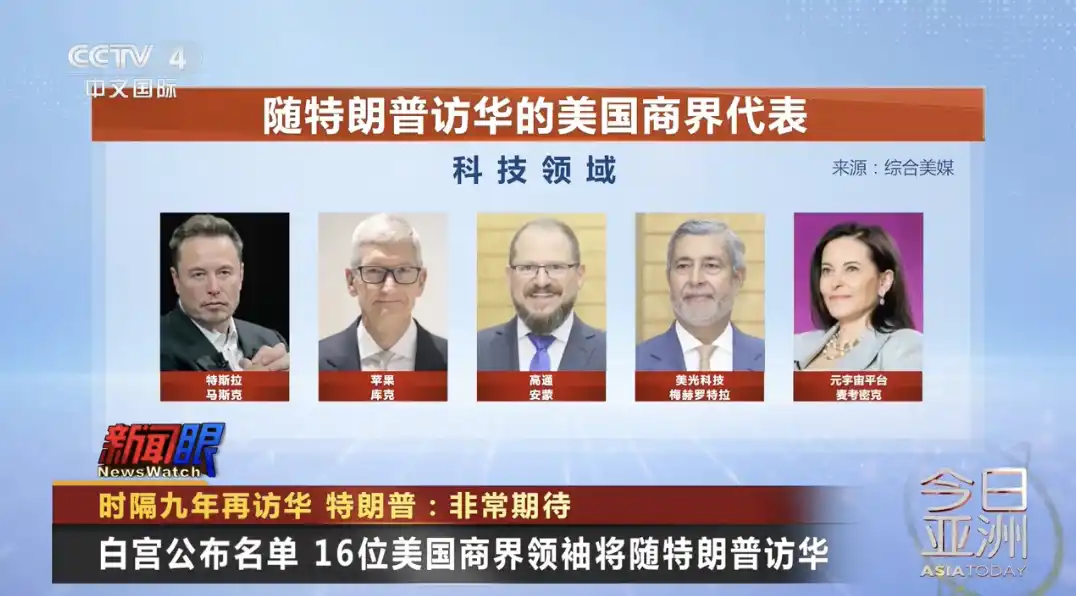
Mythos is the most powerful AI model released by Anthropic in April this year. Its offensive and defensive capabilities in the cybersecurity field are seen as "digital weapon-grade" technology. It is currently accessible to only about 40 U.S. and U.K. institutions. This event occurred as the Trump administration is brewing an executive order on AI regulation. He will also lead a business delegation to China this week to discuss AI-related issues.
A closed-door conversation in Singapore is becoming the latest flashpoint in the US-China AI competition.

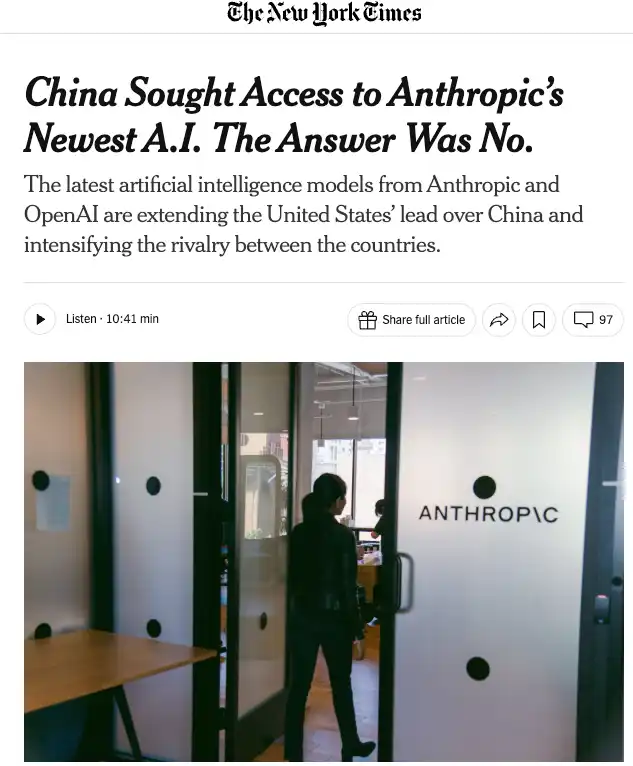
According to *The New York Times* on May 12, at a non-public meeting organized by the Carnegie Endowment for International Peace in Singapore last month, a Chinese think tank representative approached Anthropic officials during a break and made a request: hoping the company would relax its policy to allow Chinese access to its newest and most powerful AI model, Claude Mythos.

Anthropic refused on the spot.

This was not a formal diplomatic request from the Chinese government. However, according to reports from multiple media outlets, the incident triggered high alert from officials in the Trump administration's National Security Council (NSC) upon reaching Washington, seen as another signal of China's continued pressure in the AI field.

Mythos: A 'Digital Weapon' with Capabilities Far Surpassing Predecessors, Restrictively Released

To understand the weight of this event, one must look at Mythos itself.

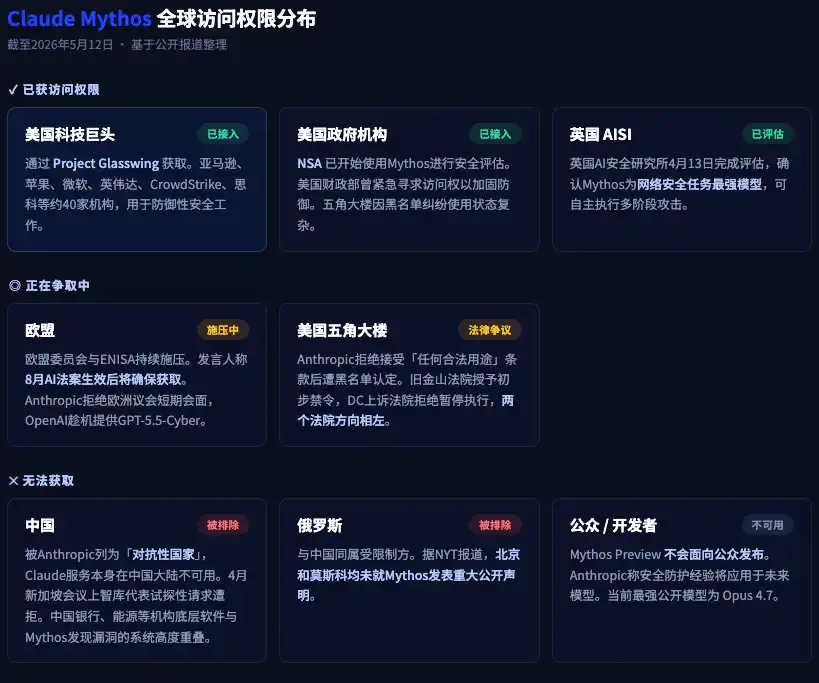
Claude Mythos Preview was officially released on April 7, 2026, but not to the public. Anthropic limited its access within a framework called the "Project Glasswing" cybersecurity defense initiative, granting access to only about 40 institutions. Partners include Amazon, Apple, Microsoft, CrowdStrike, Cisco, Nvidia, JPMorgan Chase, and the Linux Foundation.

According to Anthropic's official blog and a TechCrunch report on April 7, during internal testing, Mythos autonomously discovered thousands of zero-day vulnerabilities (i.e., security flaws previously unknown to developers), covering all major operating systems and mainstream browsers. Some vulnerabilities had existed for up to 27 years. In cybersecurity evaluations like CyberGym, Mythos's performance significantly surpassed the previous-generation model Claude Opus 4.6. Its validation score on SWE-bench reached 93.9%, compared to Opus 4.6's 80.8%.

China Excluded, Labeled an 'Adversarial Nation'

Anthropic lists China as an "adversarial nation." Its services are generally unavailable in mainland China, and the restricted release of Mythos explicitly excludes Chinese institutions.

According to a three-part series in *South China Morning Post* from late April to early May, China's reaction to the Mythos incident presents a complex picture. The official level has been relatively restrained, with no major public statements or strong responses. Some within China's AI community even questioned whether Anthropic was using security risks as a marketing gimmick to restrict model access to U.S. companies.
However, reactions within the cybersecurity industry have been starkly different. After the release of Mythos, stock prices of Chinese cybersecurity listed companies like Qi An Xin Group, Sangfor Technologies, and 360 Security Technology rose for several consecutive days, as markets anticipated accelerated demand for AI-driven cybersecurity.

IDC China Senior Research Manager Austin Zhao, in an interview with *SCMP*, stated that a Chinese model at the Mythos level "will definitely appear," but currently, the overall capabilities of domestic cybersecurity models are "still far from Mythos." However, the capabilities of Chinese models are also improving rapidly, a trend deemed irreversible. IDC predicts the scale of China's AI cybersecurity industry will grow from 1.58 billion yuan in 2025 to 59.35 billion yuan (approx. $8.7 billion) in 2030, an increase of over 37 times.

The practical dilemma is that the underlying software running in many Chinese banks, energy companies, and government agencies overlaps heavily with the systems where Mythos discovered vulnerabilities. But currently, China has no seat at this defense-upgraded table.

White House Alert and Policy Game: Executive Order Brewing, Trump Visiting China This Week

The alert triggered by the Singapore closed-door meeting adds to a series of larger policy games.

According to a May 11 report by *The Washington Post*, sharp disagreements have emerged within the Trump administration regarding AI regulation. On one hand, national security officials (including the NSA and the Office of the Director of National Intelligence) are pushing for security assessments of AI models by intelligence agencies before public release. On the other hand, the Commerce Department system prefers to keep the assessment authority within its own jurisdiction. White House National Economic Council Director Kevin Hassett revealed in a Fox Business interview last week that the government is studying the issuance of an executive order to provide a clear roadmap for the safety assessment process of AI models, similar to the FDA's pre-market review mechanism for drugs.

Simultaneously, Trump is scheduled to visit China this week, with AI-related issues expected to be on the agenda.

According to an Axios report on May 12, U.S. officials expressed hope to "use the leaders' meeting to open a dialogue, to see if a communication channel for AI affairs should be established." However, Melanie Hart, Senior Director of the Global China Hub at the Atlantic Council, cautioned that during the Biden administration, China mainly "collected U.S. information, rather than seriously discussing AI safeguards" in AI safety dialogues, and those attending the talks were often Foreign Ministry officials lacking AI technical expertise.
Pertanyaan Terkait

QWhat is Claude Mythos and why is it considered a significant model by Anthropic?

AClaude Mythos is Anthropic's latest and most powerful AI model, released in April 2026. It is considered significant due to its exceptional capabilities in the cybersecurity field, where it has demonstrated the ability to autonomously discover thousands of previously unknown zero-day vulnerabilities across major operating systems and browsers. Its performance in cybersecurity benchmarks far surpasses previous models like Claude Opus 4.6. Because of this advanced defensive (and potentially offensive) capability, it is sometimes referred to as 'digital weapon-grade' technology.

QWhat was the specific request made by the Chinese think tank representative at the Singapore meeting, and what was the response?

AAt a closed-door meeting organized by the Carnegie Endowment for International Peace in Singapore, a representative from a Chinese think tank asked Anthropic officials to grant Chinese access to its Claude Mythos AI model. Anthropic officials rejected the request on the spot.

QHow did the US government react to the news of the request and its rejection?

AThe news of the request and its rejection was relayed to Washington, where it triggered a high level of alert within the US National Security Council (NSC) under the Trump administration. US officials viewed the incident as another signal of China's continued pressure in the AI domain.

QWhat is Project Glasswing and which entities have access to Mythos?

AProject Glasswing is a cybersecurity defense initiative framework within which Anthropic has released the Claude Mythos Preview. Access to the model is highly restricted, granted only to approximately 40 US and UK-based institutions. These partners include major technology and financial companies such as Amazon, Apple, Microsoft, CrowdStrike, Cisco, Nvidia, JPMorgan Chase, and the Linux Foundation.

QWhat is the broader context of US-China AI competition mentioned in the article, particularly regarding upcoming diplomatic and policy events?

AThe incident occurs against a backdrop of escalating US-China AI competition and policy formulation. Domestically, the Trump administration is reportedly drafting an executive order to establish an AI regulatory framework, including potential pre-release security reviews akin to FDA drug approvals. Internationally, President Trump is scheduled to visit China this week, where AI-related issues are expected to be on the agenda. US officials hope to establish communication channels on AI matters, though past experiences suggest such dialogues have been challenging.

Bacaan Terkait

Lima Bentuk Inti AI Agent Menurut Pandangan YC

Penyunting: AI Agent telah berkembang dari prompt sekali pakai ke dalam alur kerja yang lebih kompleks. Pertanyaan penting sekarang bukanlah "apakah model bisa menyelesaikan tugas?", tetapi "bisakah kemampuan AI dijadikan aset proses yang dapat digunakan ulang dan terakumulasi?". Berikut adalah lima bentuk inti yang muncul: 1. **Skills:** Bukan SOP kaku, melainkan lebih seperti "pemanggilan metode". Satu alur kerja (Skill) yang sama dapat digunakan untuk banyak kasus dengan mengganti parameternya (misal, target, pertanyaan, dataset). 2. **Thin Harness:** Kerangka kerja eksekusi ringan (~200 baris kode) yang menjadi "tangan dan kaki" bagi model. Fungsinya menjalankan loop, membaca/menulis file, dan mengelola konteks. 3. **Resolvers:** Tabel perutean yang memetakan jenis tugas ke Skill spesifik. Ini mencegah "korupsi konteks" saat jumlah Skill sangat banyak, sehingga memastikan panggilan yang tepat. 4. **Latent vs. Deterministic:** Pisahkan tugas. Serahkan penilaian, sintesis, dan pemahaman kontekstual ke LLM. Gunakan kode deterministik (yang dapat ditulis model) untuk hal-hal yang memerlukan kepastian dan konsistensi, seperti perhitungan. 5. **Memory:** Lapisan memori untuk akumulasi pengetahuan jangka panjang. Contoh: folder markdown dengan satu halaman per entitas (orang/perusahaan/konsep), berisi kesimpulan terkini dan garis waktu yang terus bertambah. Kombinasi ini membentuk **"kemampuan proses" (process power)** – keunggulan kompetitif yang berkelanjutan di era AI. Ini mengubah pengalaman menjadi alur kerja yang terdokumentasi, tugas menjadi parameter, aturan stabil menjadi kode, dan pembelajaran menjadi memori yang terakumulasi. Sistem semacam ini, meski tampak sederhana (seperti folder markdown), sulit ditiru karena dibangun melalui iterasi dan disiplin yang terus-menerus, berbeda dengan aplikasi hasil "vibe coding" yang harga ekuilibrinya akan turun hingga ke biaya token.

marsbit11m yang lalu

Lima Bentuk Inti AI Agent Menurut Pandangan YC

marsbit11m yang lalu

Tiger Research: Operator Risiko On-Chain, Kesenjangan Pasar antara 147 Triliun dan 70 Miliar

Laporan oleh Tiger Research ini membahas pergeseran kekuasaan dalam sektor pinjaman keuangan terdesentralisasi (DeFi) dari protokol ke "risk operators" atau operator risiko profesional yang mengendalikan keputusan manajemen risiko. **Poin Utama:** * Era dominasi penuh oleh protokol dan komunitas di DeFi telah berakhir, digantikan oleh peran manajer aset baru. * Industri masih muda, tetapi modal dan sumber daya sudah terkonsentrasi di tim operator risiko teratas, dengan rekam jejak praktis menjadi tolok ukur utama. * Ada tiga jalur utama untuk memasuki industri: **distribusi saluran** (menggunakan tim operator sebagai pendukung backend), **penyediaan aset** (membawa aset dunia nyata ke blockchain), dan **operasi mandiri** (membangun tim operator risiko sendiri). * Pilihan jalur menentukan tingkat kendali, kemampuan inti yang dibutuhkan, dan risiko yang dihadapi. * Keputusan kritis bukanlah *apakah* masuk ke DeFi, tetapi *bagaimana* membagi tanggung jawab dan kewenangan manajemen risiko antara pihak eksternal dan internal. **Perkembangan & Kondisi Industri:** Protokol pinjaman awal seperti Aave dan Compound menyatukan infrastruktur dan standar risiko. Kemunculan Morpho dengan arsitektur vault modular memisahkan infrastruktur dan otoritas risiko, mengubah "operator risiko" dari pengelola parameter global menjadi pengelola aset mandiri yang mengoperasikan vault pinjaman khusus. Pada Mei 2026, total aset yang dikelola (TVL) sektor operator risiko mencapai $70 miliar, dengan tiga tim teratas (Steakhouse, Sentora, Gauntlet) menguasai 70% pasar. Persaingan kini berfokus pada standar penerimaan agunan, saluran distribusi modal, dan kemampuan penanganan risiko. **Struktur yang Menyerupai Manajemen Aset Tradisional:** DeFi kini mereplikasi alur kerja manajemen aset tradisional: 1. **Lapisan Distribusi/Perolehan Modal:** Pertukaran terpusat (CEX) dan platform sebagai saluran masuk modal. 2. **Lapisan Strategi & Manajemen Risiko:** Operator risiko DeFi berfungsi seperti manajer portofolio dan komite risiko. 3. **Lapisan Produk & Kustodian:** Vault sebagai produk investasi dan protokol pinjaman sebagai infrastruktur penyelesaian. **Peluang dan Pilihan bagi Lembaga:** Bagi lembaga tradisional, lapisan strategi/manajemen risiko adalah titik masuk terbaik karena memanfaatkan keahlian inti mereka dalam penilaian risiko tanpa memerlukan pengembangan teknologi blockchain yang mendalam. **Kesenjangan Besar dan Masa Depan:** Industri manajemen aset tradisional bernilai $147 triliun, sementara total TVL DeFi hanya $800 miliar, dan sektor operator risikonya hanya $70 miliar. Kesenjangan besar ini menunjukkan potensi pertumbuhan yang masif. Begitu kerangka risiko dan regulasi matang, aliran modal kecil dari pasar tradisional dapat mendorong pertumbuhan eksponensial di DeFi. Tim yang membangun fondasi dan aturan industri awal akan memiliki keunggulan dan kekuatan penetapan standar yang signifikan.

marsbit17m yang lalu

Tiger Research: Operator Risiko On-Chain, Kesenjangan Pasar antara 147 Triliun dan 70 Miliar

marsbit17m yang lalu

Memulihkan Aset Kripto, Bisnis yang Menguntungkan dan Jarang Diketahui

**Pemulihan Aset Kripto: Bisnis Nyata yang Jarang Disorot** Artikel ini membahas bisnis pemulihan aset kripto yang tumbuh seiring dengan peningkatan pengguna. Alih-alih kasus peretasan spektakuler, kebanyakan masalah berasal dari kesalahan operasional sehari-hari seperti: * Salah memilih jaringan saat deposit ke bursa. * Lupa mengisi memo/tag. * Gangguan fisik pada dompet atau aplikasi. * Kesalahan dalam mencatat *recovery phrase* (seed phrase). * Masalah dengan akun di bursa terpusat (bekukan, verifikasi, dll.). Dunia aset kripto yang desentralisasi memberikan kendali penuh kepada pengguna, namun juga membebankan tanggung jawab operasional yang sebelumnya ditangani platform. Saat semakin banyak orang non-teknis masuk, kesalahan tak terhindarkan. Bisnis pemulihan muncul sebagai jembatan antara sistem yang kompleks dan kebutuhan pengguna. Meski terdengar sederhana, bisnis ini memiliki risiko. Banyak pihak nakal menawarkan janji "pemulihan 100%" atau malah melakukan penipuan berulang. Tim profesional justru akan menjelaskan kemungkinan dan batasan, karena keberhasilan tergantung pada jenis masalahnya (misalnya, apakah dana dikirim ke alamat yang dikendalikan bursa, atau jenis kesalahan pada *recovery phrase*). Artikel ini menekankan bahwa pemulihan aset kripto berkembang menjadi pasar yang membutuhkan keahlian khusus, termasuk analisis rantai (*blockchain*), komunikasi dengan bursa, dan pemahaman hukum. Penulis menyatakan telah bermitra dengan tim profesional di bidang ini untuk membantu menilai masalah dan mencari solusi yang mungkin, tanpa menjamin keberhasilan mutlak.

marsbit1j yang lalu

Memulihkan Aset Kripto, Bisnis yang Menguntungkan dan Jarang Diketahui

marsbit1j yang lalu

Trading

Spot
Futures
活动图片