From the Wild Path to the Table: Why Compliance is the Inevitable Route

比推Dipublikasikan tanggal 2026-02-09Terakhir diperbarui pada 2026-02-09

Abstrak

The article "From the Fringes to the Main Table: Why Compliance is the Inevitable Path" discusses the critical shift toward regulatory compliance in the cryptocurrency and blockchain industry, using key players like Binance, Coinbase, and Hyperliquid as case studies. It highlights how Binance leveraged regulatory arbitrage to become a global leader by 2017 but faced increasing pressure from regulators, leading to its compliance efforts in jurisdictions like Abu Dhabi (ADGM) by 2025. Meanwhile, Coinbase capitalized on U.S. regulatory frameworks under evolving policies, though its growth in derivatives markets remained limited. Hyperliquid emerged as a significant player by exploiting gaps left by larger exchanges, capturing about 15% of Binance's market share through derivatives and ventures into non-traditional areas like precious metals and prediction markets—yet its long-term sustainability hinges on eventual compliance. The piece argues that compliance is no longer optional but essential for scalability and legitimacy, especially as Real-World Assets (RWA)—such as tokenized stocks, bonds, and stablecoins—gain traction. Regulatory clarity, particularly from the U.S. and China, is reshaping the landscape, forcing once-"underground" economies to formalize or risk exclusion from major markets. The conclusion underscores that while regulatory arbitrage offers short-term advantages, the future of crypto and DeFi depends on integrating into established financial systems und...

Written by: Zuo Ye

Original Title: Compliance is the Coming-of-Age Ceremony for the Underground Economy


In 2017, Binance rapidly became the world's number one through regulatory arbitrage, but in 2025, the more liberal Hyperliquid could only capture 15% of Binance's market share. Does RWA, as a source of underlying assets for DeFi, have the space for regulatory arbitrage and a scalable future?

Compliance has become the main theme of 2026. The offshore exchange Binance officially went onshore in the UAE's ADGM, Coinbase scored two major wins with the Talent Act and the Clarity Act, and even the Eastern power has "in principle" tested the waters of RWA regulation.

We are at a clear inflection point. Blockchain will not replace the internet, Web3 is just a self-righteous scam, the listing effect ended with Binance's purchase of Bitcoin. However, Hyperliquid is making strides in precious metals and prediction markets, while the tokenization of RWA—represented by currencies (stablecoins), stocks (U.S. stocks), bonds (U.S. bonds, subprime bonds), and funds (hedge, active)—is happening now.

Against this backdrop, compliance has evolved beyond the symbolic role of "holding a small country's license to arbitrage a large country's regulations" into a real framework separating trading, clearing, and custody. When the industry breaks through scale limitations, regulatory benefits will become profitable.

In the quiet moments, compliance not only signifies the end of the last era of reckless expansion, but also, amidst the rumbling thunder, there will always be tracks with arbitrage space for development in exchange for scale.

Let's start with exchanges to glimpse the economic considerations beyond compliance.

Civilized Wall Street, Crazy Barbarians

Barbarian conquerors are, by an eternal law of history, themselves conquered by the superior civilization of their subjects.

In 2022, FTX collapsed dramatically. Wall Street once harbored ambitions to dominate the exchange赛道. Citadel Securities, Fidelity, and Charles Schwab collaborated to launch EDX Markets in Singapore, operating under the Singapore MAS compliance framework based on the principle of separating trading and custody.

With Gary Gensler's SEC relentlessly pursuing Binance, Coinbase and Kraken were confined to the U.S. spot market,迟迟 unable to venture into高端 markets like futures and options. At that time, the market also had high hopes for EDX Markets.

If nothing unexpected happened, we should have witnessed Binance's fall, similar to BitMEX after the March 12, 2020 crash. But history never repeats itself. Hyperliquid was the real winner. The weakened Binance and the still U.S.-confined Coinbase were surprisingly not the protagonists of the next act.

To understand the winner's experience, one must first understand the loser's lessons.

After its establishment in 2017, Binance did at least two things right:

  • While actively embracing going overseas, it continued to accept users from mainland China, creating a seesaw effect between trading volume刷量 and user scale;

  • In 2019, it launched IEO (Initial Exchange Offering), creating real wealth effects before DeFi Summer.

After the September 4 ban, providing trading services to users in mainland China entered a "gray area." The third regulation directly targeted trading platforms, requiring them not to provide services like quotation, matching, and clearing. If we refer to He Yi's response to Cathie Wood, Binance would respond by "not providing services to users in mainland China."

From 2017 to 2019, Binance secured its position as the world's number one offshore exchange. From 2020 to 2022, Binance filled the futures market gap left by BitMEX. From 2022 to 2024, Binance dominated the global altcoin market, where the listing effect was equivalent to the "listed on Binance" effect.

Entering 2025, Binance officially came under the compliance framework of Abu Dhabi's ADGM in the UAE, dividing itself into three entities: trading, clearing, and over-the-counter, but this still retained Binance's characteristic arbitrage.

Especially since compliance did not stop Binance's listing team from adding Meme coins. Secondly, ADGM and the entire UAE financial system simply lack the capacity to regulate a behemoth like Binance. One can refer to the Bahamas' helplessness regarding FTX's global站.
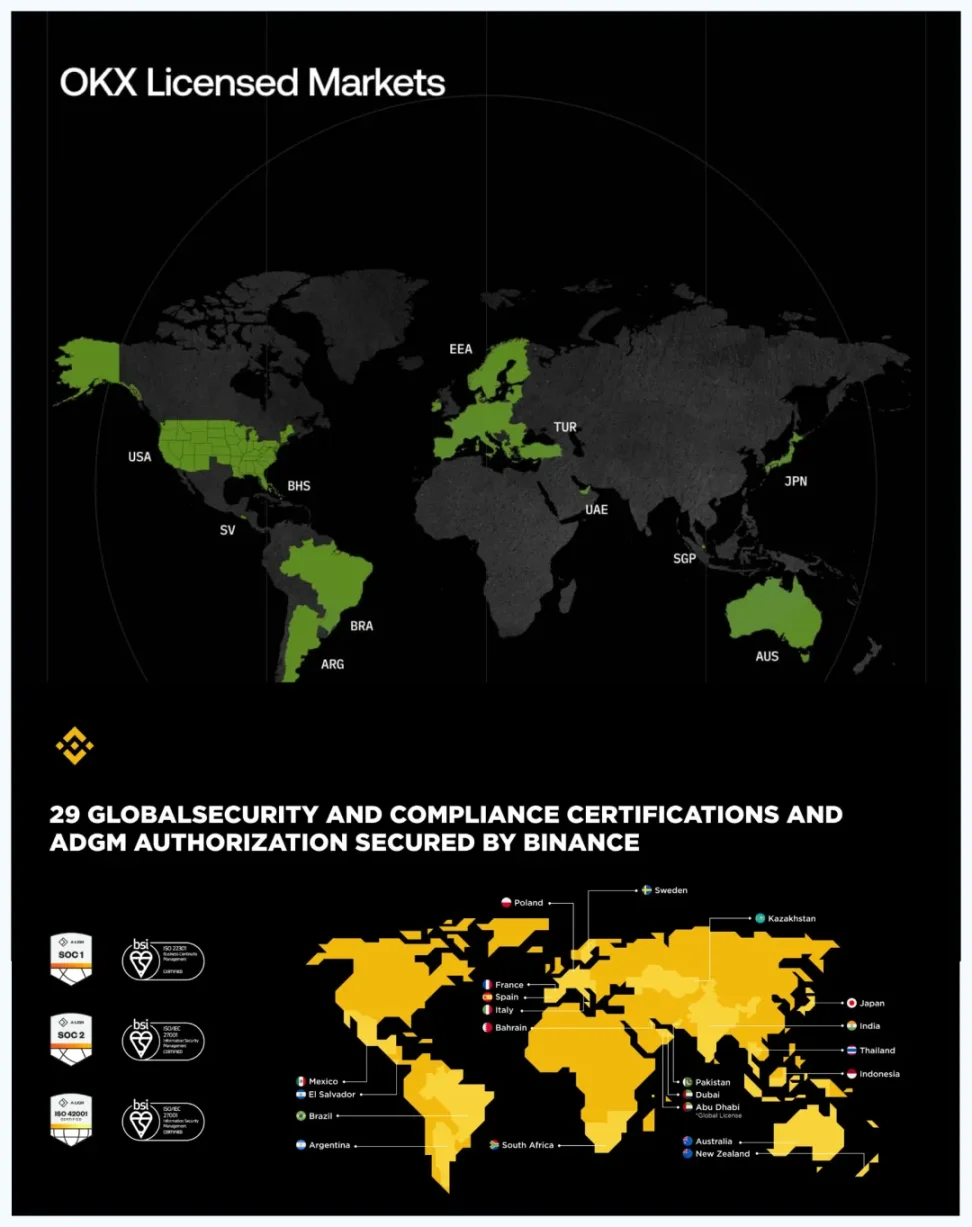
Image Caption: "Passing the Civil Service Exam" to go ashore, Image Source: @binance @okx

Coinbase was the most compliant after FTX's collapse, but this compliance stemmed from Trump's post-election restructuring of the SEC, CFTC, and OCC, demanding they adopt more crypto-friendly regulatory measures.

Roughly, the SEC is responsible for reviewing whether a token meets the definition of a security, the CFTC oversees derivatives trading, and the OCC manages banking licenses for custody services. The U.S. does not have a license类似 ADGM's "crypto exchange license"; it only has regulatory scopes divided by business type.
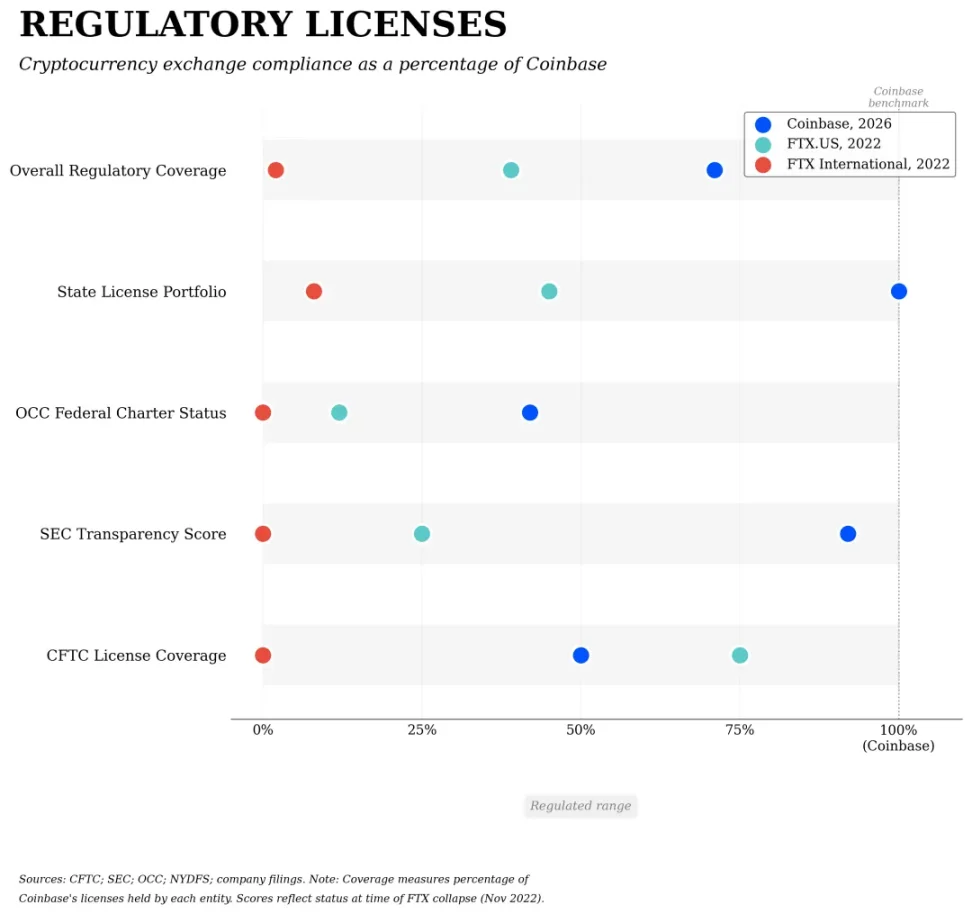
Image Caption: Regulatory Progress, Image Source: @zuoyeweb3

The construction of this regulatory framework is still ongoing, but it's certain that Coinbase will shape the U.S. compliance framework, covering listing (spot, futures), trading (spot, futures), custody (retail, institutional), clearing/settlement (fiat, crypto), audit (technical, asset)/insurance (fiat, crypto) aspects.

Binance's licensing under ADGM and Coinbase's licensing in the U.S. are completely different concepts. The latter's licensing will actually fall under the management of regulatory agencies.

Regulation is about clarifying rules, not protecting retail interests. For example, institutional clients enjoy bankruptcy isolation protection in Coinbase's custody business, corresponding to the entity Coinbase Custody Trust Company.

However, funds deposited by ordinary retail users into Coinbase correspond to the entity Coinbase Inc. If it's fiat currency, it might be protected by the corresponding bank's FDIC deposit insurance, but crypto assets could very well meet the same fate as FTX.

For instance, purchasers of the FTX token FTT were deemed equity owners and were not strictly protected in claims. Coinbase is similar. The only good news is that Coinbase has not faced a run on its funds.

Hyperliquid Enters the RWA Field "Unlicensed"

Human progress will no longer be like the terrible pagan idol, who would not drink the nectar but from the skulls of the slain.

Regulatory arbitrage still exists. In the crypto asset trading field, EDX's American compatriot Hyperliquid also started in Singapore and is蚕食 (eroding) Binance's global market and Coinbase's U.S. market.

This can be called "second-order arbitrage": Binance arbitrages global regulations, Hyperliquid arbitrages Binance.
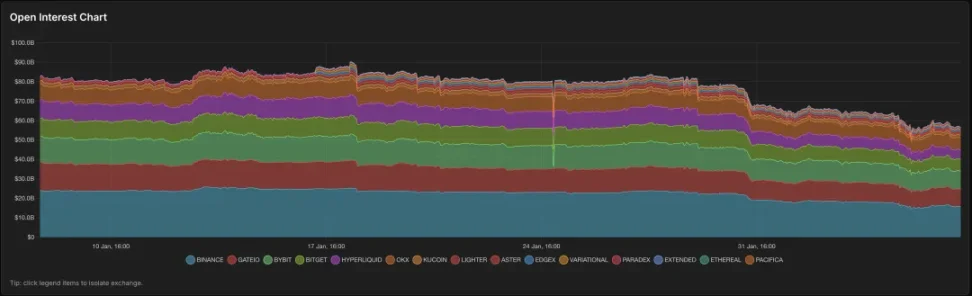
Image Caption: CEX and DEX are hard to distinguish, Image Source: @LorisTools

Hyperliquid blocks U.S. IP addresses, but this block has no practical effect. Compare this to the fact that U.S. users can almost never open an account on Binance Global站, only on Binance US.

Coinbase just began allowing futures business for U.S. users, but its business volume is almost negligible. Thus, in a bizarre space, Hyperliquid captured some European and American users outside of Binance and Coinbase, engaging in derivatives business.

But note, Hyperliquid's arbitrage cannot replicate Binance's growth miracle, nor can it learn from Coinbase to capture the U.S. compliant market. It can probably only capture about 15% of Binance's market share.

As Hyperliquid expands into non-traditional businesses like precious metals and prediction markets, its impact on the global financial market is gradually strengthening. If the U.S. can regulate Binance and Tornado Cash, then action against Hyperliquid would not meet resistance from Singapore either.

Ultimately, most "underground economy" models cannot enter the realm of scale. Take USDT as an example; it has become increasingly strict in its issuance reserves and circulation bans. The Bybit hacker放过 (spared) USDT and the freezing of black USDT after the Huione case are clear evidence.

  • Huione can support the entire underground economy of Cambodia and even Southeast Asia, but Cambodia cannot bear the cost of being placed on FATF's money laundering "grey list."

  • Binance can support the BNB chain economy dominated by altcoins, but the squeeze between China and the U.S. prevents Binance from accessing higher-quality trading assets.

This is essentially due to the U.S.'s advantage of low regulatory costs. The core of U.S. external economic sanctions is not the dollar and the U.S. military. The U.S. is the world's largest single consumer market and the most important financial market. Once Cambodia and Binance are cut off from the U.S., their fate would be like North Korea's.

This is why Binance pays a high price to become compliant, and why Hyperliquid's compliance is only a matter of time.

This leads to an extended discussion: can RWA replicate the trajectory of the crypto asset trading赛道, i.e., preserve itself through regulatory arbitrage and develop its volume within a compliance framework?

This is based on the dual premise that Hyperliquid, in the crypto asset trading field, almost certainly cannot surpass Binance, and in terms of compliance, almost certainly cannot surpass Coinbase.

If we were in 2017, CZ himself might not have believed that CEX was the future. Looking back, stamp coins, P2P, O2O, ofo were all fleeting. Looking forward, DeFi mining, NFT, GameFi, SocialFi all ended without result.

So Binance and BNB should be understood as project-based. Their光环 (halo) is constantly extended by wealth effects. They should have ended hastily, like one financial bubble after another.

But under network effects, the network effect of trading breaks free from the constraints of crypto assets and enters all financial fields, thus meeting RWA in a broad sense. Yield-bearing stablecoins冲击 (impact) CBDC, and asset-based securitization will迟早 (sooner or later) be tokenized.

For example, the recent regulatory guidelines from the Eastern power are essentially an overflow of the U.S. impact in the financial field, which will rewrite on-chain finance in a peculiar way.
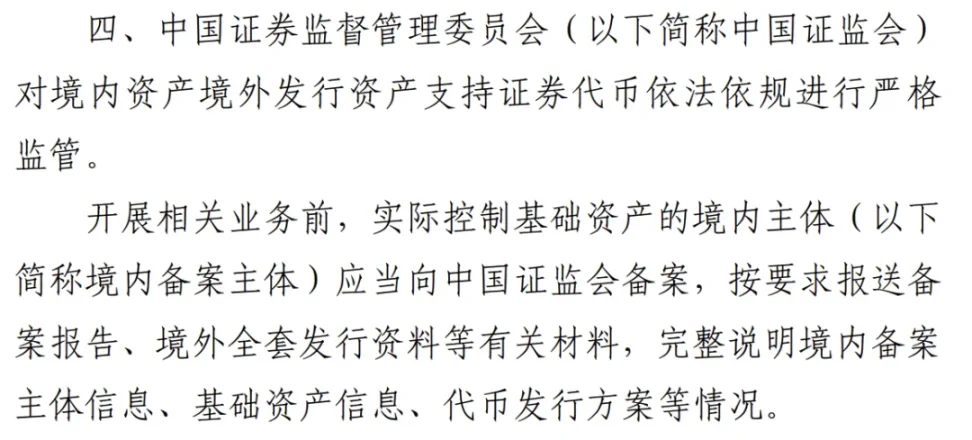
Image Caption: The flower blooms inside the wall, but its fragrance is enjoyed outside

Regarding the new regulatory measures from the Eastern power, Caixin's interpretation divides them into four categories: foreign debt, equity, asset securitization, and others. But in my view, the only meaningful aspect is the opening for security tokenization, aligning with the reform direction of "securitizing all assets." Regarding this:

  • Clearly identifies the CSRC as the competent authority

  • Requires CSRC approval for issuance

  • Only allows issuance from within the territory to outside the territory

Furthermore, these security tokenization guidelines clearly state that both rights and收益 (profits) must be compliant. This corresponds to the SEC's encouragement of the evolution of native "stock tokenization." Overseas RMB stablecoins, foreign debt, and funds are more特殊 (special cases).

  • Overseas offshore RMB stablecoin business has always existed, and Tether, the issuer of USDT, is also involved, but it lacks practical use, and the business volume is very small;

  • Overseas bond issuance and fund tokenization are already happening de facto, completely isolated from domestic assets and issued to overseas clients, unrelated to these guidelines.

This regulation involves the overseas issuance of domestic assets, essentially emphasizing this isolation: what is overseas belongs overseas, what is domestic belongs domestic. Only when the two交叉 (intersect) is there a need to enter the regulatory process.

In the current RWA field, China and the U.S. are already de facto engaged in a land grab. This liquidity溢出 (spillover) onto the chain is enough to rewrite the current financial landscape.

Conclusion

The destiny of an industry depends, of course, on self-striving, but also on the course of history.

CZ might not even believe CEX is the future himself. Even Bitcoin is just a stage of a new form of pyramid scheme, quickly becoming a historical term that vanishes with the wind, like P2P, high-interest loans.

But no one expected CEX to survive until 2026. Hyperliquid is charging into new forms like precious metals and prediction markets, but it still hasn't Flipped Binance.

If we add RWA to Hyperliquid, can it reach the other shore this time?


Twitter:https://twitter.com/BitpushNewsCN

Bitpush TG Discussion Group:https://t.me/BitPushCommunity

Bitpush TG Subscription: https://t.me/bitpush

Original Link:https://www.bitpush.news/articles/7610212

Pertanyaan Terkait

QWhat are the two key factors that contributed to Binance's rapid growth according to the article?

AAccording to the article, Binance did two things right: 1) It continued to accept users from Mainland China while actively expanding overseas, creating a seesaw effect between trading volume and user scale. 2) It launched IEO (Initial Exchange Offering) in 2019, creating a real wealth effect before the DeFi Summer.

QHow does the article differentiate between Binance's licensing in ADGM and Coinbase's licensing in the US?

AThe article states that Binance's licensing under the ADGM framework and Coinbase's licensing in the US are completely different concepts. Binance's licensing involves dividing itself into trading, clearing, and over-the-counter entities but retains its characteristic arbitrage, and the ADGM lacks the capacity to regulate a behemoth like Binance. In contrast, Coinbase's licensing in the US will place it under the actual management scope of US regulators, shaping a comprehensive US compliance framework covering listing, trading, custody, clearing/settlement, and auditing/insurance.

QWhat is the 'second-order arbitrage' mentioned in the context of Hyperliquid?

AThe 'second-order arbitrage' refers to Hyperliquid arbitraging Binance's position. While Binance arbitraged global regulations to become a top exchange, Hyperliquid is now arbitraging the opportunity created by Binance's restrictions, capturing a segment of users (including some from Europe and the US) that are not fully served by the compliant but limited Coinbase or the restricted Binance, particularly in derivatives trading.

QWhat is the core reason cited in the article for why entities like Binance and Cambodia's Huione Pay ultimately seek compliance, despite operating in 'grey areas'?

AThe core reason is the immense economic power of the United States. The US possesses a low regulatory cost advantage and is the world's largest single consumer market and most important financial market. The threat of being cut off from the US financial system and facing consequences like being placed on the FATF 'grey list' for money laundering is a powerful incentive for these entities to seek compliance to maintain global market access.

QAccording to the article's analysis, what is the significant aspect of the new Eastern power's (implied to be China) regulatory guidance on RWA?

AThe significant aspect is that it provides an opening for the securitization of tokens, aligning with a broader reform direction of 'securitizing all assets.' It mandates that the China Securities Regulatory Commission (CSRC) is the competent authority, requires CSRC approval for issuance, and only allows domestic-to-overseas issuance, emphasizing the separation between onshore and offshore activities for cross-border tokenized securities.

Bacaan Terkait

Di Balik Rekor Tertinggi Berulang HYPE, "Anak-Anak" dalam Ekosistem Justru Tertinggal

HYPE, token Hyperliquid, mencatat rekor tertinggi baru di atas 76 USDT pada 16 Juni, didorong oleh arus masuk dana ETF institusional AS dan mekanisme pembakaran token agresif dari Assistance Fund yang menggunakan 97% biaya protokol. Sementara itu, sisi ekosistem HyperEVM justru mengalami gelombang penghentian protokol di berbagai sektor seperti pinjaman, NFT, stablecoin, dan DEX. Artikel ini menjelaskan bahwa HYPE berfungsi lebih seperti "saham aplikasi" yang nilainya terikat pada pendapatan dari perdagangan kontrak berlanjutan di HyperCore, bukan pada kesuksesan proyek di HyperEVM. Hal ini berbeda dengan logika token seperti ETH. Kematian proyek di HyperEVM—seperti Ventuals, Felix, HypurrFi, Drip.Trade, dan USDH—tidak secara langsung mempengaruhi nilai HYPE. Alasan utama kesulitan proyek ekosistem adalah filosofi desain Hyperliquid yang minimalis: menyediakan infrastruktur tanpa dukungan grants, likuiditas, atau koordinasi pemasaran dari inti. Akibatnya, proyek harus bersaing ketat sejak awal. Kesuksesan HyperCore justru menciptakan efek hisap likuiditas, menyulitkan proyek di HyperEVM untuk mendapatkan perhatian dan pengguna. Mekanisme HIP-3 yang memungkinkan siapa saja meluncurkan pasar di HyperCore juga memperketat persaingan. Intinya, model bisnis Hyperliquid secara struktural memusatkan sumber daya di lapisan inti, menyisakan ruang terbatas bagi ekosistem di sekitarnya.

Foresight News42m yang lalu

Di Balik Rekor Tertinggi Berulang HYPE, "Anak-Anak" dalam Ekosistem Justru Tertinggal

Foresight News42m yang lalu

Bitcoin Melepaskan Diri dari Likuiditas M2 Global Saat Pasokan Uang Mencatat Rekor Tertinggi

Bitcoin kembali menguji salah satu asumsi makro kripto favorit: bahwa likuiditas global yang meningkat pada akhirnya mendorong BTC lebih tinggi. Menurut data 16 Juni, likuiditas M2 global telah melampaui rekor $135 triliun, sementara Bitcoin tetap jauh di bawah puncak Oktober 2025 dan diperdagangkan di kisaran pertengahan $60.000-an. Perbedaan ini menarik perhatian karena Bitcoin sering bergerak seiring likuiditas global dalam siklus sebelumnya. Namun, kali ini hubungannya tampak kurang langsung. Ada dua argumen utama: 1. **Argumen Rally Menyusul:** Pandangan bullish menyatakan Bitcoin tertinggal, bukan rusak korelasinya. Likuiditas masih kuat, tetapi butuh waktu untuk berpindah dari bank sentral ke aset berisiko. Jika hubungan lama bertahan, BTC mungkin akhirnya menyusul. 2. **Argumen Perubahan Rezim:** Pandangan lebih hati-hati menyebut struktur pasar Bitcoin telah berubah. ETF spot, aliran institusi, dolar yang kuat, dan rotasi modal ke saham AI mungkin mengubah respons BTC terhadap likuiditas. Likuiditas mungkin menjadi salah satu faktor di antara banyak faktor lainnya, bukan variabel utama. Bagi trader, kesimpulan yang berguna adalah tidak memilih satu model secara membabi buta. Divergensi ini perlu dipantau karena menciptakan pertanyaan makro yang jelas: apakah Bitcoin tertunda, atau apakah korelasinya melemah? Jawabannya akan membentuk interpretasi peserta pasar terhadap setiap rilis likuiditas besar ke depan. Dalam hal trading, kerangka kerja validasi menjadi jelas. Jika M2 global tetap tinggi dan Bitcoin mulai merebut kembali level resistensi kunci, argumen *catch-up* akan menguat. Jika BTC terus tertinggal sementara likuiditas berkembang, pandangan perubahan rezim harus dipertimbangkan lebih serius. Intinya, perkembangan ini memberi trader sesuatu yang konkret untuk diuji, bukan sekadar narasi bullish yang samar.

bitcoinist1j yang lalu

Bitcoin Melepaskan Diri dari Likuiditas M2 Global Saat Pasokan Uang Mencatat Rekor Tertinggi

bitcoinist1j yang lalu

Blok Dovish di Fed Secara Kolektif Beralih ke Hawkish, Debut Warsh 'Dilematis'

Para pembuat kebijakan di Federal Reserve (Fed) yang sebelumnya mendukung suku bunga rendah (dovish), termasuk Christopher Waller, baru-baru ini menyatakan mereka tidak menutup kemungkinan untuk menaikkan suku bunga. Hampir tidak ada anggota Komite yang masih menganjurkan pemotongan suku bunga. Pertemuan pertama yang dipimpin oleh Ketua baru Fed, Kevin Warsh, diperkirakan akan mengirimkan sinyal bahwa langkah berikutnya Fed mungkin adalah kenaikan suku bunga. Warsh, yang diangkat oleh Presiden Trump karena posisinya yang mendukung pemotongan suku bunga tahun lalu, kini menghadapi situasi yang sulit. Inflasi AS terus melampaui 3%, pasar tenaga kerja menguat, dan tekanan dari harga minyak serta hambatan pasokan mendorong kenaikan harga. Alasan-alasan yang mendasari ekspektasi pemotongan suku bunga satu per satu menghilang. Pergeseran sikap ini terlihat jelas. Waller, yang sebelumnya mendukung pemotongan, kini mengatakan dia tidak dapat lagi mengesampingkan kemungkinan kenaikan suku bunga di masa depan. Anggota dewan lain seperti Lisa Cook juga mulai bersikap terbuka terhadap opsi kenaikan jika inflasi tidak turun tepat waktu. Sementara itu, anggota yang lebih hawkish seperti Beth Hammack dan Lorie Logan telah lama mempertanyakan perlunya pemotongan dan sekarang mengkhawatirkan perlunya kenaikan suku bunga jika tren saat ini berlanjut. Pada pertemuan mendatang, Fed diperkirakan akan mempertahankan suku bunga namun menghapus bahasa 'bias longgar' dari pernyataannya, yang menyiratkan bahwa kenaikan dan penurunan suku bunga dianggap memiliki kemungkinan yang sama. 'Dot plot' triwulanan juga diperkirakan akan menunjukkan bahwa sebagian besar pejabat memperkirakan suku bunga akan tetap tidak berubah tahun ini, dengan beberapa bahkan mungkin memproyeksikan kenaikan. Warsh, yang telah lama mengkritik alat komunikasi Fed seperti 'dot plot', kini harus menyampaikan perubahan arah kebijakan ini menggunakan alat-alat yang dikritiknya, dengan komite yang tidak dipilihnya, menuju arah yang bertentangan dengan keinginan presiden yang menunjuknya. Intinya, pembicaraan di dalam Fed telah bergeser dari 'kapan menurunkan' menjadi 'apakah harus menaikkan' suku bunga.

marsbit1j yang lalu

Blok Dovish di Fed Secara Kolektif Beralih ke Hawkish, Debut Warsh 'Dilematis'

marsbit1j yang lalu

Trading

Spot
Futures

Artikel Populer

Cara Membeli ROUTE

Selamat datang di HTX.com! Kami telah membuat pembelian Router Protocol (ROUTE) menjadi mudah dan nyaman. Ikuti panduan langkah demi langkah kami untuk memulai perjalanan kripto Anda.Langkah 1: Buat Akun HTX AndaGunakan alamat email atau nomor ponsel Anda untuk mendaftar akun gratis di HTX. Rasakan perjalanan pendaftaran yang mudah dan buka semua fitur.Dapatkan Akun SayaLangkah 2: Buka Beli Kripto, lalu Pilih Metode Pembayaran AndaKartu Kredit/Debit: Gunakan Visa atau Mastercard Anda untuk membeli Router Protocol (ROUTE) secara instan.Saldo: Gunakan dana dari saldo akun HTX Anda untuk melakukan trading dengan lancar.Pihak Ketiga: Kami telah menambahkan metode pembayaran populer seperti Google Pay dan Apple Pay untuk meningkatkan kenyamanan.P2P: Lakukan trading langsung dengan pengguna lain di HTX.Over-the-Counter (OTC): Kami menawarkan layanan yang dibuat khusus dan kurs yang kompetitif bagi para trader.Langkah 3: Simpan Router Protocol (ROUTE) AndaSetelah melakukan pembelian, simpan Router Protocol (ROUTE) di akun HTX Anda. Selain itu, Anda dapat mengirimkannya ke tempat lain melalui transfer blockchain atau menggunakannya untuk memperdagangkan mata uang kripto lainnya.Langkah 4: Lakukan trading Router Protocol (ROUTE)Lakukan trading Router Protocol (ROUTE) dengan mudah di pasar spot HTX. Cukup akses akun Anda, pilih pasangan perdagangan, jalankan trading, lalu pantau secara real-time. Kami menawarkan pengalaman yang ramah pengguna baik untuk pemula maupun trader berpengalaman.

185 Total TayanganDipublikasikan pada 2024.12.11Diperbarui pada 2026.06.02

Cara Membeli ROUTE

Diskusi

Selamat datang di Komunitas HTX. Di sini, Anda bisa terus mendapatkan informasi terbaru tentang perkembangan platform terkini dan mendapatkan akses ke wawasan pasar profesional. Pendapat pengguna mengenai harga ROUTE (ROUTE) disajikan di bawah ini.

活动图片