Whales Inject an Extra $329K+ Into Bitcoin Hyper Ahead of Uptober – The Next 1000x Crypto?

bitcoinistDipublikasikan tanggal 2025-09-30Terakhir diperbarui pada 2025-09-30

Abstrak

With ‘Uptober’ just around the corner (literally tomorrow), anticipation is building for what could be a pivotal moment for $BTC....

Trusted Editorial content, reviewed by leading industry experts and seasoned editors. Ad Disclosure

With ‘Uptober’ just around the corner (literally tomorrow), anticipation is building for what could be a pivotal moment for $BTC.

October is historically one of the strongest months for the world’s largest crypto, with average returns at 21.89%.

So, what better time for the Bitcoin Hyper Layer-2 (L2) to soon go live? Suppose this peak demand takes shape, it could position itself as a go-to solution for scaling Bitcoin, precisely when the network needs it most.

It’s no surprise, then, that whales have latched on. Just yesterday, three invested $113.8K, $109.9K, and $105.4K into the ecosystem’s $HYPER presale, signaling strong confidence in the L2’s potential.

Suppose this buzz continues, $HYPER might even become the next 1000x crypto.

$BTC Rockets 4.5% in One Month, Before Possible October Rally

Since last month, $BTC has increased by over 4.5%, a sign that bullish momentum may already be underway.

Yes, $BTC has plummeted from $114K to $113K since just yesterday. But it’s not all doom and gloom for the #1 crypto.

Even during the most challenging market cycles, October is often a turning point where $BTC sentiment flips from bearish to bullish.

Take 2023 as a prime example. After a modest 3.91% gain in September, it soared by 28.52% the following month.
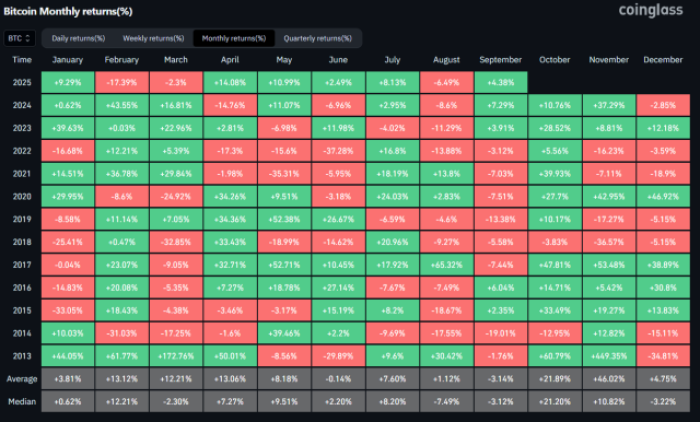
Bitcoin monthly returns on Coinglass.
Source: Coinglass

Given this, it’s no wonder that institutions are positioning themselves for what might be another legendary spike.

Just yesterday, Michael Saylor announced that his firm – Strategy (formerly MicroStrategy) – has acquired an additional 196 $BTC, worth roughly $221M.

As of September, Strategy now holds an eye-boggling 640,031 $BTC valued at $47.35B+. The average price per token is approximately $73,983.

Michael Strategy announced Strategy’s most recent BTC acquisition on X.
Source: X (Michael Saylor)

Strategy isn’t the only public company acquiring sizable amounts of $BTC in the hope of capitalizing on the next bull run.

Over the past 30 days, MARA Holdings has boosted its stack to 52,477 $BTC valued at nearly $5.94B.

XXI also bets big on the crypto leader jumping to greater heights. In total, it owns 43,515 $BTC, currently worth approximately $4.92B.
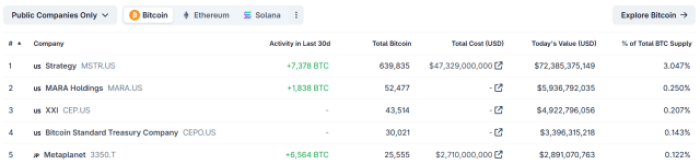
BTC held by public companies on CoinGecko.
Source: CoinGecko

When firms commit billions to $BTC, it validates the asset’s role as a store of value as opposed to being yet another speculative asset.

In turn, they fuel demand for $BTC and boost market confidence. But there’s a hitch: as the coin’s popularity surges and transaction volumes increase, the network often faces mounting pressure.

Bitcoin Processes Fees 43%+ Slower Than Ethereum

Bitcoin’s no stranger to scalability challenges. Today, the network can process just 12.47 transactions per second (tps), 43.32% lower than Ethereum’s 22.01 tps.

Even at its record level, Bitcoin has only managed 13.2 tps – a far cry from Ethereum’s 62.34 tps and nowhere near Solana’s 65K tps.

The network’s limited throughput often causes higher gas costs during peak activity. Following the halving event last October, average transaction fees rose as high as $8.36 one month later.

While fees have since dropped to just $0.84, they’re still no stranger to fluctuating. This makes it tricky for everyday traders to rely on Bitcoin for everyday transactions.
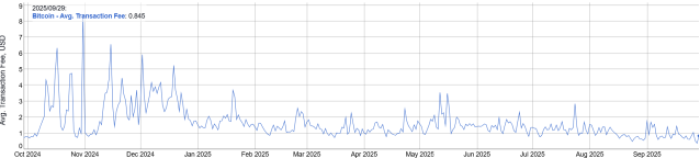
Average Bitcoin transaction fee.
Source: BitInfoCharts

Thankfully, there’s a solution. It’s Bitcoin Hyper, and it’s getting set to launch this quarter to address the network’s bottlenecks.

Bitcoin Hyper L2 to Bring Solana’s Speeds to Bitcoin

Built on the Solana Virtual Machine (SVM), Bitcoin Hyper strives to deliver Solana-level speeds and scalability to Bitcoin. In turn, it’ll enable thousands of tps at a lower price tag.

For even faster, cheaper, and more versatile transactions, the L2 will leverage a Canonical Bridge. But that’s not all; it’ll help turn Bitcoin into a hub for DeFi, dApps, launchpads, and even the best meme coins.
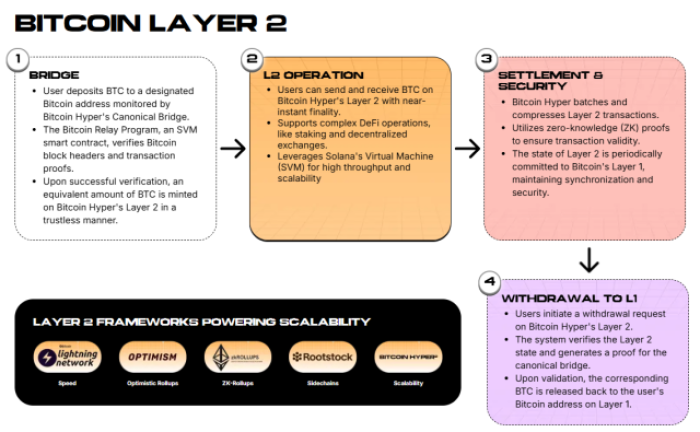
How the Bitcoin Hyper bridge works.
Source: Bitcoin Hyper

All is achieved by enabling $BTC to move seamlessly between the Bitcoin base layer and the Hyper L2 ecosystem. And once bridged, $BTC can interact directly with smart contracts, dApps, and liquidity protocols.

$HYPER Fuels L2 Growth & 61% Staking Rewards

$HYPER is at the heart of the entire ecosystem, supercharging every aspect of its utility and growth. A sizable 30% of its total token supply is allocated to fund development, after all.

Also fueling its long-term growth is an additional 25% of $HYPER being earmarked for the ecosystem treasury.
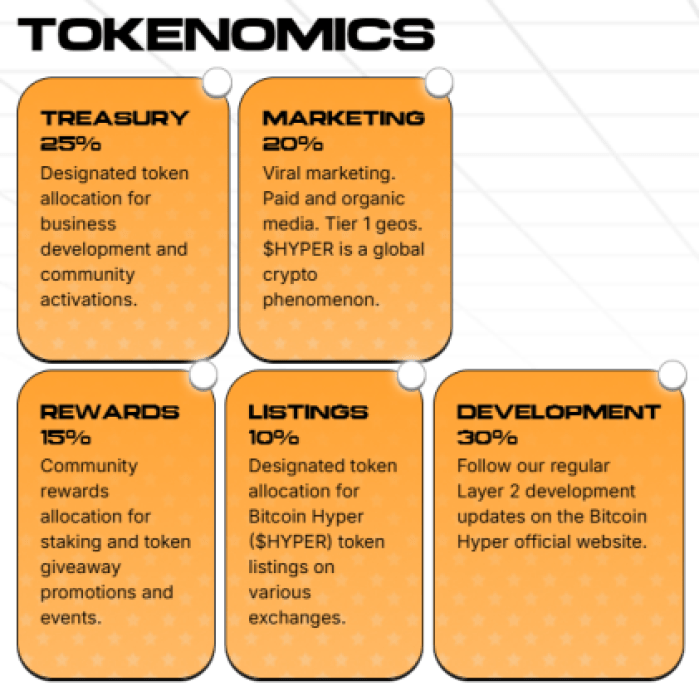
30% of Bitcoin Hyper goes to development funding.
Source: Bitcoin Hyper

Holding $HYPER doesn’t only mean you’ll contribute to the project’s sustainability; it also unlocks meaningful utility.

By purchasing $HYPER on presale – now available for $0.013005 – you’ll gain governance rights, enjoy reduced gas fees, and can stake your token at a 61% APY.

But time is of the essence: the APY will nosedive as more investors lock up their tokens. So, now’s an opportune moment to start staking $HYPER for the greatest possible gains.

Our Bitcoin Hyper price prediction also anticipates $HYPER to surpass $0.32 this year, following its listing on major CEXs. So, joining now could generate 20 times the returns (and that’s not even counting the staking rewards).

Join Bitcoin Hyper today.

We’re not financial advisors. Always do your own research and never invest more than you’d be sad to lose. 

Authored by Leah Waters, Bitcoinist – https://bitcoinist.com/bitcoin-hyper-next-1000x-crypto-whales-buy-329k/

Editorial Process for bitcoinist is centered on delivering thoroughly researched, accurate, and unbiased content. We uphold strict sourcing standards, and each page undergoes diligent review by our team of top technology experts and seasoned editors. This process ensures the integrity, relevance, and value of our content for our readers.

Leah is a British journalist with a BA in Journalism, Media, and Communications and nearly a decade of content writing experience. Over the last four years, her focus has primarily been on Web3 technologies, driven by her genuine enthusiasm for decentralization and the latest technological advancements. She has contributed to leading crypto and NFT publications – Cointelegraph, Coinbound, Crypto News, NFT Plazas, Bitcolumnist, Techreport, and NFT Lately – which has elevated her to a senior role in crypto journalism. Whether crafting breaking news or in-depth reviews, she strives to engage her readers with the latest insights and information. Her articles often span the hottest cryptos, exchanges, and evolving regulations. As part of her ploy to attract crypto newbies into Web3, she explains even the most complex topics in an easily understandable and engaging way. Further underscoring her dynamic journalism background, she has written for various sectors, including software testing (TEST Magazine), travel (Travel Off Path), and music (Mixmag). When she's not deep into a crypto rabbit hole, she's probably island-hopping (with the Galapagos and Hainan being her go-to's). Or perhaps sketching chalk pencil drawings while listening to the Pixies, her all-time favorite band.

Bacaan Terkait

Fidelity Memperingatkan: Kemakmuran Agen AI Belum Tentu Pesta untuk Rantai Publik

Fidelity mengingatkan investor agar tidak terlalu cepat menyamakan kemajuan AI agent dengan kemakmuran public blockchain. Meskipun AI yang dapat bertindak secara mandiri berpotensi menggunakan blockchain untuk pembayaran atau penyelesaian transaksi, terdapat setidaknya enam risiko yang perlu diperhatikan. Pertama, AI agent mungkin tidak memerlukan blockchain publik. Sistem tertutup oleh perusahaan teknologi besar bisa lebih dipilih karena kecepatan, biaya, stabilitas, dan kepatuhan regulasi yang lebih baik. Kedua, peningkatan transaksi on-chain tidak serta-merta menguntungkan token asli jaringan. Aktivitas pembayaran AI mungkin didominasi stablecoin, sehingga nilai tertangkap oleh penyedia layanan pembayaran, bukan token dasar blockchain. Ketiga, AI membuat pengembangan perangkat lunak lebih murah, tetapi banyaknya kode tidak sama dengan peningkatan nilai ekonomi. Persaingan bisa beralih ke pengguna, likuiditas, dan merek. Keempat, keunggulan teknologi menjadi kurang langka karena AI dapat dengan cepat mereplikasi fungsi, sehingga sulit mempertahankan keunggulan kompetitif hanya melalui kode. Kelima, AI menurunkan biaya pengembangan sekaligus biaya serangan, berpotensi meningkatkan risiko keamanan jika infrastruktur audit tidak matang. Keenam, institusi besar mungkin lebih membutuhkan blockchain "terkendali" dengan manajemen identitas, izin, dan audit yang kuat, bukan jaringan publik yang sepenuhnya terbuka. Intinya, narasi gabungan AI dan blockchain perlu dikaji lebih kritis. Fokus seharusnya pada infrastruktur mana yang benar-benar dapat menangkap kebutuhan riil dan mengubahnya menjadi nilai bisnis yang berkelanjutan.

marsbit1m yang lalu

Fidelity Memperingatkan: Kemakmuran Agen AI Belum Tentu Pesta untuk Rantai Publik

marsbit1m yang lalu

Setelah Riset di Silicon Valley, Kesimpulan Goldman Sachs: Agent Masuki Era Eksekusi, Kompetisi AI Beralih ke Workflow, World Model Bangkit

Berdasarkan laporan terbaru Goldman Sachs setelah survei di Silicon Valley, industri AI sedang memasuki tahap baru dari "mampu menjawab" menuju "mampu mengeksekusi". Kompetisi beralih dari "model siapa yang lebih kuat" ke "siapa yang benar-benar menguasai alur kerja". **Agent Masuki Era Eksekusi:** Agent AI berkembang dari alat bantu menjadi pelaksana alur kerja. Kendala utama untuk adopsi besar-besaran di perusahaan bukan lagi kemampuan model, melainkan **kontrollabilitas**, pembagian tanggung jawab, dan kemampuan untuk melacak serta memperbaiki kesalahan. Alur kerja yang paling mungkin diotomatisasi pertama kali memiliki karakteristik: batasan keputusan yang jelas, hasil yang dapat diverifikasi, dan kesalahan yang dapat dikembalikan (rollback). Penyedia layanan informasi dengan konten tepercaya, model domain yang terverifikasi, dan hubungan pengawasan yang matang memiliki peluang lebih besar. **Persaingan Model: Pembagian Tugas antara Model Mutakhir dan Model Sumber Terbuka:** Pasar kemungkinan akan berkembang menjadi pembagian kerja yang lebih jelas. **Model mutakhir (seperti GPT-4)** akan menangani tugas kompleks bernilai tinggi yang membutuhkan keandalan ekstrem. Sementara **model sumber terbuka** akan mengatasi tugas standar berskala besar dan menghabiskan sebagian besar token inferensi (sekitar 90% dalam 12-18 bulan ke depan), menawarkan biaya yang lebih rendah dengan sedikit pengorbanan kinerja untuk banyak kasus penggunaan bisnis. **Kebangkitan Model Dunia (World Model) dan Implikasinya:** Perhatian penelitian bergeser dari LLM (Large Language Model) ke "Model Dunia", yang memahami lingkungan, sebab-akibat, hukum fisika, dan interaksi dinamis di dunia nyata menggunakan data dari sistem fisik dan operasi dunia nyata. Ini semakin meningkatkan nilai **data proprietary**. Transisi AI ke dunia fisik di bidang seperti industri, sains, dan robotika akan membuka ruang masalah yang lebih luas dan memicu **kurva pertumbuhan kedua untuk permintaan komputasi AI**, menguntungkan penyedia infrastruktur cloud dan komputasi seperti Microsoft, Oracle, dan CoreWeave. **Perubahan Model Bisnis:** Komersialisasi AI bergerak dari berlangganan per kursi (**seat-based**) ke pengisian berdasarkan konsumsi, volume transaksi, dan hasil (**consumption/transaction/outcome-based**). Nilai industri bermigrasi dari model itu sendiri ke data proprietary, konteks bisnis, dan keahlian domain.

marsbit1m yang lalu

Setelah Riset di Silicon Valley, Kesimpulan Goldman Sachs: Agent Masuki Era Eksekusi, Kompetisi AI Beralih ke Workflow, World Model Bangkit

marsbit1m yang lalu

Telegram Memperkenalkan Teknologi WEB-Proxy: Menyamarkan Lalu Lintas agar Terlihat Seperti Situs Web Biasa

Telegram memperkenalkan teknologi eksperimental bernama WEB-proxy pada 21 Agustus 2026. Teknologi ini menawarkan cara baru untuk mengatasi pemblokiran dengan menyamarkan lalu lintas data aplikasi agar terlihat seperti kunjungan biasa ke situs web melalui koneksi HTTPS yang aman. Cara kerjanya, Telegram Desktop menggunakan mesin browser (WebView) bawaan untuk mengirimkan semua data melalui satu sesi yang tampak seperti loading halaman web. Data dari MTProxy dikemas dalam format khusus dan dikirim melalui saluran terenkripsi HTTPS atau WebSocket. Di sisi server, relay khusus menerima aliran data ini dan meneruskannya ke MTProxy tanpa mengetahui isi atau tujuan akhirnya, sehingga menjaga privasi. WEB-proxy beroperasi pada domain HTTPS biasa yang juga menampung situs web publik asli. Halaman jembatan proxy hanya diaktifkan jika permintaan mengandung parameter rahasia tertentu yang dihitung dari konfigurasi. Tautan koneksi proxy memiliki format spesifik dan menggunakan port 443 wajib. Saat ini, teknologi ini masih dalam tahap uji konsep dan tersedia untuk Telegram Desktop serta klien Android eksperimental, dengan rencana dukungan iOS. Dengan memanfaatkan infrastruktur web standar, WEB-proxy mempersulit sistem filter untuk membedakannya dari lalu lintas internet sah tanpa memblokir keseluruhan HTTPS. Keberhasilannya akan bergantung pada ketahanannya terhadap analisis lalu lintas yang canggih dan kemampuan skalanya.

cryptonews.ru17m yang lalu

Telegram Memperkenalkan Teknologi WEB-Proxy: Menyamarkan Lalu Lintas agar Terlihat Seperti Situs Web Biasa

cryptonews.ru17m yang lalu

Trading

Spot
活动图片