Tether And Circle Inject $12.75B To The Market In 30 Days – Details

bitcoinistDipublikasikan tanggal 2025-09-12Terakhir diperbarui pada 2025-09-13

Abstrak

The stablecoin market is once again in the spotlight after Tether minted another $1 billion USDT just a few hours...

Trusted Editorial content, reviewed by leading industry experts and seasoned editors. Ad Disclosure

The stablecoin market is once again in the spotlight after Tether minted another $1 billion USDT just a few hours ago. This fresh injection of liquidity comes at a time when the crypto market is entering a volatile phase, with uncertainty surrounding both macroeconomic conditions and investor sentiment. Bitcoin and altcoins are beginning to show shifting dynamics, and stablecoin issuers like Tether and Circle are emerging as critical players in shaping these movements.

Large mints from Tether have historically coincided with aggressive price swings across the crypto market, as the arrival of new liquidity often fuels increased trading activity. Whether this supply is immediately deployed or gradually filters into exchanges, the effect on market psychology is significant. Traders and investors frequently view such events as early signals of potential inflows into risk assets.

With Bitcoin consolidating near key levels and altcoins attempting to recover from recent corrections, the timing of this mint underscores the importance of stablecoins in the broader ecosystem. As liquidity expands, the coming days could see heightened volatility, with the possibility of strong directional moves. For now, all eyes are on how this $1 billion issuance will ripple across the crypto landscape.

Tether and Circle Add Liquidity Into The Market

According to data from Lookonchain, Tether and Circle have minted a combined $12.75 billion in stablecoins over the past month, marking one of the most significant liquidity injections in recent cycles. This expansion underscores the crucial role stablecoins play in the crypto ecosystem, acting as the backbone of trading activity and serving as a bridge for capital flowing into risk assets.
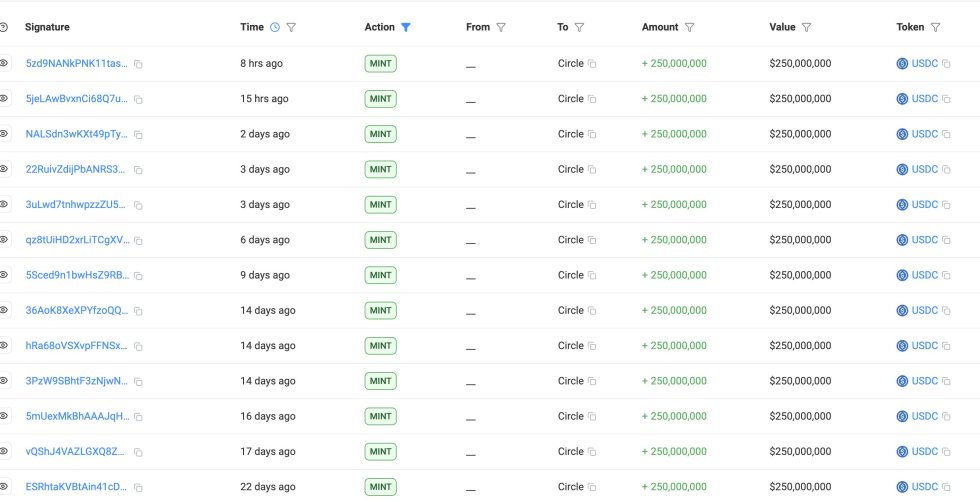
Tether and Circle Stablecoin Mints | Source: Lookonchain

The timing of this surge is notable. Bitcoin and Ethereum are consolidating near critical levels, and altcoins are beginning to show signs of renewed momentum. Historically, large stablecoin mints have preceded uptrends in crypto markets, as fresh liquidity provides the fuel for traders and institutions to deploy capital more aggressively. The $12.75B increase, therefore, reflects more than just stablecoin supply growth—it signals a market preparing for potential expansion.

Still, risks remain elevated. Some analysts caution that the broader economic environment is highly unpredictable, with lingering concerns over global growth, inflationary pressures, and liquidity conditions. The volatility of traditional markets often bleeds into crypto, making sudden swings a persistent threat.

All eyes are now on the US Federal Reserve, with investors widely anticipating a rate cut at next week’s meeting. Such a move would reinforce the bullish implications of the stablecoin surge, further boosting liquidity and supporting higher valuations across digital assets. Conversely, any hesitation or unexpected policy shift could magnify uncertainty, creating sharp volatility.

USDT Dominance Suggests Risk Appetite

Tether (USDT) dominance currently stands at 4.29%, showing a modest decline after testing resistance near 4.5%. The weekly chart reveals that USDT’s market share has been in a gradual downtrend since peaking above 9% in mid-2022. This decline reflects a healthier appetite for risk assets, as capital shifts out of stablecoins and into Bitcoin, Ethereum, and altcoins.
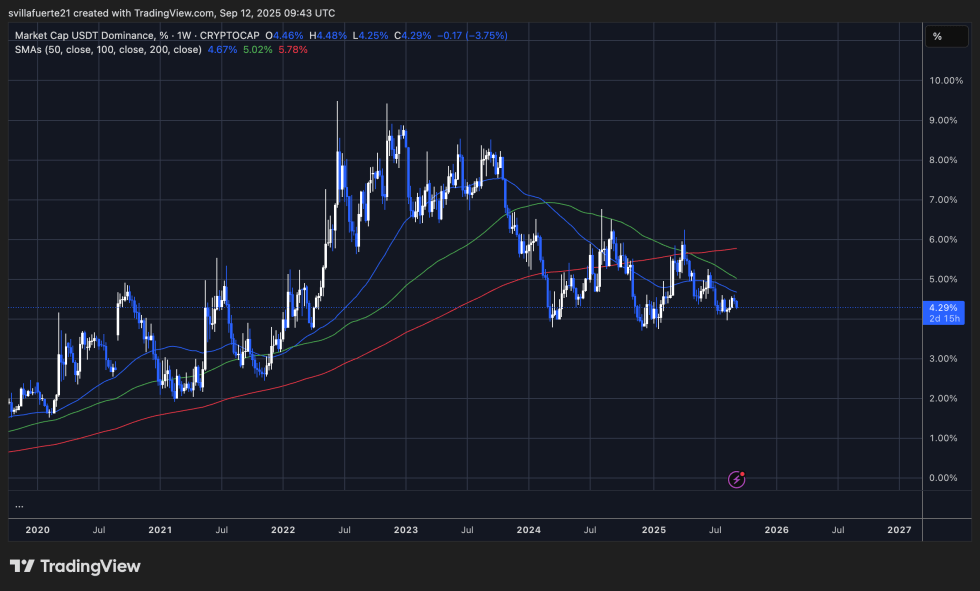
USDT Market Cap Dominance | Source: USDT.D chart on TradingView

The 50-week SMA at 4.67% and the 100-week SMA at 5.02% are both trending lower, confirming persistent weakness in dominance. Meanwhile, the 200-week SMA at 5.78% sits well above current levels, acting as a ceiling that reinforces the longer-term bearish structure for USDT’s market share. As long as USDT dominance remains below the 5% threshold, the market backdrop favors capital rotation into risk assets.

However, short-term support has emerged around the 4.2%–4.3% zone, where dominance has stabilized multiple times this year. A breakdown below this range would likely signal further risk-taking by investors, potentially fueling stronger rallies in crypto. Conversely, a bounce back toward 5% would indicate rising caution and renewed demand for stablecoins.

Featured image from Dall-E, chart from TradingView

Editorial Process for bitcoinist is centered on delivering thoroughly researched, accurate, and unbiased content. We uphold strict sourcing standards, and each page undergoes diligent review by our team of top technology experts and seasoned editors. This process ensures the integrity, relevance, and value of our content for our readers.

Sebastian's journey into the world of crypto began four years ago, driven by a fascination with the potential of blockchain technology to revolutionize financial systems. His initial exploration focused on understanding the intricacies of various crypto projects, particularly those focused on building innovative financial solutions. Through countless hours of research and learning, Sebastian developed a deep understanding of the underlying technologies, market dynamics, and potential applications of cryptocurrencies. As his knowledge grew, Sebastian felt compelled to share his insights with others. He began actively contributing to online discussions on platforms like X and LinkedIn, focusing on fintech and crypto-related content. His goal was to expose valuable trends and insights to a wider audience, fostering a deeper understanding of the rapidly evolving crypto landscape. Sebastian's contributions quickly gained recognition, and he became a trusted voice in the online crypto community. To further enhance his expertise, Sebastian pursued a UC Berkeley Fintech: Frameworks, Applications, and Strategies certification. This rigorous program equipped him with valuable skills and knowledge regarding Financial Technology, bridging the gap between traditional finance (TradFi) and decentralized finance (DeFi). The certification deepened his understanding of the broader financial landscape and its intersection with blockchain technology. Sebastian's passion for finance and writing is evident in his work. He enjoys delving into financial research, analyzing market trends, and exploring the latest developments in the crypto space. In his spare time, Sebastian can often be found immersed in charts, studying 10-K forms, or engaging in thought-provoking discussions about the future of finance. Sebastian's journey as a crypto analyst and investor has been marked by a relentless pursuit of knowledge and a dedication to sharing his insights. His ability to navigate the complex world of crypto, combined with his passion for financial research and communication, makes him a valuable asset to the industry. As the crypto landscape continues to evolve, Sebastian remains at the forefront, providing valuable insights and contributing to the growth of this revolutionary technology.

Bacaan Terkait

Orang yang Menciptakan ChatGPT, Sudah Tidak Lagi Menggunakan ChatGPT untuk Bekerja

Pembuat ChatGPT Sudah Tidak Lagi Mengandalkan ChatGPT untuk Bekerja Dalam waktu kurang dari setahun, OpenAI telah menggeser fokus dari chatbot ke agen AI cerdas (AI Agent) bernama Codex. Hingga Juni 2026, Codex menangani 99,8% dari total token keluaran mingguan perusahaan, melonjak drastis dari kurang dari 10% sepuluh bulan sebelumnya. Pergeseran besar terjadi sekitar September lalu ketika Codex diperkuat dengan model yang lebih canggih dan kemampuan yang lebih lengkap, memungkinkannya menangani tugas-tugas yang semakin kompleks. Karyawan OpenAI menemukan bahwa daripada bertanya-jawab dalam kotak dialog, lebih efisien untuk menyerahkan satu set tugas utuh kepada Codex untuk dijalankan secara mandiri. Perubahan ini tidak hanya terjadi di tim teknik, tetapi telah menyebar ke setiap departemen termasuk hukum, keuangan, dan rekrutmen. Saat ini, rata-rata lebih dari 85% token keluaran per karyawan dihasilkan oleh Codex. Agen seperti Codex mengubah unit dasar kerja pengetahuan: dari interaksi tanya-jawab singkat menjadi tugas berjangka panjang yang dapat "dilempar" untuk diselesaikan secara mandiri. Sekitar seperempat permintaan ke Codex kini terkait dengan pekerjaan yang membutuhkan waktu lebih dari satu jam jika dikerjakan manusia. Yang mengejutkan, pertumbuhan pengguna non-pengembang (pengguna individu dan organisasi) telah melampaui pengembang. Orang-orang dari bidang non-teknik seperti keuangan dan humas menggunakan Codex untuk mengotomatisasi alur kerja mereka, bahkan untuk tugas-tugas pemrograman. Ini menunjukkan bahwa Codex telah berubah dari alat bantu pemrograman menjadi agen alur kerja universal. Codex, yang didukung oleh GPT-5.5, kini dapat menjalankan rantai tugas teknik secara utuh: implementasi, refaktor, debug, pengujian, dan verifikasi. Pengguna berat bahkan dapat menjalankan beberapa agen secara paralel, menghasilkan hingga lebih dari 60 jam kerja agen dalam satu hari. Intinya, cara kerja telah bergeser: dari membuka kotak obrolan menjadi menyerahkan seluruh tugas kepada agen cerdas. Pembeda di masa depan akan terletak pada seberapa besar dan kompleks tugas yang berani dipercayakan kepada AI untuk dijalankan secara mandiri.

marsbit15m yang lalu

Orang yang Menciptakan ChatGPT, Sudah Tidak Lagi Menggunakan ChatGPT untuk Bekerja

marsbit15m yang lalu

Kebangkitan Stablecoin di Amerika Latin, Intinya Bukan 'Kemenangan Teknologi Kripto'

Kebangkitan stablecoin di Amerika Latin pada dasarnya bukanlah "kemenangan teknologi kripto", melainkan respons terhadap kebutuhan lama akan pengiriman uang lintas batas. Artikel ini, melalui percakapan dengan seorang pemilik restoran Tionghoa di Meksiko, menelusuri sejarah "surat perak" tradisional yang digunakan diaspora untuk mengirim uang pulang. Ini menggambarkan bagaimana di Amerika Latin, di mana remitansi sangat penting bagi banyak keluarga, stablecoin seperti USDT dan USDC dipahami bukan sebagai aset kripto, melainkan sebagai "dolar digital" yang dapat diandalkan. Stablecoin memecahkan masalah inti dalam sistem remitansi tradisional: biaya tinggi, lambat, dan ketidakpastian nilai tukar. Mereka berfungsi sebagai infrastruktur remitansi yang efisien, terutama di negara-negara dengan mata uang volatil seperti Argentina dan Venezuela, atau dengan aliran modal lintas batas yang besar seperti Meksiko dan Brasil. Namun, tantangan sebenarnya terletak pada integrasi "dua ujung": on-ramp (mengubah uang tunai atau saldo bank menjadi stablecoin) dan off-ramp (mengubah stablecoin menjadi mata uang lokal yang dapat digunakan, seperti melalui Pix di Brasil atau SPEI di Meksiko). Regulator di kawasan ini semakin memandang stablecoin melalui lensa kebijakan moneter dan kontrol devisa, berusaha untuk mengatur alih-alih melarangnya. Masa depan stablecoin di Amerika Latin terletak pada kemampuannya untuk beroperasi tanpa terlihat di latar belakang, menjadi tulang punggung teknis yang memungkinkan pengiriman uang yang lebih cepat dan lebih murah, sementara pengguna hanya peduli pada satu hal: apakah uangnya sudah sampai.

marsbit1j yang lalu

Kebangkitan Stablecoin di Amerika Latin, Intinya Bukan 'Kemenangan Teknologi Kripto'

marsbit1j yang lalu

Trading

Spot
活动图片