Solana Greenlights Alpenglow, Its Most Explosive Upgrade Yet

bitcoinistDipublikasikan tanggal 2025-09-03Terakhir diperbarui pada 2025-09-03

Abstrak

Solana validators have overwhelmingly approved SIMD-0326 “Alpenglow,” a sweeping consensus rewrite that aims to cut transaction finality from roughly 12.8...

Trusted Editorial content, reviewed by leading industry experts and seasoned editors. Ad Disclosure

Solana validators have overwhelmingly approved SIMD-0326 “Alpenglow,” a sweeping consensus rewrite that aims to cut transaction finality from roughly 12.8 seconds to about 150 milliseconds—a 100x reduction that developers and observers are already calling the most consequential upgrade in the network’s history. According to the official tally shared via Solana Status, 98.27% of stake voted Yes, 1.05% voted No, and 0.69% abstained, with 52% of total stake participating.

Solana Slashes Finality By 100x

“The community governance process for SIMD-0326: Alpenglow is complete. The proposal has passed: 98.27% Yes, 1.05% No, 0.69% Abstain; 52% of stake cast a vote,” Solana Status posted on X on September 2. Anza, the Solana R&D firm that authored the proposal, added context for operators: “Mainnet-beta is in epoch 843 which concludes the voting process for SIMD-0326: Alpenglow. The proposal has passed with 98% of stake voting Yes.”

Alpenglow replaces core elements of the existing consensus—Proof-of-History (PoH) and TowerBFT—with two new components designed for real-time performance: Votor, a direct-vote finality engine that achieves sub-second confirmations via single-round finalization in the “fast path” (when ~80% of stake is responsive) or two rounds in a 60% fallback; and Rotor, a streamlined block propagation layer intended to supplant Turbine and cut network overhead.

In practice, that architecture is what underpins the ~150–200 ms confirmation targets. Beyond raw speed, Alpenglow touches validator economics and fault tolerance. With vote transactions moving off-chain, Solana will eliminate per-slot vote fees and introduce a fixed Validator Admission Ticket (VAT)—initially 1.6 SOL per epoch—that is burned.

The model aims to preserve economic friction against spam even as vote traffic leaves the ledger, while simplifying load on the network. Separately, the design targets a “20+20” resilience envelope: safety if up to 20% of stake is adversarial and liveness if an additional, disjoint 20% is offline. These mechanics were debated in the forum during the governance window and were reiterated in technical explainers ahead of the vote.

Governance mechanics and timeline. The governance process followed the steps laid out on the Solana forum: discussion in epochs 833–838, stake weights captured in epoch 839, and voting in epochs 840–842, with passage defined as Yes ≥ two-thirds of (Yes + No) and a 33% quorum in which abstentions count toward quorum. Anza’s epoch-843 note simply marks the moment the chain passed the voting boundary on mainnet-beta.

With the validator signal secured, Alpenglow now moves from governance to engineering reality. Whether it ultimately delivers stable ~150 ms finality at scale is a question only testnet and mainnet can answer—but the 98% approval makes clear the Solana ecosystem’s directional bet: real-time blockchain. An official implementation schedule remains forthcoming.

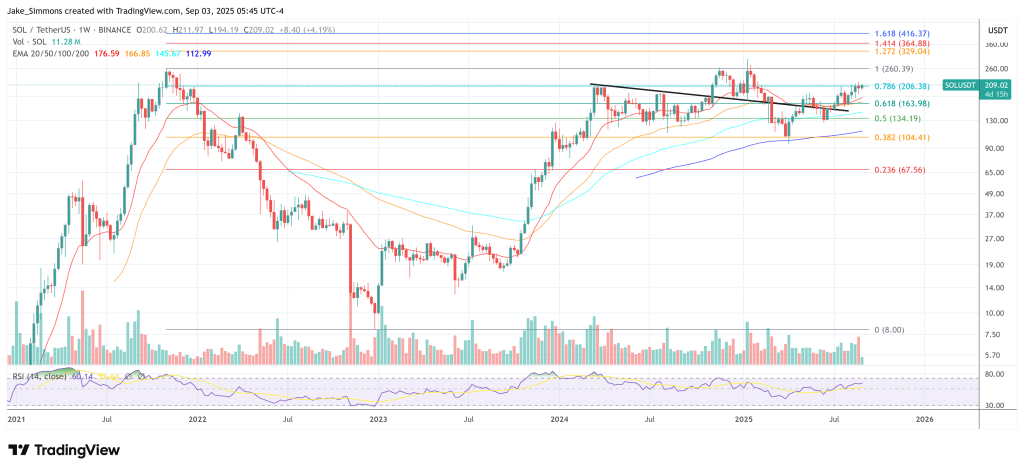
At press time, SOL traded at $209.
Solana price
SOL price fights key resistance, 1-week chart | Source: SOLUSDT on TradingView.com
Featured image created with DALL.E, chart from TradingView.com
Editorial Process for bitcoinist is centered on delivering thoroughly researched, accurate, and unbiased content. We uphold strict sourcing standards, and each page undergoes diligent review by our team of top technology experts and seasoned editors. This process ensures the integrity, relevance, and value of our content for our readers.

Jake Simmons has been a Bitcoin enthusiast since 2016. Ever since he heard about Bitcoin, he has been studying the topic every day and trying to share his knowledge with others. His goal is to contribute to Bitcoin's financial revolution, which will replace the fiat money system. Besides BTC and crypto, Jake studied Business Informatics at a university. After graduation in 2017, he has been working in the blockchain and crypto sector. You can follow Jake on Twitter at @realJakeSimmons.

Bacaan Terkait

Model Dunia, Metaverse, Digital Twin, Fisika AI: Apakah Mereka Hal yang Sama?

Dalam beberapa tahun terakhir, konsep seperti metaverse, Web3.0, platform data simulasi, digital twin, dan Physical AI bermunculan, menciptakan kebingungan. Konsep-konsep ini bukanlah hal yang sama dengan Model Dunia (World Model), tetapi semuanya mengarah pada tren besar: kaburnya batas antara dunia digital dan fisik. Model Dunia berperan sebagai "lapisan kognitif" atau "sistem operasi dasar" yang bertanggung jawab agar AI dapat memahami dan mensimulasikan dunia. Analisis hubungannya dengan konsep lain adalah sebagai berikut: 1. **Metaverse**: Ini adalah tujuan atau "ruang pengalaman" imersif. Model Dunia berpotensi menjadi "mesin" atau alat pembuat konten otomatisnya, menghasilkan dunia 3D yang dapat diinteraksi dari teks, sehingga mengatasi hambatan pembuatan konten yang mahal. 2. **Web3.0**: Berfokus pada kepemilikan data, identitas, dan insentif ekonomi berbasis blockchain (masalah aturan/ekonomi). Ini berada di lapisan teknis yang berbeda dengan Model Dunia (masalah rekayasa pemahaman dunia). 3. **Platform Data Simulasi** (mis. untuk mobil otonom): Dapat dilihat sebagai versi 1.0 dari Model Dunia. Platform tradisional mengandalkan pembuatan skenario manual/berbasis aturan, sedangkan Model Dunia (versi 2.0) menggunakan AI untuk menghasilkan variasi skenario yang realistis secara otomatis dan masif. 4. **Digital Twin**: Adalah cermin real-time dari objek fisik (mis. pabrik, kota). Model Dunia melangkah lebih jauh dengan menambahkan kemampuan untuk **memprediksi masa depan** dan mensimulasikan hasil dari berbagai tindakan, bukan hanya mereplikasi keadaan saat ini. 5. **Physical AI** (AI fisik seperti robot, mobil otonom): Model Dunia adalah komponen intinya, khususnya untuk fungsi "memahami" hukum dunia dan memprediksi konsekuensi sebelum bertindak. Ini adalah "korteks otak" yang mensimulasikan sebelum eksekusi. Secara hierarki, Model Dunia berada di **Lapisan Kognitif**, yang mendukung lapisan aplikasi (simulasi, digital twin), lapisan aksi (Physical AI), dan lapisan pengalaman (metaverse). Ia bergantung pada infrastruktur dasar seperti komputasi dan data. Kesimpulannya, Model Dunia bukanlah konsep-konsep tersebut, tetapi ia berpotensi menjadi **sistem operasi** atau fondasi kognitif yang dibutuhkan banyak konsep itu untuk mewujudkan janji-janjinya dalam menghubungkan dan mengaburkan batas antara dunia digital dan fisik.

marsbit1j yang lalu

Model Dunia, Metaverse, Digital Twin, Fisika AI: Apakah Mereka Hal yang Sama?

marsbit1j yang lalu

Membuat CPO "Kaget dan Turun", Bagaimana Cara Kerja Glass Bridge? Penjelasan Resmi dari Corning Telah Tiba

Pada 26 Juni, saham sektor CPO di A-Shares jatuh lebih dari 6%, dipicu oleh peluncuran platform interkoneksi optik "Glass Bridge" oleh raksasa serat optik AS, Corning. Teknologi ini menggunakan pandu gelombang kaca wafer-level untuk penyelarasan pasif antara serat optik dan chip fotonik, yang berpotensi menyederhanakan arsitektur CPO tradisional yang bergantung pada unit array serat (FAU) dan perangkat penyelarasan aktif presisi. Pasar khawatir hal ini akan mengurangi permintaan jangka panjang untuk komponen FAU tradisional. Inti Glass Bridge terletak pada tiga karakteristik: manufaktur wafer-level untuk konsistensi produksi massal, antarmuka koneksi fisik TMT yang terstandarisasi untuk integrasi yang mudah, dan arsitektur konektor densitas tinggi yang dapat dilepas untuk fleksibilitas. Corning menegaskan bahwa Glass Bridge melengkapi, bukan sepenuhnya menggantikan, solusi FAU yang ada, terutama dalam skenario kepadatan sangat tinggi. Reaksi pasar mencerminkan pergeseran nilai dalam industri interkoneksi optik AI. Dana mengalir keluar dari saham CPO dan PCB menengah, beralih ke saham terkait substrat kaca seperti Kaishan Tech dan Dier Laser. Analis melihat substrat kaca sebagai material inti kemasan generasi berikutnya, menawarkan peluang diferensiasi bagi industri domestik, terutama di tengah meningkatnya permintaan komputasi AI dan tantangan paten substrat silikon.

marsbit1j yang lalu

Membuat CPO "Kaget dan Turun", Bagaimana Cara Kerja Glass Bridge? Penjelasan Resmi dari Corning Telah Tiba

marsbit1j yang lalu

Trading

Spot
活动图片