Ripple–Thunes Deal Targets Faster Payments Across 7 Billion Accounts

bitcoinistDipublikasikan tanggal 2025-09-03Terakhir diperbarui pada 2025-09-03

Abstrak

Ripple and Thunes announced an expansion of their partnership aimed at accelerating cross-border settlement across a network that connects to...

Trusted Editorial content, reviewed by leading industry experts and seasoned editors. Ad Disclosure

Ripple and Thunes announced an expansion of their partnership aimed at accelerating cross-border settlement across a network that connects to over 7 billion mobile wallets and bank accounts worldwide on Tuesday, September 2. Building on a collaboration first established in 2020, the companies said the latest agreement will improve payout speed and predictability for financial institutions and enterprises while extending coverage into new currencies and markets.

Thunes Taps Ripple To Power 7 Billion Wallets

Thunes, which describes its infrastructure as a “Smart Superhighway” for moving money globally, has integrated blockchain and digital-asset rails to enhance its proprietary Direct Global Network. By combining that network with Ripple’s blockchain-powered payments stack, the firms say banks, fintechs and crypto companies gain more efficient on/off-ramps and deeper local connectivity. Ripple’s enterprise customers, in particular, will be able to withdraw funds more easily in additional currencies and jurisdictions, tightening last-mile delivery in regions with limited banking infrastructure.

The companies framed the deal as both a scale and a quality upgrade. Ripple said its Payments product now spans 90-plus payout markets representing “more than 90% coverage of the daily FX markets,” with a remit to provide fast, transparent and reliable cross-border transfers as well as compliant fiat–crypto on/off ramps. Thunes emphasized its role in dependable real-time local-currency payouts and said it is adopting Ripple Payments to bolster Thunes’ in-house SmartX Treasury System.

“Members across both the traditional finance space and the digital assets ecosystem connect with Thunes,” said Chloe Mayenobe, President and COO at Thunes. “We are in a prime position to bridge these two worlds and drive the future of digital assets, and our alliance with Ripple underscores this. By supporting real-time settlement, and deep local integrations, we are enabling digital asset companies to deliver seamless, compliant, and accessible cross-border payments at scale.”

Fiona Murray, Managing Director, Asia Pacific at Ripple, positioned the expansion as a continuation of the company’s enterprise push. “We are committed to reshaping the future of global payments through blockchain technology. Our partnership with Thunes accelerates our shared mission to improve the efficiency, speed, and security of global payments,” she said, adding that the combination of Thunes’ “extensive and trusted Direct Global Network” with Ripple’s digital-asset infrastructure is designed to enhance “payment speed, accessibility, and compliance across regions” while facilitating “seamless, low-cost transactions.”

Thunes says its Direct Global Network reaches more than 130 countries and 80-plus currencies, connecting to over 7 billion mobile wallets and bank accounts as well as 15 billion cards through more than 320 payment methods, including super-apps and mobile money services such as GCash, M-Pesa, Airtel, MTN, Orange, AliPay and WeChat Pay.

Network members span gig-economy platforms, super-apps, MTOs, PSPs, fintechs and banks. Ripple, described in the announcement as a leading provider of digital-asset infrastructure for financial institutions, is supplying the blockchain rails and enterprise tooling intended to standardize compliance and liquidity management across the expanded footprint.

Beyond reach, both firms highlighted operational mechanics that have historically constrained cross-border payments: settlement speed, transparency of fees and FX, and local disbursement. The partners promise real-time or near-real-time payouts in local currencies, “deep local integrations” to reduce friction at the endpoint, and on/off-ramp optionality for clients that operate across fiat and digital-asset domains. Thunes’ Fortress Compliance Platform and treasury tooling are positioned as control layers that complement Ripple’s enterprise infrastructure in high-throughput corridors.

While neither company disclosed new corridors or currencies by name nor the use of the XRP token, the expansion centers on distribution and payout depth as much as front-end coverage.

At press time, XRP traded at $2.82.
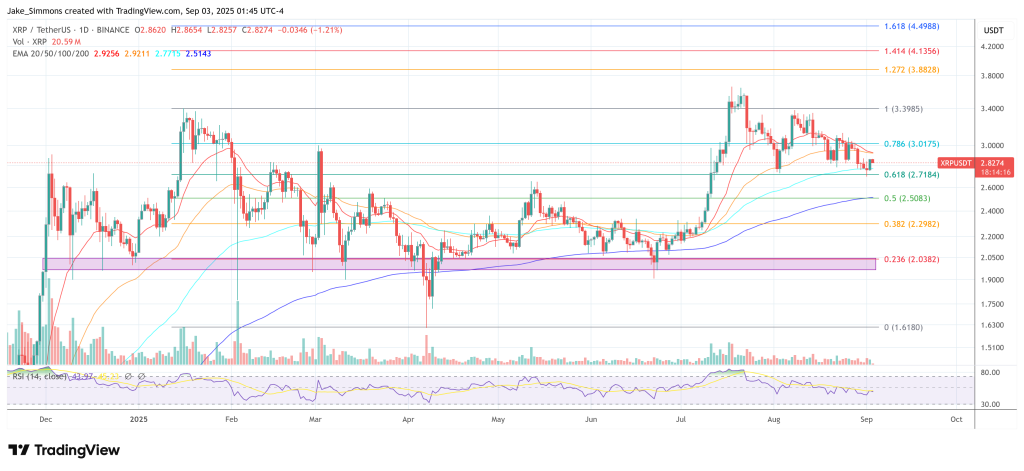
XRP price
XRP remains above the 0.618 Fib, 1-day chart | Source: XRPUSDT on TradingView.com
Featured image created with DALL.E, chart from TradingView.com
Editorial Process for bitcoinist is centered on delivering thoroughly researched, accurate, and unbiased content. We uphold strict sourcing standards, and each page undergoes diligent review by our team of top technology experts and seasoned editors. This process ensures the integrity, relevance, and value of our content for our readers.

Jake Simmons has been a Bitcoin enthusiast since 2016. Ever since he heard about Bitcoin, he has been studying the topic every day and trying to share his knowledge with others. His goal is to contribute to Bitcoin's financial revolution, which will replace the fiat money system. Besides BTC and crypto, Jake studied Business Informatics at a university. After graduation in 2017, he has been working in the blockchain and crypto sector. You can follow Jake on Twitter at @realJakeSimmons.

Bacaan Terkait

Model Dunia, Metaverse, Digital Twin, Fisika AI: Apakah Mereka Hal yang Sama?

Dalam beberapa tahun terakhir, konsep seperti metaverse, Web3.0, platform data simulasi, digital twin, dan Physical AI bermunculan, menciptakan kebingungan. Konsep-konsep ini bukanlah hal yang sama dengan Model Dunia (World Model), tetapi semuanya mengarah pada tren besar: kaburnya batas antara dunia digital dan fisik. Model Dunia berperan sebagai "lapisan kognitif" atau "sistem operasi dasar" yang bertanggung jawab agar AI dapat memahami dan mensimulasikan dunia. Analisis hubungannya dengan konsep lain adalah sebagai berikut: 1. **Metaverse**: Ini adalah tujuan atau "ruang pengalaman" imersif. Model Dunia berpotensi menjadi "mesin" atau alat pembuat konten otomatisnya, menghasilkan dunia 3D yang dapat diinteraksi dari teks, sehingga mengatasi hambatan pembuatan konten yang mahal. 2. **Web3.0**: Berfokus pada kepemilikan data, identitas, dan insentif ekonomi berbasis blockchain (masalah aturan/ekonomi). Ini berada di lapisan teknis yang berbeda dengan Model Dunia (masalah rekayasa pemahaman dunia). 3. **Platform Data Simulasi** (mis. untuk mobil otonom): Dapat dilihat sebagai versi 1.0 dari Model Dunia. Platform tradisional mengandalkan pembuatan skenario manual/berbasis aturan, sedangkan Model Dunia (versi 2.0) menggunakan AI untuk menghasilkan variasi skenario yang realistis secara otomatis dan masif. 4. **Digital Twin**: Adalah cermin real-time dari objek fisik (mis. pabrik, kota). Model Dunia melangkah lebih jauh dengan menambahkan kemampuan untuk **memprediksi masa depan** dan mensimulasikan hasil dari berbagai tindakan, bukan hanya mereplikasi keadaan saat ini. 5. **Physical AI** (AI fisik seperti robot, mobil otonom): Model Dunia adalah komponen intinya, khususnya untuk fungsi "memahami" hukum dunia dan memprediksi konsekuensi sebelum bertindak. Ini adalah "korteks otak" yang mensimulasikan sebelum eksekusi. Secara hierarki, Model Dunia berada di **Lapisan Kognitif**, yang mendukung lapisan aplikasi (simulasi, digital twin), lapisan aksi (Physical AI), dan lapisan pengalaman (metaverse). Ia bergantung pada infrastruktur dasar seperti komputasi dan data. Kesimpulannya, Model Dunia bukanlah konsep-konsep tersebut, tetapi ia berpotensi menjadi **sistem operasi** atau fondasi kognitif yang dibutuhkan banyak konsep itu untuk mewujudkan janji-janjinya dalam menghubungkan dan mengaburkan batas antara dunia digital dan fisik.

marsbit1j yang lalu

Model Dunia, Metaverse, Digital Twin, Fisika AI: Apakah Mereka Hal yang Sama?

marsbit1j yang lalu

Membuat CPO "Kaget dan Turun", Bagaimana Cara Kerja Glass Bridge? Penjelasan Resmi dari Corning Telah Tiba

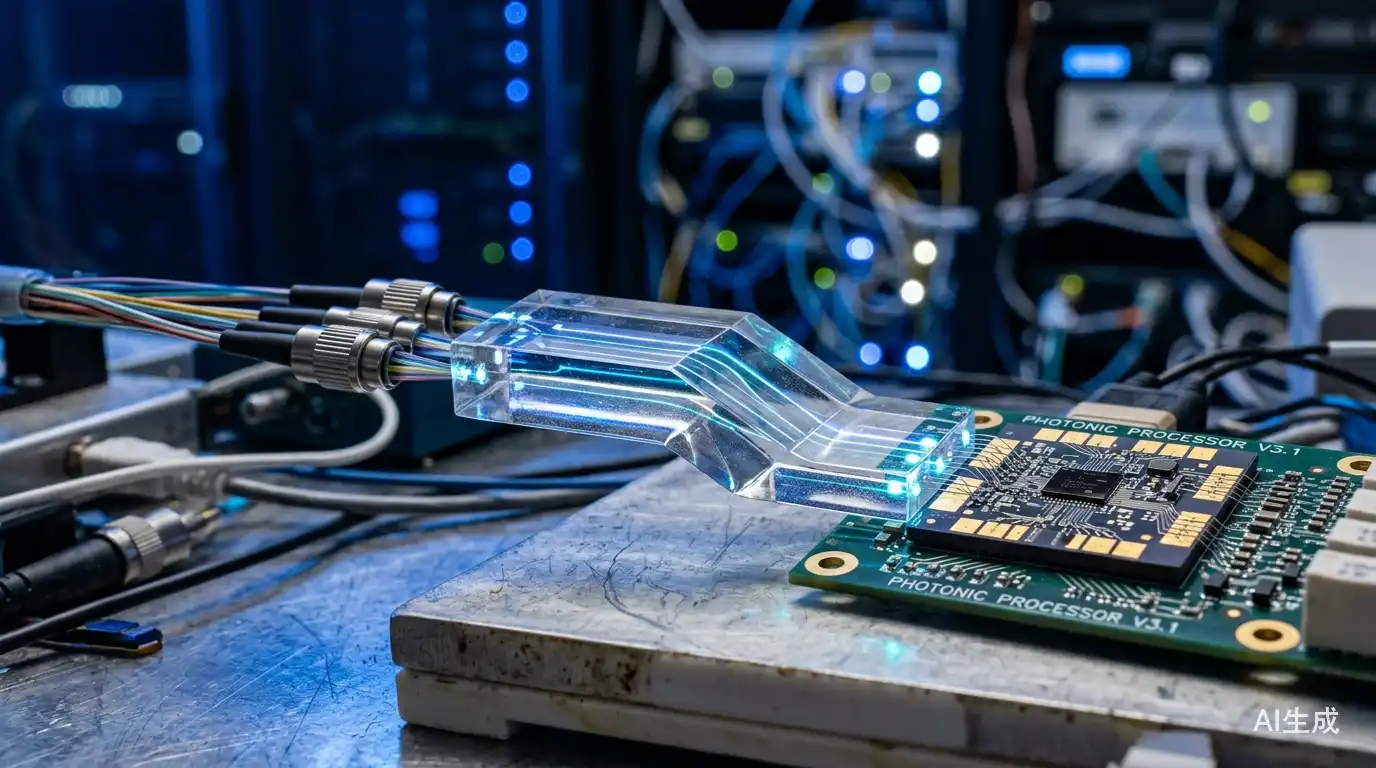
Pada 26 Juni, saham sektor CPO di A-Shares jatuh lebih dari 6%, dipicu oleh peluncuran platform interkoneksi optik "Glass Bridge" oleh raksasa serat optik AS, Corning. Teknologi ini menggunakan pandu gelombang kaca wafer-level untuk penyelarasan pasif antara serat optik dan chip fotonik, yang berpotensi menyederhanakan arsitektur CPO tradisional yang bergantung pada unit array serat (FAU) dan perangkat penyelarasan aktif presisi. Pasar khawatir hal ini akan mengurangi permintaan jangka panjang untuk komponen FAU tradisional. Inti Glass Bridge terletak pada tiga karakteristik: manufaktur wafer-level untuk konsistensi produksi massal, antarmuka koneksi fisik TMT yang terstandarisasi untuk integrasi yang mudah, dan arsitektur konektor densitas tinggi yang dapat dilepas untuk fleksibilitas. Corning menegaskan bahwa Glass Bridge melengkapi, bukan sepenuhnya menggantikan, solusi FAU yang ada, terutama dalam skenario kepadatan sangat tinggi. Reaksi pasar mencerminkan pergeseran nilai dalam industri interkoneksi optik AI. Dana mengalir keluar dari saham CPO dan PCB menengah, beralih ke saham terkait substrat kaca seperti Kaishan Tech dan Dier Laser. Analis melihat substrat kaca sebagai material inti kemasan generasi berikutnya, menawarkan peluang diferensiasi bagi industri domestik, terutama di tengah meningkatnya permintaan komputasi AI dan tantangan paten substrat silikon.

marsbit1j yang lalu

Membuat CPO "Kaget dan Turun", Bagaimana Cara Kerja Glass Bridge? Penjelasan Resmi dari Corning Telah Tiba

marsbit1j yang lalu

Trading

Spot
活动图片