Bitcoin Derivative Pressure Score Hits 30%: Downside Risk Signal

bitcoinistDipublikasikan tanggal 2025-09-02Terakhir diperbarui pada 2025-09-02

Abstrak

Bitcoin is at a crossroads after failing to reclaim higher supply levels, raising concerns among investors about the strength of...

Trusted Editorial content, reviewed by leading industry experts and seasoned editors. Ad Disclosure

Bitcoin is at a crossroads after failing to reclaim higher supply levels, raising concerns among investors about the strength of its current trend. The price has slipped below key demand zones, and bullish momentum is showing signs of exhaustion. For now, traders are watching closely as the market decides whether BTC can recover or if a deeper correction is underway.

The mood across the market has shifted, with many analysts warning that Bitcoin could soon test the $100K level. Such a move would mark one of the most significant corrections of this cycle, sparking fear among short-term participants while possibly presenting opportunities for longer-term investors.

Top analyst Axel Adler has shed light on the situation, pointing to data that highlights persistent derivative pressure. According to him, Bitcoin’s baseline trend suggests pullbacks are being driven by long de-leveraging. With derivative markets heavily influencing price action, this pressure score — currently sitting in an elevated zone — keeps the market vulnerable to downside jolts.

Bitcoin Open Interest Signals Risks Ahead

According to top analyst Axel Adler, Bitcoin’s current weakness is strongly tied to derivative market dynamics. He highlights that the Bitcoin Open Interest Pressure Score sits at 30%, placing it firmly in the upper band. Historically, this level reflects elevated risk conditions, where the market becomes vulnerable to sudden downside jolts. In such environments, leveraged longs face pressure, and any sharp decline in spot prices tends to trigger waves of liquidations that amplify volatility.
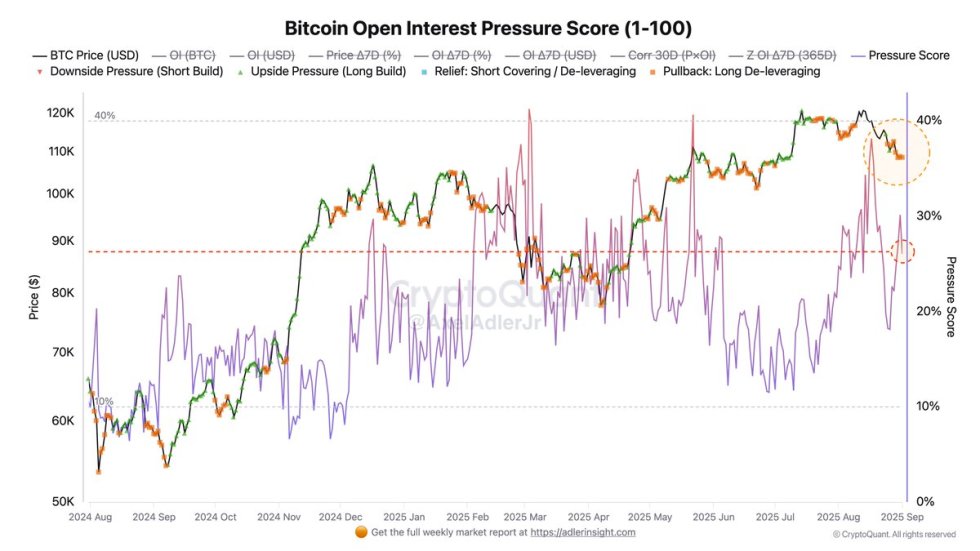
Bitcoin Open Interest Pressure Score (1-100) | Source: Axel Adler

Adler points out that the presence of orange cluster markers on the price chart reinforces this risk. These clusters typically favor continued sideways or lower movement as the market undergoes a process of long de-leveraging. Essentially, traders who overextended during Bitcoin’s surge above $120K are now being forced out of positions, which weighs on momentum and creates a ceiling on recovery attempts.

Adding further pressure is the recent capital rotation trend dominating crypto markets. Institutions and whales have been observed selling portions of their BTC holdings to accumulate Ethereum, a strategy supported by growing ETH adoption and whale activity. This shift of liquidity has likely contributed to Bitcoin’s struggle to hold above the $110K level, weakening bullish conviction.

If Bitcoin fails to reclaim lost ground and derivative pressure remains elevated, a test of the $100K zone becomes increasingly probable. Conversely, stabilization and absorption of selling could reset leverage and prepare BTC for its next major move. Either way, market participants should brace for heightened volatility.

Price Action Details: Testing Pivotal Level

Bitcoin (BTC) is showing signs of stabilization after intense volatility in recent sessions. The chart highlights BTC trading at $110,488, attempting to reclaim ground after dipping below the $110K threshold. This level has now become a pivotal battleground between bulls and bears, with the next moves likely determining short-term direction.
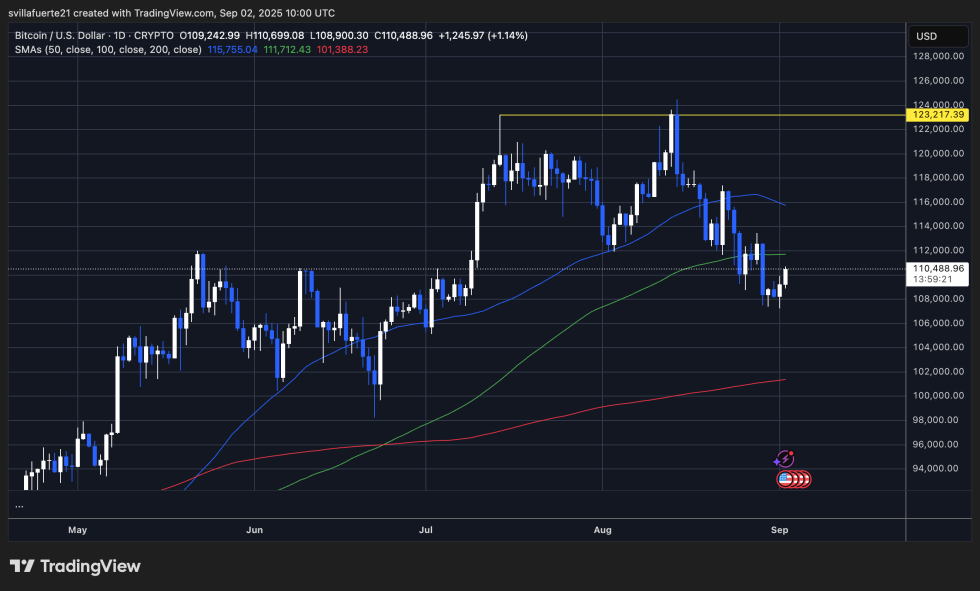
BTC consolidates around pivotal price level | Source: BTCUSDT chart on TradingView

The 50-day moving average sits above current price action, near $115,755, reinforcing the overhead resistance zone. BTC must regain this level to confirm strength and attempt a retest of the $123,217 resistance, which remains the major hurdle for continuation toward new highs. On the downside, the 200-day moving average, currently around $101,388, acts as a critical safety net. A decisive breakdown below that point could accelerate a deeper correction, with the $100K level serving as psychological support.

The structure suggests the market is in a consolidation phase, digesting the steep rally earlier in the cycle. If bulls manage to hold above $110K and build momentum, a move toward $115K and eventually $123K could follow. However, failure here may reopen the door for tests of lower demand zones closer to $105K–$101K.

Featured image from Dall-E, chart from TradingView

Editorial Process for bitcoinist is centered on delivering thoroughly researched, accurate, and unbiased content. We uphold strict sourcing standards, and each page undergoes diligent review by our team of top technology experts and seasoned editors. This process ensures the integrity, relevance, and value of our content for our readers.

Sebastian's journey into the world of crypto began four years ago, driven by a fascination with the potential of blockchain technology to revolutionize financial systems. His initial exploration focused on understanding the intricacies of various crypto projects, particularly those focused on building innovative financial solutions. Through countless hours of research and learning, Sebastian developed a deep understanding of the underlying technologies, market dynamics, and potential applications of cryptocurrencies. As his knowledge grew, Sebastian felt compelled to share his insights with others. He began actively contributing to online discussions on platforms like X and LinkedIn, focusing on fintech and crypto-related content. His goal was to expose valuable trends and insights to a wider audience, fostering a deeper understanding of the rapidly evolving crypto landscape. Sebastian's contributions quickly gained recognition, and he became a trusted voice in the online crypto community. To further enhance his expertise, Sebastian pursued a UC Berkeley Fintech: Frameworks, Applications, and Strategies certification. This rigorous program equipped him with valuable skills and knowledge regarding Financial Technology, bridging the gap between traditional finance (TradFi) and decentralized finance (DeFi). The certification deepened his understanding of the broader financial landscape and its intersection with blockchain technology. Sebastian's passion for finance and writing is evident in his work. He enjoys delving into financial research, analyzing market trends, and exploring the latest developments in the crypto space. In his spare time, Sebastian can often be found immersed in charts, studying 10-K forms, or engaging in thought-provoking discussions about the future of finance. Sebastian's journey as a crypto analyst and investor has been marked by a relentless pursuit of knowledge and a dedication to sharing his insights. His ability to navigate the complex world of crypto, combined with his passion for financial research and communication, makes him a valuable asset to the industry. As the crypto landscape continues to evolve, Sebastian remains at the forefront, providing valuable insights and contributing to the growth of this revolutionary technology.

Bacaan Terkait

Model Dunia, Metaverse, Digital Twin, Fisika AI: Apakah Mereka Hal yang Sama?

Dalam beberapa tahun terakhir, konsep seperti metaverse, Web3.0, platform data simulasi, digital twin, dan Physical AI bermunculan, menciptakan kebingungan. Konsep-konsep ini bukanlah hal yang sama dengan Model Dunia (World Model), tetapi semuanya mengarah pada tren besar: kaburnya batas antara dunia digital dan fisik. Model Dunia berperan sebagai "lapisan kognitif" atau "sistem operasi dasar" yang bertanggung jawab agar AI dapat memahami dan mensimulasikan dunia. Analisis hubungannya dengan konsep lain adalah sebagai berikut: 1. **Metaverse**: Ini adalah tujuan atau "ruang pengalaman" imersif. Model Dunia berpotensi menjadi "mesin" atau alat pembuat konten otomatisnya, menghasilkan dunia 3D yang dapat diinteraksi dari teks, sehingga mengatasi hambatan pembuatan konten yang mahal. 2. **Web3.0**: Berfokus pada kepemilikan data, identitas, dan insentif ekonomi berbasis blockchain (masalah aturan/ekonomi). Ini berada di lapisan teknis yang berbeda dengan Model Dunia (masalah rekayasa pemahaman dunia). 3. **Platform Data Simulasi** (mis. untuk mobil otonom): Dapat dilihat sebagai versi 1.0 dari Model Dunia. Platform tradisional mengandalkan pembuatan skenario manual/berbasis aturan, sedangkan Model Dunia (versi 2.0) menggunakan AI untuk menghasilkan variasi skenario yang realistis secara otomatis dan masif. 4. **Digital Twin**: Adalah cermin real-time dari objek fisik (mis. pabrik, kota). Model Dunia melangkah lebih jauh dengan menambahkan kemampuan untuk **memprediksi masa depan** dan mensimulasikan hasil dari berbagai tindakan, bukan hanya mereplikasi keadaan saat ini. 5. **Physical AI** (AI fisik seperti robot, mobil otonom): Model Dunia adalah komponen intinya, khususnya untuk fungsi "memahami" hukum dunia dan memprediksi konsekuensi sebelum bertindak. Ini adalah "korteks otak" yang mensimulasikan sebelum eksekusi. Secara hierarki, Model Dunia berada di **Lapisan Kognitif**, yang mendukung lapisan aplikasi (simulasi, digital twin), lapisan aksi (Physical AI), dan lapisan pengalaman (metaverse). Ia bergantung pada infrastruktur dasar seperti komputasi dan data. Kesimpulannya, Model Dunia bukanlah konsep-konsep tersebut, tetapi ia berpotensi menjadi **sistem operasi** atau fondasi kognitif yang dibutuhkan banyak konsep itu untuk mewujudkan janji-janjinya dalam menghubungkan dan mengaburkan batas antara dunia digital dan fisik.

marsbit4j yang lalu

Model Dunia, Metaverse, Digital Twin, Fisika AI: Apakah Mereka Hal yang Sama?

marsbit4j yang lalu

Membuat CPO "Kaget dan Turun", Bagaimana Cara Kerja Glass Bridge? Penjelasan Resmi dari Corning Telah Tiba

Pada 26 Juni, saham sektor CPO di A-Shares jatuh lebih dari 6%, dipicu oleh peluncuran platform interkoneksi optik "Glass Bridge" oleh raksasa serat optik AS, Corning. Teknologi ini menggunakan pandu gelombang kaca wafer-level untuk penyelarasan pasif antara serat optik dan chip fotonik, yang berpotensi menyederhanakan arsitektur CPO tradisional yang bergantung pada unit array serat (FAU) dan perangkat penyelarasan aktif presisi. Pasar khawatir hal ini akan mengurangi permintaan jangka panjang untuk komponen FAU tradisional. Inti Glass Bridge terletak pada tiga karakteristik: manufaktur wafer-level untuk konsistensi produksi massal, antarmuka koneksi fisik TMT yang terstandarisasi untuk integrasi yang mudah, dan arsitektur konektor densitas tinggi yang dapat dilepas untuk fleksibilitas. Corning menegaskan bahwa Glass Bridge melengkapi, bukan sepenuhnya menggantikan, solusi FAU yang ada, terutama dalam skenario kepadatan sangat tinggi. Reaksi pasar mencerminkan pergeseran nilai dalam industri interkoneksi optik AI. Dana mengalir keluar dari saham CPO dan PCB menengah, beralih ke saham terkait substrat kaca seperti Kaishan Tech dan Dier Laser. Analis melihat substrat kaca sebagai material inti kemasan generasi berikutnya, menawarkan peluang diferensiasi bagi industri domestik, terutama di tengah meningkatnya permintaan komputasi AI dan tantangan paten substrat silikon.

marsbit4j yang lalu

Membuat CPO "Kaget dan Turun", Bagaimana Cara Kerja Glass Bridge? Penjelasan Resmi dari Corning Telah Tiba

marsbit4j yang lalu

Trading

Spot
活动图片